Key Statistics
Key Takeaways
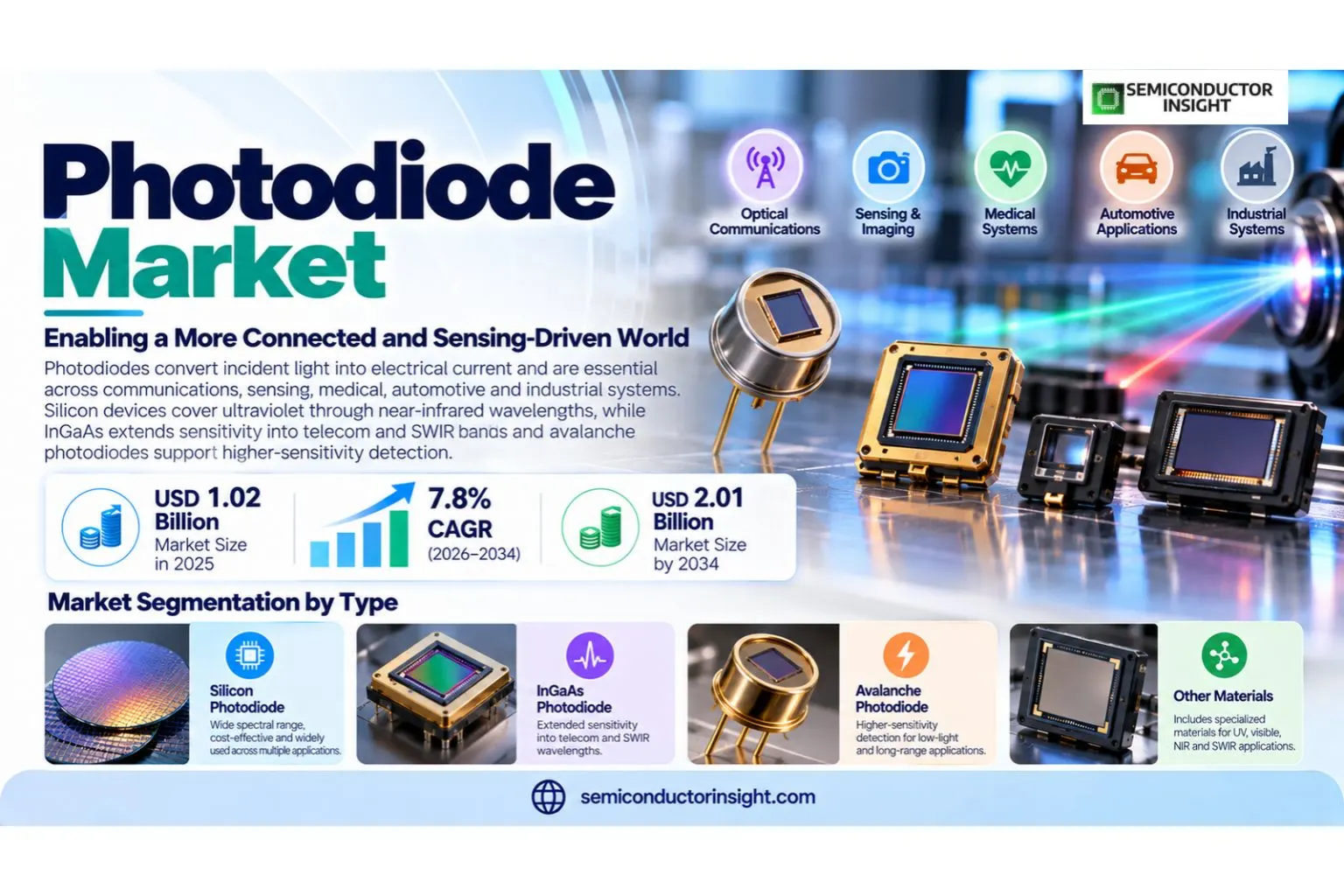
- Market size: The market is valued at USD 1.02 billion in 2025 and is projected to reach USD 2.01 billion by 2034, representing a 7.8% CAGR during 2026–2034.
- Silicon Photodiode is a leading segment, reflecting established use across major applications.
- Asia Pacific leads the market, while Asia Pacific provides the strongest growth profile.
- Optical Communication is a major application, supported by rising performance and reliability requirements.
- higher-speed detection, lower dark current and integrated optical sensor modules is becoming a central competitive differentiator as customers seek higher performance and lower system-level cost.
Photodiode Market Overview
Photodiode market is valued at USD 1.02 billion in 2025 and is projected to reach USD 2.01 billion by 2034, expanding at a 7.8% CAGR during 2026–2034. The 2026 market level is USD 1.10 billion. Photodiodes convert incident light into electrical current and are essential across communications, sensing, medical, automotive and industrial systems. Silicon devices cover ultraviolet through near-infrared wavelengths, while InGaAs extends sensitivity into telecom and SWIR bands and avalanche photodiodes support higher-sensitivity detection.
The client evidence values the market at USD 1.02 billion in 2025 and projects USD 1.89 billion by 2033. Demand is broadening through optical communications, LiDAR, medical sensing and renewable-energy monitoring alongside established consumer and industrial uses. Commercial decisions in the Photodiode market depend on qualification history, integration effort, operating reliability, lifecycle support and measurable system-level value.
Competition is segmented by material, speed, sensitivity, active area, packaging and integration. Vendors increasingly offer detector modules with amplifiers or digital interfaces to reduce customer design effort and improve signal quality. Commercial decisions in the Photodiode market depend on qualification history, integration effort, operating reliability, lifecycle support and measurable system-level value.
Segment Analysis: By Type
By type, the market is segmented into Silicon Photodiode, InGaAs Photodiode, Avalanche Photodiode, Other Materials. Product selection depends on performance, cost, manufacturing complexity and the target system architecture. Higher-value variants generally offer tighter tolerances, greater integration or improved reliability, while mainstream categories retain volume leadership because of lower cost and broad compatibility.
| Type | Commercial role |
|---|---|
| Silicon Photodiode | Silicon Photodiode addresses a distinct requirement set within the Photodiode market, with purchasing decisions shaped by performance, qualification, integration and cost. |
| InGaAs Photodiode | InGaAs Photodiode addresses a distinct requirement set within the Photodiode market, with purchasing decisions shaped by performance, qualification, integration and cost. |
| Avalanche Photodiode | Avalanche Photodiode addresses a distinct requirement set within the Photodiode market, with purchasing decisions shaped by performance, qualification, integration and cost. |
| Other Materials | Other Materials addresses a distinct requirement set within the Photodiode market, with purchasing decisions shaped by performance, qualification, integration and cost. |
Additional Segmentation: By Device Structure
Device Structure segmentation highlights important technical and commercial differences inside the Photodiode market. These categories affect pricing, qualification, process requirements and customer fit, making them useful for evaluating where value growth differs from simple unit growth. Commercial decisions in the Photodiode market depend on qualification history, integration effort, operating reliability, lifecycle support and measurable system-level value.
| Device Structure | Demand characteristics |
|---|---|
| PIN | Mainstream fast, low-noise photodetection for telecom and sensing. |
| Avalanche Photodiode | Internal gain for high-sensitivity optical detection. |
| Array / Segmented | Multiple sensing elements for imaging, position and spectroscopy. |
| Integrated Module | Photodiode combined with amplifier, filter or digital interface. |
Segment Analysis: By Application
By application, the market covers Optical Communication, Consumer Electronics, Automotive / LiDAR, Medical, Industrial Sensing, Security & Defense. Demand varies by reliability, performance, budget and product lifecycle. Premium applications usually require stricter qualification and long-term supply support, while higher-volume applications place more emphasis on cost, manufacturing scale and rapid technology migration. Commercial decisions in the Photodiode market depend on qualification history, integration effort, operating reliability, lifecycle support and measurable system-level value.
| Application | Demand characteristics |
|---|---|
| Optical Communication | Optical Communication is a material demand segment where reliability, cost and system performance influence purchasing decisions. |
| Consumer Electronics | Consumer Electronics is a material demand segment where reliability, cost and system performance influence purchasing decisions. |
| Automotive / LiDAR | Automotive / LiDAR is a material demand segment where reliability, cost and system performance influence purchasing decisions. |
| Medical | Medical is a material demand segment where reliability, cost and system performance influence purchasing decisions. |
| Industrial Sensing | Industrial Sensing is a material demand segment where reliability, cost and system performance influence purchasing decisions. |
| Security & Defense | Security & Defense is a material demand segment where reliability, cost and system performance influence purchasing decisions. |
Additional Segmentation: By End User
End User segmentation clarifies how system architecture and customer requirements reshape product selection. Growth is strongest where the technology delivers a clear performance, cost, reliability or integration advantage relative to incumbent solutions. Commercial decisions in the Photodiode market depend on qualification history, integration effort, operating reliability, lifecycle support and measurable system-level value.
| End User | Commercial role |
|---|---|
| Telecom | Fiber-optic receivers and monitoring. |
| Automotive | LiDAR, light sensing and optical safety functions. |
| Healthcare | Medical imaging, pulse oximetry and diagnostics. |
| Industrial | Machine sensing, encoders and spectroscopy. |
| Consumer Electronics | Ambient light, proximity and optical interfaces. |
Regional Analysis
Asia Pacific is used as the largest current region based on electronics manufacturing, optical-component production and automotive growth. North America and Europe remain important high-value markets for medical, industrial, aerospace and communications applications. Commercial decisions in the Photodiode market depend on qualification history, integration effort, operating reliability, lifecycle support and measurable system-level value.
Why does regional demand differ across the Photodiode market?
Regional demand varies with electronics production, telecom investment, vehicle sensing and industrial automation. Asia Pacific leads volume, while North America and Europe retain strong high-performance application demand. Commercial decisions in the Photodiode market depend on qualification history, integration effort, operating reliability, lifecycle support and measurable system-level value. Buyers therefore evaluate technical performance together with manufacturability, supply continuity and the cost of maintaining the solution across its intended service life.
How does Asia Pacific participate in the Photodiode market?
Asia Pacific demand is anchored by manufacturing scale, electronics production and growing investment in advanced infrastructure. China, Japan, South Korea, Taiwan and India contribute different mixes of production, end-market demand and technical capability, making the region central to both volume growth and supply-chain development. Commercial decisions in the Photodiode market depend on qualification history, integration effort, operating reliability, lifecycle support and measurable system-level value.
How does North America participate in the Photodiode market?
North America remains a high-value market with strong technology development, enterprise spending and specialized industrial demand. The United States is the principal contributor, supported by leading technology companies, research institutions and high-value end markets that adopt premium solutions early. Commercial decisions in the Photodiode market depend on qualification history, integration effort, operating reliability, lifecycle support and measurable system-level value.
How does Europe participate in the Photodiode market?
Europe combines advanced manufacturing, healthcare, aerospace, automotive and research demand. Germany, France, the United Kingdom, Italy and other markets emphasize reliability, energy efficiency and regulatory compliance, supporting demand for technically differentiated products with strong lifecycle support. Commercial decisions in the Photodiode market depend on qualification history, integration effort, operating reliability, lifecycle support and measurable system-level value.
How does South America participate in the Photodiode market?
South America is a smaller but developing market led by Brazil and selected industrial economies. Demand is concentrated in infrastructure, healthcare, electronics, research and industrial modernization, with import dependence making distributor support, service coverage and pricing important commercial factors. Commercial decisions in the Photodiode market depend on qualification history, integration effort, operating reliability, lifecycle support and measurable system-level value.
How does Middle East & Africa participate in the Photodiode market?
Middle East & Africa remains an emerging market where demand is concentrated in infrastructure, healthcare, energy, defense and research projects. Gulf countries account for much of the premium investment, while wider adoption depends on local technical capability, procurement cycles and access to qualified suppliers. Commercial decisions in the Photodiode market depend on qualification history, integration effort, operating reliability, lifecycle support and measurable system-level value.
Competitive Landscape
The competitive landscape includes Hamamatsu Photonics, ams OSRAM, Vishay Intertechnology, Sharp, onsemi, Excelitas, First Sensor, ROHM, Broadcom and Teledyne Technologies. Market position is shaped by technical performance, qualification depth, customer support, manufacturing scale and the ability to support product transitions without disrupting customer operations. Commercial decisions in the Photodiode market depend on qualification history, integration effort, operating reliability, lifecycle support and measurable system-level value.
Competition is increasingly centered on higher-speed detection, lower dark current and integrated optical sensor modules. Larger suppliers benefit from global engineering resources and purchasing scale, while specialized vendors can defend attractive niches through process expertise, customization and faster technical support. Commercial decisions in the Photodiode market depend on qualification history, integration effort, operating reliability, lifecycle support and measurable system-level value.
| Competitive dimension | What matters |
|---|---|
| Technology | Performance, reliability and roadmap credibility. |
| Qualification | Customer validation, compliance and field history. |
| Supply | Capacity, lead time and regional resilience. |
| Commercial support | Application engineering, service and lifecycle support. |
Production Capacity Analysis
Capacity strategy in the Photodiode market is closely linked to demand visibility, qualification cycles and customer concentration. Suppliers add capacity carefully because advanced production often requires specialized equipment, process know-how and extended validation before new lines can serve demanding applications. Commercial decisions in the Photodiode market depend on qualification history, integration effort, operating reliability, lifecycle support and measurable system-level value.
Regional capacity decisions increasingly balance cost with resilience. Customers are asking suppliers to diversify critical steps, maintain qualified backup capacity and support shorter lead times. That trend favors manufacturers able to combine scale with consistent process control and regional technical support. Commercial decisions in the Photodiode market depend on qualification history, integration effort, operating reliability, lifecycle support and measurable system-level value.
Market Dynamics
The Photodiode market is shaped by simultaneous changes in end-market demand, product architecture, manufacturing economics and qualification requirements. Technology improvements create new use cases, but commercialization depends on whether performance gains translate into measurable system value. Commercial decisions in the Photodiode market depend on qualification history, integration effort, operating reliability, lifecycle support and measurable system-level value.
Supply-chain conditions also influence purchasing behavior. Customers increasingly evaluate continuity, regional sourcing and lifecycle support alongside unit price. This shifts competition toward suppliers that can deliver stable quality and technical service through multiple product generations. Commercial decisions in the Photodiode market depend on qualification history, integration effort, operating reliability, lifecycle support and measurable system-level value.
Market Drivers
Growth is driven by high-speed optical communication, automotive LiDAR, medical sensing, industrial automation and smart consumer devices. More systems require precise light detection across visible and infrared wavelengths, increasing photodiode content per system. Commercial decisions in the Photodiode market depend on qualification history, integration effort, operating reliability, lifecycle support and measurable system-level value.
| Driver | CAGR impact |
|---|---|
| Technology upgrade cycle | +1.8 percentage points |
| End-market expansion | +1.3 percentage points |
| Higher content per system | +0.9 percentage points |
Market Restraints
Commodity silicon devices face price pressure, while high-performance photodiodes require specialized materials, low-noise packaging and strict calibration. Some applications compete with CMOS image sensors or integrated optical sensor ICs. Commercial decisions in the Photodiode market depend on qualification history, integration effort, operating reliability, lifecycle support and measurable system-level value. Buyers therefore evaluate technical performance together with manufacturability, supply continuity and the cost of maintaining the solution across its intended service life.
| Restraint | CAGR impact |
|---|---|
| Qualification and replacement cost | -0.8 percentage points |
| Price pressure | -0.6 percentage points |
| Supply or integration complexity | -0.5 percentage points |
Market Opportunities
Opportunities are strongest in 400G/800G optical links, LiDAR, SWIR sensing, medical diagnostics and integrated detector modules. Higher-speed APDs and lower-noise InGaAs devices can capture premium value in communications and scientific systems. Commercial decisions in the Photodiode market depend on qualification history, integration effort, operating reliability, lifecycle support and measurable system-level value.
| Opportunity | Commercial significance |
|---|---|
| higher-speed detection, lower dark current and integrated optical sensor modules | Supports premium product mix and new design wins. |
| Regional capacity | Improves lead times and customer resilience. |
| Application engineering | Raises switching costs and deepens customer relationships. |
Supply Chain Analysis
The Photodiode supply chain spans upstream materials and components, specialized manufacturing, qualification and integration, distribution or direct sales, and end-use deployment. Value is not distributed evenly: the highest margins generally accrue where process know-how, IP, qualification or application engineering create defensible differentiation. Commercial decisions in the Photodiode market depend on qualification history, integration effort, operating reliability, lifecycle support and measurable system-level value.
| Stage | Role |
|---|---|
| Upstream inputs | Materials, components, software or specialized process equipment. |
| Manufacturing | Core fabrication, assembly and process control. |
| Qualification & integration | Validation, reliability testing and customer-specific adaptation. |
| End-market deployment | System integration, service and lifecycle support. |
Supply continuity has become strategically important because qualified alternatives may require lengthy validation. Buyers therefore monitor second-source readiness, geographic concentration and supplier financial stability, especially where a single component can delay a high-value system. Commercial decisions in the Photodiode market depend on qualification history, integration effort, operating reliability, lifecycle support and measurable system-level value.
Recent Developments in the Photodiode Market
Report Scope & Segmentation
This analysis covers the Photodiode market from a 2025 base year through the 2026–2034 forecast period. It evaluates demand by product type, application and two additional segmentation axes, with regional coverage spanning Asia Pacific, North America, Europe, South America, and the Middle East & Africa. Commercial decisions in the Photodiode market depend on qualification history, integration effort, operating reliability, lifecycle support and measurable system-level value.
| Scope item | Coverage |
|---|---|
| Base year | 2025 |
| Estimated year | 2026 |
| Forecast period | 2026–2034 |
| By Type | Silicon Photodiode, InGaAs Photodiode, Avalanche Photodiode, Other Materials |
| By Application | Optical Communication, Consumer Electronics, Automotive / LiDAR, Medical, Industrial Sensing, Security & Defense |
| By Device Structure | PIN, Avalanche Photodiode, Array / Segmented, Integrated Module |
| By End User | Telecom, Automotive, Healthcare, Industrial, Consumer Electronics |
| Key participants | Hamamatsu Photonics, ams OSRAM, Vishay Intertechnology, Sharp, onsemi, Excelitas, First Sensor, ROHM, Broadcom and Teledyne Technologies |
Frequently Asked Questions
What is the Photodiode market size in 2025?
The market is valued at USD 1.02 billion in 2025.
What is the market forecast for 2034?
The market is projected to reach USD 2.01 billion by 2034, with a 7.8% CAGR during 2026–2034.
Which region leads the market?
Asia Pacific leads current market value, while Asia Pacific has the strongest growth profile.
Which type is most important?
Silicon Photodiode is a leading category, although mix varies by application and performance requirement.
Which applications matter most?
Optical Communication is a major demand segment, alongside Consumer Electronics, Automotive / LiDAR.
What technology trend matters most?
higher-speed detection, lower dark current and integrated optical sensor modules is a central technology and commercialization trend.
Who are the major suppliers?
Major participants include Hamamatsu Photonics, ams OSRAM, Vishay Intertechnology, Sharp, onsemi, Excelitas, First Sensor, ROHM, Broadcom and Teledyne Technologies.
What drives market growth?
Growth is driven by high-speed optical communication, automotive LiDAR, medical sensing, industrial automation and smart consumer devices. More systems require precise light detection across visible and infrared waveleng
What limits growth?
Commodity silicon devices face price pressure, while high-performance photodiodes require specialized materials, low-noise packaging and strict calibration. Some applications compete with CMOS image sensors or integrated
What will shape the market through 2034?
Technology roadmaps, qualification, supply continuity and higher-speed detection, lower dark current and integrated optical sensor modules will shape competitive outcomes.
Research Sources & Evidence Base
View selected external research sources
- Hamamatsu Photonics — Photodiodes: Current silicon, InGaAs and photodiode-array portfolio context. Open source
- Vishay — Photo Detectors: Current PIN photodiode and package portfolio context. Open source
- Hamamatsu Photonics — InGaAs Photodiodes: Current near-infrared InGaAs detector context. Open source

Get Sample Report PDF for Exclusive Insights
Report Sample Includes
- Table of Contents
- List of Tables & Figures
- Charts, Research Methodology, and more...
 Download Sample Report PDF