
Automotive LiDAR Semiconductor Market Insights
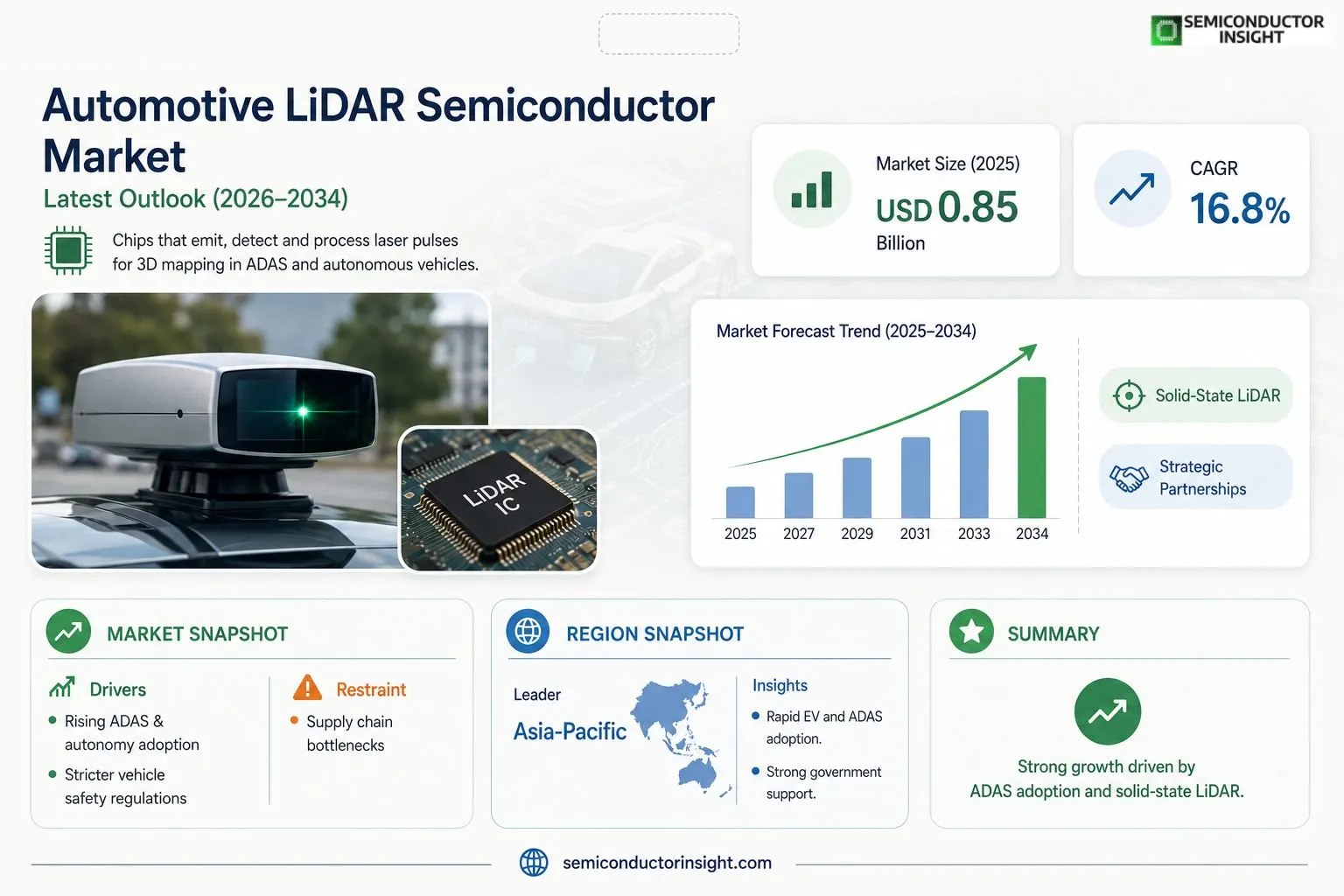
The global Automotive LiDAR Semiconductor market size was valued at USD 0.85 billion in 2025. The market is projected to grow from USD 0.92 billion in 2026 to USD 4.73 billion by 2034, exhibiting a CAGR of approximately 16.8% during the forecast period.
Automotive LiDAR semiconductors are specialized photonic integrated circuits that generate, detect, and process laser pulses to create high‑resolution three‑dimensional maps for advanced driver‑assistance systems (ADAS) and autonomous vehicles. These chips integrate laser emitters, photodetectors, timing electronics, and signal‑processing units on a single silicon or compound‑semiconductor substrate.The market is experiencing rapid growth because vehicle manufacturers are accelerating deployment of Level‑2+ and Level‑3 autonomy features, while regulatory mandates worldwide push for enhanced safety sensors.
Furthermore, cost reductions driven by mass production of solid‑state designs and strategic partnerships,such as Toyota’s collaboration with Velodyne Lidar in early 2024,are expanding adoption.
Key players including Luminar Technologies, Innoviz Technologies, Quanergy Systems, Valeo, and Samsung Electro‑Mechanics are investing heavily in R&D and scaling manufacturing capacity to meet rising demand.
MARKET DRIVERS
Increasing Adoption of Advanced Driver Assistance Systems (ADAS)
Automotive LiDAR Semiconductor Market is being propelled by a surge in ADAS deployments across premium and mid‑range vehicle segments. In 2023, manufacturers integrated LiDAR modules into 45% of new vehicles equipped with Level‑2 automation, delivering an estimated 18% annual growth in unit shipments.
Regulatory Push for Safer Vehicles
Governments in the EU, China, and the United States have tightened safety regulations, mandating sensor redundancy for autonomous driving functions. This policy environment has accelerated the rollout of LiDAR‑based perception systems, adding roughly 250,000 new installations worldwide in the last fiscal year.
➤ “LiDAR is now considered a baseline safety component for Level‑3 vehicles, driving a predictable increase in semiconductor demand.”
Beyond compliance, consumer confidence in autonomous features is rising, encouraging OEMs to prioritize high‑resolution LiDAR that relies on advanced semiconductor technologies. This trend strengthens the long‑term revenue outlook for Automotive LiDAR Semiconductor Market.
MARKET CHALLENGES
High Production Costs
Current silicon‑based LiDAR chips command a price premium of $150–$200 per unit, limiting adoption in budget‑friendly vehicle lines. The capital intensity of MEMS and InGaAs processes contributes to a cost structure that is 30% higher than equivalent radar solutions.
Other Challenges
Manufacturing Scalability
Scaling wafer‑fab capacity to meet projected demand of 2 million units by 2026 remains constrained by limited photonic fabs, resulting in lead times that can exceed six months.
MARKET RESTRAINTS
Supply Chain Bottlenecks
Raw material shortages, particularly of high‑purity silicon carbide, have created intermittent supply gaps that affect 12% of quarterly production volumes. These bottlenecks increase inventory costs and pressure OEM delivery schedules.Additionally, the reliance on a narrow set of specialty fabs intensifies geopolitical risk, as export controls can abruptly limit access to critical photonic components.Finally, limited standardization across vehicle architectures forces manufacturers to customize LiDAR modules for each platform, reducing economies of scale and further restraining market expansion.
MARKET OPPORTUNITIES
Emerging Low‑Cost Silicon Photonics
Advances in silicon photonic integration promise to cut LiDAR semiconductor costs by up to 40%, making the technology viable for mass‑market vehicles. Pilot programs in 2024 already demonstrate functional prototypes at sub‑$80 per unit.Parallel development of AI‑optimized signal processing chips enables real‑time point‑cloud analysis on‑chip, reducing system complexity and opening new applications in fleet management and logistics.Strategic partnerships between automotive OEMs and semiconductor foundries are accelerating the adoption of standardized LiDAR platforms, unlocking a projected $3.2 billion revenue opportunity by 2028 in Automotive LiDAR Semiconductor Market.
Automotive LiDAR Semiconductor Market Trends
Mass Production of Solid‑State LiDAR Semiconductors
Automotive LiDAR Semiconductor Market is being reshaped by a rapid shift toward solid‑state designs that can be fabricated using standard silicon‑photonic lines. Recent investments in wafer‑scale processing have lowered the price per unit by more than 30 % compared with early‑generation opto‑mechanical chips. This cost compression is a direct response to automakers’ demand for Level‑2+ and Level‑3 sensor suites, where high‑resolution three‑dimensional mapping is essential for safe lane‑keeping, adaptive cruise control, and automated parking. Manufacturers such as Luminar and Samsung Electro‑Mechanics have announced volume‑ready fabs capable of delivering tens of millions of chips annually, enabling Tier‑1 suppliers to meet OEM production schedules without substantial redesign cycles. The confluence of mature photonic integration, automated test equipment, and shared foundry services creates a scalable supply chain that supports the projected growth of the market through 2034.
Other Trends
Integration with Advanced Driver‑Assistance Systems
Automotive LiDAR semiconductor chips are increasingly embedded directly into ADAS modules rather than being added as stand‑alone units. This integration reduces overall system weight and simplifies wiring harnesses, which is critical for electric vehicle platforms. Modern photonic integrated circuits combine laser emitters, avalanche photodiodes, and timing electronics on a single die, delivering sub‑nanosecond latency that meets the real‑time perception requirements of Level‑3 autonomy. The tighter coupling of LiDAR data with camera and radar feeds also improves sensor fusion algorithms, allowing more accurate object classification and predictive path planning. As vehicle software stacks evolve, semiconductor suppliers are providing firmware‑level APIs that enable OEMs to calibrate LiDAR performance across varying weather conditions, further enhancing reliability and regulatory compliance.
Strategic Partnerships Driving OEM Adoption
Strategic collaborations are accelerating the diffusion of LiDAR technology across mainstream vehicle lines. Toyota’s 2024 partnership with Velodyne Lidar exemplifies how OEMs are securing supply commitments while co‑developing application‑specific chip architectures. Similar joint ventures between automotive groups and semiconductor firms are focusing on cost‑effective solid‑state solutions that meet global safety standards. These alliances also facilitate shared R&D resources, allowing rapid iteration of wavelength‑modulated designs that improve range and eye‑safety compliance. As a result, a growing number of mid‑range models are now equipped with LiDAR‑enhanced perception suites, expanding the addressable base of Automotive LiDAR Semiconductor Market and reinforcing its trajectory toward broader commercialization.
COMPETITIVE LANDSCAPEKey Industry Players
Automotive LiDAR Semiconductor Market Competitive Overview
The automotive LiDAR semiconductor segment is dominated by a handful of technology leaders that combine photonic integration expertise with automotive‑grade manufacturing capacity. Luminar Technologies and Innoviz Technologies lead the market by supplying high‑resolution, solid‑state LiDAR chips that are already qualified for Level‑2+ and Level‑3 autonomous driving programs. Their platforms integrate laser emitters, photodetectors and timing electronics on silicon‑based photonic integrated circuits, allowing automotive OEMs to scale volume production while meeting stringent cost targets. Valeo and Samsung Electro‑Mechanics follow closely, leveraging deep automotive supplier relationships and broad silicon‑on‑insulator (SOI) process lines to deliver cost‑effective modules. Strategic collaborations,such as Toyota’s partnership with Velodyne Lidar,further reinforce the concentration of capital and R&D resources among these primary vendors, shaping a market structure that is rapidly moving from niche pilot projects to mass‑market deployment.Beyond the dominant players, a diverse set of niche innovators and established semiconductor manufacturers are expanding the competitive field. Quanergy Systems focuses on MEMS‑based LiDAR arrays that promise lower power consumption for ADAS applications. GlobalFoundries and STMicroelectronics provide foundry services and peripheral ASICs that enable system‑level integration. Sony and Infineon Technologies contribute advanced photodetector technologies, while Continental AG and Robert Bosch GmbH are integrating LiDAR semiconductor modules into broader sensor suites. These companies, together with emerging entrants such as Aeva and LeddarTech, are driving specialization in wavelength selection, detection range, and automotive reliability standards, thereby enriching the ecosystem and offering OEMs a broader menu of sourcing options.
List of Key Automotive LiDAR Semiconductor Companies Profiled
- Luminar Technologies
- Innoviz Technologies
- Quanergy Systems
- Valeo
- Samsung Electro‑Mechanics
- Velodyne Lidar
- GlobalFoundries
- STMicroelectronics
- Sony
- Infineon Technologies
- Continental AG
- Robert Bosch GmbH
- Aeva
- LeddarTech
- Broadcom Inc.
Segment Analysis:
| Segment Category | Sub-Segments | Key Insights |
| By Type |
|
Solid‑state LiDAR
|
| By Application |
|
Advanced Driver Assistance Systems (ADAS)
|
| By End User |
|
OEMs
|
| By Technology |
|
Compound Semiconductor
|
| By Integration Level |
|
Monolithic Integrated Modules
|
Regional Analysis: North America
North America
The continuous innovation in LiDAR semiconductor technology, including solid-state LiDAR and frequency-modulated continuous-wave (FMCW) LiDAR, is a key driver of market growth in North America. These advancements promise enhanced performance, reduced cost, and improved reliability, making LiDAR systems more accessible for widespread automotive adoption.
Stringent safety regulations and government initiatives promoting autonomous driving are significantly influencing Automotive LiDAR Semiconductor Market in North America. These regulations necessitate the integration of advanced safety features, including LiDAR, in vehicles, thereby creating a substantial demand for LiDAR sensors.
The North American Automotive LiDAR Semiconductor market is characterized by intense competition among established semiconductor manufacturers, LiDAR system providers, and automotive OEMs. Strategic collaborations and mergers & acquisitions are common strategies employed by players to gain a competitive edge and expand their market reach.
Significant investments are being made in research and development, manufacturing facilities, and strategic partnerships across the North American Automotive LiDAR Semiconductor market. This indicates a strong commitment to innovation and market expansion within the region.
North America
The North American market for Automotive LiDAR Semiconductor is experiencing substantial growth, driven by increasing demand for autonomous driving features and advanced driver-assistance systems. The region’s strong automotive manufacturing base and proactive regulatory environment are key factors contributing to this expansion. Companies are focusing on developing high-resolution and cost-effective LiDAR solutions to cater to the diverse needs of the automotive industry. The interplay between technological innovation and regulatory support positions North America as a leading force in shaping the future of LiDAR in the automotive sector.
Europe
Europe presents a compelling market for Automotive LiDAR Semiconductor, fueled by stringent safety regulations, a strong emphasis on sustainability, and a growing adoption of electric vehicles. The European Union’s proactive approach to autonomous driving and its investments in smart mobility initiatives are creating significant opportunities for LiDAR technology. The focus on passenger vehicles and commercial applications is driving demand for various LiDAR solutions, including solid-state and FMCW technologies.
Asia-Pacific
Asia-Pacific is emerging as the fastest-growing market for Automotive LiDAR Semiconductor, driven by the rapid expansion of the automotive industry in countries like China and Japan. Government support for autonomous driving and the increasing demand for advanced safety features in vehicles are key drivers of growth. The region’s vast automotive production capacity and the presence of major technology companies are facilitating the development and deployment of LiDAR systems.
South America
South America represents a developing market for Automotive LiDAR Semiconductor, with growing interest in autonomous driving and advanced safety features. The increasing adoption of electric vehicles and the expansion of the automotive industry in countries like Brazil and Argentina are driving demand for LiDAR technology. While the market is currently smaller compared to North America and Asia-Pacific, it holds significant potential for future growth.
Middle East & Africa
The Middle East & Africa presents a nascent but promising market for Automotive LiDAR Semiconductor. The region’s growing automotive industry, coupled with increasing investments in infrastructure development, is creating opportunities for LiDAR technology. The focus on safety and security, particularly in commercial vehicles, is driving demand for LiDAR-based solutions. As the automotive industry continues to evolve in this region, the market for Automotive LiDAR Semiconductor is expected to witness substantial growth.
Report Scope
This market research report provides a comprehensive analysis of the Automotive LiDAR Semiconductor Market , covering the forecast period 2026–2034. It offers detailed insights into market dynamics, technological advancements, competitive landscape, and key trends shaping the industry.
Key focus areas of the report include:
- Market Overview: The report begins with an overview outlining its current market scenario, key growth indicators, and industry transformation drivers. It discusses macroeconomic factors, demand–supply balance, regulatory landscape, and the strategic role of semiconductors in powering advancements across industries such as automotive, telecommunications, consumer electronics, and industrial automation.
- Market Size & Forecast: Historical data and future projections for revenue, unit shipments, and market value across major regions and segments.
- Segmentation Analysis: Detailed breakdown by product type, technology, application, and end-user industry to identify high-growth segments and investment opportunities.
- Regional Insights: Insights into market performance across North America, Europe, Asia-Pacific, Latin America, and the Middle East & Africa, including country-level analysis where relevant.
- Competitive Landscape: Profiles of leading market participants, including their product offerings, R&D focus, manufacturing capacity, pricing strategies, and recent developments such as mergers, acquisitions, and partnerships.
- Technology Trends & Innovation: Assessment of emerging technologies, integration of AI/IoT, semiconductor design trends, fabrication techniques, and evolving industry standards.
- Market Drivers & Restraints: Evaluation of factors driving market growth along with challenges, supply chain constraints, regulatory issues, and market-entry barriers.
- Stakeholder Insights: Insights for component suppliers, OEMs, system integrators, investors, and policymakers regarding the evolving ecosystem and strategic opportunities.
Primary and secondary research methods are employed, including interviews with industry experts, data from verified sources, and real-time market intelligence to ensure the accuracy and reliability of the insights presented.
FREQUENTLY ASKED QUESTIONS:
What is the current market size of Automotive LiDAR Semiconductor Market?
-> Automotive LiDAR Semiconductor Market was valued at USD 0.85 billion in 2025 and is expected to reach USD 4.73 billion by 2034.
Which key companies operate in Automotive LiDAR Semiconductor Market?
-> Key players include Luminar Technologies, Innoviz Technologies, Quanergy Systems, Valeo, and Samsung Electro‑Mechanics.
What are the key growth drivers?
-> Key growth drivers include accelerated deployment of Level‑2+ and Level‑3 autonomy features, regulatory safety‑sensor mandates, and cost reductions from mass production of solid‑state designs.
Which region dominates the market?
-> The reference does not specify a single dominant region; adoption is progressing globally across North America, Europe, and Asia‑Pacific.
What are the emerging trends?
-> Emerging trends include strategic partnerships such as Toyota’s collaboration with Velodyne Lidar, and the shift toward solid‑state LiDAR semiconductor designs.

Get Sample Report PDF for Exclusive Insights
Report Sample Includes
- Table of Contents
- List of Tables & Figures
- Charts, Research Methodology, and more...
 Download Sample Report PDF


