Short-Wave Infrared (SWIR) Sensor Market Insights
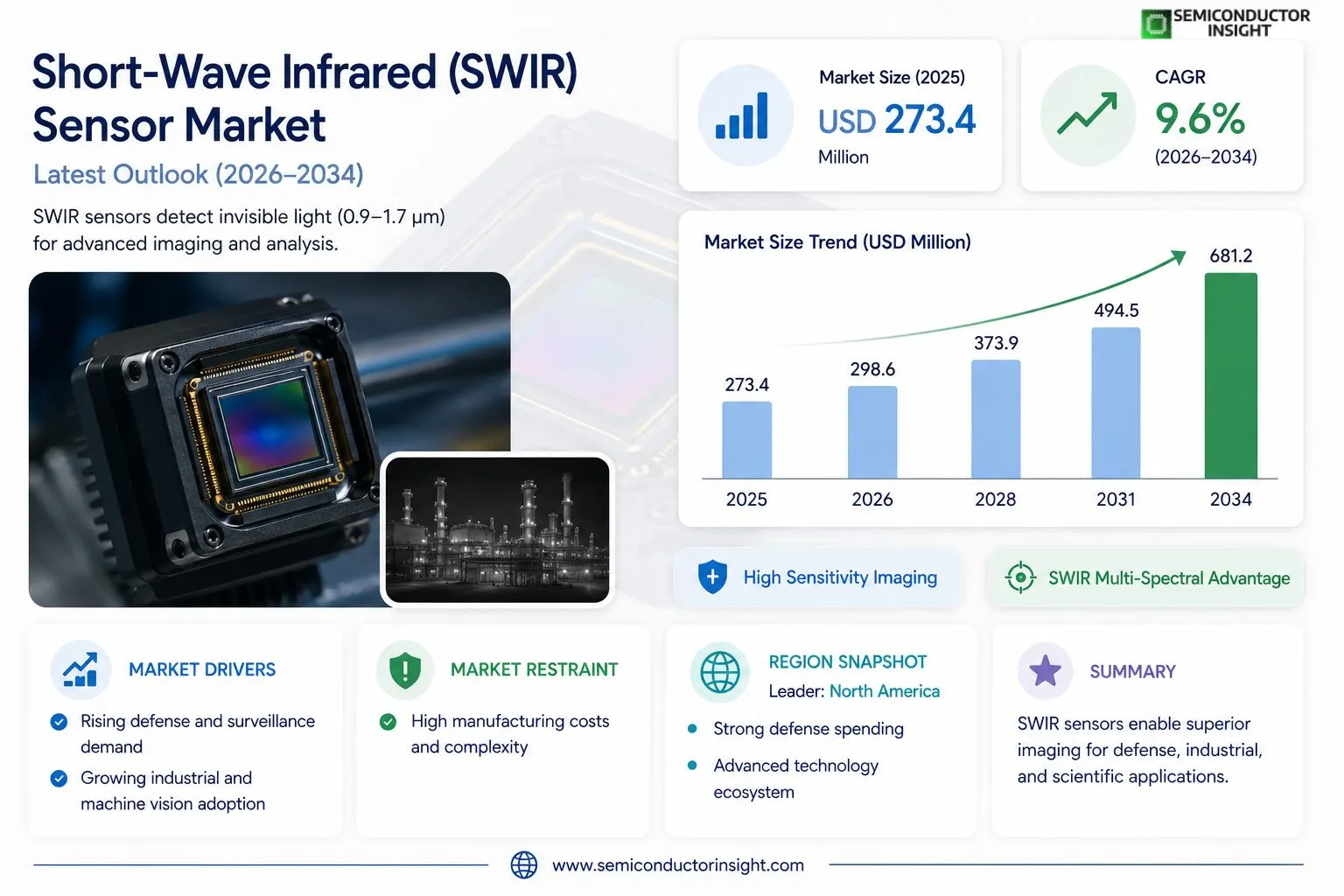
Global Short-Wave Infrared (SWIR) Sensor market size was valued at USD 273.4 million in 2025. The market is projected to grow from USD 298.6 million in 2026 to USD 681.2 million by 2034, exhibiting a CAGR of 9.6% during the forecast period.
Short-wave infrared (SWIR) sensors are advanced imaging and detection devices that operate within the wavelength range of approximately 0.9 to 1.7 micrometers, spanning the electromagnetic spectrum just beyond the visible light range. These sensors are capable of detecting light that is invisible to the human eye, enabling a wide range of applications across defense and security, industrial inspection, machine vision, semiconductor inspection, agricultural monitoring, and scientific research. SWIR sensors are commonly built on Indium Gallium Arsenide (InGaAs) detector arrays, though emerging alternatives such as silicon-based sensors and quantum dot-based detectors are gaining traction. The technology encompasses line-scan cameras, area-scan cameras, and photodetectors, each tailored for specific use cases.
The market is witnessing robust growth driven by escalating demand from the defense and surveillance sector, rapid adoption in industrial automation and quality control processes, and the expanding role of SWIR imaging in life sciences and medical diagnostics. Furthermore, the increasing integration of SWIR sensors in autonomous vehicles and LiDAR systems is opening new avenues for market expansion. Strategic collaborations and product launches by leading industry players are also propelling market momentum. For instance, Sensors Unlimited, a Collins Aerospace company, and Xenics NV are among the prominent players continuously advancing their SWIR camera portfolios to address growing end-user demands across both commercial and defense verticals.
MARKET DRIVERS
Rising Demand for Advanced Imaging in Defense and Surveillance Applications
Short-Wave Infrared (SWIR) Sensor Market is experiencing robust growth, driven significantly by escalating investments in defense modernization and border surveillance across North America, Europe, and the Asia-Pacific region. SWIR sensors operate in the 0.9–1.7 µm wavelength range, enabling exceptional imaging capabilities in low-light and adverse weather conditions where conventional visible-light cameras fall short. Defense agencies are increasingly integrating SWIR-based imaging systems into unmanned aerial vehicles (UAVs), night-vision equipment, and perimeter security platforms, recognizing the technology’s ability to detect camouflaged targets and penetrate atmospheric haze. This heightened defense procurement activity is a primary catalyst propelling Short-Wave Infrared (SWIR) Sensor Market forward.
Expansion of Machine Vision and Industrial Inspection Applications
Industrial automation and quality control processes are generating substantial demand within Short-Wave Infrared (SWIR) Sensor Market. SWIR imaging enables manufacturers to detect moisture content, surface defects, and material composition with a level of precision that is unachievable using standard optical sensors. Industries such as semiconductor manufacturing, food and beverage inspection, pharmaceutical packaging verification, and solar cell quality assurance are actively deploying SWIR-enabled machine vision systems. The growing adoption of Industry 4.0 principles and smart factory frameworks is further accelerating investments in SWIR sensor-based inspection equipment, reinforcing industrial demand as a key market driver.
➤ Global push toward autonomous vehicles and advanced driver-assistance systems (ADAS) is creating new application frontiers for SWIR sensors, particularly in LiDAR integration and low-visibility driving condition management, broadening the technology’s commercial addressable market beyond traditional defense and industrial segments.
The proliferation of scientific research initiatives, including remote sensing for agricultural monitoring, environmental surveillance, and geological surveying, is also fueling adoption of SWIR sensors. Hyperspectral and multispectral imaging platforms that incorporate SWIR detector arrays are enabling precision agriculture stakeholders to monitor crop health, soil moisture, and vegetation stress indicators with measurable accuracy improvements. As government bodies and research institutions continue to fund earth observation and climate monitoring programs, Short-Wave Infrared (SWIR) Sensor Market stands to benefit from a sustained and diversified demand pipeline well into the coming decade.
MARKET CHALLENGES
High Manufacturing Costs and Technical Complexity of Indium Gallium Arsenide (InGaAs) Detectors
One of the most significant challenges confronting Short-Wave Infrared (SWIR) Sensor Market is the elevated cost associated with the fabrication of Indium Gallium Arsenide (InGaAs) photodetector arrays, which represent the dominant detector technology in SWIR imaging systems. The epitaxial growth processes required to produce high-quality InGaAs substrates demand precision manufacturing environments and specialized equipment, translating into substantial capital expenditure for sensor manufacturers. These cost barriers restrict widespread deployment, particularly in cost-sensitive commercial and consumer applications, and limit market penetration in emerging economies where budget constraints among end-users are more pronounced. Addressing this cost challenge remains a central priority for industry stakeholders seeking to expand the commercial viability of SWIR sensor solutions.
Other Challenges
Limited Availability of Skilled Technical Workforce
The design, calibration, and integration of SWIR sensor systems require a specialized interdisciplinary skill set spanning photonics engineering, signal processing, and electro-optical systems design. Global shortage of professionals with deep expertise in infrared sensor technologies creates operational bottlenecks for both manufacturers and end-users. Organizations frequently encounter difficulties in sourcing qualified engineers capable of optimizing SWIR imaging system performance for specific application environments, which can delay product development cycles and increase project costs. This talent gap represents a persistent structural challenge within Short-Wave Infrared (SWIR) Sensor Market that is not easily resolved in the near term.
Export Controls and Regulatory Compliance Constraints
SWIR sensor technologies, particularly those intended for defense and dual-use applications, are subject to stringent export control regulations under frameworks such as the International Traffic in Arms Regulations (ITAR) in the United States and equivalent legislation in other jurisdictions. Compliance with these regulatory requirements imposes administrative burdens on manufacturers and can restrict access to certain international markets. Companies operating in Short-Wave Infrared (SWIR) Sensor Market must navigate complex licensing procedures and due diligence obligations, which can extend sales cycles and limit the speed at which they can respond to emerging global demand opportunities.
MARKET RESTRAINTS
Competition from Alternative Infrared Imaging Technologies
Short-Wave Infrared (SWIR) Sensor Market faces measurable competitive pressure from alternative infrared imaging modalities, including mid-wave infrared (MWIR) and long-wave infrared (LWIR) sensor technologies. In certain thermal imaging and surveillance applications, MWIR and LWIR systems offer comparable or superior performance characteristics, particularly in detecting heat signatures emitted by humans, vehicles, and industrial machinery. End-users evaluating imaging solutions for security and situational awareness applications may opt for these competing technologies when cost-efficiency is prioritized over the specific spectral advantages offered by SWIR imaging. This competitive landscape constrains the pace of market share expansion for SWIR sensor manufacturers in overlapping application domains.
Technology Maturity Gaps in Emerging Extended-SWIR Platforms
While the core InGaAs-based SWIR detector technology is well-established, emerging extended-SWIR and colloidal quantum dot (CQD)-based sensor platforms are still in comparatively early stages of commercial maturity. Prospective adopters in industrial and consumer markets often adopt a cautious stance toward deploying technologies that lack extensive field validation records, documented long-term reliability data, or established support ecosystems. This technology readiness gap acts as a near-term restraint on the adoption velocity of next-generation SWIR sensor architectures, potentially slowing the overall market’s transition toward higher-volume, lower-cost applications. Sustained investment in technology validation and commercialization pathways will be essential to overcoming this restraint within Short-Wave Infrared (SWIR) Sensor Market.
MARKET OPPORTUNITIES
Emergence of Colloidal Quantum Dot Technology as a Cost-Reduction Pathway
Colloidal quantum dot (CQD) sensor technology presents a transformative opportunity for Short-Wave Infrared (SWIR) Sensor Market by offering a potentially lower-cost manufacturing pathway compared to conventional InGaAs epitaxial growth processes. CQD-based SWIR sensors can be fabricated using solution-processing techniques compatible with standard complementary metal-oxide-semiconductor (CMOS) production infrastructure, enabling scalable, wafer-level manufacturing at significantly reduced cost points. As research institutions and pioneering commercial entities advance the material stability, quantum efficiency, and uniformity of CQD detector arrays, this technology pathway has the potential to democratize SWIR imaging access across consumer electronics, automotive, and broader commercial markets that have historically been priced out of adoption.
Integration with Autonomous Vehicle and ADAS Platforms
The rapid global expansion of autonomous vehicle development and advanced driver-assistance system (ADAS) deployment represents a substantial emerging opportunity for Short-Wave Infrared (SWIR) Sensor Market. SWIR sensors demonstrate a meaningful performance advantage in detecting retroreflective road markings, recognizing objects in foggy or rainy conditions, and supporting LiDAR-based depth sensing systems that operate at SWIR wavelengths. As automotive OEMs and Tier-1 suppliers intensify their investments in sensor fusion architectures to support Level 3 and Level 4 autonomous driving capabilities, SWIR imaging modules are positioned to become an integral component of next-generation automotive perception stacks. This application domain could emerge as one of the highest-volume growth vectors for the market over the medium-term horizon.
Precision Agriculture and Environmental Remote Sensing Expansion
Growing global emphasis on food security, sustainable agricultural practices, and climate change monitoring is creating significant new demand opportunities within Short-Wave Infrared (SWIR) Sensor Market. SWIR-enabled hyperspectral imaging systems mounted on satellite platforms, UAVs, and airborne survey aircraft are enabling agricultural stakeholders to conduct real-time crop health diagnostics, irrigation efficiency assessments, and pest and disease detection at field scale. Simultaneously, government-funded environmental monitoring programs across North America, Europe, and Asia are expanding their use of SWIR sensor payloads for vegetation mapping, water quality assessment, and greenhouse gas detection. These converging demand streams from both the commercial agriculture sector and the public environmental monitoring domain represent a durable, long-cycle growth opportunity for sensor manufacturers and system integrators operating in the SWIR imaging value chain.
Trends
Rising Demand from Defense and Surveillance Drives Short-Wave Infrared (SWIR) Sensor Market Growth
Short-Wave Infrared (SWIR) Sensor Market is experiencing significant momentum, largely propelled by escalating demand from defense and security applications. SWIR sensors, which operate within a wavelength range of approximately 0.9 to 1.7 micrometers, offer critical capabilities such as night vision, target identification, and covert surveillance that are indispensable to modern military operations. Defense agencies across North America, Europe, and Asia-Pacific are steadily increasing procurement of advanced SWIR imaging systems to enhance situational awareness and border security. The ability of SWIR sensors to detect light invisible to the human eye gives defense operators a decisive technological edge, reinforcing their widespread adoption in airborne reconnaissance, unmanned aerial vehicles (UAVs), and ground-based surveillance platforms.
Other Trends
Expansion in Industrial Automation and Machine Vision
Industrial automation is emerging as one of the fastest-growing application areas within Short-Wave Infrared (SWIR) Sensor Market. Manufacturers across semiconductor inspection, food and beverage quality control, and pharmaceutical production are integrating SWIR-based machine vision systems to detect surface defects, moisture content, and material inconsistencies that remain invisible under conventional visible-light imaging. The technology’s non-destructive inspection capabilities make it particularly valuable for high-throughput production environments where precision and speed are paramount. Leading SWIR camera developers, including Sensors Unlimited, a Collins Aerospace company, and Xenics NV, have been actively expanding their industrial-grade product portfolios to address this growing end-user demand.
Integration with Autonomous Vehicles and LiDAR Systems
The integration of SWIR sensors into autonomous vehicles and LiDAR systems represents a transformative trend reshaping the market landscape. SWIR-based LiDAR solutions offer superior performance in challenging environmental conditions such as fog, rain, and bright sunlight compared to conventional visible-light sensors. Automotive technology developers are increasingly evaluating SWIR detector arrays to enhance the reliability and safety of self-driving platforms. This convergence of SWIR imaging with next-generation mobility solutions is unlocking new revenue streams and attracting cross-industry investment into Short-Wave Infrared (SWIR) Sensor Market.
Emerging Detector Technologies and Life Sciences Applications Reshaping Market Dynamics
Beyond established Indium Gallium Arsenide (InGaAs) detector arrays, Short-Wave Infrared (SWIR) Sensor Market is witnessing growing interest in silicon-based sensors and quantum dot-based detectors, which promise cost reduction and broader accessibility. Simultaneously, life sciences and medical diagnostics are adopting SWIR imaging for tissue analysis and vascular imaging applications, driven by the technology’s ability to provide deeper tissue penetration compared to visible-light alternatives. Strategic product launches and collaborative research initiatives among key industry participants continue to accelerate innovation, positioning SWIR sensor technology as a critical enabler across both commercial and scientific domains in the years ahead.
COMPETITIVE LANDSCAPE
Key Industry Players
Short-Wave Infrared (SWIR) Sensor Market: Competitive Dynamics and Leading Innovators Shaping the Industry
Global Short-Wave Infrared (SWIR) Sensor market is characterized by the presence of several technologically advanced and financially robust players competing across defense, industrial, and scientific imaging segments. Sensors Unlimited, a Collins Aerospace company, stands out as one of the dominant forces in the market, leveraging decades of expertise in InGaAs-based SWIR camera and sensor development to serve both military and commercial customers. Similarly, Xenics NV, a Belgium-based imaging solutions provider, has cemented its position through continuous innovation in SWIR line-scan and area-scan camera platforms. FLIR Systems (now part of Teledyne Technologies) also commands significant market share, backed by its broad infrared imaging portfolio and global distribution network. These leading players invest heavily in R&D to develop sensors with higher resolution, lower noise, and expanded wavelength sensitivity, responding to growing end-user demands in autonomous vehicles, LiDAR integration, and semiconductor inspection.
Beyond the dominant players, the SWIR sensor market features several niche yet highly influential participants driving specialization and regional growth. Companies such as Hamamatsu Photonics, Princeton Infrared Technologies, and Raptor Photonics are recognized for their high-performance photodetector and scientific-grade SWIR camera solutions, particularly in life sciences and research applications. Emerging competitors including Lumentum Holdings and II-VI Incorporated (now Coherent Corp.) are expanding their SWIR component offerings, capitalizing on the surge in photonics and machine vision adoption. Additionally, Allied Vision Technologies and JAI A/S are noteworthy contributors in industrial machine vision, while Voxtel Inc. and Episensors continue to push boundaries in quantum dot and silicon-based SWIR detector development. The competitive landscape is further intensified by strategic collaborations, product launches, and geographic expansions, particularly across North America, Europe, and the Asia-Pacific region, where demand for SWIR imaging in defense surveillance, precision agriculture, and quality control continues to accelerate.
List of Key Short-Wave Infrared (SWIR) Sensor Companies Profiled
- Sensors Unlimited (Collins Aerospace)
- Xenics NV
- FLIR Systems (Teledyne Technologies)
- Hamamatsu Photonics K.K.
- Princeton Infrared Technologies
- Raptor Photonics
- Lumentum Holdings Inc.
- II-VI Incorporated (Coherent Corp.)
- Allied Vision Technologies
- JAI A/S
- Voxtel Inc.
- Episensors Inc.
- Photon etc.
- Infrared Laboratories Inc.
- New Imaging Technologies (NIT)
Segment Analysis:
| Segment Category | Sub-Segments | Key Insights |
| By Type |
|
InGaAs-Based SWIR Sensors continue to dominate the sensor type landscape owing to their well-established manufacturing maturity and exceptional sensitivity in the core SWIR wavelength range.
|
| By Application |
|
Defense & Surveillance remains the most prominent application segment, underpinned by persistent global demand for advanced night vision, target acquisition, and border security imaging systems.
|
| By End User |
|
Defense & Government Agencies represent the leading end-user segment, consistently channeling substantial procurement budgets toward advanced SWIR imaging solutions for national security, intelligence operations, and border management programs.
|
| By Camera Format |
|
Area-Scan Cameras hold the leading position within the camera format segment, driven by their versatility across a broad spectrum of imaging scenarios ranging from static scene surveillance to real-time object recognition in machine vision environments.
|
| By Cooling Technology |
|
Uncooled SWIR Sensors are establishing themselves as the dominant sub-segment by adoption volume, as advances in detector material engineering have progressively narrowed the performance gap with cooled counterparts while delivering compelling advantages in size, weight, power consumption, and overall system cost.
|
Regional Analysis: Short-Wave Infrared (SWIR) Sensor Market
North America
The United States military’s sustained commitment to modernizing surveillance, reconnaissance, and targeting platforms has created a structurally strong demand base for SWIR sensor technology. Programs across border security, unmanned aerial systems, and soldier-worn optics continue to prioritize high-sensitivity SWIR imaging, reinforcing the region’s leadership and driving continuous performance improvements from domestic sensor manufacturers.
North American manufacturers across pharmaceuticals, food processing, and semiconductor fabrication are rapidly integrating SWIR sensor-based machine vision systems to enhance inline quality control and defect detection capabilities. The ability of SWIR imaging to reveal subsurface features and moisture content invisible to conventional cameras makes it a preferred choice for manufacturers pursuing zero-defect production standards and regulatory compliance.
A rich ecosystem of university research centers, federally funded national laboratories, and venture-backed startups continuously advances SWIR sensor miniaturization, cost reduction, and spectral range expansion. This innovation pipeline ensures that North America consistently introduces differentiated products to Short-Wave Infrared (SWIR) Sensor Market, maintaining a competitive edge over rival regions in both performance benchmarks and time-to-market metrics.
Legislative efforts to strengthen domestic semiconductor and advanced sensor manufacturing have created favorable policy conditions for SWIR sensor producers in North America. Incentives targeting compound semiconductor production and export controls on sensitive imaging technologies have simultaneously stimulated local capacity expansion and reduced competitive pressure from lower-cost overseas suppliers, further consolidating the region’s market position.
Europe
Europe represents a strategically significant and innovation-driven region within Global Short-Wave Infrared (SWIR) Sensor Market. Nations such as Germany, France, the United Kingdom, and the Netherlands host world-class optics and photonics clusters that have cultivated deep expertise in SWIR sensor design, manufacturing, and system integration. The European defense landscape, shaped by NATO modernization commitments and increased national defense budgets, has spurred demand for advanced SWIR-enabled night vision, border surveillance, and airborne reconnaissance systems. Beyond defense, Europe’s thriving automotive sector is exploring SWIR imaging for advanced driver assistance systems and autonomous vehicle perception layers, recognizing its superior performance in adverse weather and low-light conditions. The region’s strong regulatory focus on food safety and agricultural sustainability has also opened meaningful avenues for SWIR-based sorting and quality assessment solutions. Collaborative research frameworks such as Horizon Europe and dedicated photonics industry consortia continue to fund next-generation SWIR detector development, ensuring that European manufacturers remain globally competitive in this evolving market landscape.
Asia-Pacific
Asia-Pacific is emerging as the fastest-growing regional market for Short-Wave Infrared (SWIR) Sensor technology, propelled by rapid industrialization, expanding defense modernization programs, and a surging electronics manufacturing ecosystem across China, Japan, South Korea, and India. China’s aggressive investment in domestic semiconductor capabilities and its ambitious military modernization agenda have translated into substantial demand for SWIR imaging solutions across surveillance, satellite payloads, and border monitoring applications. Japan and South Korea, renowned for their precision optics and semiconductor heritage, are actively developing indigenous SWIR sensor platforms tailored to industrial automation and consumer electronics integration. India’s growing defense procurement appetite and its emerging space program are creating new demand vectors within Short-Wave Infrared (SWIR) Sensor Market. The region’s cost-competitive manufacturing environment and expanding domestic talent pool in photonics and compound semiconductor engineering position Asia-Pacific as a critical hub for both production and consumption of SWIR sensor technologies through the forecast horizon.
South America
South America occupies a developing yet increasingly relevant position within Global Short-Wave Infrared (SWIR) Sensor Market. Brazil leads regional demand, driven by its extensive agricultural sector where SWIR-based remote sensing and crop health monitoring applications are gaining traction among large-scale farming operations seeking precision agriculture solutions. The region’s expanding mining industry also represents an emerging application frontier, with SWIR imaging being evaluated for mineral mapping, ore quality assessment, and environmental monitoring purposes. Defense modernization programs across Brazil, Colombia, and Chile are incrementally incorporating SWIR sensor-equipped surveillance platforms for border security and counter-narcotics operations. While infrastructure limitations and constrained technology investment budgets have historically tempered growth, rising commodity revenues and government-led digitalization initiatives are gradually improving the conditions for broader SWIR sensor adoption. South America is expected to exhibit steady, if measured, growth as industrial and agricultural end-users deepen their engagement with advanced imaging technologies.
Middle East & Africa
The Middle East & Africa region presents a uniquely segmented demand profile within Short-Wave Infrared (SWIR) Sensor Market. Gulf Cooperation Council nations, led by Saudi Arabia and the United Arab Emirates, are among the most active adopters of SWIR-enabled defense and security technologies in the region, driven by substantial defense budgets, ongoing military modernization initiatives, and persistent regional security challenges that necessitate advanced surveillance and threat detection capabilities. Israel, with its globally recognized defense technology industry, serves as both a significant consumer and an important innovator within the SWIR imaging domain, contributing proprietary sensor designs and integrated system solutions to the international market. In Sub-Saharan Africa, adoption remains nascent but is gradually accelerating in agricultural monitoring, wildlife conservation imaging, and resource exploration contexts. Infrastructure constraints and limited domestic manufacturing capabilities continue to restrict market expansion across broader African territories, though international partnerships and aid-supported technology programs are slowly improving technology accessibility across the continent.
Report Scope
This market research report provides a comprehensive analysis of the Short-Wave Infrared (SWIR) Sensor Market , covering the forecast period 2026–2034. It offers detailed insights into market dynamics, technological advancements, competitive landscape, and key trends shaping the industry.
Key focus areas of the report include:
- Market Overview: The report begins with an overview outlining its current market scenario, key growth indicators, and industry transformation drivers. It discusses macroeconomic factors, demand–supply balance, regulatory landscape, and the strategic role of semiconductors in powering advancements across industries such as automotive, telecommunications, consumer electronics, and industrial automation.
- Market Size & Forecast: Historical data and future projections for revenue, unit shipments, and market value across major regions and segments.
- Segmentation Analysis: Detailed breakdown by product type, technology, application, and end-user industry to identify high-growth segments and investment opportunities.
- Regional Insights: Insights into market performance across North America, Europe, Asia-Pacific, Latin America, and the Middle East & Africa, including country-level analysis where relevant.
- Competitive Landscape: Profiles of leading market participants, including their product offerings, R&D focus, manufacturing capacity, pricing strategies, and recent developments such as mergers, acquisitions, and partnerships.
- Technology Trends & Innovation: Assessment of emerging technologies, integration of AI/IoT, semiconductor design trends, fabrication techniques, and evolving industry standards.
- Market Drivers & Restraints: Evaluation of factors driving market growth along with challenges, supply chain constraints, regulatory issues, and market-entry barriers.
- Stakeholder Insights: Insights for component suppliers, OEMs, system integrators, investors, and policymakers regarding the evolving ecosystem and strategic opportunities.
Primary and secondary research methods are employed, including interviews with industry experts, data from verified sources, and real-time market intelligence to ensure the accuracy and reliability of the insights presented.
FREQUENTLY ASKED QUESTIONS:
What is the current market size of Short-Wave Infrared (SWIR) Sensor Market?
-> Global Short-Wave Infrared (SWIR) Sensor Market was valued at USD 273.4 million in 2025 and is expected to reach USD 681.2 million by 2034, growing at a CAGR of 9.6% during the forecast period from 2026 to 2034.
Which key companies operate in Short-Wave Infrared (SWIR) Sensor Market?
-> Key players include Sensors Unlimited (a Collins Aerospace company), Xenics NV, and other prominent manufacturers continuously advancing their SWIR camera portfolios to address growing end-user demands across both commercial and defense verticals.
What are the key growth drivers?
-> Key growth drivers include escalating demand from the defense and surveillance sector, rapid adoption in industrial automation and quality control processes, expanding role of SWIR imaging in life sciences and medical diagnostics, and increasing integration of SWIR sensors in autonomous vehicles and LiDAR systems.
Which region dominates the market?
-> Asia-Pacific is the fastest-growing region, while North America remains a dominant market, driven by strong defense and surveillance sector demand and advanced industrial automation adoption.
What are the emerging trends?
-> Emerging trends include silicon-based sensors, quantum dot-based detectors, integration of SWIR sensors in autonomous vehicles and LiDAR systems, and the growing use of SWIR imaging in agricultural monitoring and scientific research applications.

Get Sample Report PDF for Exclusive Insights
Report Sample Includes
- Table of Contents
- List of Tables & Figures
- Charts, Research Methodology, and more...
 Download Sample Report PDF