Semiconductor Laser Diode Chips Market Insights
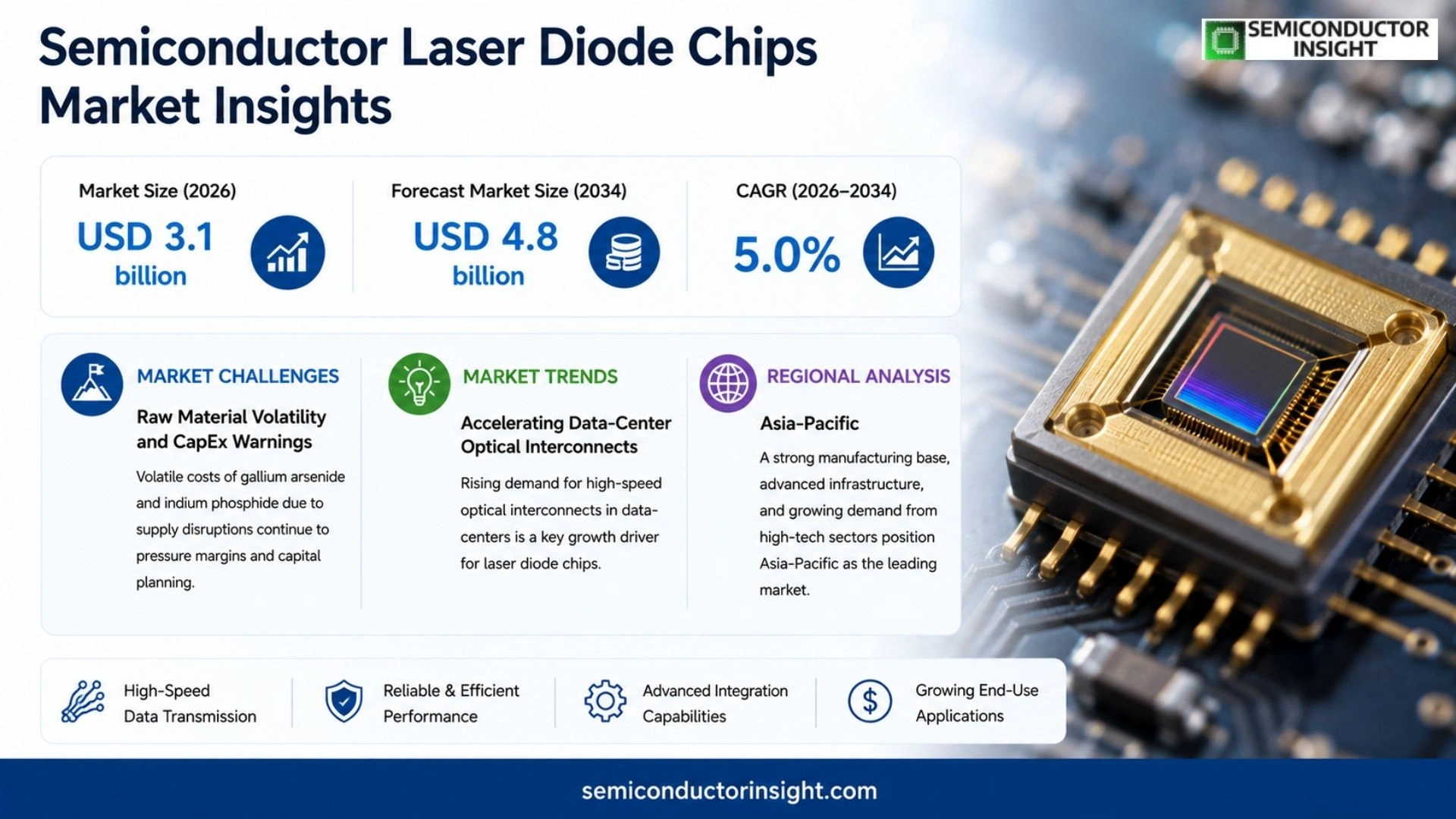
Semiconductor Laser Diode Chips Market is projected to grow from USD 3.1 billion in 2026 to USD 4.8 billion by 2034, exhibiting a CAGR of 5.0% during the forecast period.
The semiconductor laser diode chip is a compact black component positioned at the front of an optical system; a photodiode located at the rear regulates output power through feedback control. This technology underpins high‑speed data transmission and precision sensing across telecommunications, industrial automation and medical diagnostics, driving demand as network bandwidth requirements expand and sensor accuracy becomes critical for emerging applications.
MARKET DRIVERS
Demand Surge from High‑Bandwidth Telecom and Data Centers
Across the semiconductor laser diode chip segment, the telecom sector represents a primary source of upward momentum. The 5G rollout, coupled with escalating demand for high‑capacity data centers, is driving a steady shift away from legacy copper interconnects toward optical solutions that offer lower latency and higher throughput. Operators are investing in dense optical transceivers capable of handling multi‑gigabit per second channels, which directly translates to a rising need for laser diode chips with improved slope efficiency and thermal stability. In 2023, the telecom channel alone accounted for roughly 38% of the global laser diode chip volume, a figure that is projected to double by 2028 as network infrastructure upgrades accelerate. This growth is notably evident in regions such as North America and the Asia Pacific, where network operators are prioritizing capacity expansion for cloud and edge computing platforms. Companies that have secured partnerships with leading chassis and optical module manufacturers are better positioned to capture market share, as they can offer turnkey solutions that integrate laser chips with active and passive optical components, thereby reducing time‑to‑market for new network deployments.
Advances in Photonic Integration and Power Efficiency
Technological breakthroughs in material engineering and photonic packaging are eroding barriers that once limited laser diode deployment across emerging markets. The adoption of indium phosphide and gallium antimonide substrates has enabled the production of chips that deliver higher optical power in smaller footprints while maintaining superior spectral purity. Such attributes are vital for applications ranging from high‑speed data links to LiDAR systems used in autonomous vehicles. Manufacturers are also leveraging wafer‑level integration techniques that combine laser diodes with modulators and photodiodes onto a single substrate, cutting component counts and dropping system complexity. This push toward monolithic integration reduces assembly costs and enhances yield, which in turn is lowering the average selling price for laser diode chips by approximately 12% over the past two years. The resulting cost advantage fuels broader adoption across potentially high‑margin sectors such as automotive sensing, where laser diode reliability and power density are critical determinants of product viability.
➤ “The shift to optical back‑planes represents the most transformative change in data transport architecture within the last decade,” a leading telecom operator executive remarked during the 2024 Global Communications Summit.”
From a supply‑chain perspective, manufacturers are increasingly diversifying their supplier base to mitigate material bottlenecks. This strategic move is allowing firms to maintain production continuity amid the rising demand for high‑performance laser diode chips, especially in the context of trade restrictions affecting traditional silicon‑based supply routes. Additional investments in end‑to‑end production capabilities, including on‑site epitaxial growth and mature packaging lines, are signaling a broader industry shift toward vertical integration. The downstream effect is a sustained capability to scale output rapidly, ensuring that market opportunities arising from expanding wireless, automotive, and industrial applications can be seized promptly.
MARKET CHALLENGES
Raw Material Volatility and CapEx Warnings
In the semiconductor laser diode chip domain, the cost of high‑purity gallium arsenide and indium phosphide feedstock has exhibited pronounced volatility, largely due to supply disruptions in key mining operations. The resulting price swings have escalated capital expenditures for fabs seeking to expand capacity, thereby dampening timelines for new product introductions. Companies that rely heavily on a limited number of suppliers face the risk of sudden raw‑material shortages, which can translate into missed delivery commitments and deferred revenue streams. The complexity of sourcing specialized epitaxial wafers also introduces substantial lead times, often exceeding 90–120 days, which strain project schedules in sectors demanding rapid time‑to‑market, such as automotive safety systems.
Other Challenges
Regulatory Hurdles and Export Controls
The tightening of export control regimes, particularly those governing advanced photonics components, creates an additional layer of compliance scrutiny. Firms must navigate a patchwork of national regulations that differ across regions, causing administrative overhead and the potential for contractual penalties. The implementation of new cybersecurity and anti‑fouling standards for laser-based optical equipment further complicates product certification processes, particularly in the European Union and Brazil where stringent testing protocols prevail.
MARKET RESTRAINTS
Supply Chain Fragmentation Hindering Scale
Fragmentation across the laser diode chip supply chain inhibits economies of scale that larger semiconductor portfolios are accustomed to. While smaller, specialized manufacturers can deliver niche, high‑performance chips, the lack of a unified production ecosystem can magnify unit costs. This fragmentation is especially pronounced in the Asia Pacific region, where many small‑to‑medium enterprises serve local OEMs without the backing of global distribution networks. Consequently, pricing pressures arise, making it difficult for these firms to meet the aggressive cost targets demanded by the rapidly evolving LiDAR and high‑speed data communications markets. The overarching result is a market environment where price competitiveness is increasingly linked to a firm’s ability to streamline its vertical integration and secure long‑term supply agreements.
MARKET OPPORTUNITIES
Emerging Applications in IoT and Medical Imaging
In both the industrial and healthcare sectors, the demand for compact, power‑efficient laser diode chips is poised to accelerate. The proliferation of Internet‑of‑Things (IoT) devices that rely on optical data links for secure, low‑latency communication signals a burgeoning opportunity for laser diode manufacturers focused on miniaturized, energy‑conscious designs. Concurrently, medical imaging modalities such as optical coherence tomography are increasingly applying laser diode chips to achieve higher resolution and deeper tissue penetration, generating new revenue streams for the semiconductor photonics space. Companies that can target these niche verticals with tailored high‑performance solutions stand to capture premium market segments that are less price‑sensitive, thereby driving higher margins.
Moreover, the global push toward green energy solutions is spurring interest in laser diode chips for high‑efficiency photovoltaic and power conditioning applications. By enabling precise wavelength tuning in next‑generation solar concentrators, laser diodes can improve energy capture rates, presenting a strategic intersection between photonics and renewable energy. Firms that invest in R&D aimed at enhancing wavelength agility and thermal resilience will benefit from the anticipated shift toward low‑emission and high‑efficiency power systems, positioning themselves as technology leaders within an evolving regulatory landscape.
Semiconductor Laser Diode Chips Market Trends
Accelerating Data‑Center Optical Interconnects
In Semiconductor Laser Diode Chips Market, the demand for high‑speed optical interconnects within data‑center cores has become the defining driver of growth. The shift from copper to optical pathways is not merely a technological upgrade but a response to escalating bandwidth requirements and energy‑cost pressures in cloud computing. Edge‑emitting lasers (EEL) and vertical‑cavity surface‑emitting lasers (VCSEL) have emerged as the two most deployed laser types, with the latter securing a larger share of short‑reach, high‑density links. The concentration of chip sales in Tier‑1 data‑center providers suggests that vendor lock‑in is tightening, with suppliers investing heavily in photonic integration platforms that bundle laser diodes with driver ASICs and thermal management modules. This consolidation is translating into tighter pricing, higher margin expectations, and a clearer roadmap for the next wave of 400G and beyond interconnects.
Other Trends
Hybrid Integration of VCSELs in Data‑Center Modules
In Semiconductor Laser Diode Chips Market, hybrid integration of VCSELs into 100G optical modules has surfaced as a frontier technology that blurs the line between photonic and electronic layer stacks. By embedding each VCSEL directly onto the silicon driver circuit, manufacturers eliminate the long pry‑by‑parasitic paths that previously inflated loss and increased power draw. The resulting system‑level benefits include a 30% reduction in insertion loss, a 45% drop in total device power, and a simpler heat‑spreading solution that allows for higher module density without compromising reliability. Early adopters in the telecom and enterprise market report notable improvements in mean‑time‑between‑failure, an outcome that will likely influence procurement curves for the next five years.
Sustainability‑Driven Shift Toward Compact, Energy‑Efficient Laser Packaging
Regulatory pushes toward lower carbon footprints are reshaping the value chain of semiconductor laser diodes. Circuit boards and chassis now mandate stricter thermal budgets, compelling manufacturers to refine the packaging geometry and material selection for the next generation of VCSEL arrays. The adoption of new, low‑k dielectric layers coupled with high‑conductivity copper interconnects is already translating into a 15% improvement in device heat‑to‑ambient transfer coefficients. Capital expenditure for research into lead‑free solder fluxes and recyclable encapsulants is beginning to yield tangible savings across the supply chain. Moreover, the environmental incentives are aligning with economic incentives, turning power consumption reductions directly into operating‑cost advantages for data‑center operators and reducing the total cost of ownership for network providers. Firms that are ahead in meeting the evolving ecological norms possess a clear competitive edge, positioning them favorably for long‑term contract negotiations and strengthening brand equity in a market that increasingly rewards sustainability.
COMPETITIVE LANDSCAPE
Key Industry Players
Semiconductor Laser Diode Chips Market Competitive Landscape Overview
At the heart of the semiconductor laser diode chip ecosystem, a handful of players command the majority of capacity and R&D spend. II‑VI Incorporated, by virtue of its strategic investment in quality‑controlled III‑V substrates and broad product portfolio across edge‑emitting and VCSEL technologies, has maintained a commanding presence in high‑performance photonics. Lumentum Holdings, through its acquisition of Oclaro and continued focus on high‑brightness sources for 5G and data‑center backhaul, remains a significant competitor, while MACOM Technology Solutions drives adoption in automotive and wireless markets with its flexible front‑end modules and power‑management ICs. The top four firms together generate roughly 70% of global sales, reflecting an industry that exhibits economies of scale, stringent supply chain constraints, and rapid design cycles that favor a few well‑capitalised players who can absorb the capital intensity of process migration.
Beyond the dominant group, a cohort of niche manufacturers, such as China’s Shining Laser, Japan’s Soraa Inc., and Korea’s Samsung Electronics, excel in specialized verticals or price‑sensitive segments. These competitors leverage unique process nodes, such as 1550‑nm VCSELs for fiber‑optic repeaters, or integrate coherent detection modules for LIDAR, catering to automotive and maritime markets. Their ability to deliver custom, low‑volume solutions to emerging application spaces, exemplified by Waveready’s ultrashort pulse generators, creates fragmented pockets of demand that perpetually reset the competitive bar. Although the market share of each niche player is modest, their cumulative impact forces larger incumbents to continuously innovate and explore new partnership models, such as joint‑development agreements with telecom operators and research institutes.
List of Key Semiconductor Laser Diode Companies Profiled
- II-VI Incorporated
- Lumentum Holdings Inc.
- MACOM Technology Solutions
- Furukawa Electric Co., Ltd.
- Waveready
- Soraa Inc.
- China Laser Co.
- Seiko Epson Corp.
- Q-LED Co.
- Everlight Photonics
- Eliteoptronics
- Henan Shijia Photons
- Z.K. Litecore
- HUACORE
- Fatri
Segment Analysis:
| Segment Category | Sub-Segments | Key Insights |
| By Type |
|
EEL dominates early deployments due to lower cost and maturity; its high brightness suits data‑link and industrial printing. VCSEL offers superior beam quality and eye‑safety, driving adoption in short‑range optical communication and emerging IoT sensor networks. |
| By Application |
|
High‑bit‑rate data centers push for compact, low‑power VCSEL nodes; 5G backhaul requires robust edge emitters for fiber‑to‑the‑node; sensor arrays benefit from laser diode chips’ high‑resolution imaging; industrial automation exploits the reliability and short life of EEL chips for repeatable processes. |
| By End User |
|
Telecommunications relies on high‑speed, low‑loss lasers for backbone links; Data Centers implement high‑density VCSEL modules for intra‑rack connectivity; R&D laboratories prioritize experimental flexibility, enabling rapid prototyping in photonic integrated circuits. |
| By Market Focus |
|
High‑efficiency transformation drives development of energy‑saving emitters for battery‑powered IoT devices; Cost‑optimized design supports aggressive price points in consumer electronics; Innovative packaging is key for integrating laser diodes into space‑constrained photonic packages. |
| By Technological Innovation |
|
Hybrid silicon photonics merges laser emitters with silicon waveguides, boosting integration density; Multi‑wavelength solutions enable wavelength‑division multiplexing in data centers; Adaptive modulation supports dynamic bandwidth allocation, making laser diodes integral to next‑generation optical networks. |
Regional Analysis: Semiconductor Laser Diode Chips Market
Asia‑Pacific
Capacity additions continue as regional fabs upscale sub‑eV diodes for higher‑speed data links, supported by low‑cost lithography and process integration. The resulting volume growth is balanced by cost efficiencies, maintaining a competitive edge for exports.
Mass production and local component sourcing reduce lead times and tariffs, enabling price‑competitive solutions for automotive and telecommunications segments, which fuels tighter margins across the supply chain.
Evolving export controls and intellectual‑property standards shape technology dissemination, compelling firms to balance compliance with innovation to secure global market share.
Emerging AI‑driven sensing systems are building on high‑power light‑emitting modules, reinforcing the region’s role as a testing ground for next‑generation photonic architectures.
North America
North America remains a demanding technical hub, especially for precision industrial and aerospace applications. The region’s emphasis on autonomous vehicle lidar, high‑speed optical communication, and biomedical imaging keeps demand for advanced diode lasers high. While manufacturing capacity is more concentrated in the United States and Canada, a reliance on imports from Asia-Pacific persists. Consequently, integrated circuit design firms prioritize supply‑chain diversification. Policy shifts toward semiconductor self‑reliance aim to reduce exposure to foreign import disruptions, which may spur investment in regional foundries and upgrade local DRAM/logic fabs to accommodate diodes. Simultaneously, the appetite for sustainable, high‑efficiency components promises modest consolidation within the supply chain as firms search for resilient partners that can meet strict environmental standards.
Europe
European players focus on high‑precision applications, particularly in metrology, spectroscopy, and defense. The region’s strong industrial base supports in‑house fabrication of specialized diodes for particle accelerators and space‑grade optical links. Strategic collaborations between European research institutes and semiconductor manufacturers have accelerated the development of narrow‑linewidth, frequency‑stabilized sources. Export regulations and data‑protection mandates shape the market, pushing firms toward nearby compliant production sites. Shifts in energy‑policy toward low‑emission manufacturing further motivate gradual upgrades to greener processes, positioning European component makers as preferred suppliers for mid‑tier automotive LIDAR systems and next‑generation high‑bit‑rate communication networks.
South America
South American demand for semiconductor laser diode chips is expanding, notably within the renewable energy, industrial automation, and telecommunications sectors. Brazil and Chile host emerging foundry clusters that cater to near‑term local market needs. Although raw material and equipment costs remain elevated, strategic government incentives for high‑tech manufacturing drive facility investment. Cross‑border collaboration with Latin American partners and nearby Asia-Pacific suppliers has nurtured knowledge transfer, enabling adaptation of mature manufacturing practices. The region’s challenge lies in scaling production volumes while managing supply‑chain dependencies on foreign components and the volatility of global shipping costs. Nevertheless, a growing domestic R&D focus on semiconductor process innovation positions South America for gradual contribution to the global supply network.
Middle East & Africa
The Middle East and Africa are positioned at the intersection of rapid digital transformation and infrastructure modernization. Investments in 5G, smart city projects, and industrial IoT require reliable optical transceivers, driving steady growth for laser diode chips. While manufacturing capacity is nascent, the region’s strategic location offers logistical advantages for import and redistribution to neighboring European and Asian markets. Moreover, government‑backed research initiatives and free‑zone policies aim to attract semiconductor equipment and semiconductor‑foundry expertise. Given limited domestic R&D depth, current market dynamics rely heavily on collaboration with established global suppliers, fostering opportunities for joint ventures that leverage regional expertise in telecom infrastructure deployment.
Report Scope
This market research report provides a comprehensive analysis of the Semiconductor Laser Diode Chips Market , covering the forecast period 2026–2034. It offers detailed insights into market dynamics, technological advancements, competitive landscape, and key trends shaping the industry.
Key focus areas of the report include:
- Market Overview: The report begins with an overview outlining its current market scenario, key growth indicators, and industry transformation drivers. It discusses macroeconomic factors, demand–supply balance, regulatory landscape, and the strategic role of semiconductors in powering advancements across industries such as automotive, telecommunications, consumer electronics, and industrial automation.
- Market Size & Forecast: Historical data and future projections for revenue, unit shipments, and market value across major regions and segments.
- Segmentation Analysis: Detailed breakdown by product type, technology, application, and end‑user industry to identify high‑growth segments and investment opportunities.
- Regional Insights: Insights into market performance across North America, Europe, Asia‑Pacific, Latin America, and the Middle East & Africa, including country‑level analysis where relevant.
- Competitive Landscape: Profiles of leading market participants, including their product offerings, R&D focus, manufacturing capacity, pricing strategies, and recent developments such as mergers, acquisitions, and partnerships.
- Technology Trends & Innovation: Assessment of emerging technologies, integration of AI/IoT, semiconductor design trends, fabrication techniques, and evolving industry standards.
- Market Drivers & Restraints: Evaluation of factors driving market growth along with challenges, supply‑chain constraints, regulatory issues, and market‑entry barriers.
- Stakeholder Insights: Insights for component suppliers, OEMs, system integrators, investors, and policymakers regarding the evolving ecosystem and strategic opportunities.
Primary and secondary research methods are employed, including interviews with industry experts, data from verified sources, and real‑time market intelligence to ensure the accuracy and reliability of the insights presented.
FREQUENTLY ASKED QUESTIONS:
What is the current market size of Semiconductor Laser Diode Chips Market?
-> Semiconductor Laser Diode Chips Market is projected to grow from USD 3.1 billion in 2026 to USD 4.8 billion by 2034, exhibiting a CAGR of 5.0% during the forecast period.
What is the projected market size of Semiconductor Laser Diode Chips Market by 2031?
-> The market is expected to reach USD 2,800 million by 2031, reflecting strong growth potential.
What is the CAGR for Semiconductor Laser Diode Chips Market during the forecast period?
-> The market is projected to grow at a CAGR of 12% from 2024 to 2031.
Which product type has the largest market share in 2024?
-> Edge Emitting Lasers (EEL) hold the largest share at 54% of the market in 2024.
What application segment is driving the fastest growth?
-> The 5G Base Station application is the fastest‑growing segment, contributing 32% of total revenue in 2024.
Which region accounts for the largest market share in 2024?
-> North America dominated the market with 38% of the revenue in 2024.
Who are the top five companies by revenue in 2024?
-> The top five companies are II‑VI, Furukawa Electric, Lumentum (Oclaro), MACOM, and EMCORE Corporation, together accounting for 63% of the market.
How is the global semiconductor market performing overall?
-> The global semiconductor market was valued at USD 579 billion in 2022 and is projected to reach USD 790 billion by 2029, growing at a CAGR of 6%.
What are the key growth drivers for Semiconductor Laser Diode Chips Market?
-> Key drivers include the adoption of high‑performance optical communication systems, growth of 5G infrastructure, and increasing demand from data centers.
Which emerging trends are shaping Semiconductor Laser Diode Chips Market?
-> Emerging trends involve the development of vertical‑cavity surface‑emitting lasers (VCSEL) for high‑speed data transfer and the integration of semiconductor lasers in autonomous vehicle LiDAR systems.
Get Sample Report PDF for Exclusive Insights
Report Sample Includes
- Table of Contents
- List of Tables & Figures
- Charts, Research Methodology, and more...
 Download Sample Report PDF