
Key Statistics
Key Takeaways
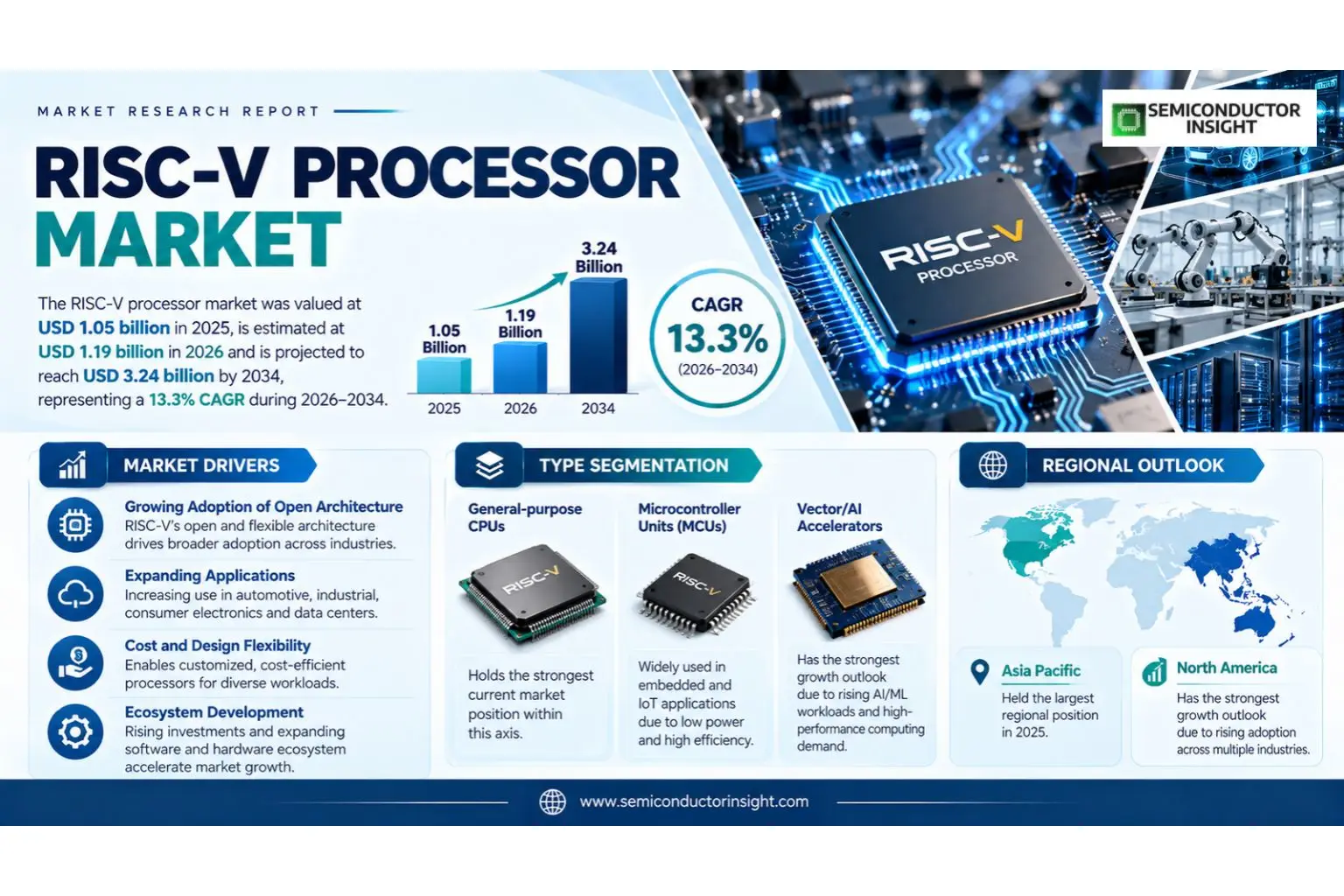
- The RISC-V processor market was valued at USD 1.05 billion in 2025, is estimated at USD 1.19 billion in 2026 and is projected to reach USD 3.24 billion by 2034, representing a 13.3% CAGR during 2026–2034.
- General-purpose CPUs represents the leading type, while Vector/AI Accelerators offers the strongest growth momentum because buyer requirements are shifting toward higher integration, flexibility and performance within the product architecture.
- Embedded IoT Devices provides the largest application base, while Data Center & Cloud is developing faster as users prioritize measurable operating outcomes and application-specific functionality rather than generic hardware capability.
- Asia Pacific is the largest regional market in 2025, supported by largest design-and-deployment ecosystem across China and the wider Asian embedded, consumer and semiconductor manufacturing base. North America has the fastest growth outlook as investment, adoption and supply ecosystems broaden.
- The principal growth mechanism is Open-standard customization. It changes the economic case for adoption by improving utilization, performance or lifecycle value rather than relying on replacement demand alone.
- A meaningful restraint is Software maturity gaps. Suppliers that reduce this barrier through integration support, qualification evidence and clearer total-cost economics are better placed to convert technical interest into repeatable commercial deployments.
RISC-V Processor Market Overview
RISC-V processor market was valued at USD 1.05 billion in 2025, is estimated at USD 1.19 billion in 2026 and is projected to reach USD 3.24 billion by 2034, representing a 13.3% CAGR during 2026–2034. Asia Pacific held the largest regional position in 2025, while North America has the strongest growth outlook.
Base year: 2025 · Estimated year: 2026 · Forecast period: 2026–2034 · Values in USD million unless stated otherwise
RISC-V processors implement an open-standard instruction set architecture that allows designers to build cores ranging from compact microcontrollers to application processors and domain-specific accelerators. Commercial value is created through processor IP, custom extensions, verification, software enablement, SoC integration and finished silicon. The architecture’s openness reduces dependence on a single proprietary ISA owner, but it does not eliminate the need for robust implementation IP, toolchains, software compatibility and long-term product support.
The market is moving from fragmented experimentation toward platform-level standardization. RISC-V International ratified the RVA23 application-processor profile with mandatory vector and hypervisor capabilities, giving operating-system and software vendors a more consistent target. During 2025 the organization also reported broader adoption across AI, automotive, data center, HPC, embedded and space markets. The strategic transition is important because software portability and profile compliance reduce one of the largest barriers to RISC-V adoption beyond deeply embedded devices.
Segment Analysis: By Type
By Type segmentation comprises General-purpose CPUs, Microcontroller Units (MCUs), Vector/AI Accelerators. General-purpose CPUs holds the strongest current market position within this axis, while Vector/AI Accelerators has the strongest growth outlook. The distinction reflects differences in purchasing triggers, technical requirements and qualification intensity rather than a uniform shift across all customer groups. Type-level competition is therefore determined by architecture, performance and lifecycle economics at the product-design stage.
| Type | Market role | Commercial and technical analysis |
|---|---|---|
| General-purpose CPUs | Leading segment | General-purpose CPUs occupy a distinct design point within the RISC-V ecosystem. Buyers select this class based on performance targets, power budgets, software maturity and the amount of differentiation they want to retain at the instruction-set or microarchitecture level. Open specifications lower architectural licensing barriers, but commercialization still requires verified cores, toolchains, operating-system support, security features and dependable implementation partners. Competition therefore occurs around execution quality rather than openness alone. |
| Microcontroller Units (MCUs) | Established segment | Microcontroller Units (MCUs) occupy a distinct design point within the RISC-V ecosystem. Buyers select this class based on performance targets, power budgets, software maturity and the amount of differentiation they want to retain at the instruction-set or microarchitecture level. Open specifications lower architectural licensing barriers, but commercialization still requires verified cores, toolchains, operating-system support, security features and dependable implementation partners. Competition therefore occurs around execution quality rather than openness alone. |
| Vector/AI Accelerators | Fastest-growing segment | Vector/AI Accelerators occupy a distinct design point within the RISC-V ecosystem. Buyers select this class based on performance targets, power budgets, software maturity and the amount of differentiation they want to retain at the instruction-set or microarchitecture level. Open specifications lower architectural licensing barriers, but commercialization still requires verified cores, toolchains, operating-system support, security features and dependable implementation partners. Competition therefore occurs around execution quality rather than openness alone. |
Segment Analysis: By Application
By Application segmentation comprises Embedded IoT Devices, Edge AI & Vision, Automotive Systems, Data Center & Cloud. Embedded IoT Devices holds the strongest current market position within this axis, while Data Center & Cloud has the strongest growth outlook. The distinction reflects differences in purchasing triggers, technical requirements and qualification intensity rather than a uniform shift across all customer groups. Application-level demand follows the operating problem being solved, so adoption speed varies with the measurable value delivered to users.
| Application | Market role | Commercial and technical analysis |
|---|---|---|
| Embedded IoT Devices | Leading segment | Embedded IoT Devices adoption depends on whether hardware and software suppliers can deliver a stable platform rather than a standalone core. In this application, processor choice is tied to compilers, operating systems, hypervisors, accelerators, safety or security requirements, and long product lifecycles. RISC-V gains ground where customization and control over the roadmap matter, but switching costs remain meaningful because existing software stacks and validation processes are often optimized around incumbent architectures. |
| Edge AI & Vision | Established segment | Edge AI & Vision adoption depends on whether hardware and software suppliers can deliver a stable platform rather than a standalone core. In this application, processor choice is tied to compilers, operating systems, hypervisors, accelerators, safety or security requirements, and long product lifecycles. RISC-V gains ground where customization and control over the roadmap matter, but switching costs remain meaningful because existing software stacks and validation processes are often optimized around incumbent architectures. |
| Automotive Systems | Established segment | Automotive Systems adoption depends on whether hardware and software suppliers can deliver a stable platform rather than a standalone core. In this application, processor choice is tied to compilers, operating systems, hypervisors, accelerators, safety or security requirements, and long product lifecycles. RISC-V gains ground where customization and control over the roadmap matter, but switching costs remain meaningful because existing software stacks and validation processes are often optimized around incumbent architectures. |
| Data Center & Cloud | Fastest-growing segment | Data Center & Cloud adoption depends on whether hardware and software suppliers can deliver a stable platform rather than a standalone core. In this application, processor choice is tied to compilers, operating systems, hypervisors, accelerators, safety or security requirements, and long product lifecycles. RISC-V gains ground where customization and control over the roadmap matter, but switching costs remain meaningful because existing software stacks and validation processes are often optimized around incumbent architectures. |
Additional Segment Analysis: By End User
By End User segmentation comprises Semiconductor OEMs, System Integrators, Automotive OEMs. Semiconductor OEMs holds the strongest current market position within this axis, while Automotive OEMs has the strongest growth outlook. The distinction reflects differences in purchasing triggers, technical requirements and qualification intensity rather than a uniform shift across all customer groups. End-user economics differ in budget ownership, deployment scale and support expectations, creating distinct routes to purchase and renewal.
| End User | Market role | Commercial and technical analysis |
|---|---|---|
| Semiconductor OEMs | Leading segment | Semiconductor OEMs is an important end user category because it changes the purchasing criteria, qualification path and value captured by suppliers. Customers evaluate compatibility with the wider system, lifecycle support and operating performance rather than treating the category as interchangeable. Market growth in this segment therefore depends on design-in activity and application-specific proof points. Suppliers with documented performance and integration support are better positioned than vendors competing on unit price alone. |
| System Integrators | Established segment | System Integrators is an important end user category because it changes the purchasing criteria, qualification path and value captured by suppliers. Customers evaluate compatibility with the wider system, lifecycle support and operating performance rather than treating the category as interchangeable. Market growth in this segment therefore depends on design-in activity and application-specific proof points. Suppliers with documented performance and integration support are better positioned than vendors competing on unit price alone. |
| Automotive OEMs | Fastest-growing segment | Automotive OEMs is an important end user category because it changes the purchasing criteria, qualification path and value captured by suppliers. Customers evaluate compatibility with the wider system, lifecycle support and operating performance rather than treating the category as interchangeable. Market growth in this segment therefore depends on design-in activity and application-specific proof points. Suppliers with documented performance and integration support are better positioned than vendors competing on unit price alone. |
Additional Segment Analysis: By Architecture Extension
By Architecture Extension segmentation comprises Vector Extensions, Security Extensions, Virtualization Extensions. Vector Extensions holds the strongest current market position within this axis, while Virtualization Extensions has the strongest growth outlook. The distinction reflects differences in purchasing triggers, technical requirements and qualification intensity rather than a uniform shift across all customer groups. Extension choices influence software portability and workload performance, making standards maturity a central design criterion.
| Architecture Extension | Market role | Commercial and technical analysis |
|---|---|---|
| Vector Extensions | Leading segment | Vector Extensions is an important architecture extension category because it changes the purchasing criteria, qualification path and value captured by suppliers. Customers evaluate compatibility with the wider system, lifecycle support and operating performance rather than treating the category as interchangeable. Market growth in this segment therefore depends on design-in activity and application-specific proof points. Suppliers with documented performance and integration support are better positioned than vendors competing on unit price alone. |
| Security Extensions | Established segment | Security Extensions is an important architecture extension category because it changes the purchasing criteria, qualification path and value captured by suppliers. Customers evaluate compatibility with the wider system, lifecycle support and operating performance rather than treating the category as interchangeable. Market growth in this segment therefore depends on design-in activity and application-specific proof points. Suppliers with documented performance and integration support are better positioned than vendors competing on unit price alone. |
| Virtualization Extensions | Fastest-growing segment | Virtualization Extensions is an important architecture extension category because it changes the purchasing criteria, qualification path and value captured by suppliers. Customers evaluate compatibility with the wider system, lifecycle support and operating performance rather than treating the category as interchangeable. Market growth in this segment therefore depends on design-in activity and application-specific proof points. Suppliers with documented performance and integration support are better positioned than vendors competing on unit price alone. |
Regional Analysis
Asia Pacific leads the market in 2025, while North America has the fastest growth outlook. Regional demand differs materially because end-market investment, local manufacturing, qualification practices, channel structure and customer economics are not uniform. The comparison below treats each geography according to its own commercial mechanism rather than repeating one global narrative with different country names.
How does regional demand differ across the RISC-V Processor market?
Regional strategy depends on where design decisions are made, where end users deploy equipment, and how local customers evaluate lifecycle value. Asia Pacific benefits from largest design-and-deployment ecosystem across China and the wider Asian embedded, consumer and semiconductor manufacturing base. North America is expanding more quickly because new adoption, local supply capabilities and application investment are broadening from a smaller or less mature base. Other regions remain relevant where regulation, installed base or specialized end markets create defensible demand.
| Region | Position | Growth outlook | Demand profile | Primary market logic |
|---|---|---|---|---|
| Asia Pacific | Largest | High | Embedded and domestic silicon led | Asia Pacific combines high semiconductor design activity, enormous embedded-device volumes and strong interest in architecture diversification. |
| North America | Fastest strategic expansion | Highest | IP, software and data-center led | North America contains major RISC-V IP companies, cloud and AI developers, hyperscalers and a deep software ecosystem. |
| Europe | Strategic | High | Automotive and sovereignty led | Europe’s RISC-V opportunity is closely linked to automotive electronics, research programs and semiconductor-sovereignty policy. |
| South America | Emerging | Moderate | Education and embedded systems | The region is a smaller commercial market but has a meaningful engineering and academic base that can adopt open architectures for education, industrial electronics and locally designed embedded systems. |
| Middle East & Africa | Emerging | Moderate | Research, secure compute and IoT | Adoption is likely to be selective and concentrated in research, secure embedded systems, industrial IoT and national technology programs. |
Detailed Regional Blocks
Competitive Landscape
RISC-V competition is unusually layered because the ISA itself is open while commercial differentiation sits above it. Processor-IP vendors compete on microarchitecture, PPA, safety, security, verification and implementation support; SoC suppliers compete on integration and software; ecosystem companies compete on compilers, operating systems and development platforms. SiFive, Andes, Codasip and other IP vendors therefore do not compete solely on instruction-set compatibility. Their value depends on how quickly customers can take a core from architectural selection to verified silicon and production software.
Competition in the risc-v processor market is shaped by design-in relationships, system integration and the cost of switching after qualification. Buyers do not evaluate suppliers solely on headline specifications. They also examine reliability, documentation, software or process compatibility, support response and the ability to maintain performance over the full product lifecycle. This favors vendors that can combine technical differentiation with repeatable delivery and customer engineering support.
The market includes established specialists, vertically integrated technology suppliers and emerging firms pursuing narrower application niches. The competitive boundary is therefore fluid: a supplier can lead in one segment without controlling the whole market. Partnerships, standards participation and ecosystem integration often matter as much as manufacturing scale because customers need assurance that a selected solution will remain compatible with future platforms and deployment requirements.
| Competitive group | Representative companies | Strategic position |
|---|---|---|
| Established / scale suppliers | SiFive, Andes Technology, Esperanto Technologies | Compete on broad customer access, installed base, qualification history and global support. |
| Technology-focused challengers | Alibaba T-Head, Codasip, StarFive Technology, Microchip Technology | Compete through technical differentiation, product focus and faster adaptation to emerging requirements. |
| Specialists and ecosystem participants | Syntacore, Nuclei System Technology, Ventana Micro Systems, Imagination Technologies | Serve specialized applications, regional demand or ecosystem roles that can be strategically important despite smaller scale. |
Profiled market participants
The profiled competitive set includes SiFive, Andes Technology, Esperanto Technologies, Alibaba T-Head, Codasip, StarFive Technology, Microchip Technology, Syntacore, Nuclei System Technology, Ventana Micro Systems, Imagination Technologies. The list spans suppliers with different scale, geographic exposure and product depth. Inclusion identifies commercial relevance to the market scope; it does not imply identical product coverage or an equal competitive position across every segment.
Production Capacity Analysis
Processor supply is not constrained by a dedicated RISC-V manufacturing process; most commercial chips use the same foundries, packaging lines and EDA infrastructure as other architectures. Capacity risk therefore appears at advanced-node wafers, mature-node microcontrollers, packaging and validation rather than at the ISA level. High-performance RISC-V devices targeting data centers or AI can face the same leading-edge capacity and advanced packaging constraints as competing architectures, while embedded MCUs can benefit from a broad mature-node manufacturing base.
Capacity should be interpreted as the ability to deliver qualified, repeatable product rather than as nominal factory floor alone. In risc-v processor, bottlenecks can sit in specialized materials, precision manufacturing, software validation, bonding or packaging, calibration, test, or customer qualification depending on the segment. A supplier with unused physical capacity may still be constrained if the required process window, certifications or engineering support are not available for a customer’s exact design.
Market Dynamics
RISC-V grows when openness converts into lower design friction and stronger differentiation, but adoption slows when software portability, validation or functional-safety requirements outweigh the licensing advantage. The commercial balance has shifted as standardized profiles, vector specifications, upstream operating-system work and vendor toolchains become more mature. Customers increasingly evaluate RISC-V not as an ideological alternative but as a platform option that can support custom accelerators, domain-specific security and supplier diversification while retaining a recognizable software target.
Market Drivers
| Driver | Relative influence | Why it matters |
|---|---|---|
| Open-standard customization | High | RISC-V lets designers add domain-specific extensions or select implementation features without changing the underlying open ISA. That flexibility is especially valuable in edge AI, storage controllers, automotive and security products where workload-specific acceleration can matter more than peak general-purpose performance. Commercial processor-IP vendors monetize the engineering around this freedom: verified cores, design tools, safety packages and implementation support shorten development cycles and reduce the risk of maintaining a fully in-house CPU design. |
| Profile and software standardization | High | Ratified profiles such as RVA23 reduce fragmentation by defining a common set of mandatory and optional capabilities for application processors. This gives operating systems, middleware and application developers a more dependable platform target. The effect is commercially important because software maintenance can exceed CPU licensing cost over a product lifecycle. Better portability lowers the hidden cost of supporting multiple RISC-V implementations and makes the architecture more credible for rich operating systems and enterprise workloads. |
| Edge AI acceleration | Medium to High | Vector processing and custom instruction extensions allow RISC-V implementations to handle neural-network, signal-processing and vision workloads efficiently. Edge devices value this because power budgets and latency constraints often prevent every task from being sent to the cloud. Designers can pair general-purpose cores with tightly coupled accelerators while keeping control software on a standard ISA. This creates demand for processor IP that combines vector capability, memory bandwidth, security and toolchain support. |
| Supply-chain and architecture diversification | Medium | Semiconductor companies and governments increasingly value architectural choice as part of broader supply-chain resilience. RISC-V can reduce dependence on a single proprietary instruction-set licensing model and enable regional or company-specific processor roadmaps. That does not make the supply chain independent of global foundries or EDA vendors, but it creates more design-side options. The benefit is strongest for organizations willing to invest in software, verification and long-term ecosystem participation. |
Open-standard customization
RISC-V lets designers add domain-specific extensions or select implementation features without changing the underlying open ISA. That flexibility is especially valuable in edge AI, storage controllers, automotive and security products where workload-specific acceleration can matter more than peak general-purpose performance. Commercial processor-IP vendors monetize the engineering around this freedom: verified cores, design tools, safety packages and implementation support shorten development cycles and reduce the risk of maintaining a fully in-house CPU design.
Profile and software standardization
Ratified profiles such as RVA23 reduce fragmentation by defining a common set of mandatory and optional capabilities for application processors. This gives operating systems, middleware and application developers a more dependable platform target. The effect is commercially important because software maintenance can exceed CPU licensing cost over a product lifecycle. Better portability lowers the hidden cost of supporting multiple RISC-V implementations and makes the architecture more credible for rich operating systems and enterprise workloads.
Edge AI acceleration
Vector processing and custom instruction extensions allow RISC-V implementations to handle neural-network, signal-processing and vision workloads efficiently. Edge devices value this because power budgets and latency constraints often prevent every task from being sent to the cloud. Designers can pair general-purpose cores with tightly coupled accelerators while keeping control software on a standard ISA. This creates demand for processor IP that combines vector capability, memory bandwidth, security and toolchain support.
Supply-chain and architecture diversification
Semiconductor companies and governments increasingly value architectural choice as part of broader supply-chain resilience. RISC-V can reduce dependence on a single proprietary instruction-set licensing model and enable regional or company-specific processor roadmaps. That does not make the supply chain independent of global foundries or EDA vendors, but it creates more design-side options. The benefit is strongest for organizations willing to invest in software, verification and long-term ecosystem participation.
Market Restraints
| Restraint | Relative influence | Commercial effect |
|---|---|---|
| Software maturity gaps | High | Established x86 and Arm ecosystems have decades of optimized software, debugging experience and commercial support. RISC-V has closed many gaps, but adoption in desktop, server and complex automotive systems still depends on toolchains, drivers, hypervisors, libraries and application certification. The cost of porting and validating software can exceed the royalty savings that motivated an architecture review. Standard profiles help, but the installed software base remains a structural advantage for incumbents. |
| Implementation fragmentation | Medium to High | The same openness that enables customization can create compatibility problems when vendors use non-standard extensions or different platform assumptions. Customers can face increased validation work if binaries, drivers or firmware do not behave consistently across implementations. RISC-V International’s profiles are designed to reduce this problem, but products built before broad profile convergence can still create ecosystem complexity. Commercial buyers therefore place increasing value on standards compliance and documented software targets. |
| Verification and functional safety | Medium | Automotive, industrial and aerospace programs require rigorous verification, traceability and often functional-safety evidence. A processor core is only one part of that obligation. Vendors need mature verification environments, safety manuals, fault analysis and long-term change control. These requirements favor established commercial RISC-V suppliers and can slow smaller entrants. The market grows fastest where openness is paired with industrial-grade verification rather than where low licensing cost is the only differentiator. |
| Incumbent ecosystem strength | Medium | Arm dominates many embedded and mobile categories, while x86 remains entrenched across PCs and servers. These ecosystems benefit from developer familiarity, software availability and proven performance. RISC-V must therefore win a specific workload, cost, customization or strategic argument rather than merely offer another instruction set. Where incumbent solutions already satisfy power, cost and software requirements, switching can create unnecessary engineering risk and delay product schedules. |
Software maturity gaps
Established x86 and Arm ecosystems have decades of optimized software, debugging experience and commercial support. RISC-V has closed many gaps, but adoption in desktop, server and complex automotive systems still depends on toolchains, drivers, hypervisors, libraries and application certification. The cost of porting and validating software can exceed the royalty savings that motivated an architecture review. Standard profiles help, but the installed software base remains a structural advantage for incumbents.
Implementation fragmentation
The same openness that enables customization can create compatibility problems when vendors use non-standard extensions or different platform assumptions. Customers can face increased validation work if binaries, drivers or firmware do not behave consistently across implementations. RISC-V International’s profiles are designed to reduce this problem, but products built before broad profile convergence can still create ecosystem complexity. Commercial buyers therefore place increasing value on standards compliance and documented software targets.
Verification and functional safety
Automotive, industrial and aerospace programs require rigorous verification, traceability and often functional-safety evidence. A processor core is only one part of that obligation. Vendors need mature verification environments, safety manuals, fault analysis and long-term change control. These requirements favor established commercial RISC-V suppliers and can slow smaller entrants. The market grows fastest where openness is paired with industrial-grade verification rather than where low licensing cost is the only differentiator.
Incumbent ecosystem strength
Arm dominates many embedded and mobile categories, while x86 remains entrenched across PCs and servers. These ecosystems benefit from developer familiarity, software availability and proven performance. RISC-V must therefore win a specific workload, cost, customization or strategic argument rather than merely offer another instruction set. Where incumbent solutions already satisfy power, cost and software requirements, switching can create unnecessary engineering risk and delay product schedules.
Market Opportunities
Automotive zonal and domain controllers
Vehicle architectures are consolidating functions into more capable controllers while simultaneously requiring safety, security and deterministic operation. RISC-V allows OEMs and semiconductor vendors to tailor cores for mixed-criticality workloads and retain greater architectural control. The opportunity spans microcontrollers, application processors and accelerators. Suppliers that pair processor IP with ISO 26262-ready collateral, cybersecurity features and long lifecycle support can access higher-value automotive programs.
Data-center control and acceleration
RISC-V can enter data centers through storage controllers, DPUs, management processors and specialized accelerators before displacing mainstream host CPUs. These functions value customization and can be deployed behind stable software interfaces. Vector and hypervisor standardization also improves the case for broader compute roles over time. The commercial opportunity is therefore incremental: control-plane and accelerator wins can establish software credibility and volume before general-purpose server adoption becomes material.
AI-focused processor IP
AI inference creates demand for cores that efficiently orchestrate matrix engines, vector units and custom accelerators. RISC-V’s extensibility allows vendors to build domain-specific instructions while preserving a standard programming base for control code. This is attractive to startups and established semiconductor companies building differentiated AI silicon. Processor-IP suppliers can monetize high-performance cores, vector extensions, verification and software libraries without needing to own the final accelerator architecture.
Regional semiconductor ecosystems
RISC-V can serve countries and companies seeking more control over processor roadmaps, particularly in Asia and Europe. Regional design programs can build around an open ISA while sourcing implementation IP, EDA and manufacturing from multiple partners. The opportunity is strongest where governments fund semiconductor R&D, automotive electronics or secure infrastructure. Success still depends on internationally compatible software; isolated national forks would reduce the portability advantage that makes the architecture commercially attractive.
Supply Chain Analysis
Upstream inputs
Core manufacturing
System integration & channels
End use & lifecycle
Upstream inputs
Materials, components, intellectual property and enabling production inputs define the technical ceiling and cost structure. Supplier concentration at this stage can affect lead times and qualification risk even when final assembly is geographically diversified. In the risc-v processor market, the balance of value shifts toward suppliers that solve integration and qualification problems instead of merely supplying an interchangeable physical component.
Core manufacturing
Fabrication, assembly, bonding, calibration, software integration or precision manufacturing converts inputs into a qualified product. Yield, process control and test discipline determine whether nominal capacity becomes saleable output. In the risc-v processor market, the balance of value shifts toward suppliers that solve integration and qualification problems instead of merely supplying an interchangeable physical component.
System integration & channels
OEMs, equipment builders, distributors, software platforms and integrators connect the product with the customer’s operating environment. This stage captures value through application engineering, configuration, distribution reach and support. In the risc-v processor market, the balance of value shifts toward suppliers that solve integration and qualification problems instead of merely supplying an interchangeable physical component.
End use & lifecycle
End users monetize the technology through productivity, performance, reliability or user outcomes. Replacement, subscriptions, maintenance, upgrades and installed-base support determine how much recurring value remains after the initial sale. In the risc-v processor market, the balance of value shifts toward suppliers that solve integration and qualification problems instead of merely supplying an interchangeable physical component.
Recent Developments
RISC-V International’s first annual report described 2025 as a landmark year, citing adoption across automotive, data center, HPC, embedded, space and AI, together with new technical specifications and broader membership. The key market implication is that commercial adoption is expanding alongside standards work, reducing the risk that RISC-V remains limited to isolated academic or deeply embedded projects.
The RISC-V Vector C Intrinsic Specification v1.0 reached ratified status. A stable intrinsic specification gives developers a standard programming interface for vector hardware, which is important for AI, signal processing and high-performance workloads. The milestone improves portability between implementations and supports vendors building vector-enabled processors without forcing software teams to rely on proprietary compiler interfaces.
RISC-V International ratified the RVA23 Profile, making vector and hypervisor capabilities mandatory for the profile’s application-processor target. The profile provides operating systems and software vendors with a consistent feature baseline and was identified as the baseline requirement for the Android RISC-V ABI. This directly addresses one of the market’s largest barriers: software portability across different implementations.
Report Scope & Segmentation
This market overview covers the commercial value of risc-v processor across the defined product, application and buyer segmentation. The scope uses 2025 as the base year, 2026 as the estimated year and 2026–2034 as the forecast period. It distinguishes market revenue from adjacent system value and uses qualitative leadership language where public evidence does not support a reliable numerical share.
| Scope attribute | Coverage |
|---|---|
| Base year | 2025 |
| Estimated year | 2026 |
| Forecast period | 2026–2034 |
| 2025 market size | USD 1.05 billion |
| 2026 estimated size | USD 1.19 billion |
| 2034 projected size | USD 3.24 billion |
| CAGR (2026–2034) | 13.3% |
| Largest market in 2025 | Asia Pacific |
| By Type | General-purpose CPUs, Microcontroller Units (MCUs), Vector/AI Accelerators |
| By Application | Embedded IoT Devices, Edge AI & Vision, Automotive Systems, Data Center & Cloud |
| By End User | Semiconductor OEMs, System Integrators, Automotive OEMs |
| By Architecture Extension | Vector Extensions, Security Extensions, Virtualization Extensions |
| Regions | North America; Europe; Asia Pacific; South America; Middle East & Africa |
| Profiled companies | SiFive, Andes Technology, Esperanto Technologies, Alibaba T-Head, Codasip, StarFive Technology, Microchip Technology, Syntacore, Nuclei System Technology, Ventana Micro Systems, Imagination Technologies |
Frequently Asked Questions
What is the size of the RISC-V Processor market?
The global risc-v processor market was valued at USD 1.05 billion in 2025, is estimated at USD 1.19 billion in 2026 and is projected to reach USD 3.24 billion by 2034. This represents a 13.3% CAGR during 2026–2034. The forecast reflects increasing adoption within the defined product and application scope rather than the value of broader adjacent systems.
Which region leads the RISC-V Processor market?
Asia Pacific holds the largest market position in 2025, supported by largest design-and-deployment ecosystem across China and the wider Asian embedded, consumer and semiconductor manufacturing base. The region combines demand, supplier access and customer readiness in a way that gives it a stronger current revenue base than other geographies. Regional leadership should be interpreted through those structural factors rather than as an unsupported universal percentage.
Which region is growing fastest?
North America has the fastest growth outlook within the forecast period. The region benefits from expanding technology adoption, new investment, local supply development and broader application deployment. Growth does not imply that every country follows the same trajectory; qualification practices, purchasing power, infrastructure and end-market concentration continue to create substantial differences inside the region.
Which product type currently has the strongest position?
General-purpose CPUs has the strongest current position within the By Type segmentation. Its leadership reflects established customer use, application fit and a larger installed or design-in base. Vector/AI Accelerators has the stronger growth outlook as product architectures evolve. Supplier success depends on matching performance and lifecycle support to the specific requirements of each type.
Which application is most important?
Embedded IoT Devices is the largest application segment within the defined scope because it provides the broadest current demand base. Data Center & Cloud has the stronger growth outlook as customers place greater value on specialized outcomes and deeper integration. The application mix matters commercially because purchasing triggers, qualification requirements and willingness to pay differ significantly between use cases.
What is the primary market driver?
Open-standard customization is a principal growth driver. RISC-V lets designers add domain-specific extensions or select implementation features without changing the underlying open ISA. That flexibility is especially valuable in edge AI, storage controllers, automotive and security products where workload-specific acceleration can matter more than peak general-purpose performance. Commercial processor-IP vendors monetize the engineering around this freedom: verified cores, design tools, safety packages and implementation support shorten development cycles and reduce the risk of maintaining a fully in-house CPU design. The effect is commercially meaningful because adoption accelerates when the technology improves measurable performance or lifecycle economics rather than simply adding a new feature.
What is the main restraint on market growth?
Software maturity gaps is a significant restraint. Established x86 and Arm ecosystems have decades of optimized software, debugging experience and commercial support. RISC-V has closed many gaps, but adoption in desktop, server and complex automotive systems still depends on toolchains, drivers, hypervisors, libraries and application certification. The cost of porting and validating software can exceed the royalty savings that motivated an architecture review. Standard profiles help, but the installed software base remains a structural advantage for incumbents. Suppliers can reduce the barrier through clearer value proof, integration support, qualification evidence and product architectures that lower total lifecycle risk for customers.
How is competition structured?
RISC-V competition is unusually layered because the ISA itself is open while commercial differentiation sits above it. Processor-IP vendors compete on microarchitecture, PPA, safety, security, verification and implementation support; SoC suppliers compete on integration and software; ecosystem companies compete on compilers, operating systems and development platforms. SiFive, Andes, Codasip and other IP vendors therefore do not compete solely on instruction-set compatibility. Their value depends on how quickly customers can take a core from architectural selection to verified silicon and production software. Buyers also consider integration support, qualification history, reliability and ecosystem compatibility, which means market share is not determined by a single technical specification. Competition therefore varies by application and customer class, with established suppliers and focused specialists often holding different advantages.
Why is supply capacity strategically important?
Processor supply is not constrained by a dedicated RISC-V manufacturing process; most commercial chips use the same foundries, packaging lines and EDA infrastructure as other architectures. Capacity risk therefore appears at advanced-node wafers, mature-node microcontrollers, packaging and validation rather than at the ISA level. High-performance RISC-V devices targeting data centers or AI can face the same leading-edge capacity and advanced packaging constraints as competing architectures, while embedded MCUs can benefit from a broad mature-node manufacturing base. Capacity matters because qualified output, not nominal floor space, determines what customers can actually buy. Yield, testing, specialized materials, software or process integration and customer approvals can all constrain shipment growth even when a supplier has physical expansion room.
What should buyers and suppliers watch through 2034?
Stakeholders should watch the pace of qualification, integration into wider ecosystems, regional investment, standards or certification changes, and the ability of suppliers to convert technical capability into repeatable production and lifecycle support. The strongest opportunities will emerge where performance gains are measurable and customer switching costs support durable relationships without creating unacceptable adoption friction.
Research Sources & Evidence Base
View research sources used for this overview.
- RISC-V International. RISC-V Annual Report 2025 — 2025 ecosystem, membership and deployment milestones.
- RISC-V International. RVA23 Profile Standard Ratification — Application-processor profile, vector and hypervisor requirements, October 2024.
- RISC-V International. RISC-V Vector C Intrinsic Specification v1.0 — Ratified vector programming interface, April 2025.
- RISC-V International. Ratified Specifications Library — Official open-standard ISA and extension specifications.
Get Sample Report PDF for Exclusive Insights
Report Sample Includes
- Table of Contents
- List of Tables & Figures
- Charts, Research Methodology, and more...
 Download Sample Report PDF



