
MARKET INSIGHTS
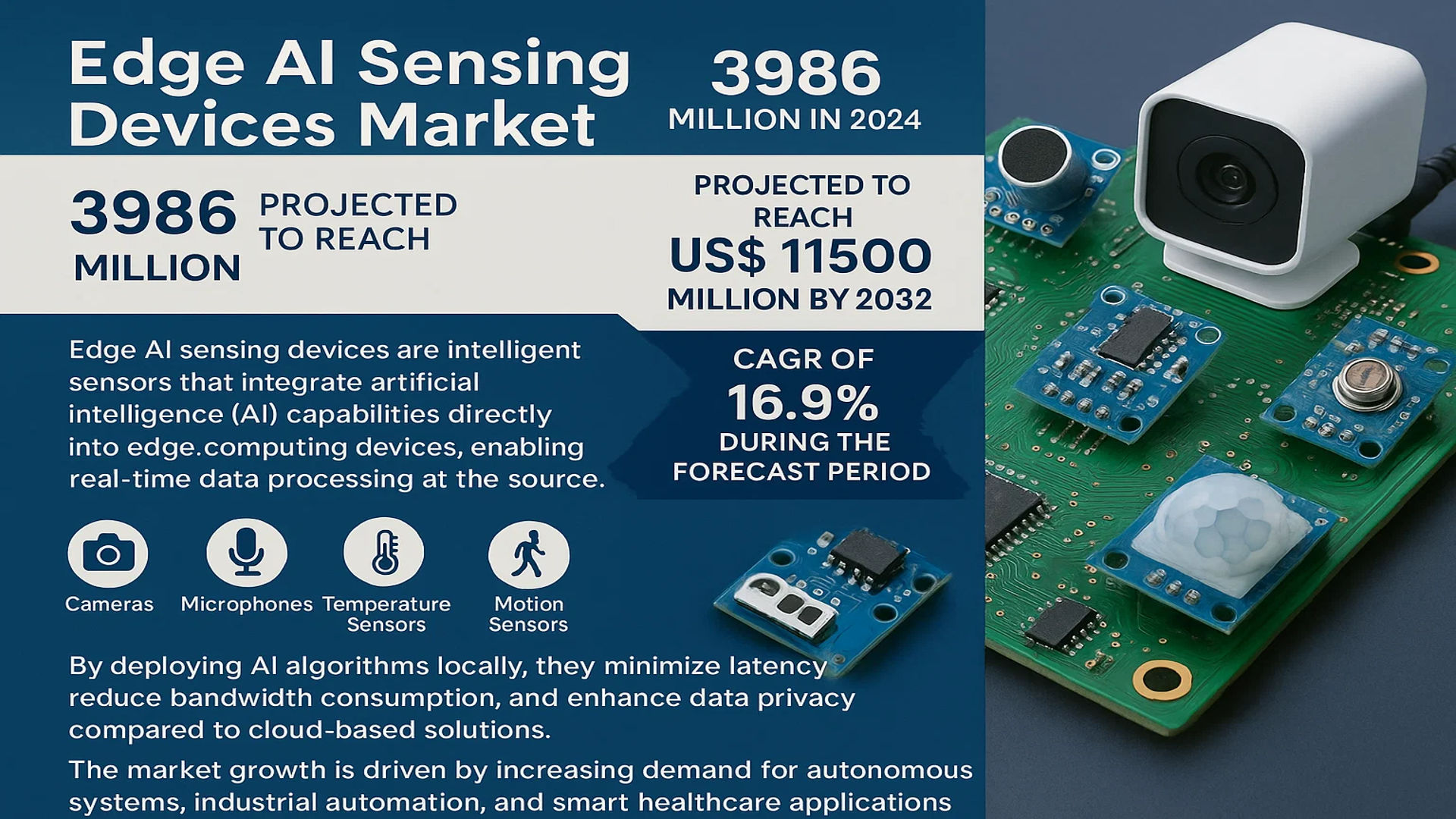
The global Edge AI Sensing Devices Market was valued at 3986 million in 2024 and is projected to reach US$ 11500 million by 2032, at a CAGR of 16.9% during the forecast period.
Edge AI sensing devices are intelligent sensors that integrate artificial intelligence (AI) capabilities directly into edge computing devices, enabling real-time data processing at the source. These devices include cameras, microphones, temperature sensors, motion sensors, and other IoT-enabled components. By deploying AI algorithms locally, they minimize latency, reduce bandwidth consumption, and enhance data privacy compared to cloud-based solutions.
The market growth is driven by increasing demand for autonomous systems, industrial automation, and smart healthcare applications. Edge AI sensing enables faster decision-making in critical scenarios like autonomous vehicles and predictive maintenance. Key players such as Sony Semiconductor Solutions, Samsung, and NVIDIA are actively developing advanced solutions, with the top five companies holding a significant revenue share in 2024. The camera segment remains dominant, while industrial automation emerges as the fastest-growing application area.
MARKET DYNAMICS
MARKET DRIVERS
Proliferation of IoT and Smart Devices Accelerating Edge AI Adoption
The global IoT market continues to expand rapidly, with over 15 billion connected devices currently in operation and projections indicating this could exceed 29 billion by 2030. This massive growth directly correlates with increasing demand for Edge AI sensing devices, as traditional cloud computing architectures struggle to handle the scale of data processing required at the network edge. By integrating AI capabilities directly into sensors and endpoints, manufacturers can achieve real-time analytics with latencies under 10 milliseconds – a critical requirement for applications like industrial automation and autonomous vehicles. Major chipmakers have responded aggressively to this trend, with semiconductor companies allocating approximately 35% of their R&D budgets towards edge AI solutions in recent fiscal years.
Advancements in Computer Vision Technologies Driving Camera Segment Growth
Computer vision represents the fastest-growing application for Edge AI sensing, with the camera segment projected to capture over 42% of total market share by 2026. Breakthroughs in neural network architectures and low-power AI accelerators have enabled sophisticated image recognition capabilities directly on camera hardware. This proves particularly valuable for surveillance systems, where privacy regulations increasingly mandate local data processing. The automotive sector’s transition towards ADAS and autonomous driving systems has further propelled demand, with leading manufacturers integrating multiple AI-enabled cameras per vehicle. Recent innovations in 3D sensing and multi-spectral imaging are creating new use cases across healthcare diagnostics and industrial quality inspection.
5G Network Rollouts Enabling Next-Generation Edge Applications
The global deployment of 5G infrastructure presents a significant catalyst for Edge AI sensing adoption, as the combination of ultra-low latency connectivity and distributed compute power unlocks transformative use cases. Telecommunications providers have invested over $200 billion in 5G networks since 2020, creating the backbone for distributed AI architectures. This infrastructure supports mission-critical applications like remote surgery, where sensor data must be processed within 1-2 milliseconds. The manufacturing sector particularly benefits from these developments, with smart factories leveraging edge sensing to achieve predictive maintenance accuracies exceeding 90%. As network slicing technologies mature, expect dedicated 5G channels to further optimize performance for AI-powered sensor networks.
MARKET RESTRAINTS
High Power Consumption Challenges in Compact Edge Devices
While edge AI sensing offers compelling advantages, power management remains a persistent challenge, particularly for battery-operated IoT devices. Advanced neural networks can require up to 10 watts of continuous power – unsustainable for many embedded applications. This limitation forces difficult tradeoffs between performance and battery life, especially in wearable devices and environmental sensors. Thermal constraints further complicate matters, as small form factors struggle to dissipate heat from high-performance AI chips. Although semiconductor manufacturers have made progress in ultra-low-power designs, achieving true always-on AI sensing below 1 milliwatt remains an industry-wide challenge holding back broader adoption.
Interoperability Issues Across Heterogeneous Edge Ecosystems
The absence of universal standards for edge AI implementations creates significant integration hurdles, as devices from different manufacturers often utilize incompatible software frameworks and communication protocols. This fragmentation particularly impacts industrial environments deploying multi-vendor sensor networks. Without standardized middleware solutions, organizations incur substantial costs developing custom integration layers. The challenge extends to AI model portability, with neural networks trained on one hardware platform frequently requiring complete retooling for deployment on different edge processors. Industry consortiums have emerged to address these issues, but achieving true plug-and-play compatibility remains years away.
MARKET CHALLENGES
Data Privacy and Security Risks in Distributed Architectures
Edge computing’s distributed nature introduces complex security vulnerabilities absent in centralized cloud models. Each sensing device represents a potential attack surface, with recent studies showing a 300% increase in edge device breaches over the past three years. The challenge intensifies for medical and financial applications handling sensitive data, where regulatory compliance adds another layer of complexity. Manufacturers must implement end-to-end encryption and hardware-based secure enclaves – features that increase bill-of-materials costs by 15-20%. The growing threat of adversarial machine learning attacks, where hackers manipulate sensor inputs to deceive AI models, further complicates security implementations.
MARKET OPPORTUNITIES
AI-Enabled Predictive Maintenance in Industrial Settings
The industrial sector presents enormous potential for Edge AI sensing, particularly in predictive maintenance applications. By analyzing vibration, temperature, and acoustic patterns directly at equipment level, manufacturers can reduce unplanned downtime by up to 45%. Emerging digital twin technologies amplify these benefits, allowing real-time comparison between physical assets and their virtual models. The oil and gas industry has been an early adopter, deploying ruggedized edge sensors capable of operating in extreme environments. As industrial IoT platforms mature, expect broader integration across manufacturing lines, energy grids, and transportation infrastructure.
Expansion of Ambient Intelligence in Smart Spaces
The convergence of Edge AI with ambient computing is creating intelligent environments that adapt seamlessly to human presence and behavior. Retail spaces now deploy millimeter-wave radar sensors to analyze customer traffic patterns while preserving privacy. Smart buildings integrate multi-modal sensing networks that automatically adjust lighting, temperature, and security based on occupancy. This ambient intelligence market could exceed $50 billion by 2028 as hospitality, healthcare, and education sectors recognize the productivity benefits. The technology particularly shines in elder care applications, where discreet sensors monitor activity levels and detect emergencies without intrusive cameras.
EDGE AI SENSING DEVICES MARKET TRENDS
Accelerated Adoption of AIoT in Industrial Automation
The integration of Artificial Intelligence of Things (AIoT) in industrial automation is emerging as a dominant trend in the Edge AI Sensing Devices market. With predictive maintenance applications alone, industrial sectors are expected to reduce operational costs by nearly 30% through real-time sensor data processing at the edge. Leading manufacturers are deploying AI-enabled cameras and temperature sensors to detect anomalies in machinery without relying on cloud computing, significantly reducing latency. Data processing at the edge is projected to grow at a CAGR of 21% in manufacturing applications by 2030, further driving demand for smart sensing solutions.
Other Trends
Autonomous Vehicle Development
The automotive industry’s rapid advancement in autonomous driving technology is creating substantial demand for edge-based AI sensors. Modern autonomous vehicles leverage multiple sensor types including LiDAR, radar, and thermal imaging cameras with integrated AI models capable of processing 4TB of data per hour locally. Major automotive manufacturers are investing heavily in edge computing platforms that process sensor data with latencies under 10 milliseconds, a critical requirement for real-time decision making in self-driving cars.
Healthcare Industry Transformation Through Edge Computing
Edge AI sensing devices are revolutionizing healthcare diagnostics through point-of-care solutions that process medical imaging and biometric data at the source. Smart wearable ECG monitors with embedded AI can now detect cardiac abnormalities with 98% accuracy while maintaining patient privacy through localized processing. Hospitals are deploying edge-based temperature monitoring systems that analyze patterns across thousands of data points per patient to predict infections before symptoms appear, demonstrating the life-saving potential of this technology.
The combination of healthcare IoT devices and edge computing is expected to grow at 24% annually as regulatory bodies approve more AI-based diagnostic tools. Recent FDA clearances for edge-based retinal scanners and AI-powered stethoscopes validate this technological shift toward decentralized healthcare analytics.
COMPETITIVE LANDSCAPE
Key Industry Players
Technology Giants and Semiconductor Leaders Dominate Edge AI Sensing Innovation
The global Edge AI sensing devices market presents a dynamic competitive environment where established semiconductor companies and emerging AI specialists vie for market leadership. The landscape is characterized by rapid technological advancements, with Intel, Samsung, and NVIDIA emerging as dominant players due to their comprehensive solutions spanning hardware, software, and AI algorithm development.
Sony Semiconductor Solutions Group maintains a strong position in the imaging sensor segment, capturing a significant share of the camera-based Edge AI market. Their advanced CMOS sensors with embedded AI processing capabilities are widely adopted in smartphones and surveillance systems. Meanwhile, Texas Instruments and STMicroelectronics lead in low-power edge processing solutions, crucial for IoT applications.
The Chinese market shows strong domestic competition, with Hikvision and SenseTime expanding aggressively through government-supported smart city projects and facial recognition technologies. These players are challenging traditional Western manufacturers by offering cost-competitive solutions tailored for large-scale deployments.
What makes this market particularly dynamic is the convergence of semiconductor expertise and AI software capabilities. Companies like Qualcomm and NVIDIA are leveraging their mobile and GPU architectures to create optimized Edge AI platforms, while traditional sensor manufacturers are acquiring or partnering with AI startups to enhance their offerings.
List of Key Edge AI Sensing Device Companies
- Sony Semiconductor Solutions Group (Japan)
- Samsung Electronics (South Korea)
- STMicroelectronics (Switzerland)
- Infineon Technologies (Germany)
- Texas Instruments (U.S.)
- Hikvision (China)
- SenseTime (China)
- NVIDIA (U.S.)
- Bosch Sensortec (Germany)
- Intel Corporation (U.S.)
- Omron Corporation (Japan)
- Qualcomm Technologies (U.S.)
Segment Analysis:
By Type
Camera Segment Dominates the Market Due to Rising Demand for AI-Powered Surveillance and Imaging
The market is segmented based on type into:
- Camera
- Microphone
- Temperature Sensor
- Motion Sensor
- Others
By Application
Autonomous Driving Segment Leads Due to Increasing Adoption of AI in Smart Vehicles
The market is segmented based on application into:
- Autonomous Driving
- Industrial Automation
- Healthcare
- Others
By End-User
Consumer Electronics Segment Holds Major Share Owing to Widespread Usage in Smart Devices
The market is segmented based on end-user into:
- Consumer Electronics
- Automotive
- Manufacturing
- Healthcare
- Others
Regional Analysis: Edge AI Sensing Devices Market
North America
North America dominates the Edge AI Sensing Devices market, driven by rapid technological advancements and substantial investments in AI infrastructure. The U.S. leads in adoption, fueled by the presence of major tech giants like NVIDIA, Intel, and Qualcomm, which are pioneering edge AI solutions. The region benefits from strong R&D ecosystems, particularly in autonomous driving and industrial automation applications. Regulatory support for AI development and increasing demand for privacy-focused, low-latency edge computing solutions further accelerate market growth. Silicon Valley remains the innovation hub, with startups continuously emerging to address niche applications in healthcare and smart manufacturing.
Asia-Pacific
Asia-Pacific is the fastest-growing region in the Edge AI Sensing Devices market, primarily due to China’s aggressive AI policies and massive industrial digitization efforts. Chinese firms like Hikvision and SenseTime lead in AI-powered cameras and surveillance systems, while Japan and South Korea focus on high-precision sensors for automotive and robotics applications. The region’s manufacturing-heavy economy drives demand for industrial automation, making edge AI sensors critical for predictive maintenance and quality control. India is emerging as a key player, with government initiatives like ‘Make in India’ boosting local production. However, intellectual property concerns and geopolitical tensions create uncertainties for international market players.
Europe
Europe maintains a strong position in the Edge AI Sensing Devices market, with Germany and the U.K. at the forefront of industrial and healthcare applications. The region’s strict GDPR regulations encourage the adoption of edge computing to ensure data privacy compliance. Automotive manufacturers like BMW and Bosch are heavily investing in edge AI for autonomous vehicle development. The EU’s Horizon Europe program allocates significant funding for AI research, with particular focus on ethical AI and energy-efficient edge devices. While the market grows steadily, fragmented regulations across member states and slower 5G rollout compared to Asia pose challenges for seamless edge network deployment.
Middle East & Africa
The Middle East is witnessing accelerated adoption of Edge AI Sensing Devices, particularly in smart city projects across UAE and Saudi Arabia. Dubai’s AI strategy aims to make it the world’s smartest city, driving demand for intelligent surveillance and traffic management systems. Africa shows potential with growing mobile penetration enabling edge computing applications, though infrastructure limitations and power reliability issues hinder widespread adoption. Israel stands out as a technology innovator, with startups developing advanced edge AI solutions for security and agriculture. The region presents long-term growth opportunities as oil-dependent economies diversify into technology-driven sectors.
South America
South America’s Edge AI Sensing Devices market is in early growth stages, with Brazil and Argentina leading adoption in agricultural and industrial sectors. The region’s focus on precision farming drives demand for AI-powered soil and climate sensors. Challenges include limited local manufacturing capabilities, reliance on imports, and economic instability affecting technology investments. However, increasing smartphone penetration and improving internet infrastructure create favorable conditions for edge computing adoption. Governments are beginning to recognize AI’s potential, but lack of coordinated policies slows market maturation compared to other regions.
Report Scope
This market research report provides a comprehensive analysis of the Global Edge AI Sensing Devices Market, covering the forecast period 2024–2032. It offers detailed insights into market dynamics, technological advancements, competitive landscape, and key trends shaping the industry.
Key focus areas of the report include:
- Market Size & Forecast: Historical data and future projections for revenue, unit shipments, and market value across major regions and segments. The global Edge AI Sensing Devices market was valued at USD 3,986 million in 2024 and is projected to reach USD 11,500 million by 2032, growing at a CAGR of 16.9%.
- Segmentation Analysis: Detailed breakdown by product type (Camera, Microphone, Temperature Sensor, Motion Sensor, Others) and application (Autonomous Driving, Industrial Automation, Healthcare, Others) to identify high-growth segments and investment opportunities.
- Regional Outlook: Insights into market performance across North America, Europe, Asia-Pacific, Latin America, and the Middle East & Africa, including country-level analysis. The U.S. and China are key markets with significant growth potential.
- Competitive Landscape: Profiles of leading market participants, including their product offerings, R&D focus, manufacturing capacity, pricing strategies, and recent developments such as mergers, acquisitions, and partnerships.
- Technology Trends & Innovation: Assessment of emerging AI/ML integration in edge sensing devices, low-power processing solutions, and evolving industry standards for privacy and data security.
- Market Drivers & Restraints: Evaluation of factors driving market growth such as IoT proliferation and Industry 4.0 adoption, along with challenges including high development costs and regulatory constraints.
- Stakeholder Analysis: Insights for semiconductor manufacturers, OEMs, system integrators, investors, and policymakers regarding the evolving ecosystem and strategic opportunities.
Primary and secondary research methods are employed, including interviews with industry experts, data from verified sources, and real-time market intelligence to ensure the accuracy and reliability of the insights presented.
FREQUENTLY ASKED QUESTIONS:
What is the current market size of Global Edge AI Sensing Devices Market?
-> Edge AI Sensing Devices Market was valued at 3986 million in 2024 and is projected to reach US$ 11500 million by 2032, at a CAGR of 16.9% during the forecast period.
Which key companies operate in Global Edge AI Sensing Devices Market?
-> Key players include Sony Semiconductor Solutions Group, Samsung, STMicroelectronics, Infineon, Texas Instruments, Hikvision, SenseTime, NVIDIA, Bosch Sensortec, Intel, Omron, and Qualcomm.
What are the key growth drivers?
-> Key growth drivers include rising demand for real-time data processing, proliferation of IoT devices, advancements in AI algorithms, and increasing adoption in autonomous vehicles and smart cities.
Which region dominates the market?
-> Asia-Pacific shows the fastest growth due to manufacturing hubs and IoT adoption, while North America leads in technological innovation.
What are the emerging trends?
-> Emerging trends include tinyML adoption, AI-powered predictive maintenance, privacy-preserving edge computing, and integration with 5G networks.

Get Sample Report PDF for Exclusive Insights
Report Sample Includes
- Table of Contents
- List of Tables & Figures
- Charts, Research Methodology, and more...
 Download Sample Report PDF



