Market Insights
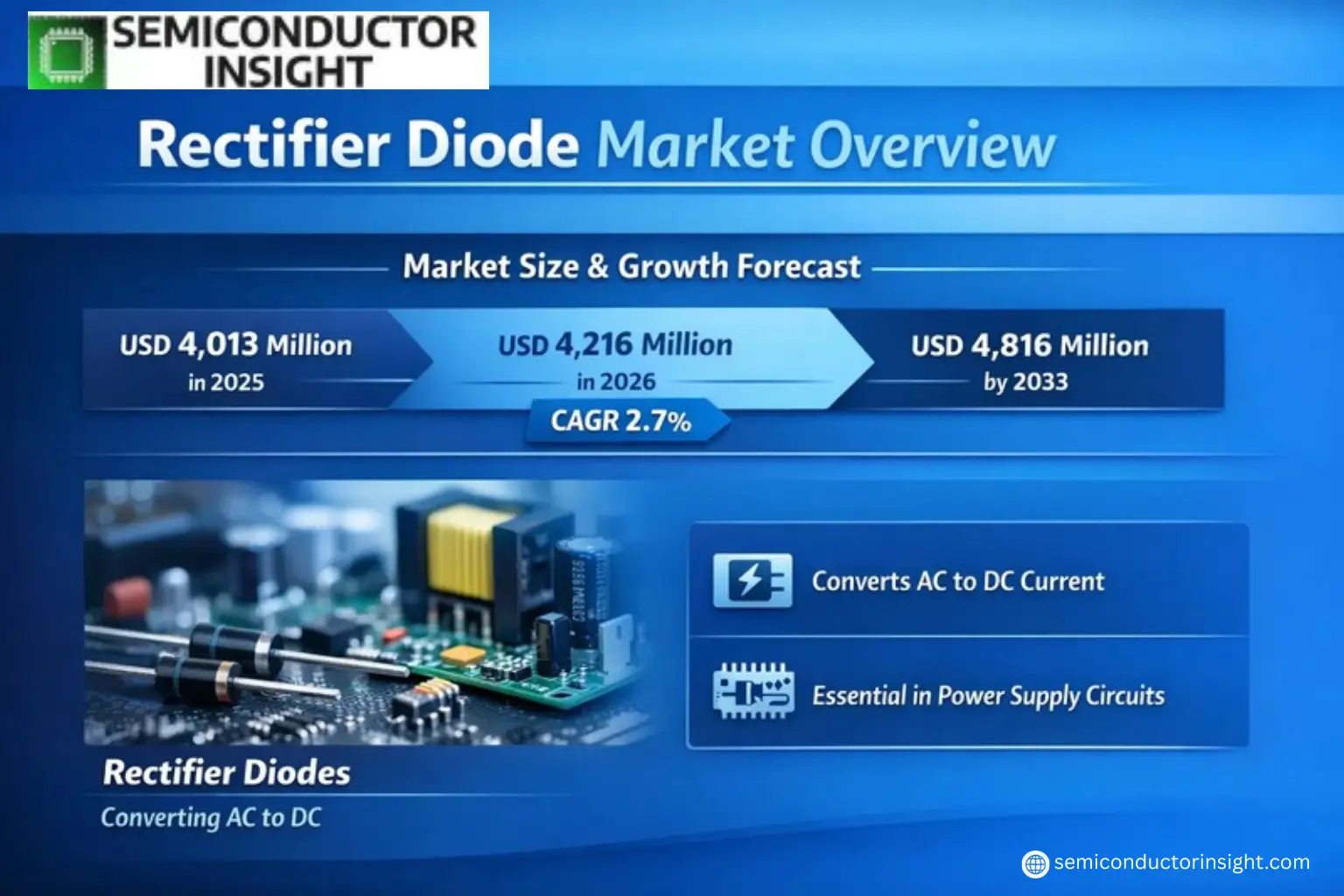
Global Rectifier Diode Market size was valued at USD 4,013 million in 2025 and is projected to grow from USD 4,216 million in 2026 to USD 4,816 million by 2033, exhibiting a CAGR of 2.7% during the forecast period.
Rectifier diodes are semiconductor devices primarily used to convert alternating current (AC) into direct current (DC), making them essential components in power supply circuits. These diodes are widely utilized across industries due to their efficiency in voltage regulation and energy conversion. The market includes various types such as SBR rectifiers, Schottky diodes, fast recovery rectifiers, and general-purpose diodes.
The market growth is driven by increasing demand for consumer electronics, industrial automation, and automotive applications. Greater China dominates the market with over 35% share, followed by the USA and EU regions. Key players like Toshiba, Vishay, and ST Microelectronics hold significant market positions due to their extensive product portfolios and technological advancements in power electronics.
MARKET DRIVERS
Growing Demand for Power Electronics
Rectifier Diode Market is experiencing steady growth due to increasing applications in power electronics, particularly in energy-efficient appliances and industrial equipment. Global shift toward renewable energy systems has further amplified the need for high-performance rectifier diodes in solar inverters and power converters.
Automotive Industry Expansion
With the rapid growth of electric vehicles (EVs) and hybrid vehicles, the demand for rectifier diodes in onboard chargers and battery management systems has surged. Manufacturers are focusing on developing diodes with higher voltage ratings and thermal stability to meet automotive industry requirements.
Telecommunications infrastructure upgrades and 5G network deployments are creating additional demand for rectifier diodes in power supply units and RF applications.
MARKET CHALLENGES
Material Cost Volatility
Fluctuating prices of semiconductor-grade silicon and other raw materials significantly impact rectifier diode production costs. Manufacturers face margin pressures when material costs rise unexpectedly.
Other Challenges
Thermal Management Issues
High-power rectifier diodes in industrial applications require advanced thermal management solutions, increasing system complexity and cost.
Miniaturization Constraints
While demand grows for compact diodes, maintaining performance characteristics in smaller form factors presents ongoing engineering challenges.
MARKET RESTRAINTS
Mature Technology Competition
Rectifier Diode Market faces competition from alternative power conversion technologies such as MOSFETs and IGBTs in certain applications, limiting growth potential in specific market segments.
Supply Chain Disruptions
Global semiconductor supply chain challenges continue to affect rectifier diode availability and lead times, particularly for specialized high-voltage components.
MARKET OPPORTUNITIES
Emerging Wide Bandgap Semiconductors
Development of silicon carbide (SiC) and gallium nitride (GaN) rectifier diodes presents significant opportunities for performance improvement in high-frequency and high-temperature applications.
Industrial Automation Growth
The increasing adoption of Industry 4.0 technologies is driving demand for robust rectifier diodes in motor drives, power supplies, and industrial control systems worldwide.
Rectifier Diode Market Trends
Steady Growth in Rectifier Diode Market
Global Rectifier Diode Market was valued at USD 4,013 million in 2025 and is projected to reach USD 4,816 million by 2033, growing at a CAGR of 2.7%. This growth is driven by increasing demand from consumer electronics and industrial applications. The market expansion reflects the essential role of rectifier diodes in power conversion across multiple industries.
Other Trends
Regional Market Dominance
Greater China leads the Rectifier Diode Market with over 35% share, followed by the USA and EU collectively holding 30%. This regional concentration correlates with manufacturing hubs and semiconductor industry development. Emerging markets in Asia show accelerated growth potential due to expanding electronics production.
Product Segment Performance
SBR Rectifiers dominate product segments with 30% market share, demonstrating superior performance in high-frequency applications. The segment’s growth aligns with increasing demand for efficient power management in consumer electronics and automotive systems. Schottky variants continue gaining traction in high-speed switching applications.
Competitive Landscape Shifts
The top five manufacturers hold over 25% market share, with Toshiba, Rohm, and Vishay maintaining leadership positions. Recent industry developments include technological advancements in heat dissipation and miniaturization. Market consolidation is expected as companies seek competitive advantages through mergers and vertical integration.
Application Diversification
Consumer Electronics remains the largest application segment, followed by industrial uses. Emerging applications in renewable energy systems and electric vehicles present significant growth opportunities. Household appliances show steady demand due to increasing smart home device adoption.
Technology Advancements
Manufacturers are focusing on developing high-efficiency rectifier diodes with lower forward voltage drops. Innovations in packaging technologies enable smaller form factors for space-constrained applications. The industry continues to address challenges in thermal management and reliability under high-load conditions.
COMPETITIVE LANDSCAPE
Key Industry Players
A consolidated market with top 5 players controlling over 25% revenue share
Toshiba dominates the Rectifier Diode Market with significant technological expertise in power semiconductor solutions, followed closely by Rohm and Vishay Intertechnology which specialize in high-efficiency diode components. The market demonstrates moderate fragmentation with regional leaders like Pan Jit International capturing Greater China’s demand while STMicroelectronics and ON Semiconductor lead in industrial applications across Europe and North America.
Niche players such as Yangzhou Yangjie and Good-Ark Electronics focus on cost-competitive solutions for consumer electronics, whereas Infineon and NXP target automotive-grade rectifiers. Emerging competition comes from Diodes Incorporated and Sanken Electric who are expanding production capacities in Southeast Asia to leverage lower manufacturing costs and proximity to electronics OEM hubs.
List of Key Rectifier Diode Companies Profiled
- Toshiba Electronic Devices & Storage Corporation
- Rohm Semiconductor
- Vishay Intertechnology
- Pan Jit International
- STMicroelectronics
- NXP Semiconductors
- Renesas Electronics
- ON Semiconductor
- Good-Ark Electronics
- Sanken Electric
- Diodes Incorporated
- Infineon Technologies
- Yangzhou Yangjie Electronic Technology
- Bourns, Inc.
- Panasonic Industry
Segment Analysis:
| Segment Category | Sub-Segments | Key Insights |
| By Type |
|
SBR Rectifiers demonstrate strong market dominance due to:
|
| By Application |
|
Consumer Electric remains the largest application segment driven by:
|
| By End User |
|
OEMs demonstrate the strongest procurement pattern because:
|
| By Voltage Range |
|
Medium Voltage segment shows growing adoption due to:
|
| By Packaging Technology |
|
Surface Mount packaging dominates demand because:
|
Regional Analysis: Global Rectifier Diode Market
China accounts for the largest share of rectifier diode production globally, with extensive manufacturing clusters in Guangdong and Jiangsu provinces. The country’s integrated electronics supply chain supports cost-effective production of standard and fast recovery rectifier diodes.
Japanese manufacturers lead in developing high-efficiency rectifier diodes for automotive and industrial applications. Companies focus on silicon carbide and gallium nitride rectifier technologies, maintaining premium positioning in the global market.
South Korea’s Rectifier Diode Market thrives on strong R&D investments and close collaboration between semiconductor companies and consumer electronics manufacturers. The country specializes in miniaturized rectifier diodes for mobile devices.
Malaysia, Thailand, and Vietnam are becoming important production bases for rectifier diodes as companies diversify supply chains. Government incentives and improving semiconductor infrastructure attract major manufacturers to establish facilities.
North America
The North American Rectifier Diode Market is characterized by strong demand from aerospace, defense, and automotive industries. The U.S. leads in research and development of advanced rectifier diode technologies, with Silicon Valley remaining a hub for power semiconductor innovation. Growing investments in renewable energy systems and electric vehicles are driving demand for high-voltage rectifier diodes. The region benefits from strong intellectual property protections and collaborations between academic institutions and semiconductor companies.
Europe
Europe maintains a strong position in the Rectifier Diode Market, particularly in automotive and industrial applications. Germany dominates with its precision engineering capabilities, supplying high-reliability rectifier diodes for automotive electronics. The region’s focus on energy efficiency regulations drives demand for advanced rectifier diode solutions. Increasing investments in renewable energy infrastructure support market growth for power rectifier applications.
South America
South America’s Rectifier Diode Market is growing steadily, driven by expanding electronics manufacturing in Brazil and infrastructure development projects across the region. Local production remains limited, with most rectifier diodes imported from Asia. The market shows potential with increasing industrialization and government initiatives to develop domestic electronics manufacturing capabilities.
Middle East & Africa
The MEA Rectifier Diode Market is in early development stages, with growth primarily driven by infrastructure projects and energy sector investments. The UAE and South Africa represent the most developed markets, importing rectifier diodes for industrial and telecom applications. Local production is minimal, but regional governments are exploring initiatives to develop semiconductor manufacturing capabilities.
Report Scope
This market research report provides a comprehensive analysis of the Rectifier Diode Market, covering the forecast period 2026–2033. It offers detailed insights into market dynamics, technological advancements, competitive landscape, and key trends shaping the industry.
Key focus areas of the report include:
- Market Overview: The report begins with an overview outlining its current market scenario, key growth indicators, and industry transformation drivers. It discusses macroeconomic factors, demand–supply balance, regulatory landscape, and the strategic role of semiconductors in powering advancements across industries such as automotive, telecommunications, consumer electronics, and industrial automation.
- Market Size & Forecast: Historical data and future projections for revenue, unit shipments, and market value across major regions and segments.
- Segmentation Analysis: Detailed breakdown by product type, technology, application, and end-user industry to identify high-growth segments and investment opportunities.
- Regional Insights: Insights into market performance across North America, Europe, Asia-Pacific, Latin America, and the Middle East & Africa, including country-level analysis where relevant.
- Competitive Landscape: Profiles of leading market participants, including their product offerings, R&D focus, manufacturing capacity, pricing strategies, and recent developments such as mergers, acquisitions, and partnerships.
- Technology Trends & Innovation: Assessment of emerging technologies, integration of AI/IoT, semiconductor design trends, fabrication techniques, and evolving industry standards.
- Market Drivers & Restraints: Evaluation of factors driving market growth along with challenges, supply chain constraints, regulatory issues, and market-entry barriers.
- Stakeholder Insights: Insights for component suppliers, OEMs, system integrators, investors, and policymakers regarding the evolving ecosystem and strategic opportunities.
Primary and secondary research methods are employed, including interviews with industry experts, data from verified sources, and real-time market intelligence to ensure the accuracy and reliability of the insights presented.
FREQUENTLY ASKED QUESTIONS:
What is the current market size of Rectifier Diode Market?
-> Rectifier Diode Market size was valued at USD 4,013 million in 2025 and is projected to grow from USD 4,216 million in 2026 to USD 4,816 million by 2033, exhibiting a CAGR of 2.7% during the forecast period.
Which key companies operate in Rectifier Diode Market?
-> Key players include Toshiba, Rohm, Vishay, Pan Jit International, ST Microelectronics, NXP, RENESAS, ON Semiconductor, Good-Ark, Sanken Electronic, Diodes Inc., Infineon, Yangzhou Yangjie, BOURNS, Panasonic, Kexin, and Microchip Technology. Global top five manufacturers hold a share over 25%.
What are the key growth drivers?
-> Key growth drivers include increasing demand in consumer electronics, industrial applications, and household appliances, along with advancements in power rectification technologies.
Which region dominates the market?
-> Greater China is the largest market, with a share over 35%, followed by USA and EU, both having a share over 30%.
What are the key product segments?
-> SBR Rectifiers dominate the market with about 30% share, followed by other segments like SBRT Rectifiers, FERD Rectifiers, Regular Schottky, Trench Schottky, Fast Recovery Rectifiers, and General Rectifier Diode.

Get Sample Report PDF for Exclusive Insights
Report Sample Includes
- Table of Contents
- List of Tables & Figures
- Charts, Research Methodology, and more...
 Download Sample Report PDF