Key Statistics
Key Takeaways
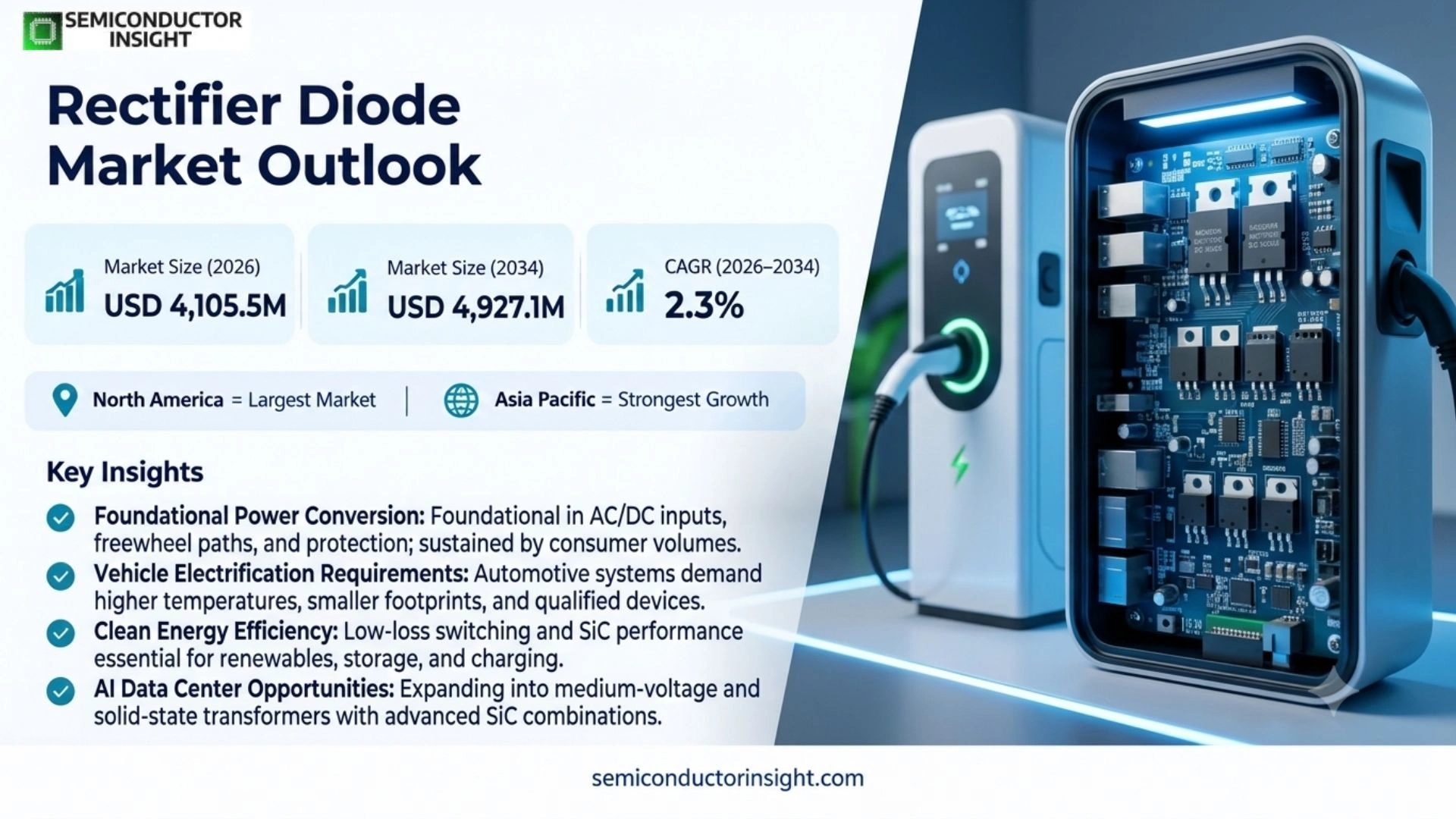
- SBR Rectifiers are the leading product segment with about 30% share in the report scope, supported by efficient high-frequency power conversion.
- Consumer Electric is the largest application because phones, computers, entertainment systems and power adapters use rectification across large unit volumes.
- Greater China is the largest reported market with more than 35% share, reflecting dense electronics production and a large domestic rectifier supply base.
- Schottky packaging is shrinking. Nexperia is moving automotive and industrial diodes into compact CFP2-HP packages with exposed heatsinks for better thermal performance.
- Trench Schottky improves efficiency. Vishay and ST continue developing low-forward-drop trench structures that reduce conduction loss in higher-frequency converters.
- SiC rectifiers extend the market upward in voltage, enabling high-frequency PFC, charging, industrial power and AI data-center power systems with lower reverse-recovery losses.
Rectifier Diode Market Overview
Rectifier Diode Market was valued at USD 4,013.0 million in 2025, is estimated at USD 4,105.5 million in 2026, and is projected to reach USD 4,927.1 million by 2034, representing a CAGR of 2.3% during 2026–2034. Greater China is the largest market in 2025, while the commercial growth mechanism is increasingly shaped by consumer power supplies, automotive electrification, industrial drives, renewable-energy converters, telecom power, compact flat-power packaging, trench Schottky structures, and SiC rectifiers.
Rectifier diodes conduct current primarily in one direction and are used to convert alternating current to direct current, freewheel inductive loads, block reverse current and protect power paths. The market spans general-purpose PN rectifiers, fast and ultrafast recovery devices, Schottky diodes, trench Schottky variants, super-barrier rectifiers and silicon-carbide Schottky products.
The market is mature in unit terms but continues to gain value through efficiency, packaging and application specialization. Consumer power supplies favor low forward voltage and compact SMD packages, vehicles need AEC-Q101 qualification and high-temperature reliability, while industrial and renewable-energy systems require higher current, surge capability and improved thermal performance.
Wide-bandgap power conversion is changing the role of the rectifier rather than eliminating it. Higher switching frequencies increase the value of low charge, low recovery loss and low forward voltage. SiC Schottky diodes are therefore expanding in PFC, charging and industrial power, while optimized silicon trench Schottky remains highly competitive at lower voltages.
Segment Analysis: By Type
By type, the market includes SBR Rectifiers, SBRT Rectifiers, FERD Rectifiers, Regular Schottky, Trench Schottky, Fast Recovery Rectifiers, General Rectifier Diode, and Others. SBR Rectifiers lead with about 30% share in the report scope.
| Type | Technical role | Market position |
|---|---|---|
| SBR Rectifiers | Super-barrier rectifier architectures target low forward voltage, low leakage and fast switching while retaining silicon manufacturing economics. | The leading type at about 30% share in the report scope, used broadly in efficient power-conversion circuits. |
| SBRT Rectifiers | Trench-enhanced super-barrier structures further optimize conduction and switching behavior. | A differentiated efficiency segment for compact power supplies and higher-frequency applications. |
| FERD Rectifiers | Field-effect rectifier diodes reduce switching loss and target efficient high-frequency conversion. | A specialized segment where low recovery charge and thermal performance justify higher device value. |
| Regular Schottky | Metal-semiconductor junction devices provide low forward voltage and fast switching, especially at low to medium voltage. | A large mature segment in consumer, telecom and automotive low-voltage power supplies. |
| Trench Schottky | Trench structures reshape the electric field to improve the trade-off between forward drop, leakage and reverse voltage. | A key innovation area. New 100 V and compact automotive products improve power density and efficiency. |
| Fast Recovery Rectifiers | PN-based diodes are optimized for reduced reverse-recovery time in switching converters and motor drives. | Important at voltages and temperatures where conventional Schottky performance is less attractive. |
| General Rectifier Diode | Standard silicon rectifiers provide low-cost AC/DC conversion in line-frequency and lower-switching-speed systems. | A high-volume mature category with strong price competition. |
| Others | Includes SiC Schottky, bridge modules and specialized high-voltage or high-current rectifier devices. | A high-value growth pool tied to EV charging, renewable energy, industrial power and AI power infrastructure. |
Why are trench Schottky and SiC devices gaining importance?
Conventional rectifiers lose energy through forward voltage and reverse recovery. Trench Schottky devices improve the silicon trade-off and can fit into smaller packages, while SiC Schottky diodes virtually eliminate reverse-recovery tail current at much higher voltages. Vishay’s 2026 100 V TMBS modules and Microchip’s 3.3 kV SiC modules show how rectifier innovation now spans both compact low-voltage conversion and very high-voltage data-center or industrial systems.
Segment Analysis: By Application
By application, the market covers Automotive Electric, Consumer Electric, Household Appliances, Industrial, and Others. Consumer Electric is the largest application in the report scope, while automotive and industrial systems are important value-growth segments.
| Application | Demand characteristics | Market position |
|---|---|---|
| Consumer Electric | Chargers, notebook adapters, televisions, set-top boxes, gaming systems and other electronics use rectifiers in AC/DC input stages, DC/DC converters and protection. | The largest application due to huge unit volumes and continued demand for smaller, more efficient power supplies. |
| Automotive Electric | Vehicles use rectifiers in DC/DC converters, LED lighting, reverse-polarity protection, onboard electronics and electrified power systems. | A high-value growth segment because AEC-Q101 qualification, thermal performance and smaller packages support premium pricing. |
| Household Appliances | White goods and smart appliances use bridge, Schottky and recovery rectifiers in auxiliary power, motor control and interface circuits. | A stable volume segment tied to appliance production and tighter standby-efficiency requirements. |
| Industrial | Motor drives, UPS, robotics, power supplies, welding, charging and renewable-energy converters require rugged rectification. | A premium segment where current, voltage, thermal design and surge capability drive device selection. |
| Others | Includes telecom, aerospace, medical and specialized power systems. | A diversified niche where reliability and electrical performance matter more than lowest unit cost. |
Why is automotive packaging becoming a competitive differentiator?
Automotive electronics increasingly places power functions in crowded ECUs exposed to high ambient temperature and vibration. Nexperia’s CFP2-HP portfolio uses a copper-clip structure and exposed heatsink to improve heat dissipation in a smaller footprint, while maintaining AEC-Q101 variants. This allows designers to replace larger SMA/B/C packages and reduce board area without sacrificing thermal performance or change-control discipline.
Regional Analysis
Greater China is the largest reported Rectifier Diode market with more than 35% share. In the five-region view, Asia Pacific leads through China, Japan, Taiwan and South Korea, followed by the United States and Europe as major automotive and industrial power markets.
Why is Greater China central to rectifier-diode volume?
China combines consumer-electronics assembly, appliance manufacturing, telecom equipment, renewable-energy systems and EV production with a large domestic diode supplier base. North America and Europe have smaller unit volumes but a richer mix of industrial, automotive and high-voltage products. Japan and Taiwan remain important through specialist suppliers and electronics manufacturing.
| Region | Position | Growth outlook | Demand profile | What decides supplier selection |
|---|---|---|---|---|
| Asia Pacific | Largest regional ecosystem | Steady to strong | Consumer, automotive, appliances and industrial | Cost, package density, supply and qualification |
| North America | High-value power market | Moderate | Industrial, AI power, automotive and telecom | Efficiency, current rating andreliability |
| Europe | Automotive & industrial specialist | Moderate | EV, industrial drives and energy systems | AEC-Q101, efficiency and thermal performance |
| South America | Import-dependent market | Selective | Appliances, automotive and industrial | Price, availability and distributor support |
| Middle East & Africa | Infrastructure-led market | Selective | Telecom, renewables and industrial power | Ruggedness, supply and service |
Competitive Landscape
Key companies include Toshiba, ROHM, Vishay, PANJIT, STMicroelectronics, NXP, Renesas, onsemi, Good-Ark, Sanken, Diodes Incorporated, Infineon, Yangjie, Bourns, Panasonic, Kexin and Microchip Technology.
Toshiba, ROHM and Vishay have broad rectifier portfolios spanning general-purpose, Schottky and fast-recovery devices. Vishay differentiates through high-current modules and trench Schottky technology, while ROHM emphasizes compact automotive-qualified products.
STMicroelectronics, Infineon and onsemi participate strongly in automotive and industrial power, including high-voltage and wide-bandgap products. Nexperia, although outside the listed source-company set, is an important technology reference for clip-bonded compact Schottky packaging.
PANJIT, Yangjie, Good-Ark and other Asian manufacturers compete aggressively in high-volume silicon rectifiers. Supplier advantage depends on wafer scale, package automation, AEC-Q101 qualification, distribution reach and the ability to move into higher-value trench or SiC products.
| Competitive tier | Representative companies | Commercial basis |
|---|---|---|
| Global diversified leaders | Toshiba; ROHM; Vishay; STMicroelectronics; Infineon; onsemi | Broad voltage/current portfolios, automotive qualification and advanced Schottky/recovery technology. |
| High-volume Asian suppliers | PANJIT; Yangjie; Good-Ark; Sanken; Panasonic | Large-scale silicon rectifier manufacturing, regional electronics relationships and cost competitiveness. |
| Specialist / broad-line suppliers | Diodes Incorporated; Bourns; Microchip Technology; NXP; Renesas | Compact packages, circuit-protection adjacency, SiC and application-specific power solutions. |
Key Market Participants
Toshiba Electronic Devices & Storage, ROHM Semiconductor, Vishay Intertechnology, PANJIT International, STMicroelectronics, NXP Semiconductors, Renesas Electronics, onsemi, Good-Ark Electronics, Sanken Electric, Diodes Incorporated, Infineon Technologies, Yangzhou Yangjie Electronic Technology, Bourns, Panasonic Industry, Microchip Technology.
Production Capacity Analysis
Rectifier-diode capacity spans silicon and SiC wafer fabrication, junction formation, metallization, wafer thinning, dicing, clip or wire bonding, molding and electrical test. Commodity devices are produced in very high volume, while automotive and high-voltage SiC products require tighter process control and qualification.
Silicon PN and Schottky rectifiers can be manufactured on mature wafer processes with high yields. Device design balances forward voltage, leakage, reverse voltage and recovery behavior, and trench structures add more process complexity to improve that trade-off.
Packaging has become an important source of performance. Copper clips and exposed thermal pads lower package resistance and improve heat flow, enabling smaller footprints and higher current density.
SiC Schottky rectifiers require high-quality wide-bandgap wafers and specialized processing but provide low reverse-recovery loss at high voltage and temperature. These devices command higher value in PFC, chargers, inverters and industrial power.
| Capacity layer | Where it concentrates | Commercial constraint |
|---|---|---|
| Silicon / SiC wafer fabrication | Asia, Europe and North America | Epitaxy, junction quality, trench control, wafer cost and yield. |
| Metallization & thinning | Integrated semiconductor fabs | Forward resistance, thermal performance and die robustness. |
| Packaging | China, Southeast Asia, Europe and global backend hubs | Clip bonding, package thermal resistance, current density and footprint. |
| Qualification & test | Global device suppliers | AEC-Q101, surge, leakage, reverse voltage and temperature screening. |
Market Dynamics
Rectifier-diode growth is steady rather than explosive, but product value is shifting toward more efficient trench, compact automotive and SiC technologies. Mature silicon price pressure remains strong, while electrification and power density create premium opportunities.
Market Drivers
| Factor | Directional impact | Why it matters |
|---|---|---|
| Consumer power conversion | High volume | Chargers, adapters and electronics require efficient compact rectification. |
| Automotive electronics | High | More DC/DC, lighting, protection and electrified systems raise qualified diode content. |
| Industrial & renewable energy | Medium-High | Drives, UPS, solar and charging require higher-current and high-voltage rectifiers. |
| AI data-center power | Emerging high value | Higher facility power creates demand for efficient medium- and high-voltage conversion. |
Every electronic system needs power conversion
Rectifier diodes remain foundational in AC/DC inputs, freewheel paths and protection even as converter architectures evolve. Large consumer volumes sustain the base market.
Vehicle electrification raises semiconductor quality requirements
Automotive systems need higher temperature, smaller footprints and strict change control. Qualified Schottky and recovery devices can capture more value than commodity rectifiers.
Renewables favor low-loss switching
Solar, storage and charging systems increasingly operate at higher switching frequency to reduce magnetic size. Low recovery charge and SiC performance improve converter efficiency.
AI data centers create new high-voltage opportunities
Medium-voltage distribution and solid-state transformer concepts use SiC MOSFET and Schottky combinations. This expands rectifier opportunity beyond traditional low-voltage power supplies.
Market Restraints
| Factor | Directional impact | Why it matters |
|---|---|---|
| Mature product price pressure | High | Commodity rectifiers are highly standardized and face intense competition. |
| MOSFET synchronous rectification substitution | Medium-High | Low-voltage systems can replace diodes with controlled MOSFETs to reduce conduction loss. |
| Thermal constraints | Medium-High | Higher current in smaller packages increases junction-temperature risk. |
| Material / wafer cost | Medium | SiC and high-performance structures cost more than conventional silicon. |
Standard rectifiers have limited differentiation
General-purpose diodes can be sourced from many suppliers, which keeps ASPs low and rewards manufacturing scale more than brand.
Synchronous rectification removes some low-voltage diode sockets
MOSFETs controlled on the secondary side can reduce losses compared with a diode in high-current low-voltage supplies. Rectifier suppliers must target applications where simplicity, cost or reverse blocking still favor diodes.
Compact packages need better heat removal
Shrinking the PCB footprint without lowering current raises thermal density. Copper clips, exposed pads and lower forward voltage are increasingly required to keep junction temperature within limits.
Wide-bandgap cost delays mass adoption
SiC delivers superior high-voltage switching behavior but remains more expensive than mature silicon. Adoption is strongest where system efficiency and thermal savings justify the premium.
Market Opportunities
Compact automotive Schottky
CFP and similar packages can replace larger SMA/B/C footprints while improving thermal density.
100–200 V trench Schottky
Higher-voltage trench structures can reduce loss in telecom, server and 48 V automotive converters.
SiC rectifiers for AI / charging
650 V to multi-kV Schottky diodes support PFC, solid-state transformers, EV charging and industrial power.
Integrated rectifier modules
Bridge and dual-diode modules reduce assembly complexity in high-current industrial systems.
Supply Chain Analysis
Wafer Materials & Epitaxy. Commodity silicon supply is mature and diversified, while SiC wafers and epitaxy remain more specialized and expensive. Material quality directly affects breakdown and leakage.
Device Fabrication. Trench geometry and barrier engineering tune the trade-off between forward voltage and reverse leakage. Fast-recovery PN products require lifetime and junction engineering to reduce stored charge.
Packaging. Package resistance and heat flow can dominate system performance at high current. Copper-clip and exposed-pad architectures are therefore strategic even when the diode die itself changes only incrementally.
OEM Integration. Diodes are qualified into power-supply reference designs and automotive ECUs. Broad distribution and long product availability matter because a small discrete shortage can stop a much more valuable final product.
Recent Developments in the Rectifier Diode Market
Developments tracked to September 2026. Entries are dated to the official publication date where available.
-
26 May 2026 SiC powerMicrochip launched 3.3 kV mSiC power modules integrating SiC MOSFETs and Schottky diodes for solid-state transformers. The devices target high-voltage power delivery for AI data centers and industrial systems.
-
21 January 2026 ProductVishay introduced 100 V Gen 2 TMBS rectifier modules in SOT-227 packages. The devices provide forward voltage down to 0.83 V and current ratings up to 400 A for industrial power conversion.
-
2026 AutomotiveROHM lists new compact automotive Schottky rectifiers in SOD-323HE packaging. The RBR1VYM family combines low forward voltage, 30–60 V ratings and AEC-Q101 qualification.
-
29 April 2025 PackagingNexperia launched 16 low-VF planar Schottky diodes in CFP2-HP packaging, including automotive-qualified variants. The exposed heatsink improves thermal dissipation while reducing board footprint.
-
2025 Wide bandgapVishay expanded 650 V and 1200 V SiC Schottky rectifier modules for high-frequency industrial, photovoltaic, charging and telecom power applications.
Report Scope & Segmentation
| Attribute | Coverage |
|---|---|
| Report title | Rectifier Diode Market, Global Business Strategies 2026-2033 |
| Base Year | 2025 |
| Estimated Year | 2026 |
| Forecast Period | 2026–2034 |
| By Type | SBR Rectifiers; SBRT Rectifiers; FERD Rectifiers; Regular Schottky; Trench Schottky; Fast Recovery Rectifiers; General Rectifier Diode; Others |
| By Application | Automotive Electric; Consumer Electric; Household Appliances; Industrial; Others |
| By End User | OEMs; Aftermarket; System Integrators |
| Regions | North America; Europe; Asia Pacific; South America; Middle East & Africa |
| Companies | Toshiba Electronic Devices & Storage; ROHM Semiconductor; Vishay Intertechnology; PANJIT International; STMicroelectronics; NXP Semiconductors; Renesas Electronics; onsemi; Good-Ark Electronics; Sanken Electric; Diodes Incorporated; Infineon Technologies; Yangzhou Yangjie Electronic Technology; Bourns; Panasonic Industry; Microchip Technology |
| Customization scope | Country, segment, company, application, technology, production and competitive-detail customization available within the study scope. |
Frequently Asked Questions
What is the size of the Rectifier Diode market?
The global Rectifier Diode market is valued at USD 4,013.0 million in 2025, is estimated at USD 4,105.5 million in 2026, and is projected to reach USD 4,927.1 million by 2034, representing a 2.3% CAGR during 2026–2034. The standardized 2025–2034 series is used consistently across the overview so market size, forecast outlook and growth rate remain on one time basis. Commercial demand is shaped by consumer power supplies, automotive electrification, industrial drives, renewable-energy converters, telecom power, compact flat-power packaging, trench Schottky structures, and SiC rectifiers.
Which market leads Rectifier Diode demand?
Greater China is the largest reported market with more than 35% share, supported by consumer electronics, appliances, EVs and a large domestic semiconductor supply base. Regional leadership reflects installed production or consumption, customer concentration, supplier ecosystems and end-market intensity. Country discussion focuses on markets with clear operating drivers rather than forcing unsupported country shares. Supplier selection in these markets therefore reflects local service, qualification history and supply assurance as well as headline component performance.
Which rectifier type leads?
SBR Rectifiers lead with about 30% share in the report scope, followed by other Schottky, recovery and general rectifier technologies. Segment leadership matters because suppliers allocate R&D, capacity and channel resources toward the product classes with the strongest combination of volume, qualification value and system relevance. Over the forecast period, the mix can still shift toward higher-value variants as technical requirements rise. This remains commercially relevant because design-in decisions can persist for several product generations once performance and reliability are validated.
Which application is largest?
Consumer Electric is the largest application because phones, computers, entertainment devices and power adapters use high volumes of rectification components. Application demand also depends on design cycles, qualification requirements, replacement timing and end-user investment, so suppliers that solve a measurable performance, efficiency or reliability problem are better positioned to defend design wins. Long design cycles can make successful application wins durable and commercially attractive for qualified suppliers.
Why are trench Schottky diodes important?
Trench structures improve the trade-off among forward voltage, leakage and reverse voltage, reducing power loss in compact high-frequency converters. The commercial importance of this technology comes from improving system performance or simplifying implementation while balancing cost, efficiency, reliability, integration and qualification requirements. That system-level value is the main reason the technology can command a premium over simpler alternatives in demanding use cases. In the Rectifier Diode market, buyers therefore evaluate lifecycle support, technical fit and supply continuity alongside the headline specification.
Why are SiC rectifiers growing?
SiC Schottky diodes provide very low reverse-recovery loss at high voltage and temperature, improving PFC, charging, industrial and renewable-energy systems. This trend affects both component selection and the surrounding system architecture, so buyers increasingly evaluate the complete power, thermal, signal or manufacturing outcome rather than one headline specification. Vendors that support application design and validation can turn this technical shift into longer customer relationships. This remains commercially relevant because design-in decisions can persist for several product generations once performance and reliability are validated.
What are the main restraints?
Commodity price pressure, synchronous MOSFET substitution in low-voltage systems, thermal constraints and higher wide-bandgap material cost are the main restraints. These constraints influence where adoption is fastest and which suppliers can earn premium margins. Proven reliability, application engineering, supply continuity and qualification support can reduce several of these barriers. These barriers can also protect established suppliers once their devices or systems are approved in production programs.
Who are the major Rectifier Diode companies?
Major companies include Toshiba, ROHM, Vishay, PANJIT, STMicroelectronics, NXP, Renesas, onsemi, Good-Ark, Sanken, Diodes, Infineon, Yangjie, Bourns and Microchip. Competitive position depends on breadth of qualified products, manufacturing scale, customer support, process technology and participation in higher-value applications rather than market presence alone. This is why product breadth and engineering support remain meaningful competitive differentiators throughout the forecast period. In the Rectifier Diode market, buyers therefore evaluate lifecycle support, technical fit and supply continuity alongside the headline specification.
How is packaging changing?
Copper-clip and exposed-thermal-pad packages allow smaller board footprints with better heat flow, making packaging a direct performance factor in automotive and industrial rectifiers. The shift is important because packaging, integration or control architecture can improve usable system performance without requiring a complete change in the end application, leaving room for differentiated products even in mature markets. Suppliers that combine device performance with manufacturability and qualification support are best placed to monetize the shift.
Where are the strongest opportunities?
The strongest opportunities are in compact automotive Schottky, higher-voltage trench Schottky, SiC rectifiers and integrated high-current rectifier modules. Opportunity is strongest where a clear system bottleneck is emerging and suppliers can solve it with better performance, integration, capacity or lifecycle support. The most attractive niches also tend to have higher qualification barriers. That combination of structural demand and qualification barriers supports the most defensible growth opportunities.
Research Sources & Evidence Base
Get Sample Report PDF for Exclusive Insights
Report Sample Includes
- Table of Contents
- List of Tables & Figures
- Charts, Research Methodology, and more...
 Download Sample Report PDF