Post CMP Brushes Market Insights
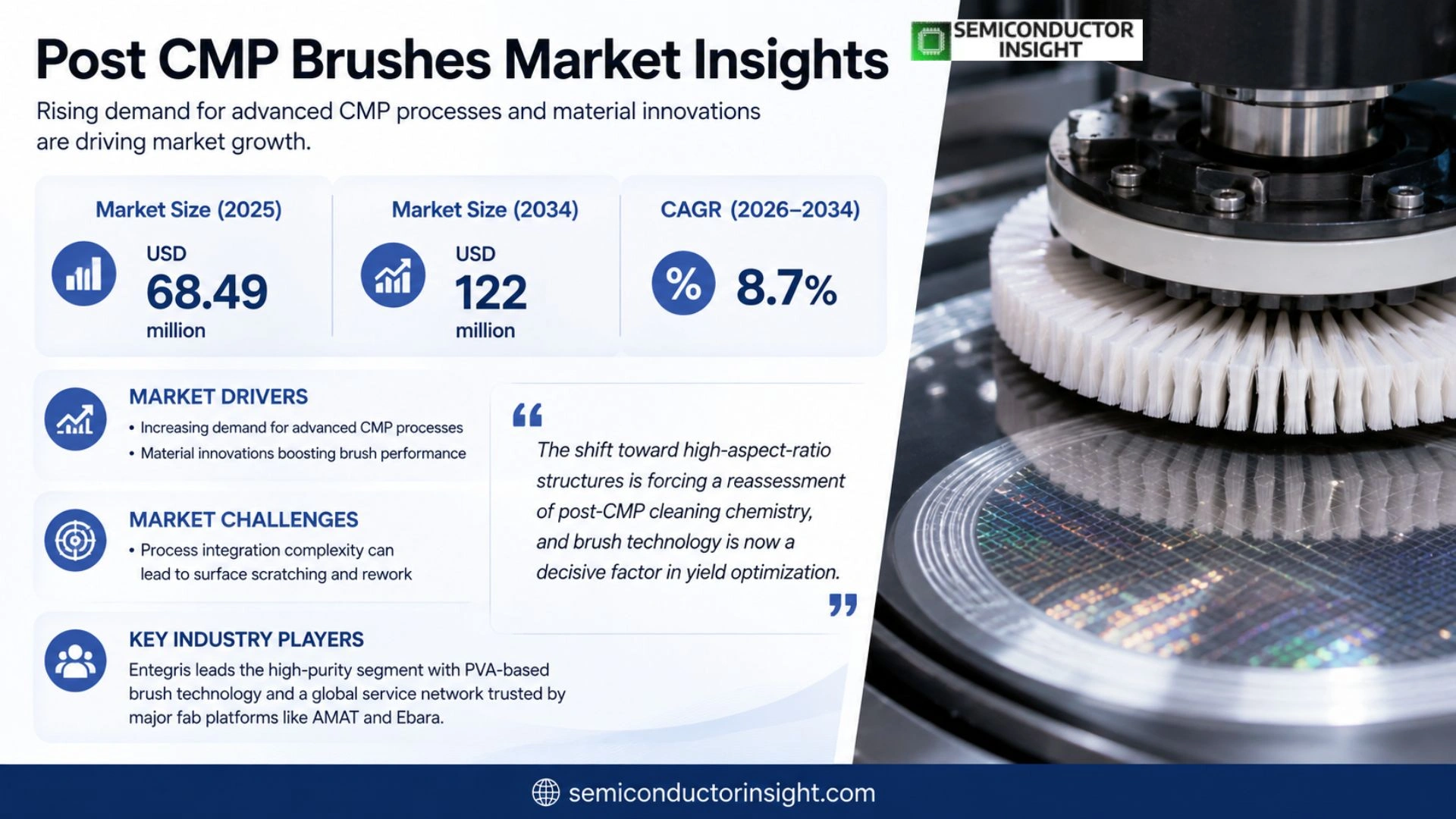
Post CMP Brushes market was valued at USD 68.49 million in 2025 and is projected to reach USD 122 million by 2034, at a CAGR of 8.7% during the forecast period.
Post CMP brushes are precision consumables employed after wafer chemical‑mechanical polishing to eliminate slurry residue, particles, metal ions and other defect sources without introducing scratches. Built on high‑purity porous PVA or PVA sponge structures, they feature integrated cores, controlled porosity and low ionic extractables to ensure consistent wafer‑to‑wafer uniformity and minimal particle release.
The competitive landscape centers on cleanliness performance, service life, break‑in time and tool compatibility, with leading suppliers such as Entegris, Rippey, Purience and AION offering variants that also target water savings and reduced dummy‑wafer consumption.
MARKET DRIVERS
Increasing Demand for Advanced CMP Processes
Post CMP Brushes Market is gaining traction as manufacturers seek tighter control over post‑polishing defect densities. Contemporary wafer‑level cleaning requires brushes that can operate at lower pH levels while maintaining abrasive effectiveness, prompting equipment suppliers to upgrade brush designs.
Material Innovations Boosting Performance
Advances in polymer composites and nano‑reinforced fibers have extended brush life and reduced particle contamination. These material gains allow fabs to extend change‑over intervals, translating into measurable throughput improvements.
➤ “The shift toward high‑aspect‑ratio structures is forcing a reassessment of post‑CMP cleaning chemistry, and brush technology is now a decisive factor in yield optimization.”
In parallel, the convergence of metrology and cleaning tools creates a feedback loop where real‑time surface analysis informs brush selection, sharpening the competitive edge of firms that integrate these capabilities.
MARKET CHALLENGES
Process Integration Complexity
Embedding post‑CMP brushing steps into tightly sequenced fab lines requires precise timing and compatible slurry chemistries. Misalignment can cause surface scratching, leading to rework that erodes cost advantage.
Other Challenges
Cost Sensitivity
Although brush longevity has improved, the upfront investment for high‑performance brush kits remains a hurdle for smaller fabs that operate on thin margins.
MARKET RESTRAINTS
Stringent Environmental Regulations
Regulatory bodies in major semiconductor hubs are tightening limits on disposable brush residues and associated wastewater. Compliance demands additional filtration steps, raising operational overhead for brush manufacturers.
Furthermore, certification processes for new brush materials can extend time‑to‑market, discouraging rapid innovation cycles in a sector that values speed.
These compliance pressures also push suppliers to document the full lifecycle of brush products, from raw material sourcing to end‑of‑life disposal, adding layers of administrative cost.
MARKET OPPORTUNITIES
Emerging 5G and AI Semiconductor Nodes
The rollout of 5G infrastructure and AI‑focused processors is accelerating the adoption of ultra‑fine patterning, which in turn steepens the need for immaculate post‑CMP surfaces. Brush manufacturers that tailor their products to these nodes can capture premium pricing.
Another opening lies in the development of reusable brush systems that integrate in‑situ cleaning cycles. Such ecosystems promise to lower consumable spend while aligning with sustainability mandates.
Finally, strategic partnerships between brush suppliers and equipment OEMs enable co‑development of integrated cleaning modules, positioning participants to dictate standards for the next generation of semiconductor manufacturing.
Post CMP Brushes Market Trends
Elevated Cleanliness Requirements Shape Consumable Innovation
Post CMP Brushes Market is increasingly defined by the tightening of defect tolerances at advanced logic and VNAND nodes. As wafers become thinner and circuit density climbs, even minute particle release from a cleaning roll can erode yield and drive costly re‑work. Suppliers therefore concentrate on porous PVA matrices that limit ionic leaching, stabilize pore geometry, and preserve chemical integrity throughout the tool life. This technical focus translates into a measurable uplift in wafer‑to‑wafer uniformity, shorter flush‑up periods, and higher overall equipment utilization. Buyers reward vendors that can demonstrate lower particle footprints and consistent break‑in performance, because such attributes directly protect throughput in high‑volume fabs.
Other Trends
Regional Supply‑Chain Dynamics
North‑American and Japanese players retain an edge in high‑purity material processing and long‑term validation cycles, leveraging decades of OEM collaboration to guarantee low‑ionic contamination. In contrast, South Korean, Chinese, and Taiwanese firms are accelerating market penetration by localizing production, tailoring brush dimensions to region‑specific tool fleets, and offering rapid field service. This bifurcation produces a two‑tier ecosystem: established global brands dominate qualification‑heavy projects, while regional manufacturers capture cost‑sensitive volume orders through agile customization. The strategic implication for fab procurement is a shift toward diversified sourcing,balancing the assurance of legacy suppliers with the flexibility of local partners to mitigate supply‑risk while maintaining cleanliness standards.
Emerging Sustainability Considerations
Beyond yield and cost, Post CMP Brushes Market is beginning to integrate environmental metrics into its value proposition. Several vendors now advertise water‑reduction technologies embedded in foam structures, a lower dummy‑wafer consumption profile, and reduced carbon emissions during brush disposal. These ESG‑aligned features resonate with manufacturers who are subject to increasingly stringent regulatory frameworks and corporate sustainability targets. When a brush can simultaneously curb defectivity, extend service intervals, and lower the fab’s water footprint, it becomes a lever for both operational efficiency and green‑manufacturing objectives. Suppliers that embed such triple‑benefit designs into their roadmaps are poised to capture incremental share as fabs prioritize holistic process optimization.
COMPETITIVE LANDSCAPE
Key Industry Players
Post CMP Brushes: Competitive Dynamics and Supplier Positioning
Entegris dominates the high‑purity segment, leveraging its extensive legacy in PVA‑based core construction and a global service network that satisfies the validation rigor of leading fab platforms such as AMAT and Ebara. AION complements this space with over six decades of material science expertise, delivering air‑foamed integrated structures that meet ultra‑low ionic contamination thresholds demanded by advanced logic nodes. Coastal PVA, based in the United States, differentiates through bonded‑on‑core custom manufacturing, offering rapid design iterations that align with early‑stage tool qualification cycles. Collectively, these firms form a tier of internationally recognised suppliers whose competitive edge derives from proven defect‑control metrics, long‑term wafer‑to‑wafer uniformity records, and the ability to guarantee uninterrupted consumable supply across eight‑ and twelve‑inch tool families.
Beyond the flagship tier, a cluster of regional specialists is expanding market breadth. BrushTek and Purience, both headquartered in South Korea, focus on cost‑effective air‑foamed and molded‑through‑core designs that cater to domestic fabs seeking localized logistics and rapid technical support. GMC Semitech in Taiwan emphasizes water‑saving chemistries and lower dummy‑wafer consumption, aligning with sustainability targets in mature‑node fabs. Benq Materials (Cenefom) brings a one‑piece construction that eases tool changeover, while AKT Components from Malaysia offers a niche portfolio for display‑glass and photomask cleaning applications. These players intensify competition on price, customization speed, and ESG‑related value propositions, gradually eroding the sole reliance on the traditional high‑purity incumbents.
List of Key Post CMP Brushes Companies Profiled
- Entegris, Inc.
- Entegris, Inc.
- AION Co., Ltd.
- AION Co., Ltd.
- Coastal PVA
- Coastal PVA
- BrushTek Co., Ltd.
- BrushTek Co., Ltd.
- Purience Co., Ltd.
- Purience Co., Ltd.
- GMC Semitech Co., Ltd.
- GMC Semitech Co., Ltd.
- BenQ Materials Corporation
- AKT Components Sdn. Bhd.
- Cenefom (BenQ Materials)
Segment Analysis:
| Segment Category | Sub-Segments | Key Insights |
| By Type |
|
Roller Type
|
| By Application |
|
Post‑CMP Wafer Cleaning
|
| By End User |
|
Logic Semiconductor Fabs
|
| By Technology |
|
Air‑Foamed Integrated Structure
|
| By Value Proposition |
|
Yield Enhancement
|
Regional Analysis: Post CMP Brushes Market
North America
Fab engineers are integrating brushes with nano‑engineered fibers that align with high‑frequency polishing cycles, a shift that trims cycle time and curtails tool wear. Early adopters report smoother post‑CMP surfaces, translating into fewer downstream rework steps.
Environmental guidelines surrounding brush material disposal have tightened, prompting manufacturers to develop recyclable polymer matrices. Compliance initiatives are becoming a differentiator in supplier selection processes.
Recent semiconductor fab expansions have exposed bottlenecks in raw‑material sourcing. Vendors are diversifying feedstock origins and establishing buffer inventories to safeguard against shipment disruptions.
Fab managers increasingly favor brushes that offer predictable wear curves, enabling more accurate process planning. This preference drives a market tilt toward standardized product families with detailed performance logs.
Europe
European fabs maintain a strong focus on precision, especially in the development of advanced logic nodes. The region’s network of consortia links equipment makers with research labs, creating a pipeline for brushes optimized for low‑particle contamination. Sustainability regulations are particularly stringent, compelling brush suppliers to adopt closed‑loop manufacturing practices. As a result, European customers prioritize solutions that balance performance with eco‑friendly attributes, influencing procurement strategies across the continent.
Asia‑Pacific
Asia‑Pacific hosts the highest concentration of wafer fabrication capacity, driving a relentless demand for post‑CMP brushes that can sustain high‑volume production. Local manufacturers are scaling up their own brush lines to reduce import reliance, fostering a competitive environment where cost efficiency merges with incremental performance gains. Moreover, the rapid rollout of 5G‑related semiconductor lines intensifies the need for brushes capable of handling novel material stacks, prompting vendors to fine‑tune abrasive formulations for these applications.
South America
While still emerging in semiconductor manufacturing, South America’s investment in niche specialty nodes is creating a modest but growing market for post‑CMP brushes. Companies entering the region are leveraging partnerships with North American OEMs to import proven brush technologies, yet they adapt specifications to local process conditions such as ambient humidity. This adaptive approach helps local fabs achieve yield stability without the capital outlay associated with fully custom brush development.
Middle East & Africa
The Middle East & Africa region shows limited but strategic participation in the post‑CMP brush market, largely driven by government‑backed semiconductor initiatives. Early‑stage fabs are trialing brush solutions that emphasize low‑maintenance characteristics, aligning with broader objectives to establish self‑sufficient production ecosystems. As these projects mature, the region is poised to attract niche suppliers offering modular brush designs that can be quickly integrated into evolving line‑ups.
Report Scope
This market research report provides a comprehensive analysis of the Post CMP Brushes Market , covering the forecast period 2026–2034. It offers detailed insights into market dynamics, technological advancements, competitive landscape, and key trends shaping the industry.
Key focus areas of the report include:
- Market Overview: The report begins with an overview outlining its current market scenario, key growth indicators, and industry transformation drivers. It discusses macroeconomic factors, demand–supply balance, regulatory landscape, and the strategic role of semiconductors in powering advancements across industries such as automotive, telecommunications, consumer electronics, and industrial automation.
- Market Size & Forecast: Historical data and future projections for revenue, unit shipments, and market value across major regions and segments.
- Segmentation Analysis: Detailed breakdown by product type, technology, application, and end-user industry to identify high-growth segments and investment opportunities.
- Regional Insights: Insights into market performance across North America, Europe, Asia-Pacific, Latin America, and the Middle East & Africa, including country-level analysis where relevant.
- Competitive Landscape: Profiles of leading market participants, including their product offerings, R&D focus, manufacturing capacity, pricing strategies, and recent developments such as mergers, acquisitions, and partnerships.
- Technology Trends & Innovation: Assessment of emerging technologies, integration of AI/IoT, semiconductor design trends, fabrication techniques, and evolving industry standards.
- Market Drivers & Restraints: Evaluation of factors driving market growth along with challenges, supply chain constraints, regulatory issues, and market-entry barriers.
- Stakeholder Insights: Insights for component suppliers, OEMs, system integrators, investors, and policymakers regarding the evolving ecosystem and strategic opportunities.
Primary and secondary research methods are employed, including interviews with industry experts, data from verified sources, and real-time market intelligence to ensure the accuracy and reliability of the insights presented.
FREQUENTLY ASKED QUESTIONS:
What is the current market size of Post CMP Brushes Market?
-> Post CMP Brushes market was valued at USD 68.49 million in 2025 and is projected to reach USD 122 million by 2034, at a CAGR of 8.7%
Which key companies operate in Post CMP Brushes Market?
-> Key players include Entegris, Inc., Coastal PVA, AION Co., Ltd., Illinois Tool Works Inc., BrushTek Co., Ltd., Purience Co., Ltd., AKT Components Sdn. Bhd., GMC Semitech Co., Ltd., BenQ Materials Corporation.
What are the key growth drivers?
-> Key growth drivers include rising front‑end fab equipment investments, AI‑driven demand for logic, memory and VNAND devices, policy support such as CHIPS for America and the European Chips Act, and sustainability initiatives like water‑saving and reduced dummy wafer consumption.
Which region dominates the market?
-> Asia is the dominant region, driven by strong demand in China, South Korea, Taiwan and Japan, while North America and Europe also exhibit significant growth.
What are the emerging trends?
-> Emerging trends include integration of water‑saving technologies, reduction of dummy wafer usage, ESG‑focused product designs, and the positioning of post‑CMP brushes as yield‑enhancement and cost‑reduction tools.

Get Sample Report PDF for Exclusive Insights
Report Sample Includes
- Table of Contents
- List of Tables & Figures
- Charts, Research Methodology, and more...
 Download Sample Report PDF