Pellicle (EUV, DUV) Membrane Material Market Insights
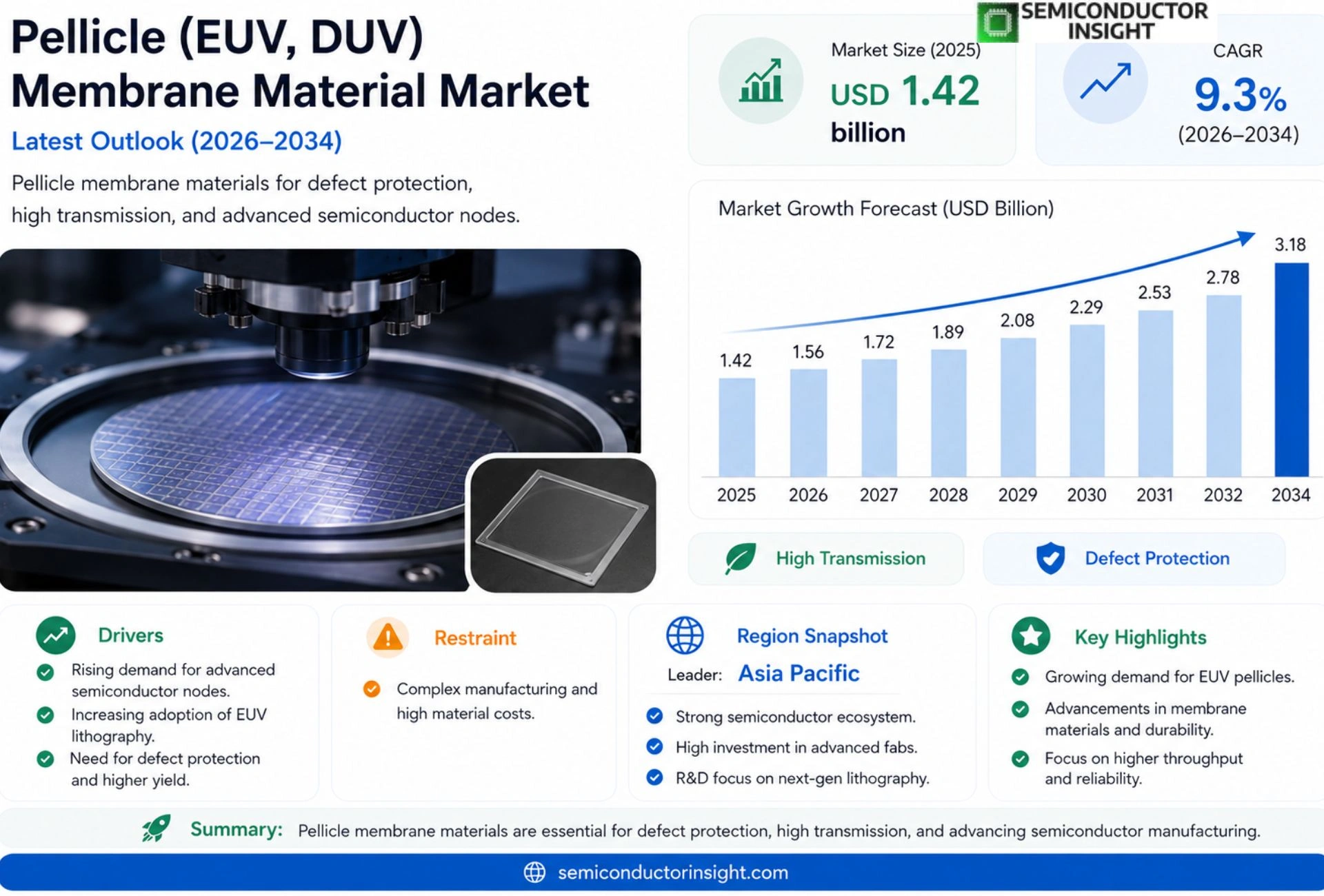
Global Pellicle (EUV, DUV) Membrane Material Market size was valued at USD 1.42 billion in 2025. The market is projected to grow from USD 1.56 billion in 2026 to USD 3.18 billion by 2034, exhibiting a CAGR of 9.3% during the forecast period.
Pellicle membrane materials are ultra-thin protective films essential for safeguarding photomask surfaces from particle contamination during semiconductor lithography processes. These membranes are specifically engineered for Extreme Ultraviolet (EUV) and Deep Ultraviolet (DUV) applications, comprising advanced materials such as polysilicon, silicon nitride, carbon nanotubes, and fluoropolymer composites that must withstand high-energy radiation while maintaining exceptional optical transparency and mechanical stability.
The market is experiencing robust expansion driven by accelerating semiconductor node shrinkage and the rapid adoption of EUV lithography at the 3nm and below process nodes. While DUV pellicles continue to serve mature node production, EUV pellicles represent the fastest-growing segment because foundries like TSMC and Samsung are ramping up EUV-equipped fab capacity to meet surging demand for advanced AI chips and high-performance computing processors. Furthermore, the increasing complexity of multi-patterning techniques and the transition to High-NA EUV systems are intensifying requirements for next-generation pellicle solutions with enhanced thermal durability and lower defectivity profiles.
MARKET DRIVERS
Rising Demand for Advanced Semiconductor Manufacturing
Pellicle (EUV, DUV) Membrane Material Market is primarily driven by the increasing demand for advanced semiconductor devices that require precise photolithography processes. Extreme Ultraviolet (EUV) and Deep Ultraviolet (DUV) lithography have become essential for fabricating cutting-edge chips, necessitating high-performance pellicle membranes to protect photomasks from contamination during exposure.
Technological Advancements Enhancing Pellicle Efficiency
The continuous development of ultra-thin and high-transmittance pellicle membranes that withstand intense EUV radiation is propelling market growth. These innovations reduce defects and improve yield rates, making pellicle materials indispensable in semiconductor fabs focused on next-generation chip design.
➤ The expansion of AI, 5G, and IoT technologies significantly escalates the need for smaller, faster, and more efficient semiconductors, thereby amplifying demand for advanced pellicle membrane materials.
Furthermore, government initiatives aimed at boosting semiconductor manufacturing capabilities globally contribute to increasing investments in high-performance pellicle membranes, strengthening the market’s overall growth trajectory.
MARKET CHALLENGES
Material Durability and Compatibility Issues
One prominent challenge Pellicle (EUV, DUV) Membrane Material Market relates to developing membranes that maintain integrity under prolonged EUV exposure. The materials must resist damage while preserving optical clarity, a balance that remains difficult to achieve consistently.
Other Challenges
High Manufacturing Costs
The intricate process of producing defect-free pellicle membranes with required specifications leads to elevated costs, limiting widespread adoption among smaller semiconductor manufacturers.
MARKET RESTRAINTS
Supply Chain Constraints and Raw Material Dependence
Pellicle (EUV, DUV) Membrane Material Market faces restraints due to dependency on high-purity raw materials, which are subject to limited suppliers and geopolitical factors. These supply chain vulnerabilities can delay production timelines and increase costs, restraining market expansion despite rising demand.
MARKET OPPORTUNITIES
Emerging Semiconductor Markets in Asia-Pacific
The rapid growth of semiconductor manufacturing hubs in Asia-Pacific presents significant opportunities for the pellicle membrane material market. Investments in fabs adopting state-of-the-art lithography techniques create a strong demand pipeline for EUV and DUV pellicles.
Additionally, ongoing research to develop next-generation pellicle materials with enhanced durability and transmittance provides manufacturers avenues for product innovation and market penetration. Collaborations between pellicle suppliers and chip manufacturers to co-develop customized membrane solutions also represent lucrative growth prospects.
Trends
Advancements in Material Technology Driving Market Expansion
Pellicle (EUV, DUV) Membrane Material Market is witnessing significant transformation due to innovations in membrane materials tailored for extreme ultraviolet (EUV) and deep ultraviolet (DUV) lithography applications. These pellicle membranes utilize sophisticated compounds such as polysilicon, silicon nitride, carbon nanotubes, and fluoropolymer composites, which are engineered to endure high-energy radiation while ensuring superior optical clarity and mechanical resilience. This technological progress supports the protection of photomask surfaces during semiconductor manufacturing, enhancing yield and device performance.
Other Trends
Rapid Adoption of EUV Lithography
EUV pellicles are increasingly favored in cutting-edge semiconductor fabrication, particularly at the 3nm and smaller process nodes. Major foundries like TSMC and Samsung are escalating investments in EUV-equipped fabrication facilities to address growing demand from AI chip and high-performance computing markets. This adoption signifies a pivotal shift from traditional DUV pellicles, which maintain relevance in mature node production but are surpassed in growth by EUV counterparts due to their compatibility with advanced manufacturing requirements.
Demand for Enhanced Durability and Reduced Defectivity
As semiconductor process complexities grow, especially with multi-patterning techniques and the transition to High-NA EUV systems, there is heightened demand for pellicle membranes with improved thermal stability and minimized defect incidence. These requirements drive innovation toward next-generation pellicle solutions that can sustain operational reliability and support the precision needed for future technology nodes.
Market Dynamics Shaped by Semiconductor Node Shrinkage
The ongoing miniaturization in semiconductor technology directly influences Pellicle (EUV, DUV) Membrane Material Market. Shrinking node sizes necessitate pellicles with enhanced filtering efficiency and stability under rigorous lithographic conditions. This trend underlines the critical role of pellicle membranes in the evolution of semiconductor manufacturing processes, affirming their indispensable status as enabling components in advancing chip technology.
COMPETITIVE LANDSCAPE
Key Industry Players
Competitive Dynamics Pellicle (EUV, DUV) Membrane Material Market
Pellicle (EUV, DUV) Membrane Material Market is characterized by a few dominant players who lead the development and production of ultra-thin films essential for semiconductor lithography protection. Leading enterprises such as Shin-Etsu Chemical and Mitsui Chemicals hold significant market shares, supported by their advanced materials technology, strong R&D capabilities, and strategic collaborations with major semiconductor foundries like TSMC and Samsung. The market structure reflects high entry barriers due to complex manufacturing requirements, especially for EUV pellicles that demand superior optical and thermal properties.
Besides the dominant players, several specialized niche companies also contribute meaningfully to innovations in this segment. Companies like JSR Corporation, Sumitomo Chemical, and AGC Inc. are notable for their focused developments on next-generation pellicles designed to meet the stringent defectivity and durability standards required as lithography advances toward High-NA EUV technology. Additionally, emerging entrants such as KT&G and DNP Microlithography are expanding their footprint by addressing specific process node demands, strengthening the market’s competitive intensity.
List of Key Pellicle (EUV, DUV) Membrane Material Companies Profiled
- Shin-Etsu Chemical
- Mitsui Chemicals
- JSR Corporation
- Sumitomo Chemical
- AGC Inc.
- DNP Microlithography
- KT&G
- Toppan Printing Co., Ltd.
- Honeywell International Inc.
- Asahi Kasei Corporation
- MacDermid Alpha Electronics Solutions
- SAFLEX Pellicles
- Tokyo Ohka Kogyo Co., Ltd.
- Covalent Materials Corporation
- Sumco Corporation
Segment Analysis:
| Segment Category | Sub-Segments | Key Insights |
| By Type |
|
EUV Pellicle is rapidly gaining prominence due to its critical role in advanced semiconductor lithography at 3nm and below nodes. It offers enhanced protection against high-energy EUV radiation while maintaining optical precision. DUV Pellicle remains indispensable for mature node manufacturing, continuing to provide effective particle contamination prevention. Both types demand materials engineered for exceptional thermal stability and minimal defectivity, supporting increasingly complex multi-patterning processes in semiconductor fabrication. |
| By Application |
|
Photomask Protection remains the fundamental application, where pellicle membranes safeguard photomasks from particle contamination ensuring yield enhancement. Multi-Patterning Techniques demand innovative pellicle materials that maintain performance despite increased process complexity, underscoring the need for durability. High-NA EUV Systems require next-generation pellicles with heightened thermal resistance and ultra-low defectivity to meet the precision and throughput requirements of cutting-edge semiconductor nodes. |
| By End User |
|
Semiconductor Foundries are the primary adopters, accelerating the deployment of EUV pellicles in high-volume production essential for advanced computing and AI chips. IDMs leverage these materials to maintain competitive edge by integrating the latest pellicle solutions for both EUV and DUV processes, balancing mass production and innovation. Research & Development Laboratories play a crucial role in pioneering material improvements that address evolving challenges such as thermal durability and optical clarity under high-energy lithography conditions. |
| By Material Composition |
|
Advanced Materials such as polysilicon and silicon nitride provide robust mechanical stability and resistance to radiation damage, critical for prolonged pellicle life. Carbon Nanotubes contribute unique strength and electrical properties to enhance pellicle performance under extreme conditions. Fluoropolymer composites improve surface protection by offering chemical resistance and reducing particle adhesion, essential for maintaining zero-defect lithography environments. |
| By Technology Advancement |
|
Next-Generation Pellicles focus on overcoming limitations in current membrane materials to boost thermal resistance and reduce defect rates, essential for future lithography nodes. High-NA EUV Solutions emphasize precision engineering to support enhanced resolution demands and throughput efficiency at advanced fabs. Multi-Patterning Compatible Pellicles are developed to withstand intensive fabrication cycles, enabling seamless integration into complex semiconductor manufacturing workflows while maintaining integrity. |
Regional Analysis: Global Pellicle (EUV, DUV) Membrane Material Market
Asia-Pacific
Asia-Pacific’s semiconductor firms are pioneering the development of advanced pellicle membranes that enable higher resistance to intense EUV light sources, ensuring durability and precision. These innovations are vital for meeting the escalating requirements of modern chip manufacturing processes.
Numerous Asia-Pacific governments provide substantial subsidies and policy support aimed at strengthening semiconductor manufacturing capabilities, indirectly boosting pellicle membrane technology investments and infrastructure upgrades.
The region boasts well-integrated supply chains with close collaborations between pellicle membrane producers, semiconductor equipment manufacturers, and end-users, fostering an ecosystem that enhances product development cycles and market responsiveness.
Emerging economies within Asia-Pacific are rapidly adopting EUV and DUV pellicle technologies through new fabrication plant inaugurations, expanding the regional market footprint and encouraging innovation tailored to local production requirements.
North America
North America remains a crucial market for Pellicle (EUV, DUV) Membrane Materials, driven predominantly by the United States’ leadership in advanced semiconductor research and development. The concentration of leading chip manufacturers, equipment suppliers, and research institutions fosters an environment conducive to advanced pellicle technology adoption. This region benefits from substantial investments in innovation and production scaling, aimed at enhancing precision lithography capabilities. Collaborative efforts among industry stakeholders focus on developing pellicles that meet stringent quality standards, supporting demand from consumer electronics, automotive, and defense sectors. Although manufacturing capacities are relatively limited compared to Asia-Pacific, North America’s strong innovation ecosystem ensures it continues to be a pivotal market with significant influence on global trends.
Europe
Europe’s Pellicle (EUV, DUV) Membrane Material Market is characterized by a strong focus on research-driven innovation and sustainability. Presence of established semiconductor equipment manufacturers and research centers in countries like Germany, the Netherlands, and France promotes development of eco-friendly pellicle materials designed to improve lithographic efficiency and reduce environmental impact. Collaborative frameworks among European firms and universities emphasize tailored membrane solutions for niche applications including automotive chips and industrial electronics. Although Europe faces competition from Asia-Pacific in volume production, its emphasis on quality, precision, and sustainability offers a unique competitive edge, attracting investments focused on long-term technological development and supply chain resilience.
South America
South America’s market for Pellicle (EUV, DUV) Membrane Materials is nascent but shows promising growth potential driven by gradual developments in semiconductor fabrication and demand for localized supply chain solutions. Countries such as Brazil and Argentina are incrementally investing in semiconductor technology capabilities, seeking to reduce import dependencies and foster innovation hubs. This market is marked by emerging collaborations with international partners aimed at technology transfer and capacity building. Despite current limited production infrastructure, South America’s strategic initiatives towards digital transformation and microelectronics manufacturing signal a gradual increase in adoption of advanced pellicle membranes over the coming decade.
Middle East & Africa
The Middle East & Africa region is an emerging market for Pellicle (EUV, DUV) Membrane Materials with growing efforts to establish semiconductor manufacturing bases, particularly in the Gulf countries. Investments focus on creating technological clusters and innovation centers to attract global players and develop in-house capabilities. While the market is currently small, increasing governmental focus on diversification away from traditional industries is catalyzing interest in advanced materials used in EUV and DUV lithography. Strategic partnerships and infrastructural developments are expected to improve market dynamics, facilitating gradual integration into global pellicle supply chains and contributing to the longer-term growth trajectory.
Report Scope
This market research report provides a comprehensive analysis of the Pellicle (EUV, DUV) Membrane Material Market , covering the forecast period 2026–2034. It offers detailed insights into market dynamics, technological advancements, competitive landscape, and key trends shaping the industry.
Key focus areas of the report include:
- Market Overview: The report begins with an overview outlining its current market scenario, key growth indicators, and industry transformation drivers. It discusses macroeconomic factors, demand–supply balance, regulatory landscape, and the strategic role of semiconductors in powering advancements across industries such as automotive, telecommunications, consumer electronics, and industrial automation.
- Market Size & Forecast: Historical data and future projections for revenue, unit shipments, and market value across major regions and segments.
- Segmentation Analysis: Detailed breakdown by product type, technology, application, and end-user industry to identify high-growth segments and investment opportunities.
- Regional Insights: Insights into market performance across North America, Europe, Asia-Pacific, Latin America, and the Middle East & Africa, including country-level analysis where relevant.
- Competitive Landscape: Profiles of leading market participants, including their product offerings, R&D focus, manufacturing capacity, pricing strategies, and recent developments such as mergers, acquisitions, and partnerships.
- Technology Trends & Innovation: Assessment of emerging technologies, integration of AI/IoT, semiconductor design trends, fabrication techniques, and evolving industry standards.
- Market Drivers & Restraints: Evaluation of factors driving market growth along with challenges, supply chain constraints, regulatory issues, and market-entry barriers.
- Stakeholder Insights: Insights for component suppliers, OEMs, system integrators, investors, and policymakers regarding the evolving ecosystem and strategic opportunities.
Primary and secondary research methods are employed, including interviews with industry experts, data from verified sources, and real-time market intelligence to ensure the accuracy and reliability of the insights presented.
FREQUENTLY ASKED QUESTIONS:
What is the current market size of Pellicle (EUV, DUV) Membrane Material Market?
-> Pellicle (EUV, DUV) Membrane Material Market was valued at USD 1.42 billion in 2025 and is expected to reach USD 3.18 billion by 2034, exhibiting a CAGR of 9.3% during the forecast period.
Which key companies operate Pellicle (EUV, DUV) Membrane Material Market?
-> Key players include Axalta Coating Systems, AkzoNobel, BASF SE, PPG, Sherwin-Williams, and 3M, among others.
What are the key growth drivers?
-> Key growth drivers include the accelerating semiconductor node shrinkage, rapid adoption of EUV lithography at advanced nodes, and increasing demand for advanced AI chips and high-performance computing processors.
Which region dominates the market?
-> Asia-Pacific is the fastest-growing region due to ramp-up of EUV-equipped fabs by foundries like TSMC and Samsung, while Europe remains a significant market.
What are the emerging trends?
-> Emerging trends include development of next-generation pellicle solutions with enhanced thermal durability, lower defectivity profiles, and adaptation to High-NA EUV systems.

Get Sample Report PDF for Exclusive Insights
Report Sample Includes
- Table of Contents
- List of Tables & Figures
- Charts, Research Methodology, and more...
 Download Sample Report PDF