Optical Memory (Holographic) Development Market Insights
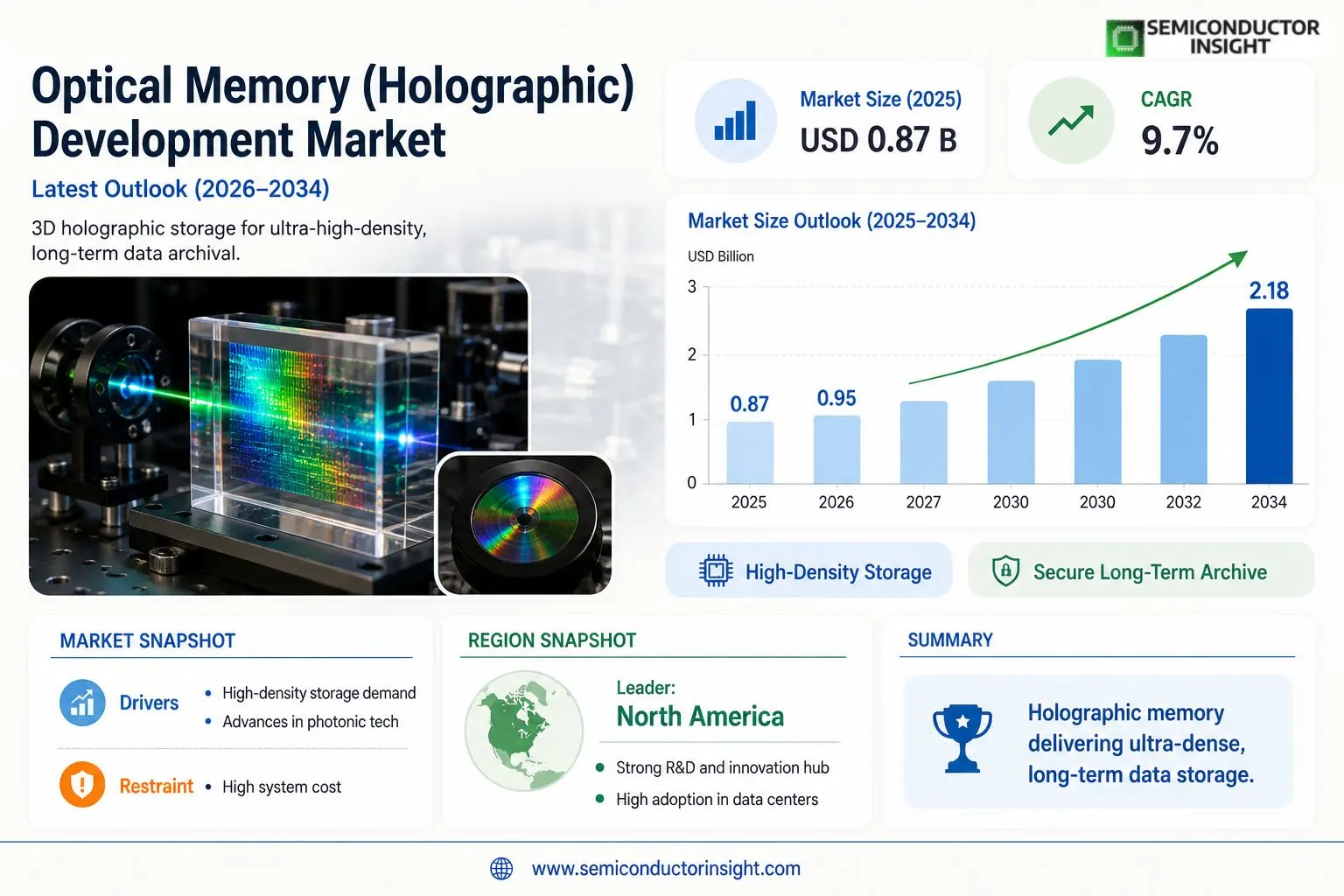
Global Optical Memory (Holographic) Development Market size was valued at USD 0.87 billion in 2025. The market is projected to grow from USD 0.95 billion in 2026 to USD 2.18 billion by 2034, exhibiting a CAGR of 9.7% during the forecast period.
Holographic optical memory is an advanced data storage technology that leverages the principles of holography to record and retrieve information in three dimensions within a photosensitive medium. Unlike conventional storage technologies that write data bit-by-bit on a surface, holographic memory systems encode data as interference patterns throughout the volume of a storage material, enabling significantly higher storage densities and faster data transfer rates. Key components and materials involved in this technology include photopolymers, lithium niobate crystals, spatial light modulators, and laser-based read/write systems.
The market is gaining considerable momentum driven by the exponential growth in global data generation, the urgent need for high-density archival storage solutions, and increasing investments in next-generation memory technologies by both public and private sector entities. Furthermore, the limitations of conventional magnetic and flash-based storage in meeting long-term data integrity requirements have accelerated interest in holographic alternatives. Key industry participants actively advancing this space include Microsoft Corporation , through its Project HSD (Holographic Storage Device) initiative in collaboration with Western Digital , as well as Sony Corporation, Optware Corporation, and InPhase Technologies, all of which maintain active development programs and intellectual property portfolios in holographic storage media and systems.
MARKET DRIVERS
Surging Demand for High-Density Data Storage Solutions
Optical Memory (Holographic) Development Market is experiencing significant momentum driven by the exponential growth of global data generation. As enterprises, cloud providers, and research institutions grapple with petabyte-scale storage requirements, conventional magnetic and flash-based storage technologies are increasingly reaching their physical density limits. Holographic optical memory systems, which store data in three-dimensional volumetric space rather than on a two-dimensional surface, offer a compelling path to substantially higher storage densities. This fundamental architectural advantage is a primary catalyst propelling investment and development activity across the holographic memory landscape.
Advancements in Photonic and Laser Technologies Accelerating Commercialization
Rapid progress in photonic integrated circuits, solid-state laser miniaturization, and high-sensitivity photodetector arrays has significantly reduced the engineering barriers that historically limited the commercial viability of holographic optical memory. The convergence of these enabling technologies is allowing system developers to design more compact, energy-efficient, and cost-effective holographic storage platforms. Improved spatial light modulators (SLMs) and volume holographic recording materials, including photopolymers and photorefractive crystals, have demonstrated enhanced sensitivity and longer archival stability, directly addressing performance requirements for enterprise-grade storage deployments.
➤ The integration of holographic optical memory into cold and archival storage tiers is gaining traction among hyperscale data center operators seeking alternatives to tape-based systems, with holographic platforms offering faster random-access retrieval alongside competitive storage density metrics.
Government and defense sector investment in Optical Memory (Holographic) Development Market has also emerged as a meaningful driver. Programs focused on secure, long-duration archival storage of classified and mission-critical data have recognized holographic optical memory’s inherent advantages in data longevity, resistance to electromagnetic interference, and read-only immutability for archival use cases. This institutional backing is supporting foundational research while simultaneously de-risking early commercialization efforts by providing stable demand signals to technology developers.
MARKET CHALLENGES
High System Cost and Manufacturing Complexity Limiting Broad Adoption
Despite its technological promise, Optical Memory (Holographic) Development Market faces substantial challenges related to the cost and complexity of manufacturing holographic storage systems at commercial scale. Precision optical alignment, the synthesis of specialized holographic recording media, and the integration of high-resolution spatial light modulators all contribute to elevated bill-of-materials costs compared to incumbent storage technologies. These cost dynamics have historically constrained the addressable market to well-funded research institutions, defense agencies, and a narrow segment of enterprise customers for whom performance characteristics outweigh price considerations.
Other Challenges
Material Stability and Environmental Sensitivity
Holographic recording media remain susceptible to degradation from environmental factors including temperature fluctuations, humidity, and UV exposure. Maintaining hologram fidelity over multi-decade archival lifespans requires careful material engineering and controlled storage environments, adding operational complexity and cost. Achieving the stability benchmarks required for enterprise and government archival applications remains an active area of research and a key commercialization hurdle for participants in Optical Memory (Holographic) Development Market.
Competition from Emerging Storage Technologies
The holographic optical memory sector faces intensifying competition from alternative next-generation storage technologies, including DNA-based data storage, glass-based optical storage, and advanced NAND flash architectures. Each of these competing approaches is attracting substantial R&D investment and may address overlapping use cases. Market participants must continuously demonstrate differentiated value propositions in terms of storage density, access speed, energy efficiency, and total cost of ownership to sustain competitive positioning within the broader advanced storage ecosystem.
MARKET RESTRAINTS
Absence of Standardized Interfaces and Industry Protocols
A significant structural restraint on Optical Memory (Holographic) Development Market is the current lack of universally adopted interface standards and interoperability protocols for holographic storage systems. Unlike mature storage segments governed by well-established standards such as NVMe, SATA, or LTO tape formats, holographic memory platforms have largely been developed as proprietary solutions by individual technology vendors. This fragmentation increases integration costs for end users, limits ecosystem development, and creates uncertainty around long-term media and hardware compatibility , factors that collectively slow enterprise procurement decisions and impede the formation of a robust supply chain.
Limited Availability of Specialized Talent and Supply Chain Infrastructure
The development and manufacture of holographic optical memory systems requires highly specialized expertise spanning optical engineering, photonic materials science, and precision manufacturing , disciplines where global talent pools remain limited. Similarly, the supply chain for critical components such as high-efficiency photopolymer recording media, custom SLMs, and coherent light sources is less mature than those supporting mainstream storage technologies. Supply chain concentration risks and long lead times for specialty optical components can constrain production scalability and introduce schedule uncertainty for both technology developers and their customers, acting as a meaningful brake on the pace of market expansion within Optical Memory (Holographic) Development Market.
MARKET OPPORTUNITIES
Expanding Archival and Cold Storage Demand from Hyperscale Data Centers
The relentless growth of unstructured data , including video content, scientific datasets, medical imaging archives, and financial records , is creating substantial long-term opportunity for Optical Memory (Holographic) Development Market within the archival and cold storage segment. Hyperscale cloud operators and large enterprises are actively evaluating alternatives to conventional tape libraries that offer improved data retrieval latency alongside comparable storage density and longevity. Holographic optical memory systems, capable of storing data for decades with minimal degradation and providing faster random-access capabilities than linear tape formats, are well positioned to capture a meaningful share of this growing archival storage demand as system costs continue to decline.
Integration with AI and Machine Learning Data Infrastructure
The proliferation of artificial intelligence and machine learning workloads is generating new opportunities for holographic optical memory as a high-capacity, high-throughput storage tier for training datasets and model repositories. Large-scale AI development pipelines require rapid access to massive datasets, and holographic memory’s potential for highly parallel data retrieval through angular and wavelength multiplexing could offer meaningful throughput advantages for specific AI infrastructure use cases. Strategic partnerships between holographic memory developers and AI infrastructure providers represent a high-growth avenue that could accelerate both market adoption and continued technology refinement within Optical Memory (Holographic) Development Market.
Defense, Government, and Secure Archive Applications
Defense agencies, national archives, healthcare institutions, and regulatory bodies represent a strategically important and relatively price-insensitive customer segment for Optical Memory (Holographic) Development Market. These organizations face stringent data retention mandates, require tamper-evident and long-duration archival storage, and place high value on storage media that is inherently resistant to cyberattack vectors such as ransomware , characteristics that holographic optical memory is well-suited to deliver. Continued growth in regulatory data retention requirements across healthcare, finance, and government sectors globally is expected to sustain and expand procurement interest in holographic storage solutions, providing a durable revenue opportunity for market participants as they advance toward broader commercialization.
Optical Memory (Holographic) Development Market Trends
Rising Demand for High-Density Archival Storage Driving Holographic Memory Adoption
Optical Memory (Holographic) Development Market is experiencing notable momentum as global data generation continues to grow at an unprecedented pace. Organizations across industries are increasingly confronting the limitations of conventional magnetic and flash-based storage technologies, particularly in meeting long-term data integrity and high-density archival requirements. This gap has accelerated enterprise and institutional interest in holographic optical memory as a next-generation alternative. Unlike surface-level bit-by-bit recording systems, holographic memory encodes data as interference patterns throughout the volume of a photosensitive medium, enabling significantly higher storage densities and faster data transfer rates compared to traditional solutions.
Other Trends
Strategic Industry Investments and Collaborative Development Initiatives
Major technology players are intensifying their commitment to holographic storage research and commercialization. Microsoft Corporation, through its Project HSD (Holographic Storage Device) initiative developed in collaboration with Western Digital, represents one of the most prominent examples of large-scale corporate investment in this space. Sony Corporation, Optware Corporation, and InPhase Technologies also maintain active development programs and substantial intellectual property portfolios in holographic storage media and systems. These collaborative and competitive dynamics are shaping the direction of technology standardization and accelerating the path toward commercially viable holographic memory products.
Advancements in Core Materials and Component Technologies
Progress in Optical Memory (Holographic) Development Market is closely tied to innovations in key enabling materials and components. Photopolymers and lithium niobate crystals have emerged as critical storage media, offering improved sensitivity and long-term stability for holographic recording. Concurrently, advances in spatial light modulators and laser-based read/write systems are enhancing the precision and efficiency of data encoding and retrieval processes. These material and component-level improvements are central to achieving the performance benchmarks required for broad commercial deployment across data-intensive sectors such as cloud infrastructure, healthcare, and media archiving.
Public and Private Sector Funding Accelerating Market Development
Increasing investments from both public institutions and private enterprises are serving as a significant growth catalyst for Optical Memory (Holographic) Development Market. Government-backed research programs and venture funding directed at next-generation memory technologies are providing the financial infrastructure necessary for sustained innovation. This dual-sector support is enabling research institutions and technology firms to advance holographic memory from experimental stages toward scalable, production-ready systems, positioning the market for meaningful expansion over the coming decade as demand for reliable, high-capacity data storage solutions continues to intensify globally.
COMPETITIVE LANDSCAPE
Key Industry Players
Optical Memory (Holographic) Development Market: Competitive Dynamics and Leading Innovators
Global Optical Memory (Holographic) Development Market is characterized by a concentrated yet progressively expanding competitive landscape, with a select group of technology giants and specialized firms driving innovation. Microsoft Corporation stands out as a leading force through its Project HSD (Holographic Storage Device) initiative, developed in strategic collaboration with Western Digital, positioning the company at the forefront of enterprise-grade holographic storage research. Sony Corporation, with its deep-rooted expertise in optical media technologies and substantial intellectual property portfolios, continues to be a dominant player pursuing high-density holographic recording systems. These organizations are complemented by pioneering firms such as Optware Corporation and InPhase Technologies, both of which have made significant contributions to holographic storage media, photopolymer development, and laser-based read/write architectures. The market, valued at USD 0.87 billion in 2025 and projected to reach USD 2.18 billion by 2034 at a CAGR of 9.7%, reflects the intensifying race among these participants to achieve commercially viable, high-throughput holographic memory solutions.
Beyond the dominant players, the competitive ecosystem encompasses a range of niche innovators and research-driven enterprises that are advancing critical enabling technologies such as spatial light modulators, photosensitive media, and lithium niobate crystal systems. Companies including Akonia Holographics, Bayer MaterialScience (now Covestro), and Dai Nippon Printing have established notable positions through materials science expertise integral to holographic media fabrication. Meanwhile, firms like Hitachi, Fujifilm, and TDK Corporation leverage their optical and magnetic storage legacies to explore holographic memory integration, while startups and research consortia backed by public and private investment continue to challenge incumbents with disruptive approaches to volumetric data encoding and retrieval architectures.
List of Key Optical Memory (Holographic) Development Companies Profiled
- Microsoft Corporation
- Sony Corporation
- Western Digital Corporation
- Covestro AG (formerly Bayer MaterialScience)
- Optware Corporation
- InPhase Technologies
- Akonia Holographics
- Fujifilm Holdings Corporation
- Dai Nippon Printing Co., Ltd.
- Hitachi, Ltd.
- TDK Corporation
- Lucent Technologies (Bell Labs)
- Aprilis Inc.
- Bholocon Inc.
- Polaroid Corporation (Holographics Division)
Segment Analysis:
| Segment Category | Sub-Segments | Key Insights |
| By Type |
|
Photopolymer-Based Holographic Memory leads this segment owing to its superior adaptability and cost-effectiveness in commercial-scale production environments.
|
| By Application |
|
Archival Data Storage stands as the dominant application segment, propelled by the urgent global need to preserve exponentially growing volumes of structured and unstructured data over extended periods.
|
| By End User |
|
IT and Telecommunications emerges as the leading end-user segment, driven by the sector’s relentless demand for next-generation storage infrastructure capable of supporting hyperscale data center operations and cloud-based services.
|
| By Storage Medium |
|
Write-Once Read-Many (WORM) Holographic Media leads this segment, reflecting the market’s strong orientation toward secure and immutable data preservation.
|
| By Component |
|
Spatial Light Modulators (SLMs) represent the leading component segment, serving as the critical interface through which data patterns are encoded into holographic storage media.
|
Regional Analysis: Optical Memory (Holographic) Development Market
North America
North America’s dominance in the holographic memory space is reinforced by a concentration of pioneering research universities and national laboratories actively advancing photonic storage technologies. Collaborative frameworks between academia and industry accelerate the commercialization of optical memory breakthroughs, ensuring the region maintains a sustained competitive advantage over emerging global challengers.
The region’s mature cloud computing and hyperscale data center infrastructure creates immediate and scalable demand for high-density holographic storage solutions. As data generation intensifies across enterprise, healthcare, and media sectors, North American operators are increasingly evaluating optical memory systems as a viable alternative to conventional magnetic and flash-based storage architectures.
U.S. defense agencies and federal intelligence bodies represent a strategically significant demand segment within Optical Memory (Holographic) Development Market. Requirements for ultra-secure, high-capacity, and long-duration archival storage align closely with the inherent capabilities of holographic memory, prompting continued government-backed procurement and classified research programs throughout the forecast period.
A dense pipeline of photonics and materials science professionals, supported by specialized graduate programs at leading universities, ensures North America retains top-tier human capital in optical memory development. This talent ecosystem, combined with proximity to global venture capital networks, accelerates product development cycles and sustains the region’s first-mover advantage in commercializing holographic storage innovations.
Europe
Europe occupies a prominent position in Global Optical Memory (Holographic) Development Market, underpinned by a strong tradition of photonics research and a well-coordinated industrial policy framework. Nations such as Germany, the United Kingdom, France, and the Netherlands have cultivated specialized photonics clusters that support both fundamental research and applied development in holographic storage technologies. The European Union’s sustained commitment to digital sovereignty and next-generation data infrastructure has elevated optical memory as a strategic technology priority, with public funding mechanisms channeling resources into collaborative cross-border research consortia. Europe’s stringent data governance regulations, including those governing long-term archival compliance, further stimulate demand for reliable and durable optical memory solutions across public institutions and regulated industries such as finance and healthcare. While the region trails North America in venture capital intensity, its depth of academic expertise and precision manufacturing capabilities in countries like Germany ensure it remains a meaningful contributor to global holographic memory advancement through 2034.
Asia-Pacific
Asia-Pacific represents the fastest-growing regional segment within Optical Memory (Holographic) Development Market, propelled by aggressive technology investment strategies across China, Japan, South Korea, and Taiwan. China’s national industrial policies explicitly target advanced data storage as a key area of technological self-sufficiency, spurring substantial domestic research activity in holographic and photonic memory platforms. Japan brings decades of precision optics expertise and a mature electronics manufacturing base, making it a natural incubator for holographic storage component development. South Korea’s leading semiconductor conglomerates are actively exploring optical memory as a complementary technology to existing flash and DRAM product lines. The region’s rapidly expanding digital economy, encompassing cloud services, streaming media, and artificial intelligence infrastructure, generates mounting demand for high-density storage solutions. Asia-Pacific’s combination of government-directed investment, manufacturing scale, and expanding end-user markets positions it as the most dynamic growth frontier for holographic memory development over the forecast horizon.
South America
South America represents an early-stage but gradually emerging market within the broader Optical Memory (Holographic) Development Market landscape. Brazil serves as the primary hub of technology adoption and research activity in the region, supported by a growing base of universities engaged in photonics and applied optics research. Increasing digitalization across the financial services, telecommunications, and media sectors is generating latent demand for advanced storage technologies, including optical memory solutions capable of supporting large-scale archival and data management requirements. However, the region’s progress is tempered by macroeconomic volatility, limited access to specialized manufacturing inputs, and relatively nascent venture capital infrastructure. Collaborative agreements between South American research institutions and North American or European partners are gradually elevating regional capabilities. As digital infrastructure investment deepens across Brazil, Chile, and Colombia, South America is expected to transition from an observer to a more active participant in Global holographic memory development ecosystem by the latter part of the forecast period.
Middle East & Africa
The Middle East and Africa region occupies a nascent but strategically noteworthy position within Global Optical Memory (Holographic) Development Market. Gulf Cooperation Council nations, particularly the United Arab Emirates and Saudi Arabia, are investing heavily in digital transformation agendas that encompass advanced data infrastructure, smart city frameworks, and sovereign cloud capabilities , all of which create indirect demand pathways for high-performance storage technologies such as holographic memory. Government-led technology parks and innovation hubs in Dubai and Riyadh are beginning to attract international technology partners with expertise in photonic and optical systems. Africa’s contribution remains limited in the near term due to infrastructure constraints and budgetary priorities focused on foundational connectivity. Nevertheless, South Africa maintains a small but active technology research community with emerging interest in advanced storage solutions. Over the long-term forecast horizon, the region’s ambitious digitalization investments and growing data sovereignty concerns are expected to gradually elevate interest in Optical Memory (Holographic) Development Market among regional policymakers and enterprise technology buyers.
Report Scope
This market research report provides a comprehensive analysis of the Optical Memory (Holographic) Development Market , covering the forecast period 2026–2034. It offers detailed insights into market dynamics, technological advancements, competitive landscape, and key trends shaping the industry.
Key focus areas of the report include:
- Market Overview: The report begins with an overview outlining its current market scenario, key growth indicators, and industry transformation drivers. It discusses macroeconomic factors, demand–supply balance, regulatory landscape, and the strategic role of semiconductors in powering advancements across industries such as automotive, telecommunications, consumer electronics, and industrial automation.
- Market Size & Forecast: Historical data and future projections for revenue, unit shipments, and market value across major regions and segments.
- Segmentation Analysis: Detailed breakdown by product type, technology, application, and end-user industry to identify high-growth segments and investment opportunities.
- Regional Insights: Insights into market performance across North America, Europe, Asia-Pacific, Latin America, and the Middle East & Africa, including country-level analysis where relevant.
- Competitive Landscape: Profiles of leading market participants, including their product offerings, R&D focus, manufacturing capacity, pricing strategies, and recent developments such as mergers, acquisitions, and partnerships.
- Technology Trends & Innovation: Assessment of emerging technologies, integration of AI/IoT, semiconductor design trends, fabrication techniques, and evolving industry standards.
- Market Drivers & Restraints: Evaluation of factors driving market growth along with challenges, supply chain constraints, regulatory issues, and market-entry barriers.
- Stakeholder Insights: Insights for component suppliers, OEMs, system integrators, investors, and policymakers regarding the evolving ecosystem and strategic opportunities.
Primary and secondary research methods are employed, including interviews with industry experts, data from verified sources, and real-time market intelligence to ensure the accuracy and reliability of the insights presented.
FREQUENTLY ASKED QUESTIONS:
What is the current market size of Optical Memory (Holographic) Development Market?
-> Global Optical Memory (Holographic) Development Market size was valued at USD 0.87 billion in 2025 and is projected to grow from USD 0.95 billion in 2026 to USD 2.18 billion by 2034, exhibiting a CAGR of 9.7% during the forecast period.
Which key companies operate in Optical Memory (Holographic) Development Market?
-> Key players include Microsoft Corporation, Sony Corporation, Optware Corporation, InPhase Technologies, and Western Digital, among others.
What are the key growth drivers?
-> Key growth drivers include the exponential growth in global data generation, the urgent need for high-density archival storage solutions, increasing investments in next-generation memory technologies by both public and private sector entities, and the limitations of conventional magnetic and flash-based storage in meeting long-term data integrity requirements.
Which region dominates the market?
-> Asia-Pacific is among the fastest-growing regions driven by rapid digitalization and data infrastructure investments, while North America remains a dominant market supported by major technology players and R&D initiatives.
What are the emerging trends?
-> Emerging trends include three-dimensional volumetric data encoding, use of advanced materials such as photopolymers and lithium niobate crystals, development of spatial light modulators, and integration of laser-based read/write systems for higher storage densities and faster data transfer rates in holographic memory solutions.

Get Sample Report PDF for Exclusive Insights
Report Sample Includes
- Table of Contents
- List of Tables & Figures
- Charts, Research Methodology, and more...
 Download Sample Report PDF