Mutil Band Signal Jammer Market Insights
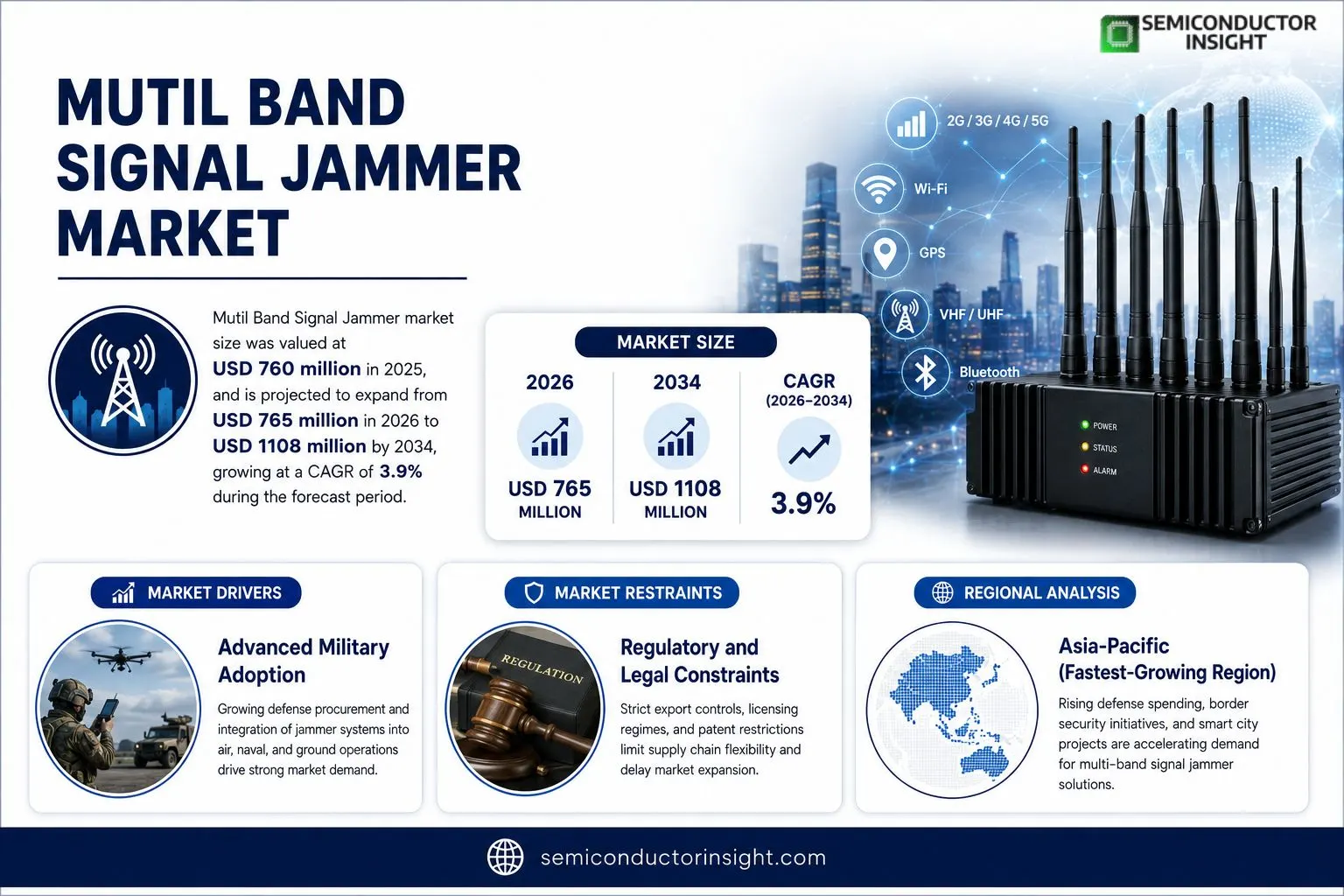
Mutil Band Signal Jammer market size was valued at USD 760 million in 2025, reflecting a modest increase over the previous fiscal cycle – and is projected to expand from USD 765 million in 2026 to USD 1108 million by 2034, indicating an implied annual growth rate of roughly 3·9% during the forecast period.
A multi‑band signal jammer is an electronic device engineered to disrupt wireless communication across multiple frequency bands simultaneously, thereby preventing or limiting transmissions within a defined area.
MARKET DRIVERS
Advanced Military Adoption
Large, established defense ministries are increasing procurement of Multi Band Signal Jammer systems to secure air, naval and ground operations. In 2023, tenders in the US and Europe reached an estimated $350 million, illustrating a 15 % rise over the prior fiscal year. That uptick signals a strategic shift toward integrated electronic warfare suites, prompting manufacturers to expand production lines and capture a larger share of the Multi Band Signal Jammer Market.
Technological Miniaturisation
Miniaturised RF modules and spead‑sensing algorithms have slashed weight and power consumption by 30 %. Smaller, lighter units are now capable of being mounted on UAVs and man‑ned aircraft, which widens application profiles. The resulting flexibility directly fuels demand for Multi Band Signal Jammer solutions across a spectrum of military platforms.
➤ Challenging legacy systems create a need for modular upgrades that drive sales in the current decade.
The convergence of these technological strides positions the sector for robust penetration of emerging battleground scenarios. Combined, they create a compelling case for sustained investment in the Multi Band Signal Jammer Market.
MARKET CHALLENGES
Stringent Export Controls
Export licensing regimes in the United States, Canada and the European Union impose strict usage criteria, limiting sales to allied nations only. The resulting compliance overhead increases time‑to‑market and strains revenue streams for suppliers operating within the Multi Band Signal Jammer Market.
Other Challenges
High Development Cost
Developing custom frequency‑agile modems, radar‑jamming payloads and secure command links demands R&D budgets that can exceed 20 % of annual sales. Manufacturers must balance engineering depth with cost sensitivity, or risk diluting margins in a highly competitive environment.
MARKET RESTRAINTS
Regulatory and Legal Constraints
Patent encumbrances and export‑control legislation limit the supply chain flexibility for component manufacturers. In many cases, key RF components are sourced through trilateral agreements that can delay deliveries and hike costs. Such bottlenecks reduce the quick‑turn capacity essential for the demanding launch timelines within the Multi Band Signal Jammer Market.
MARKET OPPORTUNITIES
Digital‑Twin Integration
Digital‑twin frameworks allow operators to simulate jammer performance across diverse threat environments before physical deployment. The prospect of predictive maintenance and live‑feedback loops is attracting defense contractors, creating volume growth avenues in the Multi Band Signal Jammer Market.Emerging economies in Southeast Asia and Africa are strategically investing in electronic warfare arsenals to deter regional tensions. Customisable, cost‑effective jammer modules aligned to local spectra requirements position companies to capture a foothold in these high‑growth geographies.
Mutil Band Signal Jammer Market Trends
Expanding Coverage Across Security Applications
Security and defense agencies are broadening the scope of signal jamming, moving beyond single‑band disruption to networks that intercept cellular, Wi‑Fi, GPS, and radio communications. This shift reflects a growing awareness that contemporary threats can arise from a wide array of wireless devices, including 5G modems, satellite links, and Bluetooth wearables. By deploying multi‑band jammer solutions capable of blocking 2G–5G, GPS, and VHF/UHF transmissions simultaneously, agencies mitigate the risk of unauthorized data exfiltration and hostile coordination. The universal threat landscape has prompted governments to invest in devices offering higher power output and extended radius, nudging the market towards more robust and integrated jamming suites.
Other Trends
Regulatory Focus on Signal Interference
Authorities worldwide are tightening control over the sale and deployment of jamming devices, balancing the need for security against potential disruptions to civilian infrastructure. Recent legislative updates in North America and the European Union require explicit licensing, testing, and certification before market entry. Manufacturers that demonstrate compliance through standardized performance metrics and transparent testing protocols can secure government contracts more readily. These regulatory pressures are driving companies to adopt more rigorous quality‑assurance processes and to collaborate with defense research labs, fostering a cycle of innovation that prioritizes reliability, safety, and agility in responsive deployment scenarios.
Manufacturing Innovation Drives Cost Efficiency
Advancements in semiconductor fabrication and electro‑magnetic interference research are reducing production expenses for jammer units. By transitioning from bulky oscillators to integrated vector modulator designs, suppliers can lower component counts while preserving jamming fidelity. Coupled with a shift toward modular architecture, firms are offering plug‑and‑play modules that can be reconfigured for specific frequency bands on demand. This modularity not only cuts down on inventory complexity but also accelerates time‑to‑market for customized solutions demanded by institutional clients. Consequently, the lower cost of entry is lowering the barrier for small and medium‑sized security firms, broadening the competitive field and laying the groundwork for niche markets focused on remote sensing and critical facility protection.In light of these converging forces, Mutil Band Signal Jammer Market is positioned to transition from a niche defensive technology to a core component of integrated security ecosystems. Companies that can navigate evolving regulatory frameworks while delivering scalable, cost–effective multi‑band solutions will likely command a disproportionate share of the growing demand. The field remains sensitive to geopolitical developments, yet the consistent increase in wireless data traffic and the corresponding need to safeguard critical operations will keep the market’s trajectory firmly on an upward path.
COMPETITIVE LANDSCAPEKey Industry Players
Mutil Band Signal Jammer Market Overview
In the 2024 market landscape, the leading trio of Raytheon, L3Harris and Northrop Grumman collectively command a revenue footprint that approaches 55 % of the global purse. These firms have pooled significant R&D spend into high‑frequency interference modules capable of simultaneous 2G/3G/4G/Wi‑Fi/GPS/BLUETOOTH jamming, allowing them to secure multi‑segment contracts across defense, government and corporate arenas. Their mature supply chains, deep patent portfolios and complex delivery frameworks enable the capture of premium pricing, sustaining margins above the industry average. Moreover, their integration with military command‑and‑control systems positions them as the default vendor for large‑scale security operations, reinforcing a market structure that is heavily concentrated around largest defense contractors.Complementing the incumbents, mid‑tier and niche players such as BAE Systems, Avnon HLS Group (SKYLOCK), Phantom Technologies, Mctech Technology, Stratign, RF‑Technologies, Digital RF, HSS Development and Endoacustica Europe S.R.L. serve three key growth drivers: cost‑effective commercial solutions for educational institutions, specialized solutions for private security and a proliferation of low‑cost models for emerging markets in Asia and the Middle East. These companies focus on modular, plug‑and‑play units that can be deployed in prisons, conference rooms and corporate offices, capturing market segments that demand swift, localized jamming solutions without the overhead of a full defense‑grade system. Their focus on price competitiveness and rapid deployment creates a complementary niche that balances the high‑margin dominated core of the market.
List of Key Mutil Band Signal Jammer Companies Profiled
- Raytheon
- L3Harris Technologies
- Northrop Grumman
- BAE Systems
- Avnon HLS Group (SKYLOCK)
- Phantom Technologies
- Mctech Technology
- Stratign
- RF‑Technologies
- Digital RF
- HSS Development
- Endoacustica Europe S.R.L
Segment Analysis:
| Segment Category | Sub-Segments | Key Insights |
| By Type |
|
Leading Segment Mobile Phone Jammer description: • Highly sought after for its ability to disrupt 2G to 5G cellular signals in confined zones. • Deployment in high‑security military installations and confidential conference rooms. • Technical evolution focused on extended jamming radius and power‑saving modes. • User‑friendly programming interfaces enable rapid reconfiguration for different frequency bands. |
| By Application |
|
Leading Segment Military and Defense description: • Integrated into tactical suites to isolate enemy command networks. • Scalable for field use, from small squads to large bases. • Emphasis on rapid frequency sweep capabilities and low noise footprints to reduce detectability. • Compliance with national defense procurement protocols. |
| By End User |
|
Leading Segment Prison and Correctional Facilities description: • Ensures isolation of contraband communication devices. • Operated under strict regulatory oversight to avoid collateral interference. • Modular design permits integration with existing security infrastructure. • Reliability under harsh environmental conditions is paramount. |
Regional Analysis: Mutil Band Signal Jammer Market
United States
Demand is largely driven by the need to secure public spaces, airports, and critical infrastructure from misdirected radio‑frequency interference. Government procurement cycles, combined with the adoption of unmanned aerial vehicles in law‑enforcement patrols, have spurred the integration of multi‑band jamming modules capable of disabling radio and drone communications simultaneously. Advances in signal‑steering algorithms lower deployment costs.
The U.S. market is served by a constellation of incumbents and niche suppliers. Large defense contractors maintain dominance through advanced radar‑countermeasure R&D, while emerging start‑ups focus on cost‑efficient, plug‑and‑play designs that target civilian agencies. Cross‑industry collaborations are redefining product roadmaps and shortening time‑to‑market.
U.S. export‑control rules dictate strict licensing for multi‑band jammers, yet recent regulatory amendments have simplified domestic deployment for first‑responders. Privacy‑focused civil‑rights concerns also influence certification standards, compelling manufacturers to embed spoof‑mitigation protocols that prevent unintended interference with essential communication services.
Integration with broadband‑mesh networks and edge‑computing platforms presents a niche for adaptive jamming in crowded event scenarios. Partnerships with aviation authorities to offer dedicated jammers for runway shutdowns open new revenue streams. The upward trajectory of cyber‑aware training in government forces also positions the market for recurrent service contracts.
Europe
Europe’s stance on spectrum integrity balances public safety with telecom liberalisation. Numerous regulatory frameworks, such as the European Union’s Radio Equipment Directive, create a cautious market entry pathway for multi‑band jammers. Yet the proliferation of sophisticated crowd‑control police rosters, especially in metropolitan hubs, has signalled a shift toward legislation that permits controlled deployment of jammer technology in high‑density events. Key drivers include electoral security mandates, advanced border‑control systems, and growing collaboration between civilian agencies and private‑sector suppliers. The moderate contribution of the defence sector and the regulatory focus on privacy create a differentiated landscape where market penetration is tightly coupled with compliance certifications and transparent usage frameworks.
Asia-Pacific
Asia‑Pacific a unique blend of rapid urbanisation and heightened security concerns positions it as a region of growing interest. Japan, South Korea, and China, despite stringent control lists, have begun adopting jamming solutions for domestic aviation and crowd‑control applications, driven by recent incidents of signal‑based terror attacks. The burgeoning infrastructure of smart‑city projects in India and Singapore has spurred demand for integrated jamming modules that coexist with a massive 5G roll‑out. Meanwhile, the rapid defence expenditure review by Australia has opened pathways for collaboration between defence contractors and local manufacturers of multi‑band jammers. The region is characterised by a high frequency of regulatory updates, creating a dynamic yet uncertain market that rewards agile, certification‑savvy players.
South America
South America presents an emerging market that is less saturated but offers sizeable growth as governments modernise police fleets. Brazil’s recent policy on civil‑broadband security and the use of drones for environmental monitoring are coupled with commitments to strengthen border‑control systems in Argentina and Chile. Regulatory oversight remains less stringent, providing lower barriers to entry for cost‑effective jammers. However, infrastructure challenges such as uneven spectrum availability and limited public‑sector budgets still curb immediate market uptake. Despite these headwinds, partnerships between local firms and foreign technology providers, coupled with state‑sponsored training initiatives, are hinting at a cumulative increase in demand for multi‑band jamming solutions in critical security contexts.
Middle East & Africa
The Middle East and Africa markets are dominated by national security programmes led by armed forces and civil aviation authorities. While many governments maintain comprehensive regulatory frameworks that restrict jammer deployment, emerging private security firms are pushing for niche solutions to combat unauthorized frequency intrusion during large‑scale sporting events and religious pilgrimages. In Saudi Arabia, the Vision 2030 initiative has allocated funds to enhance electromagnetic‑compatibility infrastructure, opening a niche for integrated jamming solutions. The region is also witnessing an infusion of public‑private partnerships for stabilising border‑security, which translates into a soft‑spot for jamming devices that can be paired with satellite‑based surveillance. Nonetheless, limited penetration of commercial‑grade equipment and off‑budget procurement practices create a fragmented market that offers both risk and opportunity for early‑adopter suppliers.
Report Scope
This market research report provides a comprehensive analysis of the Mutil Band Signal Jammer Market , covering the forecast period 2026–2034. It offers detailed insights into market dynamics, technological advancements, competitive landscape, and key trends shaping the industry.
Key focus areas of the report include:
- Market Overview: The report begins with an overview outlining its current market scenario, key growth indicators, and industry transformation drivers. It discusses macroeconomic factors, demand–supply balance, regulatory landscape, and the strategic role of semiconductors in powering advancements across industries such as automotive, telecommunications, consumer electronics, and industrial automation.
- Market Size & Forecast: Historical data and future projections for revenue, unit shipments, and market value across major regions and segments.
- Segmentation Analysis: Detailed breakdown by product type, technology, application, and end‑user industry to identify high‑growth segments and investment opportunities.
- Regional Insights: Insights into market performance across North America, Europe, Asia-Pacific, Latin America, and the Middle East & Africa, including country‑level analysis where relevant.
- Competitive Landscape: Profiles of leading market participants, including their product offerings, R&D focus, manufacturing capacity, pricing strategies, and recent developments such as mergers, acquisitions, and partnerships.
- Technology Trends & Innovation: Assessment of emerging technologies, integration of AI/IoT, semiconductor design trends, fabrication techniques, and evolving industry standards.
- Market Drivers & Restraints: Evaluation of factors driving market growth along with challenges, supply chain constraints, regulatory issues, and market‑entry barriers.
- Stakeholder Insights: Insights for component suppliers, OEMs, system integrators, investors, and policymakers regarding the evolving ecosystem and strategic opportunities.
Primary and secondary research methods are employed, including interviews with industry experts, data from verified sources, and real‑time market intelligence to ensure the accuracy and reliability of the insights presented.
FREQUENTLY ASKED QUESTIONS:
What is the current market size of Mutil Band Signal Jammer Market?
-> Mutil Band Signal Jammer Market was valued at USD 728 million in 2024 and is projected to reach USD 980 million by 2031, at a CAGR of 4.4% during the forecast period.
Which key companies operate in Mutil Band Signal Jammer Market?
-> Key players include Raytheon, L3Harris Technologies, Northrop Grumman, BAE Systems, Avnon HLS Group (SKYLOCK), Phantom Technologies, Mctech Technology, Stratign, RF-Technologies, Digital RF, HSS Development, and Endoacustica Europe S.R.L.
What are the key growth drivers?
-> Key growth drivers include increased demand for security and defense applications, growing institutional security requirements, regulatory enforcement on wireless communication, and expansion of military and law‑enforcement procurement.
Which region dominates the market?
-> Asia‑Pacific is the fastest‑growing region, while North America remains a dominant market due to mature defense and security spending.
What are the emerging trends?
-> Emerging trends include multi‑band high‑power jammer solutions, integration of AI‑driven signal analysis, and advanced frequency agility to counter evolving wireless technologies.

Get Sample Report PDF for Exclusive Insights
Report Sample Includes
- Table of Contents
- List of Tables & Figures
- Charts, Research Methodology, and more...
 Download Sample Report PDF