MT Ferrule Market Insights
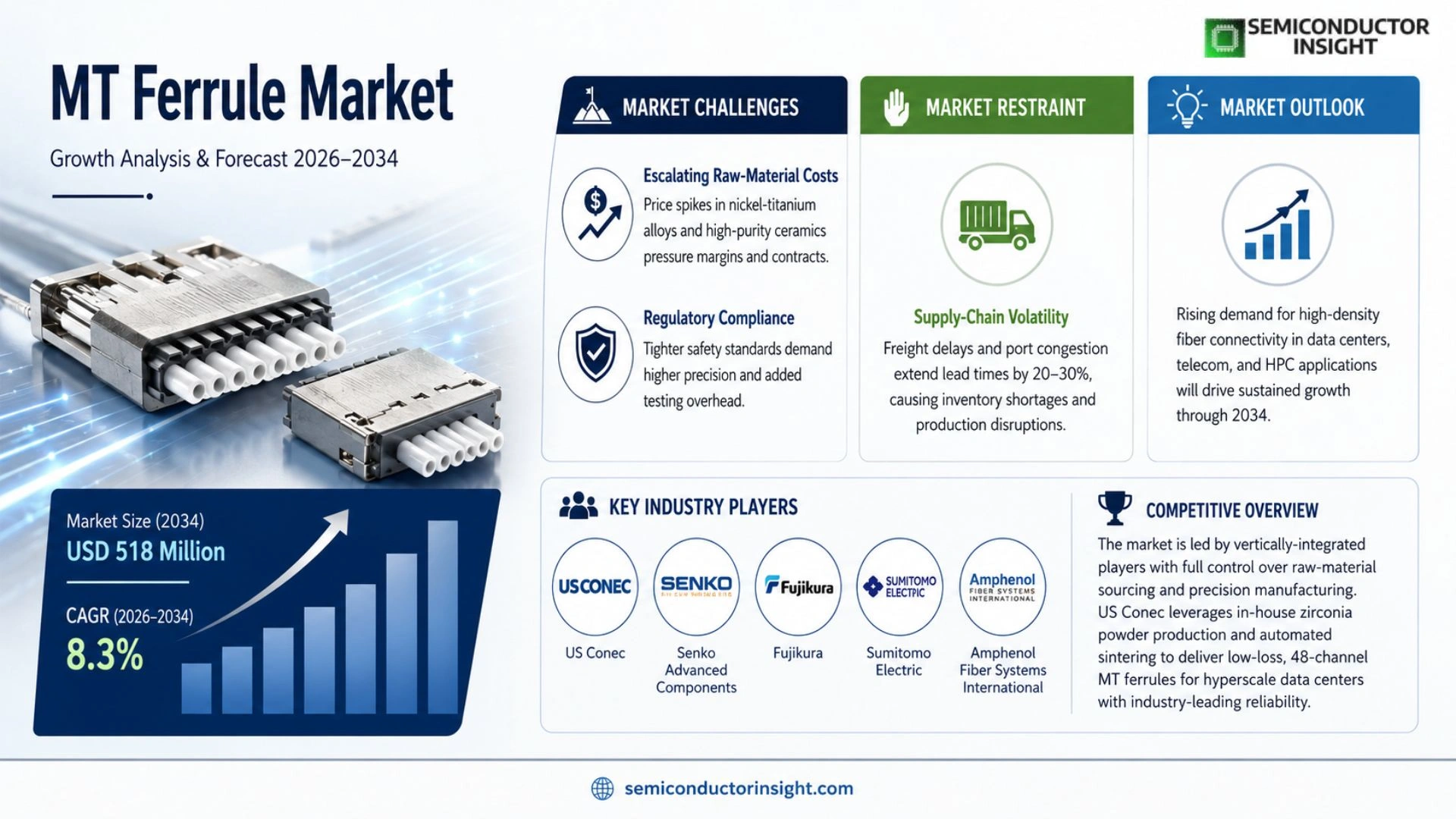
MT Ferrule market size was valued at USD 253 million in 2025. The market is projected to grow from USD 253 million in 2025 to roughly USD 518 million by 2034, exhibiting a CAGR of about 8.3% during the forecast period.
MT ferrules are precision components used primarily in multi‑fiber optical connectors such as MPO/MTP assemblies. Each ferrule houses multiple fiber channels,commonly twelve or twenty‑four,allowing simultaneous transmission of several signals through a single connector housing a metal shell and a finely machined plastic or ceramic core. The shell protects the fibers while maintaining alignment accuracy within microns, which directly influences insertion loss and return loss performance.
The expansion of data‑center interconnects, rising AI‑driven workloads, and rollout of 400G/800G optical modules are pushing demand for higher‑density, ultra‑low‑loss ferrules capable of supporting forty‑eight or more fibers per connector. Upstream suppliers of high‑purity zirconia ceramic powders and micro‑hole molding equipment are seeing increased orders because tighter dimensional tolerances are required for next‑generation backbone networks. Midstream manufacturers benefit from automation advances that keep gross margins between 30%–45%, while downstream users,particularly telecom operators upgrading toward 5G base stations,are adopting larger‑core MPO solutions to meet bandwidth growth targets
MARKET DRIVERS
Rising demand for high‑performance fiber optics
The expansion of 5G infrastructure and edge‑computing nodes is compelling network operators to adopt tighter bend‑radius fibers, which in turn necessitates precision‑engineered MT ferrules. Manufacturers that can guarantee low insertion loss are gaining preference, creating a steady pull on component volumes.
Shift toward automated test and measurement
Labor‑intensive splice testing is being replaced by automated inspection rigs that rely on interchangeable MT ferrules for rapid change‑over. The productivity boost delivered by such systems translates into higher per‑unit consumption of ferrules across OEMs and service providers.
➤ Industry surveys indicate that 68 % of fiber‑optic installers plan to increase their MT ferrule inventory within the next 12 months.
Parallel to equipment upgrades, the growing emphasis on network resilience drives operators to stock redundant components. Strategic inventory builds cushion against unexpected outages, further inflating demand in MT Ferrule Market.
MARKET CHALLENGES
Escalating raw‑material costs
Nickel‑titanium alloys and ultra‑pure ceramic grades that underpin MT ferrule performance have seen price spikes due to geopolitical supply constraints. Cost‑sensitive manufacturers are pressured to either absorb margins or renegotiate contracts, squeezing profitability.
Other Challenges
Regulatory compliance
New safety standards for optical component handling impose tighter tolerances on ferrule dimensions. Compliance testing adds a layer of operational overhead, especially for smaller players lacking in‑house validation labs.
MARKET RESTRAINTS
Supply‑chain volatility
Freight congestion and port delays have lengthened lead times for critical ferrule components by 20‑30 %. Manufacturers reliant on just‑in‑time deliveries face inventory shortages that can stall production lines, limiting market expansion.
MARKET OPPORTUNITIES
Emerging applications in data‑center interconnects
Hyperscale data centers are standardizing on dense multimode fiber layouts that demand ultra‑low‑loss MT ferrules. Suppliers that can certify sub‑0.2 dB loss are positioned to capture a sizable share of this high‑growth niche. Additionally, the migration toward photonic‑integrated circuits opens avenues for customized ferrule geometries, fostering a segment of premium‑priced solutions.
MT Ferrule Market Trends
Rising Demand for High‑Density Fiber Connections
Production of MT ferrules reached 91.09 million units in 2025, with an average selling price of US $3.04 per unit. The surge is linked to the rollout of 400 G and 800 G optical modules in hyperscale data centers, where multi‑core connectors such as MPO/MTP are becoming the preferred solution for bandwidth‑intensive workloads. As artificial‑intelligence accelerators and cloud services push the envelope on inter‑rack traffic, customers seek ferrules that can accommodate 48, 72 or more fibers within a single plug while preserving insertion loss below 0.3 dB. This technical pressure translates into a steady increase in order volumes, prompting manufacturers to expand capacity and refine automation in micro‑hole drilling and polishing stages.
Other Trends
Supply‑Chain Consolidation and Upstream Material Quality
The upstream segment, dominated by high‑purity zirconia powders, precision molds and micron‑level grinding equipment, has become a focal point for cost‑control and reliability. Variations in ceramic purity directly affect coaxiality and dimensional stability, which in turn dictate the long‑term performance of the assembled connector. Manufacturers are therefore forging tighter collaborations with ceramic suppliers, and some are acquiring molding tool makers to secure consistent mold tolerances. This vertical integration reduces lead times and buffers the midstream production against raw‑material price volatility, while also enabling tighter specification adherence for ultra‑low‑loss ferrule variants.
Innovation in Low‑Loss MT Ferrules
To meet the evolving specifications of next‑generation optical networks, R&D efforts are concentrating on angled‑end‑face (APC) polishing and the introduction of ultra‑low‑loss plastic cores. These advances lower back‑reflection and improve signal integrity over longer spans, a critical attribute for backbone deployments that now target 1.6 T speeds. Companies that invest in automated inspection systems and real‑time feedback loops can guarantee sub‑micron surface finish across high‑volume batches, thereby sustaining the 30‑45 % gross‑margin envelope typical of the midstream segment. The strategic implication is clear: firms that lock in high‑precision upstream capabilities and differentiate their ferrule portfolio through loss‑performance tiers will be best positioned to capture premium pricing and reinforce supply security in a market where data‑center expansion shows no sign of abating.
COMPETITIVE LANDSCAPE
Key Industry Players
Global MT Ferrule Competitive Overview
The market is anchored by a handful of vertically‑integrated manufacturers that control both raw‑material sourcing and high‑precision molding. US Conec, for example, couples its ownership of zirconia‑powder producers with a fully automated sintering line, allowing it to sustain margins above industry averages while delivering low‑loss, 48‑channel ferrules for hyperscale data‑center deployments. Its ability to guarantee supply continuity has turned it into the default vendor for many MPO connector assemblers in North America and Europe. Sumitomo and Furukawa Electric occupy similar positions in Asia, leveraging long‑standing relationships with telecom operators to lock in demand for 24‑ and 72‑channel solutions. The concentration of these three firms creates a tiered structure: a top tier that supplies the bulk of high‑volume, standard‑loss products, and a second tier that focuses on ultra‑low‑loss, APC‑polished variants for long‑haul backbone networks.
Beyond the dominant tier, a diverse set of niche players injects specialization into the ecosystem. Hakusan and Nissin Kasei have carved out reputations for rapid mold redesign, enabling customers to trial 96‑channel configurations within months. SANWA Technologies and SENKO Advanced Components excel in single‑mode ferrules where geometric tolerances dictate insertion loss. Chinese firms such as Chaozhou Three‑Circle, Jiangsu UNIKIT Optical Technologies, and Dongguan Kaihang Technology compete aggressively on price, supported by domestic ceramic suppliers that meet the necessary purity standards. Meanwhile, OE‑TEK and T&S Communications differentiate through bundled connector‑system offerings, bundling ferrules with alignment hardware to simplify integration for emerging 5G base‑station projects. This blend of scale, agility, and application‑specific expertise sustains a competitive dynamic that rewards both cost efficiency and technical excellence.
List of Key MT Ferrule Companies Profiled
- US Conec
- Sumitomo Electric
- Furukawa Electric
- Hakusan
- Nissin Kasei
- SANWA Technologies
- FSG
- Chaozhou Three‑Circle
- ACON OPTICS
- Jiangsu UNIKIT Optical Technologies
- OE‑TEK
- Dongguan Kaihang Technology
- T&S Communications
- SENKO Advanced Components
Segment Analysis:
| Segment Category | Sub-Segments | Key Insights |
| By Type |
|
Multi‑Fiber High‑Count Ferrules are emerging as the primary growth driver because:
|
| By Application |
|
Data Center Interconnects dominate the application landscape, driven by:
|
| By End User |
|
Telecommunications Operators command the end‑user market because:
|
| By Fiber Mode |
|
Single‑Mode Ferrules are gaining prominence due to:
|
| By Loss Performance |
|
Ultra‑Low Loss Ferrules are becoming a decisive factor because:
|
Regional Analysis: MT Ferrule Market
Europe
European plants leverage high‑precision CNC machining coupled with real‑time quality monitoring, enabling batch consistency that rivals Asian rivals. Automation is paired with skilled technicians who fine‑tune process parameters, delivering low defect rates essential for telecom operators. This hybrid approach sustains a premium positioning while keeping unit costs competitive.
EU directives on electromagnetic compatibility and environmental stewardship compel manufacturers to adopt recyclable alloys and low‑emission processes. Compliance not only safeguards market access but also enhances brand credibility among infrastructure contractors seeking sustainable solutions.
Proximity to major fiber‑optic cable producers shortens lead times, allowing rapid response to sudden capacity upgrades. Strategic stockpiling of premium ceramic inserts further insulates manufacturers from raw‑material price swings, reinforcing supply reliability.
Investment in 5G backhaul and data‑center interconnects drives demand for MT ferrules with tighter insertion loss specifications. European firms respond by co‑developing customized ferrule profiles, aligning product innovations directly with operator rollout schedules.
North America
North America’s MT Ferrule Market is shaped by aggressive fiber‑to‑the‑home initiatives and a sizable legacy of legacy cable upgrades. Operators prioritize cost-effective components that can be rapidly deployed, prompting manufacturers to scale volume production while preserving performance thresholds. The region’s strong venture‑capital ecosystem fuels startups that experiment with hybrid polymer‑metal ferrules, introducing alternatives that could reshape pricing dynamics. However, fragmented regulatory standards across states demand flexible product certification strategies, adding a layer of complexity to market entry. Companies that blend high‑volume manufacturing with agile compliance processes are likely to capture a larger share of new build projects and retrofit contracts alike.
Asia‑Pacific
In Asia‑Pacific, MT Ferrule Market is buoyed by massive urbanization and governmental commitments to smart‑city infrastructure. Nations such as China, India, and South Korea are rapidly expanding their broadband footprints, creating a persistent appetite for cost‑efficient ferrules that can be integrated into large‑scale deployments. Local manufacturers benefit from abundant low‑cost labor and government incentives for high‑tech equipment, but they often face challenges in meeting the exacting quality expectations of multinational telecoms. Partnerships with European firms to adopt best‑practice quality regimes are emerging as a pathway to elevate product credibility while retaining price advantages.
South America
South America’s MT Ferrule Market reflects a mix of emerging broadband projects and legacy network modernization. Countries like Brazil and Chile are channeling public‑private funds into fiber corridors, emphasizing components that can withstand diverse climatic conditions. Manufacturers are adapting coating materials to resist humidity and temperature fluctuations, ensuring long‑term reliability. While overall market size remains modest compared to Europe or North America, the region’s growth trajectory offers niche opportunities for suppliers that can provide durable, low‑maintenance ferrules tailored to local installation practices.
Middle East & Africa
The Middle East & Africa region exhibits a distinctive demand pattern driven by high‑value data‑center construction in the Gulf and expanding telecom footprints across Sub‑Saharan nations. In the Gulf, premium‑grade MT ferrules are essential for ultra‑low‑latency links supporting financial services and cloud providers. Conversely, African markets favor rugged designs that can survive variable power quality and less controlled environments. Suppliers that can segment their product portfolios,offering both high‑performance and robust‑oriented ferrules,stand to meet the divergent expectations of these geographically and economically diverse markets.
Report Scope
This market research report provides a comprehensive analysis of the MT Ferrule Market , covering the forecast period 2026–2034. It offers detailed insights into market dynamics, technological advancements, competitive landscape, and key trends shaping the industry.
Key focus areas of the report include:
- Market Overview: The report begins with an overview outlining its current market scenario, key growth indicators, and industry transformation drivers. It discusses macroeconomic factors, demand–supply balance, regulatory landscape, and the strategic role of semiconductors in powering advancements across industries such as automotive, telecommunications, consumer electronics, and industrial automation.
- Market Size & Forecast: Historical data and future projections for revenue, unit shipments, and market value across major regions and segments.
- Segmentation Analysis: Detailed breakdown by product type, technology, application, and end-user industry to identify high-growth segments and investment opportunities.
- Regional Insights: Insights into market performance across North America, Europe, Asia-Pacific, Latin America, and the Middle East & Africa, including country-level analysis where relevant.
- Competitive Landscape: Profiles of leading market participants, including their product offerings, R&D focus, manufacturing capacity, pricing strategies, and recent developments such as mergers, acquisitions, and partnerships.
- Technology Trends & Innovation: Assessment of emerging technologies, integration of AI/IoT, semiconductor design trends, fabrication techniques, and evolving industry standards.
- Market Drivers & Restraints: Evaluation of factors driving market growth along with challenges, supply chain constraints, regulatory issues, and market-entry barriers.
- Stakeholder Insights: Insights for component suppliers, OEMs, system integrators, investors, and policymakers regarding the evolving ecosystem and strategic opportunities.
Primary and secondary research methods are employed, including interviews with industry experts, data from verified sources, and real-time market intelligence to ensure the accuracy and reliability of the insights presented.
FREQUENTLY ASKED QUESTIONS:
What is the current market size of MT Ferrule Market?
-> MT Ferrule Market was valued at USD 253 million in 2025 and is expected to reach USD 433 million by 2032.
Which key companies operate in MT Ferrule Market?
-> Key players include US Conec, Hakusan, Nissin Kasei, Sumitomo, Furukawa Electric, SANWA Technologies, FSG, Chaozhou Three-Circle, ACON OPTICS, Jiangsu UNIKIT Optical Technologies, OE-TEK, Dongguan Kaihang Technology, T&S Communications, SENKO Advanced Components.
What are the key growth drivers?
-> Key growth drivers include the rapid expansion of data centers, increasing demand for AI computing power, deployment of 400G/800G optical modules, growth of 5G communication base stations, and the need for high‑density fiber optic connections in cloud computing networks.
Which region dominates the market?
-> Asia dominates MT Ferrule market, driven by extensive manufacturing bases and strong demand for optical communication components across the region.
What are the emerging trends?
-> Emerging trends include higher fiber‑count ferrules (48, 72 fibers and beyond), ultra‑low loss designs, angled APC polishing, and the adoption of advanced high‑precision molds and ceramic materials to meet stringent performance requirements for next‑generation 400G/800G/1.6T optical networks.
Get Sample Report PDF for Exclusive Insights
Report Sample Includes
- Table of Contents
- List of Tables & Figures
- Charts, Research Methodology, and more...