LTCC Market Insights
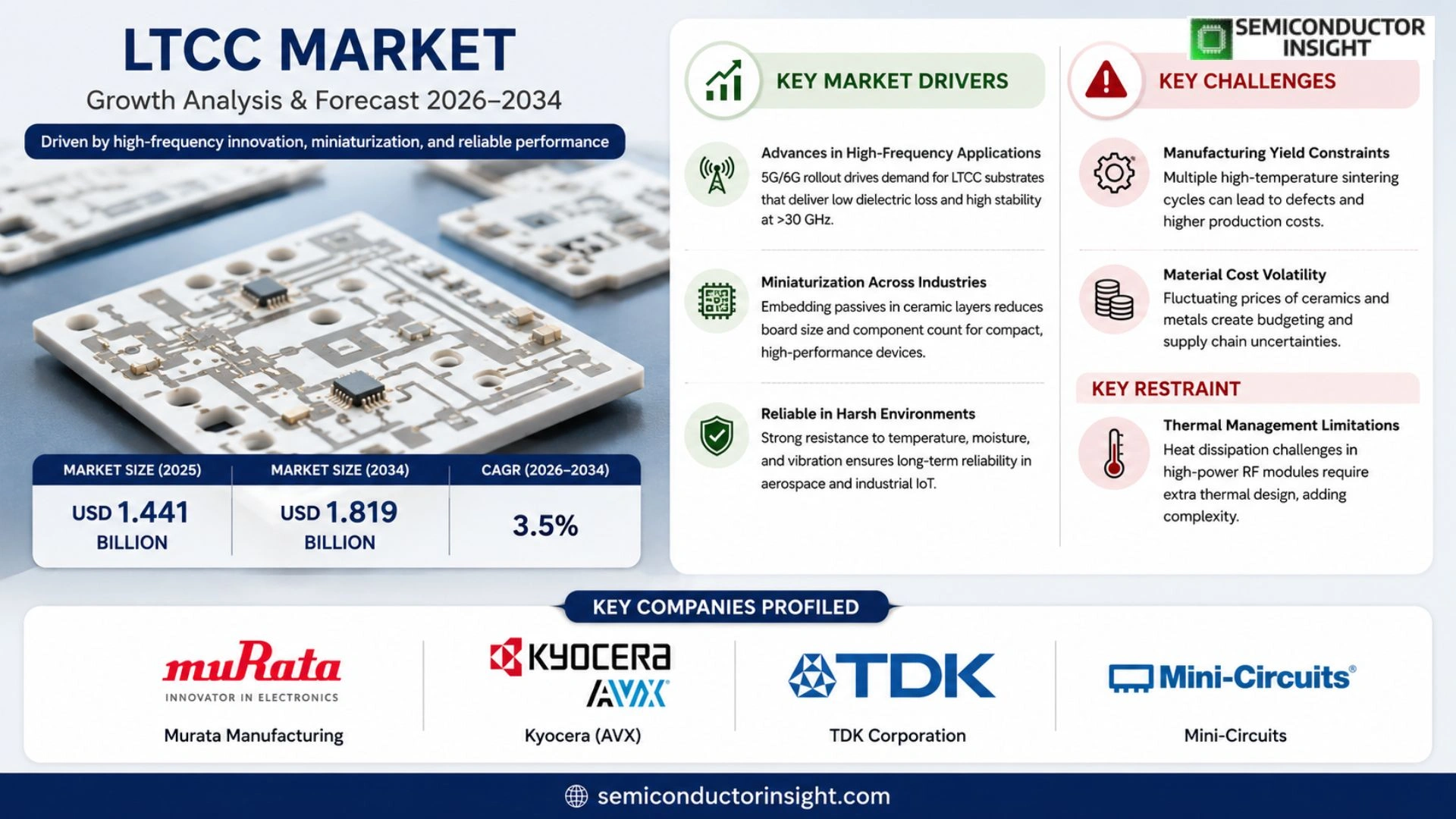
LTCC market size was valued at USD 1.441 billion in 2025. The market is projected to reach USD 1.819 billion by 2034, exhibiting a CAGR of 3.5% during the forecast period.
LTCC ceramic substrates are multilayer ceramic components fabricated at lower temperatures (approximately 850‑900 °C) by incorporating glass into alumina, which permits low‑resistivity conductors for circuit patterns. LTCC components include LC filters, directional couplers, power splitters and antennas; substrates cover Bluetooth and mobile front‑end modules; modules comprise phone antenna assemblies, Bluetooth modules and power‑amplifier units.
The market expands because consumer‑electronics RF modules demand low‑loss compact solutions, the rollout of 5G and beyond fuels high‑frequency passive devices, and automotive radar and electric‑vehicle systems create new application niches. Leading suppliers such as Murata Manufacturing, Kyocera (AVX), TDK Corporation, Mini‑Circuits, Taiyo Yuden and Samsung Electro‑Mechanics together represent roughly 80 % of revenue in 2024.
MARKET DRIVERS
Advances in High‑Frequency Applications
The rollout of 5G and emerging 6G testbeds has heightened the need for substrates that can sustain frequencies above 30 GHz. LTCC technology offers low dielectric loss and superior thermal stability, qualities that enable manufacturers to meet the exacting performance criteria of high‑frequency modules. As network operators densify antenna arrays, designers turn to LTCC to keep signal integrity intact while preserving power efficiency.
Miniaturization Pressure Across Sectors
Consumer electronics, automotive radar and medical imaging devices all pursue ever‑smaller form factors. By embedding passive components within ceramic layers, LTCC eliminates the need for discrete parts, thereby shrinking board dimensions without compromising reliability. Design teams are capitalising on this integration benefit to accelerate time‑to‑market for compact, high‑performance products.
➤ “Integrating capacitors, inductors and filters directly into the substrate cuts assembly steps and drives down overall system cost.”
Beyond pure performance, the material’s resistance to harsh environments,temperature spikes, moisture and vibration,makes it an attractive choice for aerospace and industrial IoT deployments, where failure is not an option.
MARKET CHALLENGES
Manufacturing Yield Constraints
LTCC production requires multiple high‑temperature sintering cycles, each introducing potential defect sources. Yield variations can push unit costs higher than those of traditional PCB processes, prompting some OEMs to limit LTCC use to premium‑grade applications. Addressing these inefficiencies demands investment in precision screen‑printing and tighter process control.
Other Challenges
Material Cost Volatility
The price of high‑purity ceramics and specialty metals fluctuates with global supply‑chain pressures, eroding the cost advantage that LTCC once held over competing substrate technologies. Companies that cannot lock in long‑term contracts may find budgeting for new projects increasingly unpredictable.
MARKET RESTRAINTS
Thermal Management Limitations
Despite its superior thermal conductivity relative to polymer substrates, LTCC still encounters heat dissipation challenges in high‑power RF modules. The ceramic layers can trap heat, necessitating additional thermal vias or heat‑sink integration. This design complexity can offset some of the space‑saving benefits that drive adoption.
MARKET OPPORTUNITIES
Integration with 5G/6G Infrastructure
As network operators expand dense small‑cell deployments, the demand for compact, high‑frequency front‑ends accelerates. LTCC’s capacity to embed passive networks directly on the substrate aligns perfectly with the modular architecture of next‑generation base stations. Early adopters can leverage this synergy to differentiate their hardware portfolios and capture premium market share.
Simultaneously, automotive manufacturers are embedding radar and lidar modules that operate at millimetre‑wave bands. LTCC’s robustness under temperature extremes positions it as a go‑to solution for vehicle‑to‑everything communications, opening a sizable avenue for component suppliers willing to tailor designs to automotive qualification standards.
LTCC Market Trends
5G Deployment and High‑Frequency Modules
The rollout of fifth‑generation networks has created a palpable shift toward components that can sustain low insertion loss at millimeter‑wave frequencies. Manufacturers are concentrating on LTCC structures that combine fine‑line metallization with low‑dielectric‑constant glass‑filled alumina, allowing antenna‑in‑package and filter‑in‑package solutions to shrink while preserving signal integrity. This evolution matters because telecom operators demand modules that occupy minimal board real estate yet deliver the bandwidth required for massive‑MIMO and beam‑forming arrays. The resulting design pressure encourages suppliers to refine firing cycles and adopt additive‑printing steps, ultimately reshaping the supply chain for high‑frequency passive devices.
Other Trends
Hybrid LTCC‑Organic Packaging
Integrating LTCC substrates with organic laminates is emerging as a pragmatic route to balance performance and cost. By placing LTCC dielectrics beneath organic interposers, designers achieve the thermal stability needed for power‑dense modules while leveraging the flexibility of polymer‑based routing for peripheral signals. This hybrid approach is attracting interest from automotive radar and industrial‑automation OEMs that require both high‑Q resonators and robust mechanical compliance. The trend reflects a broader industry move toward multi‑material stacks, where each layer is selected for its optimal electrical, thermal, or structural attribute, thereby widening the addressable application set beyond traditional consumer‑electronics RF.
Environmental and Sustainability Initiatives
Regulatory pressure and corporate green‑policy agendas are prompting LTCC producers to revisit sintering energy consumption and waste streams. Companies are trialing low‑temperature vitrified binders and recycling protocols that capture spent glass powders for re‑use in subsequent batches. These efforts are relevant because they not only lower operational expenditures but also position suppliers as responsible partners for OEMs seeking to certify their products under stringent environmental standards. The shift toward eco‑friendly manufacturing practices is expected to influence procurement decisions across sectors, encouraging a market that values both technical excellence and sustainability.
COMPETITIVE LANDSCAPE
Key Industry Players
LTCC Market – Competitive Overview
Murata Manufacturing dominates the high‑frequency segment, leveraging its vertically integrated supply chain and deep expertise in low‑loss ceramic dielectrics. The company’s ability to co‑develop substrate materials together with passive component designs gives it a decisive edge in smartphone RF modules and emerging 6G antenna solutions. This integrated approach has cemented Murata’s position as the reference supplier for tier‑one OEMs, allowing it to capture a disproportionate share of the overall LTCC revenue despite a modest product portfolio breadth. The market is therefore characterized by a steep concentration curve, with the ten largest firms accounting for roughly 80 % of global sales, reinforcing the importance of scale, R&D intensity, and collaborative design services.
Beyond the flagship tier, a cluster of Japanese, Korean, and European firms sustains the competitive fabric. Kyocera (AVX) and TDK Corporation excel in niche applications such as automotive radar and power‑amplifier modules, where their material‑science capabilities intersect with strict reliability standards. Mini‑Circuits, Samsung Electro‑Mechanics, and Taiyo Yuden diversify the landscape by targeting IoT and wearable markets, offering compact filters and couplers that prioritize low insertion loss. European players such as IMST GmbH and Bosch bring system‑level integration expertise, especially in ADAS and automotive electronics, while smaller specialists like Yokowo, KOA (Via Electronic) and Proterial Ltd focus on custom‑geometry LTCC shells for aerospace and defense. This breadth of specialization creates a multi‑tiered ecosystem where large incumbents set the performance baseline and agile niche firms capture emerging opportunities.
List of Key LTCC Companies Profiled
- Murata Manufacturing
- Kyocera (AVX)
- TDK Corporation
- Mini‑Circuits
- Taiyo Yuden
- Samsung Electro‑Mechanics
- Yokowo
- KOA (Via Electronic)
- Proterial Ltd
- Bosch
- IMST GmbH
- RAltron Electronics
Segment Analysis:
| Segment Category | Sub-Segments | Key Insights |
| By Type |
|
LTCC Components – Preferred for high‑frequency passive functions such as filters and couplers, offering low loss and compact form‑factor. – Strong adoption in consumer‑grade RF modules due to proven reliability and mature supply chains. – Continues to drive innovation in miniaturized antenna and power‑amplifier modules for emerging wireless standards. |
| By Application |
|
Consumer Electronics & Communications – Fuels demand for ultra‑compact RF front‑ends in smartphones and IoT devices. – Enables integration of multi‑band antennas and filters that meet stringent size and performance criteria. – Supports the migration to higher frequency bands for 5G and upcoming 6G services. |
| By End User |
|
Smartphone Manufacturers – Prioritize LTCC for its low dielectric loss, enabling high‑performance RF front‑ends. – Value the scalability of volume production combined with tight dimensional tolerances. – Seek continuous refinement of thin‑film metallization to support higher frequency operation. |
| By Technology Integration |
|
Hybrid LTCC‑Organic Packages – Merge the high‑frequency advantage of LTCC with the flexibility of organic substrates. – Enable designers to balance thermal management with electromagnetic performance. – Foster new form‑factors for wearables and compact edge‑computing modules. |
| By Market Driver |
|
5G and Beyond Deployment – Drives need for low‑loss, high‑density passive modules that can operate at mmWave frequencies. – Encourages suppliers to innovate in material purity and miniaturization techniques. – Aligns with industry push toward integrated antenna‑filter solutions for next‑generation devices. |
Regional Analysis: LTCC Market
Asia-Pacific
Co‑location of LTCC foundries with major component suppliers creates a dense manufacturing corridor, reducing component handling steps and enabling tighter tolerances. This proximity drives cost efficiencies and accelerates prototype cycles, giving regional firms a competitive edge in rapid product rollout.
Multinational electronics groups allocate a sizable share of their R&D budgets to high‑frequency ceramic technologies within the region, fostering breakthroughs in miniaturization and thermal management that ripple through the global supply chain.
Diversified sourcing of raw powders and laminates across several countries mitigates disruption risk. Regional consortia also promote shared logistics platforms, ensuring continuity even when individual routes face congestion or regulatory shifts.
The surge in 5G infrastructure, electric‑vehicle power modules, and aerospace telemetry is prompting local designers to adopt LTCC for its high‑frequency performance, carving out new niche markets that reinforce the region’s leadership stance.
North America
North America leverages its strong intellectual property framework and deep capital markets to nurture advanced LTCC design houses. While domestic production lags behind Asia‑Pacific in volume, the region excels in high‑value, low‑volume applications such as defense electronics and medical imaging, where performance outweighs cost considerations. Collaboration between universities and specialized firms accelerates the translation of academic breakthroughs into commercial substrate solutions, reinforcing a value‑added supply chain. The strategic focus on securing supply lines for critical components has also prompted major OEMs to establish local partnerships, mitigating exposure to overseas logistics shocks.
Europe
Europe’s LTCC ecosystem is shaped by a balance between precision engineering heritage and stringent regulatory standards. Countries with established automotive and aerospace clusters harness LTCC’s thermal stability to meet rigorous safety certifications, creating a niche around high‑reliability modules. Public‑private initiatives fund cross‑border projects that emphasize sustainability, encouraging the adoption of greener ceramic formulations. Although the market size is modest compared with Asia‑Pacific, Europe’s emphasis on quality and compliance positions its firms as preferred suppliers for sectors where certification timelines dominate purchasing decisions.
South America
South America is transitioning from a primarily import‑dependent stance to cultivating modest local capabilities in LTCC processing. Emerging electronics manufacturing hubs are capitalizing on lower labor costs and favorable trade agreements to attract investment in pilot lines. The region’s growth is anchored by demand for ruggedized communication devices tailored to remote and industrial environments, where LTCC’s durability offers a tangible advantage. While the ecosystem remains nascent, partnerships with Asian foundries provide technology transfer pathways that could accelerate maturity over the coming years.
Middle East & Africa
The Middle East & Africa segment exhibits a fragmented LTCC landscape, with a handful of nation‑state initiatives driving early‑stage development. In the Gulf, diversification strategies aim to reduce oil reliance by fostering high‑tech manufacturing, including ceramic substrate production for aerospace and defense contracts. African markets, meanwhile, view LTCC as a gateway to develop indigenous telecommunications infrastructure, aligning with broader digital inclusion goals. The common thread is the strategic use of LTCC to support national priorities, suggesting that future growth will hinge on government‑backed funding and targeted skill‑building programs.
Report Scope
This market research report provides a comprehensive analysis of the LTCC Market , covering the forecast period 2026–2034. It offers detailed insights into market dynamics, technological advancements, competitive landscape, and key trends shaping the industry.
Key focus areas of the report include:
- Market Overview: The report begins with an overview outlining its current market scenario, key growth indicators, and industry transformation drivers. It discusses macroeconomic factors, demand–supply balance, regulatory landscape, and the strategic role of semiconductors in powering advancements across industries such as automotive, telecommunications, consumer electronics, and industrial automation.
- Market Size & Forecast: Historical data and future projections for revenue, unit shipments, and market value across major regions and segments.
- Segmentation Analysis: Detailed breakdown by product type, technology, application, and end-user industry to identify high-growth segments and investment opportunities.
- Regional Insights: Insights into market performance across North America, Europe, Asia-Pacific, Latin America, and the Middle East & Africa, including country-level analysis where relevant.
- Competitive Landscape: Profiles of leading market participants, including their product offerings, R&D focus, manufacturing capacity, pricing strategies, and recent developments such as mergers, acquisitions, and partnerships.
- Technology Trends & Innovation: Assessment of emerging technologies, integration of AI/IoT, semiconductor design trends, fabrication techniques, and evolving industry standards.
- Market Drivers & Restraints: Evaluation of factors driving market growth along with challenges, supply chain constraints, regulatory issues, and market-entry barriers.
- Stakeholder Insights: Insights for component suppliers, OEMs, system integrators, investors, and policymakers regarding the evolving ecosystem and strategic opportunities.
Primary and secondary research methods are employed, including interviews with industry experts, data from verified sources, and real-time market intelligence to ensure the accuracy and reliability of the insights presented.
FREQUENTLY ASKED QUESTIONS:
What is the current market size of LTCC Market?
-> Global LTCC market size is projected to reach USD 1.819 billion by 2034, exhibiting a CAGR of 3.5% during the forecast period.
Which key companies operate in LTCC Market?
-> Key players include Murata Manufacturing, Kyocera (AVX), TDK Corporation, Mini-Circuits, Taiyo Yuden, Samsung Electro-Mechanics, Yokowo, KOA (Via Electronic), and Proterial Ltd, among others.
What are the key growth drivers?
-> Key growth drivers include rollout of 5G and beyond, electrification of vehicles and ADAS adoption, proliferation of IoT and wearable devices, and continuous R&D in low‑loss dielectrics and hybrid LTCC‑organic solutions.
Which region dominates the market?
-> Asia-Pacific holds the largest share, driven by strong participation from Japanese, Korean, and Chinese manufacturers, while Europe remains a significant competitor.
What are the emerging trends?
-> Emerging trends include further miniaturization through advanced printing and layering, integration of LTCC with organic substrates for hybrid packaging, and the push toward mmWave and terahertz frequencies for 6G and next‑generation sensing applications.
Get Sample Report PDF for Exclusive Insights
Report Sample Includes
- Table of Contents
- List of Tables & Figures
- Charts, Research Methodology, and more...
 Download Sample Report PDF