HTCC Package Market Insights
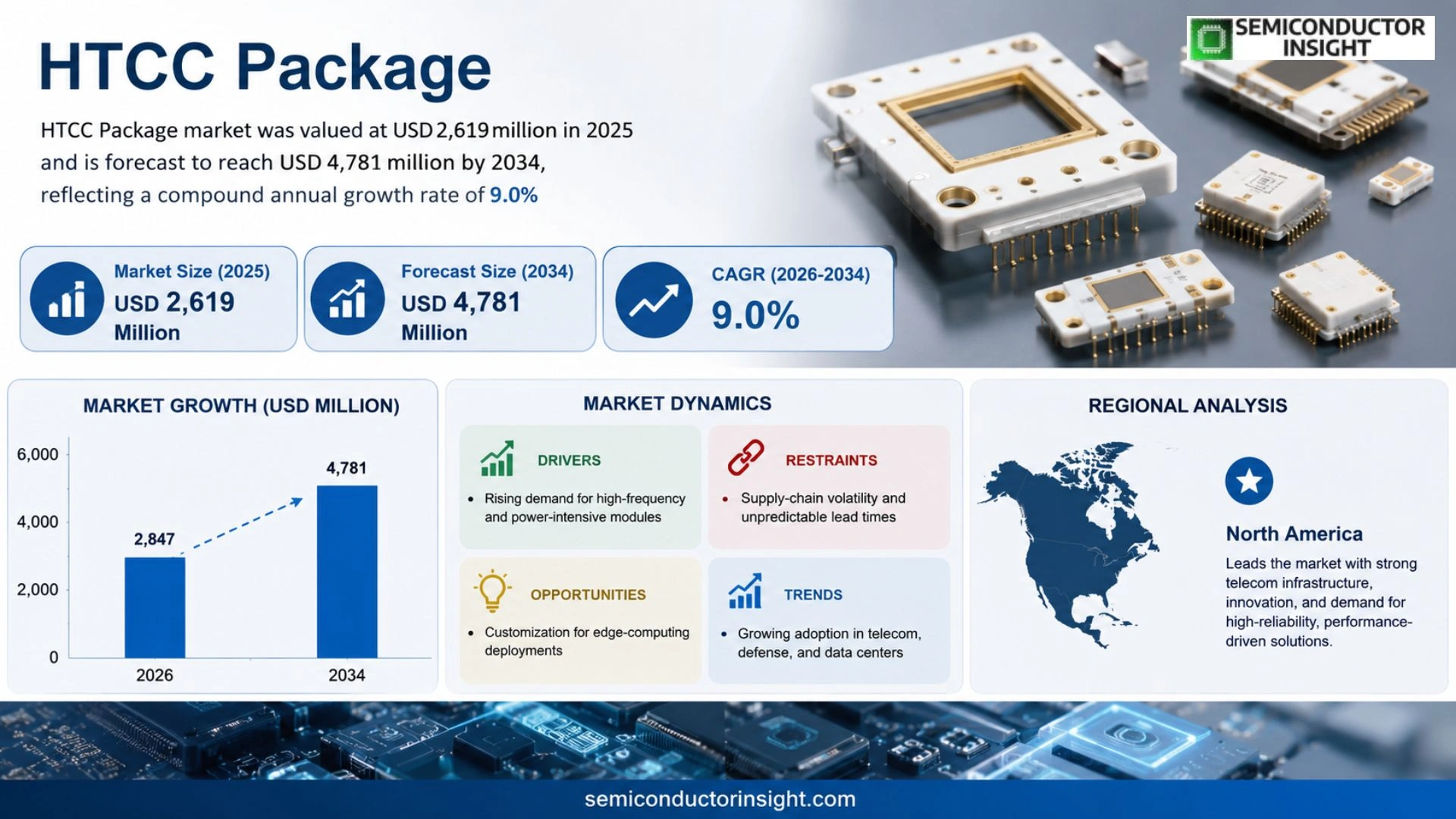
HTCC Package market was valued at USD 2,619 million in 2025 and is forecast to reach USD 4,781 million by 2034, reflecting a compound annual growth rate of 9.0% over the forecast horizon.
HTCC substrate,High Temperature Co‑fired Ceramics,refers to a multilayer ceramic structure produced by co‑firing ceramic layers with metal patterns such as tungsten or molybdenum at temperatures between 1,500 °C and 1,600 °C. This construction delivers high mechanical strength, superior heat dissipation and robust reliability, making it suitable for demanding applications including military electronics, MEMS devices, microprocessors and RF modules.
The expansion of the market stems from heightened investment in advanced electronics manufacturing, growing adoption of high‑frequency communication systems and increasing requirements for hermetic packaging in power‑dense environments. Key manufacturers such as Kyocera, Maruwa, NGK/NTK and Hebei Sinopack are expanding capacity and advancing process technologies to meet these demands.
MARKET DRIVERS
Rising Demand for Compact Power Solutions
Industrial customers are increasingly favouring compact, high‑efficiency power converters to meet space‑constrained designs. This shift is propelled by the need to reduce footprint while maintaining performance, especially in renewable‑energy installations and data‑center retrofits. As manufacturers streamline product lines, HTCC Package Market benefits from a broader adoption base.
Advancements in Semiconductor Materials
Recent breakthroughs in wide‑bandgap materials, such as silicon‑carbide (SiC) and gallium‑nitride (GaN), are unlocking higher voltage ratings and improved thermal management for packaged solutions. These technical gains translate into lower loss and longer service life, making packaged converters a compelling choice for OEMs seeking to enhance reliability without redesigning circuitry.
➤ “The convergence of miniaturisation and material science is reshaping how power is delivered across sectors.”
Collectively, these forces compress the procurement cycle, allowing end‑users to source ready‑to‑install modules faster, which in turn accelerates project timelines and improves capital‑expenditure planning.
MARKET CHALLENGES
Stringent Regulatory Environment
Compliance with global safety and electromagnetic‑interference (EMI) standards imposes additional design constraints on packaged converters. Manufacturers often need to invest in separate certification pathways for each major market, inflating development costs and extending time‑to‑market.
Other Challenges
Cost Sensitivity in Emerging Economies
While high‑performance packages deliver tangible benefits, price‑pressured buyers in developing regions may prioritise lower‑cost discrete solutions, limiting market penetration despite technical superiority.
MARKET RESTRAINTS
Supply‑Chain Volatility
Unpredictable lead times for key substrates and rare‑earth components create inventory pressure for vendors. When supply falters, manufacturers are forced to either hold excess safety stock,raising carrying costs,or risk production delays, both of which curb market growth.
MARKET OPPORTUNITIES
Customization for Edge‑Computing Deployments
Edge‑computing infrastructure demands power modules that can operate in harsh, distributed environments while delivering precise voltage regulation. Tailored HTCT Package Market offerings that incorporate ruggedised packaging and advanced thermal‑dissipation features are poised to capture this niche, where reliability outweighs price considerations.
Strategic alliances between semiconductor fabs and original equipment manufacturers (OEMs) can accelerate the rollout of application‑specific modules, turning bespoke design cycles into repeatable production runs and unlocking new revenue streams.
HTCC Package Market Trends
Rising Demand for High‑Frequency and Power‑Intensive Modules
HTCC Package Market moved from a valuation of US$ 2.62 billion in 2025 to an estimated US$ 4.78 billion by 2032, indicating a sustained 9 percent annual increase. This trajectory mirrors the push by telecom operators, data‑center architects, and defense contractors toward higher carrier frequencies and greater power densities. As 5G networks mature and early 6G concepts gain traction, circuit designers require substrates that can tolerate temperatures above 1,500 °C while preserving dielectric integrity. HTCC’s multilayer ceramic architecture supplies the low‑loss, high‑strength platform that enables tighter antenna integration and compact power‑amplifier modules. The ripple effect is visible in the procurement plans of major equipment manufacturers, who now prioritize HTCC‑based housings for RF front‑ends and laser‑driven industrial tools. By delivering superior thermal conductivity, these packages reduce the need for auxiliary cooling, directly translating into lower system‑level power budgets and higher reliability scores.
Other Trends
Regional Shifts and Supplier Consolidation
North America recorded US$ 654 million in 2024 and is slated to surpass US$ 1.16 billion by 2031, driven largely by defense spending and aerospace certification cycles. Asia‑Pacific, however, commands the lion’s share, expanding from US$ 1.51 billion in 2024 to US$ 2.70 billion in 2031, reflecting Japanese and Chinese capacity upgrades. The European segment grew from US$ 434 million to US$ 680 million over the same horizon, sustained by niche players focused on high‑precision medical lasers. Concentration among manufacturers remains high: the four largest firms,Kyocera, Maruwa, NGK/NTK, and Hebei Sinopack,hold roughly 82 percent of global revenue. Their dominance stems from vertically integrated material supply chains, long‑standing qualification dossiers, and the ability to secure volume contracts that smaller entrants cannot match. Consequently, new entrants are forced to adopt partnership models or specialize in low‑volume, custom‑design niches to gain market foothold.
Supply‑Chain Realignment and Qualification Pressure
Geopolitical considerations have reshaped sourcing strategies across HTCC Package Market. Governmental initiatives in both the United States and the European Union now mandate dual‑source arrangements for critical aerospace and telecom components, prompting firms to diversify production between Japan and emerging Chinese facilities. This shift accelerates capacity expansion in China while reinforcing the premium placed on Japanese process control and yield consistency. Concurrently, qualification cycles have lengthened, as end‑users demand exhaustive hermeticity testing and extended lifecycle assurances for mission‑critical modules. Suppliers that can deliver documented performance under extreme thermal and mechanical stress gain bargaining power, allowing them to command stable pricing even as overall volume growth moderates. The net outcome is a market that rewards technical depth and supply‑chain resilience over sheer price competition.
COMPETITIVE LANDSCAPE
Key Industry Players
HTCC Package Market – Competitive Overview
HTCC Package sector remains tightly held by a handful of firms that combine deep materials expertise with certified production lines for aerospace, telecom and high‑power electronics. Kyocera and Maruwa continue to dominate the upper tier, leveraging vertically integrated ceramic‑metal co‑firing processes that guarantee tight dimensional tolerances and yield stability. Their platforms attract customers seeking hermetic enclosures for 5G/6G RF modules, laser diodes and power converters, where any deviation can compromise reliability. Meanwhile, Japanese incumbents such as NGK/NTK and European specialist Egide sustain niche leadership by focusing on ultra‑high‑frequency substrates that address the thermal‑density challenges of data‑center optics. The concentration of capability, rather than price, forces new entrants to invest heavily in qualification, making the barrier to entry substantial.
Chinese manufacturers have accelerated expansion through state‑backed capacity programs, with Hebei Sinopack Electronic Tech & CETC 13 and Chaozhou Three‑Circle (Group) carving out sizable shares in ceramic shells and package assemblies. Their rapid scale‑up is driven by regional defense and telecom contracts that require dual‑sourcing alternatives to Japanese supply. Companies such as NEO Tech and CETC 43 (Shengda Electronics) are differentiating by offering application‑specific designs for automotive power modules and industrial laser systems. This geographic diversification is reshaping the supply chain, prompting tier‑1 system integrators to adopt a multi‑source strategy that balances Japanese quality pedigree with Chinese volume advantage.
List of Key HTCC Package Companies Profiled
- Kyocera Corporation
- Maruwa Co., Ltd.
- NGK/NTK
- Egide
- NEO Tech
- Chaozhou Three‑Circle (Group)
- Hebei Sinopack Electronic Tech & CETC 13
- CETC 43 (Shengda Electronics)
- Fujian Minhang Electronics
- AdTech Ceramics
- AMETEK Aegis
- Electronic Products, Inc. (EPI)
Segment Analysis:
| Segment Category | Sub-Segments | Key Insights |
| By Type |
|
HTCC Ceramic Shell/Housings
|
| By Application |
|
Communication Package
|
| By End User |
|
Defense & Aerospace
|
| By Frequency & Power |
|
High‑Frequency RF Modules
|
| By Reliability & Hermeticity |
|
Mission‑Critical Defense
|
Regional Analysis: HTCC Package Market
North America
Silicon Valley, Boston, and Toronto host clusters of R&D labs that iterate on HTCC architectures at a pace unmatched elsewhere. The density of talent and venture capital in these hubs translates into rapid prototyping, allowing firms to test new thermal‑management techniques within months rather than years.
The region benefits from a diversified supplier network spanning North America, East Asia, and Europe. This geographic spread mitigates single‑point failures and ensures that component shortages have limited impact on final‑stage assembly of HTCC packages.
Cloud service providers and hyperscale data centers in the United States demand ever‑higher bandwidth per module. Their appetite for compact, power‑efficient HTCC packages fuels a cycle of design refinement that resonates throughout the supply chain.
Federal agencies promote standards that prioritize energy efficiency and electromagnetic compliance. Companies aligning their HTCC offerings with these guidelines earn faster certification, shortening time‑to‑market for innovative solutions.
Europe
European firms capitalize on a strong tradition of standards‑driven engineering, shaping HTCC Package Market through collaborative consortia that harmonize design specifications across borders. The region’s emphasis on sustainability channels investment toward packages that minimize thermal waste, aligning with broader carbon‑reduction agendas. Meanwhile, the presence of major telecom operators in Germany, France, and the UK sustains demand for high‑density packaging, prompting local vendors to differentiate through modularity and ease of integration. The cumulative effect is a market that values reliability and regulatory conformity as much as raw performance.
Asia‑Pacific
In the Asia‑Pacific, rapid urbanization and the rollout of next‑generation networks create a fertile environment for HTCC adoption. Nations such as Japan, South Korea, and Singapore prioritize network densification, prompting manufacturers to tailor packages that fit constrained spatial footprints while delivering robust thermal handling. Cultural emphasis on cost‑effectiveness pushes suppliers to streamline production, often leveraging local semiconductor fabs to keep lead times short. The region’s competitive dynamics foster a climate where incremental innovation is constantly tested against price sensitivity.
South America
South American markets exhibit a cautious but optimistic stance toward HTCC technologies. Growing mobile broadband penetration and government‑backed broadband expansion projects generate a nascent demand for high‑performance packaging. Local operators, while mindful of budget constraints, recognize the long‑term operational savings offered by efficient thermal designs. Partnerships with North American and European equipment makers enable technology transfer, allowing regional players to adapt proven solutions to local network topologies.
Middle East & Africa
The Middle East & Africa region presents a mosaic of opportunities driven by large‑scale infrastructure projects and a surge in data‑center construction, particularly in the Gulf Cooperation Council states. Energy‑aware policies encourage the deployment of HTCC packages that can withstand extreme ambient temperatures without compromising performance. In Africa, emerging telecom operators view HTCC solutions as a way to leapfrog legacy equipment, aligning with ambitions to deliver reliable connectivity across underserved areas. Collaborative ventures with global OEMs are gradually shaping a market that balances rigorous environmental demands with cost considerations.
Report Scope
This market research report provides a comprehensive analysis of the HTCC Package Market , covering the forecast period 2026–2034. It offers detailed insights into market dynamics, technological advancements, competitive landscape, and key trends shaping the industry.
Key focus areas of the report include:
- Market Overview: The report begins with an overview outlining its current market scenario, key growth indicators, and industry transformation drivers. It discusses macroeconomic factors, demand–supply balance, regulatory landscape, and the strategic role of semiconductors in powering advancements across industries such as automotive, telecommunications, consumer electronics, and industrial automation.
- Market Size & Forecast: Historical data and future projections for revenue, unit shipments, and market value across major regions and segments.
- Segmentation Analysis: Detailed breakdown by product type, technology, application, and end-user industry to identify high-growth segments and investment opportunities.
- Regional Insights: Insights into market performance across North America, Europe, Asia-Pacific, Latin America, and the Middle East & Africa, including country-level analysis where relevant.
- Competitive Landscape: Profiles of leading market participants, including their product offerings, R&D focus, manufacturing capacity, pricing strategies, and recent developments such as mergers, acquisitions, and partnerships.
- Technology Trends & Innovation: Assessment of emerging technologies, integration of AI/IoT, semiconductor design trends, fabrication techniques, and evolving industry standards.
- Market Drivers & Restraints: Evaluation of factors driving market growth along with challenges, supply chain constraints, regulatory issues, and market-entry barriers.
- Stakeholder Insights: Insights for component suppliers, OEMs, system integrators, investors, and policymakers regarding the evolving ecosystem and strategic opportunities.
Primary and secondary research methods are employed, including interviews with industry experts, data from verified sources, and real-time market intelligence to ensure the accuracy and reliability of the insights presented.
FREQUENTLY ASKED QUESTIONS:
What is the current market size of HTCC Package Market?
-> HTCC Package market is forecast to reach USD 4,781 million by 2034, reflecting a compound annual growth rate of 9.0% over the forecast horizon.
Which key companies operate in HTCC Package Market?
-> Key players include Kyocera, Maruwa, NGK Spark Plug, Hebei Sinopack Electronic Tech & CETC 13, Chaozhou Three-Circle, and other leading manufacturers.
What are the key growth drivers?
-> Key growth drivers include reliability/qualification pull, high‑performance thermal and electrical characteristics, system‑level integration demand, power/thermal density challenges, and policy‑driven supply‑chain localization.
Which region dominates the market?
-> Asia‑Pacific holds the largest market share, with a 2024 value of USD 1,507 million and projected to reach USD 2,697 million by 2031, outpacing North America and Europe.
What are the emerging trends?
-> Emerging trends include higher frequency and tighter integration, increased power‑density and thermal‑management solutions, and growing demand for hermetic, miniaturized sensor, photonics and RF modules.
Get Sample Report PDF for Exclusive Insights
Report Sample Includes
- Table of Contents
- List of Tables & Figures
- Charts, Research Methodology, and more...
 Download Sample Report PDF