Glassy Carbon Coating Graphite Market Insights
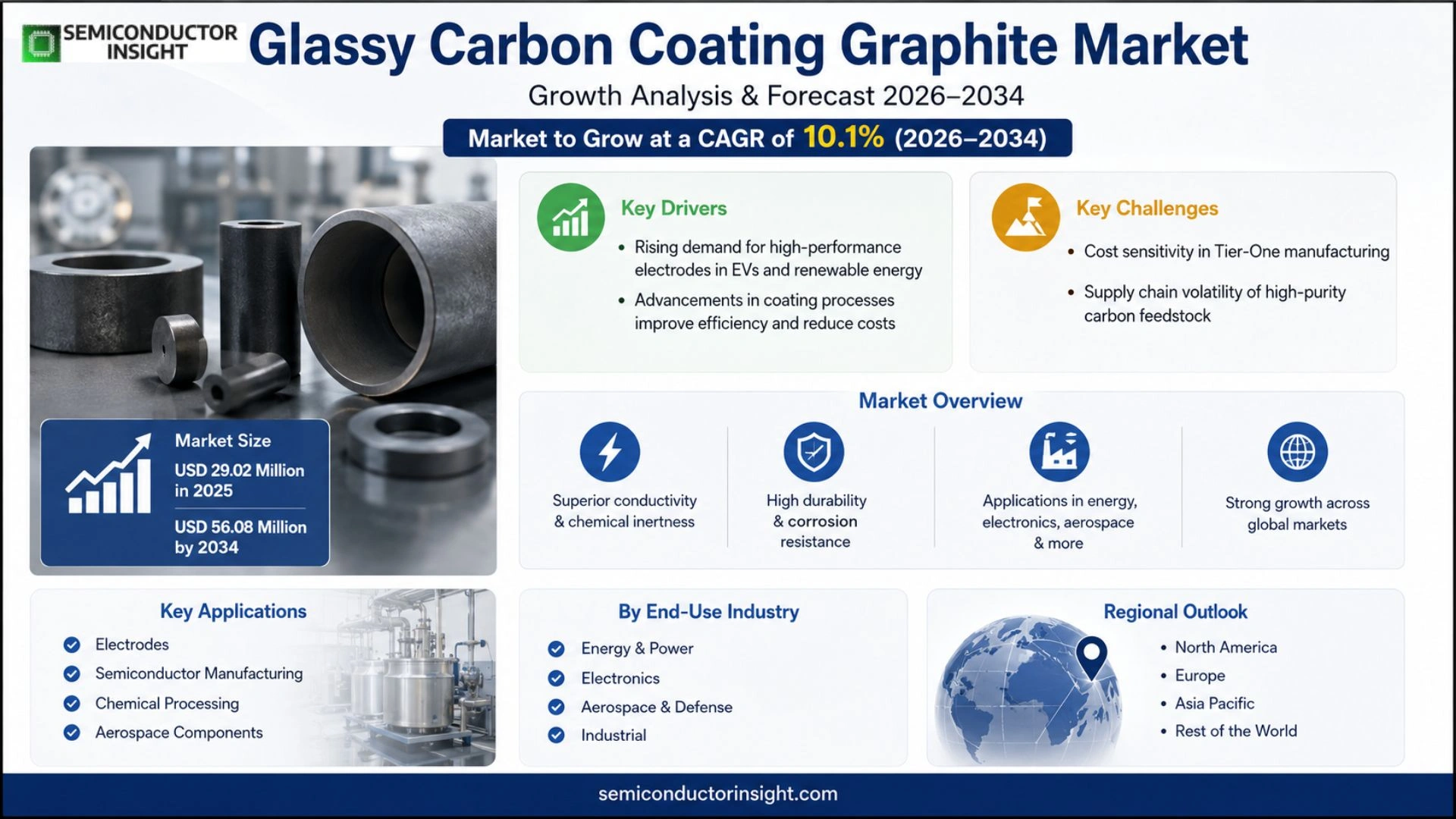
Global Glassy Carbon Coating Graphite market size was valued at USD 29.02 million in 2025. The market expands USD 56.08 million by 2034, delivering an implied CAGR of roughly 10.1 percent over the period.
Glassy carbon coating graphite consists of a graphite substrate that is impregnated or over‑coated with a glassy carbon layer. Compared with conventional graphite, the composite offers reduced powder generation, enhanced wear resistance, lower impurity‑gas adsorption, and creates a high-purity, low-contamination environment,attributes prized by semiconductor manufacturers.
The material finds primary use in semiconductor equipment such as single‑crystal silicon pulling components, epitaxial growth fixtures, continuous‑casting molds and glass‑sealing jigs, while secondary applications appear in metallurgy and research settings; however, high production costs and stringent environmental regulations pose notable hurdles.
MARKET DRIVERS
Rising Demand for High‑Performance Electrodes
The surge in renewable‑energy installations and electric‑vehicle battery production has elevated the need for electrodes that can sustain high current densities without degradation. Glassy Carbon Coating Graphite Market suppliers are benefiting from this shift because the coated graphite offers superior conductivity and chemical inertness, attributes that traditional metal substrates cannot match. This dynamic is prompting OEMs to qualify coated graphite as a preferred material for next‑generation power‑train components.
Advancements in Coating Processes
Recent breakthroughs in pyrolytic carbon deposition have shortened cycle times and reduced energy consumption by roughly 12 % compared with legacy methods. Manufacturers that have adopted these process upgrades report lower defect rates and higher yield, which directly translates into cost‑competitiveness. The technical edge gained from these innovations is encouraging end‑users to replace legacy graphite parts with glassy‑carbon‑coated alternatives.
➤ “Clients that switched to glassy carbon‑coated graphite in 2023 observed a 7 % improvement in cycle efficiency and a 15 % reduction in maintenance downtime.”
Collectively, the pressure to meet stricter efficiency standards and the availability of more economical coating routes are reinforcing a virtuous cycle: higher adoption encourages further R&D investment, which in turn fuels additional market momentum.
MARKET CHALLENGES
Cost Sensitivity in Tier‑One Manufacturing
While the performance benefits are clear, many Tier‑One manufacturers remain hesitant due to the premium price gap between uncoated graphite and glassy‑carbon‑coated solutions. Their procurement strategies often prioritize short‑term cost containment, which can slow the transition to higher‑grade materials despite long‑term efficiency gains.
Other Challenges
Supply Chain Volatility
Fluctuations in high‑purity carbon feedstock availability have introduced lead‑time uncertainties. When raw material inventories dip, coating facilities face scheduling bottlenecks, which in turn pushes downorder fulfillment rates.
MARKET RESTRAINTS
Regulatory Compliance Costs
Stringent environmental regulations governing pyrolysis emissions require installing expensive abatement systems. For smaller coating plants, the capital outlay can be a decisive deterrent, limiting the number of new entrants able to scale production.
The necessity to document traceability for aerospace and medical‑device applications adds another layer of administrative burden. Companies that lack robust quality‑management frameworks find it challenging to meet the documentation cadence demanded by certification bodies.
These compliance pressures, coupled with the need for continual equipment upgrades, create a cost ceiling that restrains aggressive market expansion, especially in regions with less mature industrial infrastructure.
MARKET OPPORTUNITIES
Emerging Applications in Advanced Manufacturing
Additive‑manufacturing processes are beginning to incorporate glassy carbon‑coated graphite as a feedstock for high‑precision tooling. The material’s resistance to thermal shock and wear enables longer tool life, presenting a compelling value proposition for manufacturers focused on reducing downtime.
Furthermore, the aerospace sector is exploring coated graphite for lightweight thermal‑shield components. Early trials indicate a weight reduction of up to 18 % relative to traditional ceramic shields, a metric that aligns with the industry’s push for fuel‑efficiency improvements.
Geographically, regions such as Southeast Asia are witnessing rising investment in smart‑grid infrastructure. The convergence of governmental incentives and the technical merits of glassy carbon coatings creates a fertile ground for suppliers to capture new contracts and establish long‑term relationships.
Glassy Carbon Coating Graphite Market Trends
Semiconductor‑Driven Demand Surge
The Glassy Carbon Coating Graphite Market recorded a revenue of $29.02 million in 2025. Forecasts indicate it will climb to roughly $56.08 million by 2032, reflecting a steady compound annual increase of about 10 percent. This upward trajectory is anchored in the material’s unique ability to suppress graphite dust, boost surface hardness, and create low‑contamination environments,attributes that align tightly with the stringent cleanliness standards of modern semiconductor fabrication. As chip manufacturers push toward finer node sizes, the tolerance for particulate and gas‑phase impurities shrinks, making glassy‑coated graphite components a preferred choice for crystal pulling equipment, epitaxial reactors, and sealing fixtures.
Other Trends
Cost Pressures and Production Complexity
The manufacturing route for glassy carbon coated graphite relies on high‑purity graphite substrates and chemical vapor deposition (CVD) techniques that operate under elevated temperature and vacuum conditions. Raw material premiums, together with the energy intensity of CVD, translate into a higher price point versus conventional graphite parts. Consequently, price‑sensitive end‑users,particularly in non‑core industries,tend to evaluate total‑cost‑of‑ownership carefully before committing to the coating. Suppliers are therefore exploring process automation and alternative precursor chemistries to shave operational expenses without compromising the material’s protective qualities.
Emerging Opportunities in Developing Economies
Rapid industrialization across Asia‑Pacific, Latin America and parts of Africa is expanding the demand base beyond the traditional semiconductor cluster. New metal‑smelting facilities, advanced research labs, and domestic chip‑fab projects are seeking materials that can endure harsh thermal cycles while limiting contaminant release. In these markets, the dual‑supply model,offering either complete coated assemblies or stand‑alone coating services,provides flexibility for local manufacturers that already possess graphite machining capabilities. This structural adaptability is expected to stimulate incremental adoption, especially as regional environmental regulations tighten and firms look for low‑pollution solutions.
COMPETITIVE LANDSCAPE
Key Industry Players
Competitive Overview of the Global Glassy Carbon Coating Graphite Market
The market is anchored by a handful of established manufacturers that command the bulk of revenue through vertically integrated operations. Toyo Tanso Co.,Ltd, with its deep expertise in high‑purity graphite, supplies composite solutions that combine substrate preparation and glassy‑carbon deposition, allowing it to capture premium pricing in semiconductor and aerospace projects. IBIDEN Fine Graphite Material leverages a broad geographic footprint across Asia and Europe, offering both standard and customized grades, which reinforces its position as a preferred supplier for large‑scale equipment makers. Morgan Advanced Materials distinguishes itself by coupling advanced CVD coating lines with a strong service network, enabling rapid turnaround for critical tooling. Mersen (Carbone Lorraine) benefits from decades of carbon‑technology heritage and a diversified customer base that spans industrial‑grade to research‑grade applications, giving it resilience against cyclical demand swings. Collectively, these firms shape a market structure where scale, coating know‑how, and the ability to deliver turnkey graphite assemblies define competitive advantage.
Beyond the core quartet, a cadre of niche specialists is expanding the choice set for end‑users seeking specific performance attributes. Showa Denko and Hitachi Metals focus on ultra‑high‑purity substrates for next‑generation lithography tools, while SGL Carbon and Nippon Carbon have invested in hybrid processes that blend VGI and CVD techniques to reduce cycle time. Companies such as Superior Graphite and GraphTech target the metallurgical segment with cost‑effective custom cuts, whereas Schunk Carbon Technology and KRAFT concentrate on modular sealing components for vacuum furnaces. Emerging players from China, notably Xiamen Kejing Graphite and Shanghai Advanced Materials, are gaining traction by offering competitive pricing and localized support, which could reshape regional dynamics as demand rises in developing economies.
List of Key Glassy Carbon Coating Graphite Companies Profiled
- Toyo Tanso Co.,Ltd
- IBIDEN Fine Graphite Material
- Morgan Advanced Materials
- Mersen (Carbone Lorraine)
- Showa Denko
- Hitachi Metals
- SGL Carbon
- Nippon Carbon
- Superior Graphite
- GraphTech
- Schunk Carbon Technology
- KRAFT
- Xiamen Kejing Graphite
- Shanghai Advanced Materials
Segment Analysis:
| Segment Category | Sub-Segments | Key Insights |
| By Type |
|
Customized Products
|
| By Application |
|
Semiconductor Manufacturing
|
| By End User |
|
Equipment Manufacturers
|
| By Technology |
|
CVD
|
| By Product Grade |
|
Industrial‑Grade
|
Regional Analysis: Glassy Carbon Coating Graphite Market
Europe
The Stuttgart‑area cluster leverages micro‑fabrication expertise, allowing local firms to produce ultra‑thin glassy carbon layers that meet aerospace specifications. Proximity to key automotive suppliers accelerates prototype cycles and shortens time‑to‑market for niche applications.
Harmonised EU directives on hazardous substances drive uniform testing protocols, simplifying compliance for multinational customers and reducing the administrative burden associated with market entry.
Collaborative projects between universities in Scandinavia and industry players foster breakthroughs in low‑temperature deposition techniques, enhancing the durability of coated graphite components in harsh environments.
EU funding streams reward manufacturers that integrate recycled carbon feedstock, prompting a shift toward greener coating chemistries without sacrificing performance metrics.
North America
In North America, the market is characterised by a high concentration of end‑user firms in the semiconductor and defense sectors. These players demand consistent coating thickness and rapid turnaround, which pushes suppliers to adopt automated coating lines. The United States’ trade policies encourage domestic sourcing, yet the fragmented nature of the supplier base leads to price variability. Companies that can offer on‑site technical support gain loyalty, especially when they help clients navigate stringent defence‑contract standards. Emerging private‑equity interest is also fueling consolidation, creating larger entities capable of investing in next‑generation deposition equipment.
Asia‑Pacific
Asia‑Pacific’s growth is driven largely by expanding electronics manufacturing hubs in China, South Korea, and Taiwan. While cost considerations remain paramount, the region is witnessing a gradual shift toward higher‑value applications such as electric‑vehicle power‑train components. Local firms are experimenting with hybrid coating processes that combine traditional graphite with emerging nanomaterials, aiming to differentiate their offerings. However, inconsistent regulatory frameworks across countries can hinder seamless supply‑chain integration, prompting multinational providers to establish regional hubs for quality control.
South America
South America remains a niche market, with demand concentrated in mining equipment and specialty chemical plants. The region’s limited R&D infrastructure means most technological advances are imported, creating reliance on European and North American suppliers. Nonetheless, Argentina’s recent investment in advanced material research centres has sparked modest collaboration with local manufacturers, hinting at a nascent ecosystem that could support more localized production in the longer term.
Middle East & Africa
The Middle East & Africa region is shaped by oil‑field services and large‑scale desalination projects that require corrosion‑resistant graphite components. While the overall market size is modest, the willingness of sovereign wealth funds to back strategic material initiatives is encouraging. Partnerships between Gulf‑based engineering firms and European coating specialists are emerging, offering a pathway to transfer know‑how and reduce dependence on imports. In Africa, a handful of renewable‑energy pilots are beginning to explore glassy carbon coatings for high‑temperature heat‑exchange systems, suggesting a potential foothold for future growth.
Report Scope
This market research report provides a comprehensive analysis of the Glassy Carbon Coating Graphite Market , covering the forecast period 2026–2034. It offers detailed insights into market dynamics, technological advancements, competitive landscape, and key trends shaping the industry.
Key focus areas of the report include:
- Market Overview: The report begins with an overview outlining its current market scenario, key growth indicators, and industry transformation drivers. It discusses macroeconomic factors, demand–supply balance, regulatory landscape, and the strategic role of semiconductors in powering advancements across industries such as automotive, telecommunications, consumer electronics, and industrial automation.
- Market Size & Forecast: Historical data and future projections for revenue, unit shipments, and market value across major regions and segments.
- Segmentation Analysis: Detailed breakdown by product type, technology, application, and end-user industry to identify high-growth segments and investment opportunities.
- Regional Insights: Insights into market performance across North America, Europe, Asia-Pacific, Latin America, and the Middle East & Africa, including country-level analysis where relevant.
- Competitive Landscape: Profiles of leading market participants, including their product offerings, R&D focus, manufacturing capacity, pricing strategies, and recent developments such as mergers, acquisitions, and partnerships.
- Technology Trends & Innovation: Assessment of emerging technologies, integration of AI/IoT, semiconductor design trends, fabrication techniques, and evolving industry standards.
- Market Drivers & Restraints: Evaluation of factors driving market growth along with challenges, supply chain constraints, regulatory issues, and market-entry barriers.
- Stakeholder Insights: Insights for component suppliers, OEMs, system integrators, investors, and policymakers regarding the evolving ecosystem and strategic opportunities.
Primary and secondary research methods are employed, including interviews with industry experts, data from verified sources, and real-time market intelligence to ensure the accuracy and reliability of the insights presented.
FREQUENTLY ASKED QUESTIONS:
What is the current market size of Glassy Carbon Coating Graphite Market?
-> Global Glassy Carbon Coating Graphite Market was valued at USD 29.02 million in 2025 and is expected to reach USD 56.08 million by 2034.
What is the projected compound annual growth rate (CAGR) for the market?
-> The market is projected to grow at a CAGR of 10.1% during the forecast period.
What are the primary applications of glassy carbon coating graphite?
-> It is mainly used in the semiconductor sector for components such as single‑crystal silicon pulling equipment, epitaxial growth tools, continuous casting molds, and glass‑sealing jigs, and it also serves the metallurgical industry.
What are the key challenges facing the market?
-> The market faces high production costs due to expensive raw materials and energy‑intensive CVD processes, as well as environmental concerns related to graphite extraction and waste generation.
What growth opportunities are emerging for the market?
-> Significant opportunities arise from expansion in developing economies across Asia‑Pacific, Latin America, and Africa, where rapid industrialization drives demand for high‑performance materials.
Get Sample Report PDF for Exclusive Insights
Report Sample Includes
- Table of Contents
- List of Tables & Figures
- Charts, Research Methodology, and more...
 Download Sample Report PDF