HTCC Packages and Substrates Market Insights
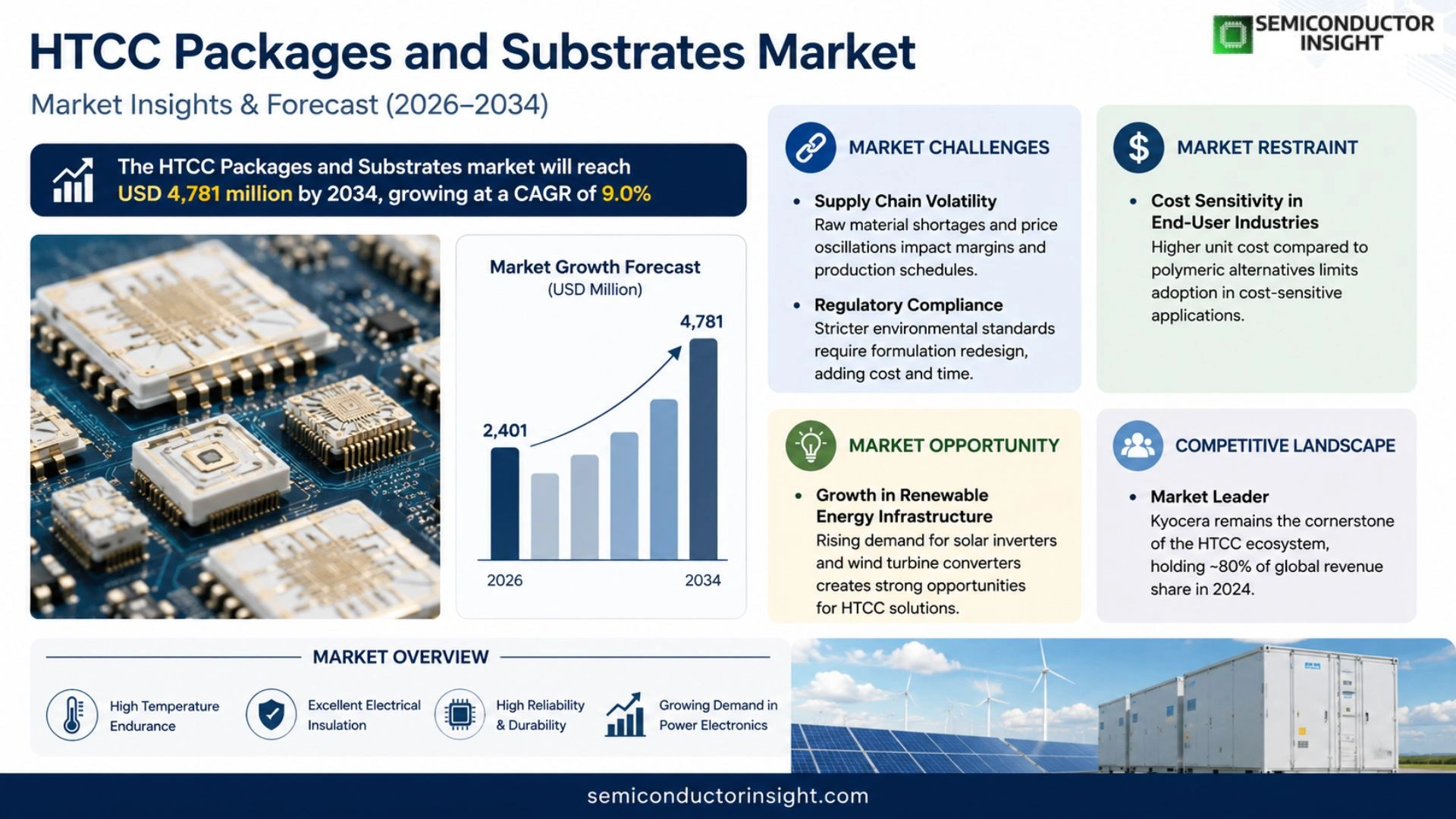
Global HTCC Packages and Substrates market size was valued at USD 2,619 million in 2025. Forecasts indicate the market will reach USD 4,781 million by 2034, reflecting an annual growth rate of approximately 9.0 % over the period.
HTCC substrate,High Temperature Co‑fired Ceramics,refers to a multilayer ceramic structure produced by co‑firing a ceramic matrix with metal conductors such as tungsten or molybdenum at temperatures between 1500 °C and 1600 °C. The resulting material offers high mechanical strength, excellent heat dissipation, and superior reliability, making it suitable for military electronics, MEMS devices, microprocessors and RF modules.
The upward trajectory is supported by expanding requirements for high‑frequency communication components, increased power‑density designs in data‑center optics, and stricter reliability standards in aerospace and defense applications. Major suppliers,including Kyocera, Maruwa, Niterra (NGK/NTK), Hebei Sinopack Electronic Tech & CETC 13,continue to invest in process optimisation and capacity expansion across Japan and China. Recent announcements of new production lines for hermetic sensor housings illustrate how manufacturers are aligning capabilities with emerging system‑level integration trends.
MARKET DRIVERS
Rising Demand for High‑Temperature Co‑Fire Solutions
Industrial manufacturers are seeking components that can tolerate extreme thermal environments without degradation. This pressure fuels adoption of HTCC Packages and Substrates Market offerings that promise reliable performance at temperatures exceeding 250 °C. As equipment uptime becomes a competitive lever, operators prioritize technologies that reduce replacement cycles.
Advances in Material Engineering
Recent breakthroughs in ceramic‑based composites and low‑k dielectric formulations have broadened the functional envelope of high‑temperature packages. Engineers can now integrate finer interconnects while retaining thermal stability, opening pathways for miniaturized power modules. HTCC Packages and Substrates Market benefits directly from these material gains, which translate into higher design flexibility for OEMs.
➤ “Material innovations are reshaping thermal management strategies, turning temperature constraints into design opportunities.”
Another catalyst lies in the shift toward electrified propulsion systems across aerospace and railway sectors. These platforms require power electronics that operate efficiently under sustained heat loads, creating a steady stream of orders for robust ceramic packages.
MARKET CHALLENGES
Supply Chain Volatility
Raw material shortages, particularly for high‑purity alumina and silicon dioxide, have introduced price oscillations that compress margins for manufacturers. Weight‑loss in inventory turnover hampers the ability to meet just‑in‑time production schedules, prompting some buyers to postpone capital expenditures.
Other Challenges
Regulatory Compliance
Environmental directives in key regions impose stricter limits on lead and other hazardous substances. Conforming to these standards demands redesign of existing formulations, adding cost and development time for suppliers.
MARKET RESTRAINTS
Cost Sensitivity in End‑User Industries
While high‑temperature ceramic packages deliver durability, their unit cost remains higher than conventional polymeric alternatives. Sectors such as consumer electronics, which operate on thin profit margins, often limit adoption to niche applications where performance outweighs expense.
MARKET OPPORTUNITIES
Growth Potential in Renewable Energy Infrastructure
Solar inverters and wind turbine converters increasingly rely on power modules that must endure harsh outdoor conditions. The ability of HTCC Packages and Substrates Market solutions to maintain electrical integrity under temperature swings positions them as attractive candidates for upcoming renewable projects. Companies that invest early in tailored substrate designs can capture a share of the expanding clean‑energy supply chain.
HTCC Packages and Substrates Market Trends
Shift Toward High‑Frequency and High‑Power Modules
Manufacturers are re‑engineering HTCC Packages and Substrates to satisfy the escalating thermal and signal‑integrity requirements of 5G, data‑center optics, and industrial laser systems. The multilayer ceramic architecture enables tighter routing and superior heat‑spreading, which translates into longer device lifetimes in harsh environments. As system designers pursue greater miniaturization, they increasingly rely on the hermetic sealing and dimensional stability that HTCC delivers, turning the material from a niche solution into a backbone for next‑generation RF and photonic modules. This technical migration is reshaping product roadmaps, prompting vendors to invest in finer firing tolerances and customized metal paste formulations to stay ahead of the performance curve.
Other Trends
Regional Production Dynamics
Japan continues to dominate the supply chain through vertically integrated operations that couple raw‑material control with advanced sintering expertise. Japanese players leverage long‑standing relationships with aerospace and telecom customers, which allows them to command premium pricing for verified yield and qualification records. China has accelerated capacity expansion, focusing on cost‑effective scaling while seeking certifications that mirror Japanese standards. Europe remains a specialist hub, concentrating on niche applications such as high‑purity medical lasers. The divergent strategies create a landscape where high‑value contracts gravitate toward established Japanese firms, whereas volume‑driven segments increasingly source from Chinese facilities.
Supply‑Chain Localization and Dual‑Sourcing
Geopolitical uncertainty and defense‑sector procurement policies are compelling OEMs to diversify their supplier base. Dual‑sourcing arrangements now pair Japanese reliability with Chinese manufacturing agility, reducing exposure to single‑point failures. This shift is prompting companies to certify multiple fabs, standardize testing protocols, and share design data across borders. For end‑users, the outcome is a more resilient supply chain that can sustain long lead‑times without sacrificing the stringent performance metrics required for mission‑critical modules. Consequently, market participants that can offer both proven quality and flexible delivery models are poised to capture a disproportionate share of upcoming contracts.
COMPETITIVE LANDSCAPE
Key Industry Players
Competitive Overview of Global HTCC Packages and Substrates Market
Kyocera remains the cornerstone of the HTCC ecosystem, commanding roughly four‑fifths of overall revenue in 2024. Its vertically integrated supply chain, spanning raw‑material sintering to multilayer packaging, provides a degree of yield consistency that few rivals match. This scale advantage translates into preferential qualification for aerospace, defense and high‑frequency telecom programs, where long‑term reliability supersedes pure cost considerations. Maruwa, long‑time partner of Kyocera within the Japanese HTCC cluster, differentiates itself through a focused portfolio of high‑power, high‑frequency substrates that target data‑center optical links and next‑generation radar. Niterra (NGK/NTK) reinforces the Japanese stronghold by leveraging extensive metal‑patterning expertise, while Chinese conglomerates such as Hebei Sinopack Electronic Tech (CETC 13) and Chaozhou Three‑Circle have accelerated capacity expansion to capture a growing share of the Asia‑Pacific demand. Collectively, the market exhibits a tight concentration: the top four manufacturers account for over 80 % of sales, a structure that discourages price wars but intensifies competition around qualification depth and application‑specific engineering.
Beyond the dominant trio, a cadre of niche players shapes segmental dynamics. European specialist Egide supplies hermetic housings for aerospace sensors, carving a defensible slice of the high‑reliability niche despite its modest scale. NEO Tech and AdTech Ceramics have built reputations in custom multilayer routing for RF modules, where fine‑line interconnects matter more than volume. AMETEK Aegis and Electronic Products, Inc. (EPI) focus on low‑volume, high‑margin SMD packages for defense contractors, capitalizing on longstanding program certifications. SoarTech, CETC 43 (Shengda Electronics), and Jiangsu Yixing Electronics add depth in substrate variants (AlN, Al₂O₃) that cater to specific thermal‑management requirements. This diversified fringe supports iterative innovation, pressures incumbents to broaden their design libraries, and offers customers alternatives when regional sourcing mandates arise.
List of Key HTCC Packages and Substrates Companies Profiled
- Kyocera
- Maruwa
- Niterra (NGK/NTK)
- Egide
- NEO Tech
- AdTech Ceramics
- AMETEK Aegis
- Electronic Products, Inc. (EPI)
- SoarTech
- CETC 43 (Shengda Electronics)
- Jiangsu Yixing Electronics
- Chaozhou Three‑Circle (Group)
- Hebei Sinopack Electronic Tech & CETC 13
- Beijing BDStar Navigation (Glead)
Segment Analysis:
| Segment Category | Sub-Segments | Key Insights |
| By Type |
|
HTCC Ceramic Shell/Housings – recognized for unmatched hermeticity and structural robustness; – Preferred for defense‑grade and aerospace modules where long‑life qualification is critical; – Enables high‑power RF and microwave assemblies by providing superior thermal pathways and dimensional stability; – Drives system‑level integration by allowing compact, multilayer routing in demanding environments. |
| By Application |
|
Communication Packages – central to next‑generation wireless infrastructure; – Supports tighter integration of RF front‑ends and optical transceivers; – Offers superior heat dissipation for high‑density antenna arrays; – Aligns with market push toward miniaturized, hermetic modules for satellite constellations. |
| By End User |
|
Telecom Infrastructure – drives demand for high‑frequency, high‑power HTCC solutions; – Enables compact RF modules that meet stringent size‑weight constraints; – Provides the reliability needed for mission‑critical back‑haul networks; – Benefits from the established qualification pedigree of Japanese and emerging Chinese suppliers. |
| By Frequency |
|
High‑Frequency Modules – essential for emerging 5G/6G and satellite communications; – HTCC’s low dielectric loss and dimensional precision enable superior signal integrity; – Supports the trend toward tighter integration of antenna, feed‑network, and active circuitry; – Aligns with industry push for smaller, more robust front‑end packages. |
| By Reliability |
|
Hermetic Sealed Packages – provide the moisture‑proof, pressure‑resistant envelope demanded by aerospace and defense; – Enable reliable operation under extreme temperature swings; – Offer a strategic advantage for customers needing secure, long‑term supply chains; – Reinforce the competitive positioning of suppliers with deep process know‑how and proven yield control. |
Regional Analysis: HTCC Packages and Substrates Market
Both economies blend deep semiconductor expertise with strong automotive supply chains, encouraging OEMs to adopt HTCC solutions for power‑dense modules. Local incentives for low‑carbon manufacturing further motivate the shift toward ceramic substrates that tolerate higher thermal loads while preserving signal integrity.
Finland, Sweden and Denmark prioritize reliability in harsh climates, prompting early adoption of high‑temperature packages for telecom infrastructure. Their focus on sustainability dovetails with the inherent durability of HTCC components, reinforcing a niche but influential market segment.
Countries such as Poland and the Czech Republic are attracting foreign investment in advanced packaging fabs. The availability of skilled labor at competitive cost enables these hubs to support the broader European supply chain without compromising quality.
Post‑Brexit, the United Kingdom has doubled down on defense and aerospace contracts, sectors that demand robust HTCC packages able to survive extreme temperature swings. This strategic emphasis fuels domestic design activity and attracts niche suppliers.
North America
In the United States and Canada, HTCC Packages and Substrates Market is shaped by the convergence of high‑performance computing and defense procurement cycles. Defense agencies prioritize components that can endure prolonged exposure to heat and vibration, making ceramic substrates a logical choice. Meanwhile, Silicon Valley‑adjacent research labs are experimenting with hybrid integration techniques that combine HTCC layers with emerging chiplet architectures. The result is a market that, while fragmented, rewards firms capable of synchronising supply‑chain agility with rigorous certification processes.
Asia‑Pacific
Asia‑Pacific demonstrates a different rhythm; dense manufacturing clusters in China, South Korea, and Taiwan focus on volume‑driven production while still pursuing incremental performance gains. Local manufacturers lean on government‑backed programs that emphasize miniaturisation of power electronics, prompting a steady elevation of HTCC package complexity. The region’s rapid product cycles compel suppliers to shorten lead times, fostering a culture of iterative design that, over time, tightens the alignment between material science breakthroughs and market needs.
South America
Brazil and Argentina are expanding their participation in the HTCC ecosystem primarily through partnerships with European firms eager to diversify sourcing. Local automotive assemblers are beginning to spec ceramic substrates for electric‑vehicle power modules, attracted by the material’s ability to sustain higher currents without excessive cooling overhead. Although the market remains nascent, the collaborative model accelerates knowledge transfer and lays the groundwork for a more self‑sufficient supply base.
Middle East & Africa
The Middle East’s investment in renewable‑energy infrastructure, particularly solar farms, creates a niche for HTCC packages that can tolerate the desert’s temperature extremes. In North Africa, telecom operators upgrade backbone networks, opting for ceramic substrates that reduce failure rates under continuous high‑temperature operation. While the overall volume is modest, the strategic importance of reliability in these environments drives a focused, albeit limited, adoption of HTCC technology.
Report Scope
This market research report provides a comprehensive analysis of the HTCC Packages and Substrates Market , covering the forecast period 2026–2034. It offers detailed insights into market dynamics, technological advancements, competitive landscape, and key trends shaping the industry.
Key focus areas of the report include:
- Market Overview: The report begins with an overview outlining its current market scenario, key growth indicators, and industry transformation drivers. It discusses macroeconomic factors, demand–supply balance, regulatory landscape, and the strategic role of semiconductors in powering advancements across industries such as automotive, telecommunications, consumer electronics, and industrial automation.
- Market Size & Forecast: Historical data and future projections for revenue, unit shipments, and market value across major regions and segments.
- Segmentation Analysis: Detailed breakdown by product type, technology, application, and end-user industry to identify high-growth segments and investment opportunities.
- Regional Insights: Insights into market performance across North America, Europe, Asia-Pacific, Latin America, and the Middle East & Africa, including country-level analysis where relevant.
- Competitive Landscape: Profiles of leading market participants, including their product offerings, R&D focus, manufacturing capacity, pricing strategies, and recent developments such as mergers, acquisitions, and partnerships.
- Technology Trends & Innovation: Assessment of emerging technologies, integration of AI/IoT, semiconductor design trends, fabrication techniques, and evolving industry standards.
- Market Drivers & Restraints: Evaluation of factors driving market growth along with challenges, supply chain constraints, regulatory issues, and market-entry barriers.
- Stakeholder Insights: Insights for component suppliers, OEMs, system integrators, investors, and policymakers regarding the evolving ecosystem and strategic opportunities.
Primary and secondary research methods are employed, including interviews with industry experts, data from verified sources, and real-time market intelligence to ensure the accuracy and reliability of the insights presented.
FREQUENTLY ASKED QUESTIONS:
What is the current market size of HTCC Packages and Substrates Market?
-> HTCC Packages and Substrates Market was valued at USD 2,619 million in 2025 and is expected to reach USD 4,781 million by 2034 at a CAGR of 9.0% during the forecast period.
Which key companies operate in HTCC Packages and Substrates Market?
-> Key players include Kyocera, Maruwa, NGK Spark Plug (Niterra), Hebei Sinopack Electronic Tech & CETC 13, Chaozhou Three‑Circle (Group), and other leading manufacturers.
What are the key growth drivers?
-> Key growth drivers include reliability and qualification pull, high‑performance thermal and insulation requirements, system‑level integration for miniaturized RF/sensor/photonics modules, rising power‑density and thermal‑management demands, and policy‑driven supply‑chain localization and strategic electronics procurement.
Which region dominates the market?
-> Asia‑Pacific holds the largest market size, valued at USD 1,507 million in 2024, and is projected to remain the dominant region through 2031.
What are the emerging trends?
-> Emerging trends include higher frequency and tighter integration designs, advanced power‑density and thermal‑management solutions, hermetic miniaturized sensor/photonics/RF module packages, and growing dual‑sourcing/regionalization driven by geopolitical and supply‑chain considerations.
Get Sample Report PDF for Exclusive Insights
Report Sample Includes
- Table of Contents
- List of Tables & Figures
- Charts, Research Methodology, and more...
 Download Sample Report PDF