Mobile Phone Chargers Market Insights
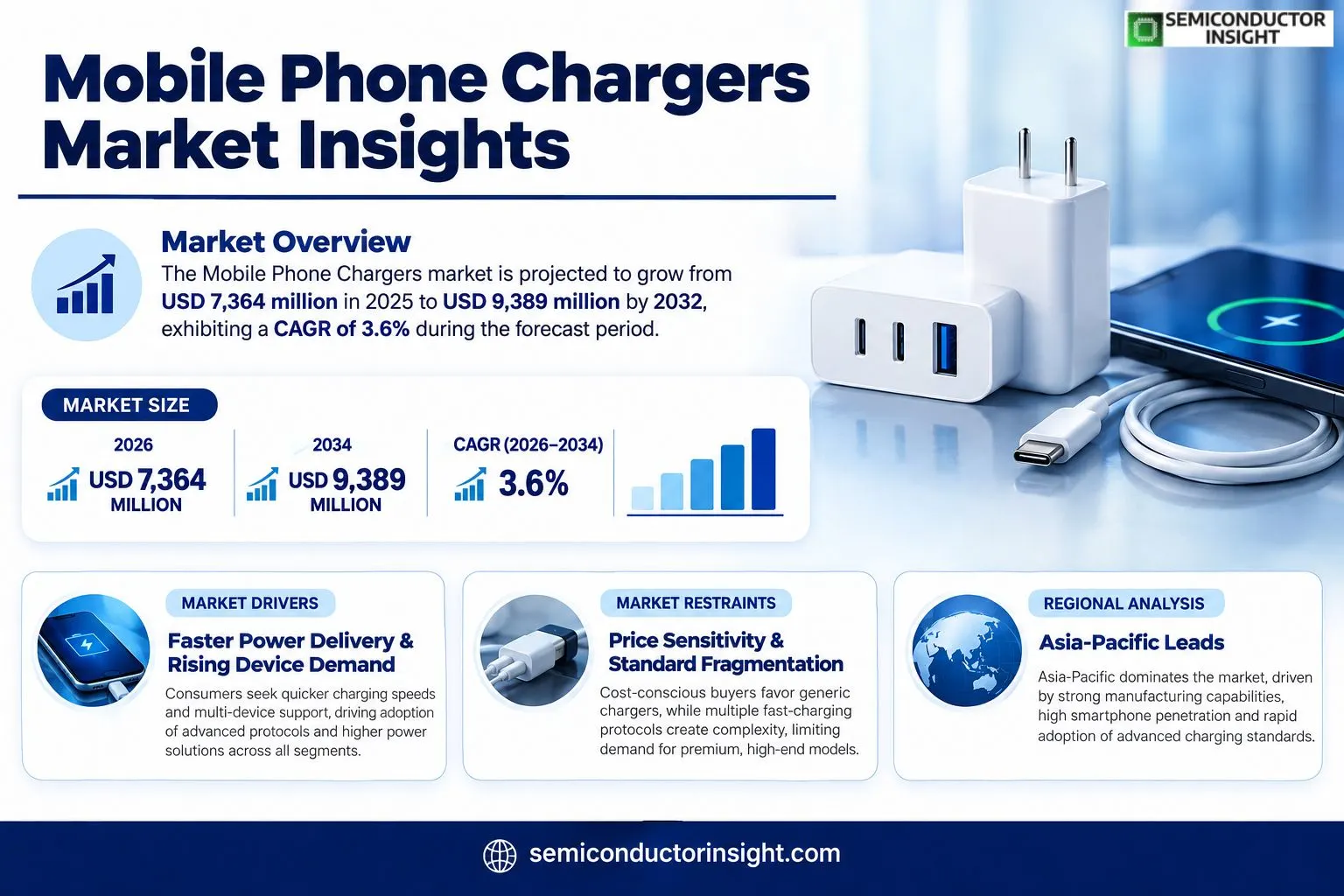
Mobile Phone Chargers market size was valued at USD 7,364 million in 2025 and is projected to reach USD 9,389 million by 2032, exhibiting a CAGR of 3.6% during the forecast period.
Mobile phone chargers are AC‑to‑DC power adapters that deliver safe and stable electricity to smartphones and related devices. The category comprises in‑box chargers supplied with handsets and out‑of‑box retail units sold through e‑commerce platforms, operators or offline retailers. Contemporary models primarily use USB‑C or USB‑A connectors and support fast‑charging protocols such as USB PD, PPS and QC; ongoing upgrades target higher wattage outputs, compact footprints, multi‑port layouts and gallium nitride (GaN) technology. Upstream supply consists of silicon MOSFETs, GaN devices, power‐management ICs and flame‑retardant plastics that together improve efficiency and thermal performance.
MARKET DRIVERS
Consumer Preference for Faster Power Delivery
Today’s smartphone users demand less downtime, prompting manufacturers to embed high‑output charging circuits. Battery capacity upgrades have outpaced traditional charging speeds, compelling OEMs to adopt quick‑charge standards. This shift fuels demand for compatible accessories, expanding Mobile Phone Chargers Market across retail and OEM channels.
Regulatory Push Toward Energy Efficiency
Authorities in key regions have introduced stricter energy‑consumption limits for electronic peripherals. Companies that redesign chargers to meet low‑standby‑power thresholds gain a competitive edge, as compliance becomes a purchasing criterion for both end‑users and enterprise buyers.
➤ Brands that integrate USB‑PD 3.0 or proprietary fast‑charge protocols are seeing higher average order values, reflecting premium pricing power tied to performance gains.
In parallel, the rise of remote work has amplified the need for reliable power sources at home offices, translating into steadier sales volumes for wall adapters, car mounts, and wireless pads.
MARKET CHALLENGES
Fragmented Standards Landscape
Multiple fast‑charging protocols coexistUSB‑PD, Qualcomm Quick Charge, and proprietary schemesforcing distributors to stock a broader SKU mix. Inventory complexity drives up logistics costs and can dilute brand focus, especially for smaller players lacking economies of scale.
Other Challenges
Supply‑Chain Volatility
Component shortages, particularly for high‑efficiency silicon chips, have lengthened lead times. Manufacturers that cannot secure reliable sources face delayed product launches and weakened market positioning.
MARKET RESTRAINTS
Price Sensitivity Among End‑Users
While premium fast chargers command higher margins, a sizable segment of buyers remains focused on cost, gravitating toward generic, low‑output alternatives. This price pressure caps the upside for high‑end offerings and can stall premium‑segment growth.Moreover, retail shelf space is limited, prompting retailers to prioritize high‑turnover SKUs over niche, high‑performance models, thereby constraining exposure for advanced chargers.
MARKET OPPORTUNITIES
Integration of Smart Features
Embedding IoT capabilitiessuch as real‑time charge monitoring, adaptive power allocation, and over‑the‑air firmware updatescreates differentiation. Companies that roll out connected chargers can tap into subscription‑based services, opening new revenue streams beyond the traditional one‑time sale.Additionally, the burgeoning electric‑vehicle ecosystem presents a crossover opportunity: vehicle‑to‑device power sharing standards could unlock a new class of multi‑modal chargers, widening the addressable market for firms that act early.
Mobile Phone Chargers Market Trends
Rise of USB‑C and GaN‑Enabled Chargers
The adoption of USB‑C as the default interface has re‑shaped the charger ecosystem. By providing a single reversible connector that supports high‑power delivery, manufacturers can design products that address a broader range of devices without proliferating proprietary cables. This convergence reduces inventory complexity for OEMs and accelerates the rollout of fast‑charging protocols such as USB PD, PPS and QC. Meanwhile, gallium‑nitride (GaN) substrates are entering mainstream production, delivering higher power density while trimming the brick‑like form factor of traditional silicon adapters. The combined effect is a market that increasingly values engineering efficiency and portability over sheer wattage, prompting a wave of multi‑port, compact chargers that fit the on‑the‑go lifestyle of today’s consumers.
Other Trends
Channel Realignment and Brand Differentiation
In‑box inclusion is gradually receding, turning the retail channel into the primary growth engine. This shift has intensified competition among online marketplaces, cross‑border e‑commerce platforms and brick‑and‑mortar retailers, each vying for shelf space and algorithmic visibility. Brands are responding by layering safety certifications, premium materials and after‑sales support onto otherwise commoditized hardware. The result is a clear stratification: low‑cost, high‑volume units compete on price alone, while mid‑tier and premium offerings rely on differentiated aesthetics, thermal management and extended warranty programs to capture margin.
Consumer Preference for Experience‑Driven Design
Beyond charging speed, users now evaluate adapters on stability, heat dissipation and longevity. The proliferation of multiple smart devices per household has turned chargers into quasi‑infrastructure, demanding solutions that can reliably power phones, tablets, wearables and earbuds simultaneously. Standardized connectors simplify this requirement, but manufacturers must also address tactile experiencedetachable plugs that feel solid, LEDs that convey charging status, and housings that resist wear. These attributes, while intangible, translate into repeat purchases and brand loyalty, compelling suppliers to invest in industrial design and rigorous testing protocols. As regulatory bodies tighten efficiency and safety standards, the firms that excel at marrying compliance with premium user experience are poised to dominate the next phase of Mobile Phone Chargers Market.
COMPETITIVE LANDSCAPEKey Industry Players
Mobile Phone Chargers Market – Competitive Overview
The most visible segment is dominated by a handful of brands that supply both original‑equipment‑manufacturer (OEM) in‑box adapters and retail‑oriented fast‑charging solutions. Samsung leverages its smartphone ecosystem to secure a sizeable share of in‑box volume, while Anker has built a reputation for premium retail chargers that combine high‑power USB‑PD with durable GaN modules. Belkin and Ugreen focus on multi‑port, travel‑friendly designs, translating safety certifications into differentiated pricing power. These firms benefit from vertically integrated supply chains that guarantee access to silicon‑based power semiconductors and advanced magnetic components, allowing them to sustain margins above the industry average despite overall price pressure.Beyond the headline names, a cluster of Chinese manufacturers and specialist component houses injects depth into the competitive set. Companies such as Lite‑On Technology, Chicony Power, and Delta Electronics operate extensive contract‑manufacturing networks that feed the OEM channel, while startups like Baseus, Mophie/Zagg, and Goneo Group push niche innovations such as ultra‑compact GaN chargers or proprietary fast‑charging protocols. Their agility stems from close relationships with semiconductor suppliers and the ability to pivot quickly toward emerging standards like USB‑PD 3.1. The coexistence of these players creates a tiered landscape where brand equity, certification breadth, and technology leadership dictate pricing tiers and channel strategies.
List of Key Mobile Phone Chargers Companies Profiled
- Samsung
- Anker
- Belkin
- Baseus
- Ugreen
- Lite‑On Technology
- Chicony Power
- Delta Electronics
- Mophie/Zagg
- Goneo Group
- Flextronics
- Huntkey
- BYD Electronics
Segment Analysis:
| Segment Category | Sub-Segments | Key Insights |
| By Type |
|
Wireless Charger is gaining traction as consumers prioritize convenience and reduced cable clutter. • Integration with premium smartphones drives demand for seamless, fast‑charging experiences. • Design aesthetics and material quality become differentiators in a crowded market. • Safety features and thermal management are critical for brand trust. |
| By Application |
|
Upper Mid-range sees heightened emphasis on fast‑charging capability while balancing cost. • Users expect multi‑port solutions that support tablets and wearables. • Form‑factor miniaturization aligns with lifestyle trends. • Brand reputation for reliability influences purchasing decisions. |
| By End User |
|
Individual Consumers drive the shift toward premium, aesthetically pleasing chargers that double as lifestyle accessories. • Preference for durable, heat‑resistant designs is rising. • Compatibility with multiple device ecosystems is a key purchase driver. • Subscription‑based or bundled offerings are emerging in retail channels. |
| By Power Rating |
|
High‑Power Fast Charger is becoming a strategic focus as smartphones adopt larger batteries. • GaN technology enables compact, high‑efficiency designs. • Thermal performance and safety certifications are paramount. • Consumers appreciate the ability to charge multiple high‑draw devices simultaneously. |
| By Charging Protocol |
|
Emerging Unified Protocol Charger reflects industry movement toward cross‑brand compatibility. • Simplifies user experience across device ecosystems. • Enhances market acceptance for third‑party accessories. • Encourages innovation in adaptive power‑delivery algorithms. |
Regional Analysis: Mobile Phone Chargers Market
Asia‑Pacific
Proximity between component suppliers and final‑assembly plants cuts lead times, enabling manufacturers to iterate charger designs within weeks rather than months. This logistical edge translates into a fluid inventory strategy that keeps shelves stocked with the latest specifications while limiting excess stock.
Young, tech‑savvy consumers in the region prioritize speed and convenience, quickly embracing chargers that support higher wattage outputs. Their willingness to upgrade accessories alongside flagship phones fuels a renewal cycle that outpaces many other product categories.
Emerging standards on energy efficiency and safety are being codified by regional bodies, prompting manufacturers to align product roadmaps with compliance timelines. Early adopters of these standards gain credibility with both retailers and end‑users.
Cities such as Shenzhen and Bangalore host dense clusters of R&D firms specializing in power‑management ICs and novel charging geometries. The cross‑pollination of ideas within these hubs accelerates the introduction of next‑generation charging solutions.
North America
In North America, consumer expectations revolve around reliability and brand reputation. The market is shaped by a strong preference for chargers that integrate seamlessly with existing ecosystems, prompting manufacturers to emphasize proprietary fast‑charge protocols. Although the continent does not host large‑scale charger assembly, its distribution network is sophisticated, with major retailers and omnichannel players demanding stringent quality certifications. This creates a premium segment where price elasticity is lower, but brand differentiation through durability and warranty support becomes paramount, influencing the strategic choices of entrants and incumbents alike.
Europe
European buyers exhibit heightened sensitivity to environmental considerations, driving demand for chargers that meet stringent eco‑design directives and energy‑efficiency labels. Regulatory pressure pushes firms to innovate around recyclable materials and modular designs that extend product lifespans. Market players therefore allocate resources to compliance testing and transparent labeling, positioning sustainability as a competitive lever. Meanwhile, the region’s fragmented retail landscape, spanning large‑scale chains to niche specialty stores, encourages a diversified portfolio that can cater to both cost‑conscious and high‑end segments.
South America
In South America, Mobile Phone Chargers Market reflects a blend of emerging‑economy price sensitivity and gradually rising smartphone penetration. Distributors prioritize cost‑effective models that still deliver acceptable charging speeds, leading suppliers to offer tiered product lines that balance performance with affordability. Urban centers show growing appetite for premium accessories, yet the bulk of sales still occur in value‑oriented channels. Companies that can navigate fluctuating import duties while maintaining consistent supply are better positioned to capture market share.
Middle East & Africa
The Middle East & Africa region presents a paradox of high disposable income pockets alongside markets where basic connectivity remains a priority. Luxury‑focused retailers in affluent Gulf cities drive demand for sleek, high‑output chargers, whereas many African economies favor durable, low‑cost solutions that can withstand inconsistent power grids. This duality forces manufacturers to adopt flexible production approaches, offering both premium and ruggedized variants within the same regional strategy. Emerging digital payment platforms also influence purchasing behavior, encouraging brands to integrate seamless checkout experiences.
Report Scope
This market research report provides a comprehensive analysis of the Mobile Phone Chargers Market , covering the forecast period 2026–2034. It offers detailed insights into market dynamics, technological advancements, competitive landscape, and key trends shaping the industry.
Key focus areas of the report include:
- Market Overview: The report begins with an overview outlining its current market scenario, key growth indicators, and industry transformation drivers. It discusses macroeconomic factors, demand–supply balance, regulatory landscape, and the strategic role of semiconductors in powering advancements across industries such as automotive, telecommunications, consumer electronics, and industrial automation.
- Market Size & Forecast: Historical data and future projections for revenue, unit shipments, and market value across major regions and segments.
- Segmentation Analysis: Detailed breakdown by product type, technology, application, and end-user industry to identify high-growth segments and investment opportunities.
- Regional Insights: Insights into market performance across North America, Europe, Asia-Pacific, Latin America, and the Middle East & Africa, including country-level analysis where relevant.
- Competitive Landscape: Profiles of leading market participants, including their product offerings, R&D focus, manufacturing capacity, pricing strategies, and recent developments such as mergers, acquisitions, and partnerships.
- Technology Trends & Innovation: Assessment of emerging technologies, integration of AI/IoT, semiconductor design trends, fabrication techniques, and evolving industry standards.
- Market Drivers & Restraints: Evaluation of factors driving market growth along with challenges, supply chain constraints, regulatory issues, and market-entry barriers.
- Stakeholder Insights: Insights for component suppliers, OEMs, system integrators, investors, and policymakers regarding the evolving ecosystem and strategic opportunities.
Primary and secondary research methods are employed, including interviews with industry experts, data from verified sources, and real-time market intelligence to ensure the accuracy and reliability of the insights presented.
FREQUENTLY ASKED QUESTIONS:
What is the current market size of Mobile Phone Chargers Market?
-> Mobile Phone Chargers Market was valued at USD 7364 million in 2025 and is expected to reach USD 9389 million by 2032, at a CAGR of 3.6% during the forecast period.
Which key companies operate in Mobile Phone Chargers Market?
-> Key players include Salcomp, Aohai Technology, Flextronics, Lite‑On Technology, Bichamp, BYD Electronics, Huntkey, Delta Electronics, Chicony Power, Samsung, Anker, Baseus, Mophie/Zagg, Belkin, Ugreen, Goneo Group.
What are the key growth drivers?
-> Key growth drivers include standardization of USB‑C and fast‑charging protocols, declining in‑box charger inclusion, power‑upgrade adoption across mid‑range smartphones, GaN technology improving power density and efficiency, and rising consumer demand for multi‑device charging solutions.
Which region dominates the market?
-> Asia‑Pacific remains the dominant region, driven by high smartphone penetration, strong manufacturing base, and rapid adoption of advanced charging standards.
What are the emerging trends?
-> Emerging trends include GaN‑based high‑power chargers, multi‑port and foldable designs, wider adoption of USB‑PD and PPS protocols, and increased focus on thermal management and sustainability.
Get Sample Report PDF for Exclusive Insights
Report Sample Includes
- Table of Contents
- List of Tables & Figures
- Charts, Research Methodology, and more...