Key Statistics
Key Takeaways
- Register Clock Driver (RCD) is the leading type because enterprise DDR5 RDIMMs require command, address and clock buffering that preserves timing margin and signal integrity as memory data rates increase.
- Servers and data centers are the dominant application, with hyperscale cloud, enterprise computing and AI infrastructure using registered memory in large volumes and creating repeated interface-chip qualification cycles.
- Asia Pacific is the dominant regional ecosystem because South Korea, Taiwan, China and Japan combine memory manufacturing, module assembly, semiconductor design and server production.
- MRDIMM increases interface-chip content. Current 12,800 MT/s architectures use an MRCD together with multiple MDB chips, making the interface chipset a central bandwidth-enabling subsystem for AI and HPC servers.
- Interface speeds are rising quickly. Recent supplier launches extend DDR5 RCD performance toward 9,200–9,600 MT/s while MRDIMM platforms target 12,800 MT/s.
Memory Interface Chip (MDB, Register Clock Driver) Market Overview
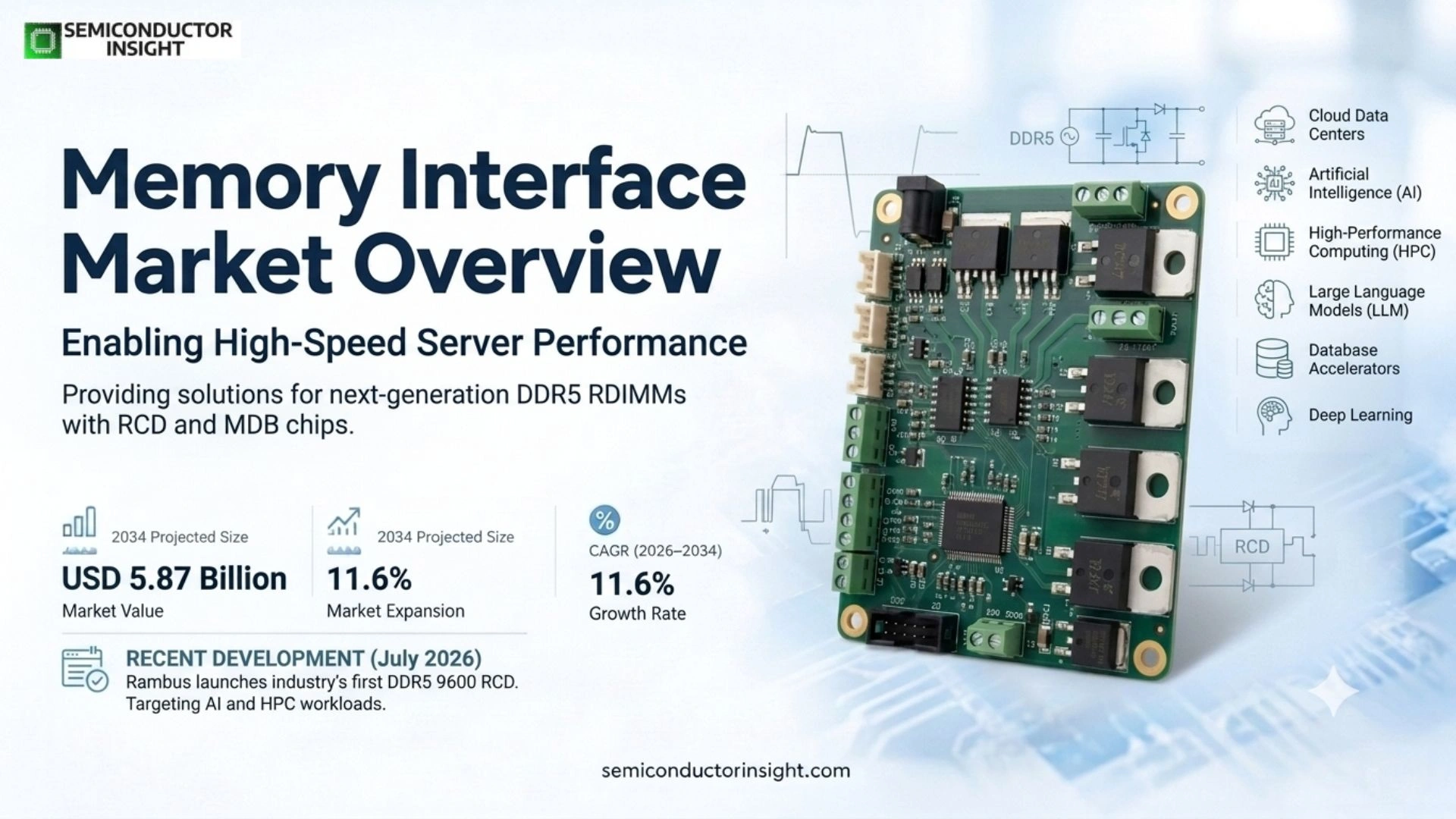
Memory Interface Chip (MDB, Register Clock Driver) market was valued at USD 2.18 billion in 2025 and is projected to reach USD 5.87 billion by 2034, representing a 11.6% CAGR during 2026–2034. The 2026 estimated market size is USD 2.43 billion. Asia Pacific is the dominant regional ecosystem, supported by memory manufacturing, module assembly and server supply chains.
Memory interface chips sit between the host memory controller and DRAM devices on server memory modules, buffering command, address, clock and data paths while adding power, telemetry and management functions. Their role becomes more important as data rates and memory capacity increase because the electrical loading of multiple DRAM devices can otherwise erode timing margin and system stability. RCDs, data buffers, MRCDs, MDBs, PMICs and SPD-related devices therefore operate as a coordinated chipset around modern enterprise DIMMs.
DDR5 changed the commercial structure of the category by placing more control and power-management intelligence on the module. Suppliers now offer portfolios containing RCD, PMIC, SPD hub and temperature-sensor devices, while MRDIMM adds multiplexed register and data-buffer logic to lift effective bandwidth. Every memory generation creates a fresh qualification cycle in which CPU platform vendors, DRAM makers, module companies and server OEMs validate signal integrity, firmware behavior, thermals and interoperability together.
AI infrastructure is raising the value of main memory even when accelerators also use HBM. CPU-based orchestration, retrieval, preprocessing, caching and inference services require large pools of DDR5 memory alongside accelerators. Higher core counts and more memory channels increase bandwidth pressure on RDIMM and MRDIMM architectures, so interface vendors compete on transfer rate, jitter, equalization, power consumption, platform validation and time to production qualification.
Segment Analysis: By Type
By type, the report covers Memory Data Buffer (MDB), Register Clock Driver (RCD), Data Buffer (DB) and Module Power Management IC (PMIC). RCD holds the leading position because it is the control and clock-buffering hub for server RDIMMs, while MDB and related multiplexed logic are gaining strategic importance as MRDIMM moves to higher bandwidth.
| Type | Function in the memory module | Market position |
|---|---|---|
| Register Clock Driver (RCD) | An RCD buffers command, address, chip-select and clock signals between the memory controller and DRAMs on a registered module. Modern DDR5 devices use dual-channel architectures, integrated PLLs and training features so each subchannel preserves timing and signal integrity at high transfer rates. | Largest type. RDIMM is the standard enterprise server-memory format and each DDR5 RDIMM depends on an RCD. Demand follows CPU platform transitions, DRAM qualification and server refresh cycles, while new speed generations require repeat engineering and validation. |
| Memory Data Buffer (MDB) | MDBs are paired with multiplexed register logic in MRDIMM architectures to handle data traffic between the host side and several DRAM ranks. The architecture can use one MRCD with multiple MDB devices, allowing a module to raise effective bandwidth while maintaining a high-capacity server form factor. | Fastest strategic content opportunity. MDB demand depends on MRDIMM adoption in bandwidth-constrained AI and HPC servers, but chip content per module is materially higher than in a conventional RDIMM, creating attractive value for qualified chipset suppliers. |
| Data Buffer (DB) | Traditional data buffers reduce the electrical load presented by DRAM devices to the host memory channel, supporting load-reduced DIMM configurations where very high capacity is required. The buffer must maintain low latency, low power and clean eye margins across multiple data lanes. | A mature high-capacity server segment. DB demand is less universal than RCD because it depends on LRDIMM and other buffered formats, but databases, virtualization and memory-heavy servers can justify the additional interface silicon. |
| Module PMIC | DDR5 moved power management onto the module, making the PMIC an integral support device that regulates rail voltages close to DRAM and interface logic. Server PMICs must handle high current with tight regulation and telemetry in a constrained thermal environment. | A large supporting segment whose growth follows DDR5 module volume. It expands chipset value per module and favors suppliers that can offer validated RCD, PMIC, SPD and sensor portfolios to module manufacturers. |
Memory standard and module architecture
The report also segments demand by memory standard and module type. DDR5 is the primary growth engine because it is the active server platform generation, while DDR4 sustains a large installed base. RDIMM drives broad RCD demand, LRDIMM pairs an RCD with data buffering for high capacity, and MRDIMM introduces MRCD and MDB logic to raise effective bandwidth. HBM is a different package-level memory architecture, but AI platforms using HBM can still increase host-side DDR5 memory requirements.
| Axis | Segments | Commercial implication |
|---|---|---|
| By Memory Standard | DDR4 · DDR5 · LPDDR5 · HBM | DDR5 creates the largest direct interface-chip opportunity in enterprise DIMMs because server modules require updated RCD, PMIC, SPD and telemetry devices. DDR4 remains a replacement market, while LPDDR5 and HBM influence adjacent memory-interface design rather than using the same server-DIMM chipset. |
| By Module Type | RDIMM · LRDIMM · UDIMM · SODIMM | RDIMM is the core enterprise module for RCD demand; LRDIMM adds data buffering for very high capacity. Client UDIMM and SODIMM use different interface-chip mixes, while newer CUDIMM, CSODIMM and MRDIMM architectures expand the broader market. |
Segment Analysis: By Application
By application, Servers and Data Centers are the dominant segment, followed by AI and machine-learning accelerators, HPC, networking infrastructure and other high-reliability computing systems. All reward interface chips that preserve signal integrity and system stability as channels become faster and more heavily populated.
| Application | Demand characteristics |
|---|---|
| Servers and Data Centers | The largest application includes hyperscale cloud, enterprise servers and colocation infrastructure. Registered memory is standard because server platforms need high capacity, ECC support and predictable signal margins. Each transition to a faster DDR5 speed grade creates renewed qualification demand for RCD, PMIC, SPD and sensor devices, making server refresh cycles the foundation of interface-chip revenue. |
| AI and Machine Learning Accelerators | AI systems use HBM near accelerators but still depend on CPU-attached DDR5 for orchestration, caching, data preparation and host-side services. Agentic and inference systems can maintain large context or retrieval structures in main memory, increasing bandwidth and capacity pressure and favoring faster RDIMM and MRDIMM chipsets. |
| High-Performance Computing | HPC clusters need balanced compute, memory capacity and bandwidth across many nodes. Scientific workloads can be limited by host-memory throughput, so system architects adopt faster DDR5 generations and high-capacity modules when performance gains justify cost. Interface suppliers win through low jitter, broad CPU-platform validation and thermal stability. |
| Networking Infrastructure | Core routers, telecom servers, storage appliances and edge infrastructure use registered memory where packet buffering, virtualization or analytics require reliability and capacity. Telecom equipment has long qualification and support cycles, rewarding interface-chip vendors that maintain supply and firmware compatibility across multi-year systems. |
| Others | Government, defense, research and specialized workstation systems form a smaller but technically demanding segment. These customers can require extended product availability, tighter screening and documented change control, which suits mature server-grade interface devices with proven reliability. |
Regional Analysis
Asia Pacific is the dominant regional ecosystem because China, South Korea, Taiwan and Japan combine DRAM manufacturing, memory-module assembly, semiconductor design, server manufacturing and large-scale data-center investment. North America remains a critical design and demand center through hyperscalers and CPU vendors, while Europe is a smaller but technically sophisticated market.
How do regional memory-interface demand mechanisms differ?
Memory-interface chips are globally traded components, so end-market demand and supply-chain location do not always coincide. Asia Pacific holds the deepest manufacturing and module ecosystem, North America shapes server-platform requirements through hyperscalers and CPU architecture, and Europe contributes telecom, industrial and sovereign-computing demand. Emerging regions consume interface chips indirectly through imported server and memory platforms as local data-center capacity expands.
| Region | Market position | Growth outlook | Demand profile | What decides supplier selection |
|---|---|---|---|---|
| Asia Pacific | Dominant ecosystem | High | Memory manufacturing & servers | Qualification, scale, cost and supply continuity |
| North America | Major design and demand center | High | Hyperscale cloud & AI | Platform validation, bandwidth and power efficiency |
| Europe | Specialized demand market | Moderate | Cloud, telecom & industrial | Reliability, lifecycle support and supply assurance |
| South America | Emerging | Moderate | Cloud and enterprise IT | Availability and platform compatibility |
| Middle East & Africa | Emerging | High from smaller base | Sovereign cloud & data centers | Supply reliability and current server platforms |
Competitive Landscape
Competition is concentrated around specialized memory-interface suppliers and vertically integrated memory companies. Montage Technology, Renesas and Rambus compete directly in RCD and related DDR5 interface logic, while Samsung, SK Hynix and Micron influence the ecosystem as major memory manufacturers. CPU vendors such as AMD and Intel shape electrical and architectural requirements that interface chips must satisfy.
Montage offers a broad server-memory interface portfolio spanning MRCD, MDB, RCD, DB, PMIC, SPD hub and temperature sensors. Its development cadence covers both MRDIMM bandwidth scaling and conventional RDIMM speed progression. Portfolio breadth creates cross-selling advantages because module manufacturers can validate several support devices from one supplier while receiving coordinated reference designs and application engineering.
Rambus competes through complete chipsets covering RCD, MRCD, MDB, PMIC, SPD hub and sensors. A complete chipset can simplify module development because electrical, firmware and telemetry interactions are engineered across a coordinated product set rather than sourced independently. This strategy also increases revenue per module and deepens the qualification relationship with server-memory manufacturers.
Renesas retains a strong RCD position through its IDT heritage and continues to push bandwidth. Competitive differentiation is moving beyond speed into equalization, jitter, low-power modes and backward compatibility because customers need a practical migration path that preserves module-design investment as server platforms evolve.
Competitive tier structure
| Tier | Companies | Basis of competition |
|---|---|---|
| Direct interface-chip leaders | Montage Technology; Renesas Electronics; Rambus | RCD/MRCD/MDB/DB performance, JEDEC compliance, validation, signal integrity and complete chipset breadth |
| Integrated memory ecosystem | Samsung Semiconductor; SK Hynix; Micron Technology | DRAM roadmaps, module integration, captive or partnered interface solutions and large qualification ecosystems |
| Platform and adjacent silicon | Marvell (Inphi); AMD; Intel; Parade Technologies | High-speed interface expertise, CPU memory-controller requirements and platform architecture influence |
Key companies profiled in the report scope
- Montage Technology
- Renesas Electronics Corporation
- Rambus Inc.
- Marvell Technology (Inphi)
- Samsung Semiconductor
- SK Hynix
- IDT (now part of Renesas)
- Micron Technology
- Advanced Micro Devices (AMD)
- Intel Corporation
- Parade Technologies
- JEDEC Solid State Technology Association
Memory Interface Chip Production & Qualification Capacity Analysis
Capacity is not defined only by wafer starts. RCD and MDB suppliers often use external foundries, so commercial capacity depends on foundry allocation, advanced packaging, test throughput, firmware maturity and the number of customer qualifications that can be supported in parallel. A chip can be manufacturable in volume but still fail to contribute revenue if it has not completed DRAM, module, CPU and server-platform validation.
Each new RCD generation must pass electrical and functional validation across multiple DRAM configurations and CPU platforms. That work includes command and address timing, clock jitter, training behavior, power states, sideband management and thermal operation. Engineering-sample capacity matters early because suppliers need enough parts to support memory vendors and OEMs before volume launch, making validation staffing and field application engineering a practical scaling constraint.
Foundry concentration remains a supply risk because high-speed digital and mixed-signal interface chips require modern process technology for power and performance. Suppliers must reserve wafer capacity before server demand is fully visible, while module customers expect reliable delivery over a multi-year platform life. Packaging and final test add constraints because high pin counts and high-speed I/O must maintain very low production defect rates.
Market Dynamics
Growth is driven by DDR5 adoption, AI and HPC server growth, rising memory capacity per socket and the transition toward MRDIMM. Restraints include long qualification cycles, concentrated customers, server-memory cyclicality and the engineering cost of each new speed generation. Opportunities are strongest in high-speed RDIMM chipsets, 12,800 MT/s MRDIMM logic and future DDR6 interfaces.
MARKET DRIVERS
Drivers Impact Analysis*
| Factor | Forecast impact* | Geographic relevance | Impact timeline |
|---|---|---|---|
| DDR5 server platform refresh | High | Global data centers | Short to medium term |
| AI and memory-intensive workloads | High | North America, Asia Pacific, Europe | Medium to long term |
| MRDIMM bandwidth scaling | High | AI/HPC servers | Medium term |
| Higher memory capacity per socket | Medium to high | Enterprise and cloud | Persistent |
*Directional analytical rating; it is not a measured contribution to the headline CAGR.
DDR5 raises interface content and performance requirements
DDR5 server modules require a coordinated set of interface and support chips that did not exist in the same form on earlier generations. RCD, PMIC, SPD hub and temperature sensing become integral to RDIMM operation, while LRDIMM and MRDIMM add buffer functions. Faster speed grades require better clock quality, training, equalization and power efficiency, creating repeated generational opportunities.
AI workloads increase host-memory bandwidth and capacity
AI accelerators rely heavily on HBM, but host processors still manage data staging, orchestration, retrieval and application services in DDR5 memory. Agentic AI can keep larger context and state active for longer periods, increasing main-memory pressure. Server vendors respond with faster RDIMMs and MRDIMMs, raising the performance target and content opportunity for interface suppliers.
MRDIMM creates more silicon content per module
MRDIMM uses time-division multiplexing to raise effective memory bandwidth without relying only on faster DRAM. Current architectures pair one MRCD with multiple MDB chips, materially increasing interface-chip content per module. If MRDIMM adoption expands, the market gains both higher value per module and a new product family beyond conventional RDIMM RCDs.
CPU core counts reward stronger signal conditioning
New server processors expose more cores and need high memory throughput to prevent those cores from waiting on data. Higher channel speeds and denser modules reduce electrical margin, making clock quality, equalization and robust training more valuable. Interface vendors can therefore justify upgrades through measurable server bandwidth and stability.
MARKET RESTRAINTS
Restraints Impact Analysis*
| Factor | Forecast impact* | Geographic relevance | Impact timeline |
|---|---|---|---|
| Long qualification cycles | High | All major server platforms | Persistent |
| Customer concentration | High | Global | Persistent |
| Server-memory cyclicality | Medium to high | Global | Short to medium term |
| Foundry and packaging dependence | Medium | Asia-focused supply chain | Persistent |
*Directional analytical rating; it is not a measured contribution to the headline CAGR.
Qualification delays revenue after product development
A new interface chip must interoperate with CPU memory controllers, DRAM devices, module layouts and server firmware before volume production. These cycles can run across multiple quarters and consume engineering-sample resources. If a generation misses the qualification window for a major CPU platform, the supplier can lose most of the revenue opportunity even when the silicon is technically competitive.
The customer base is concentrated
A small number of DRAM manufacturers, module companies, CPU platform vendors and hyperscale server customers influence global qualification. Winning one large design can transform volume, while losing it can materially reduce a generation’s revenue. This concentration increases pricing pressure and raises the importance of relationships, application engineering and proven execution.
Server memory remains cyclical
Data-center investment can grow strongly over the long term while still experiencing inventory corrections. Module makers may reduce interface-chip orders when server DRAM inventory rises, then accelerate purchases when a new platform ramps. Suppliers must balance foundry commitments against uncertain near-term demand, creating shortage or excess-inventory risk.
Advanced performance increases design cost
Moving to higher DDR5 data rates requires tighter jitter, channel equalization, package design and validation. Engineering teams must also support backward compatibility and multiple module layouts. R&D spending rises before unit economics are proven, and smaller suppliers can struggle to fund parallel development for current RCD products, MRDIMM buffers and future DDR6 programs.
MARKET OPPORTUNITIES
Secure 9,600 MT/s RDIMM design wins
The 2025–2026 product cycle shows 9,600 MT/s becoming a commercial target for next-generation DDR5 server platforms. Suppliers that qualify high-speed RCDs together with PMIC, SPD hub and temperature sensors can reduce module-development effort and gain larger chipset content. Early alignment with CPU and memory vendors is essential because a late part can miss the platform ramp.
Expand MRDIMM chipsets at 12,800 MT/s
MRDIMM creates a direct opportunity for MRCD and MDB silicon with high chip content per module. Current Gen2 chipsets demonstrate a competitive race around this architecture. Suppliers can differentiate through lower power, better equalization, robust training and complete reference designs that help module makers gain bandwidth without sacrificing reliability.
Prepare for DDR6 before platform definition is fixed
Every memory generation resets interface requirements and creates new validation cycles. Vendors that participate early in standards and work with CPU, DRAM and module partners can have engineering samples ready near platform definition. Future architectures may create new buffer, clock and power-management functions rather than simply extending today’s RCD.
Offer complete validated interface chipsets
Module makers increasingly need RCD or MRCD plus PMIC, SPD hub, sensors and coordinated firmware behavior. A supplier offering a complete portfolio can simplify sourcing and technical support while increasing revenue per DIMM and deepening customer relationships through system-level accountability.
Memory Interface Chip Supply Chain Analysis
Standards and CPU roadmaps start the commercial clock
Interface suppliers cannot design in isolation because the RCD or MRCD must satisfy JEDEC requirements and interoperate with host memory controllers. CPU platform schedules determine when engineering samples, validation boards and production silicon must be ready. Missing a platform window can defer meaningful revenue to the next server generation, making roadmap visibility strategically important.
Foundry and package execution convert design into supply
High-speed interface chips combine digital logic, clocks, PLLs and mixed-signal functions that benefit from modern process nodes and careful package design. Suppliers need foundry allocation for engineering samples and volume ramp, then must maintain package and test yield. Customers also expect multi-year supply, so sourcing and lifecycle planning matter.
Module makers perform the critical interoperability work
DRAM and module suppliers integrate RCD, PMIC, SPD hub, sensors and buffer chips on tightly constrained DIMM PCBs. They validate signal integrity, firmware and thermal behavior across DRAM densities and ranks. Interface suppliers with strong application engineering shorten this cycle with reference layouts, tuning guidance and diagnostic tools.
Server deployment determines the lifetime value of a design win
Once a DIMM architecture is qualified by a server OEM or hyperscaler, interface-chip demand can scale across thousands of systems and persist through several memory capacity points. The supplier’s revenue therefore depends on how broadly module partners win server platforms, with additional value from replacements and speed-bin upgrades.
Recent Developments in the Memory Interface Chip (MDB, Register Clock Driver) Market
Rambus launches DDR5 9600 server RDIMM chipset
Rambus introduced a sixth-generation 9,600 MT/s RCD together with PMIC, SPD hub and sensor devices for next-generation RDIMMs. The launch targets AI, HPC and other data-intensive server workloads, showing competition is moving toward complete validated interface chipsets.
Montage samples 9,200 MT/s sixth-generation DDR5 RCD
Montage Technology announced customer sampling of its RCD06 for next-generation RDIMMs. The higher data rate and equalization features show continued rapid evolution of RCD performance as server-memory platforms increase bandwidth.
Renesas delivers sixth-generation 9,600 MT/s DDR5 RCD
Renesas announced a Gen6 DDR5 RCD capable of 9,600 MT/s, positioning the device for AI, HPC and large-language-model workloads and reinforcing signal integrity and power efficiency as competitive metrics.
Montage samples Gen2 MRCD and MDB for 12,800 MT/s MRDIMM
Montage delivered engineering samples of a second-generation MRCD and MDB chipset supporting 12,800 MT/s. The architecture pairs one MRCD with multiple MDB devices to increase server-memory bandwidth and interface-chip content per module.
REPORT SCOPE & SEGMENTATION
| Attribute | Details |
|---|---|
| Study Period | 2021–2034 |
| Base Year | 2025 |
| Estimated Year | 2026 |
| Forecast Period | 2026–2034 |
| Historical Period | 2021–2025 |
| Market Size 2025 | USD 2.18 billion |
| Market Size 2034 | USD 5.87 billion |
| Growth Rate | CAGR of 11.6% from 2026–2034 |
| Unit | Value (USD Million/Billion) and unit shipments |
| Segmentation | By Type, By Application, By End User, By Memory Standard, By Module Type, By Region |
| By Type | Memory Data Buffer (MDB) · Register Clock Driver (RCD) · Data Buffer (DB) · Module Power Management IC (PMIC) |
| By Application | Servers and Data Centers · AI and Machine Learning Accelerators · High-Performance Computing (HPC) · Networking Infrastructure · Others |
| By End User | Cloud Service Providers and Hyperscalers · Enterprise IT Organizations · OEMs · Government and Defense Agencies · Research and Academic Institutions |
| By Memory Standard | DDR4 · DDR5 · LPDDR5 · HBM |
| By Module Type | RDIMM · LRDIMM · UDIMM · SODIMM |
| By Region | Each region analysed by type, application, memory standard and module architectureNorth AmericaUnited States, Canada, MexicoEuropeGermany, France, United Kingdom, Netherlands, Nordics and other European marketsAsia PacificChina, Taiwan, South Korea, Japan, India, Southeast Asia and other Asian marketsSouth AmericaBrazil, Argentina and other South American marketsMiddle East & AfricaSaudi Arabia, UAE, South Africa and other MEA markets |
| Key Companies Profiled | Montage Technology · Renesas Electronics Corporation · Rambus Inc. · Marvell Technology (Inphi) · Samsung Semiconductor · SK Hynix · IDT (now part of Renesas) · Micron Technology · Advanced Micro Devices (AMD) · Intel Corporation · Parade Technologies · JEDEC Solid State Technology Association |
| Customization Scope | Free report customization equivalent to up to four analyst working days with purchase. Addition or alteration to country, regional and segment scope. |
Frequently Asked Questions
What is the 2025 size of the Memory Interface Chip market?
The market is valued at USD 2.18 billion in 2025 and is projected to reach USD 5.87 billion by 2034. Those endpoints imply an 11.6% CAGR during 2026–2034 and a normalized 2026 estimate of USD 2.43 billion. The same endpoint values and growth rate are used throughout this overview, scope table and FAQ section.
Which memory interface chip type leads the market?
Register Clock Driver is the leading type because it is required on DDR5 RDIMMs to buffer command, address and clock signals between the host controller and DRAM devices. RCD therefore participates broadly in enterprise server memory, while MDB has a higher chip-content opportunity in MRDIMM where several data buffers are used per module.
Which application is the largest?
Servers and data centers are the largest application because registered server memory is deployed across hyperscale cloud, enterprise, AI and HPC infrastructure. Each new CPU and DDR5 speed generation creates another interface-chip qualification cycle, and server platforms require stable signal integrity, telemetry and power behavior over long operating periods.
Which region leads in 2025?
Asia Pacific is the dominant regional ecosystem because South Korea, Taiwan, China and Japan combine DRAM manufacturing, memory-module assembly, server production and semiconductor design. North America remains a major design and demand center through hyperscalers, server OEMs and CPU vendors that shape qualification requirements across the global supply chain.
What is the estimated market size in 2026?
The normalized 2026 estimate is USD 2.43 billion. It is derived from the 2025 base of USD 2.18 billion and 2034 forecast of USD 5.87 billion using a constant annual growth path, which produces an 11.6% CAGR for the 2026–2034 forecast period.
Why is DDR5 increasing interface-chip demand?
DDR5 places more support logic on the module and operates at higher data rates than earlier server memory. RDIMMs require updated RCD, PMIC, SPD and sensor devices, while LRDIMM and MRDIMM add buffering functions. Faster speed grades also require better clock quality, training, equalization and power efficiency, creating repeated product-generation opportunities.
What is the role of MDB in MRDIMM?
Memory Data Buffer chips move data between the host side and multiple DRAM ranks under control of an MRCD. Current 12,800 MT/s MRDIMM architectures use one MRCD with multiple MDB devices. This raises interface-chip content per module and enables higher bandwidth for AI and HPC servers without relying only on faster DRAM operation.
What are the main market restraints?
The strongest restraints are long customer qualification cycles, a concentrated set of large memory and server customers, cyclical server-memory demand and dependence on external foundry and packaging capacity. Suppliers must spend heavily on each new generation before volume revenue is visible, and missing one platform qualification window can materially reduce commercial value.
What recent technology transition matters most?
The move toward 9,200–9,600 MT/s DDR5 RDIMMs and 12,800 MT/s MRDIMMs is the most immediate transition. Renesas, Montage and Rambus have announced products in these performance classes during 2025 and 2026, showing bandwidth scaling is occurring simultaneously in conventional RCDs and multiplexed buffer architectures.
What does the report cover?
The report covers MDB, RCD, DB and PMIC types; server, AI, HPC and networking applications; hyperscaler, enterprise, OEM, government and research end users; DDR4, DDR5, LPDDR5 and HBM memory standards; RDIMM, LRDIMM, UDIMM and SODIMM module types; five global regions; and the full profiled participant list.
Research Sources & Evidence Base
View primary and authoritative evidence used in this overview
- Montage Technology. DDR5 Server Products – Official product portfolio covering DDR5 MRCD, MDB, RCD, DB, PMIC, SPD and temperature-sensor devices.
- Montage Technology. Gen2 MRCD & MDB engineering samples – January 2025 official evidence on 12,800 MT/s MRDIMM interface-chip development.
- Rambus. DDR5 Server DIMM Chipset – Official chipset page covering RCD, MRCD, MDB, PMIC, SPD hub and temperature-sensor products.
- Rambus. DDR5 MRCD and MDB – Official technical description of 12,800 MT/s MRDIMM interface logic and per-module chip content.
- Renesas Electronics. Sixth-generation DDR5 RCD reaches 9,600 MT/s – November 2025 official product announcement supporting the server-memory bandwidth transition.
- Rambus. DDR5 9600 Server RDIMM Chipset – July 2026 official product announcement connecting 9,600 MT/s RCD performance with AI and HPC server-memory demand.

Get Sample Report PDF for Exclusive Insights
Report Sample Includes
- Table of Contents
- List of Tables & Figures
- Charts, Research Methodology, and more...
 Download Sample Report PDF