Low Temperature Co-fired Ceramic (LTCC) Substrate Market Insights
Low Temperature Co-fired Ceramic (LTCC) Substrate Market was valued at USD 1.04 billion in 2025. The market is projected to grow from USD 1.12 billion in 2025 to USD 2.18 billion by 2034, exhibiting a CAGR of 7.6% during the forecast period.
Low Temperature Co-fired Ceramic (LTCC) substrates are multilayer ceramic structures fabricated by co-firing glass-ceramic materials with embedded conductive, resistive, and dielectric patterns at temperatures below 900°C. These substrates enable high-density interconnection of electronic components while offering superior thermal stability, low dielectric loss, and excellent high-frequency performance. LTCC technology integrates passive components such as capacitors, inductors, and resistors directly into the substrate layers, reducing overall device footprint and enhancing reliability in harsh environments.
The market is experiencing robust growth driven by escalating demand from telecommunications infrastructure, particularly the deployment of 5G networks requiring advanced RF modules and antenna systems. Furthermore, the automotive sector’s accelerating shift toward electric vehicles and advanced driver-assistance systems (ADAS) has intensified demand for compact, high-reliability electronic packaging solutions. Because LTCC substrates withstand extreme temperature fluctuations and mechanical stress, they have become indispensable in aerospace and defense applications where mission-critical performance is non-negotiable. However, the complexity of manufacturing processes and substantial capital investment requirements present notable barriers to entry for new market participants.
Recent developments underscore intensifying competitive dynamics within the industry. In March 2024, Murata Manufacturing Co., Ltd. announced expansion of its LTCC production capacity in Japan to address surging demand for 5G base station components. Similarly, Kyocera Corporation unveiled enhanced LTCC material formulations optimized for millimeter-wave applications in February 2024, targeting emerging satellite communication markets. TDK Corporation, Samsung Electro-Mechanics Co., Ltd., and Taiyo Yuden Co., Ltd. represent additional established players maintaining substantial portfolios across consumer electronics, industrial automation, and medical device sectors.
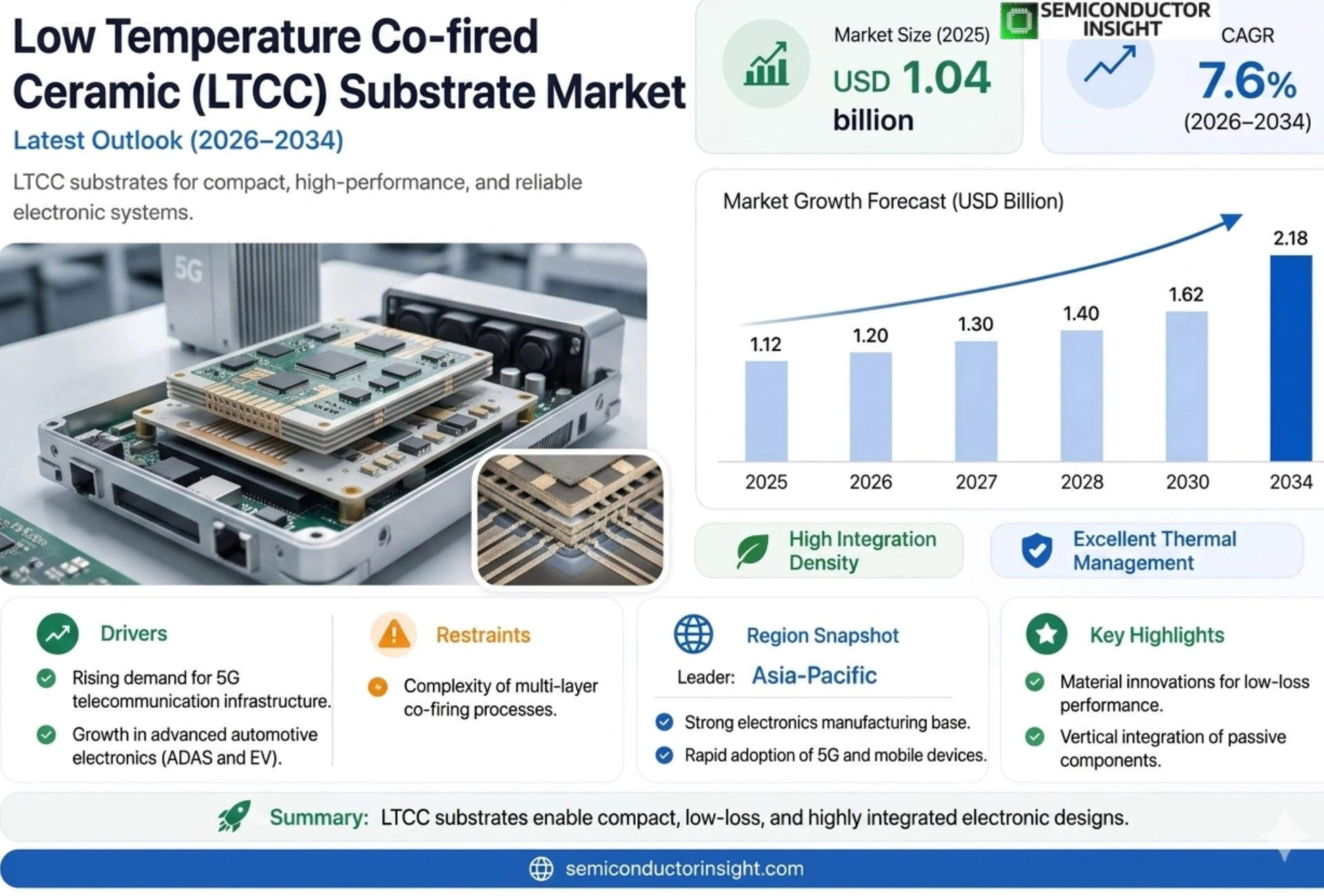
MARKET DRIVERS
Growing Demand in Telecommunications and Automotive Sectors
Low Temperature Co-fired Ceramic (LTCC) Substrate Market is experiencing significant growth due to the expanding demand for miniaturized, high-performance electronic components in telecommunications and automotive industries. Its capability to integrate passive components and multilayer circuits supports the evolving need for compact and reliable electronics.
Advancements in Wireless Communication Technologies
Increasing deployment of 5G networks and Internet of Things (IoT) applications requires substrates with enhanced thermal management and electrical properties, making LTCC substrates a preferred choice. Their suitability for high-frequency and high-density applications drives market expansion.
➤ LTCC substrates offer exceptional mechanical strength, low dielectric constant, and compatibility with thick film processing, which fuels their adoption in complex multilayer circuit designs.
As industries prioritize improved signal integrity and device miniaturization, LTCC substrate integration remains a critical market driver.
MARKET CHALLENGES
Complex Manufacturing Processes and High Initial Costs
The production of LTCC substrates involves intricate multilayer layering and precise firing conditions, leading to higher manufacturing costs and longer production cycles compared to alternative substrate materials. This complexity restricts widespread adoption in cost-sensitive applications.
Other Challenges
Material Compatibility Limitations
Incompatibility issues with certain active components and solder materials may affect the reliability and yield of LTCC-based assemblies, posing technical barriers to their broader acceptance.
MARKET RESTRAINTS
Competition from Alternative Substrate Technologies
Emerging materials such as High Temperature Co-fired Ceramics (HTCC) and organic substrate boards provide competitive alternatives with different cost and performance profiles. The availability of these options restrains LTCC substrate market growth by dividing the demand among various substrate technologies.
MARKET OPPORTUNITIES
Integration in Advanced Sensor and Medical Devices
The increasing focus on wearable health monitors, implantable medical devices, and sophisticated sensor modules leverages LTCC substrates’ superior properties, such as biocompatibility and compact design capability. This trend opens new avenues for market penetration and diversification.
Further, collaborative innovations in materials science and substrate engineering present opportunities to enhance LTCC substrate performance and cost-effectiveness, fostering wider market adoption in aerospace and defense sectors.
Trends
Robust Growth Driven by 5G and Automotive Advances
Low Temperature Co-fired Ceramic (LTCC) Substrate Market is witnessing significant expansion, primarily propelled by increased demand in the telecommunications and automotive sectors. LTCC substrates, known for their multilayer ceramic construction and ability to integrate passive components, provide high-density electronic interconnections with superior thermal stability and excellent high-frequency performance. The deployment of 5G networks necessitates advanced RF modules and antenna systems, making LTCC substrates a crucial component in telecommunications infrastructure upgrades worldwide. Concurrently, the automotive industry’s transition to electric vehicles and incorporation of advanced driver-assistance systems (ADAS) have intensified the need for compact, highly reliable electronic packaging solutions, further bolstering market demand.
Other Trends
Applications in Aerospace and Defense
LTCC substrates exhibit robustness against extreme temperature variations and mechanical stress, making them indispensable in aerospace and defense equipment where reliability is paramount. Their ability to maintain performance integrity in mission-critical environments ensures continued adoption in these sectors. The emphasis on reliability and compact design in these fields strongly supports ongoing market growth and innovation.
Technological Innovations and Competitive Landscape
Recent advancements in LTCC substrate materials and manufacturing techniques are shaping competitive dynamics. Notably, companies such as Murata Manufacturing have expanded production capacities to meet rising demand for 5G base station components, while Kyocera has optimized LTCC formulations for millimeter-wave applications targeting satellite communications. Established industry players like TDK Corporation, Samsung Electro-Mechanics, and Taiyo Yuden maintain diversified portfolios, enhancing market resilience across consumer electronics, industrial automation, and medical devices. Despite growth, challenges such as complex manufacturing processes and high capital investments continue to limit entry among new competitors.
Future Outlook and Market Sustainability
Looking ahead, Low Temperature Co-fired Ceramic (LTCC) Substrate Market is expected to maintain a positive trajectory fueled by expanding application scopes and advancements in material technology. As 5G adoption progresses and automotive electronic systems become more sophisticated, LTCC substrates will remain integral to meeting stringent performance and miniaturization requirements. Continued investment in research and production capacity highlights industry commitment to sustaining innovation and addressing evolving market demands.
COMPETITIVE LANDSCAPE
Key Industry Players
Competitive Dynamics in the LTCC Substrate Market
Low Temperature Co-fired Ceramic (LTCC) Substrate Market is characterized by a consolidated structure dominated by a few global leaders with extensive manufacturing capabilities and robust R&D frameworks. Murata Manufacturing Co., Ltd. stands out as a leading player, having recently expanded its LTCC production capacity in Japan to meet increasing demand driven by 5G telecommunications infrastructure. This strategic capacity augmentation underscores Murata’s commitment to capturing market share in advanced RF modules and antenna systems, which are core growth segments for LTCC substrates. The market’s entry barriers, including high capital intensity and technological complexity, reinforce the dominance of established players.
Other significant participants in the LTCC substrate industry include Kyocera Corporation, which has developed enhanced material formulations tailored for millimeter-wave satellite communication applications, reflecting the trend toward specialized performance requirements. Furthermore, TDK Corporation, Samsung Electro-Mechanics Co., Ltd., and Taiyo Yuden Co., Ltd. maintain diversified portfolios spanning consumer electronics, industrial automation, and medical devices, thereby strengthening their market positions. Niche players such as Ferro Corporation and AGC Inc. also contribute technological advancements, though with more focused application spectrums. The competitive landscape is further enriched by companies like Heraeus Holding GmbH and Shin-Etsu Chemical Co., Ltd., which provide critical raw materials and semi-finished products, supporting broader ecosystem stability and innovation.
List of Key Low Temperature Co-fired Ceramic (LTCC) Substrate Companies Profiled
- Murata Manufacturing Co., Ltd.
- Kyocera Corporation
- TDK Corporation
- Samsung Electro-Mechanics Co., Ltd.
- Taiyo Yuden Co., Ltd.
- Ferro Corporation
- AGC Inc.
- Heraeus Holding GmbH
- Shin-Etsu Chemical Co., Ltd.
- Kyocera AVX Components Corporation
- Chilisin Electronics Corp.
- Corning Incorporated
- CoorsTek, Inc.
- JEM Engineering Co., Ltd.
- Fuji Ceramics Co., Ltd.
Segment Analysis:
| Segment Category | Sub-Segments | Key Insights |
| By Type |
|
Multilayer LTCC dominates due to its capacity to integrate multiple passive components within compact substrates, enabling high-density interconnections vital for complex electronic devices. This segment benefits from superior thermal stability and low dielectric loss, making it well-suited for advanced telecommunications and automotive applications where performance reliability is essential in demanding environments.
Single Layer LTCC finds application in simpler circuitry but is generally less preferred for high-frequency or high-density packaging needs. However, it remains relevant in niches where manufacturing simplicity and lower costs are prioritized. |
| By Application |
|
Telecommunications leads due to escalating demand for compact, high-frequency modules essential for 5G infrastructure and satellite communications. The inherent performance characteristics of LTCC substrates, such as excellent high-frequency capabilities and reliable multi-layer integration, make them indispensable in this sector.
Automotive applications are rapidly rising, driven by increased electronic content in electric vehicles and driver assistance systems demanding substrates that withstand temperature fluctuations and mechanical stress. Aerospace & Defense segments also maintain significant demand, valuing LTCC’s robust reliability in harsh conditions for critical mission systems. |
| By End User |
|
Telecom Equipment Manufacturers represent the pivotal user base, utilizing LTCC substrates in RF modules and antennas integral to next-gen 5G networks. Their focus on miniaturization, performance consistency, and durability aligns closely with LTCC advantages.
Automotive OEMs are increasingly incorporating LTCC substrates within electric and semi-autonomous vehicle designs to fulfill stringent safety and reliability criteria under variable operating conditions. Aerospace & Defense Contractors demand LTCC-based solutions for systems requiring resilience under extreme temperatures and mechanical stresses, reinforcing the technology’s critical role in mission-critical electronics. |
| By Material Formulation |
|
High Frequency Optimized LTCC stands out as the leading material formulation due to its superior electromagnetic performance, addressing demands especially in telecommunications and satellite sectors. Tailored formulations reduce dielectric losses and improve signal integrity at millimeter-wave frequencies.
Standard LTCC remains widely used for general multi-layer substrates where cost efficiency and reliable thermal properties are prioritized. Enhanced Durability LTCC variants cater to applications exposed to harsh mechanical and thermal environments such as automotive and aerospace, where extended lifespan and robustness are critical. |
| By Manufacturing Technology |
|
Advanced High-Precision LTCC is the leading manufacturing technology enabling intricate design architectures required for modern RF modules and compact electronic systems. This technology ensures tight dimensional tolerances and integrated passive elements, critical for 5G and aerospace applications.
Conventional LTCC techniques continue to serve less complex applications balancing cost-effectiveness and performance. Custom LTCC Solutions offer tailored substrate designs, reflecting the evolving demands of automotive and defense sectors for specialized performance and reliability. |
Regional Analysis: Low Temperature Co-fired Ceramic (LTCC) Substrate Market
Asia-Pacific
Advanced research collaborations and investments in novel LTCC materials in Asia-Pacific greatly enhance substrate performance, supporting next-generation electronics. Innovation hubs in Japan and South Korea spearhead breakthroughs essential for miniaturization and multi-layered component integration.
The region’s competitive edge lies in large-scale manufacturing facilities with optimized cost structures, enabling efficient production and rapid delivery to meet global supply chain demands. China’s industrial clusters offer significant economies of scale for LTCC substrate fabrication.
Rising demand from telecommunications, automotive electronics, and consumer electronics sectors drives regional growth. The surge in IoT devices and connected systems in Asia-Pacific further accelerates demand for reliable and high-performance LTCC substrates.
Regional governments actively support development through funding and strategic partnerships aimed at enhancing technological infrastructure, standardizing quality, and promoting innovation in advanced electronic materials including LTCC technologies.
North America
North America remains a vital market for Low Temperature Co-fired Ceramic (LTCC) Substrate Market, anchored by the United States’ strong electronics and aerospace sectors. The region benefits from sophisticated R&D capabilities and a well-established semiconductor industry that fuels demand for LTCC substrates in high-reliability applications. However, relatively higher manufacturing costs challenge mass production, prompting firms to focus on innovation and high-value product segments such as defense and medical devices. Collaboration between industry and academia supports technological advancements, and the integration of LTCC substrates within emerging technologies like 5G and automotive electronics ensures sustained market relevance through the forecast period.
Europe
Europe features a mature and innovation-driven Low Temperature Co-fired Ceramic (LTCC) Substrate Market with prominent contributions from Germany, France, and the UK. Its focus on quality, regulation compliance, and precision engineering caters primarily to aerospace, automotive, and industrial automation sectors. Increasing emphasis on sustainability and advanced manufacturing techniques presents opportunities for LTCC substrate suppliers to optimize material use and improve functionalities. Although the market growth is steady, ongoing geopolitical and supply chain complexities require agile business strategies to navigate demand fluctuations and enhance regional competitiveness.
South America
South America presents an emerging market for LTCC substrates characterized by gradual adoption in telecommunications and industrial electronics markets. Brazil and Argentina lead regional activity with growing interest in advanced substrate technologies supporting local electronic device manufacturing. Challenges including limited infrastructure and investment pose constraints, yet increasing government focus on innovation and technology development fosters conducive conditions. The region’s market potential lies in leveraging partnerships and foreign direct investment to accelerate LTCC technology diffusion and establish a foothold within the global supply chain framework.
Middle East & Africa
The Middle East & Africa (MEA) Low Temperature Co-fired Ceramic (LTCC) Substrate Market is in nascent stages but offers promising avenues driven by expanding telecommunications networks and growing aerospace activities. Countries like the UAE and South Africa focus on diversifying their economic base via technology adoption, which encourages infrastructure development relevant to LTCC substrates. Investment in smart city initiatives and defense modernization programs further stimulate demand. Despite infrastructure and regulatory challenges, MEA’s strategic location and increasing market awareness suggest a positive growth trajectory in the upcoming years.
Report Scope
This market research report provides a comprehensive analysis of the Low Temperature Co-fired Ceramic (LTCC) Substrate Market , covering the forecast period 2026–2034. It offers detailed insights into market dynamics, technological advancements, competitive landscape, and key trends shaping the industry.
Key focus areas of the report include:
- Market Overview: The report begins with an overview outlining its current market scenario, key growth indicators, and industry transformation drivers. It discusses macroeconomic factors, demand–supply balance, regulatory landscape, and the strategic role of semiconductors in powering advancements across industries such as automotive, telecommunications, consumer electronics, and industrial automation.
- Market Size & Forecast: Historical data and future projections for revenue, unit shipments, and market value across major regions and segments.
- Segmentation Analysis: Detailed breakdown by product type, technology, application, and end-user industry to identify high-growth segments and investment opportunities.
- Regional Insights: Insights into market performance across North America, Europe, Asia-Pacific, Latin America, and the Middle East & Africa, including country-level analysis where relevant.
- Competitive Landscape: Profiles of leading market participants, including their product offerings, R&D focus, manufacturing capacity, pricing strategies, and recent developments such as mergers, acquisitions, and partnerships.
- Technology Trends & Innovation: Assessment of emerging technologies, integration of AI/IoT, semiconductor design trends, fabrication techniques, and evolving industry standards.
- Market Drivers & Restraints: Evaluation of factors driving market growth along with challenges, supply chain constraints, regulatory issues, and market-entry barriers.
- Stakeholder Insights: Insights for component suppliers, OEMs, system integrators, investors, and policymakers regarding the evolving ecosystem and strategic opportunities.
Primary and secondary research methods are employed, including interviews with industry experts, data from verified sources, and real-time market intelligence to ensure the accuracy and reliability of the insights presented.
FREQUENTLY ASKED QUESTIONS:
What is the current market size of Low Temperature Co-fired Ceramic (LTCC) Substrate Market?
-> Low Temperature Co-fired Ceramic (LTCC) Substrate Market was valued at USD 1.04 billion in 2025 and is expected to reach USD 2.18 billion by 2034.
Which key companies operate Low Temperature Co-fired Ceramic (LTCC) Substrate Market?
-> Key players include Murata Manufacturing Co., Ltd., Kyocera Corporation, TDK Corporation, Samsung Electro-Mechanics Co., Ltd., and Taiyo Yuden Co., Ltd.
What are the key growth drivers?
-> Key growth drivers include increasing demand from telecommunications infrastructure for 5G networks, automotive sector adoption for electric vehicles and ADAS, and aerospace and defense applications demanding high-reliability electronic packaging solutions.
Which region dominates the market?
-> Asia-Pacific dominates demand due to expansive telecommunications deployments and automotive industry growth, with significant production capacity expansions particularly in Japan.
What are the emerging trends?
-> Emerging trends include advancements in LTCC material formulations optimized for millimeter-wave and satellite communication applications, integration of passive components within substrates, and expansion of production capacities to meet 5G and other emerging technology demands.

Get Sample Report PDF for Exclusive Insights
Report Sample Includes
- Table of Contents
- List of Tables & Figures
- Charts, Research Methodology, and more...
 Download Sample Report PDF