LoRa (Long Range) Transceiver for LPWAN Market Insights
LoRa (Long Range) Transceiver for LPWAN Market size was valued at USD 1.21 billion in 2024. The market is projected to grow from USD 1.42 billion in 2025 to USD 4.87 billion by 2034, exhibiting a CAGR of 14.6% during the forecast period.
LoRa (Long Range) transceivers are semiconductor devices designed specifically for Low Power Wide Area Network (LPWAN) applications, enabling long-distance wireless communication with minimal energy consumption. These components operate on sub-GHz frequency bands and utilize chirp spread spectrum (CSS) modulation technology to transmit data across distances of up to 15 kilometers in rural environments and several kilometers in dense urban settings. The product category encompasses standalone LoRa transceiver chips, integrated LoRa modules, and system-on-chip (SoC) solutions, which are widely deployed across smart metering, asset tracking, agricultural monitoring, and industrial IoT applications.
The market is witnessing robust expansion driven by the accelerating global rollout of IoT infrastructure, rising demand for energy-efficient connectivity solutions, and growing adoption of smart city initiatives across both developed and emerging economies. Furthermore, the proliferation of LoRaWAN-based network deployments , supported by the LoRa Alliance, which counts over 500 member organizations worldwide , continues to strengthen the ecosystem. Initiatives by key industry participants are also propelling market growth. For instance, Semtech Corporation, the primary developer of LoRa technology, has consistently expanded its LoRa Edge and LoRa Connect product families to address evolving LPWAN use cases. Murata Manufacturing Co., Ltd., STMicroelectronics, and Microchip Technology Inc. are among the prominent players operating in this market with diverse and competitive product portfolios.
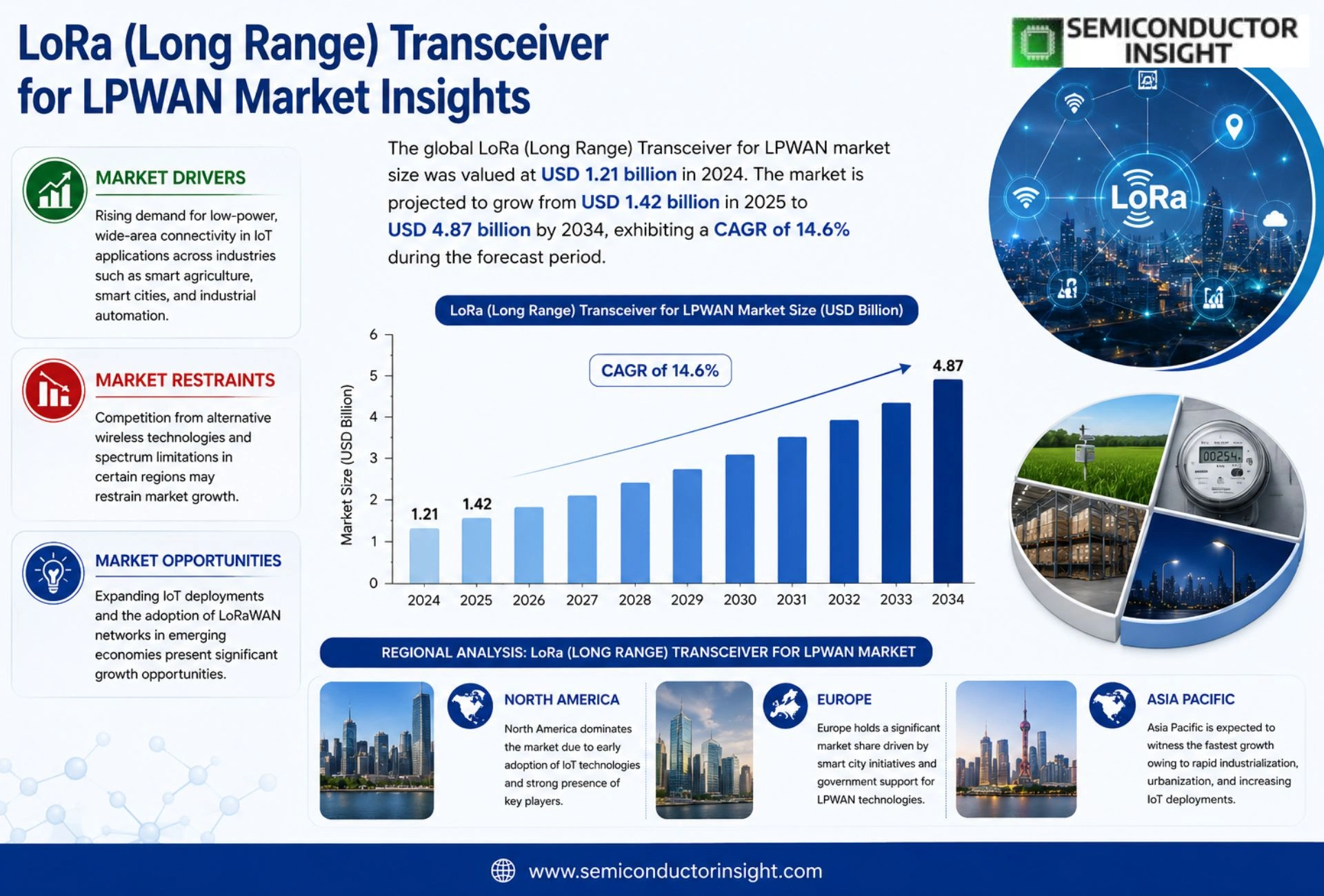
MARKET DRIVERS
Rapid Expansion of IoT Ecosystems Accelerating Demand for LoRa Transceivers
The proliferation of Internet of Things (IoT) deployments across smart cities, agriculture, utilities, and industrial automation has become one of the most significant forces driving LoRa (Long Range) Transceiver for LPWAN Market. LoRa-based transceivers offer a compelling combination of long-range communication, ultra-low power consumption, and cost-effective connectivity, making them an ideal choice for large-scale IoT sensor networks. As enterprises and municipalities accelerate digital transformation initiatives, the need for reliable, low-power wide-area connectivity solutions continues to intensify, positioning LoRa transceivers at the core of next-generation IoT infrastructure.
Growing Adoption of Smart Agriculture and Environmental Monitoring Applications
Smart agriculture represents one of the fastest-growing application segments for the LoRa LPWAN transceiver market. Farmers and agri-tech companies are deploying LoRa-enabled sensors for soil moisture monitoring, precision irrigation, crop health tracking, and livestock management across vast rural landscapes where cellular connectivity is unreliable or cost-prohibitive. Similarly, environmental monitoring agencies and utility providers are leveraging LoRa transceiver networks to collect real-time data on air quality, water levels, and energy consumption. The ability of LoRa technology to transmit data over distances exceeding 10 kilometers in open terrain, while operating on battery power for several years, makes it uniquely suited to these demanding deployment environments.
➤ LoRa transceiver modules operating on the sub-GHz frequency bands enable network deployments that can support thousands of end nodes on a single gateway, dramatically reducing infrastructure costs for large-scale LPWAN deployments in both urban and rural settings.
Government-backed smart city programs across North America, Europe, and Asia-Pacific are further catalyzing market growth by mandating the deployment of connected infrastructure for traffic management, waste monitoring, street lighting, and public safety applications. These initiatives create structured, large-volume procurement opportunities for LoRa transceiver manufacturers and LPWAN network operators, contributing to sustained revenue growth and technology standardization across LoRa (Long Range) Transceiver for LPWAN Market.
MARKET CHALLENGES
Spectrum Interference and Network Congestion in High-Density Deployment Environments
One of the primary technical challenges confronting LoRa (Long Range) Transceiver for LPWAN Market is the risk of radio frequency interference and network congestion in environments where large numbers of LoRa devices operate simultaneously within overlapping coverage areas. Because LoRaWAN operates on unlicensed ISM frequency bands , typically 868 MHz in Europe and 915 MHz in North America , the spectrum is shared with other wireless technologies, including Sigfox, Wi-Fi, and Zigbee devices. In dense urban deployments or industrial facilities with high sensor concentrations, packet collision rates can increase, degrading network reliability and data throughput. Addressing this challenge requires careful network planning, adaptive data rate management, and the implementation of advanced channel access protocols.
Other Challenges
Limited Data Rate Constraints
The inherent physical trade-off in LoRa technology between communication range, power consumption, and data rate imposes limitations on the types of applications that can be effectively supported. LoRa transceivers typically deliver data rates ranging from 0.3 kbps to 50 kbps, which is sufficient for low-frequency sensor telemetry but inadequate for applications requiring high-bandwidth data transfer such as video surveillance or real-time voice communication. This restricts the addressable market for LoRa LPWAN transceivers and necessitates careful application segmentation strategies by vendors.
Competitive Pressure from Alternative LPWAN Technologies
The LoRa transceiver for LPWAN market faces increasing competitive pressure from alternative low-power wide-area network technologies, including NB-IoT (Narrowband IoT) and LTE-M, which are backed by major global telecommunications operators and benefit from licensed spectrum and carrier-grade network infrastructure. In markets where cellular network coverage is extensive and IoT service providers offer competitive pricing, enterprises may favor NB-IoT or LTE-M solutions over LoRaWAN deployments, particularly for applications requiring guaranteed quality of service or bidirectional communication with low latency.
MARKET RESTRAINTS
Regulatory Fragmentation and Regional Spectrum Policy Differences
Regulatory heterogeneity across global markets presents a meaningful structural restraint on the growth of LoRa (Long Range) Transceiver for LPWAN Market. The unlicensed frequency bands allocated for LoRa operation differ significantly between regions , 433 MHz, 868 MHz, and 915 MHz bands each carry distinct duty cycle restrictions, transmission power limits, and channel usage requirements as mandated by local regulatory authorities including the FCC in the United States, ETSI in Europe, and equivalent bodies across Asia-Pacific and Latin America. Device manufacturers must develop region-specific transceiver configurations or multi-band modules to achieve global market compliance, increasing product development costs, extending time-to-market, and complicating supply chain management for international deployments.
Fragmented Ecosystem Interoperability and Standardization Gaps
Despite the efforts of the LoRa Alliance in promoting LoRaWAN as an open, interoperable standard, practical interoperability challenges persist across devices, gateways, and network servers from different vendors operating within the LoRa LPWAN ecosystem. Variations in firmware implementations, proprietary network management layers, and inconsistent certification processes can create integration friction for enterprises deploying multi-vendor LPWAN solutions. These interoperability gaps increase total cost of ownership, create vendor lock-in risks, and may deter risk-averse enterprise buyers from committing to large-scale LoRa transceiver deployments, thereby moderating overall market expansion velocity.
MARKET OPPORTUNITIES
Emergence of Private LoRaWAN Networks Across Industrial and Enterprise Verticals
The growing preference among industrial enterprises, logistics operators, and campus-based organizations for private, dedicated LoRaWAN network deployments represents a substantial opportunity for LoRa (Long Range) Transceiver for LPWAN Market. Unlike public network models, private LoRaWAN infrastructure gives enterprises full control over data security, network configuration, and quality of service parameters , attributes of critical importance in sectors such as oil and gas, mining, manufacturing, and healthcare. The declining cost of LoRa gateway hardware and the availability of open-source network server platforms are lowering the barriers to private network deployment, enabling a broader range of organizations to build and operate their own LPWAN infrastructure powered by LoRa transceivers.
Integration of LoRa Technology with Satellite Networks for Global IoT Connectivity
The convergence of LoRa transceiver technology with low-earth orbit (LEO) satellite communication networks is opening a transformative new frontier for the LoRa LPWAN transceiver market. Several satellite operators have begun deploying LoRa-compatible payloads aboard LEO satellites, enabling direct-to-satellite communication from standard LoRa end devices in remote areas beyond the reach of terrestrial gateway infrastructure. This capability addresses one of the most persistent connectivity gaps in global IoT deployments , particularly relevant for asset tracking in maritime environments, remote pipeline monitoring, wildlife conservation, and cross-border supply chain visibility. As satellite IoT services mature and launch costs continue to decline, the integration of LoRa transceivers into hybrid terrestrial-satellite LPWAN architectures is expected to unlock significant new addressable market segments and revenue opportunities for transceiver manufacturers and network solution providers.
Trends
Accelerating IoT Infrastructure Rollout Driving LoRa Transceiver Adoption
LoRa (Long Range) Transceiver for LPWAN Market is experiencing sustained momentum as global IoT infrastructure continues to expand at an accelerated pace. Enterprises and governments alike are increasingly deploying LoRaWAN-based networks to connect distributed assets across wide geographic areas without the energy overhead associated with traditional cellular technologies. The ability of LoRa transceivers to transmit data across distances of up to 15 kilometers in rural environments makes them particularly well-suited for applications such as smart metering, agricultural monitoring, and large-scale industrial IoT deployments. This demand trajectory is reinforced by the growing membership base of the LoRa Alliance, which now counts over 500 member organizations worldwide, underscoring the maturity and collaborative strength of the LoRaWAN ecosystem.
Other Trends
Expansion of Smart City Initiatives
Municipal governments across both developed and emerging economies are integrating LoRa transceiver technology into smart city frameworks to enable real-time monitoring of utilities, street lighting, waste management, and environmental sensors. The low power consumption profile of LoRa (Long Range) transceiver chips and modules allows city planners to deploy large-scale sensor networks with extended battery life, significantly reducing operational costs. This trend is expected to remain a key driver as urbanization rates continue to rise globally.
Product Innovation by Leading Manufacturers
Key industry participants are actively expanding their LoRa transceiver portfolios to address a broader range of LPWAN use cases. Semtech Corporation, the primary developer of LoRa technology, has continued to evolve its LoRa Edge and LoRa Connect product families. Meanwhile, Murata Manufacturing Co., Ltd., STMicroelectronics, and Microchip Technology Inc. maintain competitive product lines spanning standalone transceiver chips, integrated modules, and system-on-chip (SoC) solutions, catering to diverse application requirements across asset tracking, industrial automation, and precision agriculture.
Growing Preference for Energy-Efficient Connectivity
As sustainability considerations become central to enterprise technology procurement, LoRa (Long Range) Transceiver for LPWAN Market is benefiting from a structural shift toward energy-efficient wireless connectivity. LoRa transceivers operating on sub-GHz frequency bands with chirp spread spectrum modulation deliver reliable long-range communication at minimal power draw, making them a preferred choice for battery-operated end nodes deployed in remote or hard-to-access locations.
Rising Adoption Across Agricultural and Industrial IoT Applications
The agriculture and industrial sectors are emerging as high-growth verticals for LoRa transceiver deployments. Precision agriculture operations leverage LPWAN connectivity to monitor soil conditions, irrigation systems, and crop health across expansive farmlands, while industrial facilities use LoRa-enabled sensors for predictive maintenance and supply chain visibility. These application expansions are broadening the addressable market for LoRa (Long Range) Transceiver for LPWAN solutions and are expected to sustain long-term demand across the forecast period.
COMPETITIVE LANDSCAPE
Key Industry Players
LoRa (Long Range) Transceiver for LPWAN Market: Competitive Dynamics and Leading Innovators Shaping the Global IoT Connectivity Ecosystem
LoRa (Long Range) Transceiver for LPWAN Market is characterized by a moderately consolidated competitive structure, with Semtech Corporation holding a dominant and foundational position as the original developer and primary licensor of LoRa technology. Semtech’s proprietary chirp spread spectrum (CSS) modulation remains the cornerstone of the broader LoRaWAN ecosystem, and the company continues to assert its technological leadership through the ongoing expansion of its LoRa Edge and LoRa Connect product families, addressing a widening range of LPWAN use cases including geolocation, asset tracking, and smart metering. The company’s extensive intellectual property portfolio and its central role within the LoRa Alliance , a global consortium of over 500 member organizations , afford it a significant competitive moat that rivals find difficult to replicate. As the market grows from USD 1.42 billion in 2025 toward a projected USD 4.87 billion by 2034 at a CAGR of 14.6%, competitive intensity is expected to increase substantially, attracting both established semiconductor firms and agile module manufacturers.
Beyond Semtech, the competitive landscape encompasses a diverse set of players spanning semiconductor manufacturers, module integrators, and system-on-chip (SoC) solution providers. Murata Manufacturing Co., Ltd. and STMicroelectronics are among the most prominent challengers, offering compact LoRa modules and integrated transceiver solutions tailored to industrial IoT, smart city, and agricultural monitoring deployments. Microchip Technology Inc. competes through its versatile LoRaWAN-certified chipsets optimized for ultra-low power consumption, while companies such as Heltec Automation and RAKwireless have carved out strong niches in the developer and rapid-deployment segments through cost-competitive and highly configurable module offerings. Additionally, IMST GmbH, Pycom, Dragino Technology, and Laird Connectivity continue to serve specialized verticals, reinforcing the ecosystem’s diversity. The market’s competitive trajectory is further shaped by rising demand for smart infrastructure across both developed and emerging economies, prompting players to invest in next-generation LoRa SoC architectures, enhanced network integration capabilities, and expanded regional distribution partnerships.
List of Key LoRa (Long Range) Transceiver for LPWAN Companies Profiled
- Semtech Corporation
- Murata Manufacturing Co., Ltd.
- STMicroelectronics
- Microchip Technology Inc.
- Heltec Automation
- RAKwireless
- IMST GmbH
- Laird Connectivity
- Dragino Technology Co., Ltd.
- Pycom
- Adeunis
- Tektelic Communications Inc.
- Multitech Systems
- Nemeus
- Cavli Wireless
Segment Analysis:
| Segment Category | Sub-Segments | Key Insights |
| By Type |
|
Integrated LoRa Modules currently lead this segment, driven by their plug-and-play design that significantly reduces development complexity for OEMs and system integrators.
|
| By Application |
|
Smart Metering & Utilities represents the dominant application segment, underpinned by widespread government mandates for advanced metering infrastructure rollouts across electricity, gas, and water utility networks.
|
| By End User |
|
Industrial & Manufacturing Enterprises constitute the leading end-user segment, propelled by the accelerating convergence of operational technology and information technology within Industry 4.0 transformation programs.
|
| By Frequency Band |
|
Sub-1 GHz Band transceivers dominate this segment, as the lower frequency range delivers superior propagation characteristics essential to the core value proposition of LoRa technology.
|
| By Deployment Model |
|
Private LoRaWAN Network Deployments are emerging as the leading model, particularly among enterprises with stringent data security, network reliability, and customization requirements that cannot be adequately addressed through shared public network infrastructure.
|
Regional Analysis: LoRa (Long Range) Transceiver for LPWAN Market
North America
North American municipalities are rapidly deploying LoRa (Long Range) Transceiver for LPWAN-enabled networks to power smart metering, street lighting automation, and water management systems. Strong public-private partnerships and government-backed smart city grants are creating sustained demand for low-power wide-area solutions, particularly in urban centers across the United States and Canadian metropolitan corridors.
The industrial sector in North America is a key consumer of LoRa transceiver technology, leveraging LPWAN connectivity for real-time asset tracking, warehouse automation, and predictive maintenance. Manufacturing hubs across the U.S. Midwest and logistics networks spanning cross-border trade routes increasingly rely on LoRa-based LPWAN solutions for seamless, energy-efficient device communication at scale.
Precision agriculture represents a high-growth application for LoRa Long Range Transceiver for LPWAN technology in North America. Farmers across vast rural geographies in the U.S. and Canada deploy LoRa-enabled sensors for soil monitoring, irrigation management, and livestock tracking. The ability of LoRaWAN networks to cover expansive farmlands with minimal infrastructure investment makes them indispensable for modern agri-tech solutions.
North America benefits from a well-defined spectrum regulatory environment that facilitates LoRa transceiver deployment in unlicensed ISM bands. The LoRa Alliance’s active presence and industry standardization efforts provide a collaborative framework for vendors and operators. This ecosystem maturity reduces market entry barriers and accelerates commercial rollouts of LPWAN connectivity solutions across diverse verticals.
Europe
Europe represents a highly progressive and innovation-driven region LoRa (Long Range) Transceiver for LPWAN Market, with strong regulatory backing from the European Union’s digital single market agenda and sustainability mandates. Countries such as Germany, France, the Netherlands, and the United Kingdom are at the forefront of LoRaWAN network deployments, with national operators building extensive public LPWAN infrastructure. The region’s stringent energy efficiency directives and carbon reduction targets are accelerating the integration of LoRa transceiver solutions in smart grid modernization, environmental monitoring, and intelligent transportation systems. Europe’s emphasis on data sovereignty and GDPR compliance has also shaped the development of secure, localized LPWAN architectures. The manufacturing heartland of Central Europe and Scandinavia’s advanced digital infrastructure further support the adoption of LoRa Long Range Transceiver technology in industrial and logistics applications. With robust academic research ecosystems and cross-border IoT pilot programs, Europe is well-positioned to sustain competitive growth in the LPWAN connectivity landscape through the forecast period.
Asia-Pacific
Asia-Pacific is emerging as the fastest-growing region LoRa (Long Range) Transceiver for LPWAN Market, propelled by rapid urbanization, large-scale smart city programs, and massive IoT device deployment across China, Japan, South Korea, India, and Southeast Asian nations. China’s national IoT strategy and government-led infrastructure investments have established one of the world’s largest LoRaWAN networks, supporting applications from smart agriculture to industrial monitoring. India’s expanding digital infrastructure and ambitious smart city mission are creating significant demand for LPWAN connectivity solutions. Japan and South Korea, known for their technological sophistication, are integrating LoRa transceiver technology into advanced manufacturing and logistics ecosystems. The region’s diverse industrial base, cost-sensitive deployment environments, and a growing base of homegrown IoT solution providers collectively make Asia-Pacific a dynamic and competitive market for LoRa Long Range Transceiver for LPWAN applications through 2034.
South America
South America presents a developing yet increasingly promising landscape for LoRa (Long Range) Transceiver for LPWAN Market, characterized by growing investment in smart agriculture, remote monitoring, and urban utility management. Brazil, as the region’s largest economy, leads LPWAN adoption with LoRa transceiver deployments across its vast agricultural sector, where connectivity challenges in remote farmlands make low-power wide-area solutions particularly valuable. Colombia, Chile, and Argentina are also witnessing gradual expansion of IoT connectivity infrastructure, supported by telecommunications operators investing in LPWAN network coverage. Despite challenges such as economic volatility and uneven digital infrastructure, the region offers substantial long-term growth potential as governments prioritize digitalization. The convergence of smart metering programs and precision farming initiatives is expected to further stimulate demand for LoRa Long Range Transceiver technology across South American markets during the forecast period.
Middle East & Africa
The Middle East & Africa region occupies a nascent but strategically significant position LoRa (Long Range) Transceiver for LPWAN Market, with growth anchored in smart city ambitions, energy sector modernization, and expanding telecommunications infrastructure. Gulf Cooperation Council nations, particularly the UAE and Saudi Arabia, are investing heavily in connected city frameworks under visionary national programs, creating demand for LPWAN-enabled sensor networks and LoRa transceiver solutions. Africa’s unique connectivity challenges , spanning vast geographies with limited traditional network coverage , position LoRa Long Range Transceiver technology as a highly practical solution for agricultural monitoring, water resource management, and off-grid asset tracking. Telecommunications providers across Sub-Saharan Africa are beginning to explore LPWAN deployments as cost-effective alternatives to cellular networks for IoT applications. While infrastructure constraints and economic development gaps temper near-term growth, the region’s long-term trajectory for LoRa transceiver adoption remains positive through 2034.
Report Scope
This market research report provides a comprehensive analysis of the LoRa (Long Range) Transceiver for LPWAN Market , covering the forecast period 2026–2034. It offers detailed insights into market dynamics, technological advancements, competitive landscape, and key trends shaping the industry.
Key focus areas of the report include:
- Market Overview: The report begins with an overview outlining its current market scenario, key growth indicators, and industry transformation drivers. It discusses macroeconomic factors, demand–supply balance, regulatory landscape, and the strategic role of semiconductors in powering advancements across industries such as automotive, telecommunications, consumer electronics, and industrial automation.
- Market Size & Forecast: Historical data and future projections for revenue, unit shipments, and market value across major regions and segments.
- Segmentation Analysis: Detailed breakdown by product type, technology, application, and end-user industry to identify high-growth segments and investment opportunities.
- Regional Insights: Insights into market performance across North America, Europe, Asia-Pacific, Latin America, and the Middle East & Africa, including country-level analysis where relevant.
- Competitive Landscape: Profiles of leading market participants, including their product offerings, R&D focus, manufacturing capacity, pricing strategies, and recent developments such as mergers, acquisitions, and partnerships.
- Technology Trends & Innovation: Assessment of emerging technologies, integration of AI/IoT, semiconductor design trends, fabrication techniques, and evolving industry standards.
- Market Drivers & Restraints: Evaluation of factors driving market growth along with challenges, supply chain constraints, regulatory issues, and market-entry barriers.
- Stakeholder Insights: Insights for component suppliers, OEMs, system integrators, investors, and policymakers regarding the evolving ecosystem and strategic opportunities.
Primary and secondary research methods are employed, including interviews with industry experts, data from verified sources, and real-time market intelligence to ensure the accuracy and reliability of the insights presented.
FREQUENTLY ASKED QUESTIONS:
What is the current market size of LoRa (Long Range) Transceiver for LPWAN Market?
-> Global LoRa (Long Range) Transceiver for LPWAN Market was valued at USD 1.42 billion in 2025 and is expected to reach USD 4.87 billion by 2034, exhibiting a CAGR of 14.6% during the forecast period.
Which key companies operate LoRa (Long Range) Transceiver for LPWAN Market?
-> Key players include Semtech Corporation, Murata Manufacturing Co., Ltd., STMicroelectronics, and Microchip Technology Inc., among others.
What are the key growth drivers?
-> Key growth drivers include the accelerating global rollout of IoT infrastructure, rising demand for energy-efficient connectivity solutions, growing adoption of smart city initiatives, and the proliferation of LoRaWAN-based network deployments supported by the LoRa Alliance, which counts over 500 member organizations worldwide.
Which region dominates the market?
-> Asia-Pacific is the fastest-growing region, driven by rapid urbanization and expanding IoT infrastructure, while North America and Europe remain significant markets supported by advanced smart city and industrial IoT deployments.
What are the emerging trends?
-> Emerging trends include the expansion of LoRa Edge and LoRa Connect product families, growing deployment of system-on-chip (SoC) solutions, increased adoption in smart metering, asset tracking, and agricultural monitoring, and the use of chirp spread spectrum (CSS) modulation enabling communication over distances of up to 15 kilometers in rural environments.

Get Sample Report PDF for Exclusive Insights
Report Sample Includes
- Table of Contents
- List of Tables & Figures
- Charts, Research Methodology, and more...