Ion Sensors Market Insights
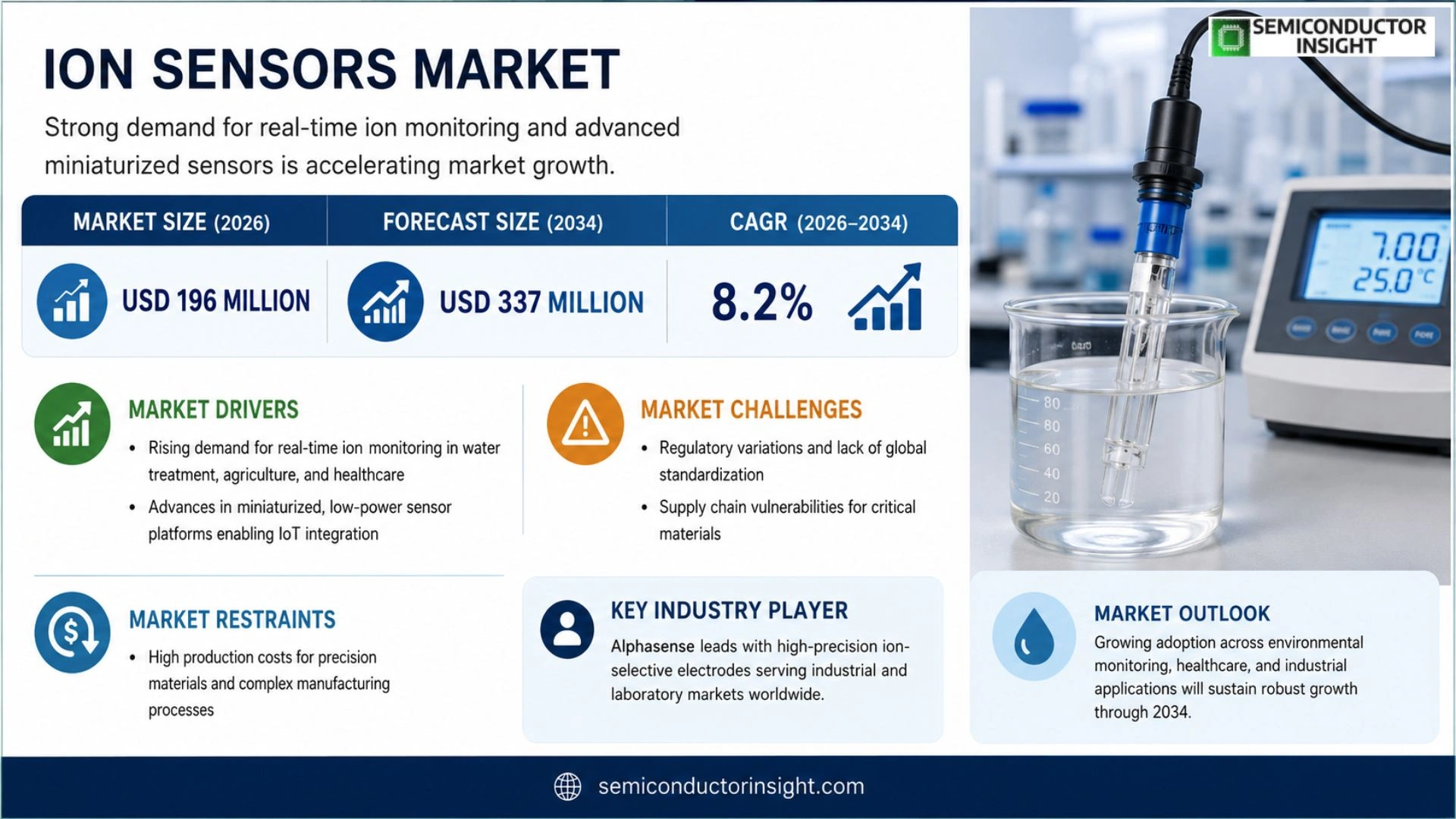
Global Ion Sensors market was valued at USD 196 million in 2026 and is forecasted to reach USD 337 million by 2034, reflecting a compound annual growth rate of 8.2% over the period.
Ion sensors enable continuous monitoring of specific ionic species,such as calcium (Ca²⁺), magnesium (Mg²⁺) and sodium (Na⁺),in aqueous environments. By converting ionic activity into measurable electrical or optical signals, these devices support real‑time process control in industrial water treatment, pharmaceutical manufacturing, and laboratory analysis. Both electrochemical and optical configurations are common, offering flexibility for diverse applications where precise ion concentration data are essential.
MARKET DRIVERS
Rising Demand for Real‑Time Ion Monitoring
Ion Sensors Market is being propelled by a surge in applications that require instantaneous ion concentration feedback, especially in water‑treatment facilities and precision agriculture. Operators are shifting away from batch‑wise laboratory analyses toward inline measurement because it minimizes downtime and reduces chemical usage. This operational shift translates into higher unit shipments for sensors capable of delivering sub‑ppm accuracy in harsh environments.
Advances in Miniaturized Sensor Platforms
Recent breakthroughs in MEMS fabrication and solid‑state electrolyte designs have shrunk sensor footprints while preserving selectivity. Manufacturers can now embed ion sensors directly onto micro‑fluidic chips, enabling integration with IoT gateways. The consequence is a broader addressable market that includes wearable health monitors and portable environmental samplers, sectors previously marginal to traditional ion‑sensing solutions.
➤ Clients that adopt integrated, low‑power ion sensors report up to a 30 % reduction in total cost of ownership within the first year of deployment.
Combined, these forces are reshaping procurement strategies: buyers prioritize platforms that offer both robustness and digital connectivity, forcing legacy suppliers to accelerate product roadmaps or risk obsolescence.
MARKET CHALLENGES
Regulatory Hurdles and Standardization
Environmental regulations in North America and the EU now mandate continuous reporting of specific ion concentrations in effluent streams. While this creates a clear need for monitoring equipment, the lack of a unified global standard for sensor calibration leads to fragmented testing protocols. End‑users must often purchase multiple certified devices to satisfy distinct regional mandates, inflating overall spend.
Other Challenges
Supply Chain Vulnerabilities
The reliance on specialty glass substrates and rare‑earth dopants makes the manufacturing pipeline sensitive to geopolitical tensions. Recent export restrictions have elongated lead times, prompting OEMs to hold higher safety stock and consequently raise inventory costs.
MARKET RESTRAINTS
High Production Costs for Precision Materials
Fabricating ion-selective membranes with reproducible performance still requires labor‑intensive coating processes and rigorous quality testing. The resulting unit cost remains a barrier for price‑sensitive segments such as small‑scale municipal utilities. Without economies of scale, many potential adopters postpone upgrades in favor of legacy analog gauges.
MARKET OPPORTUNITIES
Emerging Applications in Renewable Energy Storage
As grid‑scale battery installations mature, maintaining optimal electrolyte ion balance becomes critical to cycle life and safety. Vendors that can deliver rugged, low‑drift sensors for alkaline and lithium‑ion systems stand to secure a niche yet rapidly expanding demand pool. Partnerships with battery management system providers could accelerate market penetration, positioning these firms at the forefront of the next wave of ion‑sensing innovation.
Ion Sensors Market Trends
Growing Demand for Real‑Time Ionic Analysis
In process‑intensive sectors such as water treatment, pharmaceutical manufacturing, and food safety, operators are moving away from periodic laboratory checks toward continuous, on‑line measurement of ionic species. The ability to detect fluctuations in calcium, magnesium or sodium concentrations as they happen enables tighter process control, reduced waste, and faster response to regulatory alarms. This shift is reinforced by the proliferation of cloud‑connected platforms that aggregate sensor streams for predictive analytics. For equipment manufacturers, the trend translates into a need to embed ion‑sensing modules directly into pumps, filtration units or dosing systems, creating a new revenue stream that blends hardware sales with data‑service contracts. The broader Ion Sensors Market therefore feels the pull of digitalization as much as it does of analytical precision.
Other Trends
Miniaturization and Integrated Diagnostics
The last decade has witnessed a wave of micro‑fabrication techniques that shrink electrode arrays from bench‑top dimensions to millimetre‑scale footprints. By leveraging CMOS compatible processes, vendors can now co‑locate signal conditioning circuitry and wireless transmitters on the same chip, cutting assembly steps and lowering the bill of materials. Such compact designs make it feasible to place sensors in remote or hard‑to‑reach locations,inside pipelines, on‑site reactors, or portable field kits. The operational implication is twofold: first, end‑users gain access to granular data without massive infrastructure investments; second, suppliers can target previously untapped segments like portable environmental testing kits, expanding their addressable market.
Shift Toward Sustainable Manufacturing Practices
Environmental stewardship is influencing component choices across the sector. Manufacturers are replacing traditional noble‑metal electrodes with carbon‑based or graphene‑derived alternatives that consume less material and generate lower waste during production. Energy‑efficient designs,often powered by harvested solar or kinetic sources,are becoming standard where remote deployment is required. From a strategic perspective, firms that embed sustainability into their product roadmaps not only meet tightening emissions standards but also differentiate themselves in a crowded field, attracting clients whose procurement policies prioritize low‑impact technologies. The emerging emphasis on greener production thus reshapes supply chains, prompting raw‑material suppliers to adapt and opening collaboration opportunities for firms focused on circular‑economy solutions.
COMPETITIVE LANDSCAPE
Key Industry Players
Ion Sensors Market – Competitive Overview
The market is anchored by a handful of large‑scale manufacturers that combine extensive R&D budgets with global distribution networks. Alphasense, for instance, leverages its semiconductor expertise to deliver high‑precision ion‑selective electrodes that dominate the industrial and laboratory segments in North America and Europe. Its ability to bundle sensors with analytics platforms creates a sticky customer base, compelling smaller entrants to seek niche applications or regional partnerships. The concentration of revenue among the top five firms,Alphasense, NT Sensors, Horiba, Mettler Toledo, and Jiangsu SWR,means that competitive pressure often revolves around incremental performance gains, cost optimisation, and after‑sales service excellence rather than disruptive product launches.
Beyond the headline players, a diverse set of specialist firms sustains the market’s breadth. Companies such as Zhengzhou Winsen and Sensirion focus on low‑cost sensors for emerging IoT deployments in agriculture and environmental monitoring, where price sensitivity outweighs ultra‑high accuracy. Meanwhile, European outfits like Kyoritsu and Bosch Sensortechnik carve out space in safety‑critical applications through rigorous certification and bespoke calibration services. Asian manufacturers,including Yokogawa, Honeywell, and Teledyne,are expanding their portfolios to cover multi‑ion analysis, aligning product roadmaps with regional regulatory trends that demand tighter water‑quality control. These niche operators collectively shape a fragmented layer of the ecosystem, offering larger rivals opportunities for strategic alliances or acquisition.
List of Key Ion Sensors Companies Profiled
- Alphasense
- NT Sensors
- Horiba
- Mettler Toledo
- Jiangsu SWR
- Zhengzhou Winsen
- Sensirion
- Kyoritsu
- Bosch Sensortechnik
- Yokogawa
- Honeywell
- Teledyne
- AMS Sensors
- Fujikura
- Renesas Electronics
Segment Analysis:
| Segment Category | Sub-Segments | Key Insights |
| By Type |
|
Ca Sensors
|
| By Application |
|
Environmental Monitoring
|
| By End User |
|
Water Treatment
|
| By Sensor Principle |
|
Potentiometric Sensors
|
| By Market Trend |
|
IoT Integration
|
Regional Analysis: Ion Sensors Market
Asia‑Pacific
Concentrated semiconductor fabs and automotive parts factories generate a steady demand for high‑precision ion detection, compelling suppliers to localise assembly lines to meet tight lead‑time expectations while keeping costs competitive.
Governments are tightening air‑quality and wastewater discharge limits, prompting municipalities and heavy‑industry players to retrofit plants with advanced ion monitoring systems that can verify compliance in real time.
Growing awareness of occupational health risks drives factories to integrate ion sensors into safety protocols, while power utilities leverage the technology to optimise combustion processes and reduce pollutant formation.
Regional universities and research institutes partner with sensor firms, accelerating the development of miniaturised, low‑power ion detection modules that can be embedded in IoT‑enabled monitoring networks.
North America
North America remains a substantial arena for Ion Sensors Market, anchored by a strong tradition of technological investment and a mature regulatory framework. U.S. agencies continue to tighten permissible exposure limits for hazardous gases, prompting utilities, aerospace manufacturers, and petrochemical plants to upgrade legacy detection equipment. Canadian firms, benefiting from robust federal incentives for clean‑technology adoption, are integrating ion sensors into renewable‑energy projects, especially where hydrogen handling requires precise leakage detection. The region’s deep capital markets enable early‑stage ventures to secure funding for next‑generation sensor architectures, fostering a competitive environment that privileges speed of innovation over volume alone.
Europe
European dynamics for Ion Sensors Market are shaped by a combination of stringent environmental directives and a well‑established industrial base. The European Union’s Green Deal emphasizes accurate emissions accounting, prompting power generators and metal‑processing facilities to retrofit plants with ion‑based monitoring solutions. Germany and the Netherlands, known for precision engineering, host several niche manufacturers that specialise in high‑accuracy sensors for pharmaceutical and food‑processing sectors. Moreover, cross‑border research programmes under Horizon Europe encourage collaborative development, accelerating the rollout of sensor arrays that integrate with smart‑grid infrastructures across the continent.
South America
In South America, Ion Sensors Market is gradually emerging as mining and agribusiness sectors recognise the value of precise ion detection for both safety and environmental stewardship. Brazil’s expanding petrochemical corridor and Chile’s copper mining operations are confronting tighter local emission policies, encouraging plant operators to upgrade monitoring suites. While overall investment levels remain modest compared with northern markets, regional partnerships with Asian manufacturers are facilitating technology transfer, allowing local firms to adapt sensor designs to tropical climates and rugged operating conditions.
Middle East & Africa
The Middle East & Africa present a divergent yet opportunistic landscape for ion‑sensor adoption. Rapid urbanisation and the rollout of large‑scale desalination plants in the Gulf create a demand for reliable ion monitoring to safeguard water quality. Simultaneously, emerging economies in Sub‑Saharan Africa are confronting air‑quality challenges linked to expanding manufacturing zones, prompting governments to introduce baseline monitoring standards. International equipment providers are capitalising on these trends by establishing regional service hubs, ensuring that maintenance and calibration expertise can keep pace with the growing installed base.
Report Scope
This market research report provides a comprehensive analysis of the Ion Sensors Market , covering the forecast period 2026–2034. It offers detailed insights into market dynamics, technological advancements, competitive landscape, and key trends shaping the industry.
Key focus areas of the report include:
- Market Overview: The report begins with an overview outlining its current market scenario, key growth indicators, and industry transformation drivers. It discusses macroeconomic factors, demand–supply balance, regulatory landscape, and the strategic role of semiconductors in powering advancements across industries such as automotive, telecommunications, consumer electronics, and industrial automation.
- Market Size & Forecast: Historical data and future projections for revenue, unit shipments, and market value across major regions and segments.
- Segmentation Analysis: Detailed breakdown by product type, technology, application, and end-user industry to identify high-growth segments and investment opportunities.
- Regional Insights: Insights into market performance across North America, Europe, Asia-Pacific, Latin America, and the Middle East & Africa, including country-level analysis where relevant.
- Competitive Landscape: Profiles of leading market participants, including their product offerings, R&D focus, manufacturing capacity, pricing strategies, and recent developments such as mergers, acquisitions, and partnerships.
- Technology Trends & Innovation: Assessment of emerging technologies, integration of AI/IoT, semiconductor design trends, fabrication techniques, and evolving industry standards.
- Market Drivers & Restraints: Evaluation of factors driving market growth along with challenges, supply chain constraints, regulatory issues, and market-entry barriers.
- Stakeholder Insights: Insights for component suppliers, OEMs, system integrators, investors, and policymakers regarding the evolving ecosystem and strategic opportunities.
Primary and secondary research methods are employed, including interviews with industry experts, data from verified sources, and real-time market intelligence to ensure the accuracy and reliability of the insights presented.
FREQUENTLY ASKED QUESTIONS:
What is the current market size of Ion Sensors Market?
-> Ion Sensors market is forecasted to reach USD 337 million by 2034, reflecting a compound annual growth rate of 8.2% over the period.
Which key companies operate in Ion Sensors Market?
-> Key players include Alphasense, NT Sensors, Horiba, Mettler Toledo, Jiangsu SWR, Zhengzhou Winsen, among others.
What are the key growth drivers?
-> Key growth drivers include the attractive solution offered by ion sensors for continuous evaluation of ionic species in aqueous media, driving demand in water treatment, environmental monitoring, and industrial process control.
Which region dominates the market?
-> The market shows strong activity in both North America (particularly the United States) and Asia (notably China), making these regions primary contributors to global demand.
What are the emerging trends?
-> Emerging trends include greater integration of ion sensors with real‑time monitoring platforms and IoT-enabled water quality management systems.

Get Sample Report PDF for Exclusive Insights
Report Sample Includes
- Table of Contents
- List of Tables & Figures
- Charts, Research Methodology, and more...
 Download Sample Report PDF