Insulin Pump Motor Driver & Controller IC Market Insights
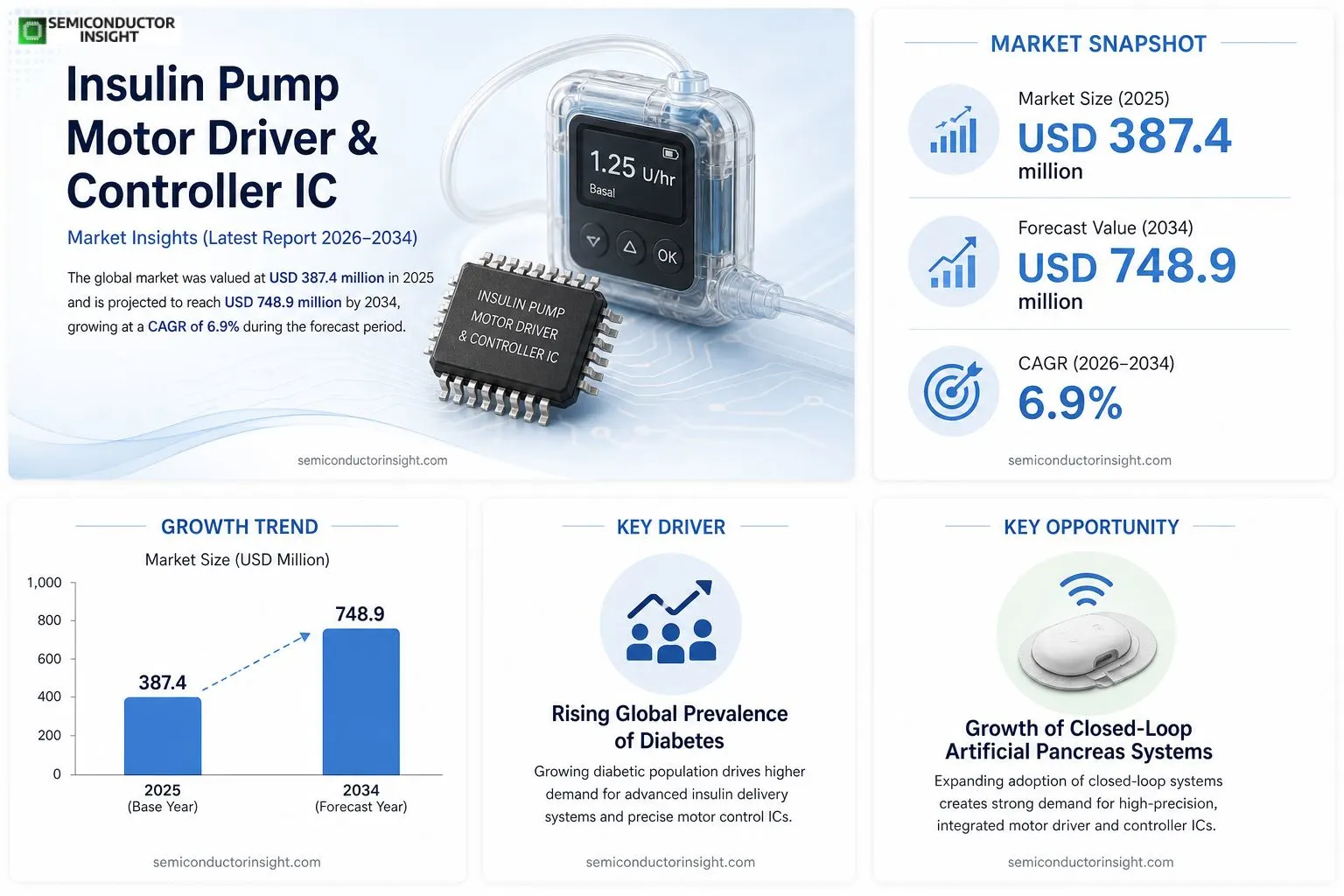
Globalnsulin Pump Motor Driver & Controller IC market size was valued at USD 387.4 million in 2025. The market is projected to grow from USD 412.6 million in 2026 to USD 748.9 million by 2034, exhibiting a CAGR of 6.9% during the forecast period.
Insulin pump motor driver and controller ICs are specialized semiconductor components designed to precisely regulate the miniaturized motors within insulin delivery devices. These integrated circuits manage stepper or DC motor actuation, ensuring accurate and consistent micro-dosing of insulin in both patch pumps and traditional tethered pump systems. The product category encompasses motor driver ICs, closed-loop controller ICs, low-power microcontrollers, and application-specific integrated circuits (ASICs) engineered specifically for ambulatory infusion pump platforms.
The market is witnessing steady growth driven by the rising global prevalence of diabetes, which affects over 537 million adults worldwide, and the accelerating adoption of advanced insulin delivery systems over conventional injection therapies. Furthermore, the ongoing miniaturization of wearable medical devices and the shift toward closed-loop artificial pancreas systems are significantly increasing demand for high-precision, ultra-low-power motor driver and controller ICs. Key players such as Texas Instruments Inc., STMicroelectronics N.V., and Analog Devices, Inc. operate in this market with specialized portfolios tailored to the stringent safety and efficiency requirements of medical-grade insulin delivery platforms.
MARKET DRIVERS
Rising Global Prevalence of Diabetes Fueling Demand for Advanced Insulin Delivery Systems
The escalating global burden of diabetes mellitus remains one of the most significant forces shaping Insulin Pump Motor Driver & Controller IC Market. With hundreds of millions of individuals living with Type 1 and insulin-dependent Type 2 diabetes worldwide, the clinical need for precise, reliable, and miniaturized insulin delivery devices has never been greater. Insulin pumps depend critically on highly accurate motor driver and controller integrated circuits to regulate basal and bolus insulin doses, and as the diabetic population continues to grow across both developed and emerging economies, the downstream demand for these semiconductor components is expected to expand in parallel.
Technological Advancements in Miniaturization and Low-Power IC Design
Continuous innovation in semiconductor fabrication and low-power circuit design is a key driver accelerating adoption within Insulin Pump Motor Driver & Controller IC Market. Modern insulin pump architectures demand motor driver ICs that operate at extremely low quiescent current levels to maximize battery life in wearable patch pumps and traditional tethered devices. Advances in CMOS process nodes, integrated system-on-chip designs, and intelligent closed-loop control algorithms have enabled manufacturers to develop controller ICs that deliver superior torque regulation, step accuracy, and fault detection within increasingly compact form factors. These technological improvements directly enhance device reliability and patient safety, accelerating physician and patient adoption.
➤ The transition toward closed-loop artificial pancreas systems is creating new engineering requirements for motor driver and controller ICs, demanding higher integration, faster response times, and tighter dose accuracy , fundamentally reshaping the component specification landscape.
The integration of continuous glucose monitoring (CGM) with automated insulin delivery platforms is further amplifying demand for sophisticated motor driver and controller ICs capable of interfacing with complex feedback control systems. As hybrid closed-loop and fully automated insulin delivery systems gain regulatory approvals across major markets, OEM insulin pump manufacturers are placing greater emphasis on sourcing controller ICs that support real-time adaptive algorithms, wireless communication protocols, and enhanced safety interlock mechanisms. This evolving system architecture is driving a structural shift in Insulin Pump Motor Driver & Controller IC Market toward higher-value, more feature-integrated semiconductor solutions.
MARKET CHALLENGES
Stringent Regulatory Requirements and Extended Medical Device Certification Timelines
Participants in Insulin Pump Motor Driver & Controller IC Market face substantial challenges arising from the rigorous regulatory environment governing medical-grade semiconductor components. Motor driver and controller ICs intended for use in implantable or wearable insulin delivery devices must comply with international standards including IEC 60601, ISO 13485, and applicable FDA Quality System Regulations. Meeting these requirements necessitates extensive design verification, validation testing, and documentation processes that can significantly extend product development cycles and increase time-to-market for new IC generations. For smaller semiconductor suppliers, the cost and complexity of achieving and maintaining medical-grade compliance represents a formidable barrier to entry and ongoing operational challenge.
Other Challenges
Supply Chain Vulnerabilities and Semiconductor Sourcing Risks
The global semiconductor supply chain has experienced notable disruptions in recent years, and Insulin Pump Motor Driver & Controller IC Market is not immune to these pressures. Insulin pump manufacturers and their IC suppliers must manage risks associated with raw material availability, specialized fabrication capacity at qualified foundries, and geopolitical factors influencing cross-border component flows. Long qualification lead times for medical-grade components mean that supply disruptions can have disproportionate operational impacts compared to consumer electronics markets, making supply chain resilience a critical strategic concern for all stakeholders.
High Development Costs and Specialized Design Expertise Requirements
Designing motor driver and controller ICs for insulin pump applications demands deep cross-disciplinary expertise spanning analog mixed-signal circuit design, embedded control systems, medical safety standards, and electromechanical actuator characterization. The specialized nature of this knowledge base limits the number of qualified engineering teams capable of delivering competitive solutions. Combined with the high non-recurring engineering costs associated with medical IC development and the relatively lower production volumes compared to consumer semiconductor markets, these factors create persistent profitability and scalability challenges for companies operating in Insulin Pump Motor Driver & Controller IC Market.
MARKET RESTRAINTS
Limited Market Volume Relative to Consumer Semiconductor Segments Constraining Economies of Scale
One of the most consequential restraints on Insulin Pump Motor Driver & Controller IC Market is the comparatively limited production volume inherent to the medical device sector. Unlike high-volume consumer or automotive semiconductor applications, insulin pump motor driver and controller ICs are produced in relatively modest quantities, which constrains manufacturers’ ability to achieve meaningful economies of scale in fabrication, testing, and packaging. This volume limitation tends to sustain elevated per-unit costs, which in turn affects the overall cost structure of insulin pump devices and can dampen adoption in cost-sensitive emerging markets where healthcare reimbursement frameworks are less developed.
Reimbursement Limitations and Healthcare Budget Pressures in Key Markets
Reimbursement policy landscapes across major healthcare systems represent a meaningful external restraint on growth within Insulin Pump Motor Driver & Controller IC Market. In numerous markets, particularly across Asia-Pacific and Latin America, reimbursement coverage for insulin pump therapy remains incomplete or subject to restrictive eligibility criteria, limiting the addressable patient population for pump-based insulin delivery. Budget pressures within public healthcare systems in Europe and elsewhere have also introduced price controls and tendering mechanisms that compress margins across the insulin pump value chain, indirectly restraining the investment capacity of device OEMs to incorporate premium IC solutions and fund next-generation platform development.
Additionally, the long product lifecycle typical of medical-grade ICs , driven by the extensive requalification efforts required to adopt updated component versions , can slow technology refresh cycles within Insulin Pump Motor Driver & Controller IC Market. Insulin pump OEMs are often reluctant to redesign validated platforms around new IC generations unless performance or regulatory benefits are compelling, creating periods of reduced design-win activity for IC suppliers and tempering near-term revenue growth prospects even when superior component technologies become available.
MARKET OPPORTUNITIES
Expansion of Wearable Patch Pump Platforms Creating New IC Design Opportunities
The accelerating shift toward disposable and semi-disposable wearable patch insulin pumps represents one of the most compelling near-term opportunities for Insulin Pump Motor Driver & Controller IC Market. Patch pump architectures impose stringent constraints on IC size, power consumption, and cost, creating strong demand for purpose-built motor driver and controller solutions optimized specifically for these form factors. Semiconductor suppliers capable of delivering highly integrated, ultra-low-power ICs with minimal external component requirements are well-positioned to capture significant design wins as patch pump platforms proliferate among both established medical device companies and new market entrants targeting the wearable diabetes management segment.
Growth of Artificial Pancreas and Closed-Loop Insulin Delivery Systems
The ongoing regulatory approvals and commercial launches of hybrid closed-loop and fully automated artificial pancreas systems across the United States, European Union, and increasingly in Asia-Pacific markets are generating substantial new opportunities within Insulin Pump Motor Driver & Controller IC Market. These advanced platforms require motor driver and controller ICs with enhanced functional integration, including support for high-resolution microstepping, real-time diagnostics, and seamless communication with CGM sensors and mobile device ecosystems. IC suppliers that proactively align their product roadmaps with the technical requirements of next-generation automated insulin delivery platforms stand to benefit from strong design engagement and favorable long-term supply agreements with leading insulin pump OEMs.
Emerging Markets Expansion and Increasing Diabetes Management Awareness
Rising healthcare infrastructure investment, improving insurance penetration, and growing clinical awareness of insulin pump therapy benefits in emerging economies across Southeast Asia, the Middle East, and Latin America present meaningful medium-to-long-term growth opportunities for Insulin Pump Motor Driver & Controller IC Market. As local and multinational insulin pump manufacturers develop cost-optimized device platforms targeting these markets, demand for competitively priced yet medically reliable motor driver and controller IC solutions is expected to grow. IC suppliers with the ability to offer scalable product families that balance performance, compliance, and cost efficiency will be strategically positioned to serve the evolving needs of a broadening global insulin pump market over the coming decade.
Insulin Pump Motor Driver & Controller IC Market Trends
Rising Diabetes Prevalence Fueling Demand for Advanced Insulin Delivery ICs
Insulin Pump Motor Driver & Controller IC Market is experiencing sustained momentum as the global burden of diabetes continues to escalate. With over 537 million adults worldwide living with diabetes, healthcare systems are increasingly prioritizing advanced insulin delivery mechanisms over conventional injection therapies. This shift is directly translating into heightened demand for specialized semiconductor components , particularly motor driver and controller ICs , that enable precise, consistent micro-dosing within modern insulin pump platforms. The transition from manual injection routines to automated, wearable infusion systems is reshaping the competitive and technological landscape of this niche but critical semiconductor segment.
Other Trends
Miniaturization and Wearable Device Integration
One of the most consequential trends shaping Insulin Pump Motor Driver & Controller IC Market is the ongoing miniaturization of wearable medical devices. Manufacturers are engineering increasingly compact patch pumps and tethered pump systems that demand ultra-low-power, high-precision ICs capable of operating within stringent size and energy constraints. This trend is driving innovation in low-power microcontrollers and application-specific integrated circuits (ASICs) purpose-built for ambulatory infusion platforms. As patient preference shifts toward discreet, body-worn devices, the pressure on IC designers to deliver greater functionality within smaller form factors continues to intensify.
Closed-Loop Artificial Pancreas Systems Gaining Traction
The advancement of closed-loop artificial pancreas systems represents a defining technological trend within Insulin Pump Motor Driver & Controller IC Market. These systems integrate continuous glucose monitoring with automated insulin delivery, requiring closed-loop controller ICs capable of real-time, adaptive motor actuation. The precision demanded by such platforms , where dosing errors can carry serious clinical consequences , is elevating the technical specifications expected of motor driver and controller ICs. Leading semiconductor companies, including Texas Instruments Inc., STMicroelectronics N.V., and Analog Devices, Inc., are actively developing specialized portfolios tailored to meet the safety, reliability, and efficiency requirements of these next-generation medical-grade platforms.
Shift Toward High-Precision, Low-Power Semiconductor Solutions
Across Insulin Pump Motor Driver & Controller IC Market, a clear industry-wide trend is emerging toward the adoption of high-precision, ultra-low-power semiconductor architectures. As insulin pump systems evolve to support both stepper and DC motor actuation with greater accuracy, IC manufacturers are prioritizing energy efficiency without compromising performance. The growing integration of motor driver ICs and microcontrollers within single-chip or highly optimized multi-chip solutions is streamlining device design while reducing overall system power consumption , a critical factor for battery-dependent wearable insulin delivery devices. This convergence of precision engineering and power optimization is expected to remain a central growth driver throughout the forecast period.
COMPETITIVE LANDSCAPE
Key Industry Players
Insulin Pump Motor Driver & Controller IC Market , Competitive Dynamics and Leading Semiconductor Manufacturers
Globalnsulin Pump Motor Driver & Controller IC market is characterized by a concentrated competitive environment dominated by a handful of established semiconductor giants with deep expertise in medical-grade analog and mixed-signal design. Texas Instruments Inc. holds a prominent position in the market, offering a broad portfolio of motor driver ICs and ultra-low-power microcontrollers that align closely with the stringent accuracy and power efficiency requirements of ambulatory insulin delivery platforms. STMicroelectronics N.V. and Analog Devices, Inc. are equally significant players, each leveraging decades of experience in precision analog ICs and ASICs tailored for closed-loop artificial pancreas systems and wearable patch pump architectures. The competitive landscape is further shaped by ongoing investment in miniaturization technologies and the development of application-specific integrated circuits (ASICs) engineered to meet IEC 60601 and other medical safety standards governing insulin pump hardware.
Beyond the tier-one players, several specialized semiconductor companies and medical IC developers occupy notable niche positions within Insulin Pump Motor Driver & Controller IC Market. Microchip Technology Inc. and NXP Semiconductors N.V. supply low-power microcontrollers and system-on-chip solutions that are increasingly integrated into next-generation closed-loop insulin delivery systems. Renesas Electronics Corporation and Maxim Integrated (now part of Analog Devices) offer motor driver and power management ICs optimized for miniaturized stepper and DC motor actuation in tethered and patch pump configurations. Infineon Technologies AG and onsemi (formerly ON Semiconductor) also maintain a presence through their respective portfolios of efficient motor control ICs suited for medical wearable applications. Emerging players and ASIC design houses are intensifying competition by providing custom silicon solutions directly to insulin pump OEMs, further fragmenting the supplier landscape as device manufacturers seek tighter integration and differentiated performance in their motor control subsystems.
List of Key Insulin Pump Motor Driver & Controller IC Companies Profiled
- Texas Instruments Inc.
- STMicroelectronics N.V.
- Analog Devices, Inc.
- Microchip Technology Inc.
- NXP Semiconductors N.V.
- Renesas Electronics Corporation
- Maxim Integrated (Analog Devices)
- Infineon Technologies AG
- onsemi (ON Semiconductor)
- ROHM Semiconductor
- Toshiba Electronic Devices & Storage Corporation
- Allegro MicroSystems, LLC
- Monolithic Power Systems, Inc.
- Trinamic Motion Control GmbH (Maxim/ADI)
- Silicon Laboratories Inc.
Segment Analysis:
| Segment Category | Sub-Segments | Key Insights |
| By Type |
|
Application-Specific Integrated Circuits (ASICs) represent the leading segment within the type category, driven by the stringent safety, precision, and power efficiency requirements unique to medical-grade insulin delivery platforms.
|
| By Application |
|
Closed-Loop Artificial Pancreas Systems are emerging as the most dynamically expanding application segment, fundamentally reshaping the performance requirements for motor driver and controller ICs across the insulin delivery landscape.
|
| By End User |
|
Insulin Pump Manufacturers (OEMs) constitute the dominant end-user segment, as they are the primary integrators of motor driver and controller ICs into finished insulin delivery products and maintain long-term, high-volume procurement relationships with IC suppliers.
|
| By Motor Type |
|
Stepper Motor Driver ICs lead this segment owing to the inherently precise positional control that stepper motor architectures provide, making them the preferred actuation mechanism for insulin micro-dosing in both traditional tethered and modern patch pump platforms.
|
| By Power Architecture |
|
Ultra-Low Power ICs represent the most strategically critical and fastest-evolving sub-segment within the power architecture category, underpinned by the accelerating miniaturization of wearable insulin delivery devices and the user expectation of extended operational autonomy between battery changes or recharges.
|
Regional Analysis: Insulin Pump Motor Driver & Controller IC Market
North America
North America’s regulatory environment, anchored by the FDA’s stringent medical device approval processes, ensures that insulin pump motor driver and controller ICs meet rigorous safety and performance standards. This framework simultaneously protects end-users and incentivizes manufacturers to develop highly reliable, compliant IC solutions, sustaining a competitive and quality-driven market ecosystem that consistently attracts global investment.
The region’s semiconductor and medtech sectors are actively pushing the boundaries of low-power motor driver IC design, enabling longer battery life and greater device precision. Integration with Bluetooth and IoT-enabled platforms further distinguishes North American insulin pump solutions, positioning regional manufacturers at the forefront of smart, connected diabetes management technology in Insulin Pump Motor Driver & Controller IC Market.
A mature and well-funded healthcare system across the United States and Canada supports accelerated adoption of advanced insulin pump technologies. High physician awareness, patient education programs, and favorable reimbursement policies collectively reduce barriers to adoption, ensuring consistent demand for sophisticated motor driver and controller IC components that power next-generation insulin delivery devices across the region.
North America hosts a dense network of venture capital activity, strategic partnerships, and mergers targeting the medical IC space. Leading semiconductor firms and specialized medical device companies invest heavily in R&D related to insulin pump motor driver architectures, resulting in a competitive landscape that consistently yields innovative, market-ready solutions and attracts global partnerships seeking regulatory and commercial entry points.
Europe
Europe represents a highly significant and mature market for Insulin Pump Motor Driver & Controller IC Market, supported by universal healthcare systems, strong diabetes prevalence across key economies, and a well-defined medical device regulatory structure under the European Medical Device Regulation framework. Countries such as Germany, France, the United Kingdom, and the Netherlands are at the forefront of insulin pump adoption, driven by clinical preference for precision dosing and patient-centric disease management. European manufacturers and research consortia are actively investing in the development of low-noise, ultra-compact motor driver ICs that align with the region’s demand for discreet and wearable medical devices. The European market also benefits from cross-border healthcare collaborations and EU-funded research programs that advance microelectronics in the medical domain. Increasing awareness of Type 1 and Type 2 diabetes management, combined with aging demographics, continues to sustain demand for sophisticated insulin pump controller IC solutions throughout the forecast period extending to 2034.
Asia-Pacific
The Asia-Pacific region is emerging as one of the fastest-growing markets in the Insulin Pump Motor Driver & Controller IC landscape, propelled by a rapidly expanding diabetic population, rising disposable incomes, and increasing government investment in healthcare modernization. China, Japan, South Korea, and India represent key growth engines, each contributing uniquely to regional market dynamics. Japan and South Korea bring advanced semiconductor manufacturing capabilities that support domestic production of high-precision motor driver ICs, while China’s expanding medtech sector is progressively shifting from basic insulin delivery to advanced pump-based systems. India’s growing awareness of insulin pump therapy, though still at a nascent stage compared to Western markets, presents a considerable long-term opportunity. Regional players are collaborating with global IC providers to localize solutions for cost-sensitive markets, and government-backed health initiatives are steadily improving access to advanced diabetes management technologies across the Asia-Pacific region.
South America
South America presents a developing but progressively expanding opportunity within Globalnsulin Pump Motor Driver & Controller IC Market. Brazil leads regional demand, supported by its large diabetic population and ongoing efforts to improve public and private healthcare service delivery. Argentina and Colombia are also witnessing gradual adoption of insulin pump technologies as awareness among endocrinologists and patients continues to grow. However, the region faces notable challenges including price sensitivity, import dependency for advanced medical ICs, limited reimbursement coverage, and variable healthcare infrastructure quality across countries. Despite these constraints, increasing urbanization, the growing middle class, and heightened focus on non-communicable disease management are creating a more favorable environment for market expansion. International medical device companies are beginning to tailor pricing and distribution strategies specifically for South American healthcare markets, signaling positive momentum for Insulin Pump Motor Driver & Controller IC Market in this region through 2034.
Middle East & Africa
The Middle East & Africa region occupies an emerging position in Insulin Pump Motor Driver & Controller IC Market, characterized by contrasting levels of development between Gulf Cooperation Council nations and Sub-Saharan African markets. Countries such as Saudi Arabia, the UAE, and Israel demonstrate comparatively higher adoption rates for advanced insulin delivery technologies, supported by well-funded healthcare systems, international hospital networks, and a high prevalence of diabetes driven by lifestyle factors. Israel, in particular, contributes to the region’s innovation profile through its vibrant medtech and semiconductor startup ecosystem. In contrast, much of Africa continues to face systemic barriers including limited healthcare access, inadequate cold chain infrastructure, and affordability constraints that restrict widespread insulin pump adoption. Nevertheless, international development organizations and regional health ministries are increasingly prioritizing diabetes care, creating pathways for gradual market penetration of advanced motor driver and controller IC-enabled insulin pump systems across the broader Middle East & Africa territory.
Report Scope
This market research report provides a comprehensive analysis of the Insulin Pump Motor Driver & Controller IC Market , covering the forecast period 2026–2034. It offers detailed insights into market dynamics, technological advancements, competitive landscape, and key trends shaping the industry.
Key focus areas of the report include:
- Market Overview: The report begins with an overview outlining its current market scenario, key growth indicators, and industry transformation drivers. It discusses macroeconomic factors, demand–supply balance, regulatory landscape, and the strategic role of semiconductors in powering advancements across industries such as automotive, telecommunications, consumer electronics, and industrial automation.
- Market Size & Forecast: Historical data and future projections for revenue, unit shipments, and market value across major regions and segments.
- Segmentation Analysis: Detailed breakdown by product type, technology, application, and end-user industry to identify high-growth segments and investment opportunities.
- Regional Insights: Insights into market performance across North America, Europe, Asia-Pacific, Latin America, and the Middle East & Africa, including country-level analysis where relevant.
- Competitive Landscape: Profiles of leading market participants, including their product offerings, R&D focus, manufacturing capacity, pricing strategies, and recent developments such as mergers, acquisitions, and partnerships.
- Technology Trends & Innovation: Assessment of emerging technologies, integration of AI/IoT, semiconductor design trends, fabrication techniques, and evolving industry standards.
- Market Drivers & Restraints: Evaluation of factors driving market growth along with challenges, supply chain constraints, regulatory issues, and market-entry barriers.
- Stakeholder Insights: Insights for component suppliers, OEMs, system integrators, investors, and policymakers regarding the evolving ecosystem and strategic opportunities.
Primary and secondary research methods are employed, including interviews with industry experts, data from verified sources, and real-time market intelligence to ensure the accuracy and reliability of the insights presented.
FREQUENTLY ASKED QUESTIONS:
What is the current market size of Insulin Pump Motor Driver & Controller IC Market?
-> Insulin Pump Motor Driver & Controller IC Market was valued at USD 387.4 million in 2025 and is projected to grow from USD 412.6 million in 2026 to USD 748.9 million by 2034, exhibiting a CAGR of 6.9% during the forecast period.
Which key companies operate in Insulin Pump Motor Driver & Controller IC Market?
-> Key players include Texas Instruments Inc., STMicroelectronics N.V., and Analog Devices, Inc., among others, operating with specialized portfolios tailored to the stringent safety and efficiency requirements of medical-grade insulin delivery platforms.
What are the key growth drivers?
-> Key growth drivers include the rising global prevalence of diabetes affecting over 537 million adults worldwide, the accelerating adoption of advanced insulin delivery systems over conventional injection therapies, ongoing miniaturization of wearable medical devices, and the shift toward closed-loop artificial pancreas systems increasing demand for high-precision, ultra-low-power motor driver and controller ICs.
Which region dominates the market?
-> Asia-Pacific is the fastest-growing region driven by rising diabetes prevalence and expanding healthcare infrastructure, while North America remains a dominant market owing to advanced medical device adoption and strong regulatory frameworks supporting insulin pump technologies.
What are the emerging trends?
-> Emerging trends include the development of closed-loop artificial pancreas systems, miniaturization of wearable patch pump devices, integration of application-specific integrated circuits (ASICs) for ambulatory infusion platforms, and growing demand for ultra-low-power motor driver and controller ICs designed to meet the stringent safety requirements of medical-grade insulin delivery systems.

Get Sample Report PDF for Exclusive Insights
Report Sample Includes
- Table of Contents
- List of Tables & Figures
- Charts, Research Methodology, and more...