Infusion Pump (Multi-channel) Motor Control IC Market Insights
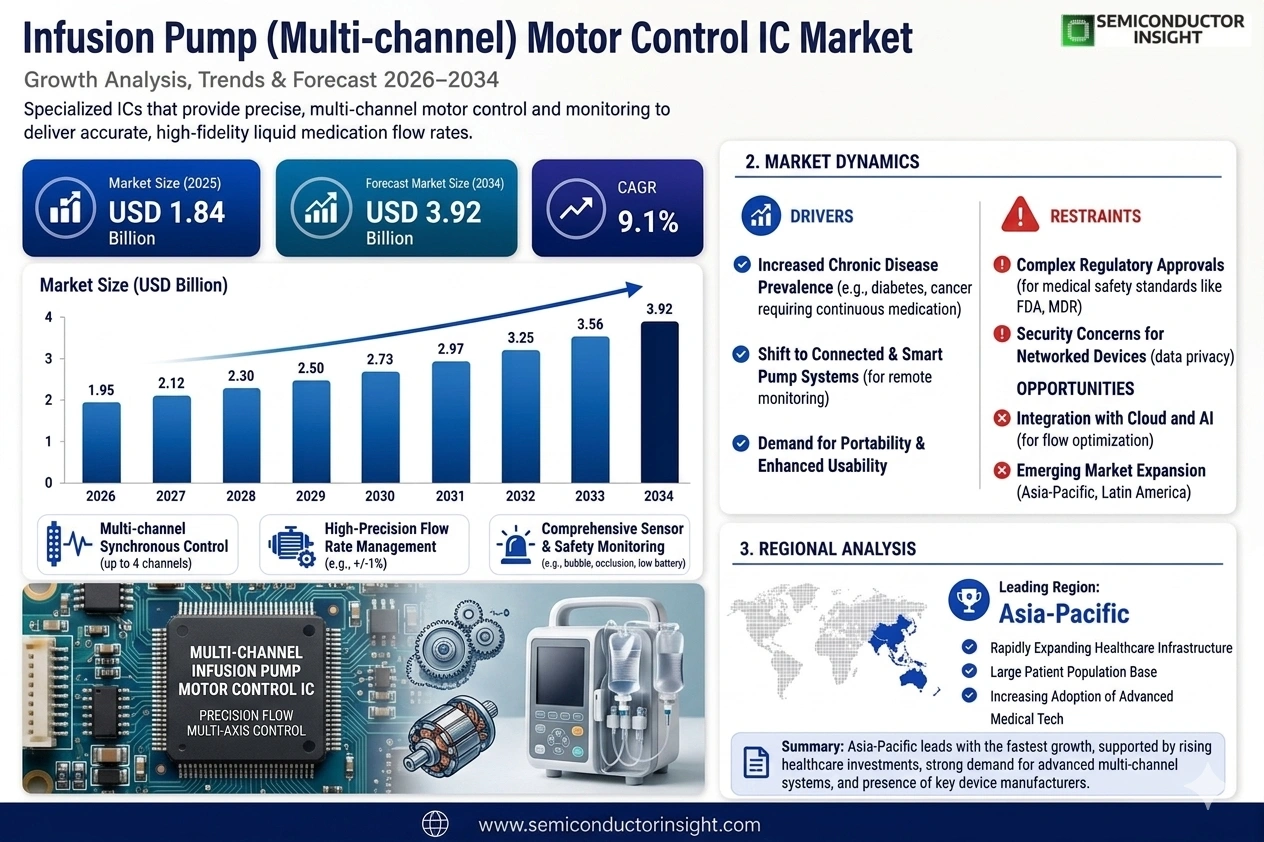
Infusion Pump (Multi-channel) Motor Control IC Market size was valued at USD 1.87 billion in 2025. The market is projected to grow from USD 2.01 billion in 2026 to USD 3.54 billion by 2034, exhibiting a CAGR of 6.5% during the forecast period.
Motor control integrated circuits (ICs) designed for multi-channel infusion pumps are specialized semiconductor components that precisely regulate the stepper or DC motors responsible for delivering fluids, medications, and nutrients to patients at controlled rates. These ICs integrate functions such as current sensing, PWM motor driving, fault detection, and closed-loop feedback control within a compact, power-efficient package , enabling infusion pumps to operate multiple independent delivery channels simultaneously with high accuracy and reliability.
The market is gaining strong momentum driven by the rising global burden of chronic diseases requiring long-term intravenous therapy, the expanding adoption of ambulatory and home-care infusion systems, and growing hospital infrastructure investments across emerging economies. Furthermore, the increasing complexity of drug delivery protocols , particularly in oncology, pain management, and parenteral nutrition , is pushing device manufacturers toward more sophisticated multi-channel motor control solutions. Key industry participants including Texas Instruments, STMicroelectronics, and Renesas Electronics continue to advance their motor control IC portfolios tailored to medical-grade infusion applications, reinforcing competitive dynamics and ongoing innovation across the market.
MARKET DRIVERS
Rising Global Demand for Advanced Infusion Therapy and Precision Drug Delivery Systems
The global healthcare sector is witnessing a sustained increase in the adoption of infusion therapy across hospital, ambulatory, and home care settings. This shift is directly fueling demand for sophisticated motor control integrated circuits designed specifically for multi-channel infusion pump platforms. As clinical protocols evolve toward simultaneous administration of multiple drug therapies, Infusion Pump (Multi-channel) Motor Control IC Market is experiencing meaningful growth momentum driven by the need for highly accurate, low-noise, and energy-efficient motor drive solutions capable of managing independent pump channels with sub-microliter precision.
Expansion of Chronic Disease Patient Populations and Increased Hospitalization Rates
Chronic conditions including diabetes, cancer, cardiovascular disease, and autoimmune disorders require long-term intravenous and subcutaneous drug delivery, creating a structurally growing end-market for multi-channel infusion pumps. Healthcare providers managing these populations demand pump systems capable of running concurrent infusion channels with independent rate control, alarm management, and closed-loop feedback , all of which place advanced requirements on the underlying motor control IC architecture. Infusion Pump (Multi-channel) Motor Control IC Market benefits directly from demographic aging trends across North America, Europe, and the Asia-Pacific region, where the burden of chronic illness continues to expand healthcare infrastructure investment.
➤ Regulatory initiatives promoting smart infusion pump adoption, including dose error reduction software mandates and interoperability standards, are compelling original equipment manufacturers to integrate next-generation motor control ICs that support real-time feedback, digital communication interfaces, and embedded diagnostics , accelerating upgrade cycles across the installed base of infusion devices globally.
Technological advancements in semiconductor design, including the integration of sensorless motor control algorithms, 32-bit processing cores, and SPI/I²C communication protocols within a single IC package, are enabling pump manufacturers to achieve higher channel density without proportional increases in board footprint or power consumption. This integration trend is a core growth driver for Infusion Pump (Multi-channel) Motor Control IC Market, as device makers seek to reduce component count, improve reliability, and accelerate time-to-market for next-generation multi-channel platforms.
MARKET CHALLENGES
Stringent Medical Device Regulatory Requirements Creating Extended Development and Certification Timelines
Semiconductor components intended for use in life-critical infusion pump systems must comply with demanding regulatory frameworks including IEC 60601-1, ISO 14971 risk management standards, and FDA 21 CFR Part 820 quality system regulations. For motor control IC suppliers targeting Infusion Pump (Multi-channel) Motor Control IC Market, achieving and maintaining design qualification within these frameworks requires substantial investment in documentation, functional safety verification , including IEC 61508 SIL assessments , and ongoing post-market surveillance. These requirements extend product development cycles significantly and raise barriers to entry for smaller IC design houses, concentrating competitive dynamics among established, compliance-capable semiconductor vendors.
Other Challenges
Thermal Management and Power Efficiency Constraints
Multi-channel infusion pump designs place simultaneous load demands on motor control ICs across several independent stepper or DC motor drivers operating in parallel. Managing heat dissipation within compact, portable pump form factors while maintaining motor current accuracy across all active channels is a significant engineering challenge. IC designers must balance drive current capability, quiescent power consumption, and thermal resistance within stringent package size constraints, particularly as the market trends toward ambulatory and wearable infusion devices where battery life and patient comfort are paramount considerations for Infusion Pump (Multi-channel) Motor Control IC Market.
Supply Chain Complexity and Component Sourcing Vulnerability
Medical-grade motor control ICs for infusion pump applications typically require long product lifecycle commitments, low defect-per-million guarantees, and traceability documentation that standard commercial semiconductor supply chains are not structured to provide. Disruptions in specialty analog and mixed-signal IC fabrication capacity, combined with extended lead times from qualified foundries, create procurement risk for pump manufacturers and constrain the ability of IC suppliers to scale production responsively to demand fluctuations withInfusion Pump (Multi-channel) Motor Control IC Market.
MARKET RESTRAINTS
High Development Costs and Capital-Intensive Qualification Processes Limiting Market Participation
Bringing a motor control IC to market for multi-channel infusion pump applications demands a level of upfront investment in functional safety engineering, reliability testing, and regulatory documentation that imposes a substantial cost burden on IC developers. Unlike consumer or industrial motor driver markets where shorter qualification cycles and higher volume economics improve return on investment, Infusion Pump (Multi-channel) Motor Control IC Market is characterized by lower annual unit volumes, higher per-unit certification costs, and customer qualification timelines that can extend across multiple years. These dynamics act as a structural restraint on the pace of new entrant activity and on the rate at which innovative motor control architectures achieve commercial deployment within infusion pump platforms.
Incumbent Platform Loyalty and Long Product Refresh Cycles Among Infusion Pump Manufacturers
Established infusion pump original equipment manufacturers maintain long-term design commitments with qualified component suppliers, and the cost and regulatory burden associated with redesigning a cleared or approved device around a new motor control IC creates significant switching inertia. Once a motor control IC is designed into a multi-channel infusion pump and the device has received market authorization, manufacturers are strongly incentivized to maintain that bill of materials rather than undertake the re-verification and re-submission activities that a component change would require. This loyalty to incumbent silicon suppliers functions as a meaningful restraint on revenue opportunity for new or alternative motor control IC providers seeking to penetrate Infusion Pump (Multi-channel) Motor Control IC Market, particularly in the mid-to-high acuity pump segment where regulatory scrutiny is most intense.
MARKET OPPORTUNITIES
Integration of Functional Safety Features and Closed-Loop Control Capabilities Within Motor Control IC Architecture
As infusion pump manufacturers respond to regulatory guidance encouraging enhanced alarm management, occlusion detection, and dose-rate verification, there is a growing market opportunity for motor control IC suppliers that can embed functional safety logic, real-time motor current sensing, and closed-loop feedback control directly within the IC rather than requiring external microcontroller intervention. Motor control ICs offering integrated fault detection, watchdog functionality, and hardware-based current limiting reduce system complexity for pump designers while improving the overall safety architecture of multi-channel platforms. This convergence of motor drive and safety functionality represents one of the most commercially significant opportunities withInfusion Pump (Multi-channel) Motor Control IC Market in the current product development cycle.
Growth of Home Infusion Therapy and Wearable Drug Delivery Device Segments
The accelerating transition of infusion therapy from acute hospital settings to home and outpatient environments is creating demand for a new generation of compact, battery-powered, multi-channel infusion devices that place premium emphasis on miniaturization, low standby current consumption, and wireless connectivity. Motor control IC suppliers capable of developing solutions optimized for ultra-low quiescent current operation, small-outline packaging, and compatibility with Bluetooth or NFC-based device management interfaces are well positioned to capture emerging design wins within this high-growth segment of Infusion Pump (Multi-channel) Motor Control IC Market. The home infusion therapy market expansion, supported by payer reimbursement policy evolution and patient preference for non-hospital care settings, is expected to sustain above-average demand growth for miniaturized multi-channel motor control solutions over the medium term.
Asia-Pacific Healthcare Infrastructure Investment Opening New Design Win Opportunities
Rapid investment in hospital infrastructure, domestic medical device manufacturing capability, and healthcare access across China, India, South Korea, and Southeast Asian markets is creating a pipeline of new infusion pump development programs by regional OEMs seeking to establish competitive positions in both domestic and export markets. These emerging pump manufacturers represent a strategically important opportunity for motor control IC suppliers Infusion Pump (Multi-channel) Motor Control IC Market, as regional device developers may have greater flexibility in component selection during initial platform design compared to established Western OEMs bound by legacy bill-of-materials commitments. Engaging these customers at the earliest design stages, with application-specific reference designs and regulatory support resources, positions IC suppliers to secure long-term supply relationships in one of the fastest-growing geographic segments of the global infusion pump industry.
Infusion Pump (Multi-channel) Motor Control IC Market Trends
Rising Chronic Disease Burden Accelerating Demand for Multi-Channel Motor Control ICs
Infusion Pump (Multi-channel) Motor Control IC Market is experiencing significant momentum driven by the escalating global prevalence of chronic conditions requiring sustained intravenous therapy. Diseases such as cancer, diabetes, and cardiovascular disorders necessitate prolonged and precise drug delivery, compelling healthcare providers to adopt advanced multi-channel infusion systems. Motor control ICs that enable simultaneous, independent fluid delivery across multiple channels are becoming central components in modern infusion devices, as clinicians demand higher accuracy, real-time fault detection, and closed-loop feedback capabilities to ensure patient safety. This clinical imperative is translating directly into sustained procurement activity across hospitals and specialty care centers worldwide.
Other Trends
Expansion of Ambulatory and Home-Care Infusion Systems
A notable shift toward outpatient and home-based care is reshaping demand patterns withInfusion Pump (Multi-channel) Motor Control IC Market. As healthcare systems seek to reduce inpatient costs and improve patient quality of life, compact and portable multi-channel infusion pumps are being deployed in ambulatory settings. This transition requires motor control ICs that are not only highly power-efficient but also capable of maintaining precision performance within miniaturized form factors. Semiconductor manufacturers are responding by developing integrated solutions that combine PWM motor driving, current sensing, and fault detection in compact, low-power packages suitable for wearable and portable infusion devices.
Growing Hospital Infrastructure Investment in Emerging Economies
Rapid healthcare infrastructure development across emerging economies in Asia-Pacific, Latin America, and the Middle East is creating new growth avenues for Infusion Pump (Multi-channel) Motor Control IC Market. Government-led initiatives to modernize hospital facilities and expand critical care capacity are driving procurement of advanced infusion systems equipped with multi-channel motor control capabilities. Local device manufacturers in these regions are increasingly partnering with global IC suppliers to integrate medical-grade motor control solutions into next-generation infusion platforms.
Technological Innovation Among Leading Semiconductor Players
Key industry participants including Texas Instruments, STMicroelectronics, and Renesas Electronics are actively advancing their motor control IC portfolios to address the evolving requirements of multi-channel infusion pump applications. These companies are focusing on enhanced integration , consolidating multiple control functions onto single-chip architectures , to support the increasingly complex drug delivery protocols seen in oncology, pain management, and parenteral nutrition. As device manufacturers prioritize both clinical performance and regulatory compliance, continued innovation from established semiconductor leaders is expected to sustain competitive momentum and drive further technological refinement across Infusion Pump (Multi-channel) Motor Control IC Market.
COMPETITIVE LANDSCAPE
Key Industry Players
Infusion Pump (Multi-channel) Motor Control IC Market: Competitive Dynamics and Leading Semiconductor Innovators
The Global Infusion Pump (Multi-channel) Motor Control IC Market is characterized by the dominant presence of established semiconductor giants that possess deep expertise in medical-grade motor control solutions. Texas Instruments, STMicroelectronics, and Renesas Electronics collectively hold a significant share of this specialized market, leveraging their broad portfolios of stepper and DC motor driver ICs optimized for precision fluid delivery in multi-channel infusion systems. These leading players differentiate themselves through advanced integration capabilities , embedding current sensing, PWM motor driving, closed-loop feedback control, and fault detection within compact, power-efficient packages that meet stringent medical device reliability and safety standards. Their sustained investment in R&D, coupled with established relationships with top-tier infusion pump OEMs, reinforces their competitive positioning as the market grows from USD 2.01 billion in 2026 toward USD 3.54 billion by 2034 at a CAGR of 6.5%.
Beyond the market leaders, a range of specialized and mid-tier semiconductor companies play a significant role in shaping competitive dynamics withInfusion Pump (Multi-channel) Motor Control IC Market. Companies such as Infineon Technologies, Microchip Technology, and Allegro MicroSystems have carved out strong niches by offering highly integrated motor control ICs with low power consumption profiles suited to ambulatory and home-care infusion platforms. Meanwhile, players including ROHM Semiconductor, Toshiba Electronic Devices, Monolithic Power Systems, and Maxim Integrated (now part of Analog Devices) contribute innovative solutions addressing the increasing complexity of multi-channel drug delivery protocols in oncology, pain management, and parenteral nutrition applications. The competitive landscape continues to evolve as rising chronic disease burdens, expanding hospital infrastructure across emerging economies, and growing demand for ambulatory infusion systems drive device manufacturers to source ever more sophisticated motor control IC solutions from a broadening pool of technically capable suppliers.
List of Key Infusion Pump (Multi-channel) Motor Control IC Companies Profiled
- Texas Instruments Incorporated
- STMicroelectronics N.V.
- Renesas Electronics Corporation
- Infineon Technologies AG
- Microchip Technology Incorporated
- Allegro MicroSystems, LLC
- ROHM Semiconductor
- Toshiba Electronic Devices & Storage Corporation
- Monolithic Power Systems, Inc.
- Analog Devices, Inc. (including Maxim Integrated)
- NXP Semiconductors N.V.
- onsemi (ON Semiconductor)
- Trinamic Motion Control GmbH (a Maxim/ADI company)
- Sanken Electric Co., Ltd.
- Melexis NV
Segment Analysis:
| Segment Category | Sub-Segments | Key Insights |
| By Type |
|
Stepper Motor Control ICs represent the leading segment withInfusion Pump (Multi-channel) Motor Control IC Market, owing to their intrinsic ability to deliver precise, incremental fluid dosing across multiple independent channels simultaneously.
|
| By Application |
|
Oncology Drug Delivery stands as the dominant application segment, driven by the increasing complexity and precision requirements associated with chemotherapy and targeted biologic infusion regimens.
|
| By End User |
|
Hospitals & Intensive Care Units (ICUs) remain the predominant end-user segment, given their high patient throughput, critical care requirements, and ongoing infrastructure investments, particularly across emerging economies.
|
| By Channel Configuration |
|
Quad-Channel Motor Control ICs are emerging as the leading configuration segment, striking the optimal balance between integration density, power efficiency, and clinical versatility for modern infusion pump platforms.
|
| By Interface & Connectivity |
|
SPI/I2C Interface-Based ICs currently lead the connectivity segment due to their widespread compatibility with the microcontroller architectures predominantly used in medical-grade infusion pump designs.
|
Regional Analysis: Infusion Pump (Multi-channel) Motor Control IC Market
North America
The U.S. FDA’s stringent yet innovation-supportive regulatory framework plays a pivotal role in shaping the Infusion Pump Motor Control IC Market in North America. Manufacturers are compelled to meet exacting safety and performance standards, which in turn drives the development of more sophisticated, reliable, and fault-tolerant motor control IC architectures purpose-built for multi-channel infusion pump applications.
North America hosts a dense ecosystem of semiconductor design firms and medical technology innovators who are actively advancing motor control IC capabilities. The convergence of miniaturization, low-power design, and real-time feedback integration is defining the next wave of multi-channel infusion pump platforms, with the region’s engineering talent serving as a critical catalyst for global product roadmaps.
A significant shift toward home-based and ambulatory care is creating new growth vectors for Infusion Pump (Multi-channel) Motor Control IC Market across North America. Patients increasingly require portable, multi-channel infusion solutions outside clinical settings, prompting OEMs to develop compact, energy-efficient motor control ICs that maintain clinical-grade precision while supporting mobile deployment scenarios.
The widespread adoption of electronic health records and integrated hospital management systems in North America is accelerating the demand for infusion pumps equipped with smart motor control ICs. These components enable seamless data exchange, remote monitoring, and automated dosage adjustments, positioning the region at the forefront of intelligent, connected infusion therapy solutions across acute and long-term care environments.
Europe
Europe represents a highly significant and mature market within the Global Infusion Pump (Multi-channel) Motor Control IC Market, characterized by rigorous medical device regulation under the EU MDR framework and a strong culture of clinical precision. Germany, France, and the United Kingdom lead regional activity, with well-funded public health systems that consistently invest in advanced infusion technologies to improve patient outcomes. The region’s pharmaceutical manufacturing sector also generates substantial demand for multi-channel infusion pump systems in clinical research and biomanufacturing applications. European semiconductor and medical device companies are increasingly focused on energy-efficient IC designs that align with the region’s sustainability mandates. Cross-border collaboration within the European Union facilitates harmonized product development and market access, enabling manufacturers to scale efficiently. Growing elderly populations across Western and Northern Europe are also intensifying the need for reliable, multi-channel drug delivery infrastructure, further underpinning steady regional demand through the forecast period.
Asia-Pacific
Asia-Pacific is emerging as one of the most dynamic and rapidly expanding regions Infusion Pump (Multi-channel) Motor Control IC Market, propelled by accelerating healthcare modernization across China, Japan, South Korea, and India. Massive public and private investment in hospital infrastructure, combined with a rising middle-class population seeking quality medical care, is creating substantial opportunities for advanced infusion pump technologies. China’s domestic semiconductor industry is gaining strategic importance, with local manufacturers beginning to develop indigenous motor control IC solutions tailored for multi-channel medical applications. Japan and South Korea, with their established electronics manufacturing excellence, contribute to both regional supply and global innovation. India’s expanding network of tertiary care hospitals and government healthcare initiatives are further bolstering demand. The region’s cost-sensitive procurement environment continues to encourage the development of high-performance yet competitively priced motor control ICs, attracting global players to localize their manufacturing and product strategies.
South America
South America occupies a developing but increasingly relevant position in the Global Infusion Pump (Multi-channel) Motor Control IC Market. Brazil and Argentina serve as the primary demand centers, supported by growing investments in public healthcare infrastructure and a gradual shift toward more sophisticated clinical equipment. The region’s market is shaped by a combination of import dependency, currency volatility, and regulatory complexity, which can slow the adoption of cutting-edge motor control IC technologies in infusion pump applications. However, rising awareness of patient safety standards and an expanding private hospital sector are creating incremental opportunities. Regional distributors and local assembly operations are beginning to play a more active role in reducing supply chain lead times. As healthcare budgets across key South American economies continue to grow and digital health adoption accelerates, the region is expected to progressively increase its engagement with advanced multi-channel infusion pump solutions over the forecast horizon.
Middle East & Africa
The Middle East and Africa region represents an early-stage but strategically important market withInfusion Pump (Multi-channel) Motor Control IC Market. Gulf Cooperation Council nations, particularly Saudi Arabia and the UAE, are investing heavily in world-class hospital infrastructure and medical technology procurement as part of broader national health transformation agendas. These investments are translating into growing demand for sophisticated infusion pump systems and the motor control ICs that power them. South Africa serves as a regional anchor in Sub-Saharan Africa, with its comparatively advanced private healthcare network supporting gradual technology adoption. Across the broader African continent, limited local manufacturing capacity and healthcare funding constraints remain challenges, though international partnerships and aid-driven medical equipment programs are helping to extend market reach. As healthcare access improves and clinical standards evolve throughout the region, demand for reliable multi-channel infusion pump motor control solutions is anticipated to strengthen progressively through 2034.
Report Scope
This market research report provides a comprehensive analysis of the Infusion Pump (Multi-channel) Motor Control IC Market , covering the forecast period 2026–2034. It offers detailed insights into market dynamics, technological advancements, competitive landscape, and key trends shaping the industry.
Key focus areas of the report include:
- Market Overview: The report begins with an overview outlining its current market scenario, key growth indicators, and industry transformation drivers. It discusses macroeconomic factors, demand–supply balance, regulatory landscape, and the strategic role of semiconductors in powering advancements across industries such as automotive, telecommunications, consumer electronics, and industrial automation.
- Market Size & Forecast: Historical data and future projections for revenue, unit shipments, and market value across major regions and segments.
- Segmentation Analysis: Detailed breakdown by product type, technology, application, and end-user industry to identify high-growth segments and investment opportunities.
- Regional Insights: Insights into market performance across North America, Europe, Asia-Pacific, Latin America, and the Middle East & Africa, including country-level analysis where relevant.
- Competitive Landscape: Profiles of leading market participants, including their product offerings, R&D focus, manufacturing capacity, pricing strategies, and recent developments such as mergers, acquisitions, and partnerships.
- Technology Trends & Innovation: Assessment of emerging technologies, integration of AI/IoT, semiconductor design trends, fabrication techniques, and evolving industry standards.
- Market Drivers & Restraints: Evaluation of factors driving market growth along with challenges, supply chain constraints, regulatory issues, and market-entry barriers.
- Stakeholder Insights: Insights for component suppliers, OEMs, system integrators, investors, and policymakers regarding the evolving ecosystem and strategic opportunities.
Primary and secondary research methods are employed, including interviews with industry experts, data from verified sources, and real-time market intelligence to ensure the accuracy and reliability of the insights presented.
FREQUENTLY ASKED QUESTIONS:
What is the current market size of Infusion Pump (Multi-channel) Motor Control IC Market?
-> Global Infusion Pump (Multi-channel) Motor Control IC Market was valued at USD 1.87 billion in 2025 and is expected to reach USD 3.54 billion by 2034, growing at a CAGR of 6.5% during the forecast period from 2026 to 2034.
Which key companies operate Infusion Pump (Multi-channel) Motor Control IC Market?
-> Key players include Texas Instruments, STMicroelectronics, and Renesas Electronics, among others, who continue to advance their motor control IC portfolios tailored to medical-grade infusion applications.
What are the key growth drivers?
-> Key growth drivers include rising global burden of chronic diseases requiring long-term intravenous therapy, expanding adoption of ambulatory and home-care infusion systems, growing hospital infrastructure investments across emerging economies, and increasing complexity of drug delivery protocols particularly in oncology, pain management, and parenteral nutrition.
Which region dominates the market?
-> Asia-Pacific is among the fastest-growing regions driven by growing hospital infrastructure investments across emerging economies, while established markets in North America and Europe continue to demonstrate strong demand for advanced multi-channel infusion pump motor control solutions.
What are the emerging trends?
-> Emerging trends include sophisticated multi-channel motor control IC solutions, integration of current sensing and closed-loop feedback control, PWM motor driving technologies, fault detection capabilities, and development of compact power-efficient semiconductor packages enabling infusion pumps to operate multiple independent delivery channels simultaneously with high accuracy and reliability.

Get Sample Report PDF for Exclusive Insights
Report Sample Includes
- Table of Contents
- List of Tables & Figures
- Charts, Research Methodology, and more...
 Download Sample Report PDF