Inductive Position Sensor (Non-contact) Market Insights
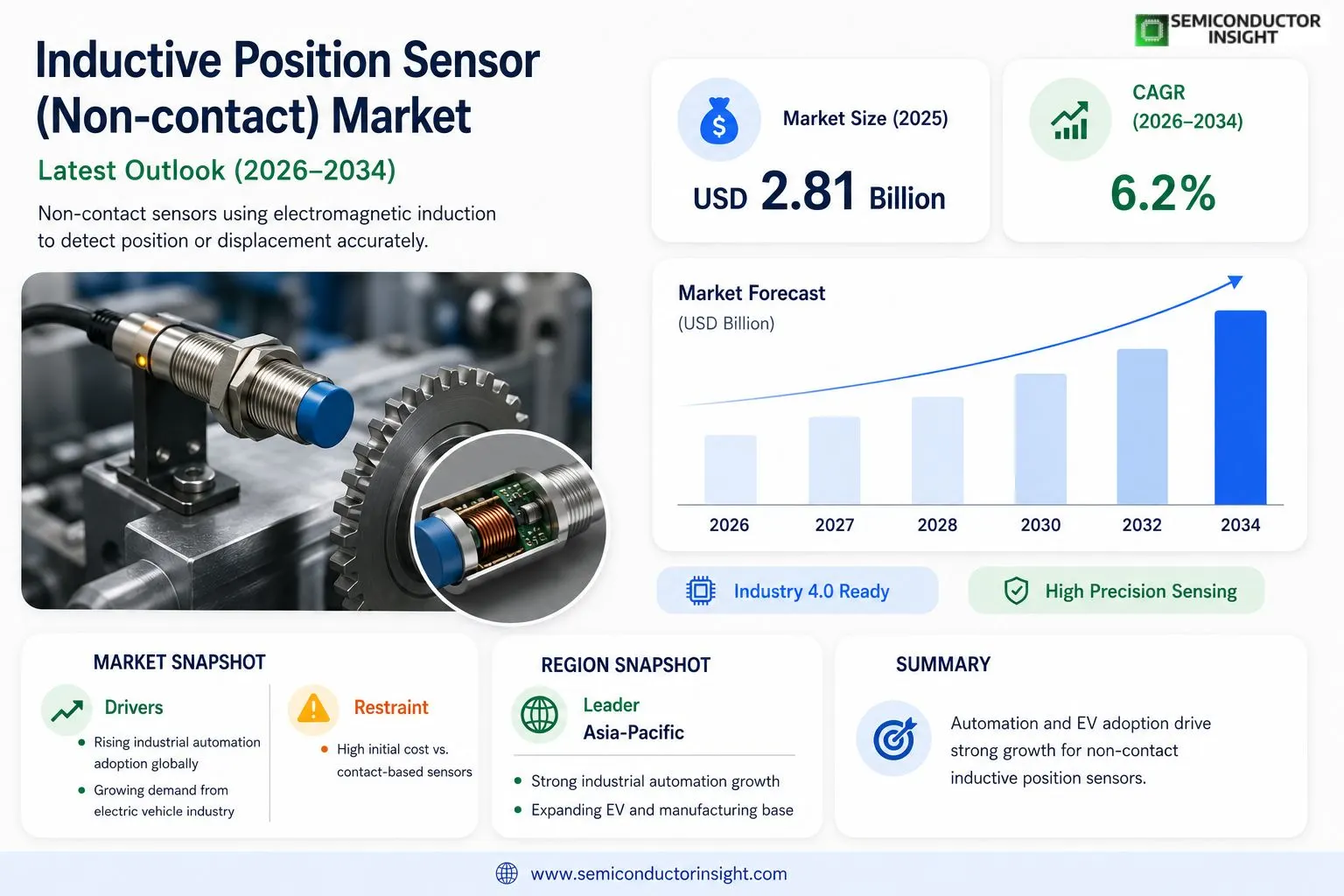
Global Inductive Position Sensor (Non-contact) market size was valued at USD 2.81 billion in 2025. The market is projected to grow from USD 2.98 billion in 2026 to USD 5.12 billion by 2034, exhibiting a CAGR of 6.2% during the forecast period.
Inductive position sensors (non-contact) are precision measurement devices that detect the position or displacement of a target object without any physical contact, relying on the principle of electromagnetic induction. These sensors generate an alternating magnetic field through a coil arrangement; when a conductive or ferromagnetic target enters the field, it alters the inductance, enabling highly accurate position detection. They are widely used across industrial automation, automotive systems, robotics, aerospace, and consumer electronics, owing to their durability, resistance to contamination, and long operational life.
The market is witnessing strong momentum driven by the rapid expansion of industrial automation, growing adoption of electric vehicles, and increasing demand for precise motion control systems in manufacturing environments. Furthermore, the integration of Industry 4.0 technologies and smart factory initiatives across major economies is significantly accelerating the deployment of non-contact sensing solutions. Key players such as Honeywell International Inc., TE Connectivity Ltd., and Sensata Technologies continue to expand their product portfolios to address evolving application demands across diverse end-use industries.
MARKET DRIVERS
Rising Adoption of Automation and Industry 4.0 Across Manufacturing Sectors
Global Inductive Position Sensor (Non-contact) Market is experiencing significant growth momentum, driven primarily by the accelerating adoption of industrial automation and smart manufacturing practices worldwide. As factories transition toward digitized, fully automated production environments, the demand for highly reliable, wear-free sensing technologies has surged. Non-contact inductive position sensors offer exceptional durability and precision without physical contact, making them ideal for high-cycle industrial applications where mechanical wear would otherwise compromise performance and increase maintenance costs.
Growing Demand from the Automotive Industry for Precision Sensing Solutions
The automotive sector remains one of the most critical end-use industries propelling the Inductive Position Sensor (Non-contact) Market forward. These sensors are extensively used in throttle position detection, pedal position monitoring, gear shift control, and electric motor feedback systems. With Global transition toward electric vehicles (EVs) and hybrid powertrains, the need for non-contact inductive position sensors has intensified, as EV drivetrains require precise, interference-resistant position feedback across a broad range of operating temperatures and conditions. Automakers are increasingly specifying inductive sensing solutions over traditional potentiometric alternatives due to their superior longevity and resistance to contamination.
➤ The increasing penetration of electric vehicles globally is creating a sustained and expanding demand cycle for non-contact inductive position sensors, particularly in motor control and battery management applications, reinforcing long-term market growth.
Beyond automotive, sectors such as aerospace, robotics, medical devices, and heavy industrial machinery are further amplifying demand. In robotics and collaborative automation, non-contact inductive position sensors enable highly repeatable joint and axis positioning, which is critical for maintaining operational accuracy. The convergence of these multi-sector drivers is creating a robust and diversified growth base for the Inductive Position Sensor (Non-contact) Market through the forecast period.
MARKET CHALLENGES
Complexity in Sensor Calibration and Integration with Legacy Industrial Systems
Despite the strong growth trajectory, the Inductive Position Sensor (Non-contact) Market faces notable challenges related to the complexity of integrating advanced non-contact sensing solutions into existing legacy industrial infrastructure. Many manufacturing plants operating with older programmable logic controllers (PLCs) and control architectures require significant engineering effort and cost to adapt non-contact inductive position sensors to their systems. Calibration requirements, signal conditioning compatibility, and varying output standards (analog, digital, PWM) add layers of complexity that can slow adoption, particularly among small and mid-sized enterprises with limited technical resources.
Other Challenges
Sensitivity to Environmental Electromagnetic Interference
While non-contact inductive position sensors are inherently robust, they can be susceptible to strong electromagnetic interference (EMI) in certain industrial environments, such as those near high-power welding equipment or large electrical motors. Shielding and signal filtering add to the bill of materials cost and design complexity, potentially limiting deployment in the most electromagnetically hostile settings without additional engineering investment.
Higher Upfront Cost Compared to Contact-Based Alternatives
The initial acquisition cost of non-contact inductive position sensors remains higher than conventional contact-based sensors such as potentiometers. For cost-sensitive applications or markets where total cost of ownership is not the primary procurement consideration, this price differential can be a barrier. Educating procurement teams on the long-term savings in maintenance and downtime reduction is an ongoing challenge for suppliers operating in the Inductive Position Sensor (Non-contact) Market.
MARKET RESTRAINTS
Supply Chain Disruptions and Semiconductor Component Shortages Impacting Production
One of the primary restraints affecting the Inductive Position Sensor (Non-contact) Market is the vulnerability of Global electronics supply chain to component shortages and logistical disruptions. Non-contact inductive position sensors rely on specialized analog and mixed-signal semiconductor components for signal processing and output conditioning. Periodic shortages of these components, as witnessed during recent global supply chain dislocations, have led to extended lead times and production bottlenecks among sensor manufacturers, constraining market supply even when end-market demand remains strong.
Limited Awareness and Technical Expertise in Emerging and Developing Markets
In several emerging economies across Southeast Asia, Latin America, and parts of Africa, the penetration of non-contact inductive position sensors remains constrained by a lack of technical awareness and trained engineering talent. Local industries in these regions often default to lower-cost contact-based sensing alternatives due to familiarity and lower perceived risk. This technical skills gap, combined with limited after-sales support networks for advanced sensing technologies, acts as a structural restraint on Global expansion of the Inductive Position Sensor (Non-contact) Market, slowing the rate at which these geographies contribute to overall market revenue growth.
MARKET OPPORTUNITIES
Expansion of Electric Vehicle Production Creating New Application Frontiers
The rapid global scaling of electric vehicle manufacturing represents one of the most significant near-term opportunities for the Inductive Position Sensor (Non-contact) Market. EV powertrains, battery thermal management systems, and advanced driver assistance systems (ADAS) all require precise, reliable, and durable position sensing. Non-contact inductive position sensors are particularly well-suited for these demanding applications given their immunity to contamination, extended operational lifespan, and ability to perform accurately across wide temperature ranges, directly aligning with automotive OEM requirements for next-generation vehicle platforms.
Integration with IIoT Platforms and Smart Factory Ecosystems
The proliferation of Industrial Internet of Things (IIoT) architectures and smart factory platforms is opening significant new growth avenues within the Inductive Position Sensor (Non-contact) Market. Sensor manufacturers that develop IIoT-compatible non-contact inductive position sensors with embedded diagnostics, digital communication interfaces (IO-Link, CAN bus, EtherCAT), and predictive maintenance capabilities are well-positioned to capture premium market segments. As manufacturers prioritize real-time asset monitoring and data-driven production optimization, the demand for intelligent sensing nodes , including advanced inductive position sensors , is expected to grow substantially.
Medical and Robotic Surgery Applications Emerging as High-Value Growth Segments
Emerging applications in medical robotics, surgical equipment, and rehabilitation devices are creating high-value growth opportunities for the Inductive Position Sensor (Non-contact) Market. The stringent requirements for sterilizability, miniaturization, and zero-maintenance operation in medical environments make non-contact inductive position sensors highly attractive compared to alternatives. As robotic-assisted surgical platforms continue to advance and gain regulatory approvals globally, the embedded sensing content per system is rising, offering sensor manufacturers a compelling and differentiated growth pathway with premium pricing potential and long product lifecycle characteristics.
Inductive Position Sensor (Non-contact) Market Trends
Industrial Automation Driving Sustained Demand for Non-Contact Sensing Solutions
The Inductive Position Sensor (Non-contact) Market is experiencing strong growth momentum, largely propelled by the accelerating pace of industrial automation across manufacturing sectors worldwide. As factories increasingly migrate toward automated production lines, the demand for precise, reliable, and maintenance-free position detection has surged considerably. Inductive position sensors, which operate on the principle of electromagnetic induction to detect target displacement without physical contact, offer exceptional durability and resistance to dust, oil, and other industrial contaminants , qualities that make them particularly well-suited for demanding factory environments. This fundamental advantage over contact-based alternatives continues to reinforce their adoption across assembly lines, robotics cells, and CNC machinery.
Other Trends
Electric Vehicle Adoption Expanding Automotive Application Scope
The rapid global transition toward electric vehicles represents a significant trend reshaping demand within the Inductive Position Sensor (Non-contact) Market. EVs require highly accurate position sensing across multiple subsystems, including throttle control, battery management, motor shaft positioning, and pedal displacement measurement. Non-contact inductive sensors are increasingly favored in these applications due to their long operational life, immunity to mechanical wear, and ability to perform reliably in high-vibration automotive environments. Leading sensor manufacturers such as Honeywell International Inc., TE Connectivity Ltd., and Sensata Technologies are actively expanding their automotive-grade product portfolios to capture growing demand from EV platforms.
Industry 4.0 and Smart Factory Initiatives Accelerating Deployment
The widespread integration of Industry 4.0 frameworks and smart manufacturing initiatives across major economies is serving as a critical trend amplifying demand for inductive position sensors. Smart factories rely on continuous, real-time data acquisition from machinery and production equipment, and non-contact inductive sensors deliver the precision signal outputs required for predictive maintenance systems, digital twin environments, and adaptive control architectures. As manufacturers in North America, Europe, and Asia-Pacific advance their digital transformation agendas, sensor deployment density across production facilities is increasing substantially.
Miniaturization and Enhanced Performance Opening New Application Frontiers
Another prominent trend within the Inductive Position Sensor (Non-contact) Market is the ongoing development of miniaturized sensor designs capable of delivering high-resolution position measurement in compact form factors. Advances in coil design, signal processing electronics, and materials engineering are enabling manufacturers to produce sensors suited for space-constrained applications in aerospace systems, medical devices, and consumer electronics. This trend toward smaller, higher-performing sensing solutions is broadening the addressable market beyond traditional heavy industrial segments and positioning inductive non-contact technology as a versatile solution across a widening range of precision measurement applications globally.
COMPETITIVE LANDSCAPE
Key Industry Players
Inductive Position Sensor (Non-contact) Market: Competitive Dynamics and Leading Manufacturers Shaping Global Industry Growth
Global inductive position sensor (non-contact) market is characterized by the presence of several well-established multinational corporations alongside specialized sensor manufacturers, creating a moderately consolidated competitive environment. Honeywell International Inc. maintains a prominent position in the market, leveraging its extensive industrial automation portfolio and global distribution network to deliver high-precision non-contact inductive sensing solutions across automotive, aerospace, and manufacturing sectors. TE Connectivity Ltd. and Sensata Technologies are also among the frontrunners, continuously investing in research and development to enhance sensor accuracy, miniaturization, and compatibility with Industry 4.0 and smart factory ecosystems. These leading players are strategically expanding their product lines to address diverse application demands, including electric vehicle drivetrains, robotic motion control, and precision machining, reinforcing their competitive advantage in a market projected to grow at a CAGR of 6.2% through 2034.
Beyond the dominant players, the inductive position sensor (non-contact) market also features several highly specialized and regionally significant manufacturers that cater to niche industrial and automotive applications. Companies such as Balluff GmbH, Turck Inc., IFM Electronic GmbH, and Pepperl+Fuchs SE are recognized for their deep engineering expertise in inductive sensing technologies, offering application-specific solutions for harsh industrial environments requiring high resistance to contamination, vibration, and extreme temperatures. Meanwhile, players like Sick AG, Baumer Group, and Kaman Corporation compete on the basis of technological differentiation, offering customized non-contact position sensing platforms for robotics, semiconductor equipment, and precision motion systems. The competitive landscape is further intensified by growing investments in electromagnetic induction-based sensing innovations from companies like Micro-Epsilon Messtechnik GmbH, Novotechnik Messwertaufnehmer OHG, and Positek Ltd., all of which serve highly specialized segments demanding sub-micron level measurement accuracy.
List of Key Inductive Position Sensor (Non-contact) Companies Profiled
- Honeywell International Inc.
- TE Connectivity Ltd.
- Sensata Technologies
- Balluff GmbH
- Turck Inc.
- IFM Electronic GmbH
- Pepperl+Fuchs SE
- Sick AG
- Baumer Group
- Kaman Corporation
- Micro-Epsilon Messtechnik GmbH
- Novotechnik Messwertaufnehmer OHG
- Positek Ltd.
- Curtiss-Wright Corporation
- Omron Corporation
Segment Analysis:
| Segment Category | Sub-Segments | Key Insights |
| By Type |
|
Rotary Inductive Position Sensors represent the leading segment within this category, driven by their extensive adoption in automotive and industrial automation applications where angular measurement and rotational feedback are critical.
|
| By Application |
|
Position and Displacement Measurement stands as the dominant application segment, underpinned by the fundamental role these sensors play in ensuring process accuracy and operational reliability across a broad spectrum of industries.
|
| By End User |
|
Automotive emerges as the leading end-user segment, propelled by the accelerating global transition toward electric vehicles and the expanding integration of advanced driver-assistance systems (ADAS) that demand highly reliable, contamination-resistant sensing technologies.
|
| By Technology |
|
Resonant Inductive Sensing is rapidly consolidating its position as the leading technology segment, owing to its outstanding accuracy, compact form factor, and suitability for integration into next-generation automotive and industrial applications.
|
| By Output Signal |
|
IO-Link and Smart Digital Interfaces represent the fastest-growing and increasingly dominant output signal segment, strongly aligned with the widespread adoption of Industry 4.0 and smart factory paradigms across global manufacturing ecosystems.
|
Regional Analysis: Inductive Position Sensor (Non-contact) Market
Asia-Pacific
Asia-Pacific’s booming electric vehicle industry is creating exceptional demand for inductive position sensors in battery management, motor control, and drivetrain systems. China’s position as the world’s largest EV market ensures that non-contact sensing technologies are embedded at scale across new vehicle platforms, while Japan’s hybrid vehicle expertise continues to refine sensor application in complex powertrain architectures requiring precision, durability, and electromagnetic compatibility.
The proliferation of smart manufacturing and Industry 4.0 adoption across China, Japan, South Korea, and increasingly India is generating robust requirements for reliable, maintenance-free position sensing. Inductive non-contact sensors are preferred in harsh factory environments where contamination, vibration, and temperature extremes render contact-based alternatives impractical, making them a preferred specification for new automated production lines and robotic workcells throughout the region.
A growing cohort of Asia-Pacific-based sensor manufacturers is developing inductive position sensing solutions that rival imported alternatives in performance while offering cost and supply chain advantages. This localization trend is reshaping procurement strategies among regional OEMs and system integrators, broadening the addressable market and reducing dependence on European or North American sensor suppliers for standard and mid-tier application segments.
Beyond traditional industrial applications, Asia-Pacific is witnessing expanded deployment of inductive position sensors in railway signaling systems, renewable energy installations, and semiconductor fabrication equipment. Government-funded infrastructure modernization programs across the region are catalyzing adoption in public transportation and energy sectors, while the semiconductor industry’s relentless precision demands create high-value niche opportunities for technologically advanced non-contact sensing solutions.
North America
North America represents a mature yet steadily evolving region within Global inductive position sensor (non-contact) market, characterized by its emphasis on technological sophistication, stringent performance standards, and deep integration across aerospace, defense, and advanced manufacturing sectors. The United States anchors regional demand, with its robust automotive industry centered in the Midwest, a thriving aerospace and defense industrial base, and a growing landscape of smart factory investments driving consistent specification of non-contact inductive sensing solutions. Canada contributes through its oil and gas sector, where the durability and reliability of inductive position sensors in demanding extraction and processing environments are highly valued. The region’s innovation culture supports ongoing product development, with numerous technology firms and research institutions advancing miniaturization, wireless capability, and integration with industrial IoT platforms. Regulatory frameworks emphasizing workplace safety and process reliability further incentivize adoption of dependable, maintenance-free non-contact sensing technologies across North American industrial operations.
Europe
Europe occupies a strategically important position in the inductive position sensor (non-contact) market, anchored by its world-renowned mechanical and electrical engineering heritage and a manufacturing culture that prizes precision, quality, and regulatory compliance. Germany serves as the regional nucleus, with its automotive industry , encompassing both legacy OEMs and a rapidly expanding electric vehicle transition , generating substantial demand for high-accuracy, non-contact position sensing across powertrain, chassis, and body control applications. Countries including France, Italy, Switzerland, and the United Kingdom contribute through their specialized industrial machinery, medical device manufacturing, and aerospace sectors. Europe’s stringent industrial safety and electromagnetic compatibility standards effectively raise the performance bar for inductive position sensors deployed in the region, favoring established suppliers with proven engineering credentials. The ongoing energy transition and growing investment in renewable power infrastructure also open new application pathways for non-contact sensing technologies in wind turbine control and grid management systems.
South America
South America presents a developing but increasingly relevant market landscape for inductive position sensors (non-contact), with growth prospects tied closely to the region’s industrial modernization ambitions and natural resource sectors. Brazil leads regional adoption, supported by its substantial automotive manufacturing industry and expanding agricultural machinery sector, both of which are progressively incorporating automation technologies that require reliable, contamination-resistant position sensing solutions. The mining and mineral processing industries across Chile, Peru, and other Andean nations represent a meaningful application vertical, where the ruggedness and maintenance-free characteristics of inductive non-contact sensors align well with demanding operational environments. Infrastructure investment cycles, while variable, periodically stimulate demand for industrial sensing technologies across construction and energy sectors. Economic volatility and import dependency remain challenges, but gradual industrialization and increasing openness to automation investment are expected to support steady market development throughout the forecast period.
Middle East & Africa
The Middle East and Africa region occupies an emerging position in Global inductive position sensor (non-contact) market, with demand patterns shaped primarily by the oil and gas industry, infrastructure development initiatives, and nascent manufacturing sector growth. Gulf Cooperation Council nations, particularly Saudi Arabia and the United Arab Emirates, are the primary demand centers, driven by extensive petrochemical processing facilities and large-scale infrastructure and smart city projects that increasingly incorporate advanced industrial sensing technologies. The industrial diversification strategies being pursued by several Middle Eastern economies are gradually broadening the application base for inductive position sensors beyond energy sector deployments. In Africa, market development remains concentrated in South Africa and select North African economies where automotive assembly, mining, and process industries provide the most immediate demand environment. Improving access to global supply chains and growing awareness of the lifecycle cost benefits associated with non-contact sensing technologies are expected to support incremental market expansion across both sub-regions over the coming years.
Report Scope
This market research report provides a comprehensive analysis of the Inductive Position Sensor (Non-contact) Market , covering the forecast period 2026–2034. It offers detailed insights into market dynamics, technological advancements, competitive landscape, and key trends shaping the industry.
Key focus areas of the report include:
- Market Overview: The report begins with an overview outlining its current market scenario, key growth indicators, and industry transformation drivers. It discusses macroeconomic factors, demand–supply balance, regulatory landscape, and the strategic role of semiconductors in powering advancements across industries such as automotive, telecommunications, consumer electronics, and industrial automation.
- Market Size & Forecast: Historical data and future projections for revenue, unit shipments, and market value across major regions and segments.
- Segmentation Analysis: Detailed breakdown by product type, technology, application, and end-user industry to identify high-growth segments and investment opportunities.
- Regional Insights: Insights into market performance across North America, Europe, Asia-Pacific, Latin America, and the Middle East & Africa, including country-level analysis where relevant.
- Competitive Landscape: Profiles of leading market participants, including their product offerings, R&D focus, manufacturing capacity, pricing strategies, and recent developments such as mergers, acquisitions, and partnerships.
- Technology Trends & Innovation: Assessment of emerging technologies, integration of AI/IoT, semiconductor design trends, fabrication techniques, and evolving industry standards.
- Market Drivers & Restraints: Evaluation of factors driving market growth along with challenges, supply chain constraints, regulatory issues, and market-entry barriers.
- Stakeholder Insights: Insights for component suppliers, OEMs, system integrators, investors, and policymakers regarding the evolving ecosystem and strategic opportunities.
Primary and secondary research methods are employed, including interviews with industry experts, data from verified sources, and real-time market intelligence to ensure the accuracy and reliability of the insights presented.
FREQUENTLY ASKED QUESTIONS:
What is the current market size of Inductive Position Sensor (Non-contact) Market?
-> Global Inductive Position Sensor (Non-contact) Market was valued at USD 2.81 billion in 2025 and is expected to reach USD 5.12 billion by 2034, growing at a CAGR of 6.2% during the forecast period from 2026 to 2034.
Which key companies operate in Inductive Position Sensor (Non-contact) Market?
-> Key players include Honeywell International Inc., TE Connectivity Ltd., and Sensata Technologies, among others, who continue to expand their product portfolios to address evolving application demands across diverse end-use industries.
What are the key growth drivers?
-> Key growth drivers include rapid expansion of industrial automation, growing adoption of electric vehicles, increasing demand for precise motion control systems in manufacturing environments, and integration of Industry 4.0 technologies and smart factory initiatives across major economies.
Which region dominates the market?
-> Asia-Pacific is the fastest-growing region driven by strong industrial automation growth, while North America and Europe remain significant markets owing to advanced manufacturing ecosystems and early adoption of non-contact sensing technologies.
What are the emerging trends?
-> Emerging trends include integration of Industry 4.0 and smart factory technologies, increased deployment of non-contact sensing solutions in electric vehicles, and growing use of inductive position sensors in robotics, aerospace, and consumer electronics due to their durability and resistance to contamination.

Get Sample Report PDF for Exclusive Insights
Report Sample Includes
- Table of Contents
- List of Tables & Figures
- Charts, Research Methodology, and more...
 Download Sample Report PDF