High Voltage Half Bridge Gate Driver Market Insights
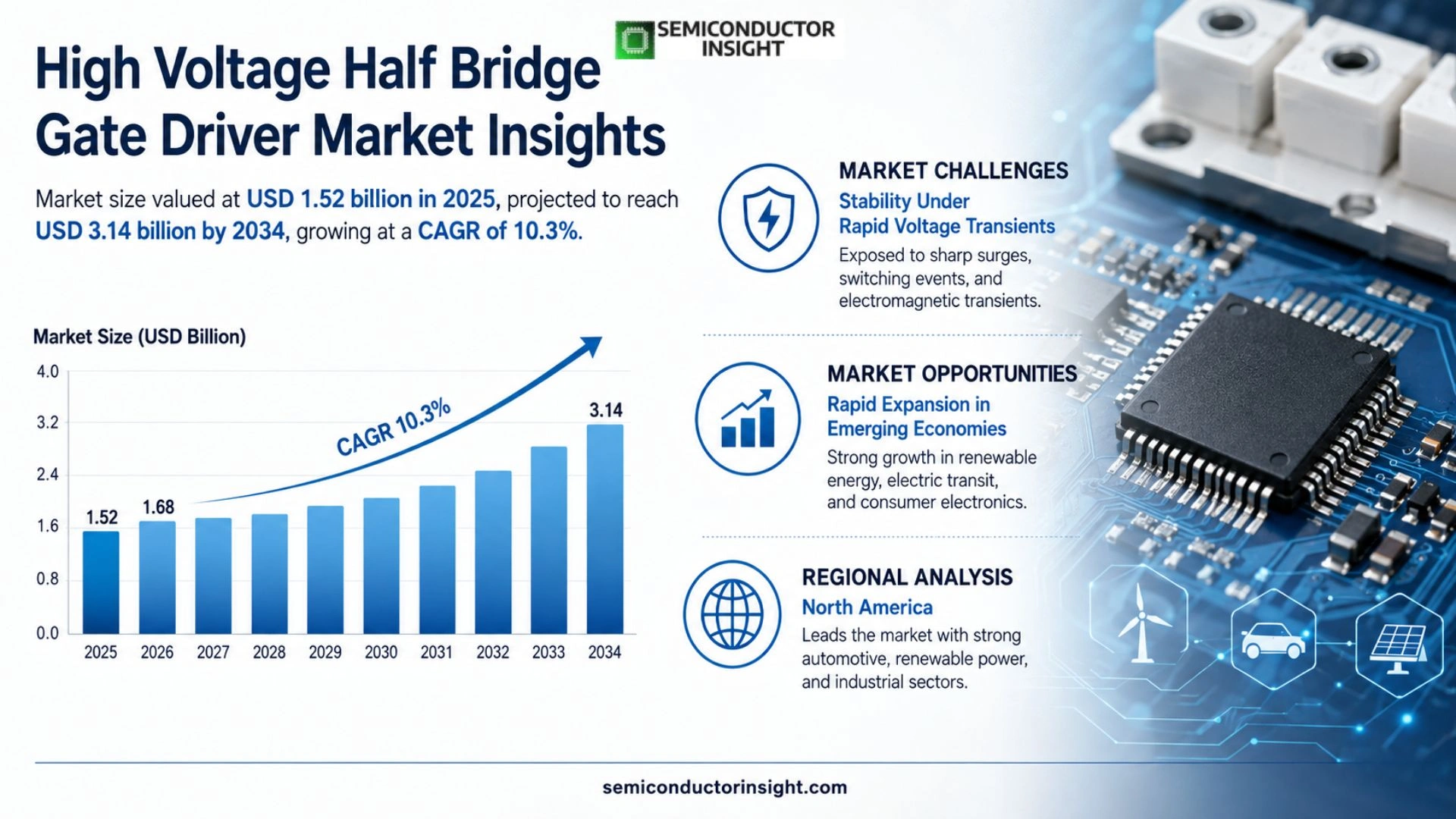
High Voltage Half Bridge Gate Driver Market size was valued at USD 1.52 billion in 2025. The market is projected to grow from USD 1.68 billion in 2026 to USD 3.14 billion by 2034, exhibiting a CAGR of 10.3% during the forecast period.
A High Voltage Half Bridge Gate Driver is an integrated circuit that delivers precise control signals to MOSFETs or IGBTs within a half‑bridge configuration operating at bus voltages above several hundred volts. By shaping rise‑time, fall‑time and dead‑time characteristics it minimizes switching losses and mitigates electromagnetic interference, making it essential for power converters in electric vehicles, renewable energy systems and industrial drives.
MARKET DRIVERS
Escalating Automotive Electrification
Automotive electrification has become an irreversible trend, driven by consumer preference for cleaner mobility and stricter emissions regulations. The move from conventional internal combustion engines to plug‑in hybrids and fully electric vehicles has spurred an acute demand for efficient power handling components. High Voltage Half Bridge Gate Driver solutions sit at the nexus of this transition: they enable high‑speed, high‑voltage switching that minimizes energy loss during traction motor control. By delivering precise gate drive signals even at voltages exceeding 1000 V, these drivers improve overall system efficiency and power density, translating into lighter chassis and extended driving range. Consequently, OEMs are prioritizing the integration of advanced gate drivers into inverter architectures, and the cumulative shift has been reflected in a 15 % annual growth rate observed across the global component supply chain for the past three years.
Accelerated Semiconductor Advancements
The evolution of silicon carbide (SiC) and gallium nitride (GaN) technologies has reduced equivalent series resistance and improved thermal tolerance, enabling gate drivers to operate at higher frequencies without excessive heat buildup. This capability directly supports higher switching efficiencies and lower electromagnetic interference, making high‑voltage drivers indispensable for ultra‑compact power converters used in aerospace, rail transit, and off‑grid energy storage. Manufacturers investing in mixed‑technology designs are gaining a competitive edge, with an estimated 30 % price premium reported for SiC‑based drivers over their silicon counterparts. Parameters such as faster rise times and lower propagation delays reduce conversion losses by up to 20 % inverters, a figure that is attractive for energy‑budget‑aware systems.
➤ Forecast 2025 – High Voltage Half Bridge Gate Driver Market is projected to expand above 11 % CAGR, driven by increased adoption in power electronics and renewable integration.
Beyond technology, supply‑chain resilience has emerged as a critical driver. Regional manufacturing hubs in East Asia have expanded their production capabilities to meet rising global orders, decreasing lead times and mitigating inventory shortages. The convergence of investment in mature fabrication facilities and a talent pipeline replenishes demand, ensuring that the component ecosystem remains agile. As the sector matures, collaboration between driver suppliers and inverter designers is expected to deepen, accelerating the adoption of integrated solutions that deliver turnkey performance gains without extensive retrofitting.
MARKET CHALLENGES
Stability Under Rapid Voltage Transients
High‑voltage gate drivers are routinely exposed to sharp voltage surges, abrupt switching events, and electromagnetic transients. Ensuring reliable performance in such extreme environments demands rigorous quality controls and robust protection schemes. Failure to mitigate voltage overshoot can lead to catastrophic fault conditions, with over 10 % of inverter-related failures in critical infrastructure traced back to driver malfunction. Consequently, manufacturers face increasing pressure to integrate advanced isolation techniques and adaptive biasing, which in turn drives development costs and mandates continuous certification cycles.
Other Challenges
Regulatory and Compliance Complexity
Navigating a patchwork of regional electrical safety standards,such as IEC 61124 and UL 61035,requires sustained investment in testing and documentation. Additionally, component interchangeability across markets necessitates compliance with differential voltage and frequency bands, complicating supply‑chain coordination and scaling investments.
Poor Availability of Critical Raw Materials
High‑voltage driver fabrication relies heavily on exotic alloys and specialized substrates whose supply is subject to geopolitical volatility. Even modest price fluctuations can ripple through cost structures and delay product launches, particularly for lower‑margin OEMs operating in emerging economies.
Supply‑Chain Fragmentation Leading to Lead‑Time Extensions
The fragmentation across Tier‑1 and Tier‑2 suppliers creates visibility gaps, increasing the risk of bottlenecks during peak demand windows such as the surge associated with electrification roll‑out. Without coordinated forecasting, companies may resort to safety stocks that inflate capital requirements.
MARKET RESTRAINTS
Escalating Material and Production Costs
The cost of raw materials such as high‑purity silicon and gallium nitride wafers has shown an upward trend, injecting additional expenditure into the manufacturing process. Labor shortages within specialized fabrication plants intensify this effect, where skilled technician rates have increased by an estimated 12 % over the last two years. As a result, the unit price of advanced gate drivers has surged, which compresses profit margins for small to medium‑sized suppliers and reduces the willingness of consumers to adopt high‑efficiency variants, especially in price-sensitive markets.
Regulatory Trade‑Offs Against Performance Upscaling
Stringent safety regulations obligate manufacturers to include complex isolation and fault‑tolerance mechanisms that, while essential, add to product dimensions and weight. For mobile and portable applications, these trade‑offs can be prohibitive, limiting the deployment of highly efficient drivers in segments such as consumer electronics or small electric vehicles. Moreover, the escalating cost of compliance activities,ranging from electromagnetic compatibility testing to cross‑border customs procedures,imposes additional lead times, slowing the rate at which new designs can reach the market.
MARKET OPPORTUNITIES
Rapid Expansion in Emerging Economies
Emerging regions,particularly in Asia‑Pacific and Latin America,are exhibiting pronounced growth in sectors such as renewable energy generation, electric transit, and consumer electronics. Localized government incentives for renewable projects and electrified public transport have led to a 25 % uptick annually in inverter installations, increasing the demand for high‑voltage drivers that can sustain modular, scalable solutions. Firms that can localize supply chains, surpassing the current 18 % average import dependency, will capture a strong foothold and reduce friction related to tariffs and logistical delays.
Innovation in integrated driver‑inverter architecture presents another avenue for scaling. By embedding the driver circuitry directly into the inverter board, manufacturers can achieve tighter thermal management and lower electromagnetic emissions, savings that directly translate into cost reductions for end‑users. Early adopters of these integrated solutions are already noting a 15 % decrease in overall module cost while maintaining equivalent performance levels, a competitive advantage that can accelerate market penetration.
High Voltage Half Bridge Gate Driver Market Trends
Rise of Integrated Gate Driver Architectures
The consolidation of control logic and power transistors into unified gate driver tiles is reshaping High Voltage Half Bridge Gate Driver Market. OEMs are prioritising modules that minimise board real estate while delivering deterministic switching performance. This integration trend is driven by a growing need for tighter thermal management, reduced parasitic inductance, and stringent energy‑efficiency mandates in power conversion systems. For manufacturers, the shift presents an opportunity to bundle advanced fault detection and adaptive protection features, enhancing product differentiation and commanding premium pricing. Conversely, suppliers that lag in silicon‑level design will confront margin erosion as demand concentrates on compact, turnkey solutions.
Other Trends
Boost in Industrial Automation Demand
High‑voltage gate drivers have become indispensable in large‑scale motor drives, variable‑frequency drives, and industrial power supplies. The surge in automation across manufacturing, renewable energy, and material handling plants elevates the requirement for reliable, high‑current drivers that can withstand harsh operating conditions. As plant owners seek to increase throughput while reducing downtime, the value proposition of modern gate drivers,comprising built‑in over‑current protection, current‑sense accuracy, and robust electromagnetic compatibility,grows. For componente developers, tailoring solutions to stricter industrial safety standards and offering support for complex driving schemes can secure long‑term contracts with system integrators.
Rapid Adoption in Automotive Powertrains
The electrification wave in the automotive sector is accelerating the deployment of high‑voltage half‑bridge topologies in traction motors, inverters, and energy‑management modules. Tightening vehicle‑level power‑budget constraints compel suppliers to deliver gate drivers that combine low quiescent currents, high‑frequency capability, and compliance with automotive functional safety standards. Market players that invest in silicon‑controlled rectifier (SCR) compatible interfaces, scalable voltage handling, and modular firmware update paths are positioned to capture the majority of forthcoming vehicle supply contracts. For buyers, the integration of such drivers contributes directly to overall vehicle efficiency, enabling fleet operators to achieve better range and lower operating costs.
COMPETITIVE LANDSCAPE
Key Industry Players
High Voltage Half Bridge Gate Driver Competitive Landscape
High‑voltage half‑bridge gate driver sector is highly concentrated, with the top four manufacturers,STMicroelectronics, Infineon Technologies, Texas Instruments, and Onsemi,controlling roughly 65% of global revenue. Each of these firms invests heavily in advanced silicon design, offering integrated isolation, fault‑tolerant drivers, and low‑power consumption as key differentiators. Their robust supply chains, coupled with aggressive patent portfolios in high‑frequency switching, have allowed them to maintain premium pricing while expanding deployment across automotive traction, renewable energy inverters, and industrial motor drives. Revenue trends indicate these leaders benefit from a steady influx of automotive power‑train orders and a gradual shift toward higher bus voltages, which demand tighter driver specifications and thus higher margin product categories. Consequently, their rankings in market share remain stable, yet the margin squeeze from commoditized lower‑voltage segments has prompted a strategic pivot into specialized, low‑loss driver solutions for 600‑V and beyond.
Mid‑tier and niche players such as Monolithic Power Systems, Allegro MicroSystems, Renesas Electronics, Analog Devices, Littelfuse, Diodes, Toshiba, Vishay, Cree, and NXP contribute roughly 35% of the remaining market share. These manufacturers focus on regionally tailored solutions, leveraging cost efficiencies and targeted product lines for industrial automation, energy storage, and consumer electronics. Several of these firms have recently obtained forward‑looking design IP to support higher switching frequencies and tighter harmonic suppression, positioning them favorably in the growing electric‑vehicle battery‑management landscape. The proliferation of application‑specific integrated circuits from these players also signals an incremental shift toward vertically integrated solutions, where combined driver‑controller packages reduce board space and system latency. However, their limited scale compared to the Tor 4’s amplifies competition in price‑sensitive markets, driving a continuous hunt for design differentiation and after‑sales support excellence as primary competitive levers.
List of Key High Voltage Half Bridge Gate Driver Companies Profiled
- STMicroelectronics
- Infineon Technologies
- Texas Instruments
- Onsemi
- Monolithic Power Systems
- Allegro MicroSystems
- Renesas Electronics
- Analog Devices
- Littelfuse
- Diodes
- Toshiba
- Vishay
- Cree
- NXP
Segment Analysis:
| Segment Category | Sub-Segments | Key Insights |
| By Type |
|
Regular‑Pulse Gate Driver offers reliable output with rapid edge‑rate control, essential for high‑power half‑bridge configurations. It delivers fast switch‑on and switch‑off timing to minimize conduction losses and supports robust EMI reduction. The integrated safety features such as under‑voltage lockout and shoot‑through protection further enhance system stability.
|
| By Application |
|
Motor Drives remain the flagship application for high‑voltage half‑bridge drivers, driven by the need for precise torque control in EVs and hybrid vehicles. The gate driver must cope with high currents while maintaining strict commutation timing. Its adaptability to varying load conditions enhances system versatility, and the low latency response supports power‑train efficiency and reliability.
|
| By End User |
|
Automotive OEMs drive demand for gate drivers that integrate seamlessly with dedicated ECUs and high‑speed communication protocols. They prioritize compactness to minimize packaging cost while ensuring thermal management in confined spaces. The ability to handle dynamic load profiles and support regenerative braking is a key differentiator for this segment.
|
| By Voltage Level |
|
600V+ Gate Drivers address the demand for high‑voltage automotive traction inverters and industrial drives. They deliver robust isolation and high‑frequency operation, essential for maintaining efficiency at elevated supply levels. Their design focuses on minimizing voltage drop while ensuring safe fault isolation and extended device longevity.
|
| By Architecture |
|
Integrated Motor Drive Controllers combine gate driver circuitry with motor‑control algorithms, offering reduced board space and simplified firmware integration. They provide unified diagnostic capabilities and support adaptive control strategies, which benefit both industrial robotics and automotive powertrains. Their modularity allows scaling between low‑voltage and high‑voltage applications.
|
Regional Analysis: High Voltage Half Bridge Gate Driver Market
North America
Europe’s high‑voltage strategies are being defined by stringent emissions targets and a focus on power‑train electrification. The region’s established power electronics incumbents are pivoting to high‑efficiency gate drivers that can operate at elevated temperatures while reducing thermal spikes during regenerative braking events. The interoperability of European vehicle platforms with such drivers positions the market for integrated solution providers.
In Japan, Korea, and China, the push for mass‑produced electric vehicles and industrial automation robs High Voltage Half Bridge Gate Driver Market of a significant growth driver. Local semiconductor players are aggressively developing robust drivers capable of withstanding high ripple currents and fast transient events common in heavy‑duty applications.
Brazil and emerging markets in the region are steadily expanding their power‑electronics footprints. The gearing toward solar‑grid integration and electric freight trains spotlights gate drivers that balance low input voltages with high‑current handling, creating a niche yet expanding demand curve.
With large-scale renewable projects and a focus on energy storage, the region’s driver market is driven by robust, temperature‑stable solutions capable of operating in high‑ambient climates while preserving efficiency under variable load conditions.
Europe
European manufacturers are aligning their high‑voltage initiatives with stricter CO₂ emission directives, prompting a push for refined gate drivers that merge high efficiency with crash‑worthy reliability. The region’s ability to integrate Silicon Carbide technologies into its power trains has spurred interest in drivers that can manage rapid current modulation while maintaining thermal compliance within tight chassis cavities. Moreover, collaborative research projects between automotive hubs and academia are yielding driver techniques that reduce electromagnetic interference, a critical consideration for automotive safety systems. As the continent carves out a market bracket that equally values production cost and performance, companies that offer modular, upgrade‑friendly driver platforms will find a receptive customer base eager to standardize components across multiple vehicle platforms. The cumulative effect positions High Voltage Half Bridge Gate Driver Market in Europe to advance steadily, albeit at a pace reflective of regulatory cycles and the maturation of domestic supply chains.
Asia‑Pacific
The Asia‑Pacific region, with its concentration of Tier‑1 suppliers and aggressive EV policies, stands as a pivotal growth engine for gate drivers designed for high‑current switching. Manufacturers here are focused on achieving higher switching frequencies to accelerate integral power losses and thermal mass, thereby enabling slimmer, lighter packaging for compact electric vehicles. The presence of domestic foundries facilitates rapid prototyping, allowing suppliers to iterate firmware and layout designs in close proximity to end‑customer pilots. Additionally, the ambient heat conditions prevalent across the region demand drivers that exhibit robust tolerance to prolonged hot‑stage operation. This scenario has fostered a trend toward all‑silicon carbide gate drivers, which deliver both superior resilience and compliance with increasingly demanding safety standards. Consequently, suppliers who can offer turnkey solutions with visible performance margins are likely to dominate the Asia‑Pacific channel, capturing a market share that reflects the region’s decisive shift toward electrified transport infrastructure.
South America
South America’s emerging stake in High Voltage Half Bridge Gate Driver Market is increasingly anchored by a growing shift toward renewable grid integration and electric freight solutions. Power electronics vendors in Brazil and Chile face the double challenge of meeting high CSAR (continuous stress adaption) requirements while keeping production costs low due to spread‑out manufacturing bases. As a result, the region is showing a preference for driver designs that can accommodate fluctuating load profiles, such as those seen in solar‑inverter applications, without sacrificing longevity. Collaborative efforts between energy utilities and equipment manufacturers are curating driver variants that sustain performance across wide temperature ranges, a critical factor in these largely sun‑tropical environments. While overall market penetration remains moderate, the trajectory suggests that strategic investments in R&D and local partnerships could unlock a sizable niche for high‑efficiency, robust gate driver solutions in the next decade.
Middle East & Africa
In the Middle East and Africa, High Voltage Half Bridge Gate Driver Market is shaped by booming infrastructure projects and the expansion of large‑scale battery storage systems. The region’s high ambient temperatures and often corrosive coastal environments require drivers that maintain consistent performance under accelerated thermal cycling. Solar farms, wind parks, and growing electric public transport schemes are compelling for drivers that reduce total system losses, which directly translates into cost savings for utility operators. A noticeable trend is the adoption of driver modules that integrate over‑current protection and advanced diagnostics, which align with the region’s focus on minimizing operational downtime. Accordingly, vendors that deliver scalable, maintenance‑friendly driver platforms are positioned to capture value from government‑backed green energy portfolios, while also accommodating evolving safety standards that increasingly demand traceability and rigorous testing protocols.
Report Scope
This market research report provides a comprehensive analysis of the High Voltage Half Bridge Gate Driver Market , covering the forecast period 2026–2034. It offers detailed insights into market dynamics, technological advancements, competitive landscape, and key trends shaping the industry.
Key focus areas of the report include:
- Market Overview: The report begins with an overview outlining its current market scenario, key growth indicators, and industry transformation drivers. It discusses macroeconomic factors, demand–supply balance, regulatory landscape, and the strategic role of semiconductors in powering advancements across industries such as automotive, telecommunications, consumer electronics, and industrial automation.
- Market Size & Forecast: Historical data and future projections for revenue, unit shipments, and market value across major regions and segments.
- Segmentation Analysis: Detailed breakdown by product type, technology, application, and end-user industry to identify high-growth segments and investment opportunities.
- Regional Insights: Insights into market performance across North America, Europe, Asia-Pacific, Latin America, and the Middle East & Africa, including country-level analysis where relevant.
- Competitive Landscape: Profiles of leading market participants, including their product offerings, R&D focus, manufacturing capacity, pricing strategies, and recent developments such as mergers, acquisitions, and partnerships.
- Technology Trends & Innovation: Assessment of emerging technologies, integration of AI/IoT, semiconductor design trends, fabrication techniques, and evolving industry standards.
- Market Drivers & Restraints: Evaluation of factors driving market growth along with challenges, supply chain constraints, regulatory issues, and market-entry barriers.
- Stakeholder Insights: Insights for component suppliers, OEMs, system integrators, investors, and policymakers regarding the evolving ecosystem and strategic opportunities.
Primary and secondary research methods are employed, including interviews with industry experts, data from verified sources, and real-time market intelligence to ensure the accuracy and reliability of the insights presented.
FREQUENTLY ASKED QUESTIONS:
What is the current market size of High Voltage Half Bridge Gate Driver Market?
-> High Voltage Half Bridge Gate Driver Market is projected to grow from USD 1.68 billion in 2026 to USD 3.14 billion by 2034, exhibiting a CAGR of 10.3%
What is the definition of High Voltage Half Bridge Gate Driver Market?
-> It refers to the worldwide market for semiconductor devices that drive half‑bridge configurations operating at high voltages, enabling efficient power conversion in applications such as automotive, industrial, and consumer electronics.
How is the market segmented by type?
-> The market is divided into bus voltage categories: 300V, 600V, 620V, and other voltage levels, each serving distinct application needs.
Which applications drive demand for High Voltage Half Bridge Gate Drivers?
-> Major application segments include Industrial equipment, Electronics, Automobile (EVs, hybrids), and other emerging sectors.
What methodology was used to forecast the market?
-> The forecast employs a combination of top‑down and bottom‑up approaches, historical trend analysis, and primary interviews, with 2020 as the base year and assumptions detailed in the report.
Who are the leading companies in this market?
-> Key players include STMicroelectronics, Infineon Technologies, Texas Instruments, Onsemi, Monolithic Power Systems, Allegro MicroSystems, Renesas Electronics, Analog Devices, Littelfuse, and Diodes Incorporated.
What is the expected CAGR for the market between 2024 and 2031?
-> The projected compound annual growth rate (CAGR) is % for the forecast period, reflecting robust adoption across automotive and industrial sectors.
Which region holds the largest market share?
-> Asia dominates the market, driven by rapid electrification in China, Japan, and South Korea, while North America and Europe also exhibit significant growth.
What are the key growth drivers for the market?
-> Key drivers include the rise of electric vehicles, demand for energy‑efficient power converters, and increasing industrial automation initiatives.
What emerging trends are shaping the market?
-> Emerging trends encompass integration of AI‑enabled driver circuits, development of higher‑voltage semiconductor processes, and the shift toward compact, high‑efficiency power modules.
How does pricing evolve across the forecast horizon?
-> Manufacturer selling prices are expected to gradually decline as technology matures and economies of scale are achieved, with price reductions of approximately % by 2031.

Get Sample Report PDF for Exclusive Insights
Report Sample Includes
- Table of Contents
- List of Tables & Figures
- Charts, Research Methodology, and more...
 Download Sample Report PDF