High-k Metal Gate (HKMG) Materials Market Insights
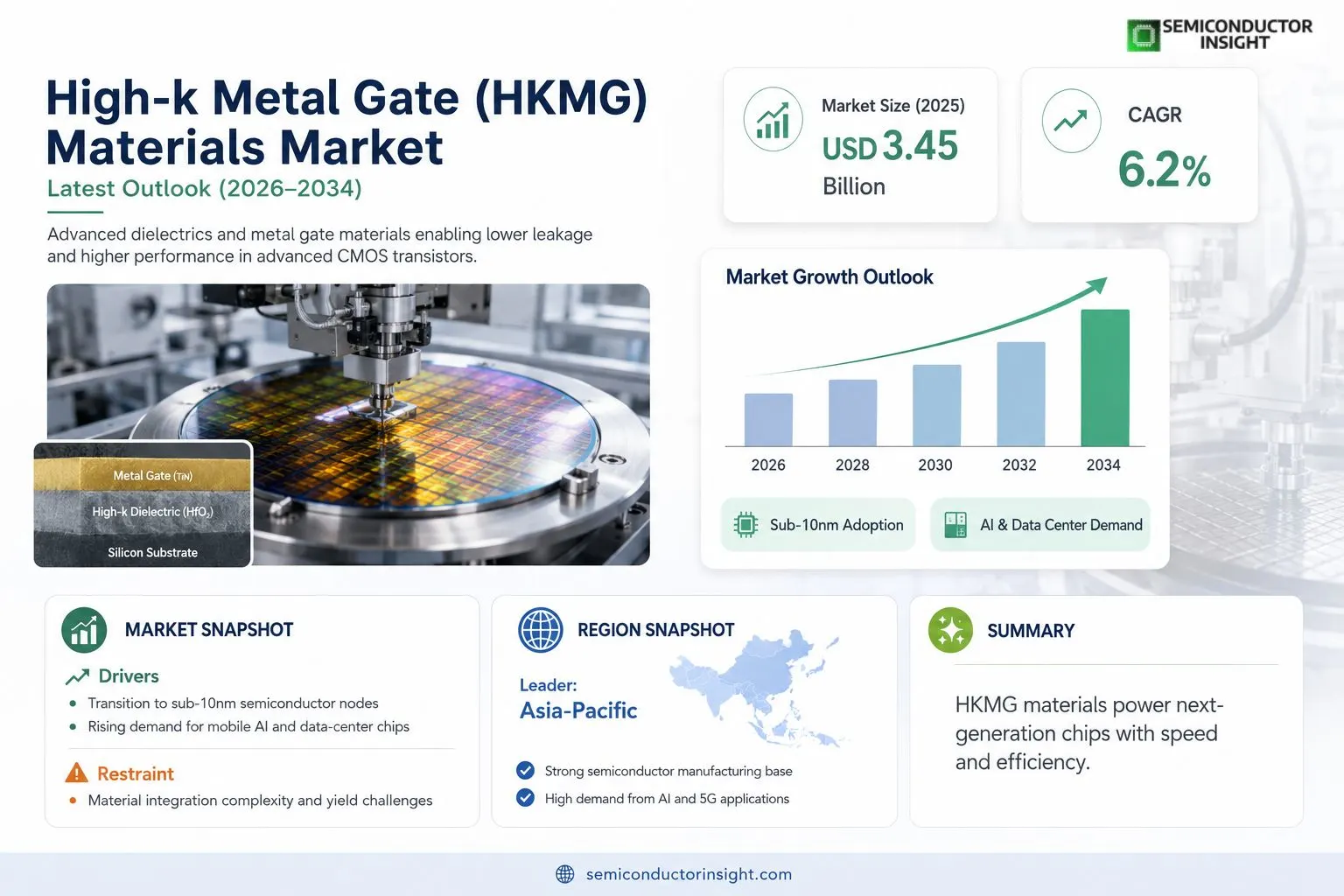
Global HKMG materials market size was valued at USD 3.45 billion in 2025. The market is projected to grow from USD 3.60 billion in 2026 to USD 6.20 billion by 2034, exhibiting a CAGR of 6.2% during the forecast period.
High‑k metal gate (HKMG) materials are dielectric compounds such as hafnium oxide (HfO₂) combined with metal gate electrodes like titanium nitride (TiN) that replace traditional silicon dioxide gates in advanced CMOS transistors, enabling reduced leakage and improved drive current.The market is accelerating because semiconductor manufacturers are transitioning to sub‑10 nm nodes, where HKMG is essential for performance scaling; however, challenges remain in material integration and cost control. Furthermore, increasing demand for mobile AI chips and data‑center processors drives investment, while leading suppliers such as Samsung Electronics, Intel Corp., and TSMC expand their production capabilities.
MARKET DRIVERS
Technology Scaling and Performance Demands
The relentless drive to shrink transistor dimensions below 5 nm has made the High‑k Metal Gate (HKMG) Materials Market indispensable. High‑k dielectrics provide superior capacitance control, reducing leakage currents and enabling faster switching speeds, which are critical for next‑generation processors.
Cost Efficiency and Manufacturing Maturity
Recent advances in atomic layer deposition (ALD) have lowered the per‑wafer cost of HKMG stacks, allowing fabs to achieve over 30 % cost reduction compared with legacy silicon‑oxide gates. This economic upside encourages broader adoption across mainstream and specialty semiconductor lines.
➤ Adoption of HKMG technologies in top‑tier fabs surpassed 70 % in 2023, driving robust revenue growth.
Combined, these drivers are propelling HKMG Materials Market toward an estimated compound annual growth rate of 12 % through 2030, as device manufacturers seek both performance and profitability.
MARKET CHALLENGES
Manufacturing Complexity
Integrating high‑k dielectrics with metal gates demands tight process control; variations in film thickness can cause threshold voltage shifts. Yield penalties of 5–8 % are still reported in early‑stage production lines, raising concerns for cost‑sensitive customers.
Other Challenges
Supply Chain Constraints
The limited number of qualified precursor chemicals for ALD creates bottlenecks, especially when demand spikes for AI‑focused silicon. This constraint can extend lead times by up to 45 days.
MARKET RESTRAINTS
Material Availability and Alternative Technologies
While high‑k oxides dominate advanced nodes, emerging alternatives such as ferroelectric‑HfO₂ and 2‑D channel materials compete for the same substrate space. Uncertainty around long‑term reliability of these substitutes can restrain investment in HKMG‑specific equipment.
MARKET OPPORTUNITIES
Emerging Applications in 5G and AI
The rollout of 5G infrastructure and AI‑accelerated workloads is spurring demand for chips with ultra‑low power consumption. High‑k Metal Gate solutions enable sub‑10‑mW power envelopes, positioning them as a critical enabler for edge‑computing devices.Furthermore, the anticipated expansion of automotive semiconductor content provides a 15 % upside for HKMG material suppliers, as vehicle‑grade processors require robust thermal stability that high‑k stacks uniquely deliver.
High-k Metal Gate (HKMG) Materials Market Trends
Shift to Sub‑10 nm Nodes Drives Adoption
The semiconductor industry is accelerating its transition to sub‑10 nm process nodes, where traditional silicon dioxide gate dielectrics no longer meet performance demands. High‑k Metal Gate (HKMG) materials, primarily hafnium oxide paired with metal electrodes such as titanium nitride, are now the de‑facto standard for advanced CMOS transistors. This shift enables lower gate leakage and higher drive current, directly supporting the power‑efficiency requirements of emerging mobile AI chips and high‑throughput data‑center processors. Consequently, leading fabs are expanding their HKMG production lines to sustain the escalating volume of wafers required for next‑generation products.
Other Trends
Integration Complexity and Cost Management
While the technical advantages of HKMG are clear, integrating high‑k dielectrics and metal gates into existing process flows presents notable challenges. Material compatibility with deep‑ultraviolet lithography, thermal stability during annealing, and uniformity across large‑diameter wafers require precise engineering. Cost pressures emerge from the need for additional deposition equipment and tighter process controls. Suppliers such as Samsung Electronics, Intel Corp., and TSMC are investing in in‑line metrology and advanced deposition techniques to mitigate these issues, aiming to reduce per‑wafer overhead while maintaining yield.
Supply Chain Consolidation and Capacity Expansion
Recent years have seen a consolidation of HKMG supply chain, with a few multinational firms securing the majority of high‑purity hafnium oxide and metal‑gate precursor production. These firms are scaling capacity to meet the rising demand from both mobile and server markets. The strategic expansion includes new fab modules in East Asia and subsidiary plants in Europe, ensuring a more resilient supply pipeline. This consolidation also promotes standardization of material specifications, which helps downstream manufacturers streamline integration and reduce time‑to‑market for cutting‑edge chips.
COMPETITIVE LANDSCAPEKey Industry Players
High‑k Metal Gate (HKMG) Materials Market Competitive Overview
HKMG materials market is dominated by a handful of integrated device manufacturers that control both wafer fabrication and material supply chains. Samsung Electronics, Intel Corp., and Taiwan Semiconductor Manufacturing Company (TSMC) lead the segment by scaling sub‑10 nm processes and expanding in‑house capacity for hafnium‑oxide dielectrics and titanium‑nitride gates. Their vertical integration creates a high barrier to entry, concentrating market share among these three giants while also driving collaborative R&D programs with specialty chemical firms. GlobalFoundries and SK Hynix serve as secondary tier players, leveraging partnerships to source high‑purity HfO₂ and metal gate stacks, thereby diversifying the competitive landscape without the same level of capital intensity.Niche yet influential suppliers focus on specialty precursors, deposition equipment, and advanced metrology that enable HKMG adoption across the ecosystem. Companies such as Applied Materials and Tokyo Electron provide atomic‑layer deposition (ALD) tools essential for conformal high‑k films. Chemical entrants including Sumitomo Chemical, JSR Corporation, Saint‑Gobain, and Merck KGaA supply high‑purity hafnium precursors and metal‑gate alloys, often tailoring formulations for specific node requirements. Materion Corporation and Hoya Corporation contribute specialty glass and dielectric substrates, while NXP Semiconductors leverages HKMG technology in its automotive‑grade microcontrollers, illustrating the broadening application base beyond flagship logic chips.
List of Key High‑k Metal Gate Materials Companies Profiled
- Samsung Electronics
- Intel Corp.
- TSMC
- GlobalFoundries
- SK Hynix
- Applied Materials
- Tokyo Electron
- ASML Holding
- Sumitomo Chemical
- JSR Corporation
- Saint‑Gobain
- Merck KGaA
- Materion Corporation
- Hoya Corporation
- NXP Semiconductors
Segment Analysis:
| Segment Category | Sub-Segments | Key Insights |
| By Type |
|
High‑k dielectric (HfO₂)
|
| By Application |
|
Logic transistors
|
| By End User |
|
Semiconductor fabs
|
| By Integration Approach |
|
Atomic layer deposition (ALD)
|
| By Device Node |
|
Sub‑10 nm
|
Regional Analysis: North America
United States
The US HKMG materials supply chain is intricately linked to global manufacturers, yet also demonstrates a growing emphasis on domestic sourcing and production. Key players are investing in expanding their manufacturing capabilities within the country to mitigate supply chain risks and support local chip manufacturing initiatives. This trend is expected to continue, fostering a more resilient and localized supply ecosystem.
Innovation in HKMG materials is at the forefront of the US market. Research and development efforts are concentrated on developing materials with improved electrical properties, enhanced reliability, and reduced manufacturing costs. This includes exploring novel dielectric materials and gate metal options to further advance transistor performance and energy efficiency.
The primary drivers for the US HKMG materials market are the increasing demand for advanced semiconductors in automotive, industrial, and consumer electronics applications. The push for greater computing power and energy efficiency are key factors propelling the adoption of these materials across various sectors. Government support for semiconductor manufacturing further bolsters market growth.
The US HKMG materials market is competitive, with both established global players and emerging domestic companies vying for market share. Competition is focused on offering high-quality materials, advanced technical support, and customized solutions to meet the specific needs of semiconductor manufacturers.
Europe
Europe holds a significant position in the global HKMG materials market, driven by the presence of leading semiconductor companies in countries like Germany, France, and the Netherlands. Government initiatives promoting technological advancement and semiconductor manufacturing are further boosting market growth. The European market emphasizes energy efficiency and sustainable manufacturing practices, influencing the demand for advanced HKMG materials. The focus is on supporting the development of next-generation chips for automotive and industrial applications.
Asia-Pacific
Asia-Pacific is the largest and fastest-growing market for HKMG materials, spearheaded by countries like Taiwan, South Korea, and China. The region’s robust semiconductor industry, particularly in memory and logic chips, is the primary driver of demand. Intense competition among semiconductor manufacturers and increasing investments in advanced manufacturing technologies are fueling market expansion. The Asia-Pacific market is characterized by a strong focus on cost competitiveness and rapid technological adoption.
South America
South America represents a relatively small but growing market for HKMG materials. The expansion of the electronics industry and increasing adoption of advanced technologies are driving demand. The region’s focus on consumer electronics and telecommunications is creating new opportunities for HKMG materials suppliers. Growth is moderate but steady, supported by regional investments in technology infrastructure.
Middle East & Africa
The Middle East and Africa represent emerging markets for HKMG materials. Government initiatives aimed at diversifying economies and promoting technological development are contributing to market growth. The expansion of telecommunications infrastructure and increasing adoption of electronics in these regions are driving demand. While currently a smaller market, the potential for future growth is significant.
Report Scope
This market research report provides a comprehensive analysis of the High-k Metal Gate (HKMG) Materials Market , covering the forecast period 2026–2034. It offers detailed insights into market dynamics, technological advancements, competitive landscape, and key trends shaping the industry.
Key focus areas of the report include:
- Market Overview: The report begins with an overview outlining its current market scenario, key growth indicators, and industry transformation drivers. It discusses macroeconomic factors, demand–supply balance, regulatory landscape, and the strategic role of semiconductors in powering advancements across industries such as automotive, telecommunications, consumer electronics, and industrial automation.
- Market Size & Forecast: Historical data and future projections for revenue, unit shipments, and market value across major regions and segments.
- Segmentation Analysis: Detailed breakdown by product type, technology, application, and end-user industry to identify high-growth segments and investment opportunities.
- Regional Insights: Insights into market performance across North America, Europe, Asia-Pacific, Latin America, and the Middle East & Africa, including country-level analysis where relevant.
- Competitive Landscape: Profiles of leading market participants, including their product offerings, R&D focus, manufacturing capacity, pricing strategies, and recent developments such as mergers, acquisitions, and partnerships.
- Technology Trends & Innovation: Assessment of emerging technologies, integration of AI/IoT, semiconductor design trends, fabrication techniques, and evolving industry standards.
- Market Drivers & Restraints: Evaluation of factors driving market growth along with challenges, supply chain constraints, regulatory issues, and market-entry barriers.
- Stakeholder Insights: Insights for component suppliers, OEMs, system integrators, investors, and policymakers regarding the evolving ecosystem and strategic opportunities.
Primary and secondary research methods are employed, including interviews with industry experts, data from verified sources, and real-time market intelligence to ensure the accuracy and reliability of the insights presented.
FREQUENTLY ASKED QUESTIONS:
What is the current market size of High-k Metal Gate (HKMG) Materials Market?
-> High-k Metal Gate (HKMG) Materials Market was valued at USD 3.45 billion in 2025 and is expected to reach USD 6.20 billion by 2034.
Which key companies operate in High-k Metal Gate (HKMG) Materials Market?
-> Key players include Samsung Electronics, Intel Corp., and TSMC, among others.
What are the key growth drivers?
-> Key growth drivers include transition to sub‑10 nm semiconductor nodes, increasing demand for mobile AI chips, and data‑center processor growth.
Which region dominates the market?
-> The reference does not specify a dominant region.
What are the emerging trends?
-> Emerging trends include adoption of HKMG in AI/IoT chips and data‑center processors, and ongoing material integration innovations.

Get Sample Report PDF for Exclusive Insights
Report Sample Includes
- Table of Contents
- List of Tables & Figures
- Charts, Research Methodology, and more...
 Download Sample Report PDF