Key Statistics
Key Takeaways
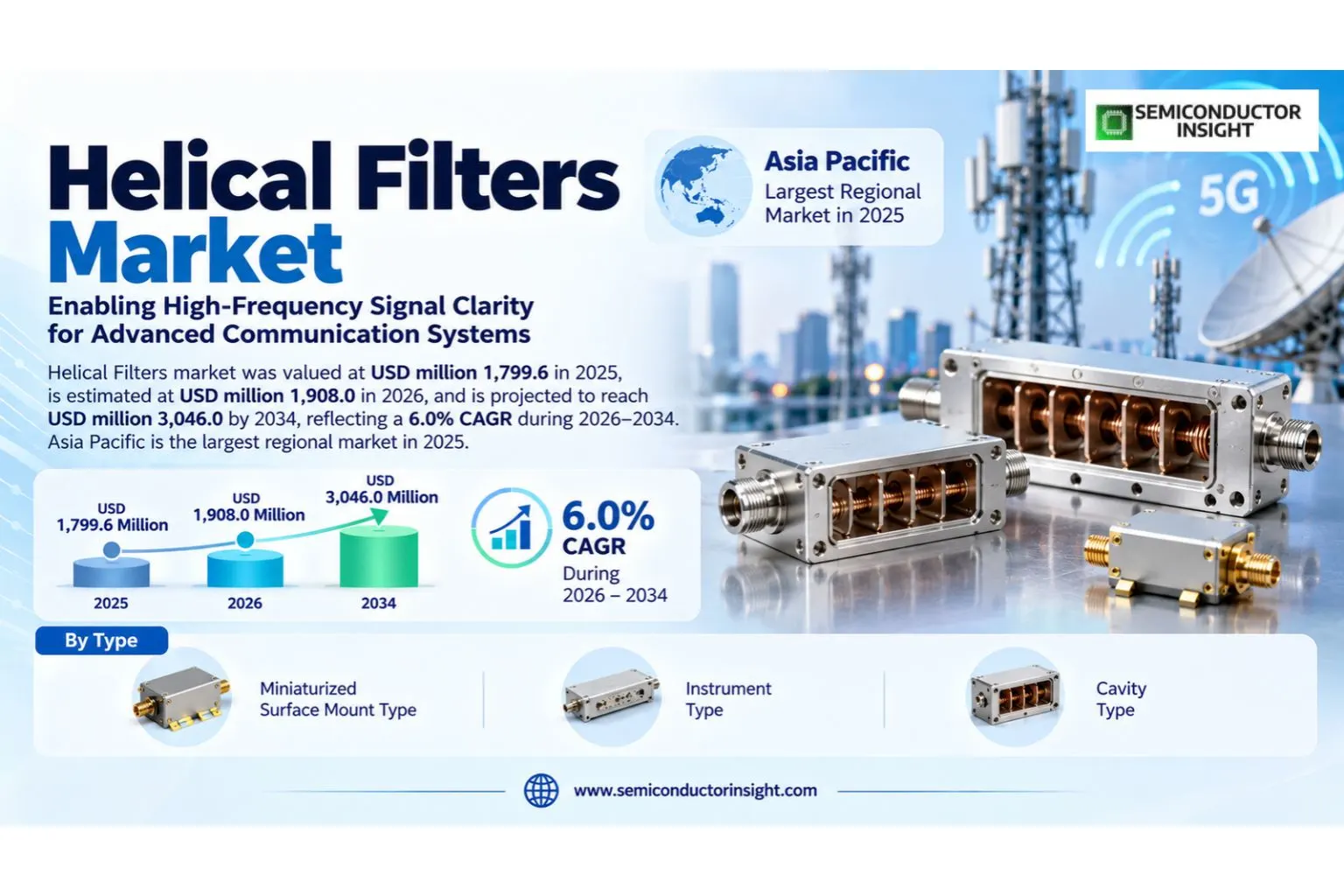
- Helical Filters market was valued at USD million 1,799.6 in 2025 and is projected to reach USD million 3,046.0 by 2034, representing a 6.0% CAGR over 2026–2034.
- Miniaturized surface-mount designs are positioned for above-average growth because customer designs increasingly reward integration, performance consistency and lower system-level complexity.
- Telecommunications and private wireless infrastructure provides one of the clearest demand pathways as purchasing decisions move toward higher performance, tighter qualification and longer lifecycle support.
- Asia Pacific held the largest market position in 2025, supported by the concentration of relevant manufacturing, infrastructure, customers or technology investment.
- The central market constraint is not simply price; qualification, process control and switching risk can slow adoption even when a competing product offers an attractive specification.
- Competitive advantage is shifting toward suppliers that combine product performance with application engineering, dependable capacity and regional technical support.
Helical Filters Market Overview
Helical Filters market was valued at USD million 1,799.6 in 2025, is estimated at USD million 1,908.0 in 2026, and is projected to reach USD million 3,046.0 by 2034, reflecting a 6.0% CAGR during 2026–2034. Asia Pacific is the largest regional market in 2025.
Base year: 2025 · Estimated year: 2026 · Forecast period: 2026–2034 · Values in USD million unless otherwise stated
Helical Filters refers to a passive RF component that uses a helical resonator, commonly a wound conductive coil inside a shielded cavity, to deliver selective bandpass or bandstop response with high Q in a compact physical volume. The commercial boundary includes products and enabling solutions sold specifically for the defined application, while excluding adjacent technologies that do not perform the same core function. This scope discipline is important because neighboring components can share end customers without being economically interchangeable.
Purchasing is engineering-led. Frequency, insertion loss, rejection, power handling, temperature stability, connector format and package constraints define the shortlist before price becomes decisive. Demand therefore tracks radio-density growth and the need to suppress increasingly crowded interference environments.
Segment Analysis: By Type
By type, the market is segmented into Miniaturized Surface Mount Type, Instrument Type, Cavity Type. The segment mix reflects differences in architecture, cost, integration and end-use qualification. Miniaturized surface-mount designs are positioned for stronger growth where customers value higher performance or reduced system complexity.
| Type | Market role | Commercial characteristics |
|---|---|---|
| Miniaturized Surface Mount Type | Core segment | Miniaturized Surface Mount Type represents a distinct purchasing and performance profile within the Helical Filters market. Supplier differentiation depends on technical fit, qualification requirements, operating environment and the economics of the customer workflow rather than on a single headline specification. |
| Instrument Type | Strategic segment | Instrument Type represents a distinct purchasing and performance profile within the Helical Filters market. Supplier differentiation depends on technical fit, qualification requirements, operating environment and the economics of the customer workflow rather than on a single headline specification. |
| Cavity Type | Strategic segment | Cavity Type represents a distinct purchasing and performance profile within the Helical Filters market. Supplier differentiation depends on technical fit, qualification requirements, operating environment and the economics of the customer workflow rather than on a single headline specification. |
Segment Analysis: By End User
| End User | Market role | Commercial characteristics |
|---|---|---|
| Network Infrastructure Providers | Core segment | Network Infrastructure Providers represents a distinct purchasing and performance profile within the Helical Filters market. Supplier differentiation depends on technical fit, qualification requirements, operating environment and the economics of the customer workflow rather than on a single headline specification. |
| Military/Aerospace OEMs | Strategic segment | Military/Aerospace OEMs represents a distinct purchasing and performance profile within the Helical Filters market. Supplier differentiation depends on technical fit, qualification requirements, operating environment and the economics of the customer workflow rather than on a single headline specification. |
| Industrial Equipment Manufacturers | Strategic segment | Industrial Equipment Manufacturers represents a distinct purchasing and performance profile within the Helical Filters market. Supplier differentiation depends on technical fit, qualification requirements, operating environment and the economics of the customer workflow rather than on a single headline specification. |
Segment Analysis: By Core Material
| Core Material | Market role | Commercial characteristics |
|---|---|---|
| Ceramic Dielectric Spiral Filter | Core segment | Ceramic Dielectric Spiral Filter represents a distinct purchasing and performance profile within the Helical Filters market. Supplier differentiation depends on technical fit, qualification requirements, operating environment and the economics of the customer workflow rather than on a single headline specification. |
| Metal Spiral Filter | Strategic segment | Metal Spiral Filter represents a distinct purchasing and performance profile within the Helical Filters market. Supplier differentiation depends on technical fit, qualification requirements, operating environment and the economics of the customer workflow rather than on a single headline specification. |
| Composite Dielectric Spiral Filter | Strategic segment | Composite Dielectric Spiral Filter represents a distinct purchasing and performance profile within the Helical Filters market. Supplier differentiation depends on technical fit, qualification requirements, operating environment and the economics of the customer workflow rather than on a single headline specification. |
Segment Analysis: By Application
By application, demand spans Telecommunications Industry, Aerospace and Defense, Automotive Electronics, Others. Telecommunications and private wireless infrastructure has one of the strongest growth profiles because performance requirements and deployment intensity are increasing faster than in mature replacement-led uses.
| Application | Demand characteristics |
|---|---|
| Telecommunications Industry | Purchasing in Telecommunications Industry is driven by application performance, qualification, lifecycle cost and supplier support. The segment rewards vendors that can translate technical specifications into measurable system-level reliability, throughput or user value rather than competing only on component price. |
| Aerospace and Defense | Purchasing in Aerospace and Defense is driven by application performance, qualification, lifecycle cost and supplier support. The segment rewards vendors that can translate technical specifications into measurable system-level reliability, throughput or user value rather than competing only on component price. |
| Automotive Electronics | Purchasing in Automotive Electronics is driven by application performance, qualification, lifecycle cost and supplier support. The segment rewards vendors that can translate technical specifications into measurable system-level reliability, throughput or user value rather than competing only on component price. |
| Others | Purchasing in Others is driven by application performance, qualification, lifecycle cost and supplier support. The segment rewards vendors that can translate technical specifications into measurable system-level reliability, throughput or user value rather than competing only on component price. |
Regional Analysis
Asia Pacific leads the market in 2025. Regional demand differs by manufacturing concentration, deployment economics, regulation, infrastructure maturity and customer qualification practices, so supplier strategies must be adapted rather than copied from one geography to another.
How does regional demand differ in the Helical Filters market?
Regional performance depends on where the underlying systems are manufactured, deployed and qualified. Asia Pacific benefits from the strongest concentration of the relevant demand engine, while North America and Europe typically offer deeper premium niches and structured qualification. South America and Middle East & Africa remain smaller but can provide project-driven or import-led opportunities.
| Region | Position | Growth outlook | Demand profile | Supplier selection |
|---|---|---|---|---|
| Asia Pacific | Largest | Positive | Distinct application mix | Qualification, availability and lifecycle support |
| North America | Position 2 | Positive | Distinct application mix | Qualification, availability and lifecycle support |
| Europe | Position 3 | Positive | Distinct application mix | Qualification, availability and lifecycle support |
| South America | Position 4 | Positive | Distinct application mix | Qualification, availability and lifecycle support |
| Middle East & Africa | Position 5 | Positive | Distinct application mix | Qualification, availability and lifecycle support |
Competitive Landscape
Competition in the Helical Filters market is shaped by technical differentiation, qualification history, application engineering and the ability to support customers through design-in and production. Price remains important, but switching risk gives incumbents an advantage once a product is qualified.
The competitive set includes Murata, Knowles Precision Devices, K&L Microwave, Temwell, NEOSID, Benchmark Lark alongside specialist and regional suppliers. Large diversified vendors benefit from broader customer access and manufacturing scale, while specialists compete through narrower technical depth, customization and responsiveness. The balance varies by application because qualification intensity and purchasing volumes differ materially.
Supplier share can change slowly in mature qualified applications because redesigning a component, material or software element creates engineering work beyond the purchase price. New platforms and greenfield capacity therefore create disproportionate opportunities for challengers, while aftermarket and replacement demand tends to reinforce incumbent relationships.
| Competitive group | Representative companies | Primary advantage |
|---|---|---|
| Global diversified suppliers | Murata, Knowles Precision Devices, K&L Microwave, Temwell | Scale, broad account access, quality systems and lifecycle support |
| Specialists and focused vendors | NEOSID, Benchmark Lark, Microwave Filter Company, Spectrum Control, MCV Microwave | Application expertise, customization and faster engineering response |
| Regional and emerging suppliers | Telewave, Anatech Electronics, RS Microwave, TTE Filters, Sumida, Reactel | Local availability, price competitiveness and proximity to customers |
Key Participants
The profiled competitive landscape includes Murata, Knowles Precision Devices, K&L Microwave, Temwell, NEOSID, Benchmark Lark, Microwave Filter Company, Spectrum Control, MCV Microwave, Telewave, Anatech Electronics, RS Microwave, TTE Filters, Sumida, Reactel. Competitive relevance should be read by product fit and end-market qualification, since not every supplier participates with the same breadth across all regions, specifications and customer tiers.
Production Capacity Analysis
Capacity in the Helical Filters market is constrained by more than nominal factory output. The commercially useful measure is qualified capacity: production that can repeatedly meet customer specifications, quality controls and delivery requirements. Expansion therefore requires process capability, test infrastructure and trained engineering support as well as physical equipment.
Geographic concentration follows the upstream and downstream ecosystem supporting the market. Asia Pacific has a structural advantage where local suppliers can shorten qualification loops, support customer troubleshooting and synchronize capacity with nearby system manufacturers or deployment programs. North American and European suppliers often defend premium niches through IP, certification and application expertise.
The principal capacity risk is mismatch rather than absolute shortage. A supplier can have available floor space yet lack the process window, material grade, test capability or customer approval needed for a specific design. Buyers therefore increasingly examine business-continuity planning, second-source readiness and regional service capability when approving strategic suppliers.
Market Dynamics
The market is expanding because technology intensity is increasing in the systems that consume Helical Filters solutions, but adoption remains gated by qualification, lifecycle economics and supply-chain execution. The strongest suppliers convert technical performance into lower integration risk and more predictable customer operations.
Market Drivers
| Driver | Impact | Commercial mechanism |
|---|---|---|
| More crowded RF environments raise rejection requirements | High | More crowded RF environments raise rejection requirements expands addressable demand by increasing system performance requirements, installation intensity or replacement value. The impact is strongest where customers can quantify avoided downtime, improved throughput or reduced integration complexity. |
| Private 5G and professional radio add filter sockets | High | Private 5G and professional radio add filter sockets expands addressable demand by increasing system performance requirements, installation intensity or replacement value. The impact is strongest where customers can quantify avoided downtime, improved throughput or reduced integration complexity. |
| Defense modernization sustains high-performance custom filtering | Medium | Defense modernization sustains high-performance custom filtering expands addressable demand by increasing system performance requirements, installation intensity or replacement value. The impact is strongest where customers can quantify avoided downtime, improved throughput or reduced integration complexity. |
| Miniaturization supports denser RF front ends | Medium | Miniaturization supports denser RF front ends expands addressable demand by increasing system performance requirements, installation intensity or replacement value. The impact is strongest where customers can quantify avoided downtime, improved throughput or reduced integration complexity. |
More crowded RF environments raise rejection requirements
More crowded RF environments raise rejection requirements is a meaningful driver because it changes the customer requirement rather than merely adding market awareness. Suppliers benefit when the trend creates a new technical threshold, additional unit content or a higher-value specification. Commercial conversion still depends on qualification timing and whether the customer can justify the system-level benefit against switching cost.
Private 5G and professional radio add filter sockets
Private 5G and professional radio add filter sockets is a meaningful driver because it changes the customer requirement rather than merely adding market awareness. Suppliers benefit when the trend creates a new technical threshold, additional unit content or a higher-value specification. Commercial conversion still depends on qualification timing and whether the customer can justify the system-level benefit against switching cost.
Defense modernization sustains high-performance custom filtering
Defense modernization sustains high-performance custom filtering is a meaningful driver because it changes the customer requirement rather than merely adding market awareness. Suppliers benefit when the trend creates a new technical threshold, additional unit content or a higher-value specification. Commercial conversion still depends on qualification timing and whether the customer can justify the system-level benefit against switching cost.
Miniaturization supports denser RF front ends
Miniaturization supports denser RF front ends is a meaningful driver because it changes the customer requirement rather than merely adding market awareness. Suppliers benefit when the trend creates a new technical threshold, additional unit content or a higher-value specification. Commercial conversion still depends on qualification timing and whether the customer can justify the system-level benefit against switching cost.
Market Restraints
| Restraint | Impact | Market effect |
|---|---|---|
| SAW, BAW and ceramic alternatives compete in compact high-volume designs | High | SAW, BAW and ceramic alternatives compete in compact high-volume designs can delay adoption, narrow the qualified supplier pool or increase total ownership cost. The effect is strongest in applications where redesign or process change creates validation risk beyond the component purchase price. |
| High-power systems may favor larger cavity architectures | High | High-power systems may favor larger cavity architectures can delay adoption, narrow the qualified supplier pool or increase total ownership cost. The effect is strongest in applications where redesign or process change creates validation risk beyond the component purchase price. |
| Custom tuning increases engineering overhead and lead time | Medium | Custom tuning increases engineering overhead and lead time can delay adoption, narrow the qualified supplier pool or increase total ownership cost. The effect is strongest in applications where redesign or process change creates validation risk beyond the component purchase price. |
| Mechanical tolerances can affect repeatability and production yield | Medium | Mechanical tolerances can affect repeatability and production yield can delay adoption, narrow the qualified supplier pool or increase total ownership cost. The effect is strongest in applications where redesign or process change creates validation risk beyond the component purchase price. |
SAW, BAW and ceramic alternatives compete in compact high-volume designs
SAW, BAW and ceramic alternatives compete in compact high-volume designs constrains market conversion because buyers must manage technical, operational and financial risk simultaneously. Even when the long-term technology direction is favorable, project delays, qualification burden or competing architectures can shift demand between suppliers and postpone revenue recognition. Successful vendors address the restraint through design support, reliability evidence and clearer lifecycle economics.
High-power systems may favor larger cavity architectures
High-power systems may favor larger cavity architectures constrains market conversion because buyers must manage technical, operational and financial risk simultaneously. Even when the long-term technology direction is favorable, project delays, qualification burden or competing architectures can shift demand between suppliers and postpone revenue recognition. Successful vendors address the restraint through design support, reliability evidence and clearer lifecycle economics.
Custom tuning increases engineering overhead and lead time
Custom tuning increases engineering overhead and lead time constrains market conversion because buyers must manage technical, operational and financial risk simultaneously. Even when the long-term technology direction is favorable, project delays, qualification burden or competing architectures can shift demand between suppliers and postpone revenue recognition. Successful vendors address the restraint through design support, reliability evidence and clearer lifecycle economics.
Mechanical tolerances can affect repeatability and production yield
Mechanical tolerances can affect repeatability and production yield constrains market conversion because buyers must manage technical, operational and financial risk simultaneously. Even when the long-term technology direction is favorable, project delays, qualification burden or competing architectures can shift demand between suppliers and postpone revenue recognition. Successful vendors address the restraint through design support, reliability evidence and clearer lifecycle economics.
Market Opportunities
Compact filters for private 5G radio equipment
Compact filters for private 5G radio equipment creates a focused opportunity where existing products or operating models no longer fully match customer requirements. The most attractive positioning combines a measurable technical advantage with easier qualification, reliable supply and application support. Suppliers that enter early in the design cycle can secure longer-lived revenue because redesign costs increase after customer validation.
Low-PIM and rugged filters for defense communications
Low-PIM and rugged filters for defense communications creates a focused opportunity where existing products or operating models no longer fully match customer requirements. The most attractive positioning combines a measurable technical advantage with easier qualification, reliable supply and application support. Suppliers that enter early in the design cycle can secure longer-lived revenue because redesign costs increase after customer validation.
Surface-mount integration for smaller RF modules
Surface-mount integration for smaller RF modules creates a focused opportunity where existing products or operating models no longer fully match customer requirements. The most attractive positioning combines a measurable technical advantage with easier qualification, reliable supply and application support. Suppliers that enter early in the design cycle can secure longer-lived revenue because redesign costs increase after customer validation.
Rapid custom engineering for specialized interference problems
Rapid custom engineering for specialized interference problems creates a focused opportunity where existing products or operating models no longer fully match customer requirements. The most attractive positioning combines a measurable technical advantage with easier qualification, reliable supply and application support. Suppliers that enter early in the design cycle can secure longer-lived revenue because redesign costs increase after customer validation.
Supply Chain Analysis
Conductors, ceramics and shield materials
Resonator winding and cavity fabrication
Tuning, assembly and RF test
Radio, network and defense-system integration
Conductors, ceramics and shield materials
Conductors, ceramics and shield materials is a critical value-chain stage because quality, lead time and technical consistency at this point propagate into downstream performance. Value capture is highest when suppliers solve a difficult qualification or integration problem, while bottlenecks emerge when specialized materials, process know-how or test capacity cannot be substituted quickly.
Resonator winding and cavity fabrication
Resonator winding and cavity fabrication is a critical value-chain stage because quality, lead time and technical consistency at this point propagate into downstream performance. Value capture is highest when suppliers solve a difficult qualification or integration problem, while bottlenecks emerge when specialized materials, process know-how or test capacity cannot be substituted quickly.
Tuning, assembly and RF test
Tuning, assembly and RF test is a critical value-chain stage because quality, lead time and technical consistency at this point propagate into downstream performance. Value capture is highest when suppliers solve a difficult qualification or integration problem, while bottlenecks emerge when specialized materials, process know-how or test capacity cannot be substituted quickly.
Radio, network and defense-system integration
Radio, network and defense-system integration is a critical value-chain stage because quality, lead time and technical consistency at this point propagate into downstream performance. Value capture is highest when suppliers solve a difficult qualification or integration problem, while bottlenecks emerge when specialized materials, process know-how or test capacity cannot be substituted quickly.
Recent Developments
2026
Helical filter suppliers continued to position compact, high-Q resonator designs for denser communications equipment where designers must balance selectivity, insertion loss and enclosure volume. Source
2025
Private and 5G radio architectures increased the number of coexistence and interference-management problems that can justify discrete RF filtering in specialized nodes and repeaters. Source
2025
Custom filter catalogs increasingly emphasize configurable center frequency, bandwidth, rejection and package choices, reinforcing an engineering-service business model alongside standardized component sales. Source
Taken together, these developments show that market structure is being shaped by concrete technology, capacity, standards and regulatory changes rather than by demand growth alone. For suppliers, the practical implication is to align product roadmaps and regional support with the specific transition that is changing customer qualification or procurement behavior.
Report Scope & Segmentation
| Attribute | Coverage |
|---|---|
| Base year | 2025 |
| Estimated year | 2026 |
| Forecast period | 2026–2034 |
| 2025 market size | USD million 1,799.6 |
| 2026 estimated size | USD million 1,908.0 |
| 2034 projected size | USD million 3,046.0 |
| CAGR (2026–2034) | 6.0% |
| By Type | Miniaturized Surface Mount Type, Instrument Type, Cavity Type |
| By Application | Telecommunications Industry, Aerospace and Defense, Automotive Electronics, Others |
| By End User | Network Infrastructure Providers, Military/Aerospace OEMs, Industrial Equipment Manufacturers |
| By Core Material | Ceramic Dielectric Spiral Filter, Metal Spiral Filter, Composite Dielectric Spiral Filter |
| Regions | North America, Europe, Asia Pacific, South America, Middle East & Africa |
| Companies | Murata, Knowles Precision Devices, K&L Microwave, Temwell, NEOSID, Benchmark Lark, Microwave Filter Company, Spectrum Control, MCV Microwave, Telewave, Anatech Electronics, RS Microwave, TTE Filters, Sumida, Reactel |
Frequently Asked Questions
What is the Helical Filters market size in 2025?
The global market is valued at USD million 1,799.6 in 2025. The 2026 estimate is USD million 1,908.0, providing the starting point for the 2026–2034 forecast period.
What is the forecast market size by 2034?
The market is projected to reach USD million 3,046.0 by 2034, reflecting continued adoption across the applications and regions covered in this overview.
What is the expected CAGR during 2026–2034?
The market is expected to expand at a CAGR of 6.0% during 2026–2034. Growth is supported by technology upgrades, higher performance requirements and broader deployment in the strongest application segments.
Which region is the largest market?
Asia Pacific is the largest regional market in 2025. Its position reflects the concentration of relevant manufacturing, infrastructure deployment, technology investment or end-user demand supporting this market.
Which product type has the strongest growth profile?
Miniaturized surface-mount designs have a strong growth profile because customers increasingly value performance, integration and lifecycle economics. Segment leadership can vary by application because qualification requirements and system architectures are not uniform.
Which application is expanding fastest?
Telecommunications and private wireless infrastructure is one of the fastest-expanding application areas, supported by rising technical requirements and a growing need for qualified suppliers that can support design-in, integration and ongoing operations.
What are the main market drivers?
The main drivers include More crowded RF environments raise rejection requirements, Private 5G and professional radio add filter sockets, Defense modernization sustains high-performance custom filtering. Each driver affects purchasing by changing required performance, deployment intensity or the cost of system failure rather than simply increasing product awareness.
What are the main restraints?
Key restraints include SAW, BAW and ceramic alternatives compete in compact high-volume designs, High-power systems may favor larger cavity architectures, Custom tuning increases engineering overhead and lead time. These factors can extend qualification cycles, raise switching costs or shift demand toward competing architectures when customers prioritize risk reduction.
Who are the key market participants?
Key profiled participants include Murata, Knowles Precision Devices, K&L Microwave, Temwell, NEOSID, Benchmark Lark, Microwave Filter Company, alongside additional specialist and regional suppliers. Competitive positioning depends on product fit, qualification record, supply reliability and application support.
What determines supplier selection?
Supplier selection is typically determined by technical compliance, repeatable quality, qualification history, total lifecycle cost, delivery reliability and access to regional application support. In high-consequence applications, proven field performance can outweigh a modest unit-price difference.
Research Sources & Evidence Base
View research sources used for this overview.
- Temwell. What is a Helical Filter? — Helical resonator construction, RF filtering behavior and application range.
- Temwell. 5G Filter Applications — RF filtering applications in 5G communication equipment.
- Temwell. Filter product and design catalog — Commercial design formats and filter customization context.
Get Sample Report PDF for Exclusive Insights
Report Sample Includes
- Table of Contents
- List of Tables & Figures
- Charts, Research Methodology, and more...
 Download Sample Report PDF