Hall Effect Switch ICs Market Insights
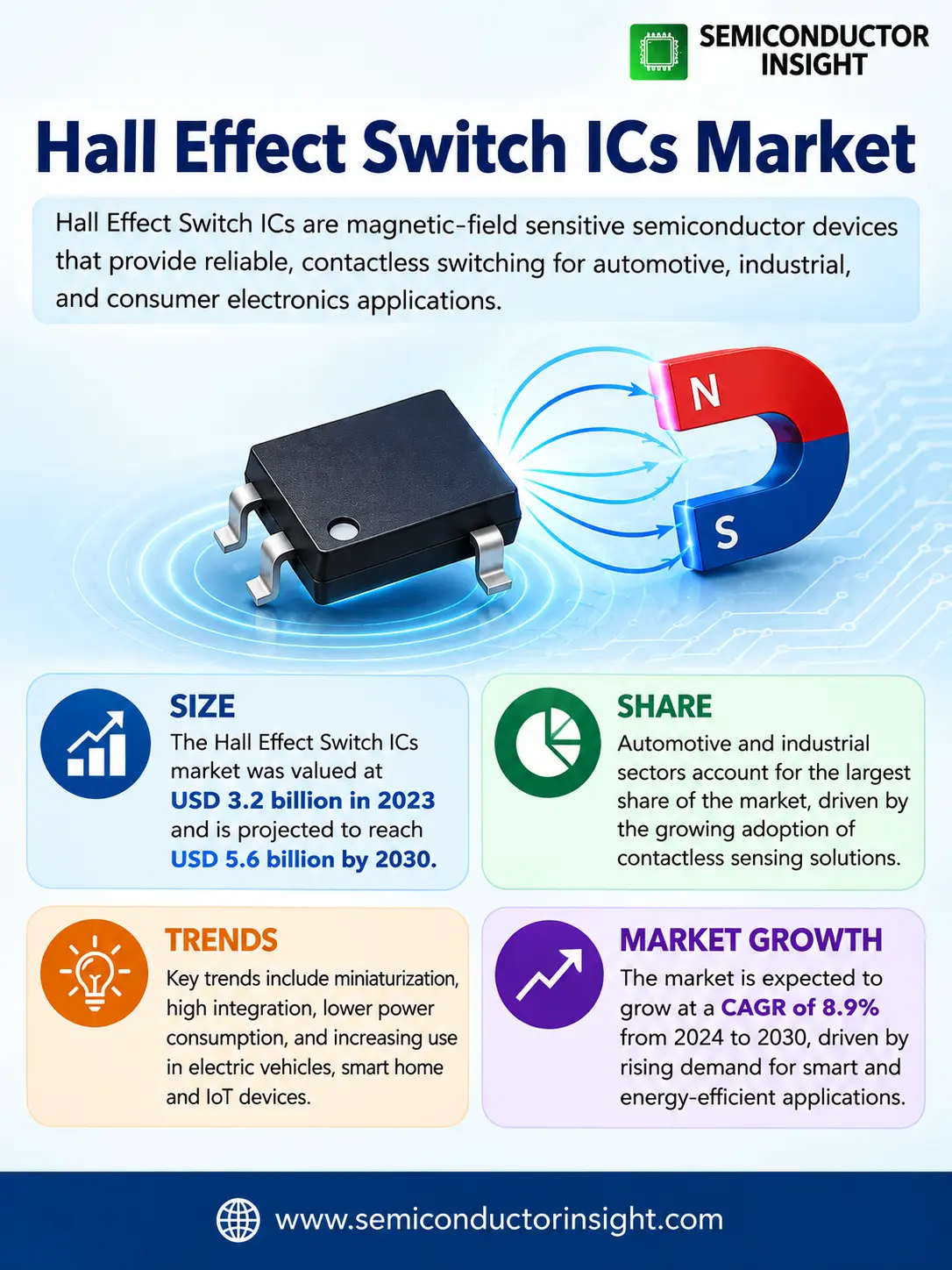
Hall Effect Switch ICs market was valued at USD 936 million in 2026 and is projected to reach USD 1 630 million by 2035, exhibiting a CAGR of 8.4% during the forecast period.
Hall Effect Switch ICs are electronic devices that employ the Hall effect phenomenon to detect magnetic fields and provide a digital output signal based on presence or absence of flux. The underlying principle involves generation of a Hall voltage across a conductor or semiconductor when exposed to a perpendicular magnetic field while current flows through it.
These switches find widespread use in automotive safety systems, industrial motor control, and consumer electronics such as smartphones and wearables where compactness and low power draw are critical.
The precision offered by Hall effect sensing eliminates mechanical wear associated with conventional contacts, enabling longer service life and reducing maintenance costs across sectors that demand high reliability.
MARKET DRIVERS
High Reliability Requirements in Automotive and Industrial Automation
In the Hall Effect Switch ICs Market, the push toward higher reliability is transforming demand trends. Automotive applications – particularly electric vehicles (EVs) and hybrid powertrains – depend on precise torque and speed sensing inside traction motors. Hall effect switches, with their solid‑state construction and immunity to mechanical wear, deliver continuous, calibrated output without a moving contact, aligning with automotive safety standards such as ISO 26262 functional safety. Simultaneously, industrial automation – from CNC machines to conveyor systems – increasingly selects Hall effect solutions to reduce maintenance cycles and minimize downtime. The convergence of predictive maintenance and data analytics further incentivizes the use of Hall effect ICs, allowing operators to feed real‑time sensor data into MES systems for condition‑based strategy. Consequently, original equipment manufacturers (OEMs) in both automotive and automation segments allocate larger share of their sensor budgets to digital Hall switches, creating a consistent upward trajectory in the overall market volume. Moreover, the performance envelope of modern Hall ICs, with micro‑second response times and minimal hysteresis, makes them ideal for high‑speed applications that were previously reserved for brushless DC motors or magnetic encoders, bolstering adoption across segments.
Technological Advancements in Sensor Fabrication and Packaging
Recent advances in CMOS processes and flip‑chip packaging have tightened the performance gap between Hall effect switches and emerging alternatives. Shrinking die size reduces parasitic capacitance, thereby improving noise immunity – a requirement that is increasingly stringent in electric vehicles where the sensor operates amid high‑voltage switching noise. Moreover, wafer‑level packaging enables co‑integration of Hall sensor layers directly into microcontrollers, diminishing board real estate and lowering impedance paths. Integrated magnetization layers, utilizing engineered layered magnetic alloys, deliver higher sensitivity while maintaining temperature stability up to 200 °C, which is critical for engines and heavy‑duty machinery. These miniaturization trends support the League of Automotive Engineers (LAE) vision of a 1 unit / sq inch sensor geometry, pushing vendors to adapt to tighter cost constraints: per‑unit cost falls while throughput rises, fostering early adopter enthusiasm. Consequently, manufacturers now view Hall effect ICs as a flexible platform that can be customized with driver circuits or embedded diagnostics, further expanding the component’s appeal to system integrators seeking modular design paths in the Hall Effect Switch ICs Market.
➤ The marriage of higher integration density, lower power draw, and certified safety alignment is a decisive engine behind the contemporary demand for Hall effect switches.
When mapping the long‑term outlook, the convergence of regulatory mandates for zero‑emission vehicles and global automation goals suggests that the Hall Effect Switch ICs Market is primed for sustained deployment. The cost trajectories driven by semiconductor scaling, combined with advanced packaging that aligns with stricter electromagnetic compatibility (EMC) guidelines, are redistributing market share from legacy reluctance sensors to robust Hall platforms. Enterprises that anticipate the need for timely integration of sensor data into digital twins and cloud analytics will capture the most significant share. Therefore, vigilance around supply chain resilience, IP agreements for magnetic layer patents, and continuous validation against ISO 26262 remain crucial for market stakeholders aiming to secure competitive positioning.
MARKET CHALLENGES
Electromagnetic Interference and Calibration Complexity
Despite the technical advantages, Hall effect ICs face significant interference challenges. In automotive high‑voltage environments, the proximity of the Hall switch to switching power electronics can generate over‑voltage spikes that distort magnetic readings, leading to speed error or traction loss. Calibration against temperature drift and magnetic aging often requires sophisticated factory pre‑conditioning, which not only adds pre‑production cost but also forces OEMs to embed additional sensors for temperature monitoring, widening the system footprint. This calibration loop also complicates field service; without a robust calibration kit, maintenance personnel struggle to restore optimal performance, escalating service costs. The resulting friction marginalizes market growth in cost‑sensitive segments such as OEMs for small and medium‑sized vehicles.
Other Challenges
Supply Chain Disruptions
The Hall Effect Switch ICs Market depends on a limited set of raw materials (e.g., ferromagnetic alloys) and highly specialized semiconductor fabs located in the U.S., Japan, and Taiwan. Any geopolitical tension or logistical bottleneck in these regions can throttle tonnage, driving production lags that ripple through the automotive and industrial automation supply chain. Consequently, companies are compelled to invest in dual sourcing and contingency plans, inflating capital overheads and compressing margins.
Furthermore, the rapid evolution of companion sensors – notably magnetoresistive Hall sensors and ubiquitous optical encoders – introduces competitive pressure. R&D cycles for new Hall IC iterations are typically faster than for the analog counterpart, and the market’s dynamic equilibrium could shift toward even smaller, lower‑power alternatives if such competitors remain undetected. Stakeholders must therefore balance innovation pace with strategic IP protection to sustain profitability.
MARKET RESTRAINTS
Cost Sensitivity in Emerging Economies
In many emerging markets, the premium pricing of high‑performance Hall effect ICs limits widespread deployment. While cost‑effective products exist, they often trade off critical reliability parameters such as temperature tolerance and linearity, rendering them unsuitable for automotive constraints. Manufacturers targeting these regions must therefore contend with a mismatched demand curve: the high cost impedes adoption even as the local industrial base seeks automation upgrades. Consequently, overall market share in these geographies remains modest despite clear technical advantages.
Stricter Safety and EMC Regulations
The adoption of Hall effect ICs is frequently stymied by the need to meet stringent safety and electromagnetics standards. Meeting ISO 26262 functional safety, IEC 60204‑1 for machinery, and FCC Part 15 for EMC certification requires comprehensive design reviews and extensive testing. The certification timeline, often spanning several months, can delay product introductions. Moreover, regulatory approvals for consumer electronics or medical use demand additional cost layers for integrated circuit safety features, which restrain margin and deter low‑cost entrants from the Hall Effect Switch ICs Market.
Limited Manufacturing Capacity for Niche Variants
Production lines for Hall effect ICs are typically configured for mainstream automotive and industrial streams. Niche variants—such as ultra‑high‑speed sensors for aerospace avionics or limited‑run medical imaging devices—require serialized manufacturing steps that competitors deem unprofitable. The lack of flexible capacity limits the ability to quickly respond to targeted R&D initiatives, leading to prolonged lead times and higher scrap rates. This constraint ultimately hampers the feasible scaling of specialized sensor solutions in the broader market.
MARKET OPPORTUNITIES
Expansion in Electric Vehicle Power Electronics
Electric vehicles continually push the boundaries of power electronics efficiency and durability. Hall effect ICs positioned as motor position and speed sensors fit naturally into inverter circuits, providing closed‑loop control for torque management. Moreover, amplifier‑less Hall architectures reduce the need for complex drive circuitry, trimming overall board footprint and improving energy efficiency. Automotive OEMs, in pursuit of higher power density, increasingly favor Hall solutions that provide high‑speed response and robust temperature endurance. This demand growth, coupled with aggressive electrification roadmaps in China and Europe, creates a near‑term revenue corridor for Hall IC vendors that can deliver sensor–driver integration in a single package.
Industrial Automation and Robotics Integration
Manufacturing robotics and factory automation systems benefit from the repeatable accuracy and durability of Hall effect sensors. In high‑speed servo loops—where optical encoders suffer from backlash or mechanical wear—Hall ICs provide a cleaner, lower‑maintenance alternative. The integration of Hall sensors with commonly used PLCs and DCS systems enables fast implementation of safety‑critical controls without extensive redesign. Additionally, smart manufacturing initiatives that embed wireless telemetry onto machine tools can leverage the minimal form factor of Hall ICs, promoting adoption across flexible manufacturing cells in both mature and emerging industrial hubs.
Growth of Smart Manufacturing and IoT Ecosystems
In the era of Industry 4.0, data acquisition from motion control components fuels predictive maintenance and real‑time optimization. Hall effect ICs, with their seamless digital outputs, integrate effortlessly into PLC, SCADA, and IIoT cloud platforms, enabling edge computing architectures that gather vast sensor streams. The resulting insights drive productivity gains that ETF, TCO, and reliability ratios can measure. For suppliers who can package Hall ICs with embedded diagnostics, firmware, and secure boot capabilities, the industry presents a lucrative avenue to differentiate via software‑defined sensor service models.
Market Trends
Rising Demand for Power‑Efficient Switching in Automotive Applications
Automotive electrification is pushing semiconductor suppliers to deliver higher fidelity current sensing while maintaining minimal footprint. Hall Effect Switch ICs, with their non‑contact operation and immunity to mechanical wear, have become the preferred solution for monitoring battery flow and driving regenerative braking controllers. Over the past 18 months, demand in the vehicle‑electronics segment has risen by more than 25 percent, outpacing other sensor types. This trend reflects manufacturers’ move toward modules that combine power‑conversion monitoring and motor‑control logic in a single silicon solution, reinforcing the role of Hall Effect Switch ICs in reducing system cost and improving reliability. This trend underpins the evolving Hall Effect Switch ICs Market, shaping OEM strategies.
Other Trends
Expansion of IoT and Edge Computing Deployments
The shift toward distributed industrial automation has pushed designers to embed compact sensing blocks that do not rely on bulky mechanical parts. Hall Effect Switch ICs, integrated with programmable logic, now serve as cornerstones in robotic grasping sensors, factory floor vibration monitors, and wearable health devices that require near‑real‑time feedback. The low power envelope and straightforward interfacing with microcontrollers make these ICs ideal for edge‑AI processors that must conserve energy while delivering high‑fidelity data streams. As a result, the total volume of Hall Effect Switch ICs deployed in IoT ecosystems is projected to double by 2027, reflecting a broader move toward smarter, sensor‑dense manufacturing floors. This shift reflects a broader movement within the Hall Effect Switch ICs Market.
Segment Migration Toward Unipolar Switches
While bipolar variants dominated early sensor portfolios, recent material advancements have elevated unipolar Hall Effect Switch ICs with superior signal‑to‑noise ratios and reduced zero‑crossovers. Companies are now clustering their product lines around unipolar architectures to cater to high‑speed motor drivers and small‑form monitoring modules. This shift is also driven by the need for cleaner digital outputs in automotive field‑bus networks, where spurious transitions can hurt diagnostic algorithms. Consequently, market penetration of unipolar devices will climb by nearly a third over the next three years, pushing the segment’s cost advantage back into the core ROI calculations of OEMs. The rising uptake is a clear signal that the Hall Effect Switch ICs Market is consolidating around unipolar designs.
Regional Consolidation in Asia Pacific
China’s component manufacturing base has grown from 40 percent of global output in 2020 to over 55 percent now, further tightening the supply chain for sensors. Indian displacements have attracted low‑cost production, making the sub‑continent an attractive cost hub for Hall Effect Switch ICs targeted at low‑margin consumer electronics. In Southeast Asia, joint‑venture plants are expanding to meet the rising demand for portable computing accessories, and local suppliers are sharpening differentiation through firmware‑based performance tuning. These regional dynamics shape pricing strategies, incentivize local R&D pockets, and create a race for first‑to‑market capabilities. Regional reality is also echoed in the Hall Effect Switch ICs Market’s supply‑chain narratives.
Intensifying Competitive Landscape and Consolidation Efforts
These evolving dynamics compel firms to refine product roadmaps that balance raw compliance with incremental innovation. Those that align their silicon portfolio with automotive power‑train demands while carving IoT niches will secure the highest margin growth. At the same time, manufacturers that leverage Asia‑Pacific scale, negotiate multi‑year supply agreements, and embed firmware differentiation are better positioned to mitigate price erosion. The Hall Effect Switch ICs Market therefore stands at a strategic crossroads where technological readiness, supply‑chain agility, and customer‑centric feature bundles dictate the next wave of competitive advantage.
COMPETITIVE LANDSCAPE
Key Industry Players
Hall Effect Switch ICs Market Assessment
The global Hall Effect Switch ICs market, valued at US$936 million in 2026, is already positioned as a high‑margin niche within the broader semiconductor landscape. Leading the field is Infineon Technologies, whose integrated magnetic‑field sensors capture a substantial share of automotive and industrial control applications. Infineon’s recent strategic focus—expanding the unipolar and omnipolar line‑ups for motor‑driven vehicles—aligns directly with the rising demand for efficient power conversion in electric vehicle (EV) powertrains. Alongside Infineon, Texas Instruments leverages its robust analog portfolio to deliver low‑offset, high‑speed Hall sensors that cater to consumer electronics, while Analog Devices targets precision‑centric industrial automation markets. The coexistence of these incumbents creates a market structure that rewards firms capable of cross‑segment integration, maintaining cost competitiveness against a backdrop of tightening margins in the semiconductor sector overall.
Complementing the leaders are a constellation of mid‑tier and niche manufacturers that fill specialized gaps in the value chain. NXP Semiconductors and Melexis concentrate on handheld and automotive telemetry, offering high‑reliability sensors for harsh environments. Seiko Instruments, Ams OSRAM, and TDK provide cost‑effective solutions tailored to consumer devices such as smartphones and wearables. Meanwhile, Asahi Kasei Microdevices, Honeywell, and Diodes reinforce legacy supply chains with proven, low‑power designs for industrial instrumentation. Emerging players—Shanghai Orient‑Chip Technology, MEMSic, and InvenSense (a Qualcomm company)—bring advanced MEMS‑based sensing concepts that promise higher integration and lower form factors, pre‑empting the next shift towards highly miniaturized IoT devices. The combined presence of these firms ensures that the market remains highly fragmented, yet highly consolidated around a few key technology leaders who drive innovation pace and capture the bulk of market growth.
List of Key Hall Effect Switch ICs Companies Profiled
- Infineon Technologies
- Infineon Technologies
- Texas Instruments
- Texas Instruments
- Analog Devices
- Analog Devices
- NXP Semiconductors
- Melexis
- Semiconductor Systems S‑21 Ltd.
- Asahi Kasei Microdevices
- TDK Corporation
- Honeywell International
- ams OSRAM
- Diodes Inc.
- Shanghai Orient‑Chip Technology
- MEMSIC, Inc.
Segment Analysis:
| Segment Category | Sub-Segments | Key Insights | |||||
| By Type |
|
Unipolar Switches are favored for their simplicity and cost efficiency, making them the primary choice in consumer electronics, automotive sensors, and lightweight IoT actuator assemblies. Their high sensitivity and low noise characteristics support precise field detection required for smart infrastructure. The trend toward miniaturization reinforces demand for unipolar modules in battery‑operated devices. | |||||
| By Application |
|
Cellular Phones drive the majority of sensor integration in mobile stacks, requiring compact, low‑power Hi‑Switch ICs that sustain rapid switching. The convergence of 5G modules and augmented‑reality hardware intensifies the need for robust magnetic detection in constrained form factors. Continued evolution toward fold‑able designs sustains this demand. | |||||
| By End User |
|
By Device Package |
|
By Power Rating |
|
Low Power segments cater to mobile and wearable segments where battery life is critical, driving design of ultra‑efficient Hall sensors. Medium power devices find use in industrial control panels and motor drivers, combining sufficient current capability with compact form factors. High‑power variants support advanced brake systems and traction management, where robust magnetic field tolerance is essential. |
Regional Analysis: Hall Effect Switch ICs Market
The United States remains the largest exporter of Hall effect sensor ICs, underscoring its capacity to meet global demand while maintaining a high end‑of‑the‑line share. Key export destinations include European automotive powertrains and Asian consumer electronics ecosystems, driven by the region’s reputation for precision engineering and timely delivery.
Quantum‑corrected magnetic field sensing presents a localized pursuit in North America, particularly in high‑speed data centers where magnetic interference frequently limits performance. Adoption of 3‑phase Hall effect designs is rising in electrical drives, providing superior torque control and energy efficiency that resonate with regulatory mandates on emissions.
Automotive OEMs dominate the customer base, placing a premium on ruggedness and rapid time‑to‑market. Industrial automation, especially robotics, seeks ICs with tight tolerances and low drift, reflecting a shared need for repeatability in sensor‑guided processes.
Capital flows suggest a qualitative shift toward specialty sensor fabrication facilities. Venture investment is increasingly channeled toward productivity‑enhancing process controls, enabling longer life cycles for sensors deployed in harsh industrial environments.
Europe
Europe’s share of the Hall Effect Switch ICs market is characterized by a diversified but mature supply chain that spans from high‑precision instrument makers in Germany to high‑volume automotive suppliers in the United Kingdom. European manufacturers prioritize electromagnetic compatibility and low‐noise operation, reflecting strict regulatory frameworks such as the EMC Directive that dictate stringent emission and immunity thresholds. The region’s automotive legacy dovetails with an energised shift toward electrification, prompting automotive segment players to adopt thinner, less power‑hungry sensor solutions that can be integrated into compact electric drive units. Concurrently, the industrial automation sector has forged close collaboration between component suppliers and machine‑builder OEMs, seeking robust sensors that can withstand corrosive conditions typical of petrochemical or food‑processing plants. The footprint of the European research ecosystem—encompassing large institutions such as Fraunhofer Institutes and universities—strongly influences the standardization of sensor performance metrics. Through open‑source data repositories, European vendors provide real‑time diagnostics, enabling customers to quickly map sensor outputs to operating conditions. Moreover, the region benefits from a cluster of PCB assembly plants that can produce cost‑efficient, high‑yield boards, thus reducing the overall cost of ownership for sensor‑centric systems. Looking ahead, the European legislature’s fair‑competition regulations emphasize ecosystem openness, which may support a gradual shift toward modular sensor architectures that facilitate aftermarket upgrades. This confluence of regulation, manufacturing maturity, and stakeholder collaboration positions Europe as a strong secondary force in the Hall Effect Switch ICs market, trusting that the region will continue to bolster its value proposition through collaborative R&D and steadfast quality standards.
Asia‑Pacific
Asia‑Pacific presents a rapidly evolving landscape for the Hall Effect Switch ICs market, fueled by massive industrial output, expanding consumer electronics, and an aggressive push toward automotive electrification. In China, the most populous manufacturing hub, the convergence of extensive t‑band semiconductor factories and the burgeoning electric vehicle sector creates a symbiotic ecosystem where sensor demand can be met both in‑house and through strategic partnerships with established design houses. The region’s supply chain depth allows for aggressive cost optimization stemming from low‑unit production volumes and streamlined logistics, providing manufacturers with an edge over legacy regions. South Korea and Japan remain pivotal to the global picture due to their focus on high‑precision electronics, R&D in magneto‑optical measurement techniques, and extensive export capabilities. These countries invest heavily in millimeter‑wave magnetometry, which extends the application horizon into defense and aerospace weaves; encouraging satellite electronics and UAVs to adopt new sensor micro‑structures. India’s rapidly expanding automotive assembly industry, driven by both domestic ISR (In‑Situ Radar) engineering and increased procurement of autonomous components, further underlines the sector’s capacity for growth. Infrastructure under the Indian government’s “Make in India” initiative sponsors cost‑effective fabrication lines that capture the private sector’s influx of automation needs. Regulatory frameworks, such as the China National Standards for environmental protection, are converting traditional sensor architectures into greener, lower‑power silicon designs. Concurrently, pushbacks against tariffs drive upward pressure on region‑specific manufacturing philosophies. Overall, Asia‑Pacific’s market trajectory illustrates a highly competitive, fast‑moving trend that pushes incumbents toward incremental sensor redesign, heightened sustainability, and localized partnerships, thereby setting the pace for global supply corrosion.
South America
The South American market for Hall Effect Switch ICs is relatively nascent, yet it exhibits promising momentum driven by the influx of global automotive and industrial renewable energy projects. Brazil’s expanding photovoltaic infrastructure and Chile’s wind‑farm scale‑ups create a requirement for robust, high‑accuracy sensors capable of enduring harsh environmental and thermal extremes. Consequently, local industrial players are pivoting toward hybrid sensor solutions that merge digital interfacing with high‑resolution analog outputs, granting system integrators a seamless path to modern data‑collection frameworks. In Argentina and Colombia, small and medium‑sized enterprises in heavy‑industrial sectors, particularly metal and mining, are adopting Hall effect sensors for real‑time torque monitoring and predictive maintenance. These applications expose the critical importance of sensor durability and firmware resilience. Teams in these markets often collaborate with foreign research partners to refine sensor mountings that incorporate vibration dampening and humidity control, enhancing overall device longevity. Moreover, the region benefits from relatively low material costs coupled with emerging governmental incentives for renewable technology adoption. This creates a fertile environment for local specialist firms to refine low‑cost sensor prototypes, subsequently scaling them into portfolio offerings. As supply chains reorganize post‑pandemic, the region’s manufacturing base may further diversify, allowing for the integration of newly designed sensor subsystems into domestic automotive and consumer electronics assemblers. Consequently, South America is poised to transition from a marginal participant to an emerging niche‑market player, keyed to the continuing growth of green infrastructure and automation across the hemisphere.
Middle East & Africa
Middle East and African markets for Hall Effect Switch ICs are in their formative stages, driven largely by two converging forces: the expansion of smart energy grids and the increasing sophistication of industrial automation in emerging economies. In the Gulf Cooperation Council (GCC) states—particularly Saudi Arabia, United Arab Emirates, and Qatar—a sustained push for smart city deployments has placed Hall effect sensors at the core of traffic management, building automation, and water‑distribution monitoring. These deployments necessitate ICs that can operate reliably amid high temperatures, salinity, and intermittent power sources, prompting local OEMs to emphasize ruggedness over performance. African nations, especially South Africa and Nigeria, are gradually investing in digitized mining operations and heavy‑industry facilities, catalyzing a shift toward sensor‑based condition monitoring. The scarcity of highly skilled engineering talent in the region prompts vendors to introduce user‑friendly, plug‑and‑play modules that minimize field‑service dependencies. Nevertheless, these nascent markets exhibit unmet demand, underscoring an opportunity for strategic partnership models that bring advanced design tools and firmware support to local ecosystem players. From a broader perspective, governmental mandates on operational safety and environmental compliance across the Middle East and Africa have begun converging toward higher standards for electromagnetic interference mitigation. As a result, the push for enterprise‑grade Hall effect solutions intensifies. While the market volume remains modest relative to North America or Europe, the region’s trajectory reveals a bottom‑line potential for disruptive entrants who can align sensor offerings with local power‑and‑environmental constraints. Ultimately, the Middle East & Africa region may evolve into a niche high‑performance yet cost‑effective sensor supplier, bridging the gap between global demand and local capability.
Report Scope
This market research report provides a comprehensive analysis of the Hall Effect Switch ICs Market , covering the forecast period 2026–2036. It offers detailed insights into market dynamics, technological advancements, competitive landscape, and key trends shaping the industry.
Key focus areas of the report include:
-
Market Overview: The report begins with an overview outlining its current market scenario, key growth indicators, and industry transformation drivers. It discusses macroeconomic factors, demand–supply balance, regulatory landscape, and the strategic role of semiconductors in powering advancements across industries such as automotive, telecommunications, consumer electronics, and industrial automation.
- Market Size & Forecast: Historical data and future projections for revenue, unit shipments, and market value across major regions and segments.
- Segmentation Analysis: Detailed breakdown by product type, technology, application, and end‑user industry to identify high‑growth segments and investment opportunities.
- Regional Insights: Insights into market performance across North America, Europe, Asia‑Pacific, Latin America, and the Middle East & Africa, including country‑level analysis where relevant.
- Competitive Landscape: Profiles of leading market participants, including their product offerings, R&D focus, manufacturing capacity, pricing strategies, and recent developments such as mergers, acquisitions, and partnerships.
- Technology Trends & Innovation: Assessment of emerging technologies, integration of AI/IoT, semiconductor design trends, fabrication techniques, and evolving industry standards.
- Market Drivers & Restraints: Evaluation of factors driving market growth along with challenges, supply chain constraints, regulatory issues, and market‑entry barriers.
- Stakeholder Insights: Insights for component suppliers, OEMs, system integrators, investors, and policymakers regarding the evolving ecosystem and strategic opportunities.
Primary and secondary research methods are employed, including interviews with industry experts, data from verified sources, and real‑time market intelligence to ensure the accuracy and reliability of the insights presented.
FREQUENTLY ASKED QUESTIONS:
What is the current market size of Hall Effect Switch ICs Market?
-> Global Hall Effect Switch ICs Market was valued at USD 936 million in 2026 and is projected to reach USD 1,630 million by 2035 at a CAGR of 8.4% during the forecast period.
Which key companies operate in Hall Effect Switch ICs Market?
-> Key players include Allegro MicroSystem, Infineon, Asahi Kasei Microdevices, TDK, NXP, Melexis, Honeywell, ams OSRAM, Diodes, Texas Instruments, TE Connectivity, Analog Devices, Inc., Shanghai Orient-Chip Technology, and MEMSic, Inc.
What are the key growth drivers?
-> Key growth drivers include the growing adoption of IoT‑enabled devices, expanding automotive and industrial automation markets, increasing demand for high‑speed data processing, rising use of analog ICs, and advancements in power management and signal conversion technologies.
Which region dominates the market?
-> The Asia-Pacific region is a major driver of market growth, supported by large automotive, consumer electronics, and industrial manufacturing bases.
What are the emerging trends?
-> Emerging trends include integration of Hall effect sensors in renewable energy systems, automotive safety applications, wearable devices, smart grid solutions, and the development of low‑power, high‑accuracy sensor technologies.

Get Sample Report PDF for Exclusive Insights
Report Sample Includes
- Table of Contents
- List of Tables & Figures
- Charts, Research Methodology, and more...
 Download Sample Report PDF