GPS SoC Market Insights
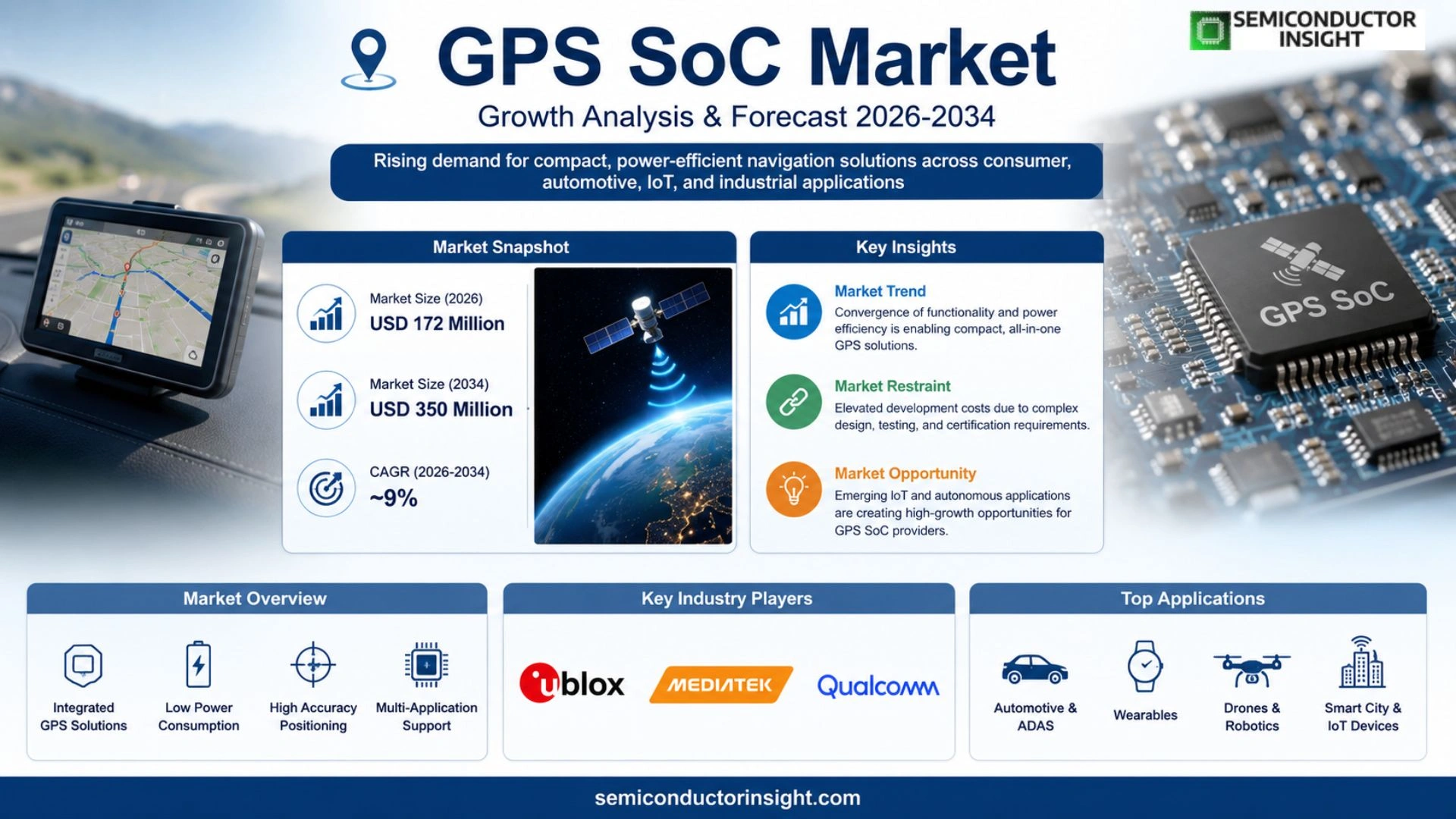
Global GPS SoC market size was valued at USD 158 million in 2025. The market is projected to grow from USD 172 million in 2026 to USD 350 million by 2034, exhibiting a CAGR of approximately 9% during the forecast period.
GPS SoC is a chip that integrates baseband, RF and interface modules on a single die; it typically includes a CPU, memory blocks such as ROM, SRAM and Flash, an RTC, PLL and power‑management circuitry.
These System‑on‑Chip solutions are now embedded across personal and commercial vehicles, PDAs, smartphones, laptops and smart‑watch platforms, reflecting broader adoption of location‑based services and tighter integration requirements.
MARKET DRIVERS
Rising Demand for Integrated Navigation Solutions
Automotive manufacturers and consumer‑electronics firms are consolidating antenna, RF front‑end and processing blocks into single‑chip solutions. This integration reduces bill‑of‑materials and shortens time‑to‑market, prompting OEMs to favor silicon that can deliver centimeter‑level positioning without auxiliary hardware. Consequently, GPS SoC market benefits from a steady influx of design wins across vehicle infotainment, wearables, and supply‑chain tracking devices.
Advancements in Low‑Power Semiconductor Technologies
Process nodes below 28 nm have unlocked sub‑100 mW power envelopes for high‑accuracy positioning cores. These efficiencies enable battery‑operated devices to run continuous location services for weeks, a capability that fuels adoption in remote‑monitoring and agricultural IoT platforms. Companies that leverage advanced FinFET or FD‑SOI processes are gaining a competitive edge, as their chips meet the stringent energy budgets of next‑generation products.
➤ “Integrating GNSS, inertial sensing and AI inference on a single die is no longer a luxury; it is becoming the baseline architecture for edge devices.”
From a business perspective, the convergence of navigation and edge‑AI creates cross‑selling opportunities for silicon vendors. Clients can bundle positioning with sensor‑fusion algorithms, opening recurring revenue streams tied to software licensing and OTA updates, which reshapes the profit model of traditional component sales.
MARKET CHALLENGES
Regulatory Hurdles and Spectrum Constraints
The allocation of L‑band and additional GNSS frequencies is subject to divergent national policies. In regions where spectrum licensing is delayed or fragmented, manufacturers face redesign cycles that erode margins and extend product timelines. This regulatory complexity forces firms to maintain multiple design variants, inflating engineering overhead and complicating supply‑chain planning.
Other Challenges
Supply Chain Volatility
Geopolitical tensions and semiconductor shortages have created lead‑time spikes for critical components such as high‑Q oscillators and precision reference clocks. The inability to secure a reliable inventory of these parts disrupts volume production, especially for high‑volume consumer segments that depend on predictable launch windows.
Furthermore, the talent gap in RF‑aware system architects intensifies the difficulty of delivering differentiated GPS SoC products. Companies that do not invest in specialized training or strategic hires risk falling behind as design cycles compress.
MARKET RESTRAINTS
Elevated Development Costs
Designing a fully integrated GPS SoC entails extensive verification across multiple RF bands, temperature ranges, and power states. The need for advanced simulation tools, multi‑project wafer runs, and extensive certification drives upfront capital expenditures. Smaller players, in particular, find these barriers prohibitive, which concentrates market power among a limited set of incumbents and restricts the influx of innovative entrants.
MARKET OPPORTUNITIES
Emerging Applications in IoT and Autonomous Systems
Edge devices that combine precise positioning with real‑time analytics are proliferating in smart‑city infrastructure, autonomous drones, and robotics. The demand for location‑aware AI at the edge creates a fertile niche where a GPS SoC, co‑designed with machine‑learning accelerators, can command premium pricing. Early movers that secure design wins in these high‑growth verticals are positioned to capture disproportionate market share as deployment scales.
GPS SoC Market Trends
Convergence of Functionality and Power Efficiency
The most visible shift in the GPS SoC arena is the merging of baseband, RF front‑end, memory, power‑management and real‑time clock onto a single silicon die. This consolidation eliminates peripheral interconnects, slashes board‑level bill of materials, and curtails the power envelope that has traditionally limited GPS deployment in battery‑driven wearables. OEMs now regard the integrated GPS SoC as a gateway to embed precise positioning into devices that were previously too cost‑sensitive for a discrete receiver,smart watches, low‑end smartphones, and passenger‑car infotainment modules are prime examples. The trend is driven not merely by component‑level economics but by the strategic imperative to differentiate products with location‑aware services while preserving device slimness.
Other Trends
Channel‑Count Expansion for Precision Demands
Early‑generation GPS SoCs offered 24‑channel architectures sufficient for basic navigation. Market participants are increasingly releasing 48‑channel and 72‑channel parts to meet the accuracy expectations of autonomous‑driving modules and high‑end surveying tools. The higher channel count improves satellite acquisition speed and resilience in urban canyons, directly influencing the value proposition of advanced driver‑assistance systems. Suppliers that can balance the added silicon area with the low‑power targets of electric‑vehicle platforms are gaining traction among tier‑one automotive integrators.
Supply‑Chain Consolidation and Regional Demand Divergence
In the broader semiconductor landscape, analog and sensor segments posted double‑digit growth in 2022 while memory contracted modestly. This macro‑trend filters into GPS SoC market: manufacturers are rationalising wafer capacity to align with the surge in automotive demand from North America, where sales grew over 17 % year‑on‑year, and the steadier consumer‑electronics appetite in Europe. Conversely, the Asia‑Pacific region faced a slight dip, reflecting tighter consumer spending and a pause in discretionary device launches. Companies that diversify their fab partnerships across these regions mitigate exposure to localized downturns and can assure automotive customers of uninterrupted supply for safety‑critical applications.
COMPETITIVE LANDSCAPE
Key Industry Players
GPS System‑on‑Chip Market Competitive Overview
u‑blox dominates the high‑precision segment, leveraging its long‑standing relationships with automotive OEMs and its extensive portfolio that integrates baseband, RF front‑end and power‑management on a single die. The firm’s strategy of bundling advanced augmentation services with its chips has cemented its position as a preferred supplier for premium navigation systems in electric vehicles and advanced driver‑assistance modules. Meanwhile, MediaTek and Qualcomm have pushed the market toward mass‑market smartphones and wearables by embedding GPS SoC capabilities within broader application‑processor platforms, allowing device makers to reduce bill‑of‑materials while preserving location accuracy. The coexistence of dedicated GPS SoC specialists and large‑scale SoC integrators creates a bifurcated competitive structure where price‑sensitive consumer segments gravitate to the latter, and performance‑critical domains remain loyal to the former.
Beyond the top three, a constellation of niche players adds depth to the ecosystem. STMicroelectronics supplies automotive‑grade modules that emphasize ruggedness and long‑term reliability, targeting commercial fleets and heavy‑duty machinery. Unicore Communications focuses on low‑power designs for IoT devices, capitalizing on the surge in asset‑tracking deployments. Navika Electronics and Furuno Electric, both with strong roots in marine navigation, have adapted their offerings for maritime‑grade drones and autonomous surface vessels. Emerging entrants such as Quectel, Skyworks Solutions, and Synaptics are extending their radio‑frequency expertise into integrated GPS solutions, while regional specialists like ABEO (France) and Spirent (UK) provide customized modules for defense and aerospace applications. This diversified roster ensures that end‑users can select a partner aligned with specific regulatory, environmental, or cost constraints.
List of Key GPS SoC Companies Profiled
- u‑blox
- MediaTek
- Qualcomm
- STMicroelectronics
- Unicore Communications
- Navika Electronics
- Furuno Electric
- Quectel
- Skyworks Solutions
- Synaptics
- ABEO
- Spirent
- Rohm Semiconductor
- Renesas Electronics
- Maxim Integrated
Segment Analysis:
| Segment Category | Sub-Segments | Key Insights |
| By Type |
|
High‑Channel Count SoCs are emerging as the preferred choice for performance‑driven applications.
|
| By Application |
|
Automotive GPS SoC drives the most compelling adoption trends.
|
| By End User |
|
Wearable GPS SoC is gaining traction in health‑monitoring and outdoor‑activity markets.
|
| By Integration Level |
|
Multi‑Function SoC is the leading integration tier for emerging smart‑device ecosystems.
|
| By Market Vertical |
|
Asset Tracking represents the most dynamic vertical for GPS SoC adoption.
|
Regional Analysis: GPS SoC Market
North America
Tier‑1 suppliers in the United States are consolidating antenna, baseband, and processor functions onto single SoCs, a move that reduces bill‑of‑materials and simplifies validation cycles for Level‑3 and Level‑4 autonomy initiatives.
Smartphone OEMs leverage North American design houses to embed GPS SoCs with Bluetooth and Wi‑Fi, delivering seamless location services while extending battery life for wearables and AR headsets.
Federal mandates for precise vehicle positioning in smart‑city deployments compel manufacturers to adopt integrated chips that meet accuracy thresholds without external calibration.
A dense network of silicon fabs and test facilities mitigates disruption risk, enabling steady component flow for fleet‑scale rollouts and aftermarket upgrades.
Europe
European automotive clusters, particularly in Germany and France, are translating stringent emissions legislation into demand for compact, energy‑efficient GPS SoCs. Manufacturers value the ability to embed navigation directly within electronic control units, eliminating redundant hardware and complying with EU type‑approval processes. Simultaneously, the region’s strong emphasis on data privacy drives the integration of secure element functionality inside the SoC, reassuring both regulators and consumers. Collaboration between semiconductor firms and consortiums such as AUTOSAR ensures that integrated positioning solutions align with broader software‑defined vehicle architectures, reinforcing Europe’s position as a hub for high‑performance, compliant GPS technologies.
Asia‑Pacific
Asia‑Pacific’s rapid urbanization and burgeoning e‑mobility sector create fertile ground for GPS SoC adoption across multiple verticals. Chinese and Indian manufacturers prioritize cost‑effective integration, pushing design houses to shrink die size while preserving multipath resistance in dense cityscapes. The region’s aggressive rollout of 5G infrastructure complements GPS SoCs that incorporate multi‑constellation support, enabling smoother handoffs between satellite and terrestrial positioning. Moreover, regional standards bodies are harmonizing testing protocols, which reduces time‑to‑market for new chip families targeting smart‑city logistics and agricultural automation platforms.
South America
In South America, emerging logistics networks and expanding ride‑hailing fleets stimulate interest in GPS SoCs that balance precision with robustness against rugged road conditions. Local OEMs gravitate toward chips offering integrated inertial measurement units, a feature that mitigates signal loss in remote interior regions. Partnerships between regional telecom operators and semiconductor vendors foster the development of hybrid positioning solutions, blending GNSS with cellular‑based location services to improve reliability in areas where satellite visibility is intermittent.
Middle East & Africa
The Middle East’s investment in autonomous freight corridors and the African continent’s drive toward smart‑agriculture solutions underscore a growing appetite for GPS SoCs that can endure extreme temperatures and dust exposure. Suppliers focus on hardened packaging and low‑power sleep modes, enabling deployment in solar‑powered field devices. Collaborative research programs between Gulf universities and chip designers accelerate the incorporation of AI‑enhanced error correction within the SoC, a capability that elevates positioning accuracy without inflating system complexity.
Report Scope
This market research report provides a comprehensive analysis of the GPS SoC Market , covering the forecast period 2026–2034. It offers detailed insights into market dynamics, technological advancements, competitive landscape, and key trends shaping the industry.
Key focus areas of the report include:
- Market Overview: The report begins with an overview outlining its current market scenario, key growth indicators, and industry transformation drivers. It discusses macroeconomic factors, demand–supply balance, regulatory landscape, and the strategic role of semiconductors in powering advancements across industries such as automotive, telecommunications, consumer electronics, and industrial automation.
- Market Size & Forecast: Historical data and future projections for revenue, unit shipments, and market value across major regions and segments.
- Segmentation Analysis: Detailed breakdown by product type, technology, application, and end-user industry to identify high-growth segments and investment opportunities.
- Regional Insights: Insights into market performance across North America, Europe, Asia-Pacific, Latin America, and the Middle East & Africa, including country-level analysis where relevant.
- Competitive Landscape: Profiles of leading market participants, including their product offerings, R&D focus, manufacturing capacity, pricing strategies, and recent developments such as mergers, acquisitions, and partnerships.
- Technology Trends & Innovation: Assessment of emerging technologies, integration of AI/IoT, semiconductor design trends, fabrication techniques, and evolving industry standards.
- Market Drivers & Restraints: Evaluation of factors driving market growth along with challenges, supply chain constraints, regulatory issues, and market-entry barriers.
- Stakeholder Insights: Insights for component suppliers, OEMs, system integrators, investors, and policymakers regarding the evolving ecosystem and strategic opportunities.
Primary and secondary research methods are employed, including interviews with industry experts, data from verified sources, and real-time market intelligence to ensure the accuracy and reliability of the insights presented.
FREQUENTLY ASKED QUESTIONS:
What is the current market size of GPS SoC Market?
-> GPS SoC market size is projected to grow from USD 172 million in 2026 to USD 350 million by 2034, exhibiting a CAGR of approximately 9%
Which key companies operate in GPS SoC Market?
-> Key players include u-blox, MediaTek, STMicroelectronics, Qualcomm, Unicore Communications, Navika Electronics, Furuno Electric, among others.
What are the key growth drivers?
-> Key growth drivers include rising adoption of GPS technology in automotive advanced driver‑assistance systems, increasing demand for location‑based services in smartphones and wearables, expansion of IoT ecosystems, and the need for integrated low‑power, multi‑constellation SoCs.
Which region dominates the market?
-> Asia‑Pacific remains the largest market by revenue, driven by strong automotive and consumer electronics demand, while North America shows the highest growth rate.
What are the emerging trends?
-> Emerging trends include integration of multi‑GNSS constellations, AI‑enhanced positioning algorithms, ultra‑low‑power designs for wearables, and increased focus on secure, OTA‑updatable GPS SoCs.
Get Sample Report PDF for Exclusive Insights
Report Sample Includes
- Table of Contents
- List of Tables & Figures
- Charts, Research Methodology, and more...
 Download Sample Report PDF