Key Statistics
Key Takeaways
- Market scale: SiC discrete-device and associated module revenue rises from USD 3,241 million in 2025 to USD 10,624 million in 2034; the forecast reflects broader use of wide-bandgap switches in transport, industrial conversion and electrical infrastructure.
- Dominant product family: Semiconductor triodes, principally MOSFET-class switches, represent an estimated ~60% of 2025 revenue, ahead of diodes at ~27%, other discrete products at ~9% and specialty thyristors at ~4%.
- Application concentration: Automotive accounts for an estimated ~51% of 2025 spending, with energy and power systems contributing ~24%, industrial installations ~16%, information technology and telecom ~6%, and aerospace and defense ~3%.
- Regional leadership: Asia-Pacific captures an estimated ~57% of 2025 sales, compared with ~18% for North America, ~17% for Europe, and ~4% each for South America and Middle East and Africa.
- Voltage positioning: The 600–1700 V class carries an estimated ~68% of 2025 demand; devices below 600 V represent ~19%, while equipment rated above 1700 V contributes ~13%.
- Packaging choices: Discrete packages hold an estimated ~48% of 2025 revenue, power modules ~42% and bare dies ~10%; design-in decisions increasingly depend on thermal performance and qualified assembly options.
- Growth catalysts: Electric traction inverters, photovoltaic conversion, battery storage, factory electrification and solid-state transformer development expand the number of applications that justify SiC cost premiums.
- Execution risks: Wafer defects, device qualification, package reliability, pricing cycles and manufacturing yield remain material constraints even as suppliers expand 200 mm production and introduce higher-voltage platforms.
Global Silicon Carbide (SiC) Discrete Product Market Overview
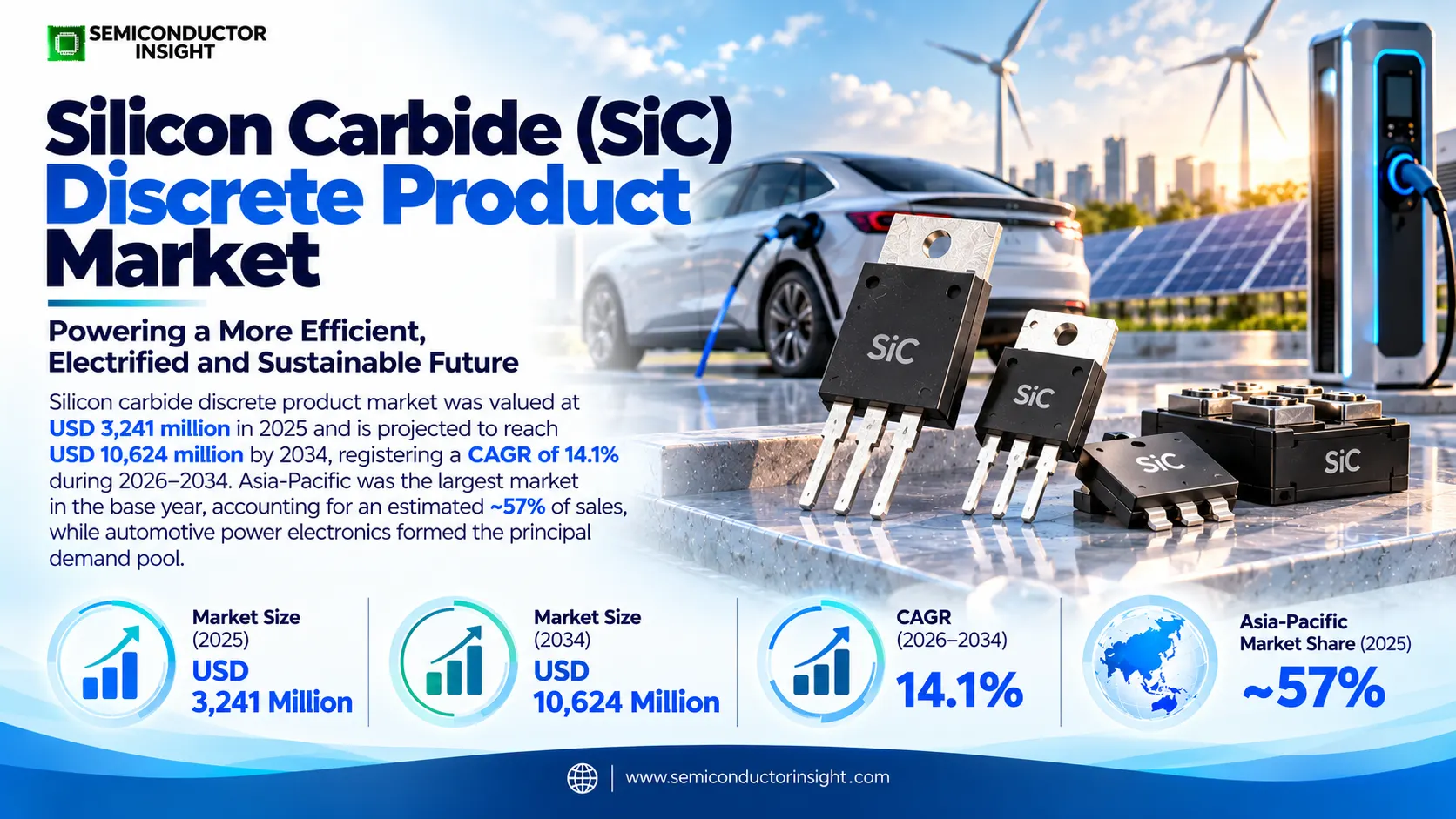
Silicon carbide discrete product market was valued at USD 3,241 million in 2025 and is projected to reach USD 10,624 million by 2034, registering a CAGR of 14.1% during 2026–2034. Asia-Pacific was the largest market in the base year, accounting for an estimated ~57% of sales, while automotive power electronics formed the principal demand pool.
Silicon carbide devices convert electrical energy at switching frequencies, junction temperatures and voltage levels that can be difficult to serve economically with conventional silicon components. The commercial perimeter includes power diodes, transistor-class devices, specialized thyristors, related products, packaged power modules and bare dies because these formats are represented in the market segmentation. It excludes substrate-only wafer transactions, complete traction inverters, photovoltaic plants and finished vehicles. Buyers evaluate total system efficiency rather than the semiconductor purchase price in isolation, especially where cooling, passive components and battery capacity affect equipment economics.
The 2025 baseline reflects a sector moving beyond isolated high-performance niches into repeated design wins. Global electric-car sales exceeded 20 million vehicles in 2025 according to the International Energy Agency, creating a large installed base for traction, onboard charging and DC conversion architectures. Device demand does not scale mechanically with vehicle deliveries: voltage platform, silicon versus silicon-carbide content, packaging choice and the number of inverter stages alter semiconductor value per vehicle. Nonetheless, higher battery voltages and pressure to reduce energy losses support a widening addressable market for qualified switches.
Energy systems provide a separate source of adoption because solar arrays, stationary batteries, high-power chargers and grid interfaces place conversion losses directly into project operating costs. The IEA expects roughly 4,600 GW of renewable power additions between 2025 and 2030, with solar responsible for nearly four-fifths of expansion. These figures describe adjacent electrical infrastructure, not semiconductor sales. Their relevance is the number of inverter, converter and power-conditioning decisions through which a silicon carbide supplier can secure recurring platform revenue across multiple equipment generations.
Product development spans 400 V and 440 V switching devices for selected auxiliary circuits, mainstream 650–1700 V power stages, and specialized 2300 V or 3300 V offerings for high-voltage equipment. Suppliers must balance conduction losses against switching behavior, package inductance, thermal resistance and short-circuit survival. A device with an attractive electrical data sheet can still fail commercial qualification if a customer cannot obtain automotive documentation, predictable supply or field-reliability evidence. The manufacturing transition toward 200 mm wafers offers a cost path, but yield and capital utilization determine whether nominal capacity translates into saleable units.
The modeled base-year mix is led by semiconductor triodes at ~60% and automotive at ~51%; neither estimate implies a measured company-level market share. Medium-voltage devices represent ~68% because mainstream inverter designs cluster around commonly offered 650 V, 750 V, 1200 V and 1700 V classes. Power modules account for ~42% of packaging revenue even though the title refers to discrete products, reflecting the inclusion of module products in the segmentation boundary. Forecast growth depends on both expanding equipment deployment and increased SiC penetration within each design rather than an assumed uniform price increase.
Segment Analysis: By Type
Transistor-class silicon carbide switches lead the type mix at an estimated ~60% of 2025 revenue. Schottky barrier diodes represent ~27%, specialized thyristors ~4% and other discrete products ~9%. Device families serve distinct conduction, blocking and commutation requirements; suppliers compete through channel resistance, reverse-recovery behavior, qualification history and the number of packages available for an electrical rating.
| Type | 2025 mix and 2034 growth characteristics | System-design relevance |
|---|---|---|
| Semiconductor triodes | ~60% of 2025 revenue; modeled ~15.1% annual growth to 2034; primary value from MOSFET-class switches and associated drive requirements. | Traction inverters, industrial variable-frequency drives, fast chargers and bidirectional conversion favor switching efficiency and controlled thermal impedance. |
| Semiconductor diodes | ~27% share in 2025; modeled ~12.3% annual growth; Schottky structures minimize reverse-recovery penalties in suitable circuits. | Power-factor correction, rectification and freewheel positions retain discrete diode demand alongside integrated transistor modules. |
| Thyristors | ~4% of 2025 sales; modeled ~10.8% annual growth; a smaller specialized category with conservative adoption assumptions. | Selected industrial switching and controlled-rectification tasks use devices chosen for rugged operation rather than maximum switching frequency. |
| Other discrete products | ~9% in 2025; modeled ~13.4% annual growth; application-specific devices and mixed discrete functions comprise the residual type category. | Engineers may specify nonstandard die, ruggedized packages and custom electrical characteristics for low-volume designs. |
Semiconductor triodes
MOSFET-class SiC switches are the economic center of this category because their low switching loss can enable smaller magnetics and less demanding thermal systems at 650 V, 750 V, 1200 V and 1700 V. An estimated ~60% base-year share translates into a large exposure to automotive and energy-conversion programs, but design qualification commonly lasts longer than an annual product refresh. Suppliers that offer predictable gate-drive behavior, avalanche ruggedness and consistent die characteristics are better positioned for multi-year platform nominations.
The modeled ~15.1% type growth rate exceeds the ~14.1% total-market path because more equipment designers are adopting active SiC switches in positions previously served by silicon IGBTs. This transition is uneven: smaller industrial installations may remain price sensitive, while premium charging systems can justify efficiency improvements immediately. Device makers therefore offer multiple resistance bins and package options instead of relying on one nominal voltage class. The fastest volume expansion is not necessarily the highest gross-margin portion of the product range.
Semiconductor diodes
SiC Schottky barrier diodes contribute an estimated ~27% of 2025 market revenue, with modeled annual growth of ~12.3% through 2034. Their appeal lies in fast commutation and low reverse-recovery energy in suitable topologies, especially where designers seek higher switching frequencies. ROHM maintains a dedicated SiC Schottky product catalogue, indicating that stand-alone diode demand remains commercially relevant even as module integration increases. Application engineers still assess forward drop, surge-current capability and temperature behavior rather than treating every diode as interchangeable.
Thyristors and other discrete products
The combined smaller families represent an estimated ~13% of 2025 revenue but address engineering requirements that are not fully captured by mainstream MOSFET catalogues. Thyristor applications may prize controlled conduction and endurance under difficult transients, whereas other devices include specialized functions or customized packages. Their modeled growth rates of ~10.8% and ~13.4%, respectively, reflect narrower socket opportunities than vehicle traction. Buyers often emphasize long product lifetimes, documentation and form-fit compatibility because redesigning an industrial converter can cost more than the component itself.
Segment Analysis: By Application
Automotive leads application demand at an estimated ~51% in 2025, reflecting the high value of traction inverters and charging conversion in electrified platforms. Energy and power account for ~24%, industrial equipment ~16%, IT and telecom ~6%, and aerospace and defense ~3%. Application revenue varies with design power, installed device count, qualification class and adoption of modules rather than discrete packages.
| Application | Demand characteristics |
|---|---|
| Automotive | ~51% share in 2025; modeled ~13.7% annual growth. Traction stages, onboard chargers and DC-DC converters create recurring opportunities, although device content varies across 400 V and 800 V vehicle architectures and by inverter supplier. |
| Energy & power | ~24% of 2025 revenue; modeled ~15.2% growth. Photovoltaic inverters, battery storage, charging depots and emerging grid interfaces benefit from efficient high-voltage switching and robust power modules. |
| Industrial | ~16% in 2025; modeled ~12.6% growth. Motor drives, automation cabinets, welding supplies and power conditioning require predictable thermal behavior and service support through long equipment life cycles. |
| Aerospace & defense | ~3% in 2025; modeled ~12.0% growth. Specialized power conversion places a premium on reliability documentation, supply traceability and qualification under demanding environmental conditions. |
| IT & telecom | ~6% share in 2025; modeled ~17.0% growth. Data-center power distribution and telecom rectification increase interest in efficient high-frequency conversion, but architecture and voltage choices determine device content. |
Automotive platforms are not a single product socket. The inverter usually determines the largest SiC content, but battery charging, auxiliary conversion and vehicle-to-grid capability add separate design decisions. An 800 V battery system may require a different transistor blocking rating than a 400 V vehicle, and its higher power density can favor integrated modules. Suppliers seek vehicle-platform nominations because successful qualification can sustain shipments for several model years, although automakers can dual-source components or redesign packages when price pressure intensifies.
Solar, storage and industrial customers often make purchase decisions on lifetime energy loss and cabinet size. A utility inverter running many hours per year can justify a different semiconductor price premium than a lightly utilized machine. Energy and power applications therefore contribute a modeled ~24% of the base-year mix and industrial systems ~16%, but their procurement cycles differ: project developers require bankable equipment warranties, whereas factory integrators demand spare-part continuity and motor-control compatibility. The distinction matters when translating power-capacity announcements into device revenue.
Information technology and telecom form a smaller ~6% revenue category with a modeled ~17.0% growth trajectory, partly because higher-density power shelves can reward switching-frequency improvements. Aerospace and defense remain a ~3% specialized segment, where device traceability, environmental testing and controlled change management limit rapid substitution. Neither application should be scaled directly from server expenditure or military budgets. Actual silicon-carbide revenue depends on the electrical topology selected, the fraction of systems adopting the material and the number of qualified suppliers.
Regional Analysis
Asia-Pacific is the largest regional market at an estimated ~57% of 2025 revenue. North America follows with ~18% and Europe with ~17%, while South America and Middle East and Africa each account for ~4%. These modeled allocations reflect vehicle electrification, power-conversion manufacturing, equipment supply chains and project deployment rather than an assumption that regional device sales equal local equipment installations.
Where are silicon carbide discrete power devices being adopted most intensively?
The geographic balance reflects two different locations: where a device is produced and where the finished electrical system is used. Asian manufacturers and integrators are deeply involved in EV traction and inverter production, while European suppliers maintain automotive, industrial and power-module engineering networks. North American demand benefits from electric transport, power electronics development and domestic semiconductor investment. Smaller regions can show high percentage growth from limited starting bases without approaching the revenue scale of Asia-Pacific. Modeled shares are reported as directional estimates, not country-level supplier shipment measurements.
| Region | Position | Growth outlook | Demand profile | What decides supplier selection |
|---|---|---|---|---|
| Asia-Pacific | Largest (~57%) | ~14.2% CAGR | EV and converter production | Qualified automotive supply, cost curve and local engineering support |
| North America | Second (~18%) | ~13.5% CAGR | Power systems and EV programs | Qualification records, secure sourcing and production continuity |
| Europe | Third (~17%) | ~13.7% CAGR | Industrial conversion and transport | Long-life modules, efficiency standards and automotive certification |
| South America | Emerging (~4%) | ~15.4% CAGR | Renewables and e-mobility | Import channels, maintenance support and project financing |
| Middle East & Africa | Emerging (~4%) | ~16.0% CAGR | Solar and grid modernization | Thermal robustness, EPC qualification and delivery logistics |
Competitive Landscape
The SiC discrete-device field combines vertically integrated power-semiconductor manufacturers, specialized wide-bandgap suppliers and established industrial module businesses. Competition is determined by wafer access, defect control, package qualification, automotive production approvals and the ability to support 650 V through 3300 V designs. The market includes both discrete components and modules, so a supplier strong in one package family need not lead every application.
Infineon, STMicroelectronics, onsemi, ROHM and Wolfspeed have broad exposure to silicon-carbide device technology, but their commercial models differ in manufacturing integration, customer mix and product focus. Toshiba, Mitsubishi Electric, Microchip, Vishay and Fuji Electric address selected device or module requirements, including industrial and high-voltage applications. Supplier comparison must consider the exact electrical and packaging scope: a 1200 V automotive MOSFET cannot be ranked directly against a 3300 V railway module without normalizing the end use. No company revenue share is asserted without a consistent product-level disclosure.
Navitas Semiconductor owns the GeneSiC business acquired in August 2022, so GeneSiC should be treated as a product brand rather than counted as an additional independent corporate competitor. Likewise, Microsemi became part of Microchip following its May 2018 acquisition. These ownership changes affect supplier lists and historical comparisons, especially when older technical literature continues to use former brand names. The present landscape focuses on current entities with publicly documented SiC offerings, avoiding unsupported rankings derived from total semiconductor company sales.
Customers increasingly request evidence of short-circuit robustness, gate-oxide stability, repetitive avalanche behavior and package endurance before approving a replacement component. Those requirements favor suppliers able to provide detailed application engineering and controlled manufacturing changes. Price remains a powerful factor for standard packages, but a low bid can be outweighed by a longer qualification cycle or the risk of production interruption. Over the forecast horizon, the winners may differ by automotive, renewable, industrial and grid application because these customers place different weights on efficiency, supply assurance and service.
Tier structure
| Tier | Companies | Basis of competition |
|---|---|---|
| Integrated global suppliers | Infineon; STMicroelectronics; onsemi; ROHM; Wolfspeed | Broad device portfolios, process investment and extensive automotive or industrial customer qualification. |
| Industrial module specialists | Mitsubishi Electric; Toshiba; Fuji Electric; Microchip | Application engineering and higher-voltage package offerings for transport, factory and power systems. |
| Focused device participants | Navitas Semiconductor; Vishay | Specialized product families, channel reach and design support in selected voltage and packaging classes. |
Key companies profiled
- Infineon Technologies
- Wolfspeed
- ROHM Semiconductor
- STMicroelectronics
- onsemi
- Toshiba Electronic Devices & Storage
- Mitsubishi Electric
- Microchip Technology
- Navitas Semiconductor (GeneSiC)
- Vishay Intertechnology
- Fuji Electric
Production Economics and Technology Roadmap
Manufacturing economics depend on crystal quality, wafer diameter, device structure, metallization and assembly yield. The transition from 150 mm to 200 mm production can increase usable die output per wafer, but only when defect density, process uniformity and utilization are controlled. Device qualification and packaging performance remain essential because a larger substrate does not automatically translate into lower delivered cost per reliable switch.
A silicon-carbide device passes through crystal growth, wafer preparation, epitaxy, front-end processing, electrical testing and package assembly before shipment. Defects introduced early in the process can affect breakdown performance or long-term reliability, creating an economic penalty that is magnified for large-area high-current dies. Suppliers may respond by improving material inspection, redesigning cell structures or shifting production toward larger wafers. These changes require capital and engineering time, and customers may insist on fresh qualification when a manufacturing process or fabrication site changes.
Device structures are evolving in parallel with wafer manufacturing. Trench MOSFET designs seek lower on-resistance and better switching efficiency, while designers continue to evaluate short-circuit endurance and gate-oxide reliability. Integrated Schottky functions can change inverter behavior and reduce component count in certain applications. Higher-voltage products require careful field management and insulation, particularly in modules for rail or grid equipment. The roadmap therefore involves trade-offs rather than a single universal performance improvement that applies to every package and voltage class.
Packaging can be a greater constraint than the intrinsic semiconductor material. High switching speeds magnify the effects of stray inductance, while thermal cycling stresses solder, sintered interfaces and wire or clip connections. Designers choose among through-hole discrete packages, surface-mount variants, power modules and bare dies according to current, heat removal and assembly strategy. The estimated ~48% discrete-package share and ~42% module share in 2025 illustrate a mixed commercial structure, with bare dies accounting for the remaining ~10% and requiring specialist integration capabilities.
Market Dynamics: Drivers, Restraints and Opportunities
Growth is supported by the ability of silicon-carbide devices to reduce switching losses and improve power density, but commercial adoption depends on system-level economics. The impact estimates below distribute the modeled 14.1% annual market growth across demand catalysts and offsetting constraints. They are analytical contribution assumptions, not separately observed causal coefficients or a substitute for product-level shipment data.
MARKET DRIVERS
Drivers Impact Analysis*
| Market Drivers | Impact Rank | CAGR Contribution (%) | 2026–2028 | 2029–2031 | 2032–2034 |
|---|---|---|---|---|---|
| Electric vehicle traction inverters | High | +5.40% | High | High | Medium |
| Solar photovoltaic and storage conversion | High | +4.20% | High | High | High |
| Industrial power efficiency | Medium-High | +3.10% | Medium | High | High |
| Grid and data-center voltage architectures | Medium | +2.40% | Low | Medium | High |
| Others (rail, aviation and telecom) | Low | +1.70% | Low | Medium | Medium |
Electric traction inverters and charging
The largest modeled positive contribution is 5.40 percentage points from vehicle power conversion. Higher battery voltages can favor devices with lower switching losses, allowing engineers to reduce thermal burdens and sometimes shrink passive components. However, content per vehicle differs across 400 V and 800 V architectures and between discrete and integrated module solutions. Suppliers must secure design wins years before production, so the near-term pipeline is influenced by qualification milestones rather than just monthly electric-car deliveries.
Photovoltaics, storage and bidirectional power
Solar and battery systems add a modeled 4.20 percentage points to the growth path because energy efficiency affects project economics over long operating periods. The addressable sockets include DC-DC stages, inverters and grid interfaces, but not the full value of solar modules or storage installations. Equipment designers balance semiconductor efficiency against total bill of materials, thermal engineering and serviceability. Larger renewable projects can support high-power modules, while distributed installations often remain sensitive to the price premium of SiC devices.
Industrial electrification and high-voltage architectures
Factory drives, charging infrastructure, rail traction and evolving power distribution collectively widen the range of viable silicon-carbide applications. Industrial efficiency contributes a modeled 3.10 points, while grid and data-center architectures add 2.40 points; specialized transport and telecom contribute a further 1.70 points. Adoption is strongest where switching losses, weight or cooling capacity are expensive system constraints. It can be slower in established equipment families that require extensive safety testing and support for legacy electrical interfaces.
MARKET RESTRAINTS
Restraints Impact Analysis*
| Market Restraints | Impact Rank | CAGR Contribution (%) | 2026–2028 | 2029–2031 | 2032–2034 |
|---|---|---|---|---|---|
| Wafer defects and manufacturing costs | High | -1.10% | High | Medium | Medium |
| Qualification and field-reliability requirements | Medium-High | -0.80% | High | Medium | Low |
| Price pressure and oversupply cycles | Medium | -0.50% | Medium | High | Medium |
| Others (thermal packaging and trade constraints) | Low | -0.30% | Low | Medium | Medium |
Material yield and device cost
Silicon-carbide wafers require demanding crystal growth and fabrication controls, making defect density and usable die yield major determinants of manufacturing cost. The modeled restraint contribution is −1.10 percentage points, largest among the negative factors. Capacity expansion can reduce some unit costs, but a rapid increase in nominal wafer output does not guarantee consistent high-voltage device performance. Customers may delay adoption if a lower-cost silicon alternative meets their energy and thermal requirements without extensive redesign.
Reliability qualification and cyclical pricing
Automotive and industrial customers require evidence that a device will tolerate electrical transients, thermal cycling and extended service life. This imposes an estimated −0.80 percentage-point drag through long qualification schedules and testing expenses. Market pricing creates an additional −0.50-point restraint when competing suppliers add capacity faster than approved equipment platforms absorb it. Packaging and trade-related constraints account for the residual −0.30-point effect, particularly where sourcing rules or specialist assembly services limit supplier flexibility.
MARKET OPPORTUNITIES
Solid-state transformers and grid interfaces
Emerging solid-state transformer architectures create opportunities for 3.3 kV-class SiC modules and associated Schottky devices. The commercial opportunity is not the full grid modernization budget but the qualified semiconductor content of each converter stage. Suppliers can use pilot deployments to establish reliability records before large orders materialize. Higher voltage reduces current for a given power transfer but raises demands on insulation, switching coordination and package construction, creating scope for differentiated module engineering rather than commodity device substitution.
Application-specific packaging and bare-die integration
Power modules and bare dies collectively account for an estimated ~52% of the 2025 packaging mix, creating a sizeable integration opportunity beyond catalogued discrete packages. Automotive and industrial customers may seek low-inductance layouts, advanced thermal interfaces or co-designed gate drivers that reduce total system cost. Suppliers able to support custom assemblies can defend value even as standardized transistor prices decline. The challenge is managing development resources and maintaining reproducible quality across customer-specific designs with very different production volumes.
Supply Chain and Go-to-Market Structure
The silicon-carbide power-device supply chain runs from crystal and epitaxial materials through fabrication, testing, package assembly and distribution into converter manufacturers. A supplier can own several stages or source wafers and specialist packaging externally. The commercial bottleneck is not always fabrication capacity: a shortage of qualified modules, gate drivers or engineering support can delay a product launch even when raw die are available.
Wafer and fabrication economics. A 200 mm process may create more usable die than a 150 mm process at comparable defect levels, but material uniformity and fab utilization govern the realized advantage. Device suppliers also require stable epitaxy, gate oxide processing and high-voltage test capability. Supply-chain resilience improves when customers have qualified alternate manufacturing routes, yet changing a process can trigger costly validation. The result is a production system where nominal capacity and saleable automotive-grade output must be distinguished.
Packaging and channel relationships. Power-module assembly involves substrates, interconnects, thermal materials and test processes that are not captured by the cost of bare semiconductor die. Customers may buy a discrete switch from distribution or a custom module through a long-term engineering agreement. Application specialists and field engineers help optimize gate resistance, protection circuits and thermal design. These services can increase adoption by reducing the risk of a system-level failure that would otherwise make the efficiency gain commercially unattractive.
Procurement and traceability. Automotive and critical-infrastructure customers often require process-change notifications, component traceability and continuity commitments that last beyond a normal product marketing cycle. Suppliers with multi-site capacity must demonstrate consistent electrical parameters across production lots. Smaller buyers may rely on authorized distributors for inventory and technical assistance. Procurement performance therefore depends on qualification, lifecycle management and delivery reliability in addition to the price of an individual 1200 V or 1700 V device.
Recent Developments and Product Milestones
- 6 October 2026 Industrial and rail
Toshiba Electronic Devices & Storage announced a 3300 V, 800 A dual silicon-carbide MOSFET module intended for demanding industrial and railway power conversion. The rating illustrates the move toward high-voltage, high-current assemblies rather than only lower-voltage discrete packages. For buyers, the relevant consideration is how insulation, thermal cycling and inverter architecture translate the device capability into system reliability. This announcement indicates an available product direction, not a measured increase in total market revenue. Source - 9 June 2026 Device technology
Wolfspeed introduced fifth-generation silicon-carbide MOSFET technology covering 750 V and 1200 V classes and linked the platform to 200 mm manufacturing. The release highlights efforts to combine improved electrical performance with a more scalable production base. Vehicle and industrial customers still need application-specific qualification, so the technology launch should not be equated with immediate shipment growth. Its market significance is an additional competitive option in the voltage range serving many traction and conversion designs. Source - 2 June 2026 Switch architecture
Infineon introduced 750 V CoolSiC G2 bidirectional switches in top-side-cooled Q-DPAK packages, addressing converter designs that benefit from bidirectional power flow and compact thermal arrangements. The package choice is commercially meaningful because a switching device must work within the customer’s heat-removal and circuit-layout constraints. Engineers evaluating the part will consider drive compatibility and protection behavior alongside conduction loss. The development supports application diversification without establishing a company-wide market-share change. Source - 26 May 2026 Grid conversion
Microchip launched 3.3 kV HVD3 mSiC power modules for solid-state transformer applications, combining high-voltage switching capability with a package intended for demanding electrical systems. This expands the engineering toolkit available for grid interfaces that operate beyond common automotive voltage classes. The announcement is relevant to the emerging high-voltage segment, although grid adoption requires additional qualification and system-level validation. No transformer installation total is treated as silicon-carbide module revenue in this assessment. Source - 11 May 2026 High-voltage modules
Infineon expanded its XHP 2 CoolSiC module offering with 2300 V MOSFET technology for 1500 V DC-link applications. Higher blocking capability can support converter designers seeking different insulation and switching trade-offs in energy and industrial systems. The commercial opportunity depends on package qualification, inverter design and service-life economics, not the nominal voltage rating alone. The release demonstrates continued investment in high-voltage modules within a market whose packaging segmentation also includes discrete components and bare dies. Source - 28 April 2026 Automotive partnerships
onsemi and Geely expanded their strategic collaboration involving EliteSiC power semiconductor technology for electric-vehicle systems. Such customer relationships matter because traction components typically pass extended qualification and platform integration processes before high-volume production. The announcement is evidence of automotive design engagement, not a disclosed figure for global SiC device sales. It also shows how supplier competition increasingly occurs through engineering partnerships with automakers and tier-one powertrain integrators rather than through interchangeable catalogue parts alone. Source - 19 March 2026 Rugged packaging
Microchip presented BZPACK mSiC power modules intended for demanding operating environments, emphasizing package performance and moisture resilience. The launch addresses a practical adoption issue: a device with favorable switching characteristics still needs a mechanically reliable package for industrial and renewable equipment. Qualification data and assembly quality influence lifetime operating cost and customer acceptance. The product announcement supports the importance of packaging technology as a separate competitive dimension, without implying that all high-power installations will adopt SiC. Source - 28 January 2026 Module form factor
Vishay introduced 1200 V silicon-carbide MOSFET power modules in SOT-227 packages, adding an option for equipment designers who require a familiar mechanical form factor. Standardized packaging can reduce redesign effort, but thermal resistance, connection inductance and gate-drive behavior still require verification in the final circuit. The significance is wider package availability for industrial power conversion rather than a direct estimate of new device revenue. Suppliers compete by making electrical upgrades compatible with existing equipment constraints. Source
REPORT SCOPE & SEGMENTATION
| Attribute | Details |
|---|---|
| Market name | Global Silicon Carbide (SiC) Discrete Product Market |
| Base year | 2025 |
| 2025 market size | USD 3,241 million |
| 2026 estimated size | USD 3.70 billion |
| 2034 forecast size | USD 10,624 million |
| Forecast CAGR | 14.10% for 2026–2034 |
| Historical reference | 2024 publisher monetary anchor; 2025 rebased baseline |
| Revenue boundary | SiC diodes, transistor-class devices, thyristors, other discrete products, related power modules and bare dies; excludes substrate-only revenue and complete equipment |
| By Type | Semiconductor diodes (~27% in 2025); Semiconductor triodes (~60%); Thyristors (~4%); Other discrete products (~9%) |
| By Application | Automotive (~51% in 2025); Energy & power (~24%); Industrial (~16%); Aerospace & defense (~3%); IT & telecom (~6%) |
| By Voltage Range | Low voltage (below 600V, ~19% in 2025); Medium voltage (600V–1700V, ~68%); High voltage (above 1700V, ~13%) |
| By Packaging Technology | Discrete packages (~48% in 2025); Power modules (~42%); Bare dies (~10%) |
| By Region | Regional figures represent modeled 2025 device and module revenue shares; they are not installations or supplier headquarters allocations. Asia-PacificChina, Japan, South Korea, India, Southeast Asia (~57% modeled share) North AmericaUnited States, Canada, Mexico (~18% modeled share) EuropeGermany, Italy, France, United Kingdom and other European markets (~17% modeled share) South AmericaBrazil, Chile, Argentina and neighboring countries (~4% modeled share) Middle East & AfricaSaudi Arabia, United Arab Emirates, South Africa, Türkiye and other markets (~4% modeled share) |
| Key Companies Profiled | Infineon Technologies; Wolfspeed; ROHM; STMicroelectronics; onsemi; Toshiba Electronic Devices & Storage; Mitsubishi Electric; Microchip Technology; Navitas Semiconductor (GeneSiC); Vishay; Fuji Electric |
| Customization Scope | Detailed country-level volume and revenue, device-level voltage splits, packaging preferences, competitor product benchmarking, application forecasts and automotive qualification pipeline analysis. |
Frequently Asked Questions
How large is the silicon carbide discrete product market in 2025?
The modeled global market measures USD 3,241 million in 2025, covering SiC diodes, MOSFET-class transistor devices, specialty thyristors, associated modules and bare dies. This scope follows the product and packaging categories used in the market definition. It does not include the full selling price of an electric vehicle, inverter or semiconductor substrate sold separately. Revenue is forecast using the headline market anchors and a consistent annual growth trajectory.
What is the expected market size in 2034?
The market is projected to reach USD 10,624 million in 2034 under the base forecast. That outcome assumes continuing penetration of silicon-carbide devices into vehicle traction, renewable conversion and industrial power equipment. The figure is a device-and-module revenue forecast rather than an estimate of installed generation capacity. It also depends on the balance between unit adoption and semiconductor selling-price changes, which can differ across voltage classes and packages.
What CAGR is forecast for 2026–2034?
The expected compound annual growth rate is 14.1% over 2026–2034, based on the rebased market values and eight year-to-year intervals between those endpoints. This trajectory reflects demand growth offset by material cost, qualification and price pressure. Individual product families can grow faster or slower than the headline rate because their voltage, packaging and end-use mixes differ. A printed historical-period CAGR should not be substituted for the current forecast window.
Which region leads demand for SiC discrete devices?
Asia-Pacific leads with an estimated ~57% of base-year revenue, supported by automotive production, photovoltaic inverter manufacturing and extensive electronics integration. North America and Europe follow at modeled ~18% and ~17%, respectively. The allocation reflects where semiconductor value is associated with equipment demand and sourcing rather than simply the country in which a fab operates. Smaller regions can grow rapidly from limited starting bases without displacing Asia-Pacific leadership.
What is the largest SiC product type?
Semiconductor triodes are the largest type at an estimated ~60% of 2025 sales, driven principally by MOSFET-class switches used in traction and other power converters. Diodes account for ~27%, while specialized thyristors and other discrete devices represent smaller categories. A type classification describes device function and should not be confused with the packaging axis. The same transistor technology may be sold as a discrete package, integrated module or bare die.
Which end-use application generates the most revenue?
Automotive is the largest application, contributing an estimated ~51% of 2025 device and module revenue. Traction inverters are particularly important, although onboard charging and DC conversion create additional sockets. Energy and power systems form the next-largest pool at ~24%, followed by industrial equipment. Semiconductor content varies across vehicle platforms and power-system architectures, so these shares should not be inferred directly from equipment unit counts.
Why is the 600–1700 V category important?
Medium-voltage devices hold an estimated ~68% of the 2025 voltage mix because common 650 V, 750 V, 1200 V and 1700 V products address many inverter and charging requirements. Lower-voltage applications account for ~19%, while systems above 1700 V represent ~13%. The optimal rating depends on DC bus voltage, switching transients, insulation design and the number of devices connected in each power stage. A higher rating is not automatically more efficient for every circuit.
Are SiC modules included in this market?
Yes. The defined packaging segmentation explicitly includes power modules, which represent an estimated ~42% of 2025 revenue alongside discrete packages at ~48% and bare dies at ~10%. This prevents the analysis from omitting products that the category itself lists, even though its title uses the word discrete. Complete inverters and vehicles remain outside the boundary. Customers may choose a module when current handling, thermal integration or assembly efficiency outweigh the flexibility of separate packaged switches.
What are the principal barriers to faster adoption?
Material defects, manufacturing yield, device cost and demanding qualification programs remain major barriers. The model assigns a combined negative contribution of 2.7 percentage points to wafer economics, reliability testing, price cycles and packaging or trade constraints. A lower-loss transistor does not automatically deliver a cheaper system once drivers, cooling and requalification are included. Customers also need confidence in long-term supply and component traceability, especially for automotive and infrastructure applications.
How do suppliers compete in this market?
Suppliers differentiate through qualified voltage portfolios, wafer and device yields, package endurance, engineering support and dependable delivery. Infineon, STMicroelectronics, ROHM, onsemi and Wolfspeed have significant technology exposure, while other manufacturers serve industrial and specialist niches. GeneSiC belongs to Navitas Semiconductor and Microsemi to Microchip, so former brands should not be counted as independent current companies. No manufacturer revenue ranking is asserted without consistent disclosure for the defined SiC device-and-module perimeter.
Research Sources & Evidence Base
Get Sample Report PDF for Exclusive Insights
Report Sample Includes
- Table of Contents
- List of Tables & Figures
- Charts, Research Methodology, and more...
 Download Sample Report PDF