Key Statistics
Key Takeaways
- RF front-end chip market was valued at USD 31.71 billion in 2025 and is projected to reach USD 114.19 billion by 2034, representing a 15.3% CAGR over 2026–2034.
- Smartphones remain the largest RF front-end demand pool because each new cellular generation adds bands, carrier combinations and antenna complexity, increasing the value of filters, tuners, power amplifiers and integrated modules.
- Wi-Fi 7 expands RF front-end content through 6 GHz operation, coexistence requirements and higher linearity, creating additional demand for integrated FEMs and acoustic filtering beyond cellular handsets.
- Asia Pacific is the largest regional market because smartphone, networking and electronics manufacturing are concentrated in China, South Korea, Taiwan, Japan and Southeast Asia, while North America remains a major design and supplier base.
- Integration is the structural competitive theme: vendors are combining amplifiers, switches, filters, tuners and software-aware control to reduce board area, power consumption and OEM design complexity.
RF Front-end Chip Market Overview
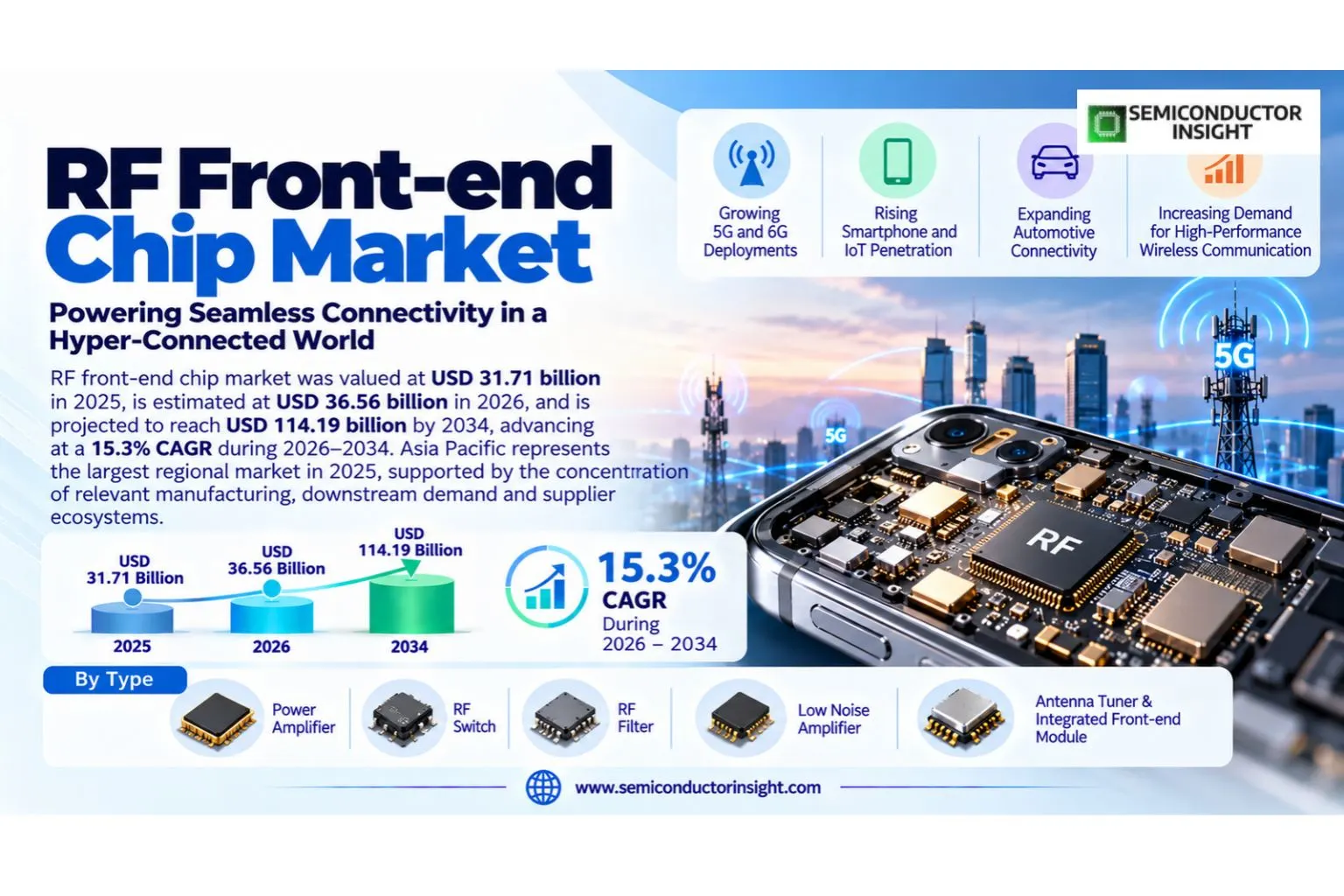
RF front-end chip market was valued at USD 31.71 billion in 2025, is estimated at USD 36.56 billion in 2026, and is projected to reach USD 114.19 billion by 2034, advancing at a 15.3% CAGR during 2026–2034. Asia Pacific represents the largest regional market in 2025, supported by the concentration of relevant manufacturing, downstream demand and supplier ecosystems.
RF front-end chips sit between the antenna and the transceiver or modem, conditioning radio signals through power amplification, low-noise amplification, switching, filtering and impedance tuning. In modern wireless devices the front end is no longer a collection of isolated components; it is increasingly delivered as tightly integrated modules optimized for cellular bands, Wi-Fi, satellite connectivity and coexistence across multiple radios.
Market value rises as wireless systems add frequency bands, carrier aggregation, MIMO, Wi-Fi 7, 5G Advanced and satellite features. Each step increases the number of signal paths and tightens insertion-loss, linearity and power-efficiency requirements. That favors suppliers with complementary expertise in acoustic filters, compound-semiconductor power amplifiers, antenna tuning and system-level modem-to-antenna optimization.
The commercial structure of the rf front-end chip market is shaped by design qualification, production economics and the interaction between component performance and downstream system requirements. Suppliers that can combine consistent manufacturing, application engineering and supply assurance are better positioned to convert technical eligibility into repeat business. Customer decisions increasingly account for lifecycle continuity, geographic resilience and integration cost, which makes proven process control and ecosystem compatibility as important as nominal product capability.
Segment Analysis: By Type
By type, the RF Front-end Chip market is segmented into Power Amplifier, RF Switch, RF Filter, Low Noise Amplifier, Antenna Tuner & Integrated Front-end Module. Power amplifiers and filters capture substantial value because transmitter efficiency and band isolation directly affect battery life, throughput and regulatory performance. Integrated front-end modules combine these functions with switches and LNAs to simplify OEM design and reduce board area. Purchasing decisions vary by performance requirement, qualification burden, integration complexity and lifecycle economics, so suppliers compete on application fit rather than on a single technical specification.
| Type | Role in the market | Demand characteristics |
|---|---|---|
| Power Amplifier | Power Amplifier addresses a distinct part of the product and process mix. Its commercial position depends on technical fit, manufacturing maturity, integration requirements and customer qualification rather than on headline specifications alone. | Demand is strongest where the segment aligns with established customer designs, predictable supply, and measurable system-level performance. Suppliers that can document repeatability, compatibility and lifecycle support are better placed to defend design wins. |
| RF Switch | RF Switch addresses a distinct part of the product and process mix. Its commercial position depends on technical fit, manufacturing maturity, integration requirements and customer qualification rather than on headline specifications alone. | Demand is strongest where the segment aligns with established customer designs, predictable supply, and measurable system-level performance. Suppliers that can document repeatability, compatibility and lifecycle support are better placed to defend design wins. |
| RF Filter | RF Filter addresses a distinct part of the product and process mix. Its commercial position depends on technical fit, manufacturing maturity, integration requirements and customer qualification rather than on headline specifications alone. | Demand is strongest where the segment aligns with established customer designs, predictable supply, and measurable system-level performance. Suppliers that can document repeatability, compatibility and lifecycle support are better placed to defend design wins. |
| Low Noise Amplifier | Low Noise Amplifier addresses a distinct part of the product and process mix. Its commercial position depends on technical fit, manufacturing maturity, integration requirements and customer qualification rather than on headline specifications alone. | Demand is strongest where the segment aligns with established customer designs, predictable supply, and measurable system-level performance. Suppliers that can document repeatability, compatibility and lifecycle support are better placed to defend design wins. |
| Antenna Tuner & Integrated Front-end Module | Antenna Tuner & Integrated Front-end Module addresses a distinct part of the product and process mix. Its commercial position depends on technical fit, manufacturing maturity, integration requirements and customer qualification rather than on headline specifications alone. | Demand is strongest where the segment aligns with established customer designs, predictable supply, and measurable system-level performance. Suppliers that can document repeatability, compatibility and lifecycle support are better placed to defend design wins. |
Segment Analysis: By Integration Level
By integration level, the RF Front-end Chip market is segmented into Discrete RF ICs, Integrated Front-end Modules, Modem-to-Antenna Systems. Discrete ICs remain useful in flexible or cost-sensitive designs, while integrated FEMs and modem-to-antenna systems reduce layout complexity and allow tighter hardware-software optimization. The highest integration levels create stronger vendor lock-in but can deliver better power and RF performance. Purchasing decisions vary by performance requirement, qualification burden, integration complexity and lifecycle economics, so suppliers compete on application fit rather than on a single technical specification.
| Integration Level | Role in the market | Demand characteristics |
|---|---|---|
| Discrete RF ICs | Discrete RF ICs represents a relevant purchasing and deployment pathway within this market. Commercial attractiveness depends on how well it aligns with customer architecture, supply-chain constraints and required performance. | Growth is linked to design-in activity, installed-base transitions and the ability of suppliers to meet qualification, cost and availability requirements over the full product lifecycle. |
| Integrated Front-end Modules | Integrated Front-end Modules represents a relevant purchasing and deployment pathway within this market. Commercial attractiveness depends on how well it aligns with customer architecture, supply-chain constraints and required performance. | Growth is linked to design-in activity, installed-base transitions and the ability of suppliers to meet qualification, cost and availability requirements over the full product lifecycle. |
| Modem-to-Antenna Systems | Modem-to-Antenna Systems represents a relevant purchasing and deployment pathway within this market. Commercial attractiveness depends on how well it aligns with customer architecture, supply-chain constraints and required performance. | Growth is linked to design-in activity, installed-base transitions and the ability of suppliers to meet qualification, cost and availability requirements over the full product lifecycle. |
Segment Analysis: By Application
By application, the RF Front-end Chip market is segmented into Smartphones, Wi-Fi & Broadband CPE, Cellular Infrastructure, Automotive & IoT. Smartphones remain the largest application, but Wi-Fi 7 infrastructure, fixed wireless access, automotive connectivity and industrial IoT broaden the market. Growth outside handsets can improve supplier diversification and reduce dependence on a small number of premium smartphone programs. Purchasing decisions vary by performance requirement, qualification burden, integration complexity and lifecycle economics, so suppliers compete on application fit rather than on a single technical specification.
| Application | Role in the market | Demand characteristics |
|---|---|---|
| Smartphones | Smartphones creates demand when the underlying system requires the market’s core function at production scale. Procurement is normally tied to platform launches, equipment upgrades, capacity expansion or replacement cycles. | Buyers evaluate reliability, qualification time, integration cost and vendor support alongside unit economics. Adoption accelerates when the solution removes a system bottleneck or supports a new performance tier without creating disproportionate redesign risk. |
| Wi-Fi & Broadband CPE | Wi-Fi & Broadband CPE creates demand when the underlying system requires the market’s core function at production scale. Procurement is normally tied to platform launches, equipment upgrades, capacity expansion or replacement cycles. | Buyers evaluate reliability, qualification time, integration cost and vendor support alongside unit economics. Adoption accelerates when the solution removes a system bottleneck or supports a new performance tier without creating disproportionate redesign risk. |
| Cellular Infrastructure | Cellular Infrastructure creates demand when the underlying system requires the market’s core function at production scale. Procurement is normally tied to platform launches, equipment upgrades, capacity expansion or replacement cycles. | Buyers evaluate reliability, qualification time, integration cost and vendor support alongside unit economics. Adoption accelerates when the solution removes a system bottleneck or supports a new performance tier without creating disproportionate redesign risk. |
| Automotive & IoT | Automotive & IoT creates demand when the underlying system requires the market’s core function at production scale. Procurement is normally tied to platform launches, equipment upgrades, capacity expansion or replacement cycles. | Buyers evaluate reliability, qualification time, integration cost and vendor support alongside unit economics. Adoption accelerates when the solution removes a system bottleneck or supports a new performance tier without creating disproportionate redesign risk. |
Segment Analysis: By Frequency Range
By frequency range, the RF Front-end Chip market is segmented into Sub-6 GHz Cellular, 2.4/5/6 GHz Wi-Fi, Millimeter Wave. Sub-6 GHz cellular carries the largest installed volume, Wi-Fi 6E/7 expands demand around 6 GHz, and millimeter-wave requires specialized antenna modules and front-end architectures. Each frequency range uses different filter, amplifier and packaging technologies. Purchasing decisions vary by performance requirement, qualification burden, integration complexity and lifecycle economics, so suppliers compete on application fit rather than on a single technical specification.
| Frequency Range | Role in the market | Demand characteristics |
|---|---|---|
| Sub-6 GHz Cellular | Sub-6 GHz Cellular represents a relevant purchasing and deployment pathway within this market. Commercial attractiveness depends on how well it aligns with customer architecture, supply-chain constraints and required performance. | Growth is linked to design-in activity, installed-base transitions and the ability of suppliers to meet qualification, cost and availability requirements over the full product lifecycle. |
| 2.4/5/6 GHz Wi-Fi | 2.4/5/6 GHz Wi-Fi represents a relevant purchasing and deployment pathway within this market. Commercial attractiveness depends on how well it aligns with customer architecture, supply-chain constraints and required performance. | Growth is linked to design-in activity, installed-base transitions and the ability of suppliers to meet qualification, cost and availability requirements over the full product lifecycle. |
| Millimeter Wave | Millimeter Wave represents a relevant purchasing and deployment pathway within this market. Commercial attractiveness depends on how well it aligns with customer architecture, supply-chain constraints and required performance. | Growth is linked to design-in activity, installed-base transitions and the ability of suppliers to meet qualification, cost and availability requirements over the full product lifecycle. |
Regional Analysis
Asia Pacific leads the rf front-end chip market in 2025, while regional growth patterns differ according to manufacturing concentration, customer investment cycles, regulation, product mix and supply-chain access. The most important regional distinction is not simply market size; it is the mechanism that converts local investment and end-market demand into qualified purchases.
How does regional demand differ across the rf front-end chip market?
Regional demand for rf front-end chip is structurally uneven because manufacturing assets, design centers, downstream customers and qualification ecosystems are not distributed evenly. Asia Pacific typically has the deepest electronics manufacturing base, North America combines technology development with capital investment, Europe emphasizes reliability and industrial requirements, and emerging regions are more dependent on imported systems. These differences influence vendor selection, inventory policy, service expectations and the pace at which new technologies are adopted.
| Region | Market position | Growth outlook | Demand profile | Supplier-selection gate |
|---|---|---|---|---|
| Asia Pacific | Largest | Strong | Device-manufacturing led | OEM design wins and supply scale |
| North America | Technology and supplier hub | Strong | Modem-RF and RF-component led | Platform integration and OEM qualification |
| Europe | Automotive and industrial | Moderate-strong | Connectivity and automotive led | Automotive qualification and lifecycle support |
| South America | Emerging demand | Moderate | Handset and network-upgrade led | Device affordability and operator investment |
| Middle East & Africa | Developing | Strong from smaller base | 5G, FWA and smartphone led | Operator rollout and device mix |
Detailed Regional Blocks
Competitive Landscape
Competition in the rf front-end chip market is determined by technical qualification, manufacturing consistency, customer relationships and the ability to support product lifecycles. Price matters, but it rarely overrides reliability, integration effort or switching cost once a supplier has been designed into a production platform.
The competitive field includes Qualcomm Technologies, Broadcom, Qorvo, Skyworks Solutions, Murata Manufacturing, NXP Semiconductors, alongside other specialized suppliers. Market share can shift when a vendor gains access to a new platform, expands qualified capacity or introduces a technology that materially improves system performance. Because customer validation can be lengthy, incumbent suppliers often benefit from continuity, while challengers need a clear technical or supply-chain advantage to displace an approved source.
Competitive strategy is increasingly multi-dimensional. Leading suppliers invest in process or product development, application engineering and regional support at the same time, while customers seek second-source options where technically feasible. This creates a market in which differentiation is sustained through documented performance, manufacturing yield, quality systems, responsiveness and the ability to support future roadmap transitions without forcing unnecessary redesigns.
| Company | Competitive position | Primary basis of competition |
|---|---|---|
| Qualcomm Technologies | Established global / strategic supplier | Competes through product capability, qualification, account access and supply execution. |
| Broadcom | Established global / strategic supplier | Competes through product capability, qualification, account access and supply execution. |
| Qorvo | Established global / strategic supplier | Competes through product capability, qualification, account access and supply execution. |
| Skyworks Solutions | Specialist / regional competitor | Competes through product capability, qualification, account access and supply execution. |
| Murata Manufacturing | Specialist / regional competitor | Competes through product capability, qualification, account access and supply execution. |
| NXP Semiconductors | Specialist / regional competitor | Competes through product capability, qualification, account access and supply execution. |
| Infineon Technologies | Focused challenger / niche participant | Competes through product capability, qualification, account access and supply execution. |
| TDK | Focused challenger / niche participant | Competes through product capability, qualification, account access and supply execution. |
| Taiyo Yuden | Focused challenger / niche participant | Competes through product capability, qualification, account access and supply execution. |
| MACOM | Focused challenger / niche participant | Competes through product capability, qualification, account access and supply execution. |
Production Capacity Analysis
RF front-end capacity is distributed across multiple semiconductor technologies rather than one manufacturing flow. GaAs and GaN compound-semiconductor fabs supply power amplifiers, silicon and SOI processes support switches and tuners, while BAW, FBAR and SAW filters require specialized piezoelectric manufacturing. This technology diversity makes the supply chain more resilient in some areas but also creates bottlenecks that cannot be solved by simply adding generic wafer capacity.
Asia Pacific concentrates much of device assembly and passive-component manufacturing, while North American suppliers lead several high-value RF architectures and filter technologies. Capacity planning is therefore global: design centers may sit close to OEMs in the United States, while wafers, filters, module assembly and final device production are spread across Taiwan, Japan, China, Southeast Asia and other manufacturing hubs.
Capacity should therefore be evaluated on a qualified-output basis rather than as nominal installed capability. A supplier may possess equipment or production lines that appear suitable but still require customer-specific validation, process tuning, test correlation or upstream material qualification. This distinction becomes especially important during demand spikes, when headline capacity can overstate the volume that is immediately available for a particular application, technology generation or reliability class.
Market Dynamics
The rf front-end chip market is being shaped by rising performance requirements and technology transitions on the demand side, while qualification complexity, supply concentration and cost discipline constrain the pace of adoption. The balance of these forces favors suppliers that can solve a measurable system problem without increasing integration risk.
Demand expansion is not uniform across all product variants or customer groups. New technology creates attractive design opportunities, but buyers typically require a clear economic or performance case before changing a qualified architecture. At the same time, supply-chain localization, capacity investment and tighter quality requirements are changing procurement behavior. As a result, growth is likely to concentrate around applications where performance upgrades, manufacturing scale and lifecycle value reinforce one another.
Market Drivers
Four forces provide the strongest support for demand in the rf front-end chip market: performance-driven technology upgrades, expansion of relevant downstream applications, investment in manufacturing or infrastructure, and the need for more resilient supply. Their importance varies by segment, but each creates a direct reason for customers to qualify or purchase additional solutions.
| Driver | Impact | Commercial mechanism |
|---|---|---|
| 5G Advanced increases band and antenna complexity | High | New cellular releases add carrier combinations, spectrum flexibility and satellite features, increasing demand for efficient amplifiers, tuners, filters and integrated front-end control. |
| Wi-Fi 7 expands 6 GHz front-end requirements | High | Wi-Fi 7 uses wider channels and 6 GHz spectrum, raising coexistence, linearity and power-efficiency requirements in access points, gateways, PCs and smartphones. |
| RF integration reduces device size and engineering effort | Medium-High | Combining amplifiers, switches, filters and LNAs into FEMs reduces PCB footprint and can improve calibrated system performance, which is especially valuable in premium mobile and connected devices. |
| Automotive and IoT broaden demand beyond smartphones | Medium-High | Connected vehicles, industrial IoT and smart-city networks create additional sockets for RF front-end components, improving market diversification. |
5G Advanced increases band and antenna complexity
New cellular releases add carrier combinations, spectrum flexibility and satellite features, increasing demand for efficient amplifiers, tuners, filters and integrated front-end control. The commercial effect is strongest where customers can link the technology change to higher throughput, lower power, improved reliability, reduced lifecycle cost or access to a new end-market requirement.
Wi-Fi 7 expands 6 GHz front-end requirements
Wi-Fi 7 uses wider channels and 6 GHz spectrum, raising coexistence, linearity and power-efficiency requirements in access points, gateways, PCs and smartphones. The commercial effect is strongest where customers can link the technology change to higher throughput, lower power, improved reliability, reduced lifecycle cost or access to a new end-market requirement.
RF integration reduces device size and engineering effort
Combining amplifiers, switches, filters and LNAs into FEMs reduces PCB footprint and can improve calibrated system performance, which is especially valuable in premium mobile and connected devices. The commercial effect is strongest where customers can link the technology change to higher throughput, lower power, improved reliability, reduced lifecycle cost or access to a new end-market requirement.
Automotive and IoT broaden demand beyond smartphones
Connected vehicles, industrial IoT and smart-city networks create additional sockets for RF front-end components, improving market diversification. The commercial effect is strongest where customers can link the technology change to higher throughput, lower power, improved reliability, reduced lifecycle cost or access to a new end-market requirement.
Market Restraints
Growth is moderated by qualification burden, cyclical purchasing, technology substitution and supply-chain risk. These restraints do not eliminate demand, but they can extend sales cycles, limit supplier switching and reduce the speed at which technically superior solutions convert into production revenue.
| Restraint | Impact | Commercial consequence |
|---|---|---|
| RF design complexity creates high qualification barriers | High | Filters, amplifiers and antenna networks interact with the full system, so changes can require extensive RF tuning, certification and field validation. This protects incumbents but slows supplier switching. |
| Premium smartphone concentration creates customer risk | High | A small number of large OEMs account for significant RF content, and platform losses can materially affect supplier revenue. This increases pricing pressure and makes design-win timing important. |
| Advanced acoustic and compound-semiconductor manufacturing is specialized | Medium | BAW/FBAR filters, GaAs PAs and GaN RF devices require process expertise that is not easily replicated, limiting rapid capacity shifts and raising capital intensity. |
| Band fragmentation increases development cost | Medium | Regional spectrum differences force suppliers to support many filter combinations, FEM variants and antenna configurations, increasing inventory and engineering complexity. |
RF design complexity creates high qualification barriers
Filters, amplifiers and antenna networks interact with the full system, so changes can require extensive RF tuning, certification and field validation. This protects incumbents but slows supplier switching. Suppliers can mitigate part of this pressure through stronger qualification support, transparent lifecycle planning, dual-source strategies and better alignment between product roadmaps and customer production schedules.
Premium smartphone concentration creates customer risk
A small number of large OEMs account for significant RF content, and platform losses can materially affect supplier revenue. This increases pricing pressure and makes design-win timing important. Suppliers can mitigate part of this pressure through stronger qualification support, transparent lifecycle planning, dual-source strategies and better alignment between product roadmaps and customer production schedules.
Advanced acoustic and compound-semiconductor manufacturing is specialized
BAW/FBAR filters, GaAs PAs and GaN RF devices require process expertise that is not easily replicated, limiting rapid capacity shifts and raising capital intensity. Suppliers can mitigate part of this pressure through stronger qualification support, transparent lifecycle planning, dual-source strategies and better alignment between product roadmaps and customer production schedules.
Band fragmentation increases development cost
Regional spectrum differences force suppliers to support many filter combinations, FEM variants and antenna configurations, increasing inventory and engineering complexity. Suppliers can mitigate part of this pressure through stronger qualification support, transparent lifecycle planning, dual-source strategies and better alignment between product roadmaps and customer production schedules.
Market Opportunities
The most attractive opportunities in the rf front-end chip market occur where a technology transition creates measurable value and where suppliers can enter before the customer architecture is locked. Early engagement, application-specific engineering and credible supply planning can convert these windows into durable design positions.
5G Advanced and early 6G front ends
Release 19 and future 6G research create new requirements for wider bandwidth, higher-frequency operation, sensing and intelligent RF management. The opportunity is strongest for suppliers that can demonstrate performance with production-relevant data, provide engineering support during qualification and maintain a roadmap that gives customers confidence in long-term availability.
Wi-Fi 7 and Wi-Fi 8
6 GHz operation, higher order modulation and multi-link operation create new filter, PA and FEM design opportunities in gateways, enterprise APs and client devices. The opportunity is strongest for suppliers that can demonstrate performance with production-relevant data, provide engineering support during qualification and maintain a roadmap that gives customers confidence in long-term availability.
Automotive connectivity platforms
Telematics, infotainment, GNSS and vehicle-to-everything functions increase RF content per vehicle and favor suppliers with automotive-grade quality and lifecycle support. The opportunity is strongest for suppliers that can demonstrate performance with production-relevant data, provide engineering support during qualification and maintain a roadmap that gives customers confidence in long-term availability.
Integrated modem-to-antenna architectures
Closer coordination between baseband, transceiver, tuning and front-end hardware can improve power efficiency and coverage, creating value for vendors with broad system portfolios. The opportunity is strongest for suppliers that can demonstrate performance with production-relevant data, provide engineering support during qualification and maintain a roadmap that gives customers confidence in long-term availability.
Supply Chain Analysis
Compound-semiconductor and silicon wafers
GaAs, GaN, SOI, CMOS and related wafer processes create the active RF devices used in amplifiers, switches and tuners. Value capture at this stage depends on quality consistency, technical differentiation and the difficulty of substitution. Bottlenecks can propagate downstream when qualification or material compatibility prevents customers from shifting quickly to an alternative supplier.
Acoustic filters and RF component fabrication
SAW, BAW and FBAR manufacturing provides band selection and coexistence performance across cellular and Wi-Fi frequencies. Value capture at this stage depends on quality consistency, technical differentiation and the difficulty of substitution. Bottlenecks can propagate downstream when qualification or material compatibility prevents customers from shifting quickly to an alternative supplier.
Module integration and test
Multiple RF dies, filters and passive components are assembled into front-end modules and calibrated for power, noise, insertion loss and linearity. Value capture at this stage depends on quality consistency, technical differentiation and the difficulty of substitution. Bottlenecks can propagate downstream when qualification or material compatibility prevents customers from shifting quickly to an alternative supplier.
Device and network integration
Smartphone, router, automotive and infrastructure OEMs integrate the RF front end with antennas, modems, software control and regional spectrum requirements. Value capture at this stage depends on quality consistency, technical differentiation and the difficulty of substitution. Bottlenecks can propagate downstream when qualification or material compatibility prevents customers from shifting quickly to an alternative supplier.
Recent Developments
Recent developments show how technology roadmaps, manufacturing investment and standards are changing the competitive requirements of the rf front-end chip market. The entries below are selected for their direct relevance to product capability, capacity, qualification or downstream adoption rather than for general corporate activity.
Qualcomm announced the X105 5G Modem-RF system as a 3GPP Release 19-ready platform with a 6 nm RF transceiver, integrated NR-NTN support and up to 14.8 Gbps peak download speed. The launch pushes RF front-end optimization deeper into integrated modem-to-antenna architectures and raises power-efficiency expectations for premium devices. Source
Skyworks reported Wi-Fi 7 momentum across enterprise access points and home connectivity platforms and highlighted a new FR3 RF-front-end power amplifier for 6G research. The combination shows how RF suppliers are balancing near-term Wi-Fi growth with next-generation cellular development. Source
Skyworks expanded its Wi-Fi 7 front-end module and BAW-filter portfolio for 2.4 GHz, 5 GHz and 6 GHz bands. The launch reflects rising coexistence and efficiency requirements as Wi-Fi moves deeper into 6 GHz spectrum. Source
Report Scope & Segmentation
| Report attribute | Coverage |
|---|---|
| Market | RF Front-end Chip |
| Base Year | 2025 |
| Estimated Year | 2026 |
| Forecast Period | 2026–2034 |
| 2025 Market Size | USD 31.71 billion |
| 2026 Estimated Size | USD 36.56 billion |
| 2034 Forecast Size | USD 114.19 billion |
| CAGR (2026–2034) | 15.3% |
| Largest Market in 2025 | Asia Pacific |
| By Type | Power Amplifier, RF Switch, RF Filter, Low Noise Amplifier, Antenna Tuner & Integrated Front-end Module |
| By Application | Smartphones, Wi-Fi & Broadband CPE, Cellular Infrastructure, Automotive & IoT |
| By Integration Level | Discrete RF ICs, Integrated Front-end Modules, Modem-to-Antenna Systems |
| By Frequency Range | Sub-6 GHz Cellular, 2.4/5/6 GHz Wi-Fi, Millimeter Wave |
| Companies Profiled | Qualcomm Technologies, Broadcom, Qorvo, Skyworks Solutions, Murata Manufacturing, NXP Semiconductors, Infineon Technologies, TDK, Taiyo Yuden, MACOM |
Frequently Asked Questions
What was the rf front-end chip market size in 2025?
The global rf front-end chip market was valued at USD 31.71 billion in 2025. The 2025 value is the base-year reference used throughout this overview and provides the starting point for comparing the 2026 estimate and the 2034 forecast.
What is the projected rf front-end chip market size in 2034?
The global market is projected to reach USD 114.19 billion by 2034. The forecast reflects the interaction of downstream adoption, technology transitions, production investment and the qualification requirements that shape commercial conversion across the market.
What is the CAGR of the rf front-end chip market from 2026 to 2034?
The rf front-end chip market is expected to expand at a 15.3% CAGR during 2026–2034. Growth will not be uniform across every product or region because customer qualification, capital cycles, supply constraints and application-specific performance requirements differ materially.
Which region is the largest rf front-end chip market?
Asia Pacific is the largest regional market in 2025. Its position is supported by the concentration of relevant manufacturing, customers, technology ecosystems and downstream demand, although the precise commercial mechanism differs by country and application.
How is the rf front-end chip market segmented by type?
By type, the market is segmented into Power Amplifier, RF Switch, RF Filter, Low Noise Amplifier, Antenna Tuner & Integrated Front-end Module. These categories address different performance, cost and integration requirements, so supplier selection depends on application fit, qualification history and lifecycle economics rather than a single specification.
What are the main applications for rf front-end chip?
By application, the market covers Smartphones, Wi-Fi & Broadband CPE, Cellular Infrastructure, Automotive & IoT. Demand in each application is linked to platform launches, capacity expansion, equipment replacement and the degree to which the technology improves system performance or manufacturing economics.
What are the principal growth drivers for the rf front-end chip market?
Key drivers include 5g advanced increases band and antenna complexity and wi-fi 7 expands 6 ghz front-end requirements. These forces increase demand when customers can translate technical improvements into higher performance, lower cost, greater reliability or access to new applications.
What are the main restraints in the rf front-end chip market?
Important restraints include rf design complexity creates high qualification barriers and premium smartphone concentration creates customer risk. The resulting qualification burden, purchasing cyclicality and technology risk can extend sales cycles and limit rapid supplier substitution even when new solutions offer clear technical advantages.
Which companies participate in the rf front-end chip market?
Companies profiled in this market include Qualcomm Technologies, Broadcom, Qorvo, Skyworks Solutions, Murata Manufacturing, NXP Semiconductors, Infineon Technologies, TDK. Competition centers on qualification, product or process performance, manufacturing consistency, customer support and the ability to maintain supply across the required product lifecycle.
What should buyers evaluate when selecting a rf front-end chip supplier?
Buyers should evaluate demonstrated performance, qualification history, manufacturing consistency, lifecycle support, supply resilience and integration cost. A technically strong product can still face adoption barriers if it increases redesign risk, lacks regional support or cannot meet the customer’s production and quality requirements.
Research Sources & Evidence Base
View research sources used for this overview.
- Qualcomm. Qualcomm X105 5G Modem-RF announcement — Release 19, RF transceiver, power and modem-to-antenna integration context.
- Qualcomm. 5G modem-RF systems — Modem, transceiver and RF-front-end integration across wireless applications.
- Broadcom. Wi-Fi 7 front-end modules — Integrated FBAR filtering and PA architecture for 5 GHz and 6 GHz Wi-Fi 7.
- Skyworks Solutions. Second-quarter fiscal 2026 results — Wi-Fi 7, mobile, automotive and 6G RF-front-end business context.
- Qorvo. QPF4257 Wi-Fi 7 front-end module — Integrated PA, switch and LNA example for Wi-Fi 7.

Get Sample Report PDF for Exclusive Insights
Report Sample Includes
- Table of Contents
- List of Tables & Figures
- Charts, Research Methodology, and more...
 Download Sample Report PDF