Market Insights
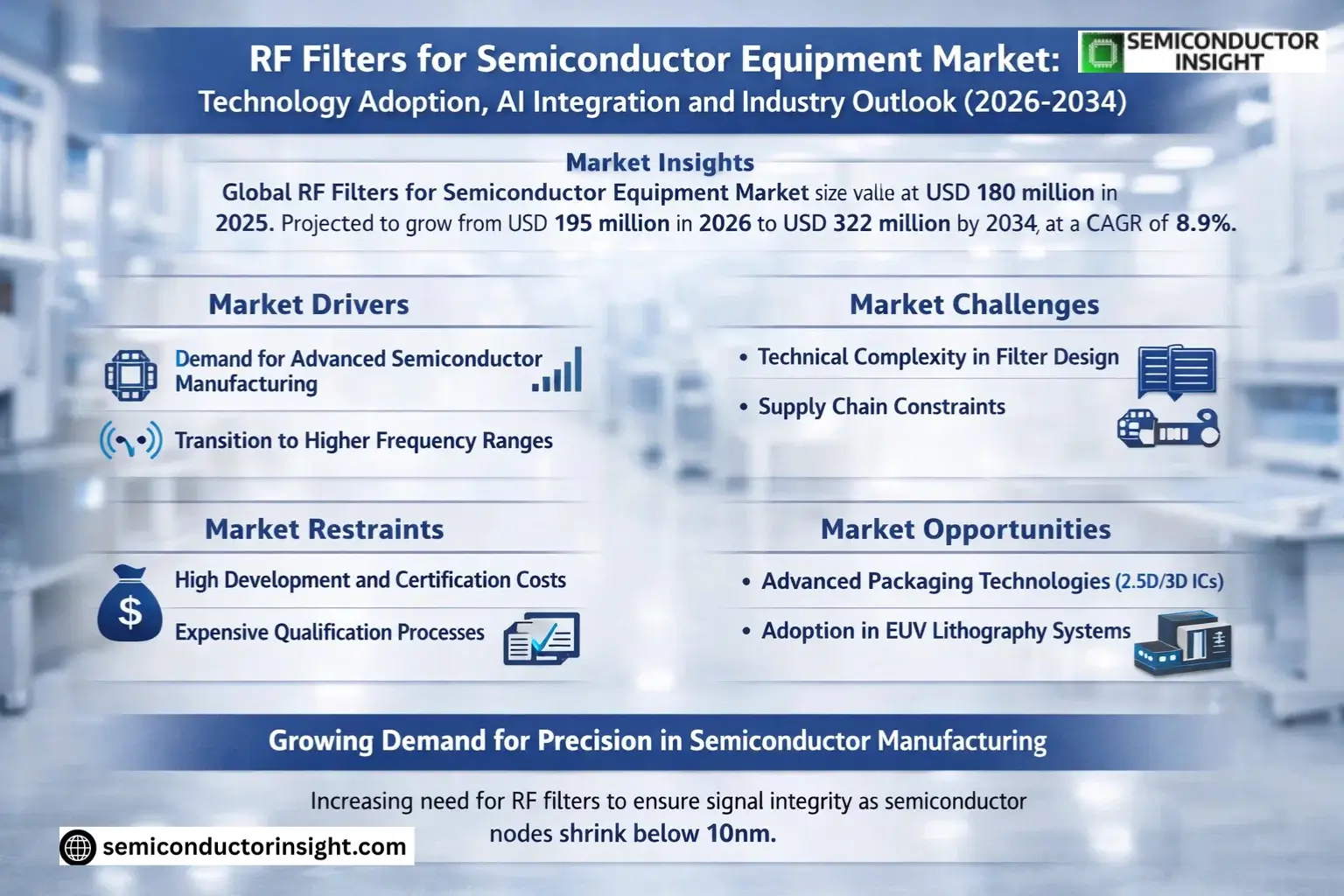
Global RF Filters for Semiconductor Equipment Market size was valued at USD 180 million in 2025. The market is projected to grow from USD 195 million in 2026 to USD 322 million by 2034, exhibiting a CAGR of 8.9% during the forecast period.
RF filters are critical components in semiconductor manufacturing equipment, designed to manage radio frequency signals by eliminating unwanted noise and interference. These filters ensure signal integrity and protect sensitive semiconductor components during fabrication, packaging, and testing processes. Key types include DC filters and AC filters, each serving distinct functions in maintaining operational efficiency.
The market growth is driven by increasing demand for advanced semiconductor devices, particularly in 5G technology and IoT applications. While the U.S. remains a dominant player, China’s rapid expansion in semiconductor production is accelerating regional demand. Leading manufacturers such as Smiths Interconnect and Mini-Circuits are investing in R&D to enhance filter performance, addressing challenges like miniaturization and higher frequency requirements.
MARKET DRIVERS
Growing Demand for Advanced Semiconductor Manufacturing
RF Filters for Semiconductor Equipment Market is experiencing significant growth due to increasing demand for high-performance semiconductors in 5G, IoT, and AI applications. Semiconductor manufacturers require precision RF filters to ensure signal integrity in advanced fabrication processes, driving adoption across foundries and IDMs.
Transition to Higher Frequency Ranges
With the semiconductor industry moving toward millimeter-wave and terahertz frequencies for next-generation chips, RF filters with superior bandpass characteristics are becoming critical components in semiconductor manufacturing equipment. This transition supports market expansion with an estimated 18% annual growth in high-frequency filter applications.
Increasing wafer sizes (200mm to 300mm transition) and smaller process nodes (below 7nm) further necessitate advanced RF filtering solutions to maintain production yields and equipment performance.
MARKET CHALLENGES
Technical Complexity in Filter Design
Developing RF filters that meet the stringent requirements of semiconductor equipment (wide bandwidths, high rejection ratios, minimal insertion loss) while maintaining thermal stability presents significant engineering challenges. Many manufacturers struggle with yield rates below 65% for high-specification filters.
Other Challenges
Supply Chain Constraints for Specialty Materials
The production of high-performance RF filters requires rare earth elements and specialized substrates, with lead times extending beyond 6 months for certain critical materials. This creates bottlenecks in meeting semiconductor equipment OEM demand.
MARKET RESTRAINTS
High Development and Certification Costs
The extensive R&D investment and lengthy qualification processes required for RF filters in semiconductor applications create significant barriers to entry. A single filter design can require over USD 2M in development costs before reaching production, limiting market participation to established players.
MARKET OPPORTUNITIES
Emerging Packaging Technologies
The growth of advanced packaging solutions (2.5D/3D IC, chiplets) creates new demand for RF filters that can operate in multi-chip module environments. Semiconductor equipment manufacturers are seeking filters with improved crosstalk suppression capabilities for these applications.
Adoption in EUV Lithography Systems
Extreme ultraviolet lithography systems require ultra-precise RF filtering for their laser and metrology subsystems. This niche application segment is projected to grow at 22% CAGR through 2028 as EUV adoption expands beyond leading-edge logic fabrication.
RF Filters for Semiconductor Equipment Market Trends
Increasing Demand for Precision in Semiconductor Manufacturing
RF Filters for Semiconductor Equipment Market is experiencing significant growth due to rising demand for high-precision semiconductor manufacturing. These filters play a critical role in maintaining signal integrity by eliminating unwanted RF interference, which is becoming increasingly important as semiconductor nodes shrink below 10nm. Manufacturers are adopting advanced filter technologies to meet the stringent requirements of modern fabrication processes.
Other Trends
Shift Towards 5G-Compatible Semiconductor Equipment
With the global rollout of 5G networks, semiconductor equipment manufacturers are incorporating specialized RF filters capable of handling higher frequencies. This trend is particularly prominent in Asia Pacific regions, where 5G infrastructure development is most aggressive. The demand for filters that can operate effectively in the millimeter-wave spectrum is creating new market opportunities.
Integration of AI in Filter Design
Leading RF filter manufacturers are increasingly using AI-driven design tools to optimize filter performance. These advanced simulation tools allow for rapid prototyping and performance testing, reducing development time while improving filter efficiency. The integration of machine learning algorithms helps in predicting filter behavior under various operating conditions.
Expansion of Automotive Semiconductor Applications
The growing adoption of autonomous vehicles and advanced driver-assistance systems (ADAS) is driving demand for specialized RF filters in automotive semiconductor equipment. These applications require filters with superior noise suppression capabilities to ensure reliable operation of radar and communication systems in vehicles. Major suppliers are developing ruggedized filters that can withstand harsh automotive environments.
Supply Chain Diversification Strategies
Following recent global supply chain disruptions, semiconductor equipment manufacturers are reevaluating their RF filter procurement strategies. Many companies are establishing dual-source agreements with filter suppliers across different regions to mitigate risks. This trend is particularly noticeable among North American and European semiconductor equipment makers.
Emerging Material Innovations
Research into new filter materials, including advanced ceramics and composite substrates, is gaining momentum. These materials offer improved thermal stability and frequency response characteristics, making them suitable for next-generation semiconductor equipment. The development of tunable RF filters using novel materials is expected to be a key area of focus in coming years.
COMPETITIVE LANDSCAPE
Key Industry Players
Global RF Filters Market Dominated by Specialized Technology Providers
RF Filters for Semiconductor Equipment Market is characterized by a mix of established global players and specialized regional manufacturers. Smiths Interconnect and Astrodyne TDI lead the market with comprehensive RF filtering solutions tailored for semiconductor fabrication environments, holding significant market share in 2025. Mini-Circuits has strengthened its position through innovative broadband filter technologies, while RFPT Co has gained traction in Asia-Pacific markets with cost-effective solutions for packaging equipment.
Emerging players like Shenzhen Yanbixin Technology and Jiangsu WEMC Electronic Technology are expanding their presence through localized manufacturing and rapid customization capabilities. Several Japanese and South Korean manufacturers are focusing on high-precision filters for advanced semiconductor nodes, creating specialized niches in the competitive landscape. The market shows increasing consolidation as larger players acquire smaller innovators to enhance their technological portfolios.
List of Key RF Filters for Semiconductor Equipment Companies Profiled
- Smiths Interconnect
- Astrodyne TDI
- RFPT Co
- Mini-Circuits
- Shenzhen Yanbixin Technology
- Jiangsu WEMC Electronic Technology
- Taiyo Yuden
- Murata Manufacturing
- TDK Corporation
- Qorvo
- Broadcom Inc.
- Skyworks Solutions
- Analog Devices
- NXP Semiconductors
- Microwave Filter Company
Segment Analysis:
| Segment Category | Sub-Segments | Key Insights |
| By Type |
|
DC Filters dominate the market due to their critical role in high-frequency semiconductor applications.
|
| By Application |
|
Semiconductor Manufacturing Equipment holds the largest application segment due to stringent quality requirements.
|
| By End User |
|
Foundries represent the most significant end-user segment owing to their production volume.
|
| By Technology |
|
Bulk Acoustic Wave (BAW) Filters are gaining prominence in semiconductor applications.
|
| By Frequency Range |
|
Medium Frequency (1-6 GHz) represents the most critical segment for semiconductor equipment.
|
Regional Analysis: RF Filters for Semiconductor Equipment Market
World’s largest semiconductor foundries in Taiwan demand ultra-pure RF signals, driving adoption of advanced RF filters with enhanced rejection capabilities for nanometer-scale processes where signal noise would compromise yields.
Memory manufacturers require RF filters with exceptional stability for high-frequency testing equipment, particularly as 3D NAND and DRAM technologies push into higher frequency spectrums during wafer probing and final test processes.
China’s emerging semiconductor equipment manufacturers are integrating intelligent RF filters with self-calibration features to compete with imported tools, prioritizing filters that maintain performance across varied operating conditions.
Japan excels in ceramic-based RF filters for semiconductor metrology equipment, where material purity and thermal stability are critical for measurements at extreme semiconductor process nodes.
North America
North America maintains strong RF filter innovation through semiconductor equipment leaders like Applied Materials and Lam Research, developing filters optimized for advanced packaging technologies. The region sees growing demand for AI-optimized RF filters that can dynamically adjust to different process recipes in tools performing heterogeneous integration. U.S. national initiatives in chip manufacturing are driving requirements for secure, domestically-produced RF components in semiconductor tools. Research institutions collaborate with filter manufacturers to develop quantum-resistant filtering technologies for next-gen semiconductor fabrication equipment.
Europe
European semiconductor equipment manufacturers focus on RF filters for specialized applications like automotive and industrial chips. Germany’s equipment suppliers lead in developing ruggedized RF filters for harsh manufacturing environments. The region shows increasing adoption of energy-efficient RF filter designs to comply with strict environmental regulations. Collaborative R&D projects between academic institutions and equipment makers are advancing MEMS-based RF filter technologies for semiconductor manufacturing applications with space and power constraints.
Middle East & Africa
The region is emerging as an adopter of RF filters through new semiconductor initiatives in countries like Israel and Saudi Arabia. Equipment for power electronics and MEMS manufacturing is driving demand for RF filters with high-temperature stability. Local universities collaborate with global semiconductor equipment providers to develop filtering solutions tailored to regional environmental conditions, focusing on dust and humidity resistance in fabrication environments.
South America
Brazil’s growing electronics manufacturing sector is creating localized demand for RF filters in semiconductor test equipment. Regional equipment service providers emphasize cost-effective, field-repairable RF filter solutions suitable for smaller semiconductor packaging operations. Chile and Argentina show increasing interest in RF filters for mining equipment semiconductor components, requiring robust filtering against industrial interference in remote locations.
Report Scope
This market research report provides a comprehensive analysis of the RF Filters for Semiconductor Equipment Market , covering the forecast period 2025–2034. It offers detailed insights into market dynamics, technological advancements, competitive landscape, and key trends shaping the industry.
Key focus areas of the report include:
- Market Overview: The report begins with an overview outlining its current market scenario, key growth indicators, and industry transformation drivers. It discusses macroeconomic factors, demand–supply balance, regulatory landscape, and the strategic role of semiconductors in powering advancements across industries such as automotive, telecommunications, consumer electronics, and industrial automation.
- Market Size & Forecast: Historical data and future projections for revenue, unit shipments, and market value across major regions and segments.
- Segmentation Analysis: Detailed breakdown by product type, technology, application, and end-user industry to identify high-growth segments and investment opportunities.
- Regional Insights: Insights into market performance across North America, Europe, Asia-Pacific, Latin America, and the Middle East & Africa, including country-level analysis where relevant.
- Competitive Landscape: Profiles of leading market participants, including their product offerings, R&D focus, manufacturing capacity, pricing strategies, and recent developments such as mergers, acquisitions, and partnerships.
- Technology Trends & Innovation: Assessment of emerging technologies, integration of AI/IoT, semiconductor design trends, fabrication techniques, and evolving industry standards.
- Market Drivers & Restraints: Evaluation of factors driving market growth along with challenges, supply chain constraints, regulatory issues, and market-entry barriers.
- Stakeholder Insights: Insights for component suppliers, OEMs, system integrators, investors, and policymakers regarding the evolving ecosystem and strategic opportunities.
Primary and secondary research methods are employed, including interviews with industry experts, data from verified sources, and real-time market intelligence to ensure the accuracy and reliability of the insights presented.
FREQUENTLY ASKED QUESTIONS:
What is the current market size of RF Filters for Semiconductor Equipment Market?
-> RF Filters for Semiconductor Equipment Market size was valued at USD 180 million in 2025. The market is projected to grow from USD 195 million in 2026 to USD 322 million by 2034, exhibiting a CAGR of 8.9% during the forecast period.
Which key companies operate in RF Filters for Semiconductor Equipment Market?
-> Key players include Smiths Interconnect, Astrodyne TDI, RFPT Co, Mini-Circuits, Shenzhen Yanbixin Technology, and Jiangsu WEMC Electronic Technology, among others.
What are the key growth drivers?
-> Key growth drivers include rising demand for semiconductor manufacturing equipment, increasing adoption of RF communication systems, and the need to protect sensitive semiconductor components from interference and signal noise.
Which region dominates the market?
-> Asia is a key growth region, with China expected to reach significant market size by 2034, while North America remains a prominent market, particularly the U.S.
What are the emerging trends?
-> Emerging trends include advancements in RF filter technology, increasing integration in semiconductor packaging and testing equipment, and the development of more efficient filtering solutions.
Get Sample Report PDF for Exclusive Insights
Report Sample Includes
- Table of Contents
- List of Tables & Figures
- Charts, Research Methodology, and more...
 Download Sample Report PDF