
Market Insights
Global RF Blocking Filters for Semiconductor Equipment Market size was valued at USD 180 million in 2025. The market is projected to grow from USD 195 million in 2026 to USD 322 million by 2034, exhibiting a CAGR of 8.9% during the forecast period.
RF blocking filters are critical components in semiconductor manufacturing equipment, designed to mitigate electromagnetic interference (EMI) and radio frequency (RF) noise that can disrupt sensitive electronic processes. These filters ensure signal integrity by suppressing unwanted frequencies while allowing desired signals to pass through, enhancing the precision and reliability of semiconductor fabrication tools such as etching systems, deposition equipment, and lithography machines.
The market growth is driven by increasing demand for advanced semiconductor devices, rising complexity in chip designs requiring higher EMI protection, and stringent regulatory standards for electronic emissions. Key players like Smiths Interconnect and Mini-Circuits are investing in compact, high-performance filter solutions to address evolving industry needs. Additionally, the expansion of 5G infrastructure and IoT applications is further accelerating adoption across global markets.
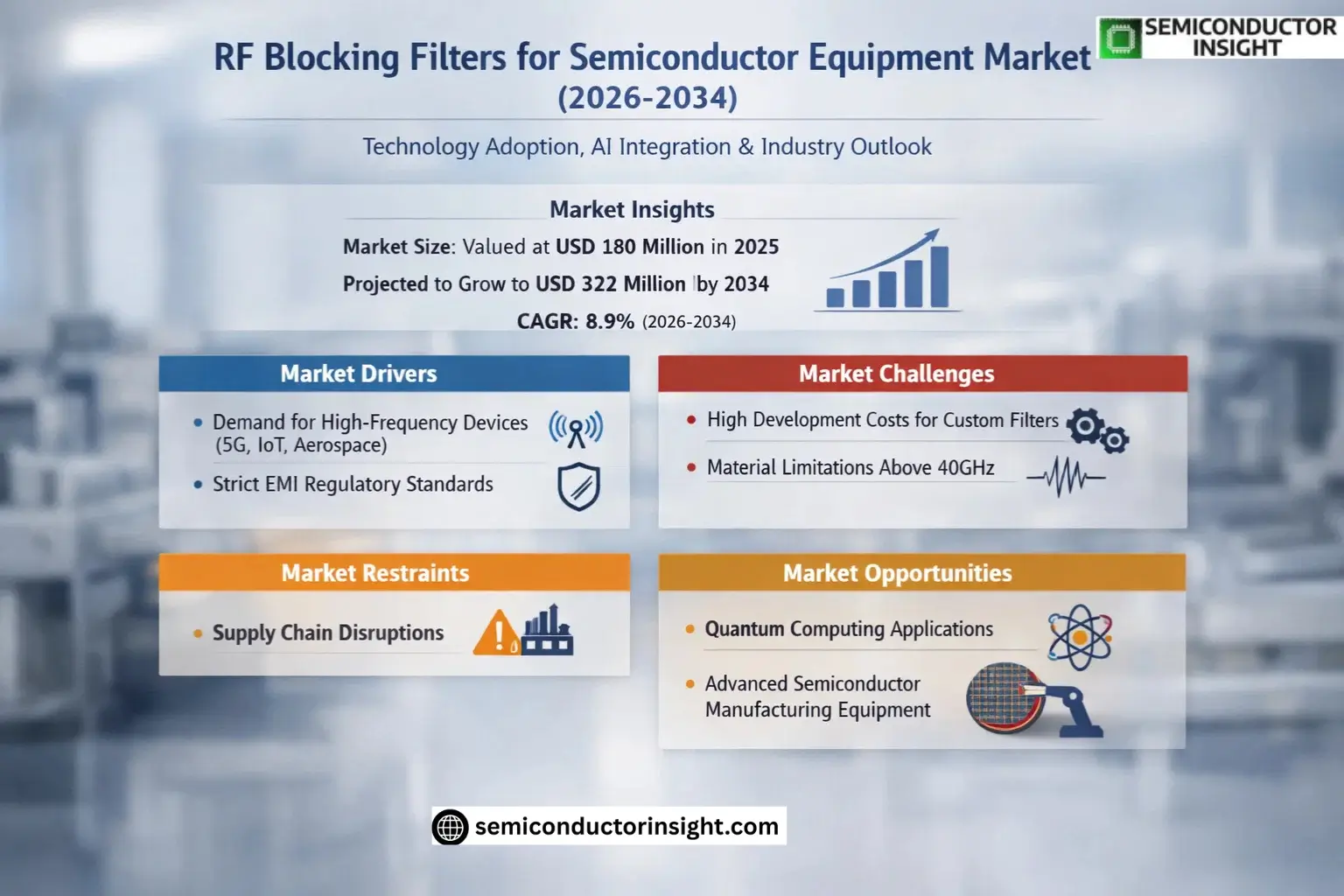
MARKET DRIVERS
Growing Demand for High-Frequency Semiconductor Devices
RF Blocking Filters for Semiconductor Equipment Market is witnessing growth due to increasing demand for high-frequency devices in 5G, IoT, and aerospace applications. Semiconductor manufacturers are investing heavily in advanced RF shielding solutions to minimize signal interference and improve device performance. The market is projected to grow at a CAGR of 7.2% through 2028, driven by these technological advancements.
Strict Regulatory Standards for EMI Compliance
Regulatory bodies worldwide are enforcing stringent electromagnetic interference (EMI) standards, compelling semiconductor equipment manufacturers to adopt RF blocking filters. These filters help companies comply with FCC, CE, and other international regulations while ensuring device reliability. The Asia-Pacific region, in particular, has seen a 12% increase in compliance-driven filter adoption over the past two years.
With rising complexity in semiconductor designs, RF blocking filters are critical for maintaining signal integrity in advanced nodes below 7nm.
MARKET CHALLENGES
High Development Costs for Custom Filters
Designing application-specific RF blocking filters for semiconductor equipment requires significant R&D investment, often accounting for 15-20% of total project costs. Small and medium manufacturers face difficulties in justifying these expenses against competitive pricing pressures in the semiconductor industry.
Other Challenges
Material Limitations at Extreme Frequencies
Current RF blocking filter materials show performance degradation above 40GHz, creating technical hurdles for next-gen semiconductor equipment targeting mmWave applications. Material research accounts for nearly 30% of filter development budgets industry-wide.
MARKET RESTRAINTS
Supply Chain Disruptions Affecting Critical Components
RF Blocking Filters for Semiconductor Equipment Market faces constraints from ongoing supply chain challenges affecting rare earth materials and specialized ceramics. Lead times for key filter components have extended from 8 weeks to 6-8 months in recent years, impacting production schedules across the semiconductor equipment sector.
MARKET OPPORTUNITIES
Emerging Applications in Quantum Computing
Quantum computing development is creating new demand for ultra-high-performance RF blocking filters capable of operating at cryogenic temperatures. The market for quantum-ready filters is expected to reach USD 120 million by 2026, growing at 28% annually from its current niche position.
RF Blocking Filters for Semiconductor Equipment Market Trends
Increasing Demand for Advanced Semiconductor Manufacturing Equipment
RF Blocking Filters for Semiconductor Equipment Market is witnessing substantial growth due to rising demand for high-performance semiconductor equipment. These filters play a critical role in eliminating signal noise and interference during chip manufacturing, ensuring optimal performance of sensitive RF circuits. Manufacturers are innovating to develop filters with higher frequency ranges and improved thermal stability.
Other Trends
Shift Toward Miniaturized Filter Designs
Semiconductor equipment manufacturers are demanding smaller, more efficient RF blocking filters to accommodate space constraints in modern fab equipment. This has led to increased R&D in compact filter designs using advanced materials like low-loss ceramics and thin-film technologies without compromising performance.
Regional Market Developments
Asia Pacific leads in adoption rates, driven by China’s expanding semiconductor production capacity and government initiatives supporting domestic chip manufacturing. North America maintains strong demand from advanced R&D facilities, while European markets show steady growth in specialized RF applications.
Growing Focus on Filter Customization
Equipment manufacturers increasingly require application-specific RF blocking filters tailored to unique frequency responses and power handling capacities. This trend is prompting filter suppliers to expand their product portfolios with customizable solutions across various frequency bands.
Supply Chain and Technological Advancements
Leading manufacturers are integrating AI and machine learning in filter testing processes to enhance quality control. The market is also seeing vertical integration among key players to secure component supply chains, particularly for specialized materials used in high-frequency filters.
COMPETITIVE LANDSCAPE
Key Industry Players
Strategic Positioning in the USD 322M RF Filter Market by 2034
RF Blocking Filters for Semiconductor Equipment Market is moderately consolidated, with the top five players collectively holding significant market share. Smiths Interconnect and Astrodyne TDI currently lead as global manufacturers with comprehensive product portfolios and established distribution networks across key semiconductor manufacturing regions. These leaders specialize in high-performance RF filters that meet stringent industry requirements for signal integrity and electromagnetic interference suppression in semiconductor fab equipment.
Niche players like RFPT Co and Mini-Circuits have carved specialized positions through technological differentiation, particularly in compact filter designs and custom solutions for advanced packaging applications. Emerging Chinese manufacturers such as Shenzhen Yanbixin Technology and Jiangsu WEMC Electronic Technology are gaining traction through competitive pricing and rapid product development cycles, especially in the Asia-Pacific semiconductor equipment market.
List of Key RF Blocking Filters Companies Profiled
- Smiths Interconnect
- Astrodyne TDI
- RFPT Co
- Mini-Circuits
- Shenzhen Yanbixin Technology
- Jiangsu WEMC Electronic Technology
- Murata Manufacturing
- TDK Corporation
- Taiyo Yuden
- Broadcom Inc.
- Qorvo Inc.
- Knowles Precision Devices
- Johanson Technology
- Anatech Electronics
- API Technologies
Segment Analysis:
| Segment Category | Sub-Segments | Key Insights |
| By Type |
|
DC Filters dominate the market due to:
|
| By Application |
|
Semiconductor Manufacturing Equipment shows strongest demand because:
|
| By End User |
|
Foundries represent the largest consumer segment due to:
|
| By Technology |
|
Passive Filters maintain strong market position because:
|
| By Product Form |
|
Module Filters are preferred for:
|
Regional Analysis: RF Blocking Filters for Semiconductor Equipment Market
TSMC’s advanced fabs in Hsinchu drive cutting-edge RF Blocking Filter requirements for 3nm and upcoming 2nm semiconductor production lines, setting regional technology standards.
Domestic semiconductor equipment initiatives create parallel demand for locally-sourced RF Blocking Filters, with Yangtze Memory and SMIC expanding production capacities.
Samsung and SK Hynix’s mega-fabs require specialized RF filtering solutions for DRAM and NAND flash production, particularly in advanced packaging applications.
Japan’s specialty glass and ceramic manufacturers provide high-performance substrates for RF Blocking Filters used in EUV lithography systems across the region.
North America
The North American RF Blocking Filters market benefits from semiconductor equipment innovation clusters in Silicon Valley and Arizona, with Intel’s IDM 2.0 strategy driving demand. Research institutions collaborate with filter manufacturers to develop solutions for quantum computing and photonic chip manufacturing applications. The region shows increasing adoption of AI-optimized RF filters for next-generation semiconductor test equipment.
Europe
Europe’s RF Blocking Filters market centers around ASML’s lithography equipment supply chain and specialized MEMS manufacturers. The EU Chips Act stimulates demand for precision filters in new semiconductor fabs, while automotive-grade RF solutions gain importance for power electronics in electric vehicles. Collaborative R&D projects focus on filters for compound semiconductor production.
Middle East & Africa
Emerging semiconductor initiatives in the Gulf states create new opportunities for RF Blocking Filter suppliers targeting compound semiconductor production facilities. South Africa’s growing electronics manufacturing sector shows increasing demand for medium-performance RF shielding solutions in consumer electronics assembly.
South America
Brazil’s established electronics manufacturing base drives steady demand for RF Blocking Filters in legacy semiconductor packaging operations. Regional trade agreements facilitate technology transfer for filter manufacturing capabilities supporting automotive and industrial electronics production.
Report Scope
This market research report provides a comprehensive analysis of the RF Blocking Filters for Semiconductor Equipment Market, covering the forecast period 2025–2034. It offers detailed insights into market dynamics, technological advancements, competitive landscape, and key trends shaping the industry.
Key focus areas of the report include:
- Market Overview: The report begins with an overview outlining its current market scenario, key growth indicators, and industry transformation drivers. It discusses macroeconomic factors, demand–supply balance, regulatory landscape, and the strategic role of RF filters in protecting sensitive semiconductor components from interference.
- Market Size & Forecast: Historical data and future projections for revenue, unit shipments, and market value across major regions and segments.
- Segmentation Analysis: Detailed breakdown by product type (DC Filter, AC Filter), application (Semiconductor Manufacturing Equipment, Semiconductor Packaging and Testing Equipment), and region.
- Regional Insights: Insights into market performance across North America, Europe, Asia, South America, and Middle East & Africa, including country-level analysis.
- Competitive Landscape: Profiles of leading market participants, including their product offerings, market share, and recent developments.
- Technology Trends & Innovation: Assessment of emerging technologies in RF filtering for semiconductor equipment.
- Market Drivers & Restraints: Evaluation of factors driving market growth along with challenges and potential risks.
- Stakeholder Insights: Strategic insights for manufacturers, suppliers, and investors in the RF blocking filters ecosystem.
The analysis is based on primary and secondary research methods, including interviews with industry experts and verified market data.
FREQUENTLY ASKED QUESTIONS:
What is the current market size of RF Blocking Filters for Semiconductor Equipment Market?
-> RF Blocking Filters for Semiconductor Equipment Market size was valued at USD 180 million in 2025. The market is projected to grow from USD 195 million in 2026 to USD 322 million by 2034, exhibiting a CAGR of 8.9% during the forecast period.
Which key companies operate in RF Blocking Filters for Semiconductor Equipment Market?
-> Key players include Smiths Interconnect, Astrodyne TDI, RFPT Co, Mini-Circuits, Shenzhen Yanbixin Technology, and Jiangsu WEMC Electronic Technology. In 2025, the top five players held a significant market share.
What are the key growth drivers?
-> Key growth drivers include increasing semiconductor equipment demand, need for RF interference protection, and advancements in semiconductor manufacturing technologies.
Which region dominates the market?
-> Asia is a key market, with China showing significant growth potential, while North America remains an important region with the US market size estimated at USD million in 2025.
What are the key product segments?
-> The market is segmented into DC Filters and AC Filters, with DC Filters projected to reach USD million by 2034.

Get Sample Report PDF for Exclusive Insights
Report Sample Includes
- Table of Contents
- List of Tables & Figures
- Charts, Research Methodology, and more...
 Download Sample Report PDF

