➣ Global QSFP Optical Transceiver Market Overview
QSFP optical transceiver is a four-channel small pluggable optical module with four independent full-duplex transceiver channels. It was originally designed to replace single-channel SFPs with high-density optical modules. QSFP is only 30% larger than standard SFP modules. This device supports rates from 100Mbps to 10Gbps, and like SFP, it also has digital diagnostic capabilities to monitor link performance. QSFP was developed for high-density applications. The original system design was limited by the area of the equipment frame panel and the number of optical fibers. Using standard SFP or 10Gbps XFP connectors, the number of channels that can be accommodated was mainly limited by physical space.
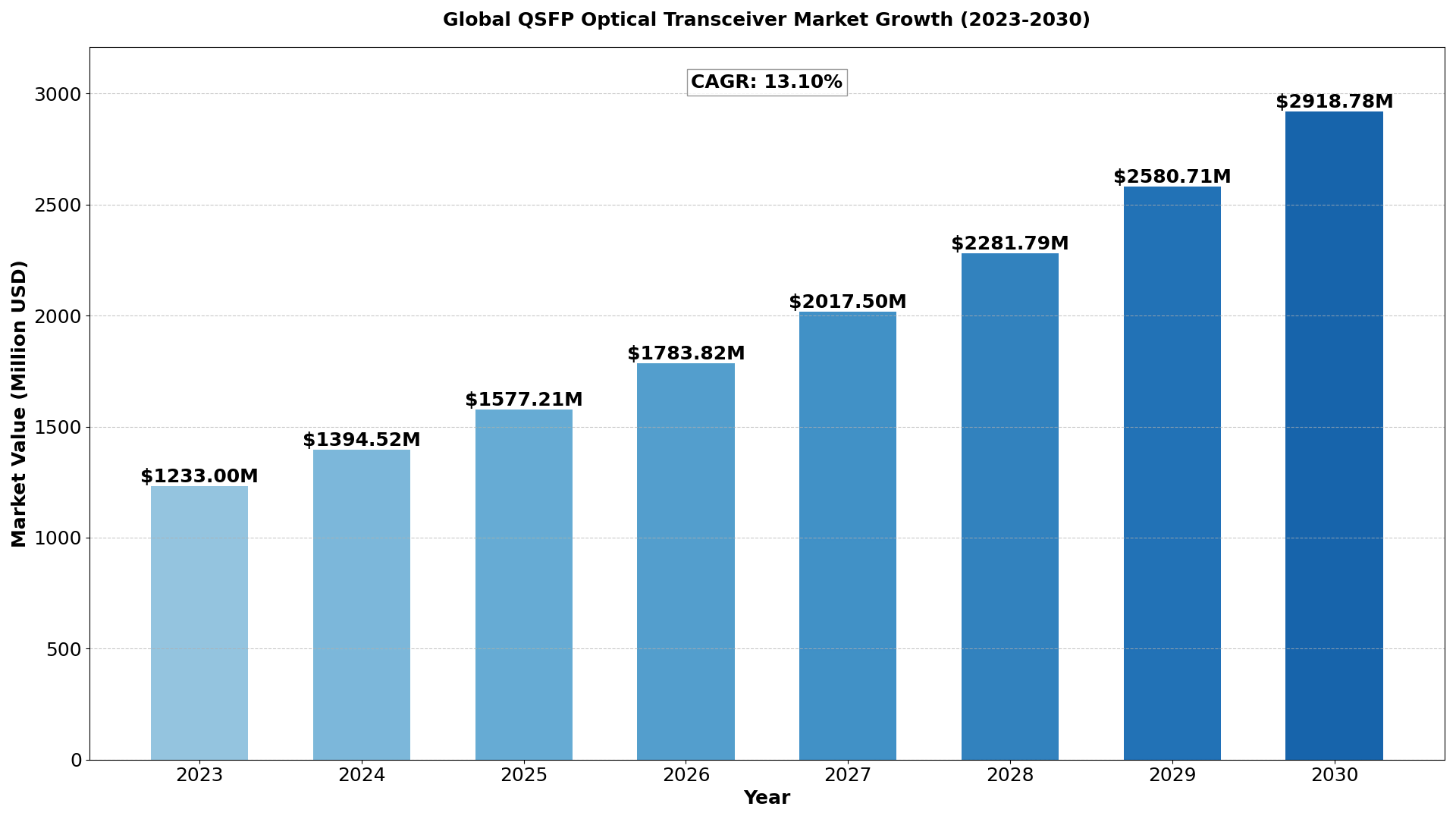
The Global QSFP Optical Transceiver Market size was estimated at USD 1233 million in 2023 and is projected to reach USD 2918.78 million by 2030, exhibiting a CAGR of 13.10% during the forecast period.
North America QSFP Optical Transceiver market size was USD 321.28 million in 2023, at a CAGR of 11.23% during the forecast period of 2024 through 2030.
Click Here to Download Your Free Sample Report
This report provides a deep insight into the global QSFP Optical Transceiver market, covering all its essential aspects. This ranges from a macro overview of the market size to micro details such as the market share, competitive landscape, development trends, niche markets, key market drivers and challenges, SWOT analysis, value chain analysis, and more.
The analysis helps the reader to shape the competition within the industries and strategies for the competitive environment to enhance the potential profit. Furthermore, it provides a simple framework for evaluating and assessing the position of the business organization. The report structure also focuses on the competitive landscape of the Global QSFP Optical Transceiver Market. This report introduces in detail the market share, market performance, product situation, operation situation, etc., of the main players. This helps readers in the industry to identify the main competitors and deeply understand the competition pattern of the market.
In a word, this report is a must-read for industry players, investors, researchers, consultants, business strategists, and all those who have any kind of stake or are planning to foray into the QSFP Optical Transceiver market in any manner.
Global QSFP Optical Transceiver Market: Market Segmentation Analysis
The research report includes specific segments by region (country), manufacturers, Type, and Application. Market segmentation creates subsets of a market based on product type, end-user or application, Geographic, and other factors. By understanding the market segments, the decision-maker can leverage this targeting in the product, sales, and marketing strategies. Market segments can power your product development cycles by informing how you create product offerings for different segments.
Key Company
- II-VI Incorporated
- Perle Systems
- Lumentum
- Sumitomo Electric Industries
- Accelink
- Applied Optoelectronics
- Fujitsu Optical Components
- Innolight
- Mellanox
- NeoPhotonics
- Ciena
- Cisco
- Hisense Broadband
- NEC
Click Here to Download Your Free Sample Report
Market Segmentation (by Type)
- 850 nm Band
- 1310 nm Band
- 1550 nm Band
- Other
Market Segmentation (by Application)
- Telecommunication
- Data Center
- Enterprise
- Other
Geographic Segmentation
- North America (USA, Canada, Mexico)
- Europe (Germany, UK, France, Russia, Italy, Rest of Europe)
- Asia-Pacific (China, Japan, South Korea, India, Southeast Asia, Rest of Asia-Pacific)
- South America (Brazil, Argentina, Columbia, Rest of South America)
- The Middle East and Africa (Saudi Arabia, UAE, Egypt, Nigeria, South Africa, Rest of MEA)
- Industry drivers, restraints, and opportunities covered in the study
- Neutral perspective on the market performance
- Recent industry trends and developments
- Competitive landscape & strategies of key players
- Potential & niche segments and regions exhibiting promising growth covered
- Historical, current, and projected market size, in terms of value
- In-depth analysis of the QSFP Optical Transceiver Market
- Overview of the regional outlook of the QSFP Optical Transceiver Market:
➣ Key Reasons to Buy this Report:
- Access to date statistics compiled by our researchers. These provide you with historical and forecast data, which is analyzed to tell you why your market is set to change
- This enables you to anticipate market changes to remain ahead of your competitors
- You will be able to copy data from the Excel spreadsheet straight into your marketing plans, business presentations, or other strategic documents
- The concise analysis, clear graph, and table format will enable you to pinpoint the information you require quickly
- Provision of market value (USD Billion) data for each segment and sub-segment
- Indicates the region and segment that is expected to witness the fastest growth as well as to dominate the market
- Analysis by geography highlighting the consumption of the product/service in the region as well as indicating the factors that are affecting the market within each region
- Competitive landscape which incorporates the market ranking of the major players, along with new service/product launches, partnerships, business expansions, and acquisitions in the past five years of companies profiled
- Extensive company profiles comprising of company overview, company insights, product benchmarking, and SWOT analysis for the major market players
- The current as well as the future market outlook of the industry concerning recent developments which involve growth opportunities and drivers as well as challenges and restraints of both emerging as well as developed regions
- Includes in-depth analysis of the market from various perspectives through Porters five forces analysis
- Provides insight into the market through Value Chain
- Market dynamics scenario, along with growth opportunities of the market in the years to come
- 6-month post-sales analyst support
Click Here to Download Your Free Sample Report
Customization of the Report
In case of any queries or customization requirements, please connect with our sales team, who will ensure that your requirements are met.
➣ Drivers
- Increased Demand for High-Speed Data Transmission: The growing demand for high-speed internet and cloud computing services is driving the need for faster, more efficient data transmission solutions. QSFP (Quad Small Form-factor Pluggable) optical transceivers, offering high data rates (up to 400G), are increasingly adopted in data centers, telecom networks, and enterprise networks to meet these needs.
- Growth of 5G Networks: The rollout of 5G technology is a significant driver for the QSFP optical transceiver market. 5G networks require ultra-fast, high-bandwidth solutions to handle large data volumes, and QSFP optical transceivers are integral in enabling these requirements in telecom infrastructures.
- Data Center Expansion: With the rapid expansion of data centers, especially in the cloud and edge computing sectors, the demand for reliable and high-speed interconnect solutions has risen. QSFP transceivers offer the perfect balance of cost, performance, and scalability, making them a popular choice for interconnecting switches, routers, and servers within data centers.
- Technological Advancements in Optical Fiber: Advancements in fiber optic technology, such as the development of multi-mode and single-mode fiber, are boosting the performance of QSFP transceivers. With continuous improvements in optical technology, these transceivers can now support faster speeds and longer transmission distances, further accelerating their adoption.
➣ Restraints
- High Initial Cost: While the cost of QSFP optical transceivers has decreased over time, their initial purchase price can still be relatively high, especially for advanced versions like 400G transceivers. This may deter small and medium-sized enterprises from adopting the technology, limiting market growth in certain segments.
- Complexity in Integration: Integrating QSFP optical transceivers into existing network infrastructure can be complex, particularly for organizations with legacy systems. This integration challenge may hinder widespread adoption, particularly in smaller or older data centers that are reluctant to upgrade their infrastructure.
- Power Consumption and Heat Dissipation: Although the latest QSFP transceivers have improved energy efficiency, high-speed optical transceivers, especially those supporting 400G, tend to consume significant amounts of power and generate heat. This could lead to higher operational costs, particularly in large-scale networks that require numerous units.
- Compatibility Issues: The rapid pace of innovation in the optical transceiver market has led to a diversity of standards and protocols. Compatibility issues between different brands, form factors, and fiber types can hinder the seamless integration of QSFP transceivers, slowing their adoption.
➣ Opportunities
- Emerging Markets: The demand for high-speed internet is rising in developing economies due to increasing digital transformation efforts. These regions offer significant growth potential for the QSFP optical transceiver market as they build out their telecom and data center infrastructures.
- Adoption of 400G and Beyond: As data transmission needs continue to grow, the shift toward higher-speed solutions like 400G and even 800G transceivers presents significant opportunities for market players. These ultra-high-speed transceivers are vital for managing large-scale data operations and enabling applications like AI, IoT, and big data analytics.
- Artificial Intelligence (AI) and Edge Computing: The rapid advancement of AI and edge computing is generating vast amounts of data that need to be transmitted at high speeds with minimal latency. QSFP optical transceivers can support the data-intensive workloads of AI and edge applications, opening new avenues for growth.
- Strategic Partnerships and Innovations: Manufacturers in the QSFP optical transceiver space have opportunities to engage in strategic collaborations and partnerships with telecom providers, cloud service providers, and hardware manufacturers to create customized, high-performance solutions. This could drive product innovation and open new market segments.
➣ Challenges
- Evolving Industry Standards: As the industry progresses toward faster and more efficient transceivers (e.g., 800G and 1.6T), staying ahead of evolving standards and specifications can be challenging for manufacturers. Ensuring compatibility with current and future technologies while maintaining cost-effectiveness can be a significant hurdle.
- Supply Chain Constraints: The global semiconductor supply chain has faced disruptions in recent years, impacting the availability of optical components required for QSFP transceivers. These disruptions can result in delays, higher component prices, and supply shortages, affecting manufacturers’ ability to meet growing demand.
- Competition from Alternative Technologies: The QSFP optical transceiver market faces competition from other high-speed interconnect technologies, including direct attach copper (DAC) cables and other pluggable modules. These alternatives can offer cost advantages in certain applications, posing a challenge to the widespread adoption of QSFP optical transceivers.
- Security Concerns: As optical transceivers are integral to high-speed data transmission, ensuring their security in the context of emerging threats, such as cyber-attacks and data breaches, is critical. Manufacturers and operators must invest in ensuring that these transceivers are resilient to potential security vulnerabilities.
Interested in related market reports? Click here to explore more!
➣ About Semiconductor Insight:
Semiconductor Insight was founded in 2016 and focuses on offering thorough research and analysis of the semiconductor industry to help companies make informed decisions in this fast-paced, dynamic field. We have always been dedicated to providing comprehensive semiconductor market research, recognizing the major trends, opportunities, and difficulties influencing the worldwide semiconductor market.
Our clients can stay ahead of the competition thanks to the actionable intelligence provided by our professionally prepared semiconductor market studies, which include competitive analysis, market predictions, in-depth semiconductor industry analysis, and insights into technical breakthroughs. With almost ten years of experience, we continue to lead innovation and provide strategic clarity to semiconductor companies.
Our dedication to provide our clients insights into semiconductor market share and industry trends guarantees that they have the data they require.

Get Sample Report PDF for Exclusive Insights
Report Sample Includes
- Table of Contents
- List of Tables & Figures
- Charts, Research Methodology, and more...
 Download Sample Report PDF