Key Statistics
Key Takeaways
- Common IP Phone remains the larger volume type in 2025 because most enterprise extensions still require dependable voice, programmable keys, PoE and centralized provisioning rather than an integrated video screen; video-capable endpoints are the faster-value segment as meeting, reception and executive workflows converge with unified communications.
- Commerical is the dominant application in the source segmentation because enterprises, public institutions, hospitality sites and distributed branch networks purchase phones as managed fleets, while the Individual segment is smaller and increasingly competes with softphones, headsets and mobile-first calling.
- North America is treated as the largest market in 2025 because the source page’s FAQ explicitly identifies it as the largest region and U.S. FCC data show a very large installed base of interconnected VoIP business connections; Asia Pacific has the strongest structural expansion potential as fixed broadband and cloud communications penetration deepen.
- Cloud calling and SIP interoperability are changing the replacement cycle: Microsoft’s SIP Gateway can connect compatible Cisco, Poly, Yealink and AudioCodes devices to Teams, which extends the useful life of installed endpoints while still encouraging refreshes where security, video, Wi-Fi or new management features are required.
- Softphone substitution is the principal structural restraint. Dedicated hardware retains an benefit at reception desks, common areas, contact points, regulated facilities and always-on business locations, but ordinary knowledge-worker extensions increasingly compete against PCs and mobile devices that already have microphones, cameras and collaboration clients.
IP Phone Market Overview
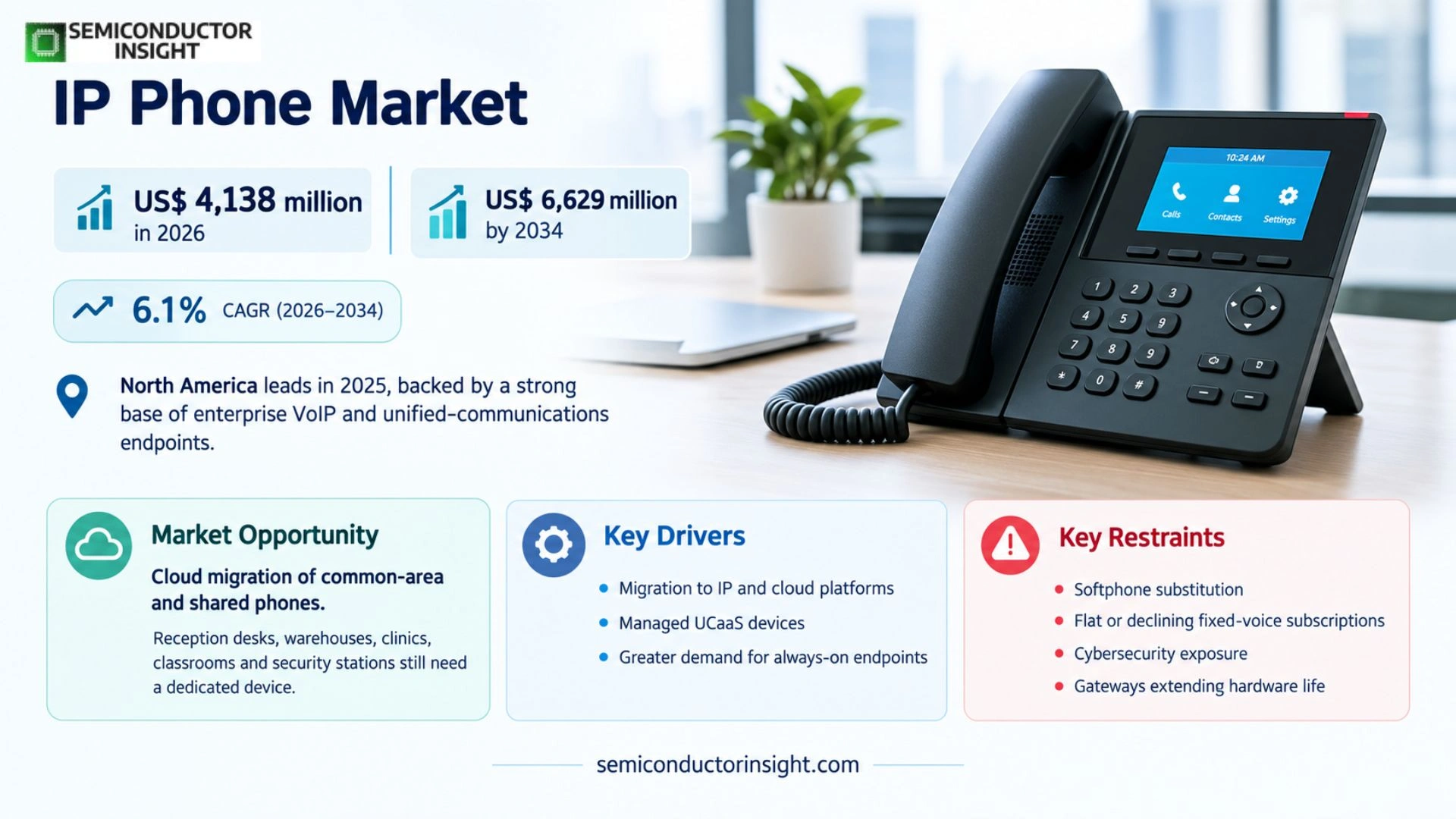
IP Phone market is rebased to US$ 3,901 million in 2025, with an estimated US$ 4,138 million in 2026, and is projected to reach US$ 6,629 million by 2034. The implied compound rate is 6.1% for 2026–2034. North America is the largest market in 2025, supported by a deep installed base of enterprise VoIP and unified-communications endpoints.
An IP phone is a purpose-built endpoint that converts voice and, in some models, video into Internet Protocol traffic for transmission across an enterprise LAN, managed WAN, broadband connection or cloud calling service. The category spans basic SIP desk phones, programmable business handsets, receptionist and common-area devices, executive color-screen phones and video-enabled endpoints. It excludes general-purpose PCs, smartphones and software-only softphones even when those devices use the same calling platform.
The market is being reshaped less by a simple migration from analog telephony and more by the operating model of enterprise communications. Organizations increasingly buy calling as a cloud service, but a cloud migration does not automatically eliminate the desk endpoint. Microsoft documents SIP Gateway support for compatible Cisco, Poly, Yealink and AudioCodes devices, illustrating how cloud platforms can preserve existing hardware while centralizing identity, policy and PSTN connectivity across managed estates.
Demand should therefore be read as a fleet-management and workflow market rather than a pure subscriber-count market. U.S. FCC data reported 63.6 million interconnected VoIP subscriptions in December 2024 and showed that 65% of the 80 million U.S. wireline retail voice connections were business connections. That installed base creates recurring replacement, security, provisioning and interoperability demand even when the number of fixed voice subscriptions itself is no longer rising rapidly. FCC source.
Broadband remains the enabling infrastructure. ITU’s 2025 statistics state that fixed-broadband subscriptions grew at an average 5.2% annually over the preceding five years, while fixed-telephone subscriptions declined by about 3% per year. The commercial implication is important: value is shifting from legacy line ownership toward IP-based communications, but endpoint opportunity varies sharply by region and by workflow because high-income economies had 39 fixed-broadband subscriptions per 100 inhabitants versus 0.6 per 100 in low-income economies. ITU source.
Base year: 2025 · Estimated year: 2026 · Forecast period: 2026–2034 · Historical source anchor: 2024 · Values in US$ million
Segment Analysis: By Type
By type, the source page segments the market into Video IP Phone and Common IP Phone. Common IP Phone represents the broader installed base in 2025 because most business extensions prioritize voice reliability, PoE, programmable keys and centralized provisioning. Video IP Phone is the faster-value segment as collaboration, executive and meeting-room use cases move toward richer displays, cameras and platform-certified experiences.
| Type | Function | Market position |
|---|---|---|
| Video IP Phone | Combines SIP or platform calling with a color display and integrated or attachable camera, supporting voice, video, presence, directory access and richer unified-communications workflows. | Faster-value segment. Adoption is concentrated in executive offices, reception, healthcare, education and collaboration-intensive environments where a dedicated screen improves meeting joining, identity verification or visual interaction. Unit volumes remain below conventional desk phones, but higher hardware value and deeper platform integration support above-average revenue growth. |
| Common IP Phone | Purpose-built voice endpoint using Ethernet or Wi-Fi connectivity, typically with PoE, multiple SIP lines, programmable keys, headset support, speakerphone, secure signaling and centralized provisioning. | Largest volume segment in 2025. The category benefits from the enormous installed base of reception, branch, common-area and fixed-position enterprise extensions. Replacement is driven by platform migration, security support, Ethernet refreshes and end-of-life cycles, although ordinary desk users increasingly substitute softphones and mobile clients. |
Pricing and feature mix
Pricing is increasingly determined by display size, camera capability, Wi-Fi and Bluetooth radios, line and key count, platform certification, security features and lifecycle support rather than by basic SIP calling itself. Common phones occupy the broadest price ladder because suppliers can strip features for hospitality or common-area deployments and add expansion modules for reception. Video phones command a premium, but the premium must be justified by a workflow that cannot be served equally well by a PC client.
Segment Analysis: By Application
By application, the source page lists Commerical and Individual. The Commerical segment is structurally larger because IP phones are purchased and administered as enterprise fleets with directory integration, emergency-calling policies, extension plans and lifecycle management. Individual demand exists in home offices and small businesses, but it faces greater substitution from smartphones, laptops and software clients that already provide cloud calling.
| Application | Demand characteristics |
|---|---|
| Commerical | Purchasing is triggered by office moves, PBX-to-cloud migrations, branch openings, contact-point standardization, reception and common-area requirements, compliance with emergency-calling policies, and replacement of unsupported hardware. Fleet provisioning and interoperability with Microsoft Teams, Webex, BroadWorks, hosted PBX and open SIP platforms matter more than isolated handset specifications. |
| Individual | Demand comes from home offices, professionals who want a persistent business number, very small businesses and users who prefer a physical handset over a headset. This segment is more price-sensitive and less sticky because a laptop or smartphone can often perform the same communications task, so vendors compete on simplicity, bundled service and zero-touch provisioning. |
How cloud calling changes application demand
Cloud platforms expand addressable use cases while simultaneously increasing substitution risk. Microsoft’s SIP Gateway can onboard compatible SIP devices into Teams and manage them through regional provisioning infrastructure, while Cisco’s multiplatform firmware supports Webex Calling, BroadWorks and approved UCaaS platforms. These architectures make the phone a managed cloud endpoint rather than a PBX peripheral, which supports commercial refreshes even as the number of traditional fixed lines declines. Microsoft and Cisco.
Regional Analysis
North America is the largest IP phone market in 2025 because enterprise VoIP is deeply established and a large share of fixed voice connections serve businesses. Asia Pacific is the strongest structural growth region as broadband, cloud calling and enterprise digitalization expand from a lower installed base. Europe is mature and replacement-led, while South America and Middle East & Africa remain more uneven and channel-dependent.
How does regional demand differ across the IP phone market?
Regional demand is not simply proportional to population or broadband connections. The decisive variables are the installed base of business extensions, migration speed from on-premises PBX to cloud calling, the percentage of workers who still require dedicated desk endpoints, availability of certified local channel partners, emergency-calling requirements and the economics of replacing a functioning SIP handset. Those factors produce very different purchasing cycles across mature enterprise markets and newer digitalization markets.
| Region | Position | Growth outlook | Demand profile | What decides supplier selection |
|---|---|---|---|---|
| North America | Largest | Moderate | Replacement and cloud migration led | Teams/Webex interoperability, security support, channel reach, emergency-calling configuration and installed-base migration tools. |
| Europe | Second tier | Moderate | Mature enterprise and public-sector refresh | Multilingual provisioning, GDPR-aligned communications practices, local carrier interoperability, support lifecycle and energy-efficient fleet management. |
| Asia Pacific | Large and expanding | Highest structural growth | New deployments plus cloud migration | Local language support, aggressive price-performance, broad SIP compatibility, distributor availability and support for mixed on-premises/cloud estates. |
| South America | Developing | Above mature-market average | SME and service-provider led | Landed cost, financing, local hosted-PBX partnerships, zero-touch provisioning and resilience on variable broadband infrastructure. |
| Middle East & Africa | Smaller base | Selective high growth | Project, hospitality, government and enterprise led | Local integrator capability, multilingual support, power/network resilience, certification, and reliable remote management. |
Detailed Regional Market Analysis
Key IP Phone Manufacturers and Competitive Landscape
Competition is fragmented across legacy enterprise-communications vendors, cloud-platform ecosystem suppliers, specialist SIP endpoint manufacturers and value-focused regional brands. The strategic contest is no longer only about handset acoustics or line count; it is about whether a vendor can remain compatible across on-premises PBX, hosted SIP, Microsoft Teams, Webex and other UCaaS environments while providing secure firmware, zero-touch provisioning and dependable channel support.
Cisco, Avaya and Mitel enter the market with deep enterprise call-control relationships, installed bases and channel coverage. Their benefit is strongest where customers want endpoints, call control, support and migration planning under a coordinated architecture. However, platform migration also creates an opening for endpoint specialists because enterprises can decouple the handset from the historical PBX vendor and choose a certified SIP device based on price, management features and user experience.
Yealink, Grandstream, Fanvil and Snom compete strongly on breadth of SIP portfolios, rapid feature refreshes and price-performance. Their commercial leverage is especially high in hosted-PBX and service-provider channels, where a distributor or operator may standardize a small number of endpoint families across thousands of SME customers. In these channels, remote provisioning, firmware stability, expansion modules and local stock availability can matter more than the brand preference of the eventual end user.
A second competitive shift is the growing importance of cloud-platform certification and gateway support. Microsoft’s SIP Gateway specifically preserves compatible devices from multiple vendors, while Cisco offers multiplatform firmware for several hosted environments. This weakens proprietary lock-in at the endpoint layer but raises the value of long software support. A phone that remains supported across successive cloud-service updates can deliver a lower total fleet cost than a cheaper device with a shorter firmware life.
| Competitive tier | Companies | Basis of competition |
|---|---|---|
| Enterprise platform incumbents | Cisco; Avaya; Mitel; Alcatel-Lucent; NEC | Installed call-control relationships, global service coverage, enterprise security, migration tooling and support lifecycles. |
| SIP endpoint specialists / challengers | Yealink; Grandstream; Fanvil; Snom; Escene | Price-performance, broad SIP compatibility, rapid product refreshes, cloud provisioning and service-provider channel reach. |
| Networking-adjacent value supplier | D-Link | Channel familiarity and networking bundle opportunities where IP phones are purchased with switches, routers or SME communications equipment. |
| Legacy brand continuity | Polycom | Installed enterprise and conference-room base; brand and product lines have evolved under later ownership but remain part of the source page’s profiled competitive set. |
Companies profiled in the report
- Cisco
- Avaya
- Mitel
- Polycom
- Alcatel-Lucent
- Yealink
- Grandstream
- NEC
- D-Link
- Escene
- Fanvil
- Snom
IP Phone Production Capacity Analysis
IP phone production is an electronics-assembly market rather than a capacity-constrained process industry. Supply is determined by access to displays, application processors, Ethernet and Wi-Fi chipsets, memory, power-management components, microphones, speakers, plastics and contract manufacturing capacity. China and wider Asia account for a large share of electronics assembly, while brand ownership, firmware engineering, certifications and enterprise support are distributed globally.
The most important capacity constraint is not the ability to assemble another handset but the qualification of a stable bill of materials over a multi-year enterprise lifecycle. A large corporate customer may standardize one model for thousands of extensions, so a chipset or display change can trigger re-certification, firmware work and user-interface validation. Vendors with better component planning can maintain the same product family longer and avoid forcing customers into disruptive refreshes.
Video IP phones carry a more exposed bill of materials than common voice handsets because they require larger displays, more capable processors, camera modules and often additional wireless components. This increases both component value and the number of items that can become obsolete. Common phones can be manufactured with more mature components and therefore support longer commercial lifecycles, which is one reason they remain attractive for hospitality, common-area and branch deployments.
Capacity strategy also interacts with channel inventory. Service providers and distributors prefer endpoint families that can be stocked globally with common firmware and regional power or regulatory variants kept to a minimum. A vendor that can serve multiple UCaaS platforms from the same hardware platform reduces working capital for the channel. This makes firmware flexibility and certification breadth an indirect form of manufacturing productivity.
IP Phone Market Dynamics: Drivers, Restraints and Opportunities
The market expands where organizations migrate voice services to IP and cloud platforms while retaining dedicated endpoints for workflows that require an always-on handset. Growth is strongest where phones become managed UCaaS devices rather than isolated PBX peripherals. The main restraints are softphone substitution, flat or declining fixed-voice subscriptions in mature economies, cybersecurity exposure and the ability of gateways to extend the life of existing hardware.
MARKET DRIVERS
Drivers Impact Analysis*
| Market factor | (~) % Impact on CAGR Forecast* | Commercial interpretation |
|---|---|---|
| Cloud PBX and UCaaS migration | +1.8% | Creates new provisioning, certification and fleet-management requirements even when organizations reuse part of the installed endpoint base. |
| Replacement of legacy PBX endpoints | +1.2% | Unsupported firmware, platform migration and network modernization trigger hardware refreshes at fixed workflow positions. |
| Expansion of business broadband and IP networks | +0.9% | Broadband growth widens the technical base for hosted voice, especially in developing enterprise markets. |
| Video and richer collaboration endpoints | +0.6% | Raises average selling value for executive, reception, healthcare, education and meeting-intensive use cases. |
Cloud calling turns the endpoint into a managed service device
Microsoft’s SIP Gateway and Cisco’s multiplatform firmware show how cloud calling changes endpoint economics. The phone is provisioned, authenticated, monitored and updated as part of a cloud estate, which makes lifecycle support and remote administration measurable purchasing criteria. This drives refreshes where old devices cannot meet security or platform requirements, while also allowing compatible models to remain useful longer. Microsoft source.
The installed business VoIP base creates recurring replacement demand
FCC data show 63.6 million U.S. interconnected VoIP subscriptions in December 2024 and 52 million business wireline connections. Even with interconnected VoIP subscriptions declining at a 2.1% compound annual rate over 2021–2024, the installed base is large enough to sustain a multi-year replacement market. The relevant purchase mechanism is aging hardware, not net-new subscription growth. FCC source.
Broadband growth supports migration away from switched voice
ITU reported average fixed-broadband subscription growth of 5.2% annually over five years while fixed-telephone subscriptions declined by about 3% per year. That divergence supports an all-IP communications architecture in which voice travels over the same data network as other applications. For IP phone suppliers, the opportunity is strongest where business workflows still justify a fixed endpoint after the network transition. ITU source.
Premium collaboration endpoints increase revenue per seat
Video calling, touch displays, Bluetooth, Wi-Fi, USB headset support, directory integration and one-touch meeting joining raise the value of selected endpoints. Enterprises do not need these capabilities at every desk, but they are willing to pay more at executive positions, reception, patient or guest communication points and shared collaboration spaces. As a result, revenue can grow faster than unit demand when the product mix shifts upward.
MARKET RESTRAINTS
Restraints Impact Analysis*
| Market factor | (~) % Impact on CAGR Forecast* | Commercial interpretation |
|---|---|---|
| Softphone and mobile substitution | -1.5% | Eliminates dedicated hardware at ordinary knowledge-worker desks where a PC or smartphone already handles calling. |
| Long hardware replacement cycles | -0.8% | SIP phones can remain functional for many years, and gateways can extend useful life during cloud migration. |
| Security and compliance burden | -0.5% | Firmware vulnerabilities, certificate management, emergency-calling rules and network policy increase support cost. |
| Mature fixed-voice subscriber base | -0.4% | In developed markets the installed base is large but not expanding quickly, making growth dependent on refresh and premium mix. |
Softphones absorb ordinary desk extensions
The most direct substitute for an IP phone is not another handset but the communications client already running on a laptop or smartphone. Hybrid work strengthened this substitution because employees expect the same identity, contacts and calling features away from the office. Dedicated hardware therefore has to defend a workflow benefit such as always-on availability, shared use, reception control, tactile keys, speakerphone performance or continuity during PC maintenance.
SIP Gateway can defer replacement
Microsoft explicitly positions SIP Gateway as a way to preserve investment in compatible SIP devices while connecting them to Teams. That is strategically positive for cloud calling but a restraint on immediate hardware sales because an organization can migrate the service first and replace handsets later. Vendors need a refresh argument based on security, richer features, wireless connectivity or lifecycle support rather than platform migration alone. Microsoft source.
Flat VoIP subscriptions limit mature-market unit growth
FCC’s December 2024 report shows interconnected VoIP subscriptions at about 63.6 million, down from 67.7 million in December 2021, a 2.1% CAGR decline. The data do not mean IP phones are disappearing, but they demonstrate that mature-market growth cannot be justified by subscriber expansion alone. Replacement frequency and endpoint value must carry more of the revenue forecast. FCC source.
Cybersecurity raises lifecycle costs
An IP phone is a networked computing device with firmware, certificates, management interfaces and access to enterprise identity and calling systems. A low-priced model with weak patch support can become expensive if the customer has to isolate or replace it before the rest of the fleet. Security therefore benefits reputable vendors with long support commitments but restrains adoption in small organizations that lack device-management resources.
MARKET OPPORTUNITIES
Cloud migration of common-area and shared phones
Common areas, reception desks, warehouses, clinics, classrooms and security stations still need a persistent device even when personal calling moves to software. Cloud platforms increasingly support these shared-device scenarios with centralized policies and provisioning. Suppliers that package durable hardware, remote onboarding and clear administration can capture refresh demand that is less vulnerable to personal softphone substitution.
Video endpoints for high-value workflows
Video IP phones have an opportunity where the endpoint itself must provide visual communication without relying on a separate PC. Executive offices, patient communication, reception, secure rooms and certain education environments fit this pattern. The commercial opportunity is not universal seat conversion; it is targeted premiumization, which can lift revenue and margin even when the overall number of desk endpoints grows slowly.
Emerging-market hosted PBX bundles
In developing enterprise markets, a service provider can bundle the phone, hosted PBX, number, support and connectivity into one monthly commercial offer. That model lowers upfront procurement friction for SMEs and makes the endpoint part of a service-acquisition strategy. Vendors with low-touch provisioning, broad SIP interoperability and efficient local distribution are positioned to benefit disproportionately.
Lifecycle analytics and device management
The phone fleet is increasingly visible to centralized administration platforms, creating an opportunity to sell management software, automated firmware control, configuration templates and lifecycle analytics alongside hardware. Even where these tools are bundled, they improve hardware stickiness because IT teams value a standardized, observable fleet. The competitive benefit shifts from selling a handset once to supporting the endpoint throughout its operational life.
IP Phone Supply Chain Analysis
The IP phone supply chain runs from semiconductors, displays, acoustic components and plastics through contract electronics manufacturing, firmware integration, platform certification, regional distribution and enterprise deployment. Hardware assembly is scalable, but value capture increasingly sits in software support, certification and channel relationships. The most important bottleneck is maintaining a qualified bill of materials and secure firmware across a long enterprise lifecycle.
Upstream components
Most components are shared with broader consumer and enterprise electronics, which keeps basic capacity flexible but exposes the product to semiconductor and display lifecycle changes. The key procurement task is long-term availability rather than absolute capacity. A supplier that changes a processor or LCD panel mid-cycle may have to repeat firmware and qualification work, so component roadmaps directly affect the cost of maintaining enterprise product families.
Manufacturing and firmware integration
Assembly converts a commodity bill of materials into a managed communications endpoint. Acoustic tuning, echo cancellation, secure boot, certificate handling, Ethernet performance and firmware stability are central to customer experience. Manufacturers with efficient common platforms can reuse electronics and software across several models, creating price tiers without rebuilding the entire engineering stack. This lowers development cost and supports faster certification across multiple calling platforms.
Distribution and service providers
The channel determines which devices an SME or branch customer actually sees. Telecom operators and hosted-PBX providers often standardize a small list of supported phones because every extra model creates provisioning and help-desk cost. Winning a supported-device list can therefore be more valuable than broad retail visibility. Inventory availability, remote configuration and replacement logistics become part of the product proposition.
Enterprise deployment and lifecycle
The specification decision usually occurs during a voice-platform migration, office refresh or network standardization project, after which the same model can be purchased repeatedly for years. Device management, firmware support and compatibility with evolving cloud policies protect that design-in position. The commercial objective is therefore to become the approved endpoint for a customer estate, not merely to win an isolated handset transaction.
Recent Developments in the IP Phone Market
- June 2, 2026 Product
Cisco’s Desk Phone 9800 Series support page listed the portfolio as available for order and added documentation for the Wireless Phone 9821. The continuing expansion of Cisco’s business endpoint family indicates that dedicated enterprise phones remain strategically relevant even as cloud calling and mobile clients expand; product innovation is shifting toward security, manageability and richer connectivity rather than basic SIP voice. Cisco - May 13, 2026 Platform
Microsoft updated SIP Gateway troubleshooting guidance for compatible SIP devices used with Teams. The operational focus on onboarding, registration, firewall connectivity, policy synchronization and one-time verification codes shows that device management is becoming a cloud administration problem. Endpoint vendors that minimize these failure points can reduce total deployment cost for enterprise migrations. Microsoft - March 2026 Regulation
An FCC circulated item on communications-network modernization described the ongoing transition from switched access toward packet-switched nationwide services and a future of all-IP networks. Continued retirement of legacy network architecture supports IP endpoint relevance, but the same transition also accelerates cloud and mobile alternatives that compete with fixed desk hardware. FCC - January 1, 2026 Infrastructure
Microsoft’s SIP Gateway configuration guidance required organizations to account for additional service IP addresses across North America, EMEA and APAC beginning 1 January 2026. The change demonstrates the operational scale of cloud-managed SIP estates and reinforces why enterprise buyers increasingly evaluate firewall compatibility, centralized provisioning and remote lifecycle management alongside the physical handset. Microsoft - 2026 report, December 2024 data Market evidence
The FCC reported approximately 63.6 million interconnected VoIP subscriptions in the United States at December 2024, with 52 million business connections among 80 million wireline retail voice connections. The data confirm a very large enterprise IP-voice installed base, but also show that interconnected VoIP subscriptions declined at a 2.1% CAGR over 2021–2024, emphasizing replacement and premium mix rather than subscriber growth. FCC
Report Scope & Segmentation
| Attribute | Coverage |
|---|---|
| Report title | Global IP Phone Market Research Report 2025 (Status and Outlook) |
| Base year | 2025 |
| Estimated year | 2026 |
| Forecast period | 2026–2034 |
| 2025 market size | US$ 3,901 million |
| 2026 estimated size | US$ 4,138 million |
| 2034 projected size | US$ 6,629 million |
| CAGR | 6.1% (2026–2034) |
| Largest market 2025 | North America |
| Segmentation by Type | Video IP Phone; Common IP Phone |
| Segmentation by Application | Commerical; Individual |
| Regions | North America; Europe; Asia-Pacific; South America; Middle East & Africa |
| Companies profiled | Cisco; Avaya; Mitel; Polycom; Alcatel-Lucent; Yealink; Grandstream; NEC; D-Link; Escene; Fanvil; Snom |
| Category | Communication systems |
| Currency / basis | US$ million; manufacturer revenue and sales-market framework as defined by the report page |
The report scope follows the source page’s two type segments, two application segments, five regional groupings and full company list without adding or renaming market segments. The forecast window has been rebased to a 2025 base year, 2026 estimated year and 2034 endpoint using the growth factor implied by the source page’s published 2024 and 2032 market-size anchors, ensuring internal consistency across the overview, scope and FAQ.
Frequently Asked Questions
What is the size of the global IP Phone market in 2025?
The global IP Phone market is rebased to US$ 3,901 million in 2025. Using the growth factor implied by the source page’s published 2024 and 2032 size anchors, the market is estimated at US$ 4,138 million in 2026 and projected to reach US$ 6,629 million by 2034, equivalent to a 6.1% CAGR over 2026–2034.
Which region is the largest IP Phone market in 2025?
North America is treated as the largest market in 2025. The source page’s FAQ explicitly identifies North America as the largest region, and U.S. FCC data support the region’s scale by showing approximately 63.6 million interconnected VoIP subscriptions at December 2024 and 52 million business connections among 80 million wireline retail voice connections. The market is therefore primarily replacement and cloud-migration led.
Which IP Phone type is the largest?
Common IP Phone is the larger volume type in 2025 because most fixed enterprise extensions need reliable voice, programmable keys, PoE, headset support and centralized provisioning rather than an integrated camera and large display. The segment benefits from reception, branch, hotel, warehouse, common-area and general office applications, although softphone substitution limits growth at ordinary knowledge-worker desks.
Which IP Phone type is growing fastest?
Video IP Phone is the faster-value segment because selected workflows increasingly combine voice, video, directory access and one-touch collaboration in a dedicated endpoint. Growth is concentrated in executive offices, reception, healthcare, education and meeting-intensive positions rather than every desk. Higher displays, cameras, processors and platform integration also raise average selling value, so revenue can outpace unit growth.
What is the largest application segment?
The source page segments demand into Commerical and Individual applications, with Commerical representing the larger opportunity. Enterprises and institutions purchase phones as managed fleets tied to extension plans, emergency-calling policies, cloud platforms and support contracts. Individual users have more alternatives because laptops and smartphones already provide software calling, making dedicated hardware less essential outside home-office and small-business preferences.
What is driving IP Phone market growth?
The strongest drivers are cloud PBX and UCaaS migration, retirement of legacy PBX infrastructure, continued expansion of business broadband, replacement of unsupported endpoint fleets and premiumization toward richer collaboration devices. The key mechanism is not simply adding new voice subscribers; it is converting fixed business workflows into centrally managed IP calling environments where a dedicated endpoint still has operational value.
What is the main restraint on IP Phone demand?
Softphone and mobile substitution is the most important structural restraint. A laptop or smartphone can perform the calling function for many knowledge workers without incremental hardware, especially in hybrid work environments. Dedicated IP phones retain the strongest position where a persistent, shared or always-on device is operationally important, including reception, security, hospitality, common areas, clinics, classrooms and contact points.
How does Microsoft Teams affect the IP Phone market?
Microsoft Teams affects the market in two directions. SIP Gateway allows organizations to connect compatible existing SIP devices to Teams, which can extend hardware life and defer replacement. At the same time, centralized provisioning, policy control and cloud identity create new requirements that older or unsupported phones may not meet. The result is a staged migration cycle in which service transition can occur before hardware refresh.
Who are the companies profiled in the IP Phone report?
The source page profiles Cisco, Avaya, Mitel, Polycom, Alcatel-Lucent, Yealink, Grandstream, NEC, D-Link, Escene, Fanvil and Snom. These companies span enterprise communications incumbents, specialist SIP endpoint manufacturers and networking-adjacent suppliers. Competitive positioning depends on platform compatibility, firmware support, security, remote provisioning, channel coverage, product breadth and price-performance rather than on a single technical specification.
What is the forecast outlook through 2034?
The market is projected to expand from US$ 3,901 million in 2025 to US$ 6,629 million by 2034, with an estimated US$ 4,138 million in 2026 and a 6.1% CAGR during 2026–2034. Growth should be value-led, with cloud-managed fleets and premium collaboration endpoints offsetting softphone substitution and relatively flat fixed-voice subscriber counts in mature markets.

Get Sample Report PDF for Exclusive Insights
Report Sample Includes
- Table of Contents
- List of Tables & Figures
- Charts, Research Methodology, and more...
 Download Sample Report PDF