Key Statistics
Key Takeaways
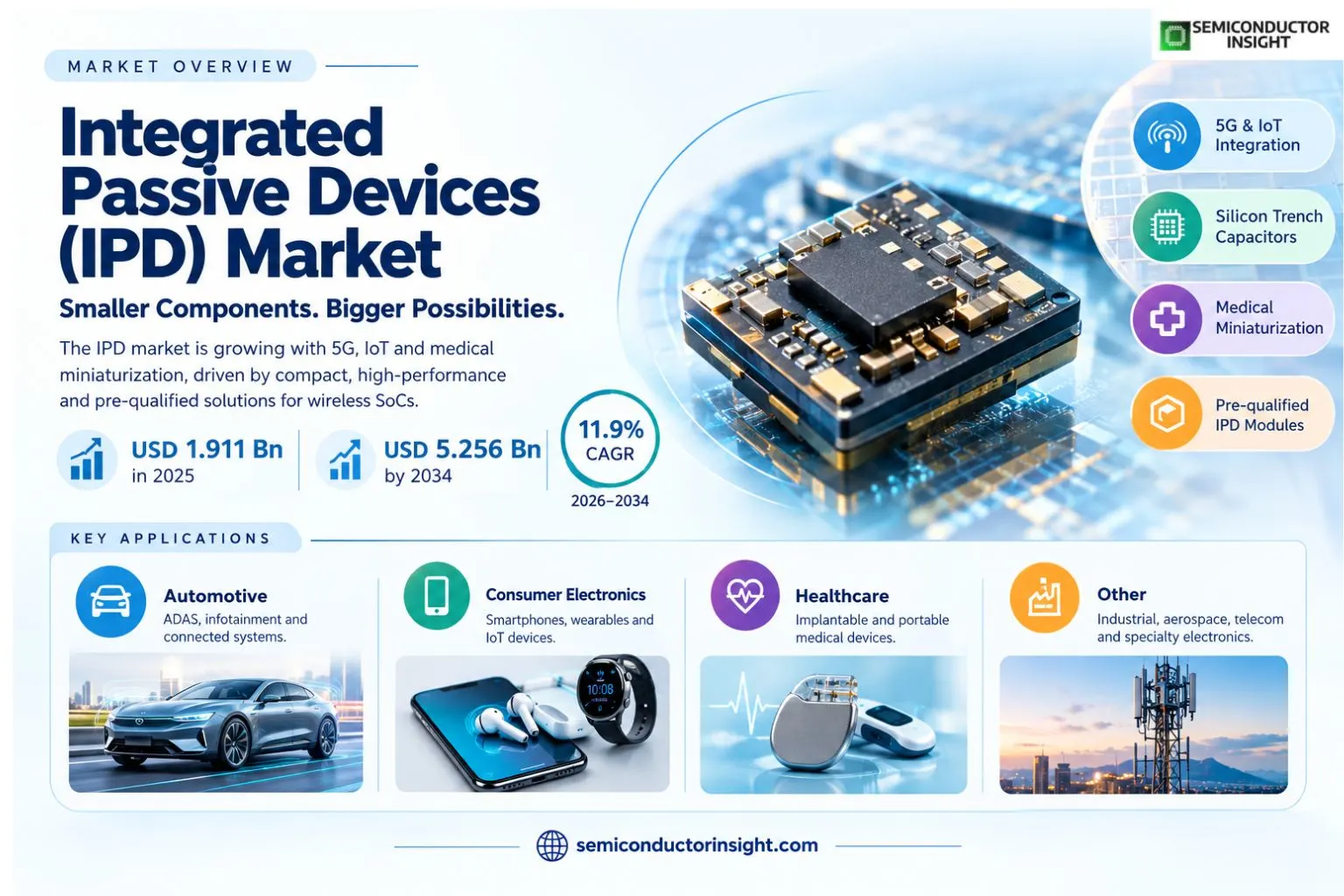
- Market size and growth: the market is valued at USD 1.911 billion in 2025 and is projected to reach USD 5.256 billion by 2034, representing a 11.9% CAGR over 2026–2034.
- RF IPD leads by type because 5G, Wi-Fi, Bluetooth and IoT radios benefit directly from integrating matching, filtering, balun and coupling networks into compact passive dies.
- Consumer Electronics leads application demand because smartphones, wearables and connected devices combine intense board-space pressure, RF complexity and high unit volume.
- Asia Pacific is the largest regional market, while Asia Pacific has the strongest incremental growth profile.
- Primary driver: wireless, wearable and medical products need more passive functions in less board area with lower electrical parasitics
- Principal restraint: custom IPD design, specialty processing and qualification can be uneconomic for low-volume or frequently changing products
Market Overview
The integrated passive devices IPD market was valued at USD 1.911 billion in 2025 and is projected to reach USD 5.256 billion by 2034, expanding at a 11.9% CAGR over 2026–2034. Asia Pacific leads in 2025, while the market is being reshaped by 5G and IoT RF front-end integration, silicon trench capacitors, medical miniaturization and pre-qualified IPD companion modules for wireless SoCs.. Commercial decisions therefore balance performance, qualification, lifecycle support and total system cost rather than relying on one headline specification.
Integrated passive devices combine multiple resistors, capacitors, inductors, filters or protection functions on one silicon, glass or ceramic structure, reducing board area and electrical parasitics compared with assembling many discrete components. STMicroelectronics describes RF IPD as a high-resistivity silicon or glass process that can integrate matching networks, harmonic filters, couplers, baluns and power splitters. onsemi’s High-Q IPD process similarly combines copper inductors, precision capacitors and resistors on 200 mm high-resistivity silicon, demonstrating that IPD has become a scalable specialty-foundry technology.
Miniaturization is the primary economic driver because passive components can occupy substantial PCB area even when the active semiconductor is highly integrated. Murata’s IPDiA technology uses three-dimensional silicon structures to increase capacitor density and has demonstrated very thin devices for medical and consumer systems. Its medical guidance shows IPDs replacing several discrete capacitors close to active electronics. This proximity can reduce loop area, improve high-frequency behavior and create more room for batteries or sensors in implantable, wearable and portable devices where every cubic millimeter has system value.
RF companion devices are expanding the addressable market beyond standalone filters. ST currently supports IPD companion chips around several STM32 wireless microcontrollers, integrating matching, filtering and balun functions for sub-GHz and 2.4 GHz radios, while Johanson supplies chipset-specific integrated passive components across common wireless bands. These examples show that IPD demand increasingly follows wireless SoC ecosystems because a qualified passive companion can simplify regulatory compliance, shorten RF tuning and reduce the number of external components an OEM must source, place and validate.
Segment Analysis: By Type
By type, the market is segmented into EMS and EMI Protection IPD, RF IPD, LED Lighting, Digital & Mixed Signal IPD. RF IPD holds the leading position because 5G, Wi-Fi, Bluetooth and IoT radios benefit directly from integrating matching, filtering, balun and coupling networks into compact passive dies. Commercial decisions therefore balance performance, qualification, lifecycle support and total system cost rather than relying on one headline specification. As deployment scales, repeatable manufacturing, application engineering and supplier support become increasingly important to customer confidence and ownership economics.
| Type | Function / role | Market position |
|---|---|---|
| EMS and EMI Protection IPD | Integrated filtering and protection networks suppress interference and electrostatic events. | Strong in mobile, industrial and dense mixed-signal boards. |
| RF IPD | Baluns, filters, couplers, diplexers and matching networks on integrated substrates. | Leading type due to 5G, Wi-Fi, IoT and compact wireless products. |
| LED Lighting | Integrated passives support compact driver and protection networks. | Niche but stable in highly integrated lighting modules. |
| Digital & Mixed Signal IPD | Capacitor arrays, termination networks and mixed passive functions. | Growing in medical, computing and space-constrained electronics. |
Commercial implications by type
RF IPD carries strong integration value because parasitics directly affect insertion loss, impedance matching and filter response at high frequencies. A well-designed IPD can replace a network of discrete inductors and capacitors while reducing component variation and assembly area. Silicon-capacitor IPDs solve a different problem by increasing volumetric capacitance and stability, so the market is not a single technology race. Suppliers compete on RF Q factor, capacitor density, voltage handling, substrate choice, qualification, package thickness and application-specific integration.
Segment Analysis: By Application
By application, demand is segmented into Automotive, Consumer Electronics, Healthcare, Other. Consumer Electronics leads because smartphones, wearables and connected devices combine intense board-space pressure, RF complexity and high unit volume. Commercial decisions therefore balance performance, qualification, lifecycle support and total system cost rather than relying on one headline specification. As deployment scales, repeatable manufacturing, application engineering and supplier support become increasingly important to customer confidence and ownership economics. This combination is shaping product roadmaps, procurement priorities and investment decisions across both established customers and newer application segments.
| Application | Demand characteristics |
|---|---|
| Automotive | ADAS, infotainment, connectivity and power systems use qualified compact passive networks. |
| Consumer Electronics | Largest application through smartphones, wearables, earbuds, IoT and portable devices. |
| Healthcare | Implantable and portable medical electronics value high reliability and extreme miniaturization. |
| Other | Industrial, aerospace, telecom infrastructure and specialty electronics broaden demand. |
By Substrate
| Substrate | Commercial relevance |
|---|---|
| High-Resistivity Silicon | Supports RF inductors, capacitors and precision resistors with semiconductor-style processing. |
| Glass | Offers low RF loss and strong isolation for filters and front-end functions. |
| Silicon Trench / PICS | Provides very high volumetric capacitor density in compact medical and electronic systems. |
| Ceramic / LTCC | Integrates passive RF functions with robust temperature stability. |
By Integration Function
| Integration Function | Commercial relevance |
|---|---|
| Matching & Balun | Reduces RF BOM around wireless chipsets. |
| Filtering & Diplexing | Controls harmonic and band-selectivity requirements. |
| Capacitor Arrays | Consolidates decoupling and energy-storage functions. |
| Protection & EMI | Integrates ESD and interference suppression close to sensitive circuits. |
By End User
| End User | Commercial relevance |
|---|---|
| Smartphone & Wearable OEMs | Prioritize area reduction, RF performance and very high volume. |
| Automotive Electronics Suppliers | Need qualification, temperature stability and long lifecycle. |
| Medical Device Manufacturers | Value volumetric efficiency and reliability. |
| IoT Module Suppliers | Use pre-qualified IPD companions to simplify RF design. |
Regional Analysis
Asia Pacific leads the market because China, Japan, Taiwan and South Korea combine the world’s largest consumer-electronics manufacturing base with major passive-component and semiconductor supply chains. Asia Pacific has the strongest growth profile as demand expands through 5G, wearables, automotive electronics and local semiconductor manufacturing continue to expand compact integrated-passive demand. Commercial decisions therefore balance performance, qualification, lifecycle support and total system cost rather than relying on one headline specification. As deployment scales, repeatable manufacturing, application engineering and supplier support become increasingly important to customer confidence and ownership economics.
How does regional demand differ across this market?
Asia Pacific leads both production and consumption because the region contains the largest consumer-electronics manufacturing base and many passive-component suppliers. North America contributes RF design, semiconductor foundry and medical-device demand, while Europe is strong in automotive, industrial and RF semiconductor applications. The market is geographically diversified by technology: silicon-capacitor expertise is concentrated around Murata/IPDiA and European heritage, RF IPD foundry capability spans U.S. and European semiconductor vendors, and high-volume module assembly is heavily concentrated in Asia.
| Region | Position | Growth outlook | Demand profile | Supplier selection |
|---|---|---|---|---|
| Asia Pacific | Largest | Fastest | Consumer electronics and wireless scale | Cost, density, local supply |
| North America | Second | Strong | RF design and medical electronics | Performance, design support, foundry flexibility |
| Europe | Third | Strong | Automotive and medical | Reliability, qualification, precision |
| South America | Smaller | Moderate | Consumer and industrial electronics | Cost and availability |
| Middle East & Africa | Emerging | Moderate | IoT and infrastructure | Availability, support, reliability |
Competitive Landscape
Competition spans semiconductor foundries, passive-component specialists and RF module suppliers, with different companies focusing on silicon capacitors, thin-film RF networks or ceramic integrated passives. Commercial decisions therefore balance performance, qualification, lifecycle support and total system cost rather than relying on one headline specification. As deployment scales, repeatable manufacturing, application engineering and supplier support become increasingly important to customer confidence and ownership economics. This combination is shaping product roadmaps, procurement priorities and investment decisions across both established customers and newer application segments.
STMicroelectronics uses high-resistivity silicon and glass for RF IPD functions such as matching networks, filters, couplers and baluns, and it increasingly pairs IPD companion devices with STM32 wireless products. onsemi offers a 200 mm High-Q IPD foundry process with copper inductors, MIM capacitors and precision resistors, while Johanson supplies integrated passive RF components across multiple bands. These models show three distinct commercial approaches: custom foundry service, semiconductor companion device and packaged passive component. Commercial decisions therefore balance performance, qualification, lifecycle support and total system cost rather than relying on one headline specification.
Murata’s IPDiA technology differentiates through high-density silicon capacitors using three-dimensional PICS structures. The company’s medical material emphasizes reduced volume and high reliability in implantable devices, while its PICS architecture demonstrates how trench structures can multiply effective capacitor area. This creates a segment where electrical stability, low equivalent series resistance and volumetric efficiency matter more than RF filtering, allowing integrated passives to address medical, aerospace and power-decoupling applications in addition to wireless front ends. Commercial decisions therefore balance performance, qualification, lifecycle support and total system cost rather than relying on one headline specification.
KYOCERA AVX and other passive suppliers compete through arrays and thin-film products that integrate several passive elements in compact formats. The market remains technologically fragmented, and no single substrate wins every application. Wireless designers prioritize insertion loss and matching; automotive buyers prioritize qualification; medical customers prioritize reliability and volume; and consumer OEMs prioritize cost and assembly reduction. These different requirements support several specialized suppliers rather than one universal IPD architecture or process. Commercial decisions therefore balance performance, qualification, lifecycle support and total system cost rather than relying on one headline specification.
| Competitive group | Representative participants | Competitive focus |
|---|---|---|
| Semiconductor IPD platforms | STMicroelectronics, onsemi | RF foundry, companion chips and silicon/glass IPD |
| Silicon capacitor specialists | Murata / IPDiA | High-density 3D silicon capacitor technology |
| Passive integration suppliers | Johanson Technology, KYOCERA AVX, Qorvo | Integrated filters, baluns, arrays and RF passives |
Companies Profiled
The companies profiled include onsemi, STMicroelectronics, Murata / IPDiA, Johanson Technology, Infineon, Qorvo, KYOCERA AVX. They span materials, semiconductor design, component manufacturing, packaging or system integration depending on themarket. Competitive positions differ by technology depth, manufacturing scale, customer qualification and geographic reach, so the strongest suppliers combine differentiated engineering with repeatable volume production, application support and long-term product availability. Commercial decisions therefore balance performance, qualification, lifecycle support and total system cost rather than relying on one headline specification.
Production Capacity Analysis
Manufacturing capacity depends on high-resistivity silicon or glass wafers, thin-film deposition, copper or aluminum metallization, lithography, trench etching for silicon capacitors and high-volume wafer-level test. Commercial decisions therefore balance performance, qualification, lifecycle support and total system cost rather than relying on one headline specification. As deployment scales, repeatable manufacturing, application engineering and supplier support become increasingly important to customer confidence and ownership economics. This combination is shaping product roadmaps, procurement priorities and investment decisions across both established customers and newer application segments.
RF IPD manufacturing resembles specialty semiconductor fabrication because inductors, capacitors and resistors are patterned using photolithography and controlled thin-film processes. onsemi’s platform uses a 200 mm high-resistivity silicon wafer with copper inductors, MIM capacitors and precision resistors, showing that capacity can leverage established specialty fabs. The economic advantage comes from producing many passive functions simultaneously on the wafer, but yield depends on tight control of line width, dielectric thickness and substrate resistivity because these variables directly affect high-frequency response.
Silicon trench capacitors add a different manufacturing challenge because extremely high capacitance density requires deep, uniform three-dimensional structures and reliable dielectric formation. Murata’s PICS technology uses etched silicon to multiply surface area while keeping the footprint small, which demands mature deep-etch and conformal deposition control. Medical-grade parts also require stronger reliability screening, so effective capacity includes long qualification, electrical characterization and traceability rather than only wafer throughput, especially for implantable or mission-critical applications. Commercial decisions therefore balance performance, qualification, lifecycle support and total system cost rather than relying on one headline specification.
Market Dynamics
The market is shifting from general passive miniaturization toward application-specific integration co-designed with wireless SoCs, medical circuits and compact power or sensing modules. Commercial decisions therefore balance performance, qualification, lifecycle support and total system cost rather than relying on one headline specification. As deployment scales, repeatable manufacturing, application engineering and supplier support become increasingly important to customer confidence and ownership economics. This combination is shaping product roadmaps, procurement priorities and investment decisions across both established customers and newer application segments.
The commercial value of an IPD is highest when it removes several discrete parts, simplifies RF tuning or enables a smaller product that could not otherwise be built. This favors companion devices matched to specific radios and high-density capacitor networks placed close to active dies. Integration can reduce flexibility because a passive network optimized for one band or chipset cannot always be reused, so suppliers must balance standard product portfolios with custom foundry services, short design turns and enough process stability to support long product lifecycles.
Market Drivers
Drivers Impact Analysis
| Driver | Impact | Commercial mechanism |
|---|---|---|
| Consumer-electronics miniaturization | High | Smartphones, wearables, earbuds and connected sensors continue to compress more radios, sensors and power-management functions into very small board areas. Replacing several inductors and capacitors with one IPD reduces footprint, assembly count and routing parasitics, while wafer-level manufacturing can improve component matching. The benefit becomes especially strong when the IPD is designed as a companion to a specific wireless chipset because the OEM receives a tested RF network rather than tuning a discrete solution from scratch. |
| 5G and IoT RF complexity | High | Modern wireless devices support cellular, Wi-Fi, Bluetooth, GNSS and sub-GHz bands, increasing the number of filters, baluns and matching elements around the radio. ST and Johanson both position integrated passive solutions for compact RF front ends, demonstrating how integration can reduce BOM while preserving high-frequency performance. As frequency rises and antenna space shrinks, predictable passive behavior, component matching and reduced interconnect parasitics become more valuable than simple component-count reduction alone. |
| Medical miniaturization | Medium | Implantable and wearable medical devices need high capacitance, reliability and low profile in extremely limited space. Murata’s PICS silicon capacitor technology replaces larger ceramic capacitor arrays with thin silicon structures and is positioned for medical systems. Reducing passive volume can free space for batteries or sensing elements, creating a direct device-level benefit and supporting premium pricing when the passive component meets strict long-term reliability, leakage, dielectric and traceability requirements. |
| Automotive electronics | Medium | Vehicles are adding connectivity, radar, ADAS, infotainment and distributed control functions that increase RF and mixed-signal component count. Integrated passive networks can reduce PCB area and improve repeatability, but automotive applications require extended temperature operation and long qualification. Suppliers with stable specialty-process control can capture higher-value demand, particularly in compact modules where discrete passive count creates assembly, field-reliability and sourcing challenges over long vehicle production cycles. |
Consumer-electronics miniaturization
Smartphones, wearables, earbuds and connected sensors continue to compress more radios, sensors and power-management functions into very small board areas. Replacing several inductors and capacitors with one IPD reduces footprint, assembly count and routing parasitics, while wafer-level manufacturing can improve component matching. The benefit becomes especially strong when the IPD is designed as a companion to a specific wireless chipset because the OEM receives a tested RF network rather than tuning a discrete solution from scratch.
5G and IoT RF complexity
Modern wireless devices support cellular, Wi-Fi, Bluetooth, GNSS and sub-GHz bands, increasing the number of filters, baluns and matching elements around the radio. ST and Johanson both position integrated passive solutions for compact RF front ends, demonstrating how integration can reduce BOM while preserving high-frequency performance. As frequency rises and antenna space shrinks, predictable passive behavior, component matching and reduced interconnect parasitics become more valuable than simple component-count reduction alone. Commercial decisions therefore balance performance, qualification, lifecycle support and total system cost rather than relying on one headline specification.
Medical miniaturization
Implantable and wearable medical devices need high capacitance, reliability and low profile in extremely limited space. Murata’s PICS silicon capacitor technology replaces larger ceramic capacitor arrays with thin silicon structures and is positioned for medical systems. Reducing passive volume can free space for batteries or sensing elements, creating a direct device-level benefit and supporting premium pricing when the passive component meets strict long-term reliability, leakage, dielectric and traceability requirements. Commercial decisions therefore balance performance, qualification, lifecycle support and total system cost rather than relying on one headline specification.
Automotive electronics
Vehicles are adding connectivity, radar, ADAS, infotainment and distributed control functions that increase RF and mixed-signal component count. Integrated passive networks can reduce PCB area and improve repeatability, but automotive applications require extended temperature operation and long qualification. Suppliers with stable specialty-process control can capture higher-value demand, particularly in compact modules where discrete passive count creates assembly, field-reliability and sourcing challenges over long vehicle production cycles. Commercial decisions therefore balance performance, qualification, lifecycle support and total system cost rather than relying on one headline specification.
Market Restraints
Restraints Impact Analysis
| Restraint | Impact | Commercial mechanism |
|---|---|---|
| Custom design cost | High | An IPD delivers maximum benefit when passive values and layout are optimized for a specific chipset or RF band, but that customization creates design, mask and qualification cost. For low-volume products or platforms that change frequently, discrete components can remain more economical because engineers can retune the network without fabricating a new passive die. Foundry shuttle services and standard companion chips reduce this barrier, yet the economics still favor applications with sufficient volume or unusually strong miniaturization value. |
| Process complexity | Medium | High-Q inductors, thin-film resistors and high-density capacitors require different materials and geometry control, making integrated-passive fabrication more complex than assembling simple discrete components. RF performance is sensitive to substrate loss, metal thickness and parasitic coupling, while trench capacitors require deep etching and conformal dielectric formation. These requirements increase process-development cost and can create yield trade-offs when several passive functions are integrated on the same substrate and must remain within tight electrical tolerance. |
| Competing discrete solutions | Medium | Discrete capacitors, inductors and filters have enormous scale, low unit cost and a mature supply chain, making them difficult to displace when board area is not critical. Designers also value the ability to change individual components during tuning or second-source qualification. IPDs therefore need to deliver more than component-count reduction; the strongest cases combine smaller footprint with lower parasitics, faster RF qualification, better matching, reliability or system simplification that is difficult to reproduce with a conventional discrete network. |
| Supply concentration | Medium | Several advanced IPD processes are proprietary to a limited number of suppliers, creating qualification and second-source challenges for high-volume OEMs. A custom RF network built on one foundry process may not be portable without electrical redesign because substrate properties, metal stack and design rules affect component values. Customers may therefore favor standardized passive arrays or companion devices when continuity of supply is more important than maximum integration, limiting the addressable share for highly customized single-source solutions. |
Custom design cost
An IPD delivers maximum benefit when passive values and layout are optimized for a specific chipset or RF band, but that customization creates design, mask and qualification cost. For low-volume products or platforms that change frequently, discrete components can remain more economical because engineers can retune the network without fabricating a new passive die. Foundry shuttle services and standard companion chips reduce this barrier, yet the economics still favor applications with sufficient volume or unusually strong miniaturization value.
Process complexity
High-Q inductors, thin-film resistors and high-density capacitors require different materials and geometry control, making integrated-passive fabrication more complex than assembling simple discrete components. RF performance is sensitive to substrate loss, metal thickness and parasitic coupling, while trench capacitors require deep etching and conformal dielectric formation. These requirements increase process-development cost and can create yield trade-offs when several passive functions are integrated on the same substrate and must remain within tight electrical tolerance. Commercial decisions therefore balance performance, qualification, lifecycle support and total system cost rather than relying on one headline specification.
Competing discrete solutions
Discrete capacitors, inductors and filters have enormous scale, low unit cost and a mature supply chain, making them difficult to displace when board area is not critical. Designers also value the ability to change individual components during tuning or second-source qualification. IPDs therefore need to deliver more than component-count reduction; the strongest cases combine smaller footprint with lower parasitics, faster RF qualification, better matching, reliability or system simplification that is difficult to reproduce with a conventional discrete network.
Supply concentration
Several advanced IPD processes are proprietary to a limited number of suppliers, creating qualification and second-source challenges for high-volume OEMs. A custom RF network built on one foundry process may not be portable without electrical redesign because substrate properties, metal stack and design rules affect component values. Customers may therefore favor standardized passive arrays or companion devices when continuity of supply is more important than maximum integration, limiting the addressable share for highly customized single-source solutions.
Market Opportunities
Wireless companion IPDs
Semiconductor vendors can pair radios with pre-qualified matching, filtering and balun devices that reduce customer RF design effort. ST’s current wireless portfolio references IPD companions for several frequency and power combinations, showing how the passive device can become part of a platform rather than a standalone component. This approach can expand IPD adoption among smaller IoT OEMs that lack deep RF expertise while improving regulatory repeatability and shortening development cycles across high-volume connected products. Commercial decisions therefore balance performance, qualification, lifecycle support and total system cost rather than relying on one headline specification.
Medical silicon capacitors
Three-dimensional silicon capacitors offer a differentiated path to high capacitance in extremely small volume, making them attractive for implantable and wearable medical systems. Murata’s IPDiA technology highlights thin form factors and high reliability as core advantages over conventional arrays. As medical devices add wireless connectivity, sensors and processing, passive density becomes more important, creating opportunities for integrated decoupling and filtering structures that meet strict long-term leakage, lifetime and biocompatibility-adjacent system requirements. Commercial decisions therefore balance performance, qualification, lifecycle support and total system cost rather than relying on one headline specification.
Automotive RF and sensing
Connected vehicles need compact RF front ends for telematics, GNSS, Wi-Fi, Bluetooth and keyless systems while adding dense sensor and ADAS electronics. Integrated passive networks can reduce assembly count and improve consistency across large production runs, provided they meet automotive temperature and reliability standards. The opportunity is strongest in modules where board area is constrained and the RF design is stable across several vehicle platforms, allowing qualification cost to be amortized over long production cycles.
High-density heterogeneous packaging
Advanced packages increasingly place active dies, sensors and memory close together, creating a need for local decoupling, filtering and impedance networks that occupy little area. Thin silicon IPDs or embedded passive structures can move these functions nearer to active dies and reduce interconnect inductance. This creates a new interface between the IPD market and chiplet or system-in-package architectures, especially where conventional surface-mount passives become too large or electrically distant for high-speed operation. Commercial decisions therefore balance performance, qualification, lifecycle support and total system cost rather than relying on one headline specification.
Supply Chain Analysis
High-resistivity silicon, glass, LTCC and trench silicon
Lithography, thin films, deep etch and metallization
CSP, bumping, thinning and test
Wireless modules, medical, automotive and consumer electronics
Substrates
Substrate choice determines dielectric loss, achievable Q factor, voltage capability and mechanical integration. High-resistivity silicon supports semiconductor-style RF IPD, glass offers strong isolation, and silicon trench structures maximize capacitor density. Suppliers must control wafer resistivity, thickness and surface quality because these properties translate directly into component performance, making specialty substrates a meaningful part of final IPD value rather than a commodity support material. Commercial decisions therefore balance performance, qualification, lifecycle support and total system cost rather than relying on one headline specification.
Passive fabrication
RF IPDs use deposition, lithography and metal patterning to create inductors, capacitors and resistors with tighter matching than discrete assembly can provide. Silicon capacitors add deep etching and three-dimensional dielectric structures to increase effective area without increasing footprint. Process control must hold electrical values within narrow tolerance because a small shift in inductance or capacitance can move an RF filter outside its intended band or reduce matching efficiency. Commercial decisions therefore balance performance, qualification, lifecycle support and total system cost rather than relying on one headline specification.
Wafer-level packaging
IPDs are often delivered in chip-scale, bumped or wire-bondable formats so they can sit close to active semiconductor devices. Thinning and compact packages preserve the area advantage created by passive integration, while wafer-level electrical test screens frequency response or capacitance before assembly. Package parasitics must remain low enough that the integrated device retains the performance advantage achieved on the wafer, particularly in multi-gigahertz RF applications. Commercial decisions therefore balance performance, qualification, lifecycle support and total system cost rather than relying on one headline specification.
OEM integration
The final value is created when the IPD replaces a group of discrete components and simplifies the customer’s system design. Companion devices matched to specific radios can reduce tuning and certification work, while medical or automotive IPDs can reduce board volume and improve long-term consistency. Suppliers therefore need application engineering and reference designs in addition to fabrication capacity because customers often judge the solution by time-to-market and module performance rather than the passive die alone.
Recent Developments
Current — ST expands IPD companion-chip support around wireless MCUs
Current STM32 wireless devices reference compact IPD companions for matching, filtering and balun functions. Source
Current — onsemi maintains 200 mm High-Q IPD foundry capability
The platform integrates copper inductors, precision capacitors and resistors on high-resistivity silicon. Source
Current — Murata continues PICS silicon capacitor platform
Murata identifies PICS as its silicon IPD manufacturing technology with multiple breakdown-voltage variants. Source
Report Scope & Segmentation
| Attribute | Coverage |
|---|---|
| Market | Integrated Passive Devices (IPD) |
| Base Year | 2025 |
| Estimated Year | 2026 |
| Forecast Period | 2026–2034 |
| 2025 Market Size | USD 1.911 billion |
| 2026 Estimated Size | USD 2.138 billion |
| 2034 Forecast Size | USD 5.256 billion |
| CAGR | 11.9% (2026–2034) |
| By Type | EMS and EMI Protection IPD, RF IPD, LED Lighting, Digital & Mixed Signal IPD |
| By Application | Automotive, Consumer Electronics, Healthcare, Other |
| By Substrate | High-Resistivity Silicon, Glass, Silicon Trench / PICS, Ceramic / LTCC |
| By Integration Function | Matching & Balun, Filtering & Diplexing, Capacitor Arrays, Protection & EMI |
| By End User | Smartphone & Wearable OEMs, Automotive Electronics Suppliers, Medical Device Manufacturers, IoT Module Suppliers |
| Regions | Asia Pacific, North America, Europe, South America, Middle East & Africa |
| Companies Profiled | onsemi, STMicroelectronics, Murata / IPDiA, Johanson Technology, Infineon, Qorvo, KYOCERA AVX |
Frequently Asked Questions
What is the integrated passive devices IPD market size in 2025?
The market is valued at USD 1.911 billion in 2025.
What is the projected market size by 2034?
The market is projected to reach USD 5.256 billion by 2034.
What is the CAGR from 2026 to 2034?
The market is expected to expand at a 11.9% CAGR.
Which region leads the market?
Asia Pacific is the largest regional market in 2025.
Which type leads the market?
RF IPD is the leading type.
Which application leads demand?
Consumer Electronics is the leading application.
What is the primary growth driver?
wireless, wearable and medical products need more passive functions in less board area with lower electrical parasitics.
What is the principal restraint?
custom IPD design, specialty processing and qualification can be uneconomic for low-volume or frequently changing products.
Where are the strongest opportunities?
RF companion chips, medical silicon capacitors, automotive-qualified IPDs and 5G/IoT front-end integration.
Which companies are active in the market?
onsemi, STMicroelectronics, Murata / IPDiA, Johanson Technology, Infineon, Qorvo, KYOCERA AVX.
Research Sources & Evidence Base
View primary and authoritative evidence used in this overview
- STMicroelectronics: RF Front-End / Integrated Passive Devices — RF IPD process, filters, baluns and foundry services.
- onsemi: Integrated Passive Devices — 200 mm High-Q silicon IPD process and passive structures.
- Murata: Integrated Passive Devices White Paper — PICS silicon integration, capacitor density and medical use.
- Murata: PICS Silicon IPD FAQ — Current PICS technology and breakdown-voltage variants.
- Johanson Technology: Integrated Passive Components — RF integrated passive components and supported bands.
- KYOCERA AVX: Capacitor Arrays — Integrated passive capacitor-array architecture.
- STMicroelectronics: STM32WL54CC Wireless MCU — Current use of IPD companion chips for matching, filtering and balun.

Get Sample Report PDF for Exclusive Insights
Report Sample Includes
- Table of Contents
- List of Tables & Figures
- Charts, Research Methodology, and more...
 Download Sample Report PDF