Industrial Wireless Chipsets Market Insights
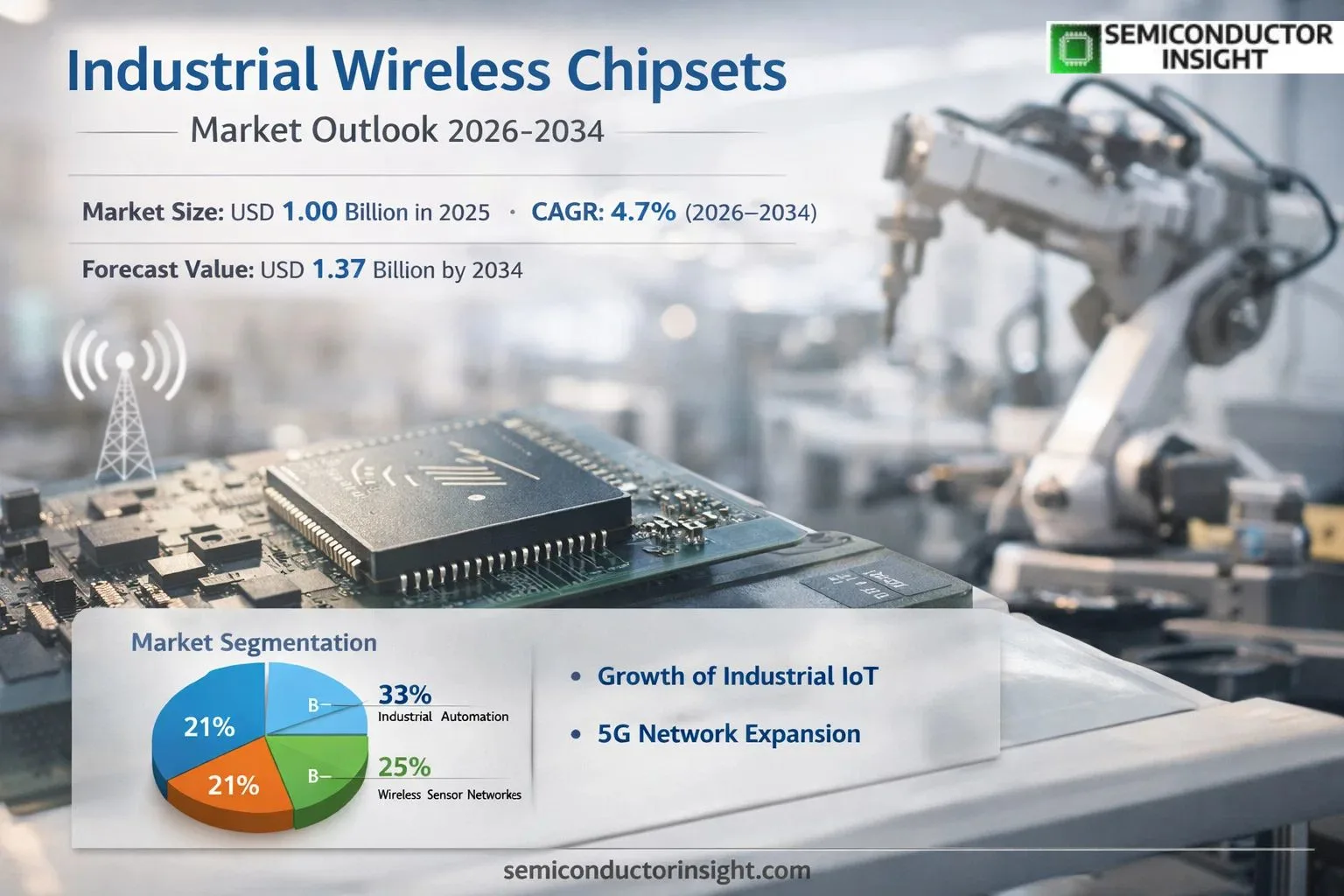
Global industrial wireless chipsets market size was valued at USD 1.00 billion in 2025. The market is projected to grow from USD 1.05 billion in 2026 to USD 1.37 billion by 2034, exhibiting a CAGR of 4.7% during the forecast period.
Industrial wireless chipsets are integrated circuit packages specifically designed for enabling wireless communication in industrial applications. These components incorporate functions such as signal processing, modulation/demodulation, and protocol implementation while supporting Wi-Fi, Bluetooth, Zigbee, LoRa, and cellular networks. Engineered for harsh environments, they withstand extreme temperatures and electromagnetic interference—critical for industrial automation, smart manufacturing, and IoT deployments where reliable data transmission is paramount.
MARKET DRIVERS
Growing Demand for Industrial IoT (IIoT) Solutions
The Industrial Wireless Chipsets Market is experiencing rapid growth driven by the increasing adoption of IIoT across manufacturing, oil & gas, and energy sectors. Industrial wireless chipsets enable real-time monitoring and predictive maintenance, reducing downtime by approximately 30% in industrial facilities. Major manufacturers are investing in wireless automation to improve operational efficiency.
5G Network Deployments Accelerating Market Growth
With global 5G infrastructure investment exceeding $200 billion in 2023, industrial wireless chipsets are evolving to support ultra-reliable low-latency communication (URLLC) for critical industrial applications. The transition from wired to wireless systems is creating significant demand for chipsets supporting 5G private networks in industrial environments.
➤ “Industrial wireless chipset shipments are projected to grow at 22.4% CAGR through 2028 as factories prioritize flexible automation solutions.”
The need for edge computing in industrial environments is further driving demand for wireless chipsets with integrated AI/ML capabilities, enabling real-time decision making at the network edge.
MARKET CHALLENGES
Interoperability Concerns in Industrial Settings
Despite growing adoption, the Industrial Wireless Chipsets Market faces challenges related to protocol fragmentation. Different industrial applications require support for multiple wireless standards (Wi-Fi 6, Bluetooth 5.3, Zigbee 3.0), making chipset design complex. Approximately 45% of industrial facilities report integration challenges when implementing wireless solutions.
Other Challenges
Security Vulnerabilities
Industrial wireless chipsets must address critical cybersecurity concerns, with industrial networks experiencing 35% more targeted attacks than commercial networks in 2023.
MARKET RESTRAINTS
High Implementation Costs for Legacy System Upgrades
The transition from wired industrial systems to wireless infrastructures requires significant capital expenditure. Many small-to-medium manufacturers face budget constraints in replacing existing equipment, slowing adoption rates in certain industrial segments.
MARKET OPPORTUNITIES
Expansion of Smart Manufacturing Facilities
Global smart factory market, projected to reach $140 billion by 2026, presents substantial growth potential for industrial wireless chipsets. These components are essential for enabling wireless sensor networks, autonomous mobile robots, and digital twin implementations in modern Industry 4.0 environments.
Key Developments in Industrial Wireless Chipsets Market Trends
Growing Adoption Across Industrial Automation Applications
The Industrial Wireless Chipsets market is experiencing significant growth due to increasing deployment in industrial automation systems. Manufacturers are integrating these chipsets for real-time monitoring and control across production lines, with demand particularly strong in automotive and electronics manufacturing sectors. Wireless sensor networks powered by these chipsets enable predictive maintenance, reducing downtime and operational costs.
Other Trends
Protocol Standardization and Multi-Protocol Support
Recent developments highlight a trend toward chipsets supporting multiple industrial wireless protocols (Wi-Fi 6, Bluetooth 5.2, Zigbee 3.0) in a single package. This flexibility allows manufacturers to create interoperable devices while minimizing hardware variations. Leading chipset providers are investing heavily in this technology to address diverse industrial requirements.
Enhanced Security Features in Industrial Wireless Chipsets
With growing cybersecurity threats in industrial networks, chipset manufacturers are implementing hardware-based security features including secure boot, cryptographic accelerators, and tamper detection. These enhancements are becoming standard in next-generation industrial wireless chipsets, particularly for critical infrastructure applications.
Edge Computing Integration Trend
The Industrial Wireless Chipsets market is witnessing increased integration of edge computing capabilities directly into wireless modules. This development supports low-latency decision making at the network edge, reducing reliance on cloud connectivity for time-sensitive industrial operations. Major semiconductor companies are releasing chipsets with built-in AI acceleration for local data processing.
Geographical Expansion and Regional Market Developments
Asia-Pacific continues to demonstrate strong growth in Industrial Wireless Chipsets adoption, driven by smart factory initiatives in China and South Korea. Meanwhile, North American market growth focuses on upgrading existing manufacturing infrastructure with wireless solutions that meet Industry 4.0 standards. European adoption emphasizes energy efficiency and sustainability in industrial operations.
COMPETITIVE LANDSCAPE
Key Industry Players
Global Industrial Wireless Chipsets Market Dominated by Semiconductor Giants
The industrial wireless chipsets market is characterized by strong competition among established semiconductor manufacturers, with Qualcomm, MediaTek, and NXP Semiconductors leading Global revenue share in 2025. These market leaders leverage their extensive R&D capabilities and existing wireless technology portfolios to maintain dominance in industrial applications. The top five players collectively account for a significant portion of global market revenue, with particular strength in processor chipsets and wireless communication chipsets segments.
Emerging competitors are gaining traction in niche applications such as wireless sensor networks and smart factories, with companies like Microchip Technology and Renesas Electronics demonstrating strong growth in specialized industrial IoT solutions. The market also features participation from specialized fabless semiconductor companies developing custom wireless solutions for harsh industrial environments.
List of Key Industrial Wireless Chipsets Companies Profiled
- Qualcomm
- MediaTek
- NXP Semiconductors
- Broadcom Inc.
- Intel Corporation
- Texas Instruments
- Marvell Technology
- STMicroelectronics
- Microchip Technology
- Renesas Electronics
- Infineon Technologies
- Silicon Laboratories
- Cypress Semiconductor
- Nordic Semiconductor
- Analog Devices
Segment Analysis:
| Segment Category | Sub-Segments | Key Insights |
| By Type |
|
Wireless Communication Chipsets demonstrate outstanding market traction owing to:
|
| By Application |
|
Smart Factory applications show remarkable adoption due to:
|
| By End User |
|
Discrete Manufacturing represents the most significant opportunity because of:
|
| By Protocol |
|
Industrial Wi-Fi chipsets dominate segment adoption due to:
|
| By Integration |
|
System-on-Chip solutions are gaining strong market traction because:
|
Regional Analysis: Global Industrial Wireless Chipsets Market
North America
The United States accounts for over 60% of North America’s industrial wireless chipsets demand, fueled by extensive factory automation initiatives and reshoring of manufacturing operations. Major automotive OEMs and defense contractors are driving specialized wireless solutions tailored for harsh industrial environments.
Canada’s industrial wireless chipsets market is growing through oil & gas sector deployments, where wireless sensors enable real-time monitoring of remote pipelines and extraction sites. Harsh northern climates create unique demands for ruggedized wireless communication solutions.
Mexico’s proximity to U.S. supply chains and lower production costs are attracting industrial wireless implementations, particularly in automotive manufacturing plants. However, interoperability challenges between different wireless standards remain a market constraint.
North America’s industrial wireless chipsets benefit from FCC and ISED certification processes that ensure reliable performance in critical infrastructure. Growing cybersecurity concerns are shaping new standards for wireless industrial network security.
Europe
Europe represents the second-largest market for industrial wireless chipsets, characterized by strong emphasis on energy efficiency and sustainable manufacturing. Germany leads regional adoption through its Industrie 4.0 initiatives in automotive and industrial machinery sectors. The EU’s strict electromagnetic compatibility regulations create both challenges and opportunities for wireless chipset manufacturers. Collaborative projects between academic institutions and industrial players are accelerating development of low-power wireless solutions for smart factories.
Asia-Pacific
The Asia-Pacific region is experiencing the fastest growth in industrial wireless chipsets adoption, driven by China’s massive industrial automation programs and smart manufacturing initiatives. Japan and South Korea contribute advanced wireless technologies for robotics and precision manufacturing. However, market fragmentation and diversity of industrial standards across countries present integration challenges. India’s growing electronics manufacturing sector is emerging as a significant consumer of industrial-grade wireless communication solutions.
South America
South America’s industrial wireless chipsets market is developing gradually, with Brazil leading adoption in mining and agricultural equipment applications. Infrastructure limitations and economic volatility have slowed large-scale industrial wireless deployments. Nonetheless, increasing foreign investments in manufacturing facilities are creating new opportunities for localized wireless solutions tailored to regional industrial needs.
Middle East & Africa
The MEA region shows promising growth in industrial wireless chipsets, particularly in oil-rich Gulf countries implementing smart refinery technologies. Africa’s market remains nascent but presents long-term potential through mining automation and infrastructure development projects. Regional adoption is constrained by limited technical expertise and preference for wired solutions in critical industrial applications.
Report Scope
This market research report provides a comprehensive analysis of the Industrial Wireless Chipsets Market , covering the forecast period 2026–2034. It offers detailed insights into market dynamics, technological advancements, competitive landscape, and key trends shaping the industry.
Key focus areas of the report include:
- Market Overview: The report begins with an overview outlining its current market scenario, key growth indicators, and industry transformation drivers. It discusses macroeconomic factors, demand–supply balance, regulatory landscape, and the strategic role of semiconductors in powering advancements across industries such as automotive, telecommunications, consumer electronics, and industrial automation.
- Market Size & Forecast: Historical data and future projections for revenue, unit shipments, and market value across major regions and segments.
- Segmentation Analysis: Detailed breakdown by product type, technology, application, and end-user industry to identify high-growth segments and investment opportunities.
- Regional Insights: Insights into market performance across North America, Europe, Asia-Pacific, Latin America, and the Middle East & Africa, including country-level analysis where relevant.
- Competitive Landscape: Profiles of leading market participants, including their product offerings, R&D focus, manufacturing capacity, pricing strategies, and recent developments such as mergers, acquisitions, and partnerships.
- Technology Trends & Innovation: Assessment of emerging technologies, integration of AI/IoT, semiconductor design trends, fabrication techniques, and evolving industry standards.
- Market Drivers & Restraints: Evaluation of factors driving market growth along with challenges, supply chain constraints, regulatory issues, and market-entry barriers.
- Stakeholder Insights: Insights for component suppliers, OEMs, system integrators, investors, and policymakers regarding the evolving ecosystem and strategic opportunities.
Primary and secondary research methods are employed, including interviews with industry experts, data from verified sources, and real-time market intelligence to ensure the accuracy and reliability of the insights presented.
FREQUENTLY ASKED QUESTIONS:
What is the current market size of Industrial Wireless Chipsets Market?
-> Global Industrial Wireless Chipsets market was valued at USD 1002 million in 2025 and is projected to reach USD 1373 million by 2034.
What is the growth rate (CAGR) of Industrial Wireless Chipsets Market?
-> The market is expected to grow at a CAGR of 4.7% during the forecast period 2026-2034.
Which key companies operate in Industrial Wireless Chipsets Market?
-> Key players include Qualcomm, MediaTek, NXP Semiconductors, Broadcom, Intel Corporation, Texas Instruments, Marvell Technology, STMicroelectronics, Microchip Technology, and Renesas Electronics.
What are the key segments in Industrial Wireless Chipsets Market?
-> Major segments include:
- By Type: Processor Chipset, Wireless Communication Chipset, Sensor Chipset, Power Management Chipset, Others
- By Application: Industrial Automation, Wireless Sensor Networks (WSN), Smart Factories, Remote Monitoring Systems, Others
Which region dominates the Industrial Wireless Chipsets market?
-> The U.S. market size is significant, while China is expected to show strong growth in the coming years.

Get Sample Report PDF for Exclusive Insights
Report Sample Includes
- Table of Contents
- List of Tables & Figures
- Charts, Research Methodology, and more...
 Download Sample Report PDF