Key Statistics
Key Takeaways
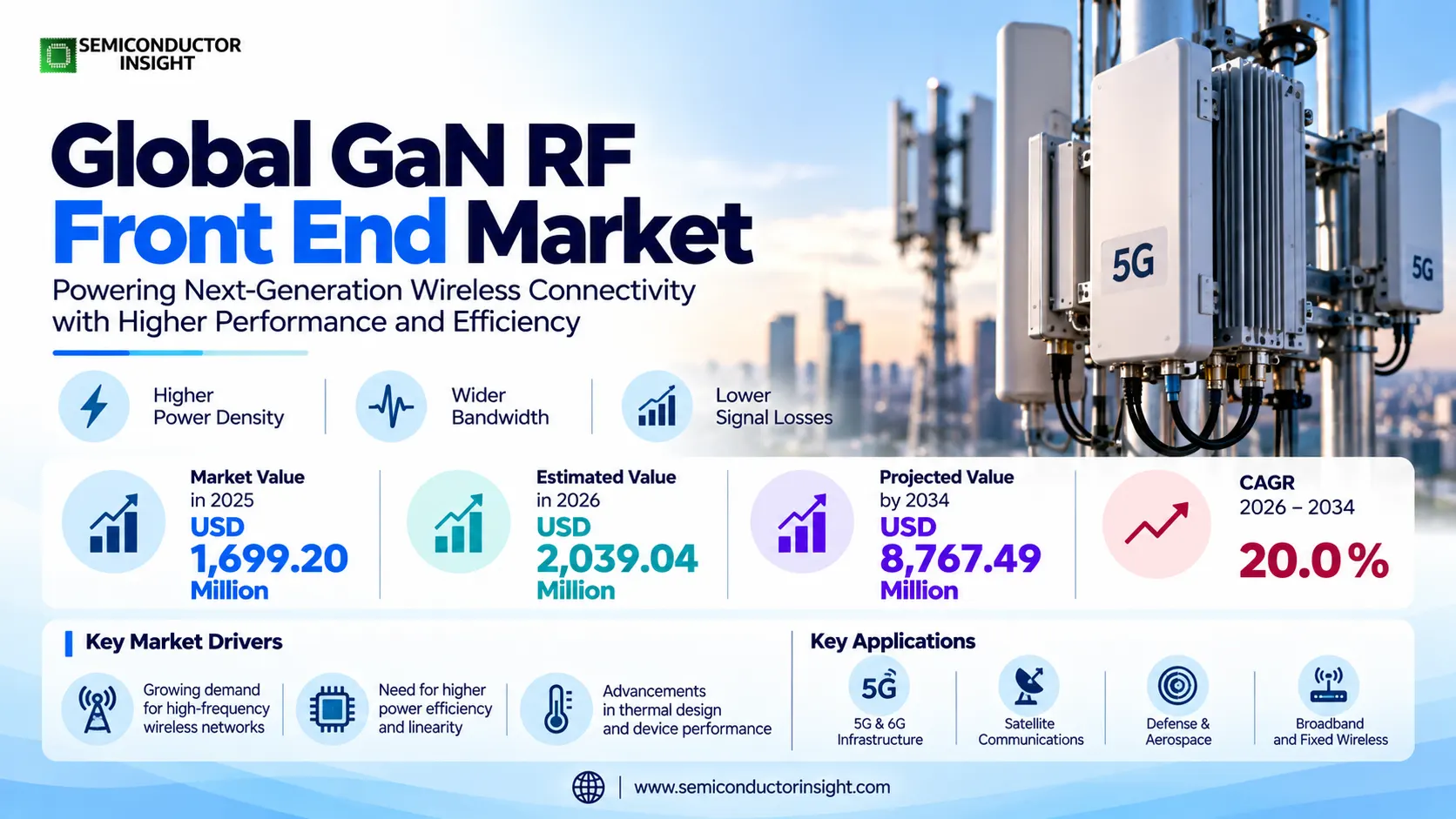
- Market foundation: The 2025 value is USD 1,699.20 million, with commercial demand spanning RF transistors, monolithic microwave integrated circuits and amplifier modules for 5G radios, satellite links and radar. The 2026 estimate is USD 2,039.04 million, while adoption differs by frequency band, thermal package and qualification cycle.
- Forecast trajectory: The global revenue opportunity is projected to reach USD 8,767.49 million by 2034 at a 20.0% CAGR, reflecting expanding radio channel counts, higher satellite payload complexity and continuing replacement of less efficient RF power chains.
- Dominant technology: GaN-on-SiC accounts for an estimated ~72% of 2025 value because high-power, high-frequency commercial portfolios concentrate on thermally conductive silicon-carbide substrates; GaN-on-Si represents an estimated ~23% and GaN-on-Diamond remains a small emerging niche.
- End-use demand: 5G Radio Access Networks contribute an estimated ~51% of revenue, ahead of Satellite Communications at ~27% and Radar System at ~22%; these are component and module allocations, not sales of complete telecom or defense platforms.
- Regional leadership: Asia-Pacific represents an estimated ~42% of 2025 revenue, with North America near ~27% and Europe near ~20%; regional shares reflect radio electronics manufacturing, defense supply chains and local procurement requirements rather than a directly measured industry census.
Global GaN RF Front End Market Overview
GaN RF front end market was valued at USD 1,699.20 million in 2025 and is estimated at USD 2,039.04 million in 2026. Revenue is projected to reach USD 8,767.49 million by 2034, a 20.0% CAGR during 2026–2034, as high-frequency wireless links demand higher power density, wider bandwidth and lower losses from the final amplification stage. Gallium nitride front-end products sit between baseband or exciter electronics and antennas, making device efficiency, linearity and thermal design decisive purchasing factors.
Gallium nitride high-electron-mobility transistors exploit a wide bandgap and high electric-field capability to sustain radio-frequency output power under demanding operating conditions. Compared with conventional silicon devices, the commercial advantage can be greater power density in the 3.4–5.0 GHz bands, fewer parallel amplifier paths and more flexibility in matching networks. These benefits are conditional on thermal management, linearity and packaging, so purchasing decisions remain application-specific rather than a blanket substitution of every RF semiconductor.
The defined revenue boundary includes discrete GaN RF power transistors, GaN-based microwave integrated circuits, qualified amplifier stages and integrated RF power modules shipped for cellular radio access, satellite communication and radar. It excludes bare SiC or silicon substrates, power-conversion GaN used in chargers, finished base stations, antenna arrays, complete satellites and radar installations. A mixed amplifier module qualifies when its radio-frequency final stage uses GaN, but an LDMOS-only driver or silicon-only front end is outside this market.
The strongest volume mechanism is the multiplication of active RF chains inside massive-MIMO antenna systems. A single radio installation can contain dozens of parallel channels, each requiring amplification, bias management, matching and protection. At 48 V supply levels, suppliers must reconcile high saturated power with useful average efficiency under modern modulation. That creates differentiated demand for transistors optimized for Doherty architectures and for modules that combine power stages with monitoring or bias circuitry, rather than simple purchases indexed to base-station counts.
Satellite communications create a different value proposition because payload mass, electrical efficiency and power dissipation are constrained at frequencies that extend into the Ku and Ka bands. High-power GaN MMICs are qualified for gain flatness, radiation-relevant reliability and packaging compatibility, while ground terminals seek economical, repeatable amplifier assemblies. Radar procurement adds pulsed peak-power requirements, stringent phase control and extended operating lifetimes. The three applications therefore have distinct pricing, qualification and replacement cycles even though they use related GaN fabrication processes.
Market competition spans merchant RF device makers, compound-semiconductor foundries and integrators that buy die and package complete amplifiers. Product catalogs provide concrete evidence of technology availability but do not measure total addressable market revenue. For example, 35 W discrete parts and 600 W cellular devices coexist with 2,800 W radar amplifier modules, yet the different power ratings do not translate into proportional selling prices. Yield, RF test coverage, application engineering and long-term supply assurance determine whether a nominally superior device wins a production socket.
Segment Analysis: By Type
By substrate technology, the market comprises GaN-on-SiC, GaN-on-Si and GaN-on-Diamond. GaN-on-SiC leads with an estimated ~72% of 2025 revenue, reflecting the thermal and high-power demands of commercial radio amplifiers; GaN-on-Si holds an estimated ~23%, while GaN-on-Diamond accounts for an estimated ~5% as a less mature route to improved heat extraction. These percentages describe modeled device and module sales, not substrate shipments.
| Type | Technical function | Commercial position |
|---|---|---|
| GaN-on-SiC | Silicon carbide provides a thermally conductive foundation for RF GaN high-electron-mobility transistors. Device makers exploit the combination in 48 V cellular amplifiers, multi-gigahertz MMICs and high-duty radar stages. Heat must still move through die attach, package flange and the system cold plate, so substrate choice is only one part of the thermal chain. | Largest segment · ~72% share in 2025. Commercial catalogs from Qorvo, MACOM and RFHIC establish a broad range of GaN-on-SiC power classes, including cellular transistors and radar modules. Qualification experience and access to consistent epitaxial material reinforce incumbency, while substrate cost remains an important constraint when customers compare total radio-unit economics. |
| GaN-on-Si | Gallium nitride layers deposited on silicon can offer wafer-size and manufacturing-cost opportunities where device stress, buffer leakage and heat dissipation are controlled. Its strongest prospect is a price-sensitive radio design that values process integration over maximum continuous RF power. Performance is evaluated at the packaged amplifier level rather than inferred from the nominal substrate price. | Emerging commercial alternative · ~23% modeled share. Cost-sensitive infrastructure and integrated RF stages create potential for GaN-on-Si where output requirements are compatible with its thermal envelope. Design teams must verify gain stability and reliability over operating temperature before replacing established GaN-on-SiC parts, so adoption follows qualification rather than an immediate substrate conversion. |
| GaN-on-Diamond | Diamond heat-spreading approaches target very high local power density by reducing the temperature rise near the transistor channel. The technical proposition is especially relevant to compact radar apertures and satellite payloads where cooling mass is expensive. Interfaces, wafer handling and process repeatability remain critical because thermal performance can be lost at the bonded boundary. | Specialist development segment · ~5% modeled share. Early use cases favor expensive or space-constrained RF hardware with a measurable benefit from lower junction temperature. The commercial pathway depends on repeatable wafer-scale processing, credible lifetime tests and integration with existing amplifier assembly methods; large-volume cellular purchasing is unlikely to change until those costs improve. |
GaN-on-SiC RF devices
The established technology class benefits from broad 2.6–6.0 GHz radio products and additional Ku-band MMIC availability. MACOM lists a 600 W device optimized for 2,620–2,690 MHz and a 48 V supply, while Qorvo offers a 35 W discrete part suitable for active antennas and small cells. Such breadth helps engineers source both driver and final stages, shortening the risk assessment for a new amplifier design.
The most demanding SiC-based designs are not necessarily the highest unit-volume products. A pulsed radar amplifier at 2.7–3.1 GHz can prioritize peak output and phase repeatability, whereas a 5G Doherty design at 3.4–4.0 GHz prioritizes average efficiency under backed-off operation. Commercial differentiation therefore comes from fit to a specific load profile and package, not from comparing maximum watts across unrelated applications.
GaN-on-Si process economics
A silicon substrate can benefit from established wafer-handling infrastructure, but the epitaxial buffer and thermal interface introduce constraints absent from an idealized cost comparison. The commercial test is whether a finished amplifier meets output, distortion and lifetime requirements at a lower delivered cost. Suppliers targeting 2026–2034 programs must also prove consistent lot-to-lot behavior, because radio manufacturers qualify a process rather than a single engineering sample.
GaN-on-Diamond thermal route
Diamond-based heat extraction is relevant where channel temperature governs device lifetime or forces a larger heatsink. It may enable denser antenna apertures or lighter airborne equipment, yet bonding complexity and qualification expenses limit near-term penetration. The estimated ~5% base-year share is therefore best understood as a small, high-value niche rather than evidence of widespread production deployment across ordinary cellular radios.
Segment Analysis: By Application
By end use, 5G Radio Access Networks, Satellite Communications and Radar System define distinct demand pools. Cellular radio chains represent an estimated ~51% of 2025 component revenue, satellite links about ~27%, and radar equipment about ~22%. These proportions reflect RF GaN device and module value within each end market; they do not include revenue from finished network infrastructure, spacecraft or defense systems.
| Application | Demand characteristics |
|---|---|
| 5G Radio Access Networks | Massive-MIMO active antennas need many parallel 3.4–3.8 GHz or 4.8–5.0 GHz RF amplification paths, so the commercial lever is channel count multiplied by qualified amplifier value. A 70 W integrated GaN module can reduce design work compared with discrete implementations, while 48 V transistor families support other macrocell configurations. Network upgrades, efficiency targets and radio replacement determine the order cadence rather than subscriber growth alone. |
| Satellite Communications | Space and ground-terminal links require GaN MMICs capable of operating across 13.75–14.5 GHz and other microwave bands while preserving gain, matching and electrical efficiency. Qorvo publishes a 55 W Ku-band amplifier and a 20 W device covering 17.3–21.2 GHz, illustrating why frequency-specific qualification matters. Procurement volumes can be smaller than cellular volumes, but stringent reliability and integration needs support higher-value device configurations. |
| Radar System | Pulsed radar amplifiers emphasize peak power, duty cycle, phase behavior and heat removal during repeated transmission bursts. RFHIC lists a 2,800 W S-band module for 2.7–3.1 GHz, whereas Analog Devices offers a 20 W X-band GaN amplifier for 8.2–11.8 GHz applications. The resulting market combines high-power transmitter modules with smaller distributed array channels, each governed by different defense and civil certification schedules. |
Demand in the three application classes is not interchangeable. Cellular operators can deploy thousands of repeatable radio units, creating scale-sensitive pricing and a strong preference for drop-in qualified parts. Satellite programs accept longer design cycles to control weight and heat, while radar customers prioritize pulsed performance and documented reliability over the lowest device price. A supplier with a broad GaN process portfolio still needs separate product-level testing, documentation and support for each of these markets.
Application forecasts also depend on whether a purchaser buys a discrete die, packaged transistor or completed RF amplifier module. Integrated solutions include more assembly value per unit but can reduce the number of externally sourced parts. The forecast captures the market value of GaN RF devices and qualifying amplifier modules without double-counting the same semiconductor when it is embedded in a downstream unit sold by another vendor.
Regional Analysis
Asia-Pacific accounts for an estimated ~42% of 2025 GaN RF front-end revenue, ahead of North America at ~27%, Europe at ~20%, South America at ~6% and Middle East & Africa at ~5%. The distribution reflects a mix of compound-semiconductor production, 5G radio manufacturing, defense procurement and satellite-equipment engineering. Growth varies with investment cycles: modeled regional rates span ~18.0% to ~23.8% CAGR, while local supplier access and qualification can outweigh headline network penetration.
How does GaN RF front-end demand differ among the five global regions?
The geographic pattern combines the location of device manufacturing with the location of final radio procurement. A GaN die fabricated in Asia may be packaged into a European amplifier and installed in a North American network, so supplier production footprints are not equivalent to end-market sales. The regional allocation is an analytical demand model using known RF electronics clusters and operator activity, with 2025 shares adding to 100% and the associated growth rates reconciling to the global 2034 forecast.
Asia-Pacific has the broadest scale in radio manufacturing and supply-chain integration, whereas North America combines defense and space requirements with demanding 5G equipment qualifications. Europe emphasizes radio efficiency and exportable amplifier design; South America purchases a larger proportion of radio electronics through integrated equipment contracts; and the Gulf states support premium 5G networks and selected satellite programs. Each region therefore has a distinct route from system investment to GaN component orders.
| Region | Position | Growth outlook | Demand profile | What decides supplier selection |
|---|---|---|---|---|
| Asia-Pacific | Largest · ~42% | ~21.0% CAGR | 5G radio and RF component production | Local manufacturing access, volume pricing and qualified thermal packages |
| North America | Second · ~27% | ~19.0% CAGR | Defense radar, space links and radio replacement | Long-life traceability, reliability and controlled sourcing |
| Europe | Third · ~20% | ~18.0% CAGR | High-efficiency radios and microwave engineering | Energy performance, documentation and integration support |
| South America | Smaller · ~6% | ~19.8% CAGR | Cellular infrastructure through equipment integrators | Delivered system cost, import lead time and service |
| Middle East & Africa | Emerging · ~5% | ~23.8% CAGR | Premium 5G, satcom and selected radar programs | Thermal robustness, project qualification and support |
GaN RF Front-End Manufacturers and Competitive Landscape
Competition in RF GaN front-end components is organized around fabrication process, microwave design expertise and the ability to deliver qualified parts at the requested frequency and output level. Qorvo, MACOM, Ampleon and RFHIC illustrate direct merchant-device or module supply, while other listed electronics groups participate through adjacent RF products, process technologies or system integration. Customers typically qualify a part number and its manufacturing flow rather than accepting a supplier solely because it markets gallium nitride technology.
Qorvo combines discrete GaN-on-SiC transistors with microwave MMICs covering cellular, satellite and radar applications. Its 35 W QPD0020 addresses lower-power active-antenna functions, while a separate 55 W Ku-band amplifier illustrates a higher-frequency specialization. The business value is not just catalog breadth: designers can use familiar RF models, evaluation boards and reliability documentation across different projects. Those benefits are difficult for a new supplier to reproduce immediately, even when a prototype offers attractive power efficiency.
MACOM competes with thermally enhanced high-power cellular products, including a 600 W amplifier specified at 48 V and 2,620–2,690 MHz. Its device-level positioning differs from the integrated module strategy visible at Ampleon, which combines GaN power amplification with intelligent bias management for massive-MIMO radio systems. Buyers compare these architectures on delivered gain, average power consumption, manufacturing yield and assembly complexity. A nominally higher transistor output does not guarantee a lower installed cost when matching and cooling hardware are considered.
RFHIC serves high-power radar and communication applications with GaN-on-SiC amplifier products, including S-band modules rated at 2,800 W. Analog Devices has GaN amplifier offerings suited to microwave radar and communications designs. These suppliers compete on engineering fit and specialized customer access rather than on consumer-electronics volume. Foundry access and thermal packaging can be critical constraints because a change in wafer process or package may require expensive requalification for aerospace or defense equipment.
The broader company ecosystem requires careful classification. Cree is a historical semiconductor identity associated with Wolfspeed, so counting Cree and Wolfspeed as independent contemporary merchant RF GaN suppliers would exaggerate competition. NXP sells mixed-technology radio amplifier products, and its documented GaN final-stage module is marked end-of-life; that part demonstrates historical architecture, not guaranteed 2026 production availability. Qualcomm, Skyworks, STMicroelectronics, Infineon and Texas Instruments have substantial RF or power-semiconductor activity, but their entire portfolios are not automatically direct GaN RF front-end revenue.
Tier structure
| Tier | Companies | Basis of competition |
|---|---|---|
| Direct RF GaN device suppliers | Qorvo; MACOM; Ampleon | Established part-number portfolios span 35 W discrete devices, 55 W Ku-band MMICs, 70 W integrated radio modules and 600 W cellular transistors. Competitive advantage depends on electrical characterization, stable wafer fabrication, thermal packages and application engineering. A buyer may prefer a lower-rated part that fits its exact frequency and modulation profile over a larger transistor with less predictable backed-off efficiency. |
| Specialist high-power integrators | RFHIC; Analog Devices; selected satellite amplifier suppliers | Radar and microwave programs value narrowband or broadband performance at specific operating frequencies, documented duty-cycle behavior and long qualification histories. A 2,800 W S-band module is purchased for a different system role from a 20 W X-band MMIC. Suppliers with specialized testing and long-term support can defend pricing despite lower production volumes and less standardized order patterns. |
| Adjacent technology and system ecosystem | NXP; Wolfspeed; Sumitomo Electric; WIN Semiconductors; selected RF system vendors | Foundries, material suppliers, integrated radio vendors and diversified semiconductor companies influence process capability and customer adoption without necessarily reporting a standalone GaN RF component revenue line. Historical brands and acquired businesses require current-owner attribution. Commercial relevance must be assessed at the qualified product level, especially when portfolios include silicon RF devices, power-conversion GaN and complete radio subsystems outside this boundary. |
Key companies profiled
- Qorvo
- MACOM
- Ampleon
- RFHIC
- Analog Devices
- NXP Semiconductors
- Sumitomo Electric
- WIN Semiconductors
- Wolfspeed
- Innoscience
- Akash Systems
- Skyworks Solutions
- STMicroelectronics
- Infineon Technologies
- Texas Instruments
Production Capacity, Technology and RF Device Economics
The economics of GaN RF front-end production depend on qualified epitaxial wafers, transistor fabrication yield, thermal packaging and RF test throughput. A device may meet its nominal 48 V output rating at a single test condition yet fail commercial requirements for efficiency, gain or stability across temperature and modulation. Suppliers therefore invest in process control and application-specific screening, while radio manufacturers value predictable lot quality and the ability to source replacement parts over long deployment periods.
GaN-on-SiC production begins with a substrate and epitaxial stack selected for breakdown performance, RF gain and thermal behavior. The wafer then moves through gate fabrication, metallization, passivation and probe testing before die are packaged or assembled into MMIC modules. Yield losses at any stage can raise effective cost per accepted amplifier. A high-output device may also need a larger heat-spreading package, so finished-product economics are influenced by materials and assembly as much as by nominal wafer size.
RF testing is a particularly important cost center because customers purchase guaranteed behavior at defined frequencies and operating points. MACOM specifies 600 W output at 2,620–2,690 MHz for its WGC27630, while Qorvo tests its Ku-band amplifier at wafer level and publishes matched-port performance. Those examples demonstrate why a production line must support different fixtures, calibration methods and thermal conditions. Test throughput can become a bottleneck when a supplier broadens its catalog across 2.6 GHz cellular and 14 GHz satellite designs.
Module integration changes the manufacturing boundary by shifting matching, bias control and some thermal engineering from the system maker to the component supplier. A 70 W bias-managed amplifier module may carry more assembly and qualification value than a bare transistor, while allowing the radio OEM to reduce design effort. The trade-off is dependence on a more complex supplier-controlled bill of materials. Customers consequently scrutinize availability, lifecycle notices, documentation and alternative sourcing before committing an entire active-antenna platform.
Long-term manufacturing risk includes silicon-carbide substrate availability, package materials, export restrictions and the cost of supporting multiple radio bands. A supplier may have ample wafer starts but limited capacity for a particular hermetic or thermally enhanced package. Radar customers can require traceable manufacturing histories and tighter change control than volume cellular buyers. These differences create distinct capacity pools, making headline GaN wafer output an imperfect indicator of saleable RF front-end supply.
Market Dynamics: Drivers, Restraints and Opportunities
The modeled growth trajectory reflects rising radio-channel density, broader satellite communications demand, radar modernization and technology improvements, partly offset by manufacturing and qualification costs. The impact allocations below are scenario contributions in percentage points rather than measured causal coefficients. They translate identifiable demand mechanisms into an internally consistent forecast framework, with the strongest effects expected when qualified GaN parts move from engineering design into repeated equipment production.
MARKET DRIVERS
Drivers Impact Analysis*
| Market Drivers | Impact Rank | CAGR Contribution (%) | 2026–2028 | 2029–2031 | 2032–2034 |
|---|---|---|---|---|---|
| 5G massive-MIMO radio-channel growth | High | +9.20% | High | High | Medium |
| Satellite microwave amplifier demand | Medium-High | +5.40% | Medium | High | High |
| Radar modernization and array density | Medium | +4.00% | Medium | High | High |
| Higher RF efficiency and module integration | Low-Medium | +3.00% | High | High | Medium |
| Others (qualification and new frequency bands) | Low | +1.70% | Medium | Medium | High |
Massive-MIMO multiplies qualified power stages
A 5G radio with many transmit channels creates more semiconductor sockets than a single-chain architecture, particularly where antenna arrays operate in 3.4–3.8 GHz or 4.8–5.0 GHz spectrum. The component opportunity depends on how many channels use GaN rather than silicon alternatives, the output power of each channel and whether the vendor buys transistors or integrated modules. Higher channel density can therefore increase RF GaN content even when the count of newly constructed macro sites grows more slowly.
Microwave satellite links reward high-frequency power density
Satellite terminals and payload subsystems require amplifier power at microwave frequencies where thermal management and matching become difficult. A Ku-band GaN MMIC operating at 13.75–14.5 GHz offers a different value proposition from a 2.6 GHz cellular transistor. Growth in satellite capacity can support more specialized die and module orders, but qualification, mission lifetime and launch schedules make demand uneven. Suppliers with tested high-frequency designs and reliable packaging can capture value without competing solely on low-cost cellular volumes.
Radar upgrades support pulsed GaN adoption
Civil and defense radar equipment can benefit from compact solid-state transmitters that deliver high pulsed power and support distributed antenna architectures. RFHIC demonstrates a 2,800 W S-band amplifier covering 2.7–3.1 GHz, while smaller microwave amplifiers serve other array and subsystem functions. Replacing older transmitter chains can improve maintainability, but procurement involves extended testing and platform budgets. As a result, radar contributes a differentiated long-cycle growth stream rather than the regular high-volume cadence of telecom components.
MARKET RESTRAINTS
Restraints Impact Analysis*
| Market Restraints | Impact Rank | CAGR Contribution (%) | 2026–2028 | 2029–2031 | 2032–2034 |
|---|---|---|---|---|---|
| High-purity process and thermal packaging cost | High | -1.50% | High | Medium | Medium |
| RF qualification cycles and program delays | Medium | -1.10% | High | Medium | Low |
| Others (export and component sourcing limits) | Low | -0.70% | Medium | Medium | High |
Heat extraction limits usable RF performance
GaN power density is commercially useful only when the package and system remove heat without unacceptable junction temperatures. A 600 W cellular transistor and a 55 W microwave MMIC operate under different thermal and electrical conditions, so device power ratings cannot be compared directly. Poor heat-spreading design may reduce efficiency or lifetime, forcing a radio vendor to redesign the amplifier. That additional engineering work can delay adoption despite an attractive transistor data sheet.
Qualification schedules constrain substitution
An RF amplifier change can affect spectral emissions, digital predistortion settings, bias stability and overall radio certification. Network vendors and defense integrators therefore test devices over frequency, temperature and production variation before accepting a new supplier. Even a GaN device that offers higher saturated power may not win if its package footprint or matching network requires extensive requalification. This slows penetration and protects established suppliers with proven application documentation.
MARKET OPPORTUNITIES
Integrated GaN modules can capture more value per channel
Bias-managed modules transfer several difficult engineering tasks to the RF supplier, including temperature compensation, matching and protection. That can reduce integration time for radio OEMs building 32-channel or 64-channel antenna systems, although the number of channels is a platform design choice rather than a market statistic. Suppliers can increase revenue per qualified assembly while helping customers reduce board complexity, provided module yield and supply continuity remain competitive.
High-frequency and thermally advanced platforms open specialist niches
Emerging satellite bands, compact radar apertures and GaN-on-Diamond thermal approaches create opportunities where the value of power density exceeds the cost of advanced packaging. These applications may begin with smaller pilot lots and stringent qualification requirements. Commercialization will depend on demonstrated reliability, accessible foundry capacity and clear system-level savings, not simply on laboratory peak-power claims. Successful niche designs can later support broader process learning across the RF portfolio.
GaN RF Front-End Supply Chain and Commercialization
The GaN RF supply chain links epitaxial materials, wafer fabrication, high-frequency circuit design, thermal packaging, application testing and integration into radios or microwave equipment. Revenue accrues at different stages, but this market counts only the saleable GaN RF devices and amplifier modules within its defined boundary. Buyers increasingly scrutinize traceability and lifecycle commitments because a failure in one small transistor can immobilize a much more expensive radio or radar assembly.
Materials qualification. The RF value chain begins with material selection, but substrate properties do not determine commercial success by themselves. A GaN-on-SiC wafer must support a stable epitaxial process, and the resulting die must survive packaging and RF stress tests. A material shortage can constrain device availability even when an amplifier factory has spare assembly capacity. For procurement teams, second-source planning should therefore consider epitaxial supply, fabrication site and final package rather than only the catalog part number.
Device and MMIC testing. Wafer-level screening identifies electrical outliers before expensive packaging, while finished-product testing confirms gain, power and efficiency at relevant frequency bands. A 55 W Ku-band MMIC tested around 14 GHz requires different fixtures from a 600 W cellular device operating near 2.6 GHz. These differences create specialized capital requirements and limit interchangeability across production lines. Suppliers with reliable characterization data can reduce the engineering burden borne by equipment manufacturers.
Thermal assembly. The path from transistor channel to heatsink often determines whether a high-power GaN device can meet its useful operating point. Packaging materials, die attachment and board-level cooling must withstand repeated temperature cycles, particularly in outdoor radios and pulsed radar equipment. Integrated modules may include monitoring to protect the amplifier, but they also add components that require qualification. Purchasing teams balance module simplicity against repairability and long-term part availability.
System acceptance. Radio and radar customers assess GaN components within a complete transmit chain that includes filters, predistortion, power supplies and antenna interfaces. A transistor that passes a supplier test may still require matching adjustments in the final product. Long approval cycles can make a small performance improvement uneconomic if the redesign interrupts production. Consequently, supplier application support and predictable change-control procedures can be as valuable as the nominal device specifications.
Recent GaN RF Front-End Developments
- 11 June 2026 INTEGRATED MODULE
Ampleon introduced the G1M3438P70C as a 70 W GaN Doherty power amplifier module for 3.4–3.8 GHz massive-MIMO base stations, incorporating intelligent bias control and monitoring. The announcement is significant because module-level integration can shift calibration and thermal management work away from the radio manufacturer. Its market effect is the potential to increase supplier content per qualified RF channel while reducing the customer’s assembly and test burden. Source - 8 June 2026 RADIO TRANSISTOR
Ampleon released the C5H4850N55D, a 55 W GaN Doherty RF power transistor covering 4,800–5,000 MHz for next-generation base stations and multi-carrier communications. The launch adds a frequency-specific option for radio engineers seeking high efficiency and linearity at 5 GHz. Commercial significance lies in the need for distinct qualified devices across regional spectrum bands rather than a single amplifier serving every 5G deployment. Source - 26 May 2026 DOHERTY DESIGN
Ampleon announced a 70 W GaN Doherty transistor for 3.4–4.0 GHz applications, citing broadband performance, internal matching and efficiency above 50% under specified conditions. This expands the design choices available to massive-MIMO radio builders at common mid-band frequencies. The commercial implication is a stronger component-level efficiency proposition, although radio vendors still must verify distortion, thermal performance and supply stability in their complete systems. Source - 16 June 2026 NETWORK DEMAND
Ericsson reported 3.1 billion global 5G subscriptions in the first quarter of 2026 after 162 million quarterly additions, with 5G standalone and uplink demand also advancing. The data describe the communications networks that purchase RF equipment rather than direct GaN semiconductor sales. Their relevance is to the future utilization and replacement of active radio chains, which can create opportunities for more efficient RF amplification without establishing a fixed component attachment rate. Source - December 2025 SATELLITE MMIC
Qorvo published a revised technical data sheet for the QPA1314D, a GaN-on-SiC MMIC delivering 55 W saturated power over 13.75–14.5 GHz and matched to 50 ohms. The product illustrates the increasing specialization of microwave amplifiers for satellite links and data transmission. Its commercial relevance is to qualification-ready high-frequency die with documented gain and power behavior, rather than a claim about the number of satellite terminals shipped. Source
REPORT SCOPE & SEGMENTATION
| Attribute | Details |
|---|---|
| Study period | 2025 base year, 2026 estimate and 2034 forecast, with a 2026–2034 CAGR window |
| Market size (2025) | USD 1,699.20 million |
| Market forecast (2034) | USD 8,767.49 million |
| Forecast CAGR (2026–2034) | 20.0% |
| Currency and units | US dollars, millions; global merchant RF GaN device and qualifying module revenue |
| Revenue boundary | Discrete RF GaN transistors, MMICs and integrated amplifier modules for cellular, satellite and radar use |
| By Type | GaN-on-SiC · GaN-on-Si · GaN-on-Diamond |
| By Application | 5G Radio Access Networks · Satellite Communications · Radar System |
| By Region | 2025 regional percentages and segment allocations are modeled estimates; the five regions reconcile to 100% and use application-specific growth assumptions. Asia-PacificChina · Japan · South Korea · India · Southeast Asia North AmericaUnited States · Canada · Mexico EuropeGermany · France · United Kingdom · Italy · Rest of Europe South AmericaBrazil · Argentina · Colombia · Rest of South America Middle East & AfricaSaudi Arabia · UAE · Egypt · Nigeria · South Africa · Rest of region |
| Key Companies Profiled | Qorvo · MACOM · Ampleon · RFHIC · Analog Devices · NXP Semiconductors · Sumitomo Electric · WIN Semiconductors · Wolfspeed · Innoscience · Akash Systems · Skyworks Solutions · STMicroelectronics · Infineon Technologies · Texas Instruments |
| Customization Scope | Country-level and application-level revenue models, substrate technology splits, amplifier design requirements, competitive product benchmarking and supplier qualification analysis for radio access, satellite and radar markets through 2034. |
Frequently Asked Questions
What is the value of the global GaN RF front-end market?
The market is valued at USD 1,699.20 million in 2025 and is expected to reach USD 8,767.49 million in 2034, with 2026 revenue estimated at USD 2,039.04 million. These figures describe GaN radio-frequency devices and amplifier modules used in cellular, satellite and radar systems. They exclude complete network installations and power-conversion components unrelated to RF transmission.
What growth rate is projected for GaN RF front-end components?
The projected annual growth rate is 20.0% over 2026–2034, reflecting the combination of more active radio channels, specialized satellite amplifiers and radar upgrades. The growth assumption applies to the defined global component and module revenue pool, not to the number of 5G subscriptions or to total defense-system spending. Actual purchasing can be uneven because RF equipment programs have different qualification and deployment schedules.
Which GaN substrate technology has the largest market share?
GaN-on-SiC is the largest modeled type with ~72% of 2025 revenue, supported by commercially available cellular, microwave and radar products. GaN-on-Si holds an estimated ~23% and GaN-on-Diamond ~5%. The difference reflects thermal performance, fabrication maturity and device qualification rather than the amount of bare substrate material sold. Each route can be attractive under different output-power and cost constraints.
Why do 5G networks buy GaN RF amplifier products?
Active antenna systems can require many parallel transmit paths, creating a substantial demand for efficient, compact RF power stages. GaN devices can support high output density and backed-off efficiency, particularly when implemented in suitable Doherty architectures. The number of GaN devices per radio is not fixed: it depends on spectrum band, array design, power level and the system vendor’s choice of amplifier technology.
How are satellite communications different from cellular RF demand?
Satellite amplifiers often operate at microwave frequencies where gain flatness, matching and payload heat are decisive. For example, commercial GaN MMICs cover 13.75–14.5 GHz and 17.3–21.2 GHz, unlike many mid-band cellular transistors. Satellite orders can involve smaller volumes and longer certification periods, but may command higher integration value. Component specifications cannot be converted directly into the revenue of a complete satellite or ground terminal.
Which region leads GaN RF front-end sales?
Asia-Pacific leads the modeled 2025 allocation with ~42% share, reflecting radio manufacturing and compound-semiconductor supply capabilities. North America follows at ~27% and Europe at ~20%, with South America and Middle East & Africa accounting for smaller shares. These are analytical allocations, not independently measured regional totals. Local demand is shaped by radio deployment, defense procurement and supplier qualification.
What are the most important restraints on market expansion?
High-purity GaN processing, silicon-carbide substrates, thermal packages and RF testing add costs that can slow substitution from established silicon technologies. A device also must satisfy distortion, temperature and lifetime requirements in the final radio or radar design. Qualification can take considerable time, particularly for aerospace and defense platforms. Export controls and the availability of specialized assembly capacity add another layer of sourcing risk.
Which companies supply commercial RF GaN products?
Direct examples include Qorvo, MACOM, Ampleon and RFHIC, with additional specialized amplifier offerings from Analog Devices and other suppliers. Their products span discrete transistors, MMICs and integrated modules at different frequencies and power ratings. A company with general GaN or RF exposure is not necessarily a current merchant supplier of the specific device class. Historical brand names and end-of-life parts require careful interpretation.
Does a 600 W transistor imply higher revenue than a 55 W MMIC?
No. The selling value of an RF product depends on manufacturing cost, test coverage, package, frequency, customer qualification and production volume, not simply on saturated output watts. A 55 W Ku-band MMIC may be highly specialized, while a 600 W cellular transistor serves a different architecture and buying cycle. Comparing their rated powers without frequency and operating conditions would misrepresent the underlying commercial markets.
What opportunities could change the market after 2030?
More integrated GaN amplifier modules, high-frequency satellite links and compact radar arrays can raise RF semiconductor content per system. Thermal advances such as GaN-on-Diamond may eventually address specialized high-power requirements if production repeatability and cost improve. Growth will depend on engineering qualification and customer economics rather than laboratory performance alone. The strongest suppliers will combine RF design support with predictable manufacturing and long product lifecycles.
Research Sources & Evidence Base
Get Sample Report PDF for Exclusive Insights
Report Sample Includes
- Table of Contents
- List of Tables & Figures
- Charts, Research Methodology, and more...
 Download Sample Report PDF