Flash Translation Layer (FTL) Software IP Market Insights
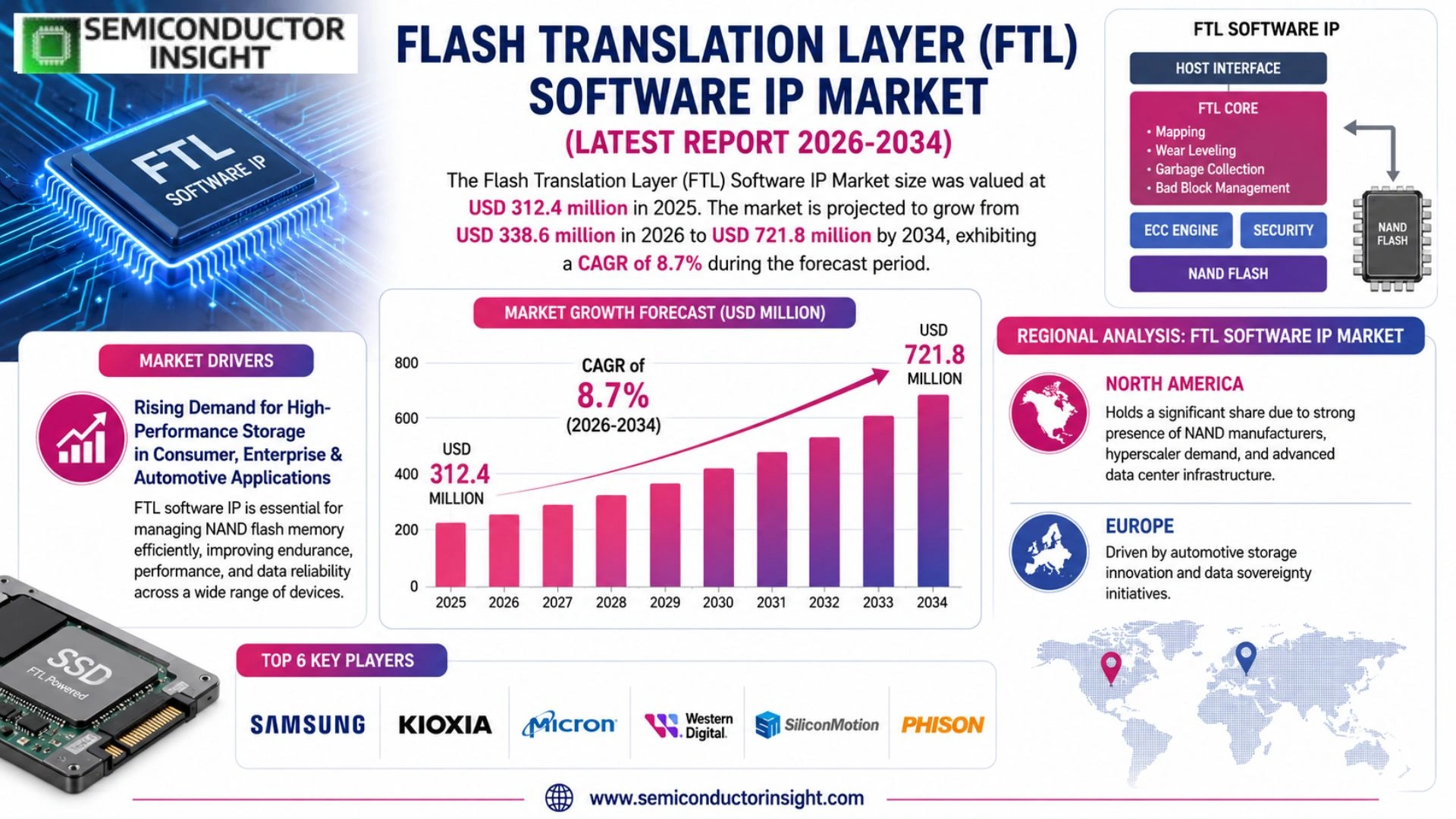
Flash Translation Layer (FTL) Software IP Market size was valued at USD 312.4 million in 2025. The market is projected to grow from USD 338.6 million in 2026 to USD 721.8 million by 2034, exhibiting a CAGR of 8.7% during the forecast period.
Flash Translation Layer (FTL) software IP refers to the firmware and intellectual property layer that manages the mapping between logical block addresses and physical NAND flash memory locations. This critical software component handles essential functions such as wear leveling, bad block management, garbage collection, and error correction, enabling reliable and high-performance operation of NAND flash-based storage devices including SSDs, eMMC, and UFS solutions. FTL IP is licensed to semiconductor manufacturers, storage OEMs, and SoC designers seeking to accelerate product development while reducing engineering overhead.
The market is gaining significant momentum driven by the surging global demand for NAND flash storage across consumer electronics, data centers, automotive, and industrial applications. Furthermore, the rapid proliferation of solid-state drives and the transition away from HDDs in enterprise environments are creating sustained demand for advanced FTL software IP. Key players such as Marvell Technology, Silicon Motion Technology, Phison Electronics, and Apacer Technology are actively investing in next-generation FTL IP development to address the growing complexity of QLC and PLC NAND architectures, further reinforcing the market’s growth trajectory through the forecast period.
MARKET DRIVERS
Surging Demand for NAND Flash Storage Across Consumer and Enterprise Segments
Flash Translation Layer (FTL) Software IP Market is experiencing robust growth, driven primarily by the accelerating global adoption of NAND flash-based storage solutions across a wide range of applications. As solid-state drives (SSDs), embedded flash modules, and UFS-based storage gain traction in consumer electronics, automotive systems, and enterprise data centers, the need for highly efficient and reliable FTL software intellectual property has intensified. Flash Translation Layer software serves as a critical abstraction layer that manages address mapping, wear leveling, and bad block management, making it indispensable to the performance and longevity of flash memory devices. The proliferation of smartphones, tablets, wearables, and IoT endpoints continues to generate consistent demand for optimized FTL IP solutions that can be seamlessly integrated into custom SoC designs.
Expansion of Data-Intensive Applications and AI-Driven Storage Workloads
The rapid expansion of artificial intelligence, machine learning, and big data analytics workloads is placing unprecedented pressure on storage subsystems, catalyzing demand for advanced Flash Translation Layer Software IP that can deliver low-latency, high-throughput performance. Enterprise NVMe SSD deployments, which rely heavily on sophisticated FTL algorithms for queue depth management and parallelism optimization, are scaling significantly across hyperscale data centers and cloud infrastructure providers. The increasing complexity of storage workloads demands FTL IP that goes beyond basic address translation to incorporate adaptive algorithms capable of dynamically balancing write amplification reduction and read performance optimization. This technological imperative is compelling semiconductor IP vendors and storage controller OEMs to invest heavily in next-generation FTL software IP development.
➤ As global data generation continues its exponential trajectory, Flash Translation Layer Software IP has evolved from a functional necessity into a strategic differentiator, with advanced wear-leveling and garbage collection algorithms directly influencing the competitive positioning of storage products in both consumer and enterprise markets.
The automotive sector represents another significant and fast-emerging driver for Flash Translation Layer (FTL) Software IP Market. The transition toward software-defined vehicles, advanced driver-assistance systems (ADAS), and in-vehicle infotainment platforms demands automotive-grade flash storage solutions that comply with stringent reliability and functional safety standards such as ISO 26262. FTL software IP tailored for automotive environments must address extended temperature ranges, endurance requirements, and data integrity under power-loss conditions, pushing IP vendors to develop specialized, certified FTL stacks. This sector-specific demand is broadening the total addressable market and opening new licensing opportunities for established and emerging FTL IP providers alike.
MARKET CHALLENGES
Technical Complexity of Developing High-Performance FTL Algorithms for Evolving NAND Flash Generations
One of the foremost challenges confronting participants Flash Translation Layer (FTL) Software IP Market is the escalating technical complexity associated with developing FTL algorithms compatible with successive generations of NAND flash technology. As the industry transitions through TLC and QLC NAND, and moves toward emerging 3D NAND architectures with increasing layer counts, the reliability and endurance characteristics of underlying flash media have become progressively more difficult to manage. Each new NAND generation introduces distinct error rates, program/erase cycle limitations, and cell-to-cell interference patterns that demand corresponding updates and validation of FTL software stacks. Maintaining a broad portfolio of FTL IP that is continuously validated across multiple NAND vendor process nodes represents a significant engineering and financial burden for software IP providers.
Other Challenges
Intellectual Property Protection and Licensing Model Complexity
The Flash Translation Layer Software IP ecosystem involves intricate licensing structures, with vendors offering a mix of royalty-based, one-time license fee, and hybrid models. Protecting proprietary FTL algorithms from reverse engineering and unauthorized replication remains a persistent concern, particularly as the market expands into regions with less rigorous IP enforcement frameworks. Ensuring that licensing agreements adequately cover derivative implementations and customizations introduced by licensees adds further legal and administrative complexity, increasing the operational overhead for IP vendors and potentially lengthening deal cycles with prospective customers.
Integration and Customization Demands from Diverse End-User Segments
Storage controller developers and SoC designers across consumer, industrial, and enterprise segments frequently require significant customization of off-the-shelf Flash Translation Layer Software IP to meet application-specific performance, power, and reliability targets. This demand for deep integration and bespoke modification stretches the engineering resources of FTL IP vendors and can delay time-to-market for end products. The challenge is compounded by the diversity of host interface standards , including NVMe, UFS, SATA, and eMMC , each requiring tailored FTL implementations. Balancing standardization of IP cores with the flexibility needed to support heterogeneous customer requirements is a fundamental operational challenge across Flash Translation Layer (FTL) Software IP Market.
MARKET RESTRAINTS
High Development and Validation Costs Limiting Participation of Smaller IP Vendors
Flash Translation Layer (FTL) Software IP Market faces a notable restraint in the form of substantial development and validation costs that create high barriers to entry for smaller and emerging IP vendors. Developing a production-grade FTL software stack requires extensive expertise in flash memory physics, error correction coding, and firmware engineering, in addition to access to a wide variety of NAND flash test vehicles from multiple manufacturers. Comprehensive validation across NAND process nodes, operating conditions, and host interface standards is both time-intensive and capital-intensive, effectively concentrating the market among a limited number of well-resourced incumbents. This dynamic restrains competitive diversity and can limit the pace of innovation within the broader Flash Translation Layer Software IP ecosystem.
In-House FTL Development by Large Storage Controller OEMs Reducing External IP Licensing Demand
A significant structural restraint on Flash Translation Layer (FTL) Software IP Market is the growing tendency among large storage controller original equipment manufacturers and vertically integrated semiconductor companies to develop proprietary FTL software stacks in-house rather than licensing third-party IP. Companies with sufficient engineering scale and NAND access programs have strategic incentives to internalize FTL development in order to achieve tighter hardware-software co-optimization, protect competitive differentiation, and avoid recurring licensing costs. This trend reduces the addressable external licensing market for independent FTL IP vendors, particularly in the high-performance enterprise SSD segment where controller companies tend to possess the resources required to sustain dedicated firmware development teams. The restraint is most pronounced in mature product categories, while greenfield opportunities remain stronger in specialized verticals such as automotive and industrial IoT storage.
MARKET OPPORTUNITIES
Growing Adoption of Computational Storage and Near-Data Processing Architectures
The emergence of computational storage devices and near-data processing architectures presents a compelling growth opportunity for Flash Translation Layer (FTL) Software IP Market. As the storage industry evolves toward devices that integrate processing capabilities directly alongside flash memory, the role of FTL software is expanding beyond traditional address translation and media management to encompass workload-aware optimization and data placement intelligence. FTL IP vendors that can offer modular, extensible software stacks compatible with computational storage frameworks stand to capture new licensing revenue streams from a market segment that is gaining significant traction in hyperscale and enterprise data center environments. This architectural shift creates demand for differentiated FTL IP that supports programmable storage semantics and open interfaces such as NVMe Zoned Namespaces (ZNS).
Expansion into Emerging Markets and Fabless Semiconductor Startups Targeting Custom Storage SoCs
The proliferation of fabless semiconductor startups targeting custom storage SoC designs for AIoT, edge computing, and smart infrastructure applications represents a significant untapped opportunity for Flash Translation Layer Software IP providers. These emerging companies typically lack the internal firmware expertise to develop production-ready FTL stacks from scratch and are natural candidates for third-party FTL IP licensing arrangements. Geographic expansion into high-growth semiconductor ecosystems in Asia-Pacific, particularly in China, South Korea, and Taiwan, where local NAND flash controller development activity is intensifying, offers additional addressable market potential. FTL IP vendors that can offer flexible, cost-competitive licensing terms alongside strong technical support and integration services are well-positioned to establish durable partnerships with this fast-growing customer segment withFlash Translation Layer (FTL) Software IP Market.
Flash Translation Layer (FTL) Software IP Market Trends
Rising Demand for NAND Flash Storage Driving Flash Translation Layer (FTL) Software IP Market Growth
Flash Translation Layer (FTL) Software IP Market is experiencing sustained momentum as global demand for NAND flash-based storage continues to accelerate across consumer electronics, enterprise data centers, automotive systems, and industrial applications. FTL software IP serves as the critical firmware layer managing the mapping between logical block addresses and physical NAND flash memory locations, enabling essential functions such as wear leveling, bad block management, garbage collection, and error correction. As storage device manufacturers seek to reduce engineering overhead and accelerate time-to-market, the adoption of licensed FTL IP from specialized vendors is becoming an increasingly preferred development strategy across the semiconductor and storage industries.
Other Trends
Transition to QLC and PLC NAND Architectures
One of the most prominent trends shaping Flash Translation Layer (FTL) Software IP Market is the growing adoption of Quad-Level Cell (QLC) and Penta-Level Cell (PLC) NAND architectures. These higher-density storage formats introduce greater complexity in data management, endurance limitations, and error correction requirements, placing increased demands on FTL software IP solutions. Leading market participants including Marvell Technology, Silicon Motion Technology, Phison Electronics, and Apacer Technology are actively investing in next-generation FTL IP to address these architectural challenges and maintain performance reliability in advanced storage devices.
Enterprise SSD Adoption Replacing HDDs
The rapid proliferation of solid-state drives in enterprise environments, driven by the ongoing transition away from traditional hard disk drives, is creating sustained demand for sophisticated Flash Translation Layer software IP. Enterprise SSDs require highly optimized FTL algorithms to deliver the performance, endurance, and data integrity levels expected in demanding data center workloads. This shift is directly reinforcing demand for advanced FTL IP licensing among storage OEMs and SoC designers.
Automotive and Industrial Application Expansion
Flash Translation Layer (FTL) Software IP Market is also benefiting from growing deployment of NAND flash storage in automotive and industrial environments, where stringent reliability, temperature resilience, and data integrity requirements make robust FTL IP indispensable. eMMC and UFS-based storage solutions used in automotive infotainment, advanced driver assistance systems, and industrial edge computing platforms increasingly rely on specialized FTL firmware IP to meet these demanding operational standards.
IP Licensing Model Gaining Traction Among Semiconductor Designers
As product development cycles shorten and NAND flash architectures grow more complex, semiconductor manufacturers and SoC designers are increasingly turning to FTL software IP licensing as a cost-effective alternative to in-house firmware development. This trend is broadening the customer base for Flash Translation Layer (FTL) Software IP Market participants, with FTL IP providers positioning their offerings as essential accelerators for storage product development across diverse end-use segments.
COMPETITIVE LANDSCAPE
Key Industry Players
Flash Translation Layer (FTL) Software IP Market: Competitive Dynamics and Leading Innovators Shaping Next-Generation NAND Storage Solutions
Flash Translation Layer (FTL) Software IP Market is characterized by a concentrated yet evolving competitive landscape, with a handful of dominant players commanding significant market share alongside a growing cohort of specialized IP licensors. Marvell Technology stands out as a leading force, leveraging its deep expertise in storage controller architecture and advanced FTL firmware to serve enterprise SSD and data center clients. Similarly, Silicon Motion Technology and Phison Electronics have established strong footholds by delivering robust FTL IP stacks that address the increasing complexity of QLC and PLC NAND architectures. These companies invest heavily in wear leveling algorithms, garbage collection optimization, and end-to-end data integrity mechanisms, positioning their IP portfolios as critical enablers for semiconductor manufacturers and storage OEMs seeking to accelerate time-to-market while minimizing internal engineering overhead.
Beyond the tier-one incumbents, several niche and mid-tier players contribute meaningfully to the competitive dynamics of the FTL Software IP Market. Apacer Technology has carved out a notable presence particularly in industrial and automotive-grade storage applications, where stringent reliability and endurance requirements demand highly specialized FTL implementations. Companies such as Greenliant Systems and Hyperstone focus on embedded and industrial NAND controller IP, offering tailored FTL solutions for mission-critical deployments. Meanwhile, emerging IP licensing firms and semiconductor IP vendors are intensifying competition by offering modular, customizable FTL IP cores compatible with leading SoC design flows. The entry of fabless SoC developers and the ongoing transition from HDD to SSD in enterprise environments continue to broaden the addressable customer base, compelling established players to differentiate through enhanced error correction capabilities, NVMe protocol support, and compatibility with next-generation 3D NAND geometries.
List of Key Flash Translation Layer (FTL) Software IP Companies Profiled
- Marvell Technology
- Silicon Motion Technology
- Phison Electronics
- Apacer Technology
- Greenliant Systems
- Hyperstone
- Nexflash (Winbond Electronics)
- Sage Microelectronics
- Kioxia Corporation
- Western Digital
- Micron Technology
- Samsung Semiconductor
- SK Hynix
- Longsys Electronics
- FORESEE (Shenzhen Longsys)
Segment Analysis:
| Segment Category | Sub-Segments | Key Insights |
| By Type |
|
Proprietary/Licensed FTL IP holds the leading position within the type segmentation of the Flash Translation Layer Software IP Market, driven by several compelling factors:
|
| By Application |
|
Solid-State Drives (SSD) represent the dominant application segment within the Flash Translation Layer Software IP Market, underpinned by a convergence of enterprise and consumer-driven demand factors:
|
| By End User |
|
Semiconductor Manufacturers constitute the leading end-user segment in the Flash Translation Layer Software IP Market, reflecting the foundational role that chip-level integration plays in the broader NAND flash storage ecosystem:
|
| By NAND Flash Architecture |
|
TLC (Triple-Level Cell) currently leads this segmentation as the most widely deployed NAND flash architecture requiring sophisticated FTL IP support, though QLC is rapidly emerging as a critical growth frontier:
|
| By Deployment Mode |
|
Device-Based FTL remains the dominant deployment mode across the Flash Translation Layer Software IP Market, owing to the inherent architectural and commercial advantages it offers across a broad range of storage applications:
|
Regional Analysis: Flash Translation Layer (FTL) Software IP Market
Asia-Pacific
Asia-Pacific hosts the world’s densest cluster of NAND flash manufacturers and storage controller developers. This ecosystem enables rapid co-development of FTL Software IP tailored to specific memory architectures, accelerating product cycles and ensuring that regional players consistently deliver optimized flash management solutions ahead of global competitors.
China’s national semiconductor strategy has catalyzed significant investment in homegrown FTL Software IP development. Local fabless design firms and state-backed research institutes are actively building proprietary flash translation layer algorithms, reducing reliance on Western licensing and creating a self-sustaining innovation pipeline withFlash Translation Layer (FTL) Software IP Market.
The region’s massive consumer electronics manufacturing base, spanning smartphones, tablets, and wearables, generates persistent demand for advanced FTL Software IP. High device shipment volumes require robust wear-leveling and garbage collection algorithms, making Asia-Pacific a primary driver of FTL Software IP licensing and integration at scale.
Japan and South Korea are advancing industrial and automotive-grade FTL Software IP to meet stringent reliability requirements in factory automation and connected vehicles. These high-value segments demand specialized flash management IP capable of enduring extreme operating conditions, positioning Asia-Pacific as the innovation center for next-generation FTL solutions.
North America
North America represents a critical and technologically sophisticated segment of Flash Translation Layer (FTL) Software IP Market. The United States, in particular, is home to a significant number of enterprise SSD developers, hyperscale data center operators, and semiconductor IP licensing firms that actively develop and commercialize advanced FTL Software IP. Silicon Valley and broader US tech corridors serve as hubs for FTL algorithm innovation, especially in the context of NVMe and high-performance enterprise storage applications. Canadian research universities also contribute foundational work in flash memory management that feeds into commercial FTL IP development. The region’s robust intellectual property framework encourages licensing-based business models, enabling specialized FTL Software IP vendors to monetize innovations globally. Enterprise adoption of data-intensive workloads including artificial intelligence, machine learning, and cloud computing continues to drive demand for high-endurance, low-latency FTL Software IP solutions across North American storage infrastructure deployments.
Europe
Europe occupies a strategically important position Flash Translation Layer (FTL) Software IP Market, primarily through its strengths in automotive electronics, industrial automation, and embedded systems design. Germany, Sweden, and the Netherlands host influential semiconductor and automotive-grade storage solution developers that require highly reliable FTL Software IP capable of meeting rigorous functional safety standards such as ISO 26262. European research institutions and universities contribute meaningfully to theoretical advancements in flash memory management algorithms, supporting a healthy pipeline of IP innovation. The region’s emphasis on data sovereignty and regulatory compliance under frameworks such as GDPR also influences the design priorities of FTL Software IP deployed in European enterprise environments. Additionally, Europe’s growing investment in defense electronics and smart infrastructure creates niche but expanding demand for ruggedized flash storage systems underpinned by specialized FTL Software IP architectures.
South America
South America remains an emerging yet gradually developing participant Flash Translation Layer (FTL) Software IP Market. Brazil leads the region in terms of electronics manufacturing and technology adoption, with its growing consumer electronics assembly sector creating incremental demand for flash storage solutions that incorporate FTL Software IP. Regional technology parks in São Paulo and Campinas are nurturing early-stage semiconductor design capabilities, though large-scale indigenous FTL Software IP development remains limited. Most demand in South America is currently met through imported storage solutions and licensed IP from North American and Asian providers. Nevertheless, as regional governments pursue digital transformation agendas and expand broadband infrastructure, the underlying demand for cost-effective flash memory management will gradually build a more receptive commercial environment for FTL Software IP adoption across enterprise and consumer segments throughout the forecast period.
Middle East & Africa
The Middle East and Africa region represents the nascent frontier of Flash Translation Layer (FTL) Software IP Market, characterized by foundational digital infrastructure development rather than indigenous IP creation. Gulf Cooperation Council nations, particularly the United Arab Emirates and Saudi Arabia, are investing substantially in smart city initiatives, cloud data centers, and digital government platforms, all of which rely on high-performance flash storage systems supported by sophisticated FTL Software IP. Africa’s rapidly expanding mobile internet user base drives consumer-facing demand for affordable flash-based devices, creating indirect market traction. While the region currently depends almost entirely on imported FTL Software IP from Asia-Pacific and North American vendors, strategic partnerships and knowledge transfer programs are beginning to establish a foundation for longer-term capability development. The region’s growth trajectory Flash Translation Layer (FTL) Software IP Market is expected to accelerate meaningfully as digital economy investments mature through 2034.
Report Scope
This market research report provides a comprehensive analysis of the Flash Translation Layer (FTL) Software IP Market , covering the forecast period 2026–2034. It offers detailed insights into market dynamics, technological advancements, competitive landscape, and key trends shaping the industry.
Key focus areas of the report include:
- Market Overview: The report begins with an overview outlining its current market scenario, key growth indicators, and industry transformation drivers. It discusses macroeconomic factors, demand–supply balance, regulatory landscape, and the strategic role of semiconductors in powering advancements across industries such as automotive, telecommunications, consumer electronics, and industrial automation.
- Market Size & Forecast: Historical data and future projections for revenue, unit shipments, and market value across major regions and segments.
- Segmentation Analysis: Detailed breakdown by product type, technology, application, and end-user industry to identify high-growth segments and investment opportunities.
- Regional Insights: Insights into market performance across North America, Europe, Asia-Pacific, Latin America, and the Middle East & Africa, including country-level analysis where relevant.
- Competitive Landscape: Profiles of leading market participants, including their product offerings, R&D focus, manufacturing capacity, pricing strategies, and recent developments such as mergers, acquisitions, and partnerships.
- Technology Trends & Innovation: Assessment of emerging technologies, integration of AI/IoT, semiconductor design trends, fabrication techniques, and evolving industry standards.
- Market Drivers & Restraints: Evaluation of factors driving market growth along with challenges, supply chain constraints, regulatory issues, and market-entry barriers.
- Stakeholder Insights: Insights for component suppliers, OEMs, system integrators, investors, and policymakers regarding the evolving ecosystem and strategic opportunities.
Primary and secondary research methods are employed, including interviews with industry experts, data from verified sources, and real-time market intelligence to ensure the accuracy and reliability of the insights presented.
FREQUENTLY ASKED QUESTIONS:
What is the current market size of Flash Translation Layer (FTL) Software IP Market?
-> Flash Translation Layer (FTL) Software IP Market was valued at USD 312.4 million in 2025 and is projected to grow from USD 338.6 million in 2026 to USD 721.8 million by 2034, exhibiting a CAGR of 8.7% during the forecast period.
Which key companies operate Flash Translation Layer (FTL) Software IP Market?
-> Key players include Marvell Technology, Silicon Motion Technology, Phison Electronics, and Apacer Technology, among others.
What are the key growth drivers?
-> Key growth drivers include surging global demand for NAND flash storage across consumer electronics, data centers, automotive, and industrial applications, as well as the rapid proliferation of solid-state drives and the transition away from HDDs in enterprise environments.
Which region dominates the market?
-> Asia-Pacific is the fastest-growing region, driven by strong semiconductor manufacturing capabilities, while North America remains a significant market due to high enterprise SSD adoption and data center investments.
What are the emerging trends?
-> Emerging trends include next-generation FTL IP development for QLC and PLC NAND architectures, increased licensing of FTL software IP by SoC designers and storage OEMs, and the integration of advanced wear leveling, bad block management, garbage collection, and error correction technologies to support high-performance SSDs, eMMC, and UFS solutions.

Get Sample Report PDF for Exclusive Insights
Report Sample Includes
- Table of Contents
- List of Tables & Figures
- Charts, Research Methodology, and more...
 Download Sample Report PDF