Fingerprint Sensor (Capacitive, Ultrasonic, Optical) Market Insights
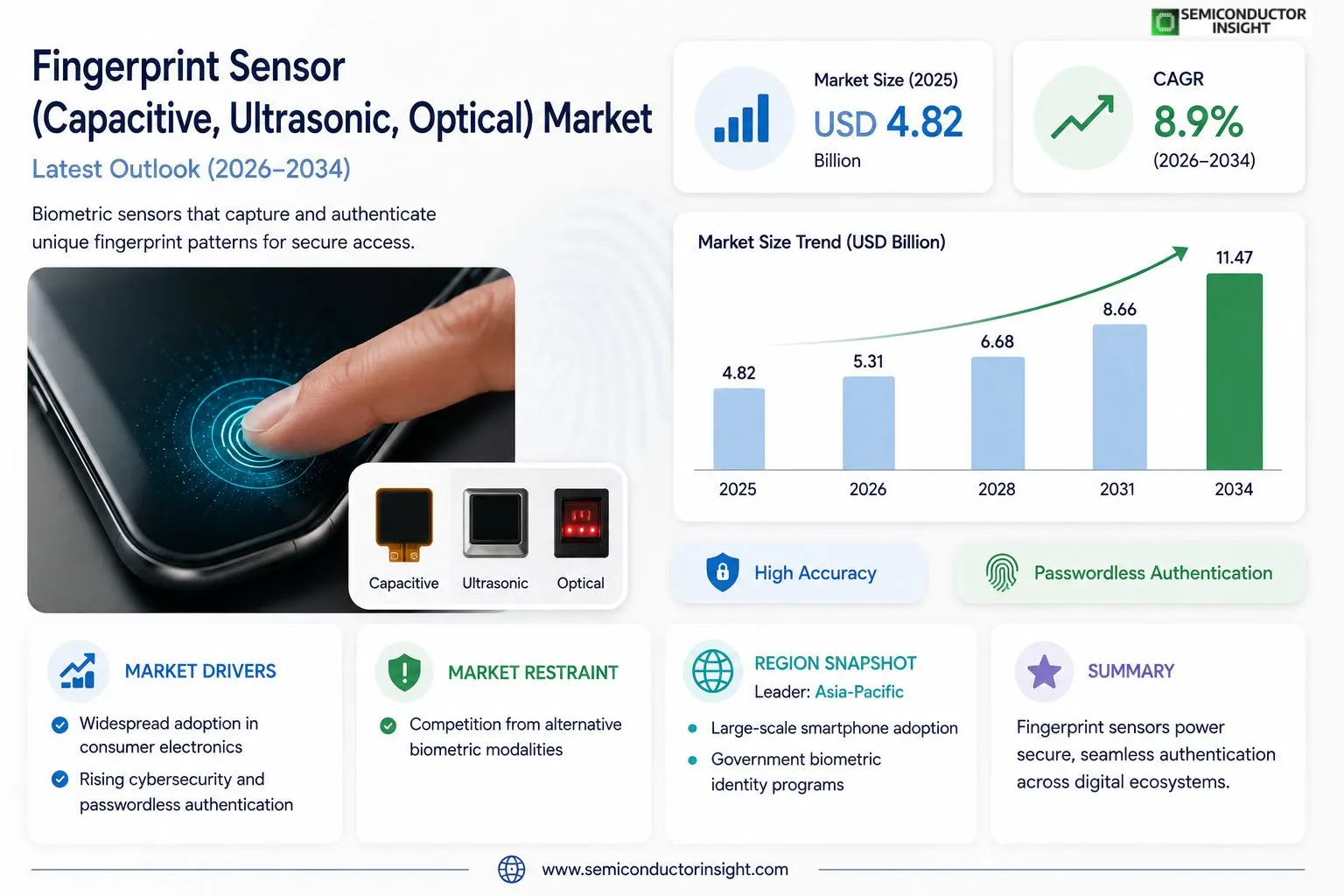
Global fingerprint sensor market size was valued at USD 4.82 billion in 2025. The market is projected to grow from USD 5.31 billion in 2026 to USD 11.47 billion by 2034, exhibiting a CAGR of 8.9% during the forecast period.
Fingerprint sensors are biometric security devices that capture and authenticate unique ridge patterns on an individual’s fingertip. These sensors operate through three primary technologies: capacitive sensors, which detect electrical differences between ridges and valleys; ultrasonic sensors, which use high-frequency sound waves to create a detailed 3D image of the fingerprint; and optical sensors, which rely on light reflection to capture fingerprint images. Each technology offers distinct advantages in terms of accuracy, security depth, and form factor compatibility.
The market is experiencing robust growth driven by the widespread adoption of biometric authentication across consumer electronics, banking, government identity programs, and access control systems. The rapid proliferation of smartphones equipped with under-display fingerprint sensors , particularly ultrasonic variants , has significantly accelerated demand. Furthermore, rising cybersecurity concerns and Global push toward passwordless authentication frameworks are reinforcing market expansion. Key players operating in this space include Qualcomm Technologies, Inc., Egis Technology Inc., Synaptics Incorporated, IDEX Biometrics ASA, and Goodix Technology, all of which maintain extensive product portfolios spanning multiple sensor technologies.
MARKET DRIVERS
Rising Demand for Biometric Authentication Across Consumer Electronics
Fingerprint Sensor (Capacitive, Ultrasonic, Optical) Market has experienced significant momentum driven by the widespread integration of biometric authentication technologies in smartphones, tablets, and wearable devices. As consumers and enterprises increasingly prioritize device security and seamless user experience, original equipment manufacturers (OEMs) have accelerated the adoption of advanced fingerprint sensing technologies. Capacitive sensors, long dominant in the mid-range smartphone segment, continue to serve as a reliable and cost-effective solution, while ultrasonic and optical variants have gained traction in premium device categories where under-display sensing capabilities are essential.
Government-Led Digital Identity and Security Initiatives Fueling Adoption
National identity programs, e-passport deployments, and border control modernization projects across Asia-Pacific, Europe, and North America have emerged as critical drivers of the fingerprint sensor market. Governments are mandating biometric verification in voter registration systems, national ID cards, and law enforcement databases, creating sustained institutional demand. The adoption of fingerprint sensors in Aadhaar-linked services in India, as well as similar initiatives across Southeast Asia and Africa, has substantially expanded the addressable market beyond consumer electronics into large-scale public-sector deployments.
➤ The increasing deployment of fingerprint sensors in banking, fintech, and digital payments infrastructure is reinforcing the market’s growth trajectory, as financial institutions integrate biometric authentication to meet regulatory compliance requirements and reduce identity fraud across digital transaction channels.
The proliferation of mobile banking and digital payment platforms has further amplified demand for reliable, high-accuracy fingerprint authentication. Financial service providers are leveraging optical and ultrasonic fingerprint sensors to enable secure, frictionless customer onboarding and transaction authorization. This trend is particularly pronounced in emerging markets where smartphone-based financial services are outpacing traditional banking infrastructure, creating a robust and expanding demand base for Fingerprint Sensor (Capacitive, Ultrasonic, Optical) Market.
MARKET CHALLENGES
Technical Limitations and Performance Variability Across Sensor Technologies
Despite rapid advancements, Fingerprint Sensor (Capacitive, Ultrasonic, Optical) Market continues to face notable technical challenges that constrain broader adoption and user trust. Optical sensors, while enabling competitive under-display integration, remain susceptible to performance degradation under varying ambient light conditions and exhibit vulnerability to spoofing using high-resolution fingerprint replicas. Capacitive sensors, although mature in technology, face limitations in wet or dry environmental conditions that reduce read accuracy and increase false rejection rates. These inconsistencies in real-world performance create friction in user experience and can undermine confidence in biometric authentication systems, particularly in critical applications such as healthcare and financial services.
Other Challenges
High Development and Integration Costs for Ultrasonic Sensors
Ultrasonic fingerprint sensors, while technically superior in terms of accuracy and spoofing resistance, involve considerably higher manufacturing and integration costs compared to capacitive and optical alternatives. This cost differential limits their deployment primarily to flagship-tier devices, restricting market penetration in price-sensitive segments and geographies. For mass-market adoption to materialize, further cost reduction through economies of scale and process innovation remains a prerequisite.
Data Privacy Regulations and Biometric Data Governance
Increasingly stringent data privacy regulations, including the General Data Protection Regulation (GDPR) in Europe, the California Consumer Privacy Act (CCPA), and emerging biometric-specific legislation in multiple jurisdictions, present compliance challenges for companies operating in Fingerprint Sensor (Capacitive, Ultrasonic, Optical) Market. The collection, storage, and processing of biometric data carry significant legal and reputational risks, requiring manufacturers and solution providers to invest in secure data architectures, on-device processing capabilities, and transparent user consent frameworks to remain compliant and maintain consumer trust.
MARKET RESTRAINTS
Commoditization Pressures and Intensifying Price Competition Among Sensor Manufacturers
The maturation of capacitive fingerprint sensor technology has led to significant commoditization within Fingerprint Sensor (Capacitive, Ultrasonic, Optical) Market, particularly in the mid- and entry-level device segments. As a growing number of manufacturers, especially those based in China and Taiwan, offer functionally comparable capacitive sensor modules at competitive price points, average selling prices have experienced sustained downward pressure. This dynamic compresses profit margins across the supply chain and disincentivizes investment in incremental innovation for established sensor form factors, potentially slowing the pace of overall market advancement.
Competition from Alternative Biometric Authentication Modalities
Fingerprint Sensor (Capacitive, Ultrasonic, Optical) Market faces growing competitive pressure from alternative biometric authentication technologies, most notably facial recognition and iris scanning. Leading smartphone OEMs have invested heavily in 3D facial recognition systems that offer a contactless, high-accuracy authentication experience, which has resonated strongly with consumers particularly in the post-pandemic period when hygiene concerns elevated interest in touchless interfaces. As facial recognition and behavioral biometrics technologies continue to mature and their integration costs decline, they represent a meaningful restraint on fingerprint sensor adoption, especially in the premium consumer electronics segment where differentiation is paramount.
MARKET OPPORTUNITIES
Expansion into Automotive, Healthcare, and Smart Infrastructure Applications
Beyond consumer electronics, Fingerprint Sensor (Capacitive, Ultrasonic, Optical) Market is poised to capitalize on substantial growth opportunities in the automotive, healthcare, and smart infrastructure sectors. In the automotive industry, fingerprint sensors are being integrated into vehicle access systems, driver authentication platforms, and personalized in-cabin experience controls, driven by the broader transition toward connected and autonomous vehicles. Healthcare applications, including patient identification, controlled substance dispensing, and secure access to electronic health records, represent a growing demand vertical where accuracy and hygiene-compliant sensing solutions are increasingly valued.
Advancements in Under-Display Sensing and Large-Area Optical Technologies
Technological innovation in large-area optical and ultrasonic fingerprint sensing represents a significant commercial opportunity for leading participants in Fingerprint Sensor (Capacitive, Ultrasonic, Optical) Market. The development of sensors capable of capturing fingerprint data across an expanded display area , rather than a fixed, small sensing zone , enables new use case paradigms, including multi-finger authentication and palm-based vein recognition. Manufacturers investing in next-generation sensor architectures that deliver improved accuracy, faster processing speeds, and enhanced anti-spoofing performance are well-positioned to capture premium market share as OEMs seek differentiated biometric features for flagship and mid-premium device categories.
Emerging Market Penetration Through Affordable Biometric Access Control Solutions
Rising smartphone penetration, increasing digitization of financial services, and expanding government-led identity verification programs across emerging economies in Africa, South Asia, and Latin America present substantial long-term growth opportunities for Fingerprint Sensor (Capacitive, Ultrasonic, Optical) Market. As device manufacturers introduce competitively priced smartphones equipped with fingerprint authentication capabilities to these markets, and as enterprises deploy biometric-enabled access control systems for workforce management and physical security, the addressable market base is expected to broaden significantly. Players that can deliver reliable, cost-optimized fingerprint sensing solutions tailored to the environmental and connectivity conditions prevalent in these regions will be strongly positioned to benefit from this secular growth opportunity.
Fingerprint Sensor (Capacitive, Ultrasonic, Optical) Market Trends
Rising Adoption of Under-Display Fingerprint Sensors in Consumer Electronics
One of the most prominent trends shaping Fingerprint Sensor (Capacitive, Ultrasonic, Optical) Market is the accelerating integration of under-display fingerprint sensors in smartphones and consumer devices. Ultrasonic fingerprint sensors, in particular, have gained significant traction due to their ability to generate a detailed three-dimensional image of the fingerprint using high-frequency sound waves, enabling authentication even through wet or dirty fingers. Leading smartphone manufacturers have progressively shifted toward ultrasonic under-display solutions, moving away from conventional capacitive side-mounted sensors. This transition reflects both enhanced security performance and evolving industrial design preferences that favor full-screen form factors.
Other Trends
Expansion of Biometric Authentication in Banking and Financial Services
The banking and financial services sector is increasingly deploying fingerprint sensor technology to strengthen customer identity verification and transaction authentication. Capacitive fingerprint sensors remain widely used in payment cards and point-of-sale terminals due to their compact form factor, cost efficiency, and reliable accuracy under standard conditions. Global push toward passwordless authentication frameworks, driven by regulatory mandates and rising fraud incidents, has prompted financial institutions to integrate biometric verification at multiple customer touchpoints, broadening the addressable market for fingerprint sensor manufacturers.
Government Identity Programs Fueling Demand for Optical Sensors
National identity programs, border control systems, and civil registration initiatives across emerging economies continue to drive demand for optical fingerprint sensors. Optical sensors, which use light reflection to capture high-resolution fingerprint images, are preferred in large-scale enrollment environments due to their affordability and scalability. Governments across Asia-Pacific, Latin America, and Africa are actively expanding digital identity infrastructure, creating sustained procurement opportunities for optical sensor suppliers and system integrators operating in Fingerprint Sensor (Capacitive, Ultrasonic, Optical) Market.
Cybersecurity Concerns Accelerating Passwordless Authentication Adoption
Escalating cybersecurity threats and the documented vulnerabilities of password-based systems are reinforcing enterprise and consumer interest in fingerprint-based authentication. Organizations across healthcare, enterprise IT, and critical infrastructure are deploying access control systems embedded with capacitive and ultrasonic fingerprint sensors to mitigate unauthorized access risks. Key industry participants, including Qualcomm Technologies, Synaptics Incorporated, Goodix Technology, Egis Technology, and IDEX Biometrics, continue to innovate across all three sensor technologies , capacitive, ultrasonic, and optical , to address the evolving security requirements of diverse end-use applications.
COMPETITIVE LANDSCAPE
Key Industry Players
Fingerprint Sensor (Capacitive, Ultrasonic, Optical) Market , Competitive Intelligence and Strategic Player Analysis
Global fingerprint sensor market, valued at USD 4.82 billion in 2025 and projected to reach USD 11.47 billion by 2034 at a CAGR of 8.9%, is characterized by intense competition among a diversified set of technology providers spanning capacitive, ultrasonic, and optical sensing modalities. Qualcomm Technologies, Inc. commands a significant position in the ultrasonic fingerprint sensor segment through its Snapdragon Sense ID platform, which has been widely adopted by leading smartphone original equipment manufacturers seeking high-security, under-display authentication solutions. Goodix Technology has emerged as a formidable competitor, capturing substantial market share in the optical under-display fingerprint sensor space particularly within the Asia-Pacific smartphone ecosystem. Synaptics Incorporated leverages its long-standing expertise in human interface solutions to offer a broad portfolio of optical and capacitive fingerprint sensors targeting both mobile and PC applications. IDEX Biometrics ASA has distinguished itself through its flexible, low-power capacitive sensor technology designed specifically for smart card and IoT biometric authentication use cases, positioning it well within the rapidly expanding fintech and secure access verticals.
Beyond the dominant players, several specialized companies contribute meaningfully to the competitive dynamics of the fingerprint sensor industry. Egis Technology Inc. maintains a robust presence across capacitive and optical sensor segments, supplying solutions to a wide range of consumer electronics and access control customers across Asia and beyond. AuthenTec, now integrated within Apple Inc.’s supply chain legacy, laid foundational groundwork for capacitive Touch ID technology, influencing subsequent industry standards. Fingerprint Cards AB (FPC), headquartered in Sweden, continues to be a key supplier of biometric sensor modules to global smartphone manufacturers and has been aggressively expanding into smart card and automotive authentication markets. Shenzhen Goodix Technology, BioEnable Technologies, and Next Biometrics Group further diversify the competitive field by addressing niche segments including government identity programs, enterprise access control, and ruggedized biometric devices. The market’s competitive intensity is further amplified by continuous R&D investment in liveness detection, anti-spoofing algorithms, and sensor miniaturization, as leading players race to deliver enhanced security performance and seamless form factor integration across an expanding array of end-use applications.
List of Key Fingerprint Sensor Companies Profiled
- Qualcomm Technologies, Inc.
- Goodix Technology Co., Ltd.
- Synaptics Incorporated
- IDEX Biometrics ASA
- Egis Technology Inc.
- Fingerprint Cards AB (FPC)
- Next Biometrics Group ASA
- Aware, Inc.
- BioEnable Technologies Pvt. Ltd.
- Suprema Inc.
- HID Global Corporation
- Precise Biometrics AB
- Validity Sensors, Inc.
- Shenzhen Silead Inc.
- CrucialTec Co., Ltd.
Segment Analysis:
| Segment Category | Sub-Segments | Key Insights |
| By Type |
|
Ultrasonic Fingerprint Sensors are rapidly emerging as the most technologically advanced and preferred sensor type in Global market, driven by several compelling factors:
|
| By Application |
|
Consumer Electronics stands as the dominant application segment, anchoring demand across the fingerprint sensor market through a broad range of end devices and use cases:
|
| By End User |
|
Individual Consumers represent the largest end-user base in the fingerprint sensor market, underpinned by the ubiquity of biometric-enabled personal devices:
|
| By Technology Integration |
|
Integrated / Embedded Fingerprint Sensors dominate this segment as device manufacturers increasingly favor seamless, space-efficient biometric solutions:
|
| By Deployment Mode |
|
On-Device (Edge) Processing is the leading deployment mode in the fingerprint sensor market, favored for its privacy-preserving architecture and low-latency authentication:
|
Regional Analysis: Fingerprint Sensor (Capacitive, Ultrasonic, Optical) Market
Asia-Pacific
Asia-Pacific’s consumer electronics sector continues to be the primary engine propelling demand for capacitive, ultrasonic, and optical fingerprint sensors. The region’s leading smartphone brands are consistently pioneering the integration of advanced under-display and side-mounted biometric solutions, reinforcing Asia-Pacific’s position as the most dynamic and innovation-driven market for fingerprint sensor adoption globally.
Across Asia-Pacific, national digital identity and e-governance programs are accelerating the deployment of fingerprint sensor technologies at scale. India’s biometric identity ecosystem, China’s smart city frameworks, and various ASEAN-region border management systems are each creating sustained institutional demand for reliable optical and capacitive fingerprint sensing solutions integrated into secure public infrastructure.
The region hosts a highly concentrated and vertically integrated supply chain for fingerprint sensor production, encompassing semiconductor fabrication, sensor module assembly, and component sourcing. This manufacturing depth provides Asia-Pacific-based producers with significant cost and scale advantages, enabling rapid iteration of capacitive, ultrasonic, and optical fingerprint sensor designs aligned with evolving global market requirements.
Research and development investment in ultrasonic and optical fingerprint sensor technologies is particularly intense across South Korea, Japan, and China. Leading display manufacturers and semiconductor firms are collaborating to refine under-display fingerprint sensing accuracy and response speed, positioning Asia-Pacific as the primary source of next-generation biometric innovations that will define global product roadmaps through the forecast period.
North America
North America represents one of the most mature and technologically sophisticated regional markets for Fingerprint Sensor (Capacitive, Ultrasonic, Optical) Market. The United States, in particular, leads regional demand through widespread adoption of biometric authentication across enterprise security, financial services, healthcare, and consumer electronics segments. Leading American technology companies have been instrumental in mainstreaming fingerprint sensor integration, particularly in premium smartphones and laptops, while also driving demand for ultrasonic fingerprint sensing solutions that offer enhanced security and performance in challenging conditions. Regulatory frameworks emphasizing data privacy and identity verification in sectors such as banking and healthcare further stimulate market uptake. Canada also contributes meaningfully to regional growth through border security modernization and enterprise access control deployments. The region’s focus on high-security, high-accuracy biometric solutions ensures continued investment in advanced capacitive and ultrasonic fingerprint sensor technologies, with innovation partnerships between technology firms and government agencies further shaping the competitive landscape through 2034.
Europe
Europe occupies a significant position in Global Fingerprint Sensor (Capacitive, Ultrasonic, Optical) Market, characterized by strong regulatory emphasis on data security, privacy compliance, and biometric standards. The General Data Protection Regulation (GDPR) has shaped the manner in which fingerprint sensor solutions are designed and deployed across the region, encouraging privacy-by-design approaches that favor secure, on-device biometric processing. Germany, the United Kingdom, France, and the Nordic countries are among the most active adopters of fingerprint sensor technologies in applications ranging from mobile payments and smart access control to government-issued digital identity documents. The European banking sector’s accelerating digital transformation is generating consistent demand for optical and capacitive fingerprint sensors as part of strong customer authentication protocols. Additionally, European automotive manufacturers are increasingly integrating biometric authentication systems into next-generation vehicle platforms, opening a promising new application frontier for the fingerprint sensor industry across the region through the forecast period.
South America
South America is an emerging growth market within Global Fingerprint Sensor (Capacitive, Ultrasonic, Optical) Market, with demand primarily driven by expanding smartphone adoption, government-sponsored digital identity initiatives, and the modernization of financial services infrastructure. Brazil stands as the region’s largest and most influential market, benefiting from extensive rollout of biometric voter registration systems and the rapid digitization of banking and payment services that rely on fingerprint-based authentication. Argentina, Colombia, and Chile are also demonstrating growing interest in biometric access control and mobile authentication solutions. While the region’s market remains at an earlier stage of maturity compared to North America and Asia-Pacific, the ongoing expansion of affordable smartphones equipped with optical and capacitive fingerprint sensors is progressively broadening consumer access to biometric security. As economic conditions stabilize and digital infrastructure investments accelerate, South America is expected to represent an increasingly attractive opportunity for fingerprint sensor market participants through 2034.
Middle East & Africa
The Middle East & Africa region presents a diverse and evolving landscape for Fingerprint Sensor (Capacitive, Ultrasonic, Optical) Market, with growth driven by distinct but complementary forces across its constituent sub-regions. In the Middle East, Gulf Cooperation Council nations are investing substantially in smart city infrastructure, digital government services, and secure border management systems, all of which incorporate advanced fingerprint sensor technologies. The UAE and Saudi Arabia, in particular, are deploying optical and capacitive biometric systems across public administration, healthcare, and financial services at a notable pace. Africa, while at a comparatively earlier stage of market development, is experiencing growing demand for fingerprint-based authentication through mobile banking expansion, digital identity programs, and national ID initiatives spanning countries such as Nigeria, Kenya, and South Africa. The region’s youthful and rapidly urbanizing population, combined with increasing smartphone penetration and government commitment to digital transformation, positions Middle East & Africa as a long-term growth frontier for fingerprint sensor market stakeholders through the 2026–2034 forecast period.
Report Scope
This market research report provides a comprehensive analysis of the Fingerprint Sensor (Capacitive, Ultrasonic, Optical) Market , covering the forecast period 2026–2034. It offers detailed insights into market dynamics, technological advancements, competitive landscape, and key trends shaping the industry.
Key focus areas of the report include:
-
Market Overview: The report begins with an overview outlining its current market scenario, key growth indicators, and industry transformation drivers. It discusses macroeconomic factors, demand–supply balance, regulatory landscape, and the strategic role of semiconductors in powering advancements across industries such as automotive, telecommunications, consumer electronics, and industrial automation.
- Market Size & Forecast: Historical data and future projections for revenue, unit shipments, and market value across major regions and segments.
- Segmentation Analysis: Detailed breakdown by product type, technology, application, and end-user industry to identify high-growth segments and investment opportunities.
- Regional Insights: Insights into market performance across North America, Europe, Asia-Pacific, Latin America, and the Middle East & Africa, including country-level analysis where relevant.
- Competitive Landscape: Profiles of leading market participants, including their product offerings, R&D focus, manufacturing capacity, pricing strategies, and recent developments such as mergers, acquisitions, and partnerships.
- Technology Trends & Innovation: Assessment of emerging technologies, integration of AI/IoT, semiconductor design trends, fabrication techniques, and evolving industry standards.
- Market Drivers & Restraints: Evaluation of factors driving market growth along with challenges, supply chain constraints, regulatory issues, and market-entry barriers.
- Stakeholder Insights: Insights for component suppliers, OEMs, system integrators, investors, and policymakers regarding the evolving ecosystem and strategic opportunities.
Primary and secondary research methods are employed, including interviews with industry experts, data from verified sources, and real-time market intelligence to ensure the accuracy and reliability of the insights presented.
FREQUENTLY ASKED QUESTIONS:
What is the current market size of Fingerprint Sensor (Capacitive, Ultrasonic, Optical) Market?
-> Global fingerprint sensor market size was valued at USD 4.82 billion in 2025. The market is projected to grow from USD 5.31 billion in 2026 to USD 11.47 billion by 2034, exhibiting a CAGR of 8.9% during the forecast period.
Which key companies operate in Fingerprint Sensor (Capacitive, Ultrasonic, Optical) Market?
-> Key players include Qualcomm Technologies, Inc., Egis Technology Inc., Synaptics Incorporated, IDEX Biometrics ASA, and Goodix Technology, among others, all of which maintain extensive product portfolios spanning multiple sensor technologies.
What are the key growth drivers?
-> Key growth drivers include widespread adoption of biometric authentication across consumer electronics, banking, government identity programs, and access control systems, as well as the rapid proliferation of smartphones equipped with under-display fingerprint sensors and rising cybersecurity concerns driving Global push toward passwordless authentication frameworks.
Which region dominates the market?
-> Asia-Pacific is the fastest-growing region, driven by large-scale smartphone adoption and government biometric identity programs, while North America remains a significant market due to strong demand in banking and enterprise security sectors.
What are the emerging trends?
-> Emerging trends include under-display ultrasonic fingerprint sensors in smartphones, integration of AI-powered fingerprint recognition, growing adoption of optical sensors in banking and fintech applications, and the advancement of capacitive sensor technology for secure access control and government identity programs.

Get Sample Report PDF for Exclusive Insights
Report Sample Includes
- Table of Contents
- List of Tables & Figures
- Charts, Research Methodology, and more...
 Download Sample Report PDF