Fiber Raman Amplifier (FRA) Market Insights
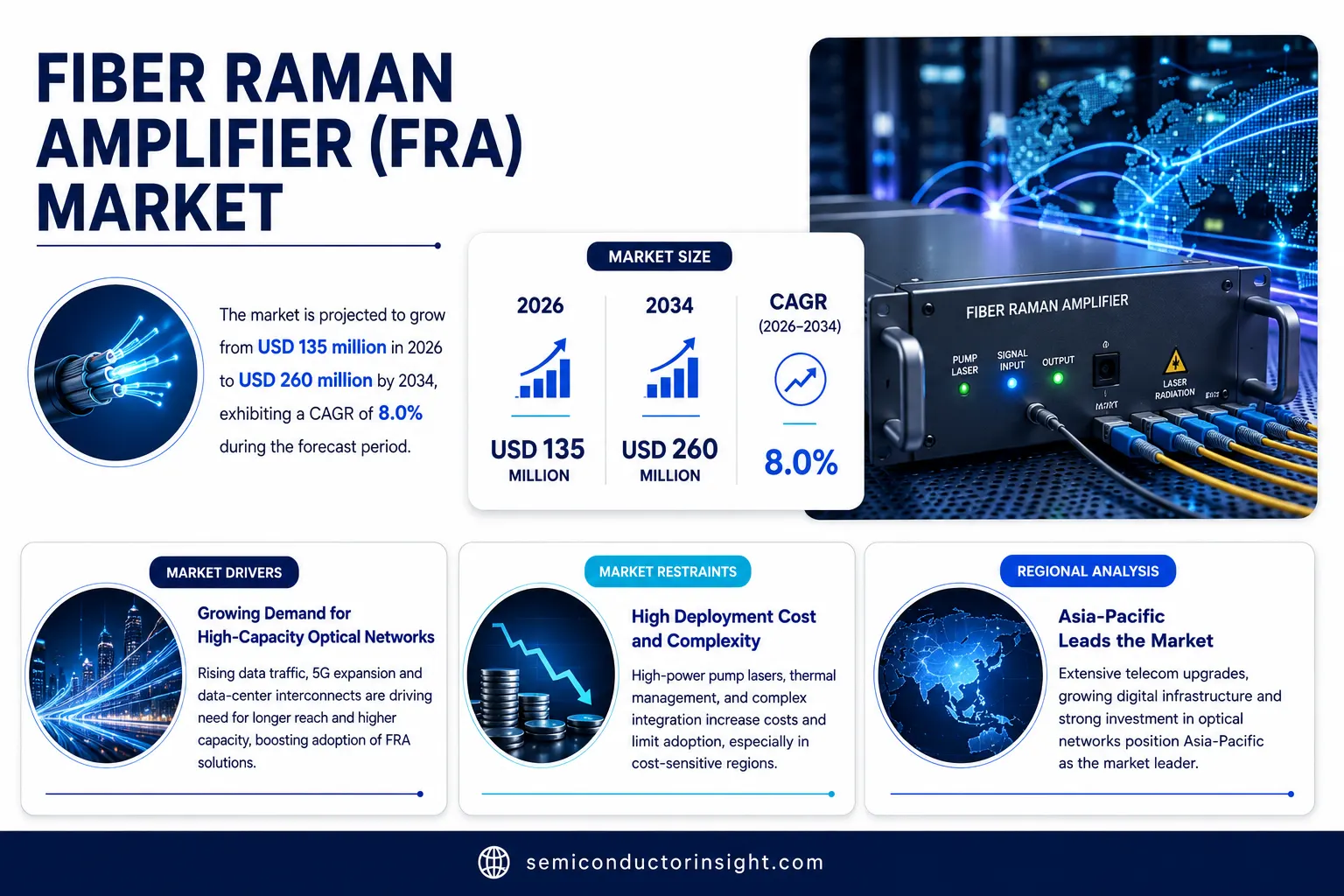
Fiber Raman Amplifier (FRA) market size was valued at USD 130 million in 2025. The market is projected to grow from USD 135 million in 2026 to USD 260 million by 2034, exhibiting a CAGR of 8.0% during the forecast period.
An FRA is a type of optical‑fiber amplifier that relies on stimulated Raman scattering when intense pump light propagates through silica fiber. The resulting gain band appears roughly 100 nm longer than the pump wavelength, offering a broad amplification window that can be tuned simply by adjusting the pump source.The expansion of high‑capacity long‑haul networks, rising data‑center interconnect traffic, and emerging laser‑radar applications are fueling demand for FRA technology. Telecommunications operators adopt FRA modules to extend reach without regenerators, while cloud providers leverage its low‑noise characteristics for ultra‑dense wavelength‑division multiplexing links. Recent product introductions from MPB Communications, Lumentum and II‑VI illustrate industry momentum, and collaborations aimed at integrating FRA into next‑generation quantum‑communication testbeds underscore its growing strategic relevance.
MARKET DRIVERS
Growing Demand for High‑Capacity Optical Networks
The surge in data‑center interconnects, 5G backhaul and edge‑computing workloads compels operators to stretch the capacity of existing fiber infrastructure. Fiber Raman Amplifier (FRA) Market solutions enable span extensions without the need for additional regenerator sites, thereby preserving the economics of long‑haul deployments. Vendors that can demonstrate seamless integration with coherent transceivers are capturing the attention of carriers looking to defer costly fiber upgrades.
Advances in Raman Gain Efficiency
Recent breakthroughs in pump‑laser architectures and distributed‑feedback designs have lifted Raman gain coefficients by roughly 30 % compared with a decade ago. This efficiency lift reduces the total pump power budget, allowing service providers to achieve comparable amplification using fewer hardware modules. The operational savings associated with lower electricity consumption are becoming a decisive argument for network planners.
➤ “Raman‑based gain profiles can be tailored in‑situ, granting operators a level of spectral agility that EDFAs simply cannot match.”
Beyond technical merits, the flexibility of Raman‑based amplification aligns with the shift toward software‑defined networking. Operators can program gain spectra through centralized controllers, supporting dynamic bandwidth allocation across multiple services without physical re‑engineering. This convergence of hardware efficiency and software control is a core catalyst for market expansion.
MARKET CHALLENGES
Technical Hurdles and Deployment Costs
While Raman amplification offers spectral flexibility, the requirement for high‑power pump lasers introduces thermal management challenges. Integrators must provision adequate cooling, which adds to capex and complicates rack‑space planning in dense carrier facilities. Moreover, the non‑linear interaction between pump and signal can generate unwanted noise, demanding sophisticated digital‑signal‑processing algorithms that increase system complexity.
Other Challenges
Standardization Gaps
Industry bodies have yet to converge on a unified set of performance metrics for FRA deployments. The absence of harmonized standards hampers cross‑vendor interoperability, forcing operators to commit to a single supplier ecosystem and limiting the competitive pressure that would otherwise drive price reductions.Supply‑chain volatility for rare‑earth dopants used in high‑efficiency pump modules further raises procurement risk. Vendors that can secure long‑term material contracts are better positioned to offer stable pricing to end users.
MARKET RESTRAINTS
Regulatory and Safety Constraints
Raman amplifiers operate with pump powers that can exceed safety thresholds defined by national telecommunications authorities. Operators must implement extensive monitoring and interlock systems to remain compliant, inflating installation timelines. In regions with stringent electromagnetic‑emission standards, the additional shielding required for high‑power pumps can become a decisive factor against FRA adoption.Furthermore, the environmental assessment process for new fiber routes now incorporates a broader set of criteria, including energy‑efficiency benchmarks. Projects that cannot demonstrate a clear reduction in carbon footprint relative to legacy EDFAs may face delayed approvals or denial.
MARKET OPPORTUNITIES
Emerging Applications in Quantum Communications
Quantum‑key‑distribution networks rely on ultra‑low‑noise amplification to preserve photon coherence over long distances. Raman‑based amplifiers, with their inherent broadband and low‑ASE characteristics, are uniquely suited to this niche. Early pilots in Europe and Asia indicate that integrating FRA technology can extend quantum channel reach by up to 40 %, unlocking commercial viability for secure communication services.In addition, the rollout of space‑division multiplexing (SDM) fibers presents a fresh market segment. By distributing pump power across multiple cores, Raman amplification can support the tremendous aggregate capacity that SDM promises, creating a new revenue stream for equipment manufacturers willing to engineer multi‑core pump distribution schemes.
Fiber Raman Amplifier (FRA) Market Trends
Escalating Need for Ultra‑Long‑Reach Optical Links
The surge in data traffic generated by cloud services, video streaming, and industrial IoT is pressuring network operators to extend reach without adding repeaters. Fiber Raman Amplifier (FRA) technology meets this pressure by delivering gain over a broad spectral window that can be aligned with the pump source, allowing carriers to span continents with fewer regeneration points. Operators are therefore favoring FRA in under‑sea and terrestrial trunks where cost per kilometre is a decisive factor. This shift reduces capital expenditure on intermediate equipment while preserving signal integrity, creating a compelling business case for vendors that can integrate Raman modules with existing DWDM platforms.
Other Trends
Emerging Roles in Quantum‑Secure Communications
Quantum key distribution networks demand ultra‑low noise amplification to preserve photon statistics across long distances. The broadband nature of Raman gain, combined with its ability to be deployed in a distributed fashion, positions FRA as a viable candidate for extending quantum channels beyond the limits of conventional erbium‑doped amplifiers. Early pilots in Europe and Asia have demonstrated that Raman‑based repeaters can maintain entanglement fidelity over 200 km, prompting research labs and equipment makers to explore hybrid architectures that blend quantum‑compatible Raman stages with conventional optics. The implication for the market is a nascent, high‑value segment that could attract dedicated R&D spending and open new revenue streams.
Regional Realignment and Consolidation of Supply Chains
Asia‑Pacific manufacturers are leveraging lower production costs and proximity to major fiber‑cable deployments to capture a growing share of the FRA ecosystem. At the same time, North American and European players are focusing on value‑added services, such as integrated monitoring and AI‑driven performance optimization, to differentiate their offerings. This geographic dichotomy is encouraging strategic alliances, where hardware suppliers partner with software firms to deliver turnkey solutions. For customers, the emerging ecosystem reduces total cost of ownership by bundling amplification hardware with network‑management platforms, while for vendors it creates pressure to expand design capabilities and protect intellectual property across borders.
COMPETITIVE LANDSCAPE
Key Industry Players
Fiber Raman Amplifier (FRA) Competitive Outlook
MPB Communications continues to dominate the FRA space, leveraging an extensive patent portfolio and vertical integration that spans component design to system delivery. Its ability to synchronize Raman pump engineering with emerging 400‑Gb/s transport architectures has secured a leading position in long‑haul network upgrades across North America and Europe. The market exhibits moderate concentration: the top five vendors collectively command roughly 45 % of total revenue, while a fragmented cohort of specialized manufacturers fills niche application gaps. This structure reflects the high capital intensity of Raman pump lasers juxtaposed with the strategic importance of wavelength‑flexible amplification for carrier‑grade fiber routes.Beyond the market leader, a cohort of technically proficient firms sustains competitive pressure. Amonics and II‑VI harness advanced nonlinear‑optics expertise to serve telecom equipment makers, whereas Lumentum focuses on integrated photonic solutions that cater to data‑center interconnects. Optilab, Nuphoton Technologies, and Avara Technologies differentiate through custom Raman‑gain modules for fiber‑sensing and quantum‑communication testbeds. Regional players such as Beijing Keyang Photonics and Guangzhou Sintai Communication capitalize on cost‑effective manufacturing in China, while PacketLight Networks and Wuxi Taclink Optoelectronics Technology target the rapidly expanding optical‑backhaul market in Southeast Asia. Cisco’s entry via its optical‑networking division adds a systems‑level perspective, and Accelink Technologies leverages its broad optoelectronic portfolio to capture emerging laser‑medical applications. Collectively, these firms deepen the ecosystem, fostering innovation and price competition across the FRA value chain.
List of Key Fiber Raman Amplifier Companies Profiled
- MPB Communications
- Amonics
- II-VI
- Lumentum
- Optilab
- Nuphoton Technologies
- Avara Technologies
- Beijing Keyang Photonics
- PacketLight Networks
- Cisco
- Guangzhou Sintai Communication
- Wuxi Taclink Optoelectronics Technology
- Accelink Technologies
Segment Analysis:
| Segment Category | Sub-Segments | Key Insights |
| By Type |
|
Lumped Type
|
| By Application |
|
Long-Distance Optical Fiber Communication
|
| By End User |
|
Telecom Service Providers
|
| By Technology Integration |
|
Integrated Photonic Platforms
|
| By Emerging Use‑Case |
|
Quantum Communication Links
|
Regional Analysis: Fiber Raman Amplifier (FRA) Market
Europe
Public‑private partnerships are funneling capital into upgrading long‑haul routes, and the preference for optically transparent upgrades makes Raman‑based amplification attractive. Funding mechanisms often target cross‑border corridors, encouraging operators to adopt solutions that can span multiple jurisdictions with minimal hardware changes.
The EU’s emphasis on digital sovereignty and spectrum efficiency translates into guidelines that reward low‑noise, energy‑conscious technologies. This regulatory tilt subtly nudges vendors toward Raman platforms that meet stringent emission standards while delivering high data rates.
Operators are piloting hybrid amplification schemes that blend Raman gain with traditional EDFAs, seeking a balance between reach and flexibility. Early field trials in metropolitan rings have demonstrated measurable improvements in OSNR, encouraging broader rollout plans.
A handful of European OEMs have cultivated niche expertise in high‑pump‑power Raman modules, while larger players leverage local partnerships to gain market traction. The competitive tension is fostering a cycle of rapid product iteration and customized service offerings.
North America
In the United States and Canada, the acceleration of edge‑computing deployments is reshaping network architecture. Service providers are increasingly looking for amplification solutions that can be embedded within dense metro fabrics, where space constraints and power budgets are paramount. The FRA’s ability to provide gain without additional active repeaters resonates with operators seeking to extend capacity on existing fiber strands. Moreover, a wave of merger activity is consolidating market share, prompting an emphasis on interoperable equipment portfolios that can be deployed across heterogeneous networks.
Asia‑Pacific
Rapid urbanisation across China, India, and Southeast Asian economies fuels a relentless demand for bandwidth. While many operators focus on building new submarine and terrestrial links, the region’s cost‑sensitive environment rewards technologies that minimise capital outlay. Raman‑based amplification, with its low‑maintenance profile, aligns with the drive to deliver high‑throughput services in densely populated corridors. Additionally, governmental push for smart‑city initiatives creates ancillary demand for resilient optical transport, where enhanced signal integrity becomes a competitive differentiator.
South America
Brazil, Argentina, and Chile are witnessing renewed investment in fiber backbones to support growing mobile data consumption. The market’s modest scale means operators prioritize versatile solutions that can be scaled incrementally. Raman amplifiers, offering a blend of performance and adaptability, fit this incremental rollout strategy. Partnerships with regional equipment integrators are also emerging, allowing localized support and faster adoption cycles despite limited economies of scale.
Middle East & Africa
Infrastructure projects linked to oil‑and‑gas logistics and emerging digital hubs in the Gulf have sparked interest in long‑distance optical links. Energy‑efficiency requirements and harsh environmental conditions make Raman amplification an appealing choice, as it reduces the need for frequent active site visits. In Sub‑Saharan Africa, nascent fiber initiatives are still in the planning phase, and the prospect of deploying amplification that can be retro‑fitted to future routes is influencing early procurement decisions.
Report Scope
This market research report provides a comprehensive analysis of the Fiber Raman Amplifier (FRA) Market , covering the forecast period 2026–2034. It offers detailed insights into market dynamics, technological advancements, competitive landscape, and key trends shaping the industry.
Key focus areas of the report include:
- Market Overview: The report begins with an overview outlining its current market scenario, key growth indicators, and industry transformation drivers. It discusses macroeconomic factors, demand–supply balance, regulatory landscape, and the strategic role of semiconductors in powering advancements across industries such as automotive, telecommunications, consumer electronics, and industrial automation.
- Market Size & Forecast: Historical data and future projections for revenue, unit shipments, and market value across major regions and segments.
- Segmentation Analysis: Detailed breakdown by product type, technology, application, and end-user industry to identify high-growth segments and investment opportunities.
- Regional Insights: Insights into market performance across North America, Europe, Asia-Pacific, Latin America, and the Middle East & Africa, including country-level analysis where relevant.
- Competitive Landscape: Profiles of leading market participants, including their product offerings, R&D focus, manufacturing capacity, pricing strategies, and recent developments such as mergers, acquisitions, and partnerships.
- Technology Trends & Innovation: Assessment of emerging technologies, integration of AI/IoT, semiconductor design trends, fabrication techniques, and evolving industry standards.
- Market Drivers & Restraints: Evaluation of factors driving market growth along with challenges, supply chain constraints, regulatory issues, and market-entry barriers.
- Stakeholder Insights: Insights for component suppliers, OEMs, system integrators, investors, and policymakers regarding the evolving ecosystem and strategic opportunities.
Primary and secondary research methods are employed, including interviews with industry experts, data from verified sources, and real-time market intelligence to ensure the accuracy and reliability of the insights presented.
FREQUENTLY ASKED QUESTIONS:
What is the current market size of Fiber Raman Amplifier (FRA) Market?
-> Fiber Raman Amplifier (FRA) Market was valued at USD million in 2024 and is expected to reach USD million by 2031.
Who are the key manufacturers in Fiber Raman Amplifier (FRA) Market?
-> Leading players include MPB Communications, Amonics, II-VI, Lumentum, Optilab, Nuphoton Technologies, Avara Technologies, Beijing Keyang Photonics, PacketLight Networks, Cisco, Guangzhou Sintai Communication, Wuxi Taclink Optoelectronics Technology, Accelink Technologies.
What are the primary applications driving the FRA market?
-> Major applications are long‑distance optical fiber communication, data‑center interconnects, laser radar, fiber optic sensing, and emerging fields such as quantum communication and laser medical devices.
What factors are driving the growth of the FRA market?
-> Growth is driven by rising digital demand, expansion of high‑speed/high‑capacity optical networks, 5G rollout, and increasing need for advanced optical amplification in telecom and data‑center infrastructures.
Which region is expected to dominate the FRA market?
-> Asia‑Pacific is projected to lead the market, supported by extensive telecommunications upgrades and strong investment in optical infrastructure.
Get Sample Report PDF for Exclusive Insights
Report Sample Includes
- Table of Contents
- List of Tables & Figures
- Charts, Research Methodology, and more...
 Download Sample Report PDF