Epitaxy Susceptor Market Insights
Epitaxy Susceptor market size was valued at USD 190 million in 2025. The market is expected to increase from USD 210 million in 2026 to USD 520 million by 2034, reflecting a CAGR of 7.3 % over the forecast horizon.
Epitaxy susceptors are specialized wafer holders employed during the epitaxial growth of compound‑semiconductor layers for LED devices. By providing uniform thermal distribution and precise temperature control, these components enable high‑quality crystal formation essential for efficient light emission.The sector’s expansion stems from rising demand for high‑performance LEDs across lighting, display and automotive applications, coupled with continuous advances in semiconductor materials engineering. Recent activity includes a March 2024 collaboration between Toyo Tanso and SGL Carbon on next‑generation SiC‑coated graphite susceptors aimed at improving thermal stability.Key manufacturers such as Tokai Carbon, Mersen and Bay Carbon are expanding production capacities while investing in process automation to meet tighter performance specifications.
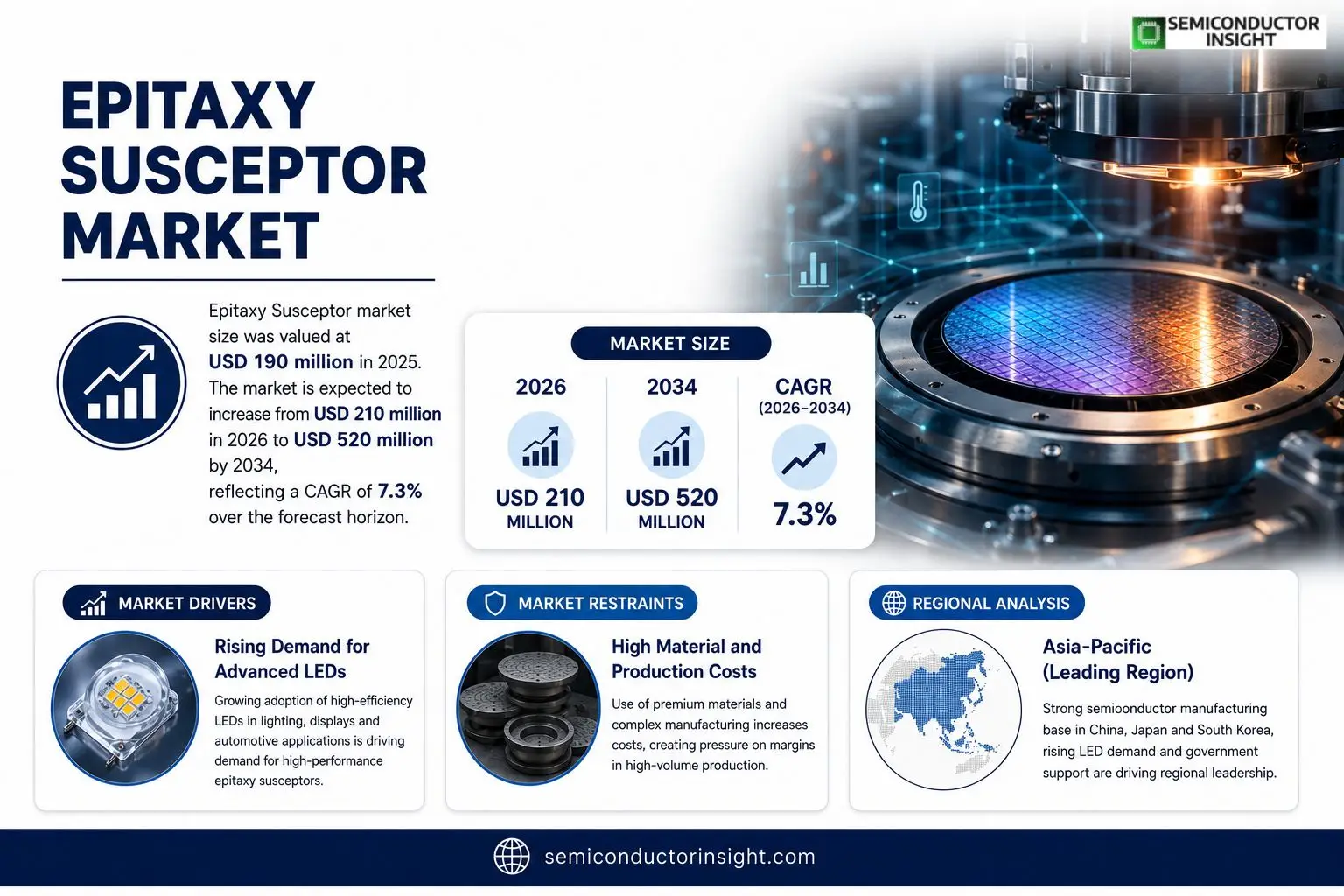
MARKET DRIVERS
Increasing Demand for Advanced Semiconductor Devices
The surge in high‑performance computing, artificial‑intelligence accelerators and 5G infrastructure is compelling chipmakers to adopt more sophisticated epitaxial processes. Silicon carbide and gallium nitride wafers require precisely engineered susceptor designs to sustain elevated temperatures while preserving crystal integrity, thereby fueling core demand for Epitaxy Susceptor Market.
Shift Toward Larger Wafer Diameters
Manufacturers are moving from 200 mm to 300 mm and even 450 mm substrates to improve throughput and reduce unit cost. Larger diameters impose stricter thermal uniformity criteria, prompting equipment suppliers to redesign susceptor geometry and material composition. This transition directly translates into higher procurement volumes for specialized susceptor solutions.
➤ “Thermal management efficiency is now the decisive factor in achieving yield improvements for power‑device epitaxy.”
Concurrent advances in in‑situ monitoring technologies, such as real‑time pyrometry and optical emission spectroscopy, are creating a feedback loop. Operators can now fine‑tune temperature profiles, but they rely on susceptor platforms that deliver repeatable heat distribution. The synergy between process analytics and susceptor engineering creates a robust growth catalyst for the market.
MARKET CHALLENGES
Cost Pressures from High‑Volume Production
While demand is rising, manufacturers are scrambling to keep capital expenditures in check. Susceptors fabricated from premium ceramics or coated with exotic alloys carry substantial price tags, and any deviation in production yield can quickly erode margins. Companies must balance material excellence against cost efficiency to stay competitive.
Other Challenges
Material Compatibility Risks
New compound semiconductors introduce unexpected reactions with traditional susceptor coatings. Unanticipated interdiffusion can degrade wafer surfaces, prompting a need for accelerated material screening programs that add complexity to the supply chain.
MARKET RESTRAINTS
Stringent Regulatory Scrutiny
Environmental and safety regulations governing the use of certain high‑temperature alloys and refractory materials are tightening across major production hubs. Compliance audits often require redesign of susceptor components, extending development cycles and raising upfront costs for manufacturers.Moreover, the need to certify equipment for clean‑room environments adds another layer of procedural overhead. Verification processes can delay product launches, especially for firms entering emerging niches such as wide‑bandgap power devices.Finally, the limited number of qualified foundries capable of handling ultra‑pure susceptor materials creates a bottleneck. Capacity constraints at these specialized facilities can throttle overall market expansion despite strong demand signals.
MARKET OPPORTUNITIES
Emerging Applications in Quantum Computing
Quantum processors increasingly rely on epitaxially grown superconducting layers, which demand ultra‑stable thermal environments. Tailored susceptor solutions that minimize thermal drift are becoming a prerequisite for scalable quantum‑chip production, opening a high‑value niche for suppliers willing to innovate.In parallel, the rise of automotive electrification is prompting a surge in SiC power devices. Manufacturers are seeking susceptor platforms that can endure repeated thermal cycling without compromising wafer quality, presenting an avenue for differentiated product offerings.Finally, strategic partnerships between equipment manufacturers and material vendors are accelerating the co‑development of next‑generation susceptor designs. These collaborations reduce time‑to‑market for advanced epitaxy tools, allowing early entrants to capture premium market share.
Epitaxy Susceptor Market Trends
Elevated Demand for LED‑Grade Susceptors
The surge in high‑efficiency LED installations across commercial lighting, automotive lighting and large‑area displays forces manufacturers to tighten tolerances on epitaxial layers. A well‑designed susceptor supplies uniform thermal distribution, which directly translates into higher luminous efficacy and longer device lifetimes. Suppliers that integrate real‑time temperature monitoring and rapid thermal cycling into susceptor designs are seeing increased adoption among LED fabs that target >30 % power‑saving benchmarks. This preference reshapes procurement strategies, as buyers now prioritize equipment that can sustain tight process windows while reducing cycle time, thereby improving overall fab throughput.
Other Trends
Material Innovation in Graphite‑Based Susceptors
Graphite remains the backbone material for most susceptor families, yet recent advances in SiC coating technologies are altering the competitive balance. SiC‑coated graphite offers superior resistance to oxidation at temperatures exceeding 1200 °C, extending service life by an estimated 20‑30 %. Manufacturers that have secured reliable SiC supply chains report lower total‑cost‑of‑ownership for end users, because maintenance intervals are spread further apart. This material shift also opens opportunities in advanced packaging and MEMS applications, where thermal stability is a decisive parameter for yield.
Geographic Shifts Influencing Supply Chains
Regional production hubs in East Asia continue to dominate the upstream segment, yet recent policy incentives in North America and Europe are attracting capacity investments for localized susceptor fabrication. Companies that locate engineering centers near major LED and semiconductor fabs benefit from shorter feedback loops, enabling faster iteration on design tweaks that address specific wafer sizes or alloy compositions. The emerging localized supply model reduces exposure to cross‑border logistics disruptions and positions participants to respond swiftly to changes in demand patterns across Epitaxy Susceptor Market.
COMPETITIVE LANDSCAPE
Key Industry Players
Epitaxy Susceptor Market – Competitive Overview
Toyo Tanso maintains the strongest foothold in the epitaxy susceptor arena, leveraging its deep expertise in graphite processing and a well‑established supply chain for high‑purity components. Its ability to customize SiC‑coated graphite solutions for LED lighting and advanced packaging customers has secured long‑term contracts with several major semiconductor fabs. Close behind, SGL Carbon and Tokai Carbon command sizable shares through aggressive investment in coating technologies that improve thermal stability and reduce particle contamination during epitaxial runs. Mersen’s portfolio, anchored by a broad range of refractory materials, complements its service model that bundles susceptor design with predictive maintenance analytics, a value proposition that resonates with manufacturers seeking to lower downtime. Together, these firms shape a tiered competitive structure: a handful of leaders dictate pricing benchmarks, while a second tier of specialized suppliers competes on niche performance attributes and regional proximity.Beyond the primary tier, the market hosts a diverse set of players addressing specific application segments or geographic niches. Bay Carbon and CoorsTek have carved out a presence in the automotive LED segment by offering cost‑effective graphite‑based products that meet automotive reliability standards. Schunk Xycarb Technology distinguishes itself through rapid prototyping capabilities, allowing customers to iterate susceptor geometries within weeksa speed advantage that many OEMs find attractive. Chinese entrants such as ZhiCheng Semiconductor and Advanced Materials Technology (AMT) are expanding capacity to satisfy the growing demand from domestic LED manufacturers, while multinational conglomerates like Ball Corporation and 3M bring cross‑industry material science experience that fuels incremental product innovation. Regional specialists, including Shin‑Etsu Chemical in Japan and ROHM Semiconductor in South Korea, add further granularity to the competitive mosaic, ensuring that end‑users have access to tailored solutions across the value chain.
List of Key Epitaxy Susceptor Companies Profiled
- Toyo Tanso
- SGL Carbon
- Tokai Carbon
- Mersen
- Bay Carbon
- CoorsTek
- Schunk Xycarb Technology
- ZhiCheng Semiconductor
- Ball Corporation
- Shin-Etsu Chemical
- 3M
- LG Chem
- ROHM Semiconductor
- Sumitomo Electric
- Advanced Materials Technology (AMT)
Segment Analysis:
| Segment Category | Sub-Segments | Key Insights |
| By Type |
|
Graphite Susceptor
|
| By Application |
|
LED Lighting
|
| By End User |
|
LED Manufacturers
|
| By Material |
|
High‑purity Graphite
|
| By Technology |
|
MOCVD Systems
|
Regional Analysis: Epitaxy Susceptor Market
Asia‑Pacific
New 300‑mm and 450‑mm lines are being commissioned across China, South Korea, and Taiwan. These factories prioritize susceptor designs that can sustain longer soak times, reducing defectivity and enabling higher yield on larger substrates.
Researchers are experimenting with composite ceramics and coated alloys to push thermal limits. Early trials suggest a tangible reduction in thermal fatigue, a factor that could reshape replacement cycles for critical process hardware.
Vertical integration of raw‑material providers with susceptor manufacturers is lessening lead‑times. Strategic stockpiling of high‑purity graphite and silicon carbide powders is mitigating the ripple effects of recent logistics disruptions.
Trade policies that favor high‑value semiconductor components are encouraging domestic sourcing of susceptor parts. Incentives for R&D centers in Singapore and Japan are further catalyzing localized design expertise.
North America
The United States retains a strong foothold through its advanced research institutions and a mature fab network primarily concentrated in the Southwest. While overall capacity growth is modest, emphasis on high‑efficiency power devices fuels demand for susceptor variants that can tolerate tighter thermal budgets. Partnerships between university labs and equipment OEMs are generating niche designs that cater to low‑defect epitaxial layers, positioning North America as a hub for premium‑grade susceptor solutions.
Europe
European players leverage a well‑established ecosystem of precision engineering firms. The region’s emphasis on sustainability translates into a preference for susceptor materials that offer longer service lives and lower energy consumption during thermal cycles. Collaborative standards bodies are harmonizing specifications across the EU, which eases cross‑border component integration and encourages manufacturers to adopt modular susceptor platforms.
South America
Growth in Brazil’s emerging semiconductor niche is modest but meaningful. Companies are focusing on cost‑effective susceptor designs that balance performance with affordability for localized production of power electronics. Government initiatives aimed at building a domestic semiconductor value chain are gradually improving access to high‑purity raw materials, reducing reliance on imports.
Middle East & Africa
Investment in wafer‑fab infrastructure is still in its infancy across the Middle East and Africa, yet several sovereign funds have earmarked capital for advanced manufacturing clusters. Early adopters are experimenting with susceptor technologies that can operate under harsher ambient conditions, reflecting the region’s climate considerations. Knowledge transfer programmes with established Asian and European firms are laying the groundwork for a nascent but potentially strategic market segment.
Report Scope
This market research report provides a comprehensive analysis of the Epitaxy Susceptor Market , covering the forecast period 2026–2034. It offers detailed insights into market dynamics, technological advancements, competitive landscape, and key trends shaping the industry.
Key focus areas of the report include:
- Market Overview: The report begins with an overview outlining its current market scenario, key growth indicators, and industry transformation drivers. It discusses macroeconomic factors, demand–supply balance, regulatory landscape, and the strategic role of semiconductors in powering advancements across industries such as automotive, telecommunications, consumer electronics, and industrial automation.
- Market Size & Forecast: Historical data and future projections for revenue, unit shipments, and market value across major regions and segments.
- Segmentation Analysis: Detailed breakdown by product type, technology, application, and end-user industry to identify high-growth segments and investment opportunities.
- Regional Insights: Insights into market performance across North America, Europe, Asia-Pacific, Latin America, and the Middle East & Africa, including country-level analysis where relevant.
- Competitive Landscape: Profiles of leading market participants, including their product offerings, R&D focus, manufacturing capacity, pricing strategies, and recent developments such as mergers, acquisitions, and partnerships.
- Technology Trends & Innovation: Assessment of emerging technologies, integration of AI/IoT, semiconductor design trends, fabrication techniques, and evolving industry standards.
- Market Drivers & Restraints: Evaluation of factors driving market growth along with challenges, supply chain constraints, regulatory issues, and market-entry barriers.
- Stakeholder Insights: Insights for component suppliers, OEMs, system integrators, investors, and policymakers regarding the evolving ecosystem and strategic opportunities.
Primary and secondary research methods are employed, including interviews with industry experts, data from verified sources, and real-time market intelligence to ensure the accuracy and reliability of the insights presented.
FREQUENTLY ASKED QUESTIONS:
What is the current market size of Epitaxy Susceptor Market?
-> Epitaxy Susceptor market size was valued at USD 190 million in 2025 USD 210 million in 2026 to USD 520 million by 2034, reflecting a CAGR of 7.3 %
Which key companies operate in Epitaxy Susceptor Market?
-> Key players include Toyo Tanso, SGL Carbon, Tokai Carbon, Mersen, Bay Carbon, CoorsTek, Schunk Xycarb Technology, ZhiCheng Semiconductor.
What are the key growth drivers?
-> Key growth drivers include rising demand for high‑performance LEDs, increasing adoption of energy‑efficient lighting solutions, continuous advancements in LED epitaxy technology, and growth of advanced packaging and MEMS applications.
Which region dominates the market?
-> Asia is the fastest‑growing region, driven by strong semiconductor manufacturing bases in China, Japan, and South Korea, while Europe remains a significant mature market.
What are the emerging trends?
-> Emerging trends include development of SiC‑coated graphite susceptors, integration of epitaxy processes with advanced packaging, and increasing focus on sustainable, low‑cost LED manufacturing.
Get Sample Report PDF for Exclusive Insights
Report Sample Includes
- Table of Contents
- List of Tables & Figures
- Charts, Research Methodology, and more...
 Download Sample Report PDF