Key Statistics
Key Takeaways
- Embedded hardware remains the larger revenue pool because microcontrollers, processors, FPGAs, analog interfaces, memory and board-level components are required in every deployed system. Embedded software is growing faster as customers shift from isolated firmware toward reusable middleware, operating systems, security stacks, AI runtimes and over-the-air update frameworks.
- Automotive is the largest application because modern vehicles contain dozens of control domains spanning powertrain, body electronics, safety, infotainment, battery management and driver-assistance functions. Software-defined vehicle architectures are increasing compute concentration, but they are also raising the value of high-performance embedded processors, secure MCUs, networking devices and safety-certified software.
- Industrial automation and edge AI are the fastest-changing demand areas. Manufacturers increasingly want low-latency analytics, machine vision and predictive control to run near the equipment rather than in the cloud. That shifts purchasing toward MCUs and MPUs with neural accelerators, higher memory bandwidth, deterministic real-time performance and secure connectivity.
- Asia Pacific is the largest regional market because it combines electronics manufacturing, automotive production, industrial equipment, telecom hardware and semiconductor supply chains across China, Japan, South Korea, Taiwan, India and Southeast Asia. North America remains the strongest design and platform market for edge AI, defense and high-value software.
- Security and certification have become structural purchase criteria. The EU Cyber Resilience Act, UN R155 automotive cybersecurity rules, functional-safety standards and sector-specific medical or aerospace requirements increasingly force suppliers to provide secure boot, hardware roots of trust, update mechanisms, safety documentation and long-term lifecycle support.
- Competitive advantage is moving from standalone silicon toward integrated development platforms. Renesas, NXP, STMicroelectronics, Infineon, Texas Instruments and other suppliers increasingly compete with hardware, software libraries, AI tools, middleware partnerships and cloud-connected developer workflows rather than processor specifications alone.
Embedded Systems Market Overview
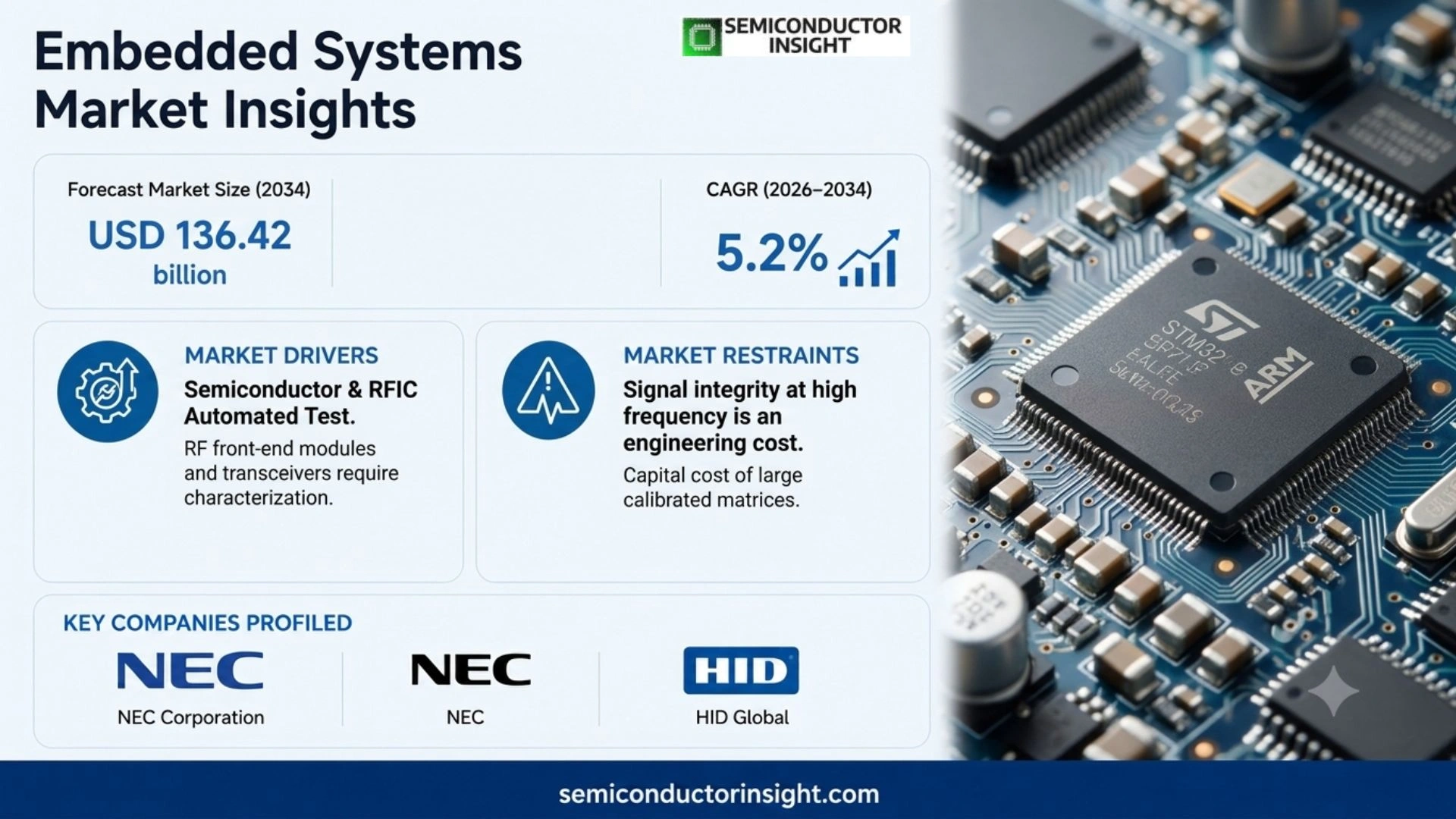
Embedded Systems Market was valued at USD 86.75 billion in 2025 and is projected to reach USD 136.42 billion by 2034, representing a 5.2% CAGR during 2026–2034. Asia Pacific is the largest market, supported by its concentration of electronics manufacturing, automotive production and industrial equipment supply, while software-defined vehicles, edge AI and connected industrial systems are widening the value captured by embedded software and high-performance processors.
An embedded system combines purpose-built hardware and software to perform a defined function inside a larger product or machine. Unlike general-purpose computing, the system is engineered around constraints such as response time, power consumption, physical size, safety, reliability, operating temperature and lifecycle support. The hardware layer commonly includes microcontrollers, microprocessors, digital signal processors, FPGAs, memory, analog interfaces and connectivity devices, while the software layer includes firmware, operating systems, middleware, drivers, security components and application code.
The market covers a very wide range of products because embedded intelligence is now present in vehicles, base stations, medical devices, factory equipment, appliances, cameras, robots, aerospace systems and connected infrastructure. Commercial value is therefore created at several levels: semiconductor vendors sell processors and MCUs; board and module vendors integrate them into deployable hardware; operating-system and middleware providers reduce software-development effort; and system integrators combine the stack with application-specific engineering, certification and lifecycle services.
The architectural center of gravity is shifting toward more software-defined products. Automotive domain controllers, industrial edge computers and connected medical platforms consolidate functions that were previously implemented in multiple small controllers, but that consolidation does not reduce embedded content. Instead, it increases requirements for multicore processing, real-time virtualization, secure networking, AI acceleration and deterministic software partitioning. NXP’s CoreRide strategy, Renesas’ R-Car roadmap, Infineon’s AURIX portfolio and STMicroelectronics’ STM32 AI ecosystem illustrate how leading suppliers are expanding from device portfolios into system platforms.
Edge AI is another major change because inference is increasingly performed where data is generated. Cameras, microphones, motors and sensors can now run compact neural networks locally, reducing latency, bandwidth use and dependence on cloud connectivity. Renesas’ 1 GHz RA8P1 MCUs integrate Arm Ethos-U55 neural processing, while STMicroelectronics has expanded its STM32 model library for vision, audio and sensing. These product directions make embedded AI a mainstream MCU and MPU selection criterion rather than a feature limited to specialized accelerators.
Segment Analysis: By Type
By type, the embedded systems market is segmented into Embedded Hardware and Embedded Software. Hardware remains the larger segment because every deployed system requires physical processing, memory, analog, connectivity and board-level components. Software is expanding faster because connected products require operating systems, middleware, security, AI runtimes, device management and continuous updates across increasingly long product lifecycles.
| Type | Function and commercial role | Market position |
|---|---|---|
| Embedded Hardware | Includes microcontrollers, microprocessors, digital signal processors, FPGAs, memory, analog interfaces, connectivity ICs, modules and embedded boards. Buyers select hardware around compute performance, deterministic response, power efficiency, safety capability, temperature range, connectivity, security and expected product availability. | Largest segment in 2025. Hardware carries the semiconductor and module content of every embedded deployment. Growth is strongest where products add higher-performance processing, sensor fusion, AI acceleration, connectivity and safety features, while mature low-end control applications remain highly price competitive. |
| Embedded Software | Includes firmware, real-time operating systems, Linux distributions, middleware, AUTOSAR software, board-support packages, security stacks, connectivity stacks, hypervisors, AI runtimes and application frameworks. Software reduces integration effort and allows hardware features to be reused across product families. | Fastest-growing segment. Software-defined vehicles, industrial edge platforms and connected devices require larger and longer-lived codebases. Suppliers increasingly monetize software through licenses, support, tools and platform integration while semiconductor vendors use software breadth to protect hardware design wins. |
System complexity as a secondary segmentation
The report also recognizes Basic Embedded Systems, Medium Complexity Systems and Highly Complex Systems. Basic systems use relatively simple control loops and small MCUs, while medium-complexity platforms add richer connectivity, user interfaces and multitasking. Highly complex systems combine multicore processors, real-time and application-class operating environments, AI workloads, functional safety and sophisticated networking. The highly complex category is gaining strategic importance because software-defined vehicles, advanced industrial control and aerospace platforms concentrate more system value in computing architecture and middleware.
Segment Analysis: By Application
By application, the market is segmented into Automotive, Telecommunication, Healthcare, Industrial, Consumer Electronics, Military and Aerospace, and Others. Automotive is the largest value segment because each vehicle contains many embedded control and processing functions, while industrial systems are among the fastest-growing as machine vision, robotics, digital twins and predictive maintenance push more compute and connectivity onto the factory floor.
| Application | Demand characteristics |
|---|---|
| Automotive | Largest application. Embedded systems control powertrain, battery management, body electronics, infotainment, connectivity, ADAS, gateways and zonal architectures. The shift to software-defined vehicles increases demand for high-performance MCUs, automotive processors, Ethernet networking, secure hardware and safety middleware. Long design cycles and functional-safety qualification create strong supplier lock-in once a platform is selected. |
| Telecommunication | Telecom equipment uses embedded processors, FPGAs, timing devices and software in base stations, routers, optical systems, radio units and network appliances. 5G and edge computing increase packet-processing and synchronization requirements, while network virtualization moves some functions into software. Suppliers compete on deterministic throughput, hardware acceleration, long availability and support for carrier-grade operating environments. |
| Healthcare | Medical imaging, patient monitoring, infusion systems, diagnostics and connected devices require embedded compute with high reliability and strict regulatory documentation. Demand favors long-lifecycle components, real-time response, secure connectivity and low power. The commercial barrier is qualification: design changes can trigger new validation work, making lifecycle support and change-control discipline as important as raw processor performance. |
| Industrial | Fast-changing application. PLCs, motor drives, robotics, machine vision, condition monitoring and edge gateways increasingly incorporate multicore processors and AI. Factory customers need deterministic Ethernet, functional safety, rugged temperature ranges and long product availability. Edge AI creates incremental demand where local inference reduces downtime or improves quality without sending high-volume sensor data to the cloud. |
| Consumer Electronics | Appliances, cameras, wearables, smart-home devices and entertainment products use high-volume embedded controllers and application processors. The segment is highly cost-sensitive and has shorter product cycles than industrial or automotive markets. Integration, low standby power, wireless connectivity and reference designs determine time to market, while supply continuity remains critical for major OEM launches. |
| Military and Aerospace | Defense and aerospace applications require ruggedized embedded computing, secure processing, deterministic communications and long lifecycle support. Programs can have lower unit volume but materially higher value per system because of certification, environmental qualification, radiation tolerance and security requirements. Procurement emphasizes trusted supply, documentation and sustained support across programs that may operate for decades. |
| Others | This category includes energy infrastructure, transportation, building automation, agriculture and specialized scientific equipment. Demand is fragmented but commercially important because many products are adding sensing, connectivity and local analytics for the first time. Suppliers win by providing scalable MCU families, development tools and reusable software that reduce engineering effort across diverse applications. |
Regional Analysis
Asia Pacific is the largest embedded systems market, while North America remains the most influential design and platform-development region. Asia Pacific benefits from electronics, automotive and industrial manufacturing scale. Europe is unusually strong in automotive, industrial automation and safety regulation. North America drives edge AI, defense and software platforms. South America and the Middle East & Africa are smaller but expanding through industrial digitalization, telecom and infrastructure modernization.
How does regional demand differ across the embedded systems market?
Regional embedded-system demand depends on where products are designed, manufactured and deployed. Asia Pacific captures high unit volume because the region manufactures electronics and vehicles at scale. North America captures disproportionate software, defense and high-performance design value. Europe’s automotive and industrial base emphasizes safety, cybersecurity and long lifecycle support. Emerging regions buy more finished embedded equipment and modules, with local design activity concentrated in telecom, industrial automation, energy and transportation applications.
| Region | Position | Growth outlook | Demand profile | What decides supplier selection |
|---|---|---|---|---|
| Asia Pacific | Largest | High | Electronics, automotive and industrial manufacturing led | Cost-performance, local support, broad MCU/MPU availability, connectivity and high-volume supply |
| North America | Major design/value market | High | Edge AI, defense, cloud-edge and automotive platform led | Software ecosystem, AI capability, security, developer productivity and trusted supply |
| Europe | Strong automotive/industrial market | Moderate to high | Automotive safety, industrial automation and regulation led | Functional safety, cybersecurity, lifecycle support, industrial networking and regulatory compliance |
| South America | Developing market | Moderate | Industrial, automotive and telecom modernization led | Cost, distributor support, ruggedness, local integration capability and import availability |
| Middle East & Africa | Emerging | Moderate to high from small base | Telecom, smart infrastructure, defense and energy led | Reliability, environmental tolerance, secure connectivity and long-term system support |
Key Embedded Systems Manufacturers and Competitive Landscape
Competition is led by semiconductor vendors that combine processing portfolios with software, tools and application-specific platforms. Renesas, STMicroelectronics, NXP, Texas Instruments, Infineon and Microchip compete across microcontrollers, processors and analog interfaces, while AMD/Xilinx and Intel/Altera contribute programmable logic and higher-performance compute. Arm influences the market through processor architecture and software ecosystems, while Advantech and Kontron capture value at the board, module and embedded-computing platform level.
The market is not won on benchmark performance alone. Automotive customers need functional safety, cybersecurity and ten-plus-year availability; industrial customers need real-time networking and deterministic control; consumer customers prioritize cost, integration and time to market. As a result, broad product families and software reuse are powerful competitive tools. A supplier that allows developers to migrate code and peripherals across multiple performance tiers can reduce customer engineering cost and make subsequent design wins easier.
AI has intensified competition because MCU and MPU vendors now differentiate through neural-processing hardware, model conversion tools, optimized libraries and pre-validated reference models. Renesas’ RA8P1 integrates a dedicated NPU, while STMicroelectronics has expanded its STM32 model zoo and NXP offers eIQ software across automotive and edge platforms. The commercial objective is to keep inference inside a familiar embedded development workflow instead of forcing the customer to adopt a separate accelerator architecture.
Automotive consolidation is also reshaping supplier strategy. NXP’s acquisition of TTTech Auto combines processors and vehicle networking with safety middleware, while Infineon is expanding AURIX toward RISC-V and Renesas is integrating multi-domain compute with its RoX software environment. These moves increase switching costs because customers qualify a broader hardware-and-software stack, but they also raise supplier responsibility for lifecycle updates, cybersecurity and integration support.
Tier structure
| Tier | Companies | Basis of competition |
|---|---|---|
| Global MCU/processor platform leaders | Renesas Electronics; STMicroelectronics; NXP Semiconductors; Texas Instruments; Infineon Technologies; Microchip Technology | Breadth of MCU/MPU families, automotive and industrial qualifications, developer tools, security, analog integration, lifecycle support and application engineering |
| Programmable and high-performance embedded compute | AMD/Xilinx; Intel/Altera; Analog Devices | FPGA acceleration, heterogeneous processing, high-speed interfaces, signal processing and specialized industrial, aerospace and communications platforms |
| Architecture, board and embedded-platform ecosystem | Arm Limited; Advantech; Kontron; Fujitsu Limited | Processor architecture, board/module integration, rugged embedded computing, software compatibility and system-level deployment support |
Key Industry Players
- Renesas Electronics
- STMicroelectronics
- NXP Semiconductors (Freescale)
- Texas Instruments, Inc.
- Xilinx (AMD)
- Intel Corporation
- Infineon Technologies
- Microchip Technology
- Analog Devices
- Fujitsu Limited
- ARM Limited
- Advantech
- Kontron
- Atmel (Microchip)
- Altera (Intel)
Embedded Systems Production Capacity Analysis
Embedded-system supply capacity is distributed across semiconductor fabrication, outsourced assembly and test, board/module manufacturing and software engineering rather than a single production process. Asia Pacific holds the largest physical manufacturing base for electronics and boards, while North America, Europe and Japan retain substantial semiconductor design and specialty manufacturing. Effective capacity is constrained not only by wafer starts but also by mature-node MCU supply, package availability, memory, passive components, firmware validation and qualified engineering resources.
Many embedded controllers use mature semiconductor nodes because analog integration, embedded flash, high-voltage interfaces and long automotive or industrial lifecycles matter more than maximum transistor density. This means capacity planning differs from leading-edge processors. A shortage at 40 nm, 55 nm, 90 nm or specialty BCD capacity can interrupt a vehicle or factory controller even when advanced-node capacity is abundant. Suppliers therefore invest in multiple foundry relationships, internal fabs, inventory buffers and package qualification to reduce exposure to a single manufacturing bottleneck.
Automotive and industrial customers also treat software capacity as part of supply capability. A new MCU without production-quality drivers, functional-safety documentation, AUTOSAR support, secure update tools or migration assistance may have little usable capacity from the customer’s perspective. This is why major suppliers increasingly expand software teams and ecosystem partnerships alongside silicon. NXP’s TTTech Auto acquisition and Infineon’s AURIX software portfolio show how engineering capacity can determine the speed at which semiconductor hardware becomes production-ready system capacity.
Regional diversification is increasing after the semiconductor shortages of the early 2020s. U.S., European, Japanese, Taiwanese and Korean manufacturing investments improve resilience, but embedded customers still face long qualification cycles when moving a design between fabs or packages. The most valuable capacity therefore combines physical availability with prequalified alternates, controlled change management and product longevity, especially in medical, automotive, aerospace and industrial applications.
Embedded Systems Market Dynamics: Drivers, Restraints and Opportunities
The market is expanding because more products require local intelligence, secure connectivity and software-defined functionality. Automotive electronics, industrial automation and edge AI increase processing and software content per system, while regulation raises the value of security and lifecycle support. Growth is restrained by system complexity, software integration cost, cybersecurity exposure and long certification cycles. The largest opportunities lie in AI-enabled edge computing, software-defined vehicles and reusable platform software that shortens customer development time.
MARKET DRIVERS
Drivers Impact Analysis*
| Market Factor | Directional Impact on CAGR Forecast* | Commercial Mechanism |
|---|---|---|
| Software-defined vehicles and automotive electronics | +1.4 to +2.0 percentage points | Higher compute concentration, Ethernet networking, safety middleware and OTA capability increase processor, MCU and software value per vehicle. |
| Industrial edge AI and automation | +1.0 to +1.5 percentage points | Machine vision, predictive maintenance and robotics add local AI acceleration, memory and networking to equipment that previously used simpler controllers. |
| Connected IoT and security requirements | +0.7 to +1.1 percentage points | Secure connectivity, device identity and updateability increase MCU and software content across appliances, infrastructure and enterprise devices. |
Software-defined vehicles increase compute and software content per platform
The transition from many independent ECUs toward domain and zonal architectures changes the embedded bill of materials rather than eliminating it. Central processors handle higher-level functions, while zonal controllers still require deterministic MCUs, networking and power management. Customers also need safety middleware, virtualization and secure OTA frameworks. NXP, Renesas and Infineon are therefore selling broader automotive platforms whose value extends well beyond the processor die.
Edge AI moves inference into mainstream embedded devices
Neural-network workloads that once required a GPU or cloud connection can now run on MCUs and low-power MPUs. Renesas’ RA8P1 reaches up to 256 GOPS through an integrated NPU, while STMicroelectronics distributes more than 140 optimized models for STM32-class devices. This expands the addressable market because cameras, motors, appliances and sensors can add AI without the power, latency or bandwidth penalty of sending every data stream to the cloud.
Industrial automation requires more deterministic connectivity and local analytics
Factories are adding machine vision, predictive maintenance, robotics and digital workcells, which increases demand for processors that combine real-time control with Ethernet, security and analytics. The purchase decision is often based on downtime reduction rather than compute performance alone. A controller that detects a failing bearing or quality defect before production stops can justify substantially more embedded content than a conventional PLC function.
Cybersecurity regulation raises the value of secure embedded platforms
Connected products now face explicit lifecycle-security obligations. Automotive suppliers must meet requirements associated with UN R155 and ISO/SAE 21434, while the EU Cyber Resilience Act introduces security responsibilities for products with digital elements. Hardware roots of trust, secure boot, cryptographic engines, protected key storage and signed updates become bill-of-material and software requirements, creating new value for vendors that provide integrated security rather than add-on components.
MARKET RESTRAINTS
Restraints Impact Analysis*
| Market Factor | Directional Impact on CAGR Forecast* | Commercial Mechanism |
|---|---|---|
| Software and system integration complexity | −1.0 to −1.5 percentage points | Multicore processors, multiple operating environments and legacy interfaces increase engineering time and delay product qualification. |
| Cybersecurity and lifecycle liability | −0.6 to −1.0 percentage points | Long-term patching, vulnerability management and secure update obligations raise development and support cost for connected products. |
| Certification and long design cycles | −0.5 to −0.9 percentage points | Automotive, medical and aerospace programs require extensive safety and reliability validation that slows adoption of new hardware platforms. |
Integration complexity can erase the benefit of higher-performance silicon
A modern embedded product may combine a real-time operating system, Linux, hypervisor, AI runtime, networking stacks and safety partitions. Each layer introduces interfaces, dependencies and debugging effort. Customers can delay a hardware upgrade if software migration risk is too high, which favors suppliers with mature board-support packages, reference code and migration tools. The market therefore grows more slowly than raw compute demand would suggest because engineering capacity becomes a bottleneck.
Security obligations continue after the hardware ships
Connected devices can remain deployed for ten or more years, forcing manufacturers to manage vulnerabilities, certificates, keys and software updates across large installed fleets. This creates recurring engineering and cloud-service costs that were minimal in older isolated systems. Smaller OEMs may delay connectivity or use simpler architectures if they cannot support long-term security maintenance, limiting embedded software expansion in cost-sensitive products.
Safety-critical qualification slows platform replacement
Automotive, aerospace, industrial safety and medical products require extensive validation before a processor or software stack can enter production. Functional-safety evidence, tool qualification, reliability testing and change control make switching expensive. This protects incumbent suppliers but also delays adoption of higher-performance architectures. Vendors must therefore commit to long product lifecycles and carefully controlled revisions to win programs where redesign costs can exceed component savings.
MARKET OPPORTUNITIES
AI-enabled microcontrollers and edge processors
The strongest cross-industry opportunity is to add useful AI without moving applications to expensive application processors. MCUs with integrated NPUs can handle visual inspection, sound recognition, predictive maintenance and sensor fusion at low power. Suppliers that provide optimized models, quantization tools and reference applications can capture both silicon and software value while shortening the customer’s path from prototype to production.
Software-defined vehicle platforms
Automotive OEMs are consolidating compute and expecting software to be reused across multiple vehicle lines. This creates demand for scalable processor families, zonal controllers, Ethernet switches, safety middleware and development environments. The commercial opportunity extends across semiconductor suppliers, middleware companies and engineering-service providers because automakers need integrated platforms that reduce software fragmentation while preserving functional safety and cybersecurity.
Secure industrial edge infrastructure
Factories and utilities are deploying connected controllers and gateways that must operate for years in hostile network environments. Secure boot, device identity, encrypted communications and remote update management can turn cybersecurity from a compliance cost into a differentiated product feature. Suppliers that combine rugged hardware with lifecycle security services can move from one-time component sales toward higher-value platform relationships.
RISC-V and open software ecosystems
RISC-V creates an opportunity for new embedded architectures in markets that value software portability, customization or supply diversity. Infineon’s automotive RISC-V announcement shows that the architecture is moving into safety-critical roadmaps, while many industrial and IoT suppliers are evaluating it for control and acceleration. The opportunity is largest for vendors that pair open instruction sets with production-grade tools, safety evidence and long-term software support.
Embedded Systems Supply Chain Analysis
The embedded systems supply chain spans semiconductor IP and design, wafer fabrication and packaging, boards and modules, software platforms, and final OEM integration. Value capture becomes increasingly application-specific downstream: a general-purpose MCU may be inexpensive, but the certified software, board design and lifecycle support built around it can be worth substantially more. Supply risk also propagates across stages, because a missing power-management IC or software dependency can stop production even when the main processor is available.
Stage 1 — Processor IP, semiconductors and foundry capacity
The upstream stage determines architecture, power, peripherals and security capability. Arm dominates many MCU and MPU designs, while x86, proprietary MCU cores, FPGA fabrics and RISC-V address other requirements. Semiconductor vendors either manufacture internally or use external foundries. Mature-node availability remains important because embedded flash, analog and high-voltage integration can matter more than leading-edge density. Long qualification cycles make abrupt process changes commercially disruptive.
Stage 2 — Packaging, board manufacturing and embedded modules
Packaged semiconductors are integrated with memory, power, storage and connectivity on PCBs or modules. Advantech, Kontron and many specialist vendors capture value by selling validated embedded computers rather than discrete devices. Board and module suppliers reduce time to market for OEMs that lack deep hardware engineering, but they must manage component obsolescence and redesign risk across product lifecycles that can exceed a decade.
Stage 3 — Operating systems, middleware and developer tools
Software is increasingly the critical bottleneck. Drivers, board-support packages, RTOS kernels, Linux distributions, connectivity stacks, AI runtimes and safety middleware determine whether silicon features can be used reliably. NXP’s acquisition of TTTech Auto demonstrates how middleware can become strategic semiconductor infrastructure. Suppliers that reduce integration effort increase the probability that customers standardize on the associated hardware family across several generations.
Stage 4 — OEM qualification and lifecycle management
Final customers integrate embedded platforms into vehicles, machines, medical equipment, infrastructure and consumer products. Qualification includes electrical testing, EMC, thermal behavior, functional safety, cybersecurity and application software. Once a platform passes these gates, switching becomes costly, creating long design-win cycles. Vendors therefore compete on sustained availability, controlled product changes, security support and technical assistance as much as on initial component price.
Recent Developments in the Embedded Systems Market
Renesas announced silicon samples, full evaluation boards and the RoX Whitebox SDK for its R-Car Gen 5 software-defined vehicle platform. The R-Car X5H uses a 3 nm process and is designed to handle ADAS, in-vehicle infotainment and gateway functions on one SoC, demonstrating how embedded automotive platforms are moving toward higher compute concentration plus reusable software environments.
STMicroelectronics announced more than 140 optimized AI models covering vision, audio and sensing for its MCU ecosystem. A broader model library lowers the engineering barrier to running neural networks on constrained embedded hardware and supports faster commercialization of edge-AI features in industrial equipment, appliances, sensors and other products that cannot justify a separate high-power accelerator.
Renesas introduced the RA8P1 MCU group with Arm Cortex-M85 and Cortex-M33 CPU cores plus an Arm Ethos-U55 neural processing unit delivering up to 256 GOPS. The product expands MCU-class processing into workloads such as vision, voice AI and real-time analytics, increasing the addressable market for edge inference while preserving low-power embedded development models.
NXP completed its acquisition of TTTech Auto, adding MotionWise safety middleware to the NXP CoreRide software-defined vehicle platform. The transaction combines processors, networking and system power with production-proven middleware, reinforcing a broader competitive trend in embedded systems: semiconductor suppliers are acquiring or building software capability to reduce integration complexity and secure larger portions of automotive platform value.
Infineon announced that a new RISC-V-based automotive MCU family will join its AURIX portfolio and presented a virtual prototype with ecosystem partners at embedded world 2025. The move is significant because it brings an open instruction-set architecture into a market that requires stringent functional safety, security and long-term support, potentially widening architectural choice for future vehicle controllers.
REPORT SCOPE & SEGMENTATION
| Study Period | 2021–2034 |
| Base Year | 2025 |
| Estimated Year | 2026 |
| Forecast Period | 2026–2034 |
| Historical Period | 2021–2025 |
| Market Size 2025 | USD 86.75 Billion |
| Market Size 2034 | USD 136.42 Billion |
| Growth Rate | CAGR of 5.2% from 2026–2034 |
| Unit | Value (USD Billion) |
| Segmentation | By Type, By Application, By System Complexity and By Region |
| By Type | Embedded Hardware · Embedded Software |
| By Application | Automotive · Telecommunication · Healthcare · Industrial · Consumer Electronics · Military and Aerospace · Others |
| By System Complexity | Basic Embedded Systems · Medium Complexity Systems · Highly Complex Systems |
| By Region | North America · Europe · Asia Pacific · South America · Middle East & Africa |
| Companies Profiled | Renesas Electronics · STMicroelectronics · NXP Semiconductors (Freescale) · Texas Instruments, Inc. · Xilinx (AMD) · Intel Corporation · Infineon Technologies · Microchip Technology · Analog Devices · Fujitsu Limited · ARM Limited · Advantech · Kontron · Atmel (Microchip) · Altera (Intel) |
| Customization Scope | Country, regional, application, hardware, software, architecture and company-level customization can be added to align the study with customer-specific embedded platforms, end markets and sourcing requirements. |
Frequently Asked Questions
What is the size of the embedded systems market in 2025?
The global embedded systems market was valued at USD 86.75 billion in 2025. The market includes embedded hardware and embedded software used across automotive, telecom, healthcare, industrial, consumer electronics, military and aerospace applications, ranging from small MCU-based controllers to highly complex multicore and AI-enabled systems.
What is the projected embedded systems market size by 2034?
The market is projected to reach USD 136.42 billion by 2034, representing a 5.2% CAGR during 2026–2034. Growth is driven by higher compute and software content in vehicles, industrial edge systems, connected devices and safety-critical platforms rather than by a single end-use industry.
Which region leads the embedded systems market?
Asia Pacific is the largest regional market because it concentrates electronics manufacturing, automotive production, industrial equipment and semiconductor supply chains across China, Japan, South Korea, Taiwan, India and Southeast Asia. North America remains especially important for platform design, edge AI, defense and software development.
What are the main embedded systems market types?
The market is segmented into Embedded Hardware and Embedded Software. Hardware includes processors, MCUs, FPGAs, memory, interfaces and boards, while software includes firmware, operating systems, middleware, connectivity stacks, security, AI runtimes and development frameworks that make the hardware usable inside production systems.
Which application is the largest?
Automotive is the largest application because modern vehicles use embedded systems across powertrain, battery management, body electronics, infotainment, safety, ADAS, gateways and zonal control. Software-defined vehicle architectures increase the value of both high-performance processors and production-grade middleware, security and networking.
Why is embedded software growing faster than hardware?
Embedded software is expanding because connected and software-defined products require larger operating environments, middleware, security stacks, AI libraries and continuous updates. Hardware remains essential, but customers increasingly pay for software that reduces integration time, enables reuse across product families and supports cybersecurity and functional-safety requirements over long lifecycles.
How is edge AI changing embedded systems?
Edge AI allows devices to analyze images, sound, vibration and sensor data locally rather than sending everything to the cloud. MCUs such as Renesas RA8P1 and software libraries such as STMicroelectronics’ STM32 AI model ecosystem show that neural processing is becoming available inside power-constrained embedded platforms used in factories, appliances, vehicles and sensors.
What are the main restraints on market growth?
The principal restraints are software integration complexity, cybersecurity lifecycle cost, certification requirements, long design cycles and component supply risk. In automotive, medical, aerospace and industrial applications, a new processor may require extensive validation and software migration, so customers often retain proven platforms longer than pure performance comparisons would suggest.
Which companies are profiled in the report?
The report profiles Renesas Electronics, STMicroelectronics, NXP Semiconductors, Texas Instruments, AMD/Xilinx, Intel, Infineon Technologies, Microchip Technology, Analog Devices, Fujitsu, Arm, Advantech, Kontron, Atmel and Altera. The competitive landscape spans semiconductor devices, processor architectures, programmable logic and embedded-computing platforms.
What is the strongest long-term opportunity in embedded systems?
The strongest opportunities are AI-enabled edge processing, software-defined vehicles, secure industrial edge platforms and reusable hardware/software ecosystems. Suppliers that combine scalable processors with development tools, safety middleware, security, AI software and lifecycle support can capture more customer value than vendors competing only on processor specifications or unit price.
Get Sample Report PDF for Exclusive Insights
Report Sample Includes
- Table of Contents
- List of Tables & Figures
- Charts, Research Methodology, and more...
 Download Sample Report PDF