Microcontroller Market, Emerging Trends, Technological Advancements, and Business Strategies 2025-2032

Microcontroller Market was valued at USD 27.20 billion in 2024 and is projected to reach USD 38.23 billion by 2032, exhibiting a CAGR of 5.2% during the forecast period

PDF Icon Download Sample Report PDF
  • Quick Dispatch

    All Orders

  • Secure Payment

    100% Secure Payment

Price range: $1,500.00 through $4,250.00

Clear

MARKET INSIGHTS

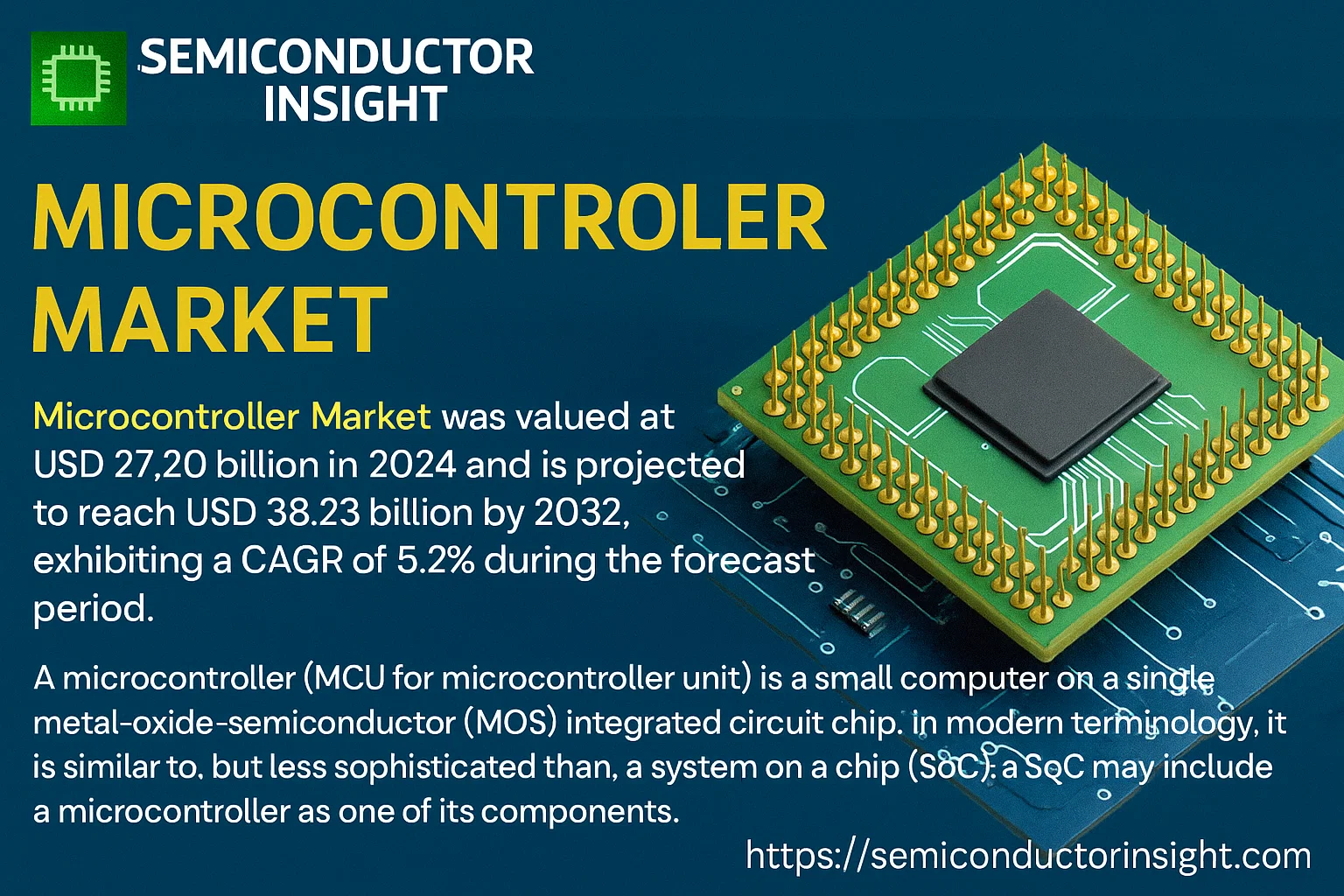
Global Microcontroller Market was valued at USD 27.20 billion in 2024 and is projected to reach USD 38.23 billion by 2032, exhibiting a CAGR of 5.2% during the forecast period.

A microcontroller (MCU for microcontroller unit) is a small computer on a single metal-oxide-semiconductor (MOS) integrated circuit chip. In modern terminology, it is similar to, but less sophisticated than, a system on a chip (SoC); a SoC may include a microcontroller as one of its components. A microcontroller contains one or more CPUs (processor cores) along with memory and programmable input/output peripherals. Program memory in the form of ferroelectric RAM, NOR flash or OTP ROM is also often included on chip, as well as a small amount of RAM. Microcontrollers are designed for embedded applications, in contrast to the microprocessors used in personal computers or other general purpose applications consisting of various discrete chips. Microcontrollers are used in automatically controlled products and devices, such as automobile engine control systems, implantable medical devices, remote controls, office machines, appliances, power tools, toys and other embedded systems. By reducing the size and cost compared to a design that uses a separate microprocessor, memory, and input/output devices, microcontrollers make it economical to digitally control even more devices and processes. Mixed signal microcontrollers are common, integrating analog components needed to control non-digital electronic systems. In the context of the internet of things, microcontrollers are an economical and popular means of data collection, sensing and actuating the physical world as edge devices.

Global main manufacturers of microcontroller include NXP Semiconductors, Microchip Technology, Renesas Electronics, etc. The top three players hold a share about 34%. The global microcontroller products are mainly produced in Europe, United States and Japan, they occupied for a share over 55%. The largest market is Asia-Pacific, holds a share about 59%, followed by Europe and North America, with around 22% and 12% market share respectively.
Microcontroller Market

MARKET DRIVERS


Proliferation of IoT and Connected Devices

The expansion of the Internet of Things (IoT) ecosystem is the primary driver for the microcontroller market. Billions of new connected devices, from smart home appliances to industrial sensors, require low-power, cost-effective processing units to function. The demand for 32-bit microcontrollers is particularly high, as they provide the necessary processing power for complex tasks like data processing and connectivity protocols while maintaining energy efficiency.

Automotive Industry Transformation

The automotive sector’s evolution towards electrification and advanced driver-assistance systems (ADAS) significantly fuels microcontroller demand. Modern vehicles incorporate dozens of microcontrollers to control everything from infotainment systems and body electronics to critical safety features and battery management in electric vehicles. This trend is expected to intensify as the push for autonomous driving technology advances.

The global microcontroller market is projected to grow at a compound annual growth rate (CAGR) of approximately 9% over the next five years, largely driven by these key sectors.

Furthermore, the ongoing industrial automation trend, often referred to as Industry 4.0, continues to be a major driver. Microcontrollers are essential components in programmable logic controllers (PLCs), robotics, and smart machinery, enabling precision control and real-time data acquisition.

MARKET CHALLENGES

Global Supply Chain Constraints

The microcontroller market has been significantly impacted by persistent supply chain disruptions. The reliance on a limited number of semiconductor fabrication plants, compounded by geopolitical tensions and raw material shortages, has led to extended lead times and allocation issues for many microcontroller variants, particularly automotive-grade chips.

Other Challenges

Rising Complexity and Design Costs
As applications become more sophisticated, designing systems with modern microcontrollers requires significant engineering expertise and investment in development tools, creating a high barrier to entry for smaller companies.

Intense Price Competition
The market is highly competitive, with significant pressure on average selling prices (ASPs). Manufacturers must continuously innovate to add features and reduce power consumption while managing production costs to remain profitable.

Cybersecurity Concerns
With microcontrollers being deployed in critical infrastructure and connected devices, ensuring robust security against cyber threats has become a major challenge, requiring additional investment in hardware-based security features.

MARKET RESTRAINTS

High Initial Investment and R&D Costs

The development of advanced microcontroller units (MCUs) involves substantial research and development expenditure. Designing chips with smaller nanometer processes, integrating more peripherals, and achieving higher performance and lower power consumption requires significant capital investment, which can act as a restraint for market growth.

Technical Complexity in System Integration

Integrating modern microcontrollers into end-products is increasingly complex. Developers must navigate intricate software development kits, real-time operating systems, and compatibility with various communication protocols, which can slow down time-to-market and increase development costs for OEMs.

Economic Volatility

Macroeconomic uncertainties, such as inflation and fluctuating demand in key end-markets like consumer electronics and automotive, can lead to volatile ordering patterns from OEMs, making it difficult for manufacturers to plan production and inventory levels effectively.

MARKET OPPORTUNITIES

Artificial Intelligence at the Edge

The integration of AI and machine learning capabilities into microcontrollers presents a significant growth opportunity. Edge AI allows for data processing to occur locally on the device, reducing latency and bandwidth usage. This is crucial for applications like smart cameras, predictive maintenance in industrial settings, and voice-activated assistants.

Expansion in Healthcare and Wearables

The healthcare sector offers substantial potential for microcontroller growth. The demand for portable medical devices, continuous health monitors, and advanced wearable technology is rising. Microcontrollers with ultra-low-power consumption and high integration are essential for the miniaturization and extended battery life required by these applications.

Renewable Energy Systems

The global transition towards renewable energy sources creates opportunities for microcontrollers in solar inverters, wind turbine control systems, and smart grid management. These systems require reliable, real-time control and monitoring, which advanced MCUs are well-suited to provide.

Microcontroller Market Trends
Robust Growth Fueled by IoT and Automotive Sectors

The global Microcontroller (MCU) market is on a solid growth trajectory, valued at $27,020 million in 2024 and projected to reach $38,230 million by 2032, achieving a Compound Annual Growth Rate (CAGR) of 5.2%. This expansion is primarily driven by the increasing integration of MCUs in Internet of Things (IoT) edge devices and the growing electronic content in modern vehicles. MCUs are essential for controlling a vast array of embedded systems, from home appliances to industrial machinery. The market is concentrated, with the top three manufacturers—NXP Semiconductors, Microchip Technology, and Renesas Electronics—holding a combined market share of approximately 34%.

Other Trends

Regional Market Distribution

Geographically, the Asia-Pacific region is the dominant force, accounting for about 59% of the global microcontroller market. This is largely due to the presence of major manufacturing hubs for consumer electronics and automobiles. Europe follows with a 22% market share, while North America holds 12%. Production of microcontroller products is concentrated in Europe, the United States, and Japan, which together account for over 55% of the global supply. This geographic distribution highlights the critical role of established semiconductor manufacturing regions in meeting global demand.

Segmentation by Type and Application

The market is segmented by product type, with 32-bit MCUs holding a significant share, favored for their processing power in complex applications like automotive infotainment and advanced industrial control. 16-bit and 8-bit MCUs remain popular for cost-sensitive applications requiring moderate performance. In terms of application, the automotive sector is a major consumer, utilizing MCUs for engine control units, safety systems, and in-car networking. The industrial segment relies on MCUs for automation and process control, while consumer electronics and communication devices continue to be substantial markets. This diverse application base ensures steady demand across multiple industries, underpinning the market’s stability and growth potential.

COMPETITIVE LANDSCAPE

Key Industry Players

A Consolidated Market Led by a Few Global Powerhouses

The global microcontroller market is characterized by a high degree of consolidation, with the top three players—NXP Semiconductors, Microchip Technology, and Renesas Electronics—collectively holding approximately 34% of the market share. This concentration reflects the significant barriers to entry, including immense R&D expenditures, complex manufacturing capabilities, and extensive intellectual property portfolios. These leading companies offer a diverse range of microcontroller units (MCUs) catering to various bit-architectures (4-bit to 32-bit) and serve as foundational suppliers to major industries such as automotive, industrial automation, and consumer electronics. Competition among these giants is intense, primarily revolving around technological innovation, power efficiency, processing performance, security features, and the breadth of product portfolios and support ecosystems. Production is heavily concentrated in Europe, the United States, and Japan, which together account for over 55% of the global output, underscoring the mature and technologically advanced nature of these manufacturing bases.

Beyond the dominant players, the market includes numerous other significant competitors that have secured strong positions in specific niches or regional markets. Companies like STMicroelectronics, Infineon Technologies, and Texas Instruments are major forces with substantial market presence, particularly in automotive and industrial applications. Other players such as Cypress Semiconductor (now part of Infineon) and Silicon Laboratories are recognized for their expertise in connectivity and low-power solutions. The competitive landscape is further populated by a range of Asian manufacturers, including Toshiba, Nuvoton, and Holtek Semiconductor, which compete effectively on cost and serve high-volume consumer segments. A growing cohort of Chinese firms, such as GigaDevice, Sino Wealth Electronic, and Sonix Technology, are also expanding their footprint, focusing on the domestic market and offering cost-competitive alternatives, which adds a dynamic layer of competition, especially in the Asia-Pacific region, which is the largest market globally with a 59% share.

List of Key Microcontroller Companies Profiled

Segment Analysis:

Segment Category Sub-Segments Key Insights
By Type
  • 32 Bit MCU
  • 16 Bit MCU
  • 8 Bit MCU
  • 4 Bit MCU
32 Bit MCUs are the leading segment, driven by their dominance in high-performance applications such as automotive ADAS, sophisticated industrial automation, and advanced consumer electronics. Their superior processing power and memory capacity are essential for handling complex tasks and running modern operating systems, making them the preferred choice for next-generation connected devices. While 8-bit and 16-bit MCUs maintain strong positions in cost-sensitive and low-power applications, the trend towards smart, connected systems solidifies the demand for 32-bit architectures as the market progresses.
By Application
  • Automotive
  • Industrial
  • Communication & Computer
  • Consumer Electronics
  • Others
Automotive applications represent the most significant and fastest-growing segment for microcontrollers, fueled by the accelerating electrification of vehicles and the proliferation of advanced driver-assistance systems (ADAS). Modern vehicles incorporate dozens of MCUs to control everything from engine management and infotainment to safety features. The industrial segment follows closely, with robust demand for automation, robotics, and smart grid technologies. The relentless innovation in consumer electronics and the expansion of communication infrastructure provide sustained growth drivers across these key application areas.
By End User
  • OEMs (Original Equipment Manufacturers)
  • ODMs (Original Design Manufacturers)
  • Aftermarket/Component Distributors
OEMs (Original Equipment Manufacturers) constitute the dominant end-user segment, as they integrate microcontrollers directly into their final products, such as vehicles, appliances, and industrial machinery. This segment drives demand for high-volume, application-specific MCU solutions. ODMs are crucial for designing custom solutions for various brands, while Aftermarket/Component Distributors play a vital role in the supply chain, catering to smaller manufacturers, hobbyists, and maintenance needs. The growth of the IoT ecosystem is also creating new opportunities across all end-user categories.
By Core Architecture
  • ARM Cortex-M
  • AVR
  • PIC
  • Other Proprietary Architectures
ARM Cortex-M is the unequivocal leader in core architecture, favored for its excellent performance-to-power consumption ratio, extensive software ecosystem, and scalability across a wide range of 32-bit microcontrollers. Its dominance is evident in automotive, industrial, and consumer applications. Established architectures like AVR and PIC maintain strong loyalty in the 8-bit and 16-bit markets, particularly for legacy systems and applications where cost and simplicity are paramount. The choice of architecture is a critical decision influencing development time, power efficiency, and overall system capability.
By Memory Capacity
  • Low Memory (Under 64 KB)
  • Medium Memory (64 KB to 512 KB)
  • High Memory (Over 512 KB)
Medium Memory (64 KB to 512 KB) microcontrollers are the leading segment, offering an optimal balance for a vast array of applications, from smart home devices and wearables to complex motor controls. This capacity range provides sufficient space for application code and data storage without the cost premium of high-memory parts. High-memory MCUs are essential for graphics-heavy interfaces and complex algorithms in automotive and high-end industrial systems. Low-memory variants remain indispensable for ultra-low-cost and ultra-low-power applications where functionality is minimal and constrained.

Regional Analysis: Microcontroller Market

Asia-Pacific

The Asia-Pacific region stands as the undisputed leader in the global microcontroller market, driven by its extensive electronics manufacturing ecosystem and robust demand from key end-use industries. This dominance is fueled by massive production hubs in China, South Korea, Japan, and Taiwan, which are central to the consumer electronics, automotive, and industrial automation sectors. A strong presence of leading semiconductor foundries and assembly facilities ensures a steady supply chain and fosters innovation. Additionally, rapid industrialization, urbanization, and significant government support for smart infrastructure projects across countries like India and Southeast Asian nations create sustained demand for embedded control solutions. The region also benefits from a highly competitive landscape with numerous local and international players investing heavily in R&D for next-generation applications like IoT devices and electric vehicles, solidifying its long-term growth trajectory.

Manufacturing & Supply Chain Hub
The region’s unparalleled manufacturing capacity for consumer electronics and automotive components creates massive, consistent demand for microcontrollers. A dense network of component suppliers and OEMs enables efficient production scaling and rapid adoption of new microcontroller technologies for everything from smartphones to smart home appliances, keeping the region at the forefront of volume production.
Government & Industrial Policy
Supportive industrial policies and initiatives, such as “Made in China 2025” and India’s production-linked incentive schemes, actively promote domestic semiconductor and electronics manufacturing. These policies encourage local sourcing of components like microcontrollers and stimulate investment in advanced manufacturing capabilities, creating a favorable environment for market growth.
IoT and Smart Device Proliferation
Explosive growth in Internet of Things applications, from industrial sensors to connected consumer devices, is a primary driver. The region’s strong tech startup culture and focus on smart city developments generate diverse use cases requiring low-power, cost-effective microcontroller units, pushing continuous innovation in connectivity and processing capabilities.
Automotive Electronics Transformation
The rapid transition towards electric vehicles and advanced driver-assistance systems in countries like China, Japan, and South Korea significantly increases the microcontroller content per vehicle. Local automotive manufacturers are integrating more sophisticated electronic control units, fueling demand for high-performance, automotive-grade microcontrollers tailored for these evolving applications.

North America
North America remains a critical and technologically advanced market for microcontrollers, characterized by strong demand from the automotive, industrial, and aerospace & defense sectors. The region is a hub for innovation, with leading semiconductor companies driving development in high-performance and specialized microcontrollers for applications like artificial intelligence at the edge, advanced robotics, and next-generation networking equipment. stringent quality and safety standards in industries such as automotive and medical devices necessitate the use of robust and reliable microcontroller solutions. The presence of major technology firms and a mature ecosystem for research and development fosters the creation of cutting-edge products, ensuring the region’s influence on global microcontroller architecture and application trends.

Europe
Europe holds a significant position in the microcontroller market, supported by its strong automotive industry, industrial automation sector, and focus on energy efficiency. The region is a leader in automotive innovation, with German and French automakers integrating complex microcontroller-based systems for vehicle electrification, connectivity, and autonomous driving features. There is also considerable demand from the industrial sector for microcontrollers used in factory automation, process control, and smart energy management systems, driven by initiatives like Industry 4.0. A strong regulatory framework emphasizing product safety, security, and environmental sustainability shapes the demand for microcontrollers that meet these specific regional standards, promoting a market for high-quality, secure, and low-power components.

South America
The microcontroller market in South America is developing, with growth primarily fueled by the industrial automation, consumer electronics, and automotive sectors in key economies like Brazil and Argentina. The region is experiencing increased adoption of microcontrollers in industrial applications aimed at improving operational efficiency and productivity. The automotive industry, while smaller than in other regions, presents opportunities as local production incorporates more electronic features. Market growth is tempered by economic volatility in some countries, but a growing middle class and increasing digitalization efforts are creating a steady demand for consumer electronics and embedded systems, providing a foundation for future market expansion.

Middle East & Africa
The Middle East & Africa region represents an emerging market with growth potential driven by infrastructure development, urbanization, and digital transformation initiatives. In the Middle East, investments in smart city projects, particularly in the Gulf Cooperation Council countries, are creating demand for microcontrollers used in smart grids, building automation, and IoT applications. The African market is characterized by growing adoption in consumer electronics and telecommunications infrastructure. While the market is still nascent compared to other regions, increasing investments in industrial automation and a gradual shift towards digital economies are expected to drive long-term demand for microcontroller solutions across various applications.

Report Scope

This market research report provides a comprehensive analysis of the Microcontroller Market , covering the forecast period 2025–2032. It offers detailed insights into market dynamics, technological advancements, competitive landscape, and key trends shaping the industry.

Key focus areas of the report include:

  • Market Overview: The report begins with an overview outlining its current market scenario, key growth indicators, and industry transformation drivers. It discusses macroeconomic factors, demand–supply balance, regulatory landscape, and the strategic role of semiconductors in powering advancements across industries such as automotive, telecommunications, consumer electronics, and industrial automation.
  • Market Size & Forecast: Historical data and future projections for revenue, unit shipments, and market value across major regions and segments.
  • Segmentation Analysis: Detailed breakdown by product type, technology, application, and end-user industry to identify high-growth segments and investment opportunities.
  • Regional Insights: Insights into market performance across North America, Europe, Asia-Pacific, Latin America, and the Middle East & Africa, including country-level analysis where relevant.
  • Competitive Landscape: Profiles of leading market participants, including their product offerings, R&D focus, manufacturing capacity, pricing strategies, and recent developments such as mergers, acquisitions, and partnerships.
  • Technology Trends & Innovation: Assessment of emerging technologies, integration of AI/IoT, semiconductor design trends, fabrication techniques, and evolving industry standards.
  • Market Drivers & Restraints: Evaluation of factors driving market growth along with challenges, supply chain constraints, regulatory issues, and market-entry barriers.
  • Stakeholder Insights: Insights for component suppliers, OEMs, system integrators, investors, and policymakers regarding the evolving ecosystem and strategic opportunities.

Primary and secondary research methods are employed, including interviews with industry experts, data from verified sources, and real-time market intelligence to ensure the accuracy and reliability of the insights presented.

FREQUENTLY ASKED QUESTIONS:

What is the current market size of Microcontroller Market?

-> Microcontroller Market was valued at USD 27.20 billion in 2024 and is projected to reach USD 38.23 billion by 2032, exhibiting a CAGR of 5.2% during the forecast period.

Which key companies operate in Microcontroller Market?

-> Key players include NXP Semiconductors, Microchip Technology, Renesas Electronics, STMicroelectronics, Infineon Technologies, and Texas Instruments, among others. The top three players hold a share of about 34%.

What are the key growth drivers?

-> Key growth drivers include the expansion of the Internet of Things (IoT), increasing demand for automotive electronics, growth in industrial automation, and the proliferation of consumer electronics.

Which region dominates the market?

-> Asia-Pacific is the largest market, holding a share of about 59%, followed by Europe and North America, with around 22% and 12% market share respectively.

What are the emerging trends?

-> Emerging trends include the integration of microcontrollers as edge devices for IoT, the development of mixed-signal microcontrollers, and advancements in low-power designs for portable and wearable applications.

Microcontroller Market, Emerging Trends, Technological Advancements, and Business Strategies 2025-2032

Get Sample Report PDF for Exclusive Insights

Report Sample Includes

  • Table of Contents
  • List of Tables & Figures
  • Charts, Research Methodology, and more...

PDF Icon Download Sample Report PDF

Download Sample Report

Table of Content

1 Introduction to Research & Analysis Reports
1.1 Microcontroller Market Definition
1.2 Market Segments
1.2.1 Segment by Type
1.2.2 Segment by Application
1.3 Global Microcontroller Market Overview
1.4 Features & Benefits of This Report
1.5 Methodology & Sources of Information
1.5.1 Research Methodology
1.5.2 Research Process
1.5.3 Base Year
1.5.4 Report Assumptions & Caveats
2 Global Microcontroller Overall Market Size
2.1 Global Microcontroller Market Size: 2024 VS 2031
2.2 Global Microcontroller Market Size, Prospects & Forecasts: 2020-2031
2.3 Global Microcontroller Sales: 2020-2031
3 Company Landscape
3.1 Top Microcontroller Players in Global Market
3.2 Top Global Microcontroller Companies Ranked by Revenue
3.3 Global Microcontroller Revenue by Companies
3.4 Global Microcontroller Sales by Companies
3.5 Global Microcontroller Price by Manufacturer (2020-2025)
3.6 Top 3 and Top 5 Microcontroller Companies in Global Market, by Revenue in 2024
3.7 Global Manufacturers Microcontroller Product Type
3.8 Tier 1, Tier 2, and Tier 3 Microcontroller Players in Global Market
3.8.1 List of Global Tier 1 Microcontroller Companies
3.8.2 List of Global Tier 2 and Tier 3 Microcontroller Companies
4 Sights by Product
4.1 Overview
4.1.1 Segment by Type – Global Microcontroller Market Size Markets, 2024 & 2031
4.1.2 32 Bit MCU
4.1.3 16 Bit MCU
4.1.4 8 Bit MCU
4.1.5 4 Bit MCU
4.2 Segment by Type – Global Microcontroller Revenue & Forecasts
4.2.1 Segment by Type – Global Microcontroller Revenue, 2020-2025
4.2.2 Segment by Type – Global Microcontroller Revenue, 2026-2031
4.2.3 Segment by Type – Global Microcontroller Revenue Market Share, 2020-2031
4.3 Segment by Type – Global Microcontroller Sales & Forecasts
4.3.1 Segment by Type – Global Microcontroller Sales, 2020-2025
4.3.2 Segment by Type – Global Microcontroller Sales, 2026-2031
4.3.3 Segment by Type – Global Microcontroller Sales Market Share, 2020-2031
4.4 Segment by Type – Global Microcontroller Price (Manufacturers Selling Prices), 2020-2031
5 Sights by Application
5.1 Overview
5.1.1 Segment by Application – Global Microcontroller Market Size, 2024 & 2031
5.1.2 Automotive
5.1.3 Industrial
5.1.4 Communication & Computer
5.1.5 Consumer Electronics
5.1.6 Others
5.2 Segment by Application – Global Microcontroller Revenue & Forecasts
5.2.1 Segment by Application – Global Microcontroller Revenue, 2020-2025
5.2.2 Segment by Application – Global Microcontroller Revenue, 2026-2031
5.2.3 Segment by Application – Global Microcontroller Revenue Market Share, 2020-2031
5.3 Segment by Application – Global Microcontroller Sales & Forecasts
5.3.1 Segment by Application – Global Microcontroller Sales, 2020-2025
5.3.2 Segment by Application – Global Microcontroller Sales, 2026-2031
5.3.3 Segment by Application – Global Microcontroller Sales Market Share, 2020-2031
5.4 Segment by Application – Global Microcontroller Price (Manufacturers Selling Prices), 2020-2031
6 Sights by Region
6.1 By Region – Global Microcontroller Market Size, 2024 & 2031
6.2 By Region – Global Microcontroller Revenue & Forecasts
6.2.1 By Region – Global Microcontroller Revenue, 2020-2025
6.2.2 By Region – Global Microcontroller Revenue, 2026-2031
6.2.3 By Region – Global Microcontroller Revenue Market Share, 2020-2031
6.3 By Region – Global Microcontroller Sales & Forecasts
6.3.1 By Region – Global Microcontroller Sales, 2020-2025
6.3.2 By Region – Global Microcontroller Sales, 2026-2031
6.3.3 By Region – Global Microcontroller Sales Market Share, 2020-2031
6.4 North America
6.4.1 By Country – North America Microcontroller Revenue, 2020-2031
6.4.2 By Country – North America Microcontroller Sales, 2020-2031
6.4.3 United States Microcontroller Market Size, 2020-2031
6.4.4 Canada Microcontroller Market Size, 2020-2031
6.4.5 Mexico Microcontroller Market Size, 2020-2031
6.5 Europe
6.5.1 By Country – Europe Microcontroller Revenue, 2020-2031
6.5.2 By Country – Europe Microcontroller Sales, 2020-2031
6.5.3 Germany Microcontroller Market Size, 2020-2031
6.5.4 France Microcontroller Market Size, 2020-2031
6.5.5 U.K. Microcontroller Market Size, 2020-2031
6.5.6 Italy Microcontroller Market Size, 2020-2031
6.5.7 Russia Microcontroller Market Size, 2020-2031
6.5.8 Nordic Countries Microcontroller Market Size, 2020-2031
6.5.9 Benelux Microcontroller Market Size, 2020-2031
6.6 Asia
6.6.1 By Region – Asia Microcontroller Revenue, 2020-2031
6.6.2 By Region – Asia Microcontroller Sales, 2020-2031
6.6.3 China Microcontroller Market Size, 2020-2031
6.6.4 Japan Microcontroller Market Size, 2020-2031
6.6.5 South Korea Microcontroller Market Size, 2020-2031
6.6.6 Southeast Asia Microcontroller Market Size, 2020-2031
6.6.7 India Microcontroller Market Size, 2020-2031
6.7 South America
6.7.1 By Country – South America Microcontroller Revenue, 2020-2031
6.7.2 By Country – South America Microcontroller Sales, 2020-2031
6.7.3 Brazil Microcontroller Market Size, 2020-2031
6.7.4 Argentina Microcontroller Market Size, 2020-2031
6.8 Middle East & Africa
6.8.1 By Country – Middle East & Africa Microcontroller Revenue, 2020-2031
6.8.2 By Country – Middle East & Africa Microcontroller Sales, 2020-2031
6.8.3 Turkey Microcontroller Market Size, 2020-2031
6.8.4 Israel Microcontroller Market Size, 2020-2031
6.8.5 Saudi Arabia Microcontroller Market Size, 2020-2031
6.8.6 UAE Microcontroller Market Size, 2020-2031
7 Manufacturers & Brands Profiles
7.1 NXP Semiconductors
7.1.1 NXP Semiconductors Company Summary
7.1.2 NXP Semiconductors Business Overview
7.1.3 NXP Semiconductors Microcontroller Major Product Offerings
7.1.4 NXP Semiconductors Microcontroller Sales and Revenue in Global (2020-2025)
7.1.5 NXP Semiconductors Key News & Latest Developments
7.2 Microchip Technology
7.2.1 Microchip Technology Company Summary
7.2.2 Microchip Technology Business Overview
7.2.3 Microchip Technology Microcontroller Major Product Offerings
7.2.4 Microchip Technology Microcontroller Sales and Revenue in Global (2020-2025)
7.2.5 Microchip Technology Key News & Latest Developments
7.3 Renesas Electronics
7.3.1 Renesas Electronics Company Summary
7.3.2 Renesas Electronics Business Overview
7.3.3 Renesas Electronics Microcontroller Major Product Offerings
7.3.4 Renesas Electronics Microcontroller Sales and Revenue in Global (2020-2025)
7.3.5 Renesas Electronics Key News & Latest Developments
7.4 STMicroelectronics
7.4.1 STMicroelectronics Company Summary
7.4.2 STMicroelectronics Business Overview
7.4.3 STMicroelectronics Microcontroller Major Product Offerings
7.4.4 STMicroelectronics Microcontroller Sales and Revenue in Global (2020-2025)
7.4.5 STMicroelectronics Key News & Latest Developments
7.5 Infineon Technologies
7.5.1 Infineon Technologies Company Summary
7.5.2 Infineon Technologies Business Overview
7.5.3 Infineon Technologies Microcontroller Major Product Offerings
7.5.4 Infineon Technologies Microcontroller Sales and Revenue in Global (2020-2025)
7.5.5 Infineon Technologies Key News & Latest Developments
7.6 Texas Instruments
7.6.1 Texas Instruments Company Summary
7.6.2 Texas Instruments Business Overview
7.6.3 Texas Instruments Microcontroller Major Product Offerings
7.6.4 Texas Instruments Microcontroller Sales and Revenue in Global (2020-2025)
7.6.5 Texas Instruments Key News & Latest Developments
7.7 Cypress Semiconductor
7.7.1 Cypress Semiconductor Company Summary
7.7.2 Cypress Semiconductor Business Overview
7.7.3 Cypress Semiconductor Microcontroller Major Product Offerings
7.7.4 Cypress Semiconductor Microcontroller Sales and Revenue in Global (2020-2025)
7.7.5 Cypress Semiconductor Key News & Latest Developments
7.8 Silicon Laboratories
7.8.1 Silicon Laboratories Company Summary
7.8.2 Silicon Laboratories Business Overview
7.8.3 Silicon Laboratories Microcontroller Major Product Offerings
7.8.4 Silicon Laboratories Microcontroller Sales and Revenue in Global (2020-2025)
7.8.5 Silicon Laboratories Key News & Latest Developments
7.9 Nuvoton
7.9.1 Nuvoton Company Summary
7.9.2 Nuvoton Business Overview
7.9.3 Nuvoton Microcontroller Major Product Offerings
7.9.4 Nuvoton Microcontroller Sales and Revenue in Global (2020-2025)
7.9.5 Nuvoton Key News & Latest Developments
7.10 Toshiba
7.10.1 Toshiba Company Summary
7.10.2 Toshiba Business Overview
7.10.3 Toshiba Microcontroller Major Product Offerings
7.10.4 Toshiba Microcontroller Sales and Revenue in Global (2020-2025)
7.10.5 Toshiba Key News & Latest Developments
7.11 Holtek Semiconductor
7.11.1 Holtek Semiconductor Company Summary
7.11.2 Holtek Semiconductor Business Overview
7.11.3 Holtek Semiconductor Microcontroller Major Product Offerings
7.11.4 Holtek Semiconductor Microcontroller Sales and Revenue in Global (2020-2025)
7.11.5 Holtek Semiconductor Key News & Latest Developments
7.12 Sino Wealth Electronic
7.12.1 Sino Wealth Electronic Company Summary
7.12.2 Sino Wealth Electronic Business Overview
7.12.3 Sino Wealth Electronic Microcontroller Major Product Offerings
7.12.4 Sino Wealth Electronic Microcontroller Sales and Revenue in Global (2020-2025)
7.12.5 Sino Wealth Electronic Key News & Latest Developments
7.13 GigaDevice
7.13.1 GigaDevice Company Summary
7.13.2 GigaDevice Business Overview
7.13.3 GigaDevice Microcontroller Major Product Offerings
7.13.4 GigaDevice Microcontroller Sales and Revenue in Global (2020-2025)
7.13.5 GigaDevice Key News & Latest Developments
7.14 Sonix Technology
7.14.1 Sonix Technology Company Summary
7.14.2 Sonix Technology Business Overview
7.14.3 Sonix Technology Microcontroller Major Product Offerings
7.14.4 Sonix Technology Microcontroller Sales and Revenue in Global (2020-2025)
7.14.5 Sonix Technology Key News & Latest Developments
7.15 Qingdao Eastsoft
7.15.1 Qingdao Eastsoft Company Summary
7.15.2 Qingdao Eastsoft Business Overview
7.15.3 Qingdao Eastsoft Microcontroller Major Product Offerings
7.15.4 Qingdao Eastsoft Microcontroller Sales and Revenue in Global (2020-2025)
7.15.5 Qingdao Eastsoft Key News & Latest Developments
7.16 Shanghai Sinomcu
7.16.1 Shanghai Sinomcu Company Summary
7.16.2 Shanghai Sinomcu Business Overview
7.16.3 Shanghai Sinomcu Microcontroller Major Product Offerings
7.16.4 Shanghai Sinomcu Microcontroller Sales and Revenue in Global (2020-2025)
7.16.5 Shanghai Sinomcu Key News & Latest Developments
7.17 Shenzhen Chipsea
7.17.1 Shenzhen Chipsea Company Summary
7.17.2 Shenzhen Chipsea Business Overview
7.17.3 Shenzhen Chipsea Microcontroller Major Product Offerings
7.17.4 Shenzhen Chipsea Microcontroller Sales and Revenue in Global (2020-2025)
7.17.5 Shenzhen Chipsea Key News & Latest Developments
7.18 Shanghai MindMotion
7.18.1 Shanghai MindMotion Company Summary
7.18.2 Shanghai MindMotion Business Overview
7.18.3 Shanghai MindMotion Microcontroller Major Product Offerings
7.18.4 Shanghai MindMotion Microcontroller Sales and Revenue in Global (2020-2025)
7.18.5 Shanghai MindMotion Key News & Latest Developments
8 Global Microcontroller Production Capacity, Analysis
8.1 Global Microcontroller Production Capacity, 2020-2031
8.2 Microcontroller Production Capacity of Key Manufacturers in Global Market
8.3 Global Microcontroller Production by Region
9 Key Market Trends, Opportunity, Drivers and Restraints
9.1 Market Opportunities & Trends
9.2 Market Drivers
9.3 Market Restraints
10 Microcontroller Supply Chain Analysis
10.1 Microcontroller Industry Value Chain
10.2 Microcontroller Upstream Market
10.3 Microcontroller Downstream and Clients
10.4 Marketing Channels Analysis
10.4.1 Marketing Channels
10.4.2 Microcontroller Distributors and Sales Agents in Global
11 Conclusion
12 Appendix
12.1 Note
12.2 Examples of Clients
12.3 DisclaimerList of Tables
Table 1. Key Players of Microcontroller in Global Market
Table 2. Top Microcontroller Players in Global Market, Ranking by Revenue (2024)
Table 3. Global Microcontroller Revenue by Companies, (US$, Mn), 2020-2025
Table 4. Global Microcontroller Revenue Share by Companies, 2020-2025
Table 5. Global Microcontroller Sales by Companies, (M Pcs), 2020-2025
Table 6. Global Microcontroller Sales Share by Companies, 2020-2025
Table 7. Key Manufacturers Microcontroller Price (2020-2025) & (USD/Pcs)
Table 8. Global Manufacturers Microcontroller Product Type
Table 9. List of Global Tier 1 Microcontroller Companies, Revenue (US$, Mn) in 2024 and Market Share
Table 10. List of Global Tier 2 and Tier 3 Microcontroller Companies, Revenue (US$, Mn) in 2024 and Market Share
Table 11. Segment by Type – Global Microcontroller Revenue, (US$, Mn), 2024 & 2031
Table 12. Segment by Type – Global Microcontroller Revenue (US$, Mn), 2020-2025
Table 13. Segment by Type – Global Microcontroller Revenue (US$, Mn), 2026-2031
Table 14. Segment by Type – Global Microcontroller Sales (M Pcs), 2020-2025
Table 15. Segment by Type – Global Microcontroller Sales (M Pcs), 2026-2031
Table 16. Segment by Application – Global Microcontroller Revenue, (US$, Mn), 2024 & 2031
Table 17. Segment by Application – Global Microcontroller Revenue, (US$, Mn), 2020-2025
Table 18. Segment by Application – Global Microcontroller Revenue, (US$, Mn), 2026-2031
Table 19. Segment by Application – Global Microcontroller Sales, (M Pcs), 2020-2025
Table 20. Segment by Application – Global Microcontroller Sales, (M Pcs), 2026-2031
Table 21. By Region – Global Microcontroller Revenue, (US$, Mn), 2025-2031
Table 22. By Region – Global Microcontroller Revenue, (US$, Mn), 2020-2025
Table 23. By Region – Global Microcontroller Revenue, (US$, Mn), 2026-2031
Table 24. By Region – Global Microcontroller Sales, (M Pcs), 2020-2025
Table 25. By Region – Global Microcontroller Sales, (M Pcs), 2026-2031
Table 26. By Country – North America Microcontroller Revenue, (US$, Mn), 2020-2025
Table 27. By Country – North America Microcontroller Revenue, (US$, Mn), 2026-2031
Table 28. By Country – North America Microcontroller Sales, (M Pcs), 2020-2025
Table 29. By Country – North America Microcontroller Sales, (M Pcs), 2026-2031
Table 30. By Country – Europe Microcontroller Revenue, (US$, Mn), 2020-2025
Table 31. By Country – Europe Microcontroller Revenue, (US$, Mn), 2026-2031
Table 32. By Country – Europe Microcontroller Sales, (M Pcs), 2020-2025
Table 33. By Country – Europe Microcontroller Sales, (M Pcs), 2026-2031
Table 34. By Region – Asia Microcontroller Revenue, (US$, Mn), 2020-2025
Table 35. By Region – Asia Microcontroller Revenue, (US$, Mn), 2026-2031
Table 36. By Region – Asia Microcontroller Sales, (M Pcs), 2020-2025
Table 37. By Region – Asia Microcontroller Sales, (M Pcs), 2026-2031
Table 38. By Country – South America Microcontroller Revenue, (US$, Mn), 2020-2025
Table 39. By Country – South America Microcontroller Revenue, (US$, Mn), 2026-2031
Table 40. By Country – South America Microcontroller Sales, (M Pcs), 2020-2025
Table 41. By Country – South America Microcontroller Sales, (M Pcs), 2026-2031
Table 42. By Country – Middle East & Africa Microcontroller Revenue, (US$, Mn), 2020-2025
Table 43. By Country – Middle East & Africa Microcontroller Revenue, (US$, Mn), 2026-2031
Table 44. By Country – Middle East & Africa Microcontroller Sales, (M Pcs), 2020-2025
Table 45. By Country – Middle East & Africa Microcontroller Sales, (M Pcs), 2026-2031
Table 46. NXP Semiconductors Company Summary
Table 47. NXP Semiconductors Microcontroller Product Offerings
Table 48. NXP Semiconductors Microcontroller Sales (M Pcs), Revenue (US$, Mn) and Average Price (USD/Pcs) & (2020-2025)
Table 49. NXP Semiconductors Key News & Latest Developments
Table 50. Microchip Technology Company Summary
Table 51. Microchip Technology Microcontroller Product Offerings
Table 52. Microchip Technology Microcontroller Sales (M Pcs), Revenue (US$, Mn) and Average Price (USD/Pcs) & (2020-2025)
Table 53. Microchip Technology Key News & Latest Developments
Table 54. Renesas Electronics Company Summary
Table 55. Renesas Electronics Microcontroller Product Offerings
Table 56. Renesas Electronics Microcontroller Sales (M Pcs), Revenue (US$, Mn) and Average Price (USD/Pcs) & (2020-2025)
Table 57. Renesas Electronics Key News & Latest Developments
Table 58. STMicroelectronics Company Summary
Table 59. STMicroelectronics Microcontroller Product Offerings
Table 60. STMicroelectronics Microcontroller Sales (M Pcs), Revenue (US$, Mn) and Average Price (USD/Pcs) & (2020-2025)
Table 61. STMicroelectronics Key News & Latest Developments
Table 62. Infineon Technologies Company Summary
Table 63. Infineon Technologies Microcontroller Product Offerings
Table 64. Infineon Technologies Microcontroller Sales (M Pcs), Revenue (US$, Mn) and Average Price (USD/Pcs) & (2020-2025)
Table 65. Infineon Technologies Key News & Latest Developments
Table 66. Texas Instruments Company Summary
Table 67. Texas Instruments Microcontroller Product Offerings
Table 68. Texas Instruments Microcontroller Sales (M Pcs), Revenue (US$, Mn) and Average Price (USD/Pcs) & (2020-2025)
Table 69. Texas Instruments Key News & Latest Developments
Table 70. Cypress Semiconductor Company Summary
Table 71. Cypress Semiconductor Microcontroller Product Offerings
Table 72. Cypress Semiconductor Microcontroller Sales (M Pcs), Revenue (US$, Mn) and Average Price (USD/Pcs) & (2020-2025)
Table 73. Cypress Semiconductor Key News & Latest Developments
Table 74. Silicon Laboratories Company Summary
Table 75. Silicon Laboratories Microcontroller Product Offerings
Table 76. Silicon Laboratories Microcontroller Sales (M Pcs), Revenue (US$, Mn) and Average Price (USD/Pcs) & (2020-2025)
Table 77. Silicon Laboratories Key News & Latest Developments
Table 78. Nuvoton Company Summary
Table 79. Nuvoton Microcontroller Product Offerings
Table 80. Nuvoton Microcontroller Sales (M Pcs), Revenue (US$, Mn) and Average Price (USD/Pcs) & (2020-2025)
Table 81. Nuvoton Key News & Latest Developments
Table 82. Toshiba Company Summary
Table 83. Toshiba Microcontroller Product Offerings
Table 84. Toshiba Microcontroller Sales (M Pcs), Revenue (US$, Mn) and Average Price (USD/Pcs) & (2020-2025)
Table 85. Toshiba Key News & Latest Developments
Table 86. Holtek Semiconductor Company Summary
Table 87. Holtek Semiconductor Microcontroller Product Offerings
Table 88. Holtek Semiconductor Microcontroller Sales (M Pcs), Revenue (US$, Mn) and Average Price (USD/Pcs) & (2020-2025)
Table 89. Holtek Semiconductor Key News & Latest Developments
Table 90. Sino Wealth Electronic Company Summary
Table 91. Sino Wealth Electronic Microcontroller Product Offerings
Table 92. Sino Wealth Electronic Microcontroller Sales (M Pcs), Revenue (US$, Mn) and Average Price (USD/Pcs) & (2020-2025)
Table 93. Sino Wealth Electronic Key News & Latest Developments
Table 94. GigaDevice Company Summary
Table 95. GigaDevice Microcontroller Product Offerings
Table 96. GigaDevice Microcontroller Sales (M Pcs), Revenue (US$, Mn) and Average Price (USD/Pcs) & (2020-2025)
Table 97. GigaDevice Key News & Latest Developments
Table 98. Sonix Technology Company Summary
Table 99. Sonix Technology Microcontroller Product Offerings
Table 100. Sonix Technology Microcontroller Sales (M Pcs), Revenue (US$, Mn) and Average Price (USD/Pcs) & (2020-2025)
Table 101. Sonix Technology Key News & Latest Developments
Table 102. Qingdao Eastsoft Company Summary
Table 103. Qingdao Eastsoft Microcontroller Product Offerings
Table 104. Qingdao Eastsoft Microcontroller Sales (M Pcs), Revenue (US$, Mn) and Average Price (USD/Pcs) & (2020-2025)
Table 105. Qingdao Eastsoft Key News & Latest Developments
Table 106. Shanghai Sinomcu Company Summary
Table 107. Shanghai Sinomcu Microcontroller Product Offerings
Table 108. Shanghai Sinomcu Microcontroller Sales (M Pcs), Revenue (US$, Mn) and Average Price (USD/Pcs) & (2020-2025)
Table 109. Shanghai Sinomcu Key News & Latest Developments
Table 110. Shenzhen Chipsea Company Summary
Table 111. Shenzhen Chipsea Microcontroller Product Offerings
Table 112. Shenzhen Chipsea Microcontroller Sales (M Pcs), Revenue (US$, Mn) and Average Price (USD/Pcs) & (2020-2025)
Table 113. Shenzhen Chipsea Key News & Latest Developments
Table 114. Shanghai MindMotion Company Summary
Table 115. Shanghai MindMotion Microcontroller Product Offerings
Table 116. Shanghai MindMotion Microcontroller Sales (M Pcs), Revenue (US$, Mn) and Average Price (USD/Pcs) & (2020-2025)
Table 117. Shanghai MindMotion Key News & Latest Developments
Table 118. Microcontroller Capacity of Key Manufacturers in Global Market, 2023-2025 (M Pcs)
Table 119. Global Microcontroller Capacity Market Share of Key Manufacturers, 2023-2025
Table 120. Global Microcontroller Production by Region, 2020-2025 (M Pcs)
Table 121. Global Microcontroller Production by Region, 2026-2031 (M Pcs)
Table 122. Microcontroller Market Opportunities & Trends in Global Market
Table 123. Microcontroller Market Drivers in Global Market
Table 124. Microcontroller Market Restraints in Global Market
Table 125. Microcontroller Raw Materials
Table 126. Microcontroller Raw Materials Suppliers in Global Market
Table 127. Typical Microcontroller Downstream
Table 128. Microcontroller Downstream Clients in Global Market
Table 129. Microcontroller Distributors and Sales Agents in Global Market

List of Figures
Figure 1. Microcontroller Product Picture
Figure 2. Microcontroller Segment by Type in 2024
Figure 3. Microcontroller Segment by Application in 2024
Figure 4. Global Microcontroller Market Overview: 2024
Figure 5. Key Caveats
Figure 6. Global Microcontroller Market Size: 2024 VS 2031 (US$, Mn)
Figure 7. Global Microcontroller Revenue: 2020-2031 (US$, Mn)
Figure 8. Microcontroller Sales in Global Market: 2020-2031 (M Pcs)
Figure 9. The Top 3 and 5 Players Market Share by Microcontroller Revenue in 2024
Figure 10. Segment by Type – Global Microcontroller Revenue, (US$, Mn), 2024 & 2031
Figure 11. Segment by Type – Global Microcontroller Revenue Market Share, 2020-2031
Figure 12. Segment by Type – Global Microcontroller Sales Market Share, 2020-2031
Figure 13. Segment by Type – Global Microcontroller Price (USD/Pcs), 2020-2031
Figure 14. Segment by Application – Global Microcontroller Revenue, (US$, Mn), 2024 & 2031
Figure 15. Segment by Application – Global Microcontroller Revenue Market Share, 2020-2031
Figure 16. Segment by Application – Global Microcontroller Sales Market Share, 2020-2031
Figure 17. Segment by Application -Global Microcontroller Price (USD/Pcs), 2020-2031
Figure 18. By Region – Global Microcontroller Revenue, (US$, Mn), 2025 & 2031
Figure 19. By Region – Global Microcontroller Revenue Market Share, 2020 VS 2024 VS 2031
Figure 20. By Region – Global Microcontroller Revenue Market Share, 2020-2031
Figure 21. By Region – Global Microcontroller Sales Market Share, 2020-2031
Figure 22. By Country – North America Microcontroller Revenue Market Share, 2020-2031
Figure 23. By Country – North America Microcontroller Sales Market Share, 2020-2031
Figure 24. United States Microcontroller Revenue, (US$, Mn), 2020-2031
Figure 25. Canada Microcontroller Revenue, (US$, Mn), 2020-2031
Figure 26. Mexico Microcontroller Revenue, (US$, Mn), 2020-2031
Figure 27. By Country – Europe Microcontroller Revenue Market Share, 2020-2031
Figure 28. By Country – Europe Microcontroller Sales Market Share, 2020-2031
Figure 29. Germany Microcontroller Revenue, (US$, Mn), 2020-2031
Figure 30. France Microcontroller Revenue, (US$, Mn), 2020-2031
Figure 31. U.K. Microcontroller Revenue, (US$, Mn), 2020-2031
Figure 32. Italy Microcontroller Revenue, (US$, Mn), 2020-2031
Figure 33. Russia Microcontroller Revenue, (US$, Mn), 2020-2031
Figure 34. Nordic Countries Microcontroller Revenue, (US$, Mn), 2020-2031
Figure 35. Benelux Microcontroller Revenue, (US$, Mn), 2020-2031
Figure 36. By Region – Asia Microcontroller Revenue Market Share, 2020-2031
Figure 37. By Region – Asia Microcontroller Sales Market Share, 2020-2031
Figure 38. China Microcontroller Revenue, (US$, Mn), 2020-2031
Figure 39. Japan Microcontroller Revenue, (US$, Mn), 2020-2031
Figure 40. South Korea Microcontroller Revenue, (US$, Mn), 2020-2031
Figure 41. Southeast Asia Microcontroller Revenue, (US$, Mn), 2020-2031
Figure 42. India Microcontroller Revenue, (US$, Mn), 2020-2031
Figure 43. By Country – South America Microcontroller Revenue Market Share, 2020-2031
Figure 44. By Country – South America Microcontroller Sales, Market Share, 2020-2031
Figure 45. Brazil Microcontroller Revenue, (US$, Mn), 2020-2031
Figure 46. Argentina Microcontroller Revenue, (US$, Mn), 2020-2031
Figure 47. By Country – Middle East & Africa Microcontroller Revenue, Market Share, 2020-2031
Figure 48. By Country – Middle East & Africa Microcontroller Sales, Market Share, 2020-2031
Figure 49. Turkey Microcontroller Revenue, (US$, Mn), 2020-2031
Figure 50. Israel Microcontroller Revenue, (US$, Mn), 2020-2031
Figure 51. Saudi Arabia Microcontroller Revenue, (US$, Mn), 2020-2031
Figure 52. UAE Microcontroller Revenue, (US$, Mn), 2020-2031
Figure 53. Global Microcontroller Production Capacity (M Pcs), 2020-2031
Figure 54. The Percentage of Production Microcontroller by Region, 2024 VS 2031
Figure 55. Microcontroller Industry Value Chain
Figure 56. Marketing Channels