RISC‑V Chip Market Insights
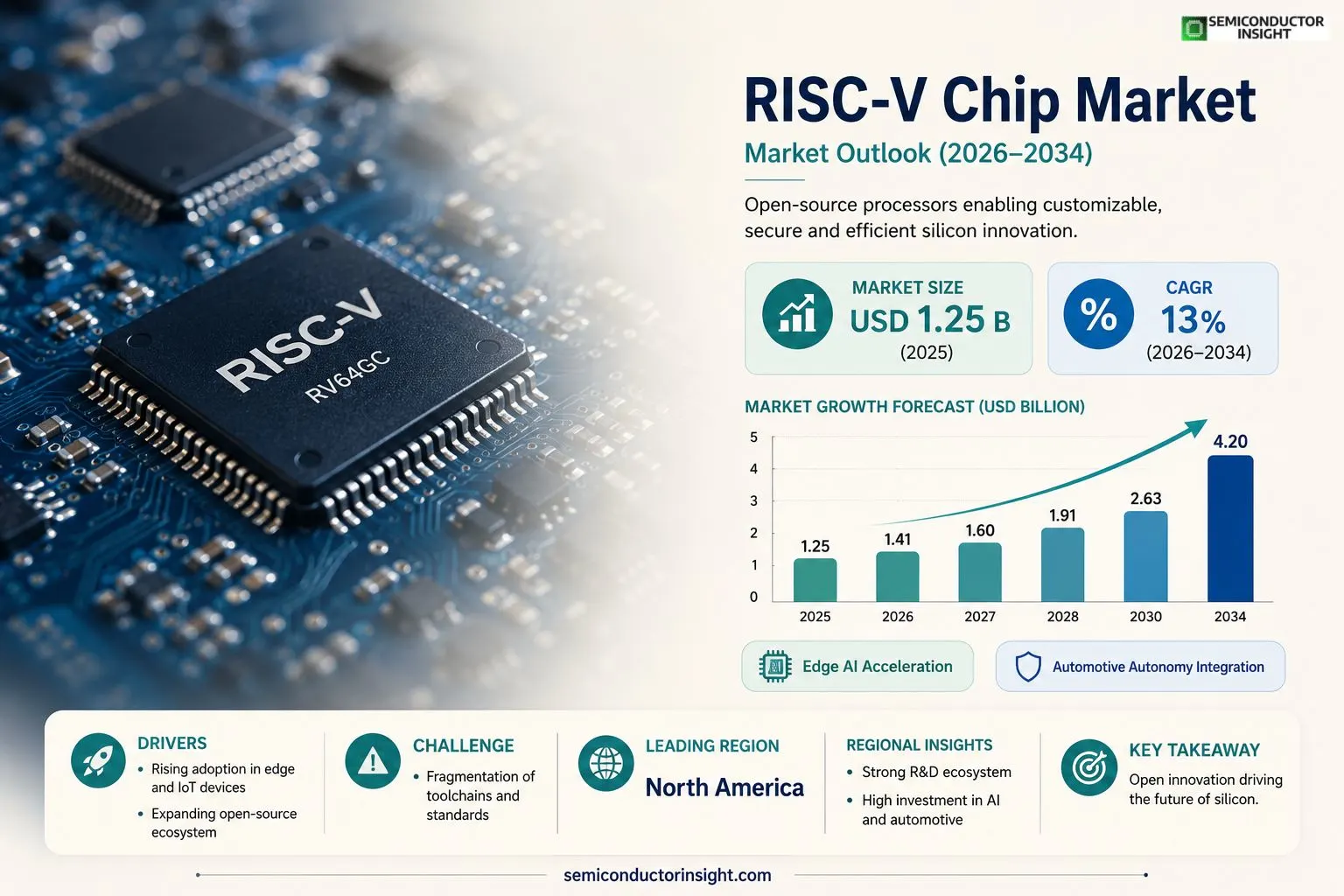
Global RISC‑V Chip Market size was valued at USD 1.25 billion in 2025. The market is projected to grow from USD 1.25 billion in 2025 to USD 4.20 billion by 2034, exhibiting a CAGR of 13% during the forecast period.
RISC‑V chips are processors built on an open‑source instruction set architecture that enables designers to customize hardware functionality while reducing licensing costs. This flexibility supports a wide range of applications,from low‑power IoT nodes to high‑performance data‑center accelerators,and encourages rapid innovation across the semiconductor ecosystem.The market is experiencing rapid growth due to several factors, including heightened investment in edge AI, expanding automotive autonomy projects, and growing demand for secure microcontrollers in consumer electronics. Furthermore, strategic collaborations such as SiFive’s partnership with Qualcomm announced in March 2024, Western Digital’s launch of RISC‑V‑based storage controllers in June 2024, and Nvidia’s exploratory program on RISC‑V for GPU management in July 2024 are accelerating adoption and driving competitive dynamics among key players.
MARKET DRIVERS
Rising Adoption in Edge and IoT Devices
RISC-V Chip Market is gaining momentum as manufacturers seek low‑power, high‑performance solutions for edge computing and Internet of Things (IoT) deployments. Open‑source licensing reduces development costs, enabling faster time‑to‑market for a broad range of devices.
Expanding Open‑Source Ecosystem
Industry collaborations are enriching the RISC‑V software stack, fostering a robust ecosystem of tools, libraries, and IP blocks. This collaborative momentum encourages start‑ups and established fabs to invest in custom silicon designs, further propelling market growth.
➤ Strategic partnerships between silicon vendors and open‑source foundations are accelerating innovation cycles across RISC‑V Chip Market.
Regulatory trends favoring security‑by‑design also highlight RISC‑V’s customizable instruction set, allowing designers to embed hardware‑level protections that meet emerging compliance requirements.
MARKET CHALLENGES
Fragmentation of Toolchains and Standards
Despite rapid growth, RISC-V Chip Market faces a fragmented landscape of development tools and varying extensions, which can increase integration complexity for OEMs. Consolidation efforts are still in early stages, creating uncertainty for large‑scale adopters.
Other Challenges
Talent Shortage
The specialized knowledge required to design and verify RISC‑V cores remains limited, leading to higher hiring costs and longer project timelines for companies entering the market.
MARKET RESTRAINTS
Intellectual Property Concerns
While the open‑source nature of RISC‑V lowers entry barriers, concerns over patent litigation and proprietary extensions can deter risk‑averse organizations, restraining broader adoption of RISC-V Chip Market.
MARKET OPPORTUNITIES
Growth in Autonomous Systems
Emerging applications in autonomous vehicles, drones, and robotics demand customizable, secure, and energy‑efficient processors. RISC‑V’s flexible architecture positions it to capture a significant share of these high‑growth segments, presenting a compelling opportunity for investors and developers alike.
RISC-V Chip Market Trends
Edge AI and IoT Acceleration
RISC-V Chip Market is currently being shaped by a pronounced shift toward edge artificial intelligence and Internet of Things deployments. Designers favor the open‑source instruction set because it permits rapid customization of low‑power cores that can process AI inference directly on the device, eliminating latency associated with cloud offload. This architectural flexibility reduces time‑to‑market for sensor‑rich products in smart cities, wearables, and industrial monitoring. As enterprises prioritize data privacy and cost efficiency, the ability to integrate security extensions without royalty fees has become a decisive factor, further encouraging adoption across heterogeneous ecosystems. Manufacturers report that the modular nature of the cores allows them to scale performance from sub‑100 mW nodes to multi‑gigahertz accelerator blocks, supporting a continuum of applications from battery‑operated meters to high‑throughput gateways. The cumulative effect is a measurable uptick in silicon design cycles that target on‑device inference, positioning RISC‑V Chip Market as a conduit for next‑generation edge solutions.
Other Trends
Automotive Autonomy Integration
Automotive autonomy projects are leveraging RISC-V Chip Market’s adaptable architecture to meet stringent safety and functional‑safety requirements. By embedding custom fault‑tolerance mechanisms at the ISA level, OEMs can certify processors for critical driving functions while maintaining a lean bill of materials. Recent vehicle prototypes integrate RISC‑V based microcontrollers for sensor fusion, power‑train management, and over‑the‑air update capabilities. The open nature of the ISA also facilitates collaboration among tier‑one suppliers, fostering a shared ecosystem of verified IP blocks that accelerate development timelines for advanced driver‑assistance systems. Furthermore, the capacity to embed secure boot and encrypted communication primitives directly in silicon helps meet automotive cybersecurity standards without incurring additional licensing costs, reinforcing the competitive advantage of RISC‑V solutions in the mobility sector.
Strategic Partnerships Driving Adoption
Strategic partnerships are amplifying the momentum of RISC-V Chip Market. Collaborations such as SiFive’s joint effort with a leading mobile chipset provider, Western Digital’s introduction of storage‑oriented cores, and Nvidia’s exploratory program for GPU management illustrate a broad industry consensus on the value of open ISA architectures. These alliances provide shared development platforms, co‑engineered reference designs, and joint validation programs that lower entry barriers for new entrants. As a result, the ecosystem is expanding rapidly, delivering a richer portfolio of ready‑to‑use cores that address diversified workloads. The convergence of technical openness, cost efficiencies, and collaborative innovation suggests a sustained upward trajectory for RISC‑V Chip Market in the coming years.
COMPETITIVE LANDSCAPEKey Industry Players
RISC‑V Chip Market Competitive Dynamics 2024‑2025
The RISC‑V ecosystem is anchored by SiFive, which remains the dominant design‑house due to its early‑stage IP portfolio and strategic alliances with major foundries. SiFive’s partnership with Qualcomm announced in March 2024 has created a hybrid solution that blends RISC‑V custom cores with Qualcomm’s 5G modem expertise, positioning the firm as a primary enabler of edge‑AI silicon. The market structure reflects a tiered hierarchy: a handful of IP vendors (SiFive, Andes Technology, Esperanto Technologies) provide reusable cores, while system‑integrators (Western Digital, Nvidia, Alibaba’s T‑Head) embed those cores into storage controllers, accelerators, or AI processors. This bifurcated model accelerates adoption, driving the forecasted CAGR of 13 % and expanding the market from USD 1.25 billion in 2025 to an estimated USD 4.20 billion by 2034.Beyond the incumbents, a diverse set of niche players is shaping specialized segments. Western Digital’s launch of RISC‑V‑based storage controllers in June 2024 underscores the architecture’s suitability for high‑throughput data‑center workloads. Nvidia’s exploratory program, revealed in July 2024, targets GPU‑management functions, highlighting cross‑industry interest. Additional contributors include GreenWaves Technologies, which focuses on ultra‑low‑power IoT processors; Microchip Technology, delivering secure microcontrollers for consumer electronics; and T‑Head, Alibaba’s cloud‑centric AI accelerator line. Companies such as Andes Technology and Esperanto Technologies provide high‑performance cores for automotive autonomy and edge AI, while Samsung and Intel are experimenting with RISC‑V extensions to complement their existing silicon portfolios, reinforcing a competitive yet collaborative landscape.
List of Key RISC‑V Chip Companies Profiled
- SiFive
- Andes Technology
- Western Digital
- Nvidia
- Qualcomm
- GreenWaves Technologies
- Esperanto Technologies
- Alibaba Cloud T‑Head
- Microchip Technology
- Samsung Electronics
- Intel Corporation
- Rivos
- Vancouver‑based SiFive Labs
- PolarisIC
- eSilicon (now part of TSMC)
Segment Analysis:
| Segment Category | Sub-Segments | Key Insights |
| By Type |
|
General‑purpose cores
|
| By Application |
|
Edge AI devices
|
| By End User |
|
Semiconductor design houses
|
| By Ecosystem Collaboration |
|
Strategic industry partnerships
|
| By Market Drivers |
|
Licensing flexibility
|
Regional Analysis: North America
United States
Federal and state governments are implementing policies to foster RISC-V adoption through funding for research and development, as well as incentives for companies to utilize the open-source architecture. This support is crucial for building a strong domestic RISC-V ecosystem.
A burgeoning ecosystem of startups, software developers, and IP providers is emerging in the United States, offering a wide range of RISC-V solutions and services. This vibrant ecosystem is accelerating the development and deployment of RISC-V-based products.
The primary applications for RISC-V in the US are currently focused on embedded systems, IoT devices, and high-performance computing, with growing interest in AI accelerators and automotive applications.
The US market sees competition from both established semiconductor giants adapting to RISC-V and agile startups leveraging its open nature to create innovative solutions.
Europe
Europe is witnessing a steady increase in RISC-V adoption, driven by a desire for greater technological independence and a focus on specialized computing needs. Several European countries are actively investing in RISC-V research and development, aiming to build a strong domestic supply chain and foster innovation in this critical area. The European Union’s emphasis on digital sovereignty is further propelling the adoption of open-source architectures like RISC-V. Key application areas in Europe include industrial automation, automotive, and medical devices, where the flexibility and customization potential of RISC-V are highly valued. The continent’s strong engineering talent pool and established manufacturing capabilities provide a solid foundation for RISC-V growth.
Asia-Pacific
The Asia-Pacific region represents a dynamic and rapidly growing market for RISC-V. Countries like China, India, and Japan are showing significant interest in adopting RISC-V for a wide range of applications, from telecommunications infrastructure to consumer electronics and industrial automation. China, in particular, is investing heavily in RISC-V to reduce its reliance on foreign semiconductor technologies. The region’s large manufacturing base and strong demand for cost-effective computing solutions are key drivers of RISC-V adoption. While the ecosystem is still developing compared to the US, it is experiencing rapid expansion, with increasing participation from both domestic and international companies.
South America
South America is an emerging market for RISC-V, with initial adoption concentrated in specific sectors such as telecommunications and industrial automation. The region’s focus on cost-effective solutions and its growing need for advanced computing capabilities present opportunities for RISC-V. Government initiatives aimed at promoting technological development and attracting foreign investment are also contributing to the growth of the RISC-V ecosystem in South America. As the region’s technological infrastructure matures, the application of RISC-V is expected to expand across various industries.
Middle East & Africa
The Middle East and Africa represent a nascent but promising market for RISC-V. Several countries in the region are exploring RISC-V for applications in areas such as smart cities, energy management, and defense. The demand for scalable and customizable computing solutions is driving interest in the open-source architecture. While the ecosystem is still in its early stages, the region’s significant investments in technology and its growing need for digital transformation suggest a strong potential for future growth in the RISC-V market.
Report Scope
This market research report provides a comprehensive analysis of the RISC-V Chip Market , covering the forecast period 2026–2034. It offers detailed insights into market dynamics, technological advancements, competitive landscape, and key trends shaping the industry.
Key focus areas of the report include:
- Market Overview: The report begins with an overview outlining its current market scenario, key growth indicators, and industry transformation drivers. It discusses macroeconomic factors, demand–supply balance, regulatory landscape, and the strategic role of semiconductors in powering advancements across industries such as automotive, telecommunications, consumer electronics, and industrial automation.
- Market Size & Forecast: Historical data and future projections for revenue, unit shipments, and market value across major regions and segments.
- Segmentation Analysis: Detailed breakdown by product type, technology, application, and end-user industry to identify high-growth segments and investment opportunities.
- Regional Insights: Insights into market performance across North America, Europe, Asia-Pacific, Latin America, and the Middle East & Africa, including country-level analysis where relevant.
- Competitive Landscape: Profiles of leading market participants, including their product offerings, R&D focus, manufacturing capacity, pricing strategies, and recent developments such as mergers, acquisitions, and partnerships.
- Technology Trends & Innovation: Assessment of emerging technologies, integration of AI/IoT, semiconductor design trends, fabrication techniques, and evolving industry standards.
- Market Drivers & Restraints: Evaluation of factors driving market growth along with challenges, supply chain constraints, regulatory issues, and market-entry barriers.
- Stakeholder Insights: Insights for component suppliers, OEMs, system integrators, investors, and policymakers regarding the evolving ecosystem and strategic opportunities.
Primary and secondary research methods are employed, including interviews with industry experts, data from verified sources, and real-time market intelligence to ensure the accuracy and reliability of the insights presented.
FREQUENTLY ASKED QUESTIONS:
What is the current market size of RISC-V Chip Market?
-> RISC‑V Chip Market was valued at USD 1.25 billion in 2025 and is expected to reach USD 4.20 billion by 2034.
Which key companies operate in RISC-V Chip Market?
-> Key players include SiFive, Qualcomm, Western Digital, Nvidia, among others.
What are the key growth drivers?
-> Key growth drivers include investment in edge AI, expansion of automotive autonomy projects, and rising demand for secure microcontrollers in consumer electronics.
Which region dominates the market?
-> The reference does not specify a dominant region for RISC‑V Chip Market.
What are the emerging trends?
-> Emerging trends include strategic collaborations such as SiFive‑Qualcomm partnership, Western Digital’s RISC‑V storage controllers, and Nvidia’s exploratory RISC‑V GPU management program.
Get Sample Report PDF for Exclusive Insights
Report Sample Includes
- Table of Contents
- List of Tables & Figures
- Charts, Research Methodology, and more...
 Download Sample Report PDF