Key Statistics
Key Takeaways
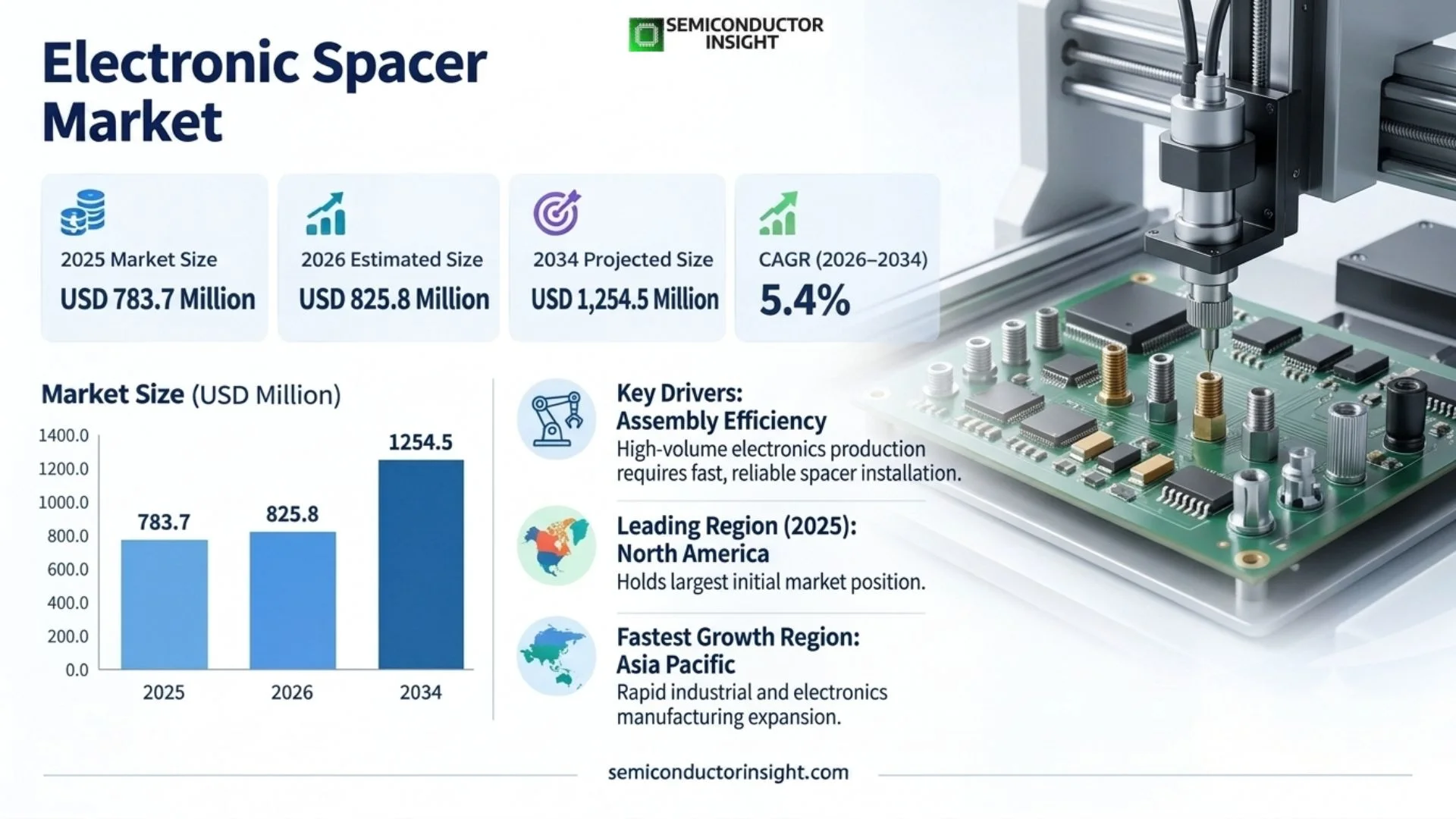
- Market size: The market is valued at USD 783.7 million in 2025 and is projected to reach USD 1,254.5 million by 2034, representing a 5.4% CAGR during 2026–2034.
- Hexagon swage and threaded spacers remain the core precision-hardware categories, while snap-fit, nylon and SMT formats gain share where fast assembly and insulation matter.
- North America is the largest 2025 market through aerospace, industrial and electronics demand, while Asia Pacific is the fastest growth region because of electronics manufacturing scale.
- Material choice is increasingly application-specific, with brass and steel favored for mechanical strength and grounding, while nylon and engineering polymers provide insulation and lower weight.
- Automation and high-density PCB assembly are increasing demand for tighter dimensional tolerances, repeatable mounting height and surface-mount compatible spacer formats.
Electronic Spacer Market Overview
Electronic Spacer Market is valued at USD 783.7 million in 2025 and is projected to reach USD 1,254.5 million by 2034, expanding at a 5.4% CAGR during 2026–2034. The 2026 market level is USD 825.8 million. North America holds the largest 2025 market position, while Asia Pacific is the fastest growth region. Electronic spacers are small but essential mechanical components used to separate, support and align PCBs, panels and modules across consumer electronics, automotive systems, industrial equipment and aerospace assemblies.
Electronic spacers and standoffs maintain controlled distance between printed circuit boards, chassis, panels and electronic modules. Products include hexagonal swage spacers, round spacers, metric standoffs, snap-fit supports and surface-mount hardware. Selection depends on board spacing, mechanical load, insulation, grounding, thread type, assembly method, material compatibility and environmental conditions. The component value is small, but dimensional or material failure can create vibration, short-circuit or serviceability problems in the finished system.
Material selection divides the market between metal and polymer solutions. Brass, steel, aluminum and stainless steel provide mechanical strength and can contribute to grounding or shielding, while nylon, PEEK, PPS and related polymers provide electrical insulation, lower weight and corrosion resistance. Essentra’s automotive component portfolio highlights both hexagonal and round standoffs in engineering thermoplastics, illustrating how material choice is becoming more specialized for higher-temperature and electrified systems.
Assembly efficiency is an important purchasing factor because spacers are installed in high-volume electronics production. Threaded parts provide strong retention, swage or force-fit parts reduce extra hardware, snap-fit designs speed manual or automated assembly, and SMT spacers can be placed during standard board production. Suppliers therefore compete on dimensional tolerance, thread consistency, plating quality, custom geometry and distribution availability rather than raw material alone.
Segment Analysis: By Type
By type, the market is segmented into hexagon swage spacers, round spacers, metric spacers and other designs. Hexagon swage spacers are important where anti-rotation and strong chassis attachment are required, round spacers provide simple board separation, and metric products align with global electronics manufacturing standards. Other formats include hinged, SMT, force-fit and specialized high-temperature supports.
| Type | Commercial role |
|---|---|
| Hexagon Swage Spacers | Mechanically locked spacers for strong panel or PCB mounting with anti-rotation geometry. |
| Round Spacers | Simple cylindrical spacing for board-to-board and board-to-chassis applications. |
| Metric Spacers | Metric-threaded or dimensioned spacers used broadly in global electronics and industrial equipment. |
| Others | SMT, hinged, force-fit, snap-fit and specialized high-temperature spacer formats. |
Additional Segmentation: By Material
Material segmentation includes metal, plastic, rubber and other specialty materials. Metal spacers are preferred where strength, grounding or high clamp load matters, while plastic products provide insulation and lower weight. Rubber and elastomeric spacers are used when vibration isolation or sealing is needed. High-temperature engineering polymers are gaining relevance in EV, power-electronics and compact electronics assemblies.
| Material | Demand characteristics |
|---|---|
| Metal | Brass, steel, aluminum and stainless steel for high strength, grounding and durable threaded connections. |
| Plastic | Nylon, PEEK, PPS, POM and other polymers for electrical insulation, low weight and corrosion resistance. |
| Rubber | Elastomeric spacing and isolation where vibration or compliance is required. |
| Others | Ceramic and specialized materials for high-temperature or electrically demanding environments. |
Segment Analysis: By Application
By application, consumer electronics is the largest volume segment because compact devices and PCBs require precise mechanical separation and support. Automotive demand is growing through ECUs, displays, battery electronics and ADAS modules, while industrial and aerospace equipment places greater emphasis on vibration resistance, service temperature and long lifecycle. Other applications include telecom, medical and energy infrastructure.
| Application | Demand characteristics |
|---|---|
| Consumer Electronics | PCB stacking, displays, modules and compact electronics requiring precise spacing and fast assembly. |
| Automotive | ECUs, infotainment, battery systems, sensors and power electronics with vibration and temperature requirements. |
| Industrial Equipment | Control panels, drives, power supplies and automation systems needing durable mechanical support. |
| Aerospace | High-reliability electronics where weight, vibration and serviceability are critical. |
| Others | Telecom, medical, energy and instrumentation applications. |
Additional Segmentation: By Mounting Style
Mounting style is a useful commercial segmentation because it determines assembly time, serviceability and mechanical retention. Threaded and screw-mount products are broadly used for strong removable joints, snap-fit and push-mount designs reduce assembly time, swage and force-fit spacers create permanent or semi-permanent mounting, and SMT spacers can be placed directly during automated PCB assembly.
| Mounting Style | Commercial relevance |
|---|---|
| Threaded / Screw Mount | Strong, serviceable mechanical mounting with standard inch or metric threads. |
| Snap-Fit / Push Mount | Tool-less assembly suited to high-volume production and electrically insulated applications. |
| Swage / Force-Fit | Press or swage mounting for permanent retention without separate nuts. |
| SMT | Surface-mount spacers and threaded inserts compatible with automated board assembly. |
Regional Analysis
North America is the largest market because of strong aerospace, industrial, automotive and electronics demand together with established suppliers such as Keystone and PennEngineering. Asia Pacific is the fastest-growing region through large-scale electronics assembly and automotive production. Europe remains a high-value precision-engineering market, while South America and the Middle East & Africa are smaller and more import-dependent.
Why does regional demand differ across the Electronic Spacer market?
Electronic spacer demand follows PCB assembly, equipment manufacturing and regional engineering standards. North America benefits from aerospace and industrial applications, Asia Pacific from electronics scale, and Europe from automotive and precision manufacturing. Supplier selection is local because customers often need short lead times, custom dimensions and a wide catalogue of thread, material and mounting options rather than only one high-volume part.
| Region | Position | Demand profile | Key commercial factor |
|---|---|---|---|
| North America | Largest | Aerospace, industrial, electronics | Catalogue breadth and precision |
| Asia Pacific | Fastest growth | Consumer electronics, automotive | Scale and assembly cost |
| Europe | Strategic | Automotive, industrial | Material compliance and reliability |
| South America | Emerging | Automotive, industrial | Import availability |
| Middle East & Africa | Emerging | Infrastructure, telecom | Distribution and service |
Competitive Landscape
Wyandotte Industries, Boker’s, MBK Tape Solutions, Fabri-Tech Components, XTO, Nyltite, Keystone Electronics, Miller Gasket and PennEngineering participate across precision spacers, washers, standoffs and custom hardware. The market is fragmented because customers need many dimensions, materials and mounting styles rather than a single standardized product. For commercial buyers in the Electronic Spacer market, purchasing decisions also depend on qualification history, integration effort, supply continuity, lifecycle support, operating reliability and measurable system-level value.
Distribution and customization are major competitive factors. Keystone’s catalogue covers hex, round, SMT, ceramic, force-fit and nylon PCB supports, while Essentra offers extensive polymer and metal spacer configurations. Suppliers that combine stocked standard parts with quick-turn custom capability can serve both engineering prototypes and high-volume OEM production. For commercial buyers in the Electronic Spacer market, purchasing decisions also depend on qualification history, integration effort, supply continuity, lifecycle support, operating reliability and measurable system-level value.
Automotive electrification and compact electronics are pushing material requirements upward. High-temperature polymers, corrosion-resistant metals and insulating designs are increasingly important near power electronics and battery systems. This creates opportunities for suppliers with materials expertise even when basic metal spacer pricing remains highly competitive. For commercial buyers in the Electronic Spacer market, purchasing decisions also depend on qualification history, integration effort, supply continuity, lifecycle support, operating reliability and measurable system-level value.
| Competitive tier | Representative companies | Primary differentiation |
|---|---|---|
| Broad electronic-hardware suppliers | Keystone Electronics, PennEngineering, Essentra | Large catalogues, global distribution and custom engineering. |
| Precision metal specialists | Wyandotte Industries, Boker’s, Nyltite | Swage, threaded and custom-machined precision hardware. |
| Custom / specialty component suppliers | MBK Tape Solutions, Fabri-Tech, XTO, Miller Gasket | Application-specific materials, isolation and custom geometries. |
Key companies profiled
Wyandotte Industries, Boker’s, MBK Tape Solutions, Fabri-Tech Components, XTO, Nyltite, Keystone Electronics, Miller Gasket and PennEngineering are included in the competitive scope. The wider market also includes Essentra and other catalogue hardware suppliers. Competitive positioning varies by material, custom capability, mounting style, thread standard and distribution reach. For commercial buyers in the Electronic Spacer market, purchasing decisions also depend on qualification history, integration effort, supply continuity, lifecycle support, operating reliability and measurable system-level value.
Production Capacity Analysis
Manufacturing capacity includes turning, cold forming, swaging, injection molding, thread rolling, plating, stamping and surface-mount hardware production. Metal and plastic spacer lines have different equipment economics, so suppliers often specialize. Effective capacity is influenced by setup time and product variety because customers may order thousands of different part numbers at relatively modest volumes.
Automation improves economics by reducing manual loading and inspection, especially for high-volume consumer and automotive programs. At the same time, custom dimensions and short lead times require flexible machining and inventory management. Suppliers with large stocked catalogues can ship immediately, while custom manufacturers compete on engineering turnaround and dimensional consistency.
Market Dynamics
The electronic spacer market grows with electronics manufacturing, automotive content and industrial automation, while remaining exposed to commodity metal costs and pricing pressure. Product value increases when spacers contribute insulation, vibration resistance, high-temperature capability or automated assembly. The strongest opportunities lie in automotive electrification, SMT-compatible hardware and engineered polymer solutions rather than basic undifferentiated spacers.
Market Drivers
| Driver | Impact | Commercial mechanism |
|---|---|---|
| Electronics manufacturing | High | More PCBs and modules create recurring demand for spacing and support hardware. |
| Automotive electronics | High | Vehicles contain more ECUs, displays, sensors and power electronics. |
| Assembly automation | Medium-High | SMT and snap-fit designs reduce installation time. |
| High-performance polymers | Medium | Engineering plastics expand the operating range of insulated spacers. |
Electronics manufacturing
Consumer devices, telecom equipment and industrial electronics require controlled PCB spacing and mechanical support. Even as products become smaller, the number of stacked boards and modules can increase, sustaining demand for precise spacers and standoffs. For commercial buyers in the Electronic Spacer market, purchasing decisions also depend on qualification history, integration effort, supply continuity, lifecycle support, operating reliability and measurable system-level value.
Automotive electronics
Electric and software-defined vehicles increase the number of electronic modules inside harsh temperature and vibration environments. This supports high-strength metal spacers, insulating polymer supports and custom mounting hardware qualified for automotive assemblies. For commercial buyers in the Electronic Spacer market, purchasing decisions also depend on qualification history, integration effort, supply continuity, lifecycle support, operating reliability and measurable system-level value.
Assembly automation
OEMs seek lower labor content and repeatable assembly. Surface-mount spacers can be placed during PCB processing, while push-in and snap-fit components eliminate separate nuts or screws. These formats create higher value than simple cut tubing because they integrate mechanical function with process efficiency. For commercial buyers in the Electronic Spacer market, purchasing decisions also depend on qualification history, integration effort, supply continuity, lifecycle support, operating reliability and measurable system-level value.
High-performance polymers
PEEK, PPS and glass-filled nylon provide electrical insulation with higher temperature capability and stiffness than commodity plastics. These materials are attractive near battery, inverter and industrial power assemblies where metal hardware could create unwanted electrical paths. For commercial buyers in the Electronic Spacer market, purchasing decisions also depend on qualification history, integration effort, supply continuity, lifecycle support, operating reliability and measurable system-level value.
Market Restraints
| Restraint | Impact | Commercial consequence |
|---|---|---|
| Raw-material volatility | High | Metal and engineering-polymer costs affect component margins. |
| Fragmented specifications | Medium-High | Thousands of sizes and thread combinations increase inventory complexity. |
| Pricing competition | Medium-High | Basic spacer designs are easy to source from multiple suppliers. |
| Miniaturization pressure | Medium | Smaller electronics reduce available mechanical space. |
Raw-material volatility
Brass, stainless steel, aluminum and engineering polymers can experience price volatility. Because many standard spacer products are price-sensitive, suppliers may not be able to pass through cost increases immediately, creating margin pressure and encouraging design substitution. For commercial buyers in the Electronic Spacer market, purchasing decisions also depend on qualification history, integration effort, supply continuity, lifecycle support, operating reliability and measurable system-level value.
Fragmented specifications
Customers require inch and metric threads, different lengths, materials, plating and mounting methods. Maintaining a broad catalogue ties up inventory and complicates forecasting. Custom orders create additional setup cost when volumes are small. For commercial buyers in the Electronic Spacer market, purchasing decisions also depend on qualification history, integration effort, supply continuity, lifecycle support, operating reliability and measurable system-level value.
Pricing competition
Standard metal and nylon spacers can become commodity products, especially in high-volume consumer electronics. Suppliers need distribution, quality, material specialization or custom engineering to avoid competing only on price. For commercial buyers in the Electronic Spacer market, purchasing decisions also depend on qualification history, integration effort, supply continuity, lifecycle support, operating reliability and measurable system-level value.
Miniaturization pressure
Compact assemblies demand lower-profile hardware and tighter tolerances. Traditional spacers may be replaced by integrated frames, molded features or alternative PCB architectures in some designs. Suppliers must therefore develop smaller SMT and custom geometries to remain relevant. For commercial buyers in the Electronic Spacer market, purchasing decisions also depend on qualification history, integration effort, supply continuity, lifecycle support, operating reliability and measurable system-level value.
Market Opportunities
SMT spacers and threaded inserts
Surface-mount compatible hardware can be placed during normal PCB assembly, reducing manual installation and supporting highly automated electronics production. For commercial buyers in the Electronic Spacer market, purchasing decisions also depend on qualification history, integration effort, supply continuity, lifecycle support, operating reliability and measurable system-level value. For commercial buyers in the Electronic Spacer market, purchasing decisions also depend on qualification history, integration effort, supply continuity, lifecycle support, operating reliability and measurable system-level value.
EV and high-voltage electronics
Battery-management, inverter and charging modules need insulated, high-temperature and vibration-resistant spacing. Engineering polymers and robust metal standoffs can capture premium value in these applications. For commercial buyers in the Electronic Spacer market, purchasing decisions also depend on qualification history, integration effort, supply continuity, lifecycle support, operating reliability and measurable system-level value.
Custom rapid-turn hardware
Design engineers frequently need non-standard heights, threads or materials. Suppliers that combine digital part configuration with quick-turn machining can win prototype business that later converts into production volume. For commercial buyers in the Electronic Spacer market, purchasing decisions also depend on qualification history, integration effort, supply continuity, lifecycle support, operating reliability and measurable system-level value.
Lightweight polymer substitution
Nylon, PEEK and PPS spacers can replace metal where electrical insulation and lower weight matter, especially in transport, aerospace and compact electronics. For commercial buyers in the Electronic Spacer market, purchasing decisions also depend on qualification history, integration effort, supply continuity, lifecycle support, operating reliability and measurable system-level value. For commercial buyers in the Electronic Spacer market, purchasing decisions also depend on qualification history, integration effort, supply continuity, lifecycle support, operating reliability and measurable system-level value.
Supply Chain Analysis
Materials. Brass, steel, aluminum, stainless steel, nylon, PEEK, PPS, rubber and ceramic are selected according to strength, conductivity, insulation and temperature requirements. Plating may add corrosion resistance or electrical performance. Material consistency affects thread quality, dimensional stability and long-term reliability. For commercial buyers in the Electronic Spacer market, purchasing decisions also depend on qualification history, integration effort, supply continuity, lifecycle support, operating reliability and measurable system-level value.
Manufacturing. Metal parts are turned, swaged, cold-formed or stamped, while plastic spacers are molded. Threads, shoulders and mounting features require tight tolerances because stack height directly affects board alignment. Surface finishing and burr control are important for electronics assemblies where loose particles or sharp edges are unacceptable. For commercial buyers in the Electronic Spacer market, purchasing decisions also depend on qualification history, integration effort, supply continuity, lifecycle support, operating reliability and measurable system-level value.
Distribution. A broad catalogue is commercially valuable because engineers often need small quantities during development. Distributors and manufacturer stock programs shorten lead times, while custom suppliers handle unusual lengths, materials or mounting features. Kitting can reduce assembly complexity for OEM customers. For commercial buyers in the Electronic Spacer market, purchasing decisions also depend on qualification history, integration effort, supply continuity, lifecycle support, operating reliability and measurable system-level value.
Assembly. Spacers are installed between boards, panels, chassis and modules using screws, swaging, snap-fit or SMT methods. Their mechanical role is simple but critical: they preserve spacing, resist vibration and prevent unwanted contact. Failure can damage boards or create electrical shorts, making quality control important despite low component value. For commercial buyers in the Electronic Spacer market, purchasing decisions also depend on qualification history, integration effort, supply continuity, lifecycle support, operating reliability and measurable system-level value.
Recent Developments in the Electronic Spacer Market
Developments tracked through September 2026 and limited to events that materially affect technology, capacity, adoption or competition.
- 2026 Product Portfolio
Keystone Electronics continued to expand and maintain a broad spacers-and-standoffs catalogue covering hex, metric, ceramic, force-fit, SMT, swage and nylon PCB support formats, reinforcing the importance of catalogue breadth and stocked availability. Source - 2026 Automotive Components Guide
Essentra’s automotive electrification portfolio highlighted round and hexagonal insulation standoffs in engineering thermoplastics such as PEEK, PPS, POM and nylon, reflecting growing demand for insulated spacing in high-power electronics. Source - 2026 Part Builder
Keystone’s online Part Builder continues to support selection of spacer and standoff materials, sizes and configurations, illustrating the market shift toward faster digital configuration and custom part selection for engineering teams. Source
Report Scope & Segmentation
| Attribute | Scope |
|---|---|
| Base year | 2025 |
| Estimated year | 2026 |
| Forecast period | 2026–2034 |
| 2025 market size | USD 783.7 million |
| 2026 estimated size | USD 825.8 million |
| 2034 projected size | USD 1,254.5 million |
| CAGR (2026–2034) | 5.4% |
| Largest market in 2025 | North America |
| By Type | Hexagon Swage Spacers; Round Spacers; Metric Spacers; Others |
| By Application | Consumer Electronics; Automotive; Industrial Equipment; Aerospace; Others |
| By Material | Metal; Plastic; Rubber; Others |
| By Mounting Style | Threaded/Screw Mount; Snap-Fit/Push Mount; Swage/Force-Fit; SMT |
| Companies profiled | Wyandotte Industries; Boker’s; MBK Tape Solutions; Fabri-Tech Components; XTO; Nyltite; Keystone Electronics; Miller Gasket; PennEngineering |
Frequently Asked Questions
What is the electronic spacer market size in 2025?
The global electronic spacer market is valued at USD 783.7 million in 2025 across consumer electronics, automotive, industrial, aerospace and other applications.
What is the market forecast for 2034?
The market is projected to reach USD 1,254.5 million by 2034, representing a 5.4% CAGR during 2026–2034. The corresponding 2026 market level is USD 825.8 million.
Which region leads the market?
North America holds the largest 2025 position because of its aerospace, industrial and electronics base, while Asia Pacific is the fastest growth region.
Which spacer types are most common?
Hexagon swage, round and metric spacers are the main categories, alongside SMT, snap-fit and other specialized designs.
Which materials are used?
Common materials include brass, steel, aluminum, stainless steel, nylon, PEEK, PPS, rubber and ceramic.
Why are plastic spacers important?
Plastic spacers provide electrical insulation, lower weight and corrosion resistance, with engineering polymers also supporting higher temperatures.
How does automotive demand affect the market?
More ECUs, displays, sensors and EV power electronics increase demand for vibration-resistant, insulated and high-temperature spacing hardware.
Who are the major suppliers?
Key companies include Wyandotte Industries, Boker’s, Keystone Electronics, PennEngineering, Nyltite, MBK Tape Solutions and other precision hardware suppliers.
What limits market growth?
Raw-material volatility, fragmented specifications, price competition and electronics miniaturization are the main restraints.
What will drive growth through 2034?
Electronics manufacturing, automotive electrification, SMT assembly, engineered polymers and demand for fast custom hardware will support expansion.
Research Sources & Evidence Base
View research sources used in this market overview
- Keystone Electronics – Spacers & Standoffs. Product formats, materials and mounting-style evidence.
- Keystone Electronics – Spacers and Standoffs Applications. Board, chassis, industrial and high-temperature application evidence.
- Essentra Components – Automotive electrification components guide. Engineering polymer standoff and automotive application evidence.

Get Sample Report PDF for Exclusive Insights
Report Sample Includes
- Table of Contents
- List of Tables & Figures
- Charts, Research Methodology, and more...
 Download Sample Report PDF