Key Statistics
Key Takeaways
- Production Line Process Screening is the largest type because high-volume manufacturers increasingly insert electrical, visual and environmental screens before final assembly, reducing the cost of discovering latent component defects after value has already been added downstream.
- Aerospace and defense remain the most specification-intensive applications, while industrial electronics expands the addressable base as factory automation, power conversion and edge-computing assemblies require higher reliability without adopting the full cost structure of space-grade qualification.
- North America holds the largest market position in 2025 because defense, aerospace and space programs sustain recurring screening requirements, while Asia Pacific is the fastest-growing region as electronics production, semiconductor packaging and independent laboratory capacity expand together.
- Reliability standards and failure-cost economics are the core demand driver: screening is purchased when the expected cost of field failure, recall, mission loss or line downtime exceeds the incremental cost of detecting weak parts before shipment or system integration.
- Capital intensity and throughput trade-offs restrain growth because burn-in ovens, thermal chambers, X-ray systems and automated electrical testers can create bottlenecks, particularly when customers demand small lots, long dwell times and documentation-heavy qualification flows.
Electronic Component Testing and Screening Market Overview
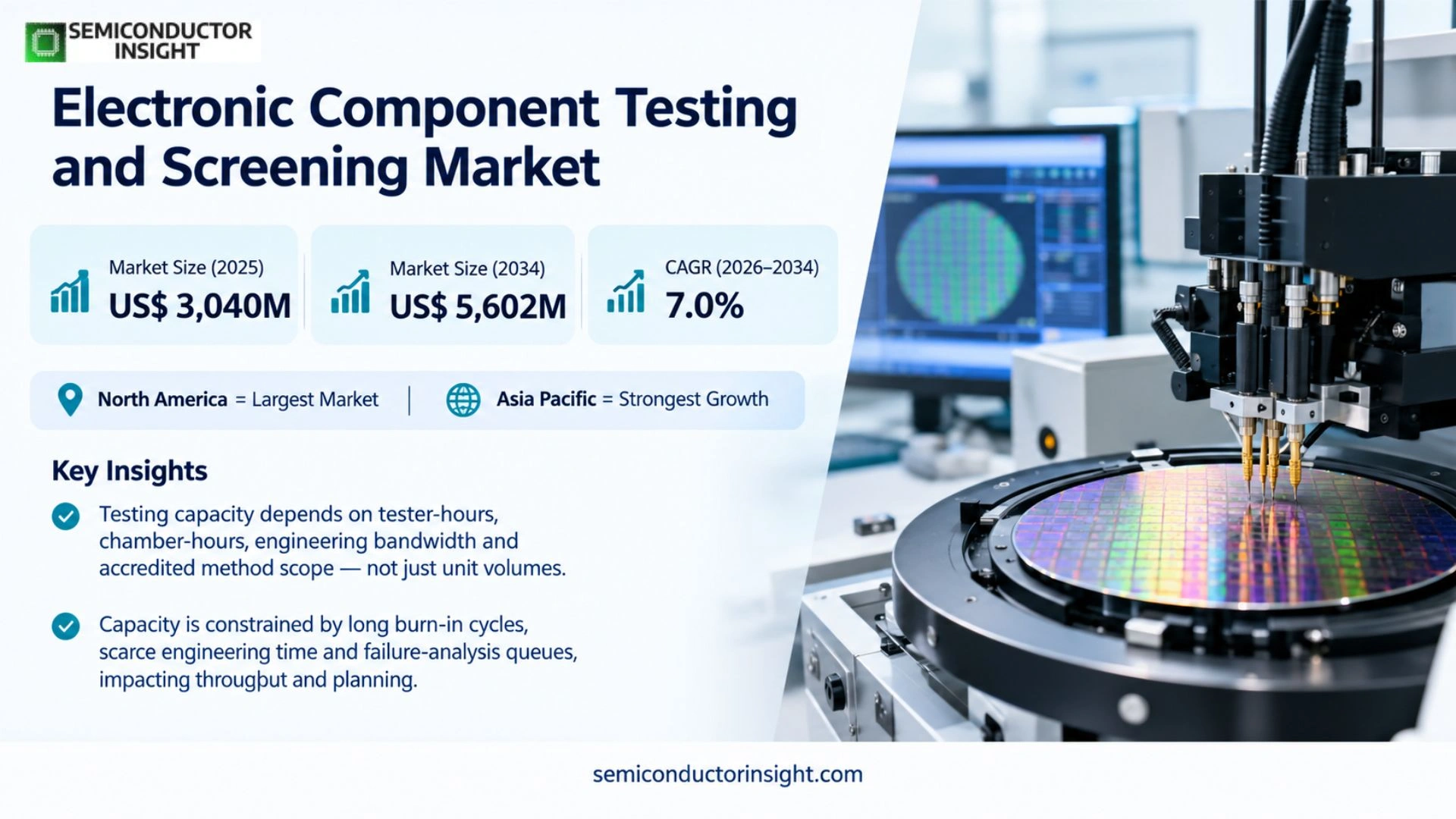
Electronic Component Testing and Screening market was rebased to US$ 3,040 million in 2025 and is projected to reach US$ 5,602 million by 2034, corresponding to an anchor-implied CAGR of 7.0% during 2026–2034. The 2026 estimated value is US$ 3,253 million. North America is the largest regional market, while Asia Pacific has the strongest structural growth profile because manufacturing expansion raises both factory-level screening volumes and demand for independent laboratories.
Electronic component testing and screening covers the inspection, electrical verification, environmental stress screening, burn-in, reliability evaluation and failure-analysis work used to identify defective or marginal electronic parts before they are installed in finished equipment. The market includes production-line screening, finished-product screening and assembly-and-adjustment screening across aerospace, defense and industrial electronics. It also spans in-circuit, functional, automated optical and X-ray inspection methods used by manufacturers, electronics manufacturing service providers and specialist laboratories.
The commercial value of screening comes from shifting defect discovery to an earlier and cheaper point in the product lifecycle. A marginal semiconductor, capacitor, connector or module may pass a simple room-temperature electrical check yet fail after thermal cycling, vibration, extended bias or soldering. Buyers therefore select combinations of stress and inspection according to mission consequence, expected operating environment, component technology and contractual qualification rules. High-reliability customers pay for traceability and documented process discipline as much as for the tester itself.
The market is changing because the electronics content of vehicles, industrial equipment, space systems and connected infrastructure is rising while component packages become smaller, denser and harder to inspect non-destructively. The U.S. CHIPS program allocates US$39 billion to manufacturing incentives and US$11 billion to semiconductor research and development, while the European Chips Act is designed to mobilize more than €43 billion of policy-driven investment through 2030. More domestic production expands the installed base that must be characterized, screened and qualified before shipment.
Segment Analysis: By Type
By type, the source market is segmented into Production Line Process Screening, Screening of Finished Products, and Assembly and Adjustment Screening. Production-line screening is the largest category because defects caught before final assembly avoid downstream rework and warranty cost. Finished-product screening remains essential where contractual acceptance is performed at the system or module level, while assembly and adjustment screening is closely linked to calibration-sensitive electronics and mixed-technology assemblies.
| Type | What the screening step does | Market position and purchasing logic |
|---|---|---|
| Production Line Process Screening | Screening is embedded inside manufacturing before the finished unit is complete. It can combine automated electrical checks, optical inspection, X-ray review and environmental sampling so process drift is identified near the operation that created it. The workflow favors repeatable automation, statistical control and rapid feedback to production engineering rather than long-duration qualification of every unit. | Largest type in 2025. Its economics improve as volumes rise because the cost of automated screening is spread across more components while avoiding expensive downstream rework. Semiconductor packaging, power electronics and high-density assemblies increasingly require inspection at multiple intermediate points, encouraging suppliers to integrate testers with manufacturing execution systems and to sell capacity, software and analytics together. |
| Screening of Finished Products | Finished parts or modules are subjected to acceptance tests after manufacturing is complete, often combining functional checks with temperature, voltage, vibration or burn-in stresses. The step is important when the customer specification is defined at the finished-item level or when internal process controls cannot fully demonstrate that every shipped part meets performance and reliability requirements. | Demand is strongest in high-reliability applications where documentation must show that shipped items passed a defined acceptance flow. Aerospace, defense and industrial safety customers may require traceable lot records, serialized results and retained failure-analysis evidence. The category grows more slowly than inline screening but carries higher service intensity because test programs, fixtures and reporting are customized by device and mission profile. |
| Assembly and Adjustment Screening | This segment covers tests performed while assemblies are being calibrated, aligned or adjusted, including mixed-signal boards, sensors, power modules and electromechanical electronics. Screening verifies that adjustment remains stable after environmental or operational stress rather than simply checking whether a bare component meets its datasheet limits at one point in time. | The segment is smaller but commercially attractive because it is engineering-intensive and difficult to commoditize. Customers often need fixture design, software, calibration expertise and failure diagnosis in addition to test equipment. That gives specialist laboratories and engineering service providers greater pricing power than basic pass/fail inspection, especially for low-volume aerospace, defense and precision-industrial programs. |
Testing methods used across the market
| Testing method | Role in the screening architecture |
|---|---|
| In-Circuit Testing | In-circuit testing verifies individual nodes and components on an assembled board using electrical access points or fixtures. It is valued for rapid localization of opens, shorts, incorrect values and assembly faults before system-level functional testing. Its main commercial constraint is test access: shrinking boards, fine-pitch packages and dense interconnects reduce probe availability, pushing suppliers toward boundary-scan techniques and greater design-for-test collaboration with OEM engineering teams. |
| Functional Testing | Functional tests exercise a component or assembly under defined operating conditions and confirm that outputs, interfaces and control behavior match the intended specification. They are indispensable where system interactions matter more than isolated parametric measurements. The market opportunity lies in reusable software platforms and modular instrumentation that can support many product variants without rebuilding the entire test station for each new hardware revision. |
| Automated Optical Inspection | Automated optical inspection uses machine vision to detect placement, solder, polarity and surface defects at production speed. Adoption expands as assemblies become denser and human visual inspection becomes inconsistent. The technology increasingly combines higher-resolution imaging with algorithmic classification so factories can distinguish true defects from harmless variation, reducing false calls that otherwise consume technician time and slow line throughput. |
| X-Ray Inspection | X-ray inspection reveals hidden solder joints, voids, cracks and internal structures that cannot be seen optically, making it important for ball-grid arrays, power modules and advanced packages. Demand rises with component density and multilayer construction, but capital cost and scan time are significant. Suppliers therefore compete on image quality, automated defect recognition and the ability to integrate selective X-ray steps without creating a production bottleneck. |
| Others | The remaining methods include environmental stress screening, burn-in, thermal cycling, vibration, destructive physical analysis, radiation evaluation and specialized failure-analysis techniques. These methods are particularly important in mission-critical programs because they expose latent weaknesses that static electrical tests may not reveal. They are also labor- and equipment-intensive, which supports independent laboratory demand when OEMs cannot economically maintain every required capability in-house. |
Segment Analysis: By Application
By application, the source page defines Aerospace, Defense and Industrial Electronics. Aerospace and defense generate the highest screening intensity per component because mission failure, repair access and certification consequences justify deeper qualification and documentation. Industrial electronics represents the broadest volume opportunity as automation, drives, robotics, power conversion and edge computing increase component counts while factories seek reliability levels above consumer-grade production without adopting every military or space screening step.
| Application | Demand characteristics |
|---|---|
| Aerospace | Aerospace customers buy screening to reduce infant mortality and latent defects in avionics, communications, navigation, power and space electronics. NASA EEE-INST-002 establishes baseline criteria for selection, screening, qualification and derating of electrical, electronic and electromechanical parts for space projects. The commercial implication is a persistent market for traceable test records, lot-specific engineering and environmental stress capability that can survive long program lifecycles and constrained component substitutions. |
| Defense | Defense demand is governed by harsh operating environments, long storage periods, mission assurance and contractual test requirements. DLA MIL-STD-883 provides uniform methods and controls for testing microelectronic devices intended for military and aerospace use, with revision activity continuing through 2025–2026. Suppliers able to maintain accredited processes, controlled equipment, configuration records and rapid failure-analysis support are better positioned than low-cost general laboratories even when unit volumes are modest. |
| Industrial Electronics | Industrial users purchase screening when downtime, safety risk or field-service cost makes failures expensive. Drives, PLCs, power supplies, robotics and process-control assemblies increasingly operate continuously and in temperature, vibration or electrical environments beyond typical consumer conditions. The segment favors scalable production tests, selective environmental stress and component-level diagnostics that improve reliability without imposing the full cost of aerospace qualification on every commercial unit. |
Regional Analysis
North America is the largest regional market in 2025, while Asia Pacific is the fastest-growing. North America is differentiated by defense, space and aerospace screening requirements and by public investment in domestic semiconductor capability. Asia Pacific combines the world’s largest electronics manufacturing footprint with expanding semiconductor fabrication and packaging. Europe is standards- and automotive-led, whereas South America and the Middle East & Africa are smaller markets where imported equipment, local certification capability and laboratory access shape adoption.
How does the commercial logic differ by region?
Regional demand is not determined simply by how many electronic components are manufactured locally. Screening intensity depends on the consequence of failure, whether customers require accredited third-party reports, how much testing is integrated inside factories, and whether local laboratories can provide environmental or analytical methods economically. A defense-heavy economy can therefore generate high service value with relatively modest unit volumes, while a manufacturing hub can generate enormous throughput but internalize much of the routine production testing.
| Region | Position | Growth outlook | Demand profile | What decides supplier selection |
|---|---|---|---|---|
| North America | Largest | Strong | Aerospace, defense, domestic semiconductor investment | Program approvals, traceability, specialized environmental and failure-analysis capability, security requirements and the ability to support long product lifecycles are decisive. Customers often value an established compliance record and engineering responsiveness more than the lowest price because a rejected qualification lot can disrupt schedules far more severely than the cost of the screening service itself. |
| Europe | Established | Moderate | Automotive, industrial, aerospace and conformity-led | Accredited laboratory systems, automotive quality expectations, CE-related product testing ecosystems and proximity to high-value industrial customers shape purchasing. Suppliers compete through broad environmental, electrical and electromagnetic capabilities that allow customers to consolidate qualification work with fewer laboratories, reducing logistics and engineering handoffs across complex multi-country development programs. |
| Asia Pacific | Fastest growing | Highest | Electronics manufacturing, packaging, semiconductor and export production | Throughput, cost, local engineering support and integration with factory production systems matter most. Customers require laboratories that can handle rapid product introductions and large lot volumes, while high-reliability exporters also need test evidence accepted by overseas customers. Domestic semiconductor investment in China, India, Japan and Southeast Asia broadens demand beyond traditional consumer-electronics inspection. |
| South America | Smaller | Selective | Industrial, automotive and imported electronics support | Local availability of accredited testing, service response and landed cost are major constraints because specialized systems and calibration support are often imported. Demand is concentrated around automotive and industrial clusters, so providers that combine several methods in one facility and reduce the need to send samples overseas can capture disproportionate value despite a smaller absolute regional market. |
| Middle East & Africa | Emerging | Project led | Defense, aerospace, telecom, energy and infrastructure electronics | Supplier selection is heavily influenced by project specifications, international accreditation and the ability to support harsh-environment testing for temperature, dust, vibration and power conditions. Many advanced analyses remain concentrated outside the region, creating an opportunity for localized laboratories where defense, space, data-center and industrial diversification programs justify sustained utilization. |
Detailed Regional Market Analysis
Key Electronic Component Testing and Screening Manufacturers and Competitive Landscape
Competition is fragmented by capability rather than by a single global scale metric. The source page profiles twelve testing and screening organizations, ranging from multi-country conformity-assessment groups to specialist microelectronics laboratories and regional test houses. Customers do not treat these providers as interchangeable: a production AOI contract, a MIL-STD screening flow and a root-cause failure investigation require different equipment, accreditations, engineering depth and documentation systems. The strongest providers therefore compete on scope, turnaround and trust rather than price alone.
Large conformity and test organizations benefit from broad laboratory networks, common quality systems and the ability to bundle electrical, environmental, mechanical, EMC and product-certification work. TÜV Rheinland reported 2025 revenue of €2.98 billion, up 9.7%, across its broader testing and certification portfolio. Although that figure is not a market-size proxy, it demonstrates the scale of the institutional platform available to support multinational customers that want consistent laboratory processes across regions.
Specialist providers compete differently. ALTER Technology emphasizes electronic-component qualification, environmental testing and high-reliability programs, while SERMA combines electrical test development, environmental screening, production testing, failure analysis and reliability work. These companies can command value by resolving engineering problems that automated production inspection cannot. Their laboratories become extensions of customer component-engineering teams, especially when customers lack enough utilization to justify maintaining specialized equipment and expertise internally.
The competitive boundary is also moving as electronics manufacturers internalize routine tests and outsource only the most specialized work. That creates pressure on independent laboratories to automate commodity inspection while investing in high-end X-ray, environmental, analytical and failure-analysis capabilities. Providers with local customer access but global technical standards are positioned well because they can handle fast-turn production issues and still support documentation-heavy aerospace, defense or automotive qualification programs.
| Competitive tier | Representative companies | Why they compete here |
|---|---|---|
| Global / multi-country assurance platforms | TÜV Rheinland; ALTER Technology | These providers can combine multiple laboratory disciplines, formal accreditations and international customer support. Their advantage is reducing supplier fragmentation for customers that need testing across several countries or product categories. They are most defensible where the buyer values recognized procedures, documentation consistency and the ability to transfer programs between facilities rather than buying only the lowest-cost individual test. |
| Specialist microelectronics & reliability laboratories | SERMA Technologies; Guangzhou GRG Metrology & Test; Global Electronics Testing Services | These companies compete through deep engineering capability in device evaluation, reliability, failure analysis and customized test development. They are favored when a standard production tester cannot answer why a part failed or when an OEM needs a qualification flow adapted to a particular package, operating environment or customer specification. Engineering labor and equipment know-how are central value drivers. |
| Regional / focused test houses | Electro Product Management; eComp; AAA Test Lab; Advanced Component Testing (ACT); HTV Group; XICE | Regional providers benefit from proximity, responsiveness and specialization. They can win recurring customer programs when quick turnaround and direct engineer-to-engineer communication matter more than a global brand. Their constraint is capital: expanding into high-end X-ray, environmental or analytical methods requires utilization sufficient to support equipment purchase, calibration and specialist staffing across economic cycles. |
Companies profiled in the report
- Alter Technology (Spain)
- SERMA Technologies (France)
- Guangzhou GRG Metrology & Test (China)
- Electro Product Management (U.S.)
- Global Electronics Testing Services (U.K.)
- eComp (U.S.)
- AAA Test Lab (U.S.)
- Advanced Component Testing (ACT) (U.S.)
- HTV Group (France)
- XICE (China)
- Weiss Technik (Germany)
- TÜV Rheinland (Germany)
Electronic Component Testing and Screening Production Capacity Analysis
Testing capacity is measured less by factory floor area than by available tester-hours, chamber-hours, engineering bandwidth and accredited method scope. A laboratory can own expensive equipment yet remain constrained if a long burn-in cycle occupies fixtures for days, if a customer-specific test program requires scarce engineering time, or if failure-analysis tools become a queue. Capacity planning therefore depends on test duration, lot mix, fixture reuse and reporting workload rather than component unit volumes alone.
Geographically, routine production screening sits closest to electronics manufacturing in Asia Pacific, while higher-value aerospace, defense and certification capability is comparatively dense in North America and Europe. The distinction matters because inline optical or electrical inspection must respond at line speed, whereas high-reliability screening can tolerate lower throughput but requires controlled environmental stresses and extensive documentation. Providers increasingly use hub-and-spoke networks, keeping common tests near customers and routing specialized analyses to expert centers.
The principal capacity bottlenecks are burn-in sockets and boards, environmental chambers, high-resolution X-ray systems, specialized analytical equipment and engineers able to develop or interpret test programs. Component diversity makes utilization uneven: a fixture designed for one package may not support another, and a temperature or vibration profile may reserve equipment longer than the actual measurement time. This creates an economic advantage for laboratories with broad customer portfolios that can smooth utilization across programs.
Upstream equipment availability also affects expansion timing. Laboratories depend on automated test equipment, imaging systems, climatic chambers, vibration systems, sockets, fixtures, calibration standards and software. A new facility therefore requires coordinated capital investment rather than a single machine purchase. Europe and North America retain strong specialist equipment ecosystems, while Asian tool suppliers increasingly support local manufacturing clusters. Customers ultimately feel these constraints through lead time, expedited-service pricing and decisions to qualify second-source laboratories.
| Capacity variable | What constrains throughput | Commercial implication |
|---|---|---|
| Electrical tester hours | Automated test equipment can process high volumes, but device-specific interfaces, load boards and test software must be prepared before the tester becomes productive. High utilization is attractive financially yet creates queues when multiple customers need the same architecture. | Laboratories invest in modular platforms and reusable software to reduce changeover time. Customers with recurring programs may reserve capacity or place equipment at supplier sites, while low-volume customers accept longer lead times or higher prices for access to underutilized specialty testers. |
| Environmental chamber & burn-in hours | Thermal cycling and extended burn-in consume elapsed time by design. Throughput cannot be accelerated beyond the required stress profile without invalidating the test, so chamber volume, sockets and power distribution become hard physical constraints. | Providers add parallel chamber capacity and optimize loading. Long-duration qualification supports higher service value but ties up capital, which makes customer forecasting and lot scheduling important to profitability and explains why urgent programs often carry premium turnaround pricing. |
| Failure-analysis engineering | Advanced failures often require sequential electrical isolation, X-ray or acoustic imaging, decapsulation, microscopy and material analysis. The bottleneck can be experienced engineers capable of deciding the next diagnostic step rather than the equipment itself. | Specialist expertise supports premium pricing and customer stickiness. Training and retention become strategic capacity investments, especially as new packaging structures make root-cause isolation more difficult and customers expect a laboratory to translate observations into a defensible corrective-action path. |
Electronic Component Testing and Screening Market Dynamics: Drivers, Restraints and Opportunities
Market growth reflects a tension between rising electronic-system complexity and the industry’s constant effort to move test cost out of the bill of materials. Reliability requirements, semiconductor investment and higher failure consequences support deeper screening, but customers simultaneously automate routine tests and bring repeatable processes in-house. The strongest growth therefore occurs where screening prevents disproportionately expensive field failures or where specialized equipment and expertise cannot be economically duplicated by each OEM.
MARKET DRIVERS
Drivers Impact Analysis*
| Factor | (~) % Impact on CAGR Forecast* | Commercial transmission mechanism |
|---|---|---|
| High-reliability aerospace & defense requirements | +1.9% | Mission assurance, long service lives and formal EEE-parts controls sustain screening intensity even when component unit volumes are modest. The driver raises revenue per tested part because programs demand traceability, environmental stress and specialized failure analysis rather than only automated pass/fail production checks. |
| Semiconductor manufacturing localization | +1.5% | CHIPS-related investment in the United States, the European Chips Act and semiconductor programs in Asia add domestic fabs, packaging and electronics production. New capacity requires metrology, characterization and reliability infrastructure during both ramp-up and recurring production, creating local demand for laboratories and production-test capability. |
| Higher electronics content in industrial systems | +1.2% | Automation, power conversion, robotics and connected equipment increase the number of components whose failure can stop expensive processes. Industrial buyers selectively add screening where downtime and service costs exceed the incremental test expense, supporting reliability workflows below full aerospace qualification levels. |
| Package density and hidden-interconnect complexity | +0.9% | Fine-pitch, multilayer and hidden-joint packages reduce the effectiveness of visual inspection alone, supporting X-ray, functional and analytical methods. Complexity increases both capital requirements and the value of specialist interpretation, especially when defects are intermittent or physically inaccessible. |
Mission assurance creates non-discretionary screening demand
NASA EEE-INST-002 and DLA MIL-STD-883 illustrate why screening is structurally embedded in high-reliability programs. When electronics support spacecraft, defense platforms or safety-critical aerospace systems, the cost of an undetected latent defect can exceed the entire test budget for a lot. Customers therefore maintain screening, qualification and failure-analysis requirements even during cost-reduction cycles, supporting laboratories that can prove method control and traceability.
Domestic semiconductor investment expands the local test ecosystem
The U.S. CHIPS framework identifies US$39 billion for manufacturing incentives and US$11 billion for research and development, while Europe and Asian governments are also supporting semiconductor capacity. Each new fab or packaging line needs process-control measurements, device characterization and qualification workflows before stable yield is achieved. As production localizes, independent laboratories gain opportunities where specialized methods are too expensive or infrequently used to build into every facility.
Industrial automation raises the financial cost of electronics failure
Factories increasingly depend on variable-speed drives, PLCs, robotics, machine vision and industrial networking. A low-cost component failure can stop equipment worth orders of magnitude more, making selective screening economically rational for power, safety and control assemblies. Suppliers respond by combining faster production tests with targeted environmental or burn-in stresses, creating a middle market between basic consumer inspection and full aerospace qualification.
Advanced packages require more non-destructive inspection
Ball-grid arrays, power modules and dense multilayer assemblies hide critical solder joints and internal interfaces from optical inspection. X-ray and complementary analytical methods are therefore becoming more important as customers seek to detect voids, cracks and assembly defects without destroying samples. This increases test capital intensity but also supports service providers that can spread high-end imaging utilization across multiple customers and product programs.
MARKET RESTRAINTS
Restraints Impact Analysis*
| Factor | (~) % Impact on CAGR Forecast* | Commercial transmission mechanism |
|---|---|---|
| In-house automation of repeatable production tests | -1.2% | Large OEMs and EMS providers internalize high-volume electrical and optical tests when utilization is sufficient, limiting outsourced service growth to specialized, qualification or overflow work. This forces independent laboratories toward methods that are harder to replicate economically. |
| Long cycle times for environmental screening | -0.9% | Burn-in and thermal cycling consume equipment time by specification, creating queues and raising service cost. Customers may reduce screening depth for lower-risk applications when elapsed time disrupts manufacturing or product-introduction schedules. |
| Capital and calibration burden | -0.8% | High-resolution X-ray, chambers, testers and analytical tools require substantial investment, maintenance, calibration and accreditation. Smaller regional laboratories can struggle to sustain utilization, concentrating advanced capability in fewer facilities. |
| Component diversity and custom fixture cost | -0.6% | Package changes and low-volume variants require new sockets, interfaces and software. Non-recurring engineering can make testing uneconomic for small commercial programs, especially when product lifecycles are short or expected volumes are uncertain. |
Routine screening is increasingly captive inside high-volume factories
Production electronics manufacturers have strong incentives to integrate AOI, functional test and basic electrical screening directly into manufacturing lines. Once equipment utilization is high, captive testing can be cheaper and provide faster feedback than sending every lot to a third party. Independent laboratories therefore face price pressure in commodity inspection and must migrate toward specialized environmental, analytical, qualification and failure-analysis work where customers cannot easily replicate the capability.
Test time is an unavoidable cost for reliability screens
Environmental screening and burn-in are deliberately time-consuming because failures may emerge only after temperature, voltage or mechanical stress accumulates. Unlike software throughput, these cycles cannot always be compressed without changing the qualification basis. Long dwell times increase work-in-process and tie up sockets and chambers, prompting cost-sensitive customers to apply deep screening only to components whose failure consequence justifies the schedule and expense.
Specialized equipment can be difficult to justify at low utilization
A high-resolution X-ray system, vibration table or analytical instrument requires purchase capital, calibration, facility support and specialist operators. Regional providers serving fragmented demand may not achieve enough utilization to recover that fixed cost competitively. The result is geographic concentration of advanced methods and continued sample shipping, which can discourage smaller customers from performing extensive analysis unless a failure is already suspected.
Rapid component change increases non-recurring engineering
New packages, firmware revisions and mixed-technology assemblies frequently require different fixtures, sockets or test software. For low-volume programs the setup cost can exceed the recurring measurement cost, making customers reluctant to requalify every variant. Providers respond with modular hardware and reusable software libraries, but the underlying customization burden remains a restraint where product lifecycles are short and unit volumes are uncertain.
MARKET OPPORTUNITIES
Localized testing around new semiconductor clusters
New fabs and packaging sites in the United States, Europe, India and other Asian markets create a location-specific opportunity for laboratories that can support yield learning, incoming inspection and reliability qualification without long logistics cycles. Providers that establish facilities near these clusters can win early engineering programs and then convert them into recurring production support, particularly when customers need independent third-party evidence or overflow capacity during ramp-up.
Advanced X-ray and failure analysis for dense packaging
As packages add hidden interconnects and multilayer structures, traditional visual inspection covers a smaller share of likely defects. Laboratories can invest in high-resolution X-ray, acoustic, electrical localization and materials analysis and package these methods as integrated root-cause services. The commercial value is highest for expensive power, automotive, aerospace and advanced-computing assemblies where resolving a failure mechanism quickly prevents repeated scrap or field incidents.
Industrial reliability programs below aerospace cost levels
Many industrial customers need more assurance than consumer-grade production tests provide but cannot justify full military or space qualification. This creates room for tailored screening plans that combine functional test, thermal cycling, vibration or burn-in according to actual operating risk. Providers that translate field-failure economics into targeted test coverage can expand demand without forcing customers into unnecessary methods, improving both adoption and service margin.
Data-driven screening and predictive quality analytics
Automated test systems generate large volumes of parametric, image and environmental data that are often used only for pass/fail decisions. Integrating results across lots and processes can identify drift earlier, reduce false calls and direct engineers toward the most informative failure-analysis step. Providers with software and analytics capability can therefore move from selling isolated tests to selling quality intelligence, improving customer retention and reducing dependence on tester-hour pricing.
Electronic Component Testing and Screening Supply Chain Analysis
Stage 1 — Components and assemblies define the test burden
The supply chain begins with the device technology, package and end-use requirement because those factors determine what defects are plausible and how much screening is economically justified. A commodity board may need rapid functional and optical checks, while a space component may require lot documentation, environmental stresses and destructive or analytical evaluation. Component suppliers that provide strong process data can reduce downstream uncertainty, but mission-critical customers still retain independent verification requirements.
Stage 2 — Equipment, fixtures and calibration create the capacity base
Testing providers depend on automated test platforms, cameras, X-ray sources and detectors, climatic chambers, vibration systems, sockets, fixtures, calibration standards and software. Value capture is highest where equipment is specialized and utilization is difficult for one customer to justify internally. The main bottlenecks are long equipment lead times, custom interfaces and the need to keep systems calibrated and validated across changing component technologies and customer methods.
Stage 3 — Execution combines automation with engineering judgment
Routine production screening is increasingly automated, but qualification and failure analysis still require engineers to interpret unexpected behavior and decide the next diagnostic step. Independent laboratories create value by maintaining specialist skills across many customers, while OEM and EMS sites capture value through immediate feedback to manufacturing. Hybrid models are common: high-volume checks remain captive, while rare environmental or analytical methods are outsourced to accredited specialist facilities.
Stage 4 — Documentation converts a test result into market access
For high-reliability customers, a measurement has limited commercial value unless it is traceable to the correct lot, method, equipment state and acceptance criteria. Reports, serialized data and corrective-action records therefore form the final supply-chain stage. Providers with robust laboratory information systems and recognized accreditation can shorten customer approval cycles, while weak documentation can force retesting even when the original hardware actually passed.
Recent Developments in the Electronic Component Testing and Screening Market
DLA published a draft screening-focused MIL-STD-883-5 document, continuing the evolution of microelectronics screening guidance. The development matters because military and aerospace laboratories must review procedures, test-method references and customer flow-down requirements when standards change. Even before final adoption, revision activity encourages customers and laboratories to keep equipment, documentation and quality systems flexible enough to incorporate updated screening methods.
SERMA announced an expansion of its microelectronics facilities in La Rochelle, and company sustainability material describes a new roughly 1,200-square-meter building with cleanroom infrastructure in the La Rochelle/Périgny area. The expansion adds physical capacity for engineering-intensive microelectronics work and illustrates how specialist laboratories are investing in clean environments and equipment rather than relying only on higher utilization of legacy test floors.
The Defense Logistics Agency released Revision L of MIL-STD-883. The standard provides uniform methods and controls for testing microelectronic devices used in military and aerospace applications. A current revision gives laboratories and component suppliers a concrete reason to review controlled procedures, equipment calibration and contractual flow-downs, sustaining demand for engineering and compliance work around high-reliability screening programs.
TÜV Rheinland continued expanding testing and certification activity and reported group revenue of €2.98 billion for 2025, an increase of 9.7% across its broader services portfolio. The figure is not a component-testing market size, but it shows the financial scale of diversified testing platforms able to invest in laboratories, digital systems and international coverage. Customers with multinational programs increasingly value consistent methods across such networks.
India reported electronics production of ₹13.11 lakh crore, up 15.8% year over year, while semiconductor projects moved further into implementation. The development expands the domestic base of devices and assemblies that require inspection, functional verification, reliability screening and failure analysis. It also improves the business case for local laboratories because recurring manufacturing support can raise utilization of equipment previously justified only by imported or project-based demand.
Report Scope & Segmentation
| Attribute | Report coverage |
|---|---|
| Market | Electronic Component Testing and Screening Market. The report covers third-party and captive testing and screening activities used to verify electronic components and assemblies for production quality, qualification, reliability and failure investigation across the source-defined application and method scope. |
| Base / estimate / forecast | Base year 2025: US$ 3,040 million. Estimated year 2026: US$ 3,253 million. Forecast end 2034: US$ 5,602 million. Anchor-implied CAGR for 2026–2034: 7.0%. The rebased series is calculated from the source page’s published 2024 and 2032 size anchors rather than from its printed CAGR label. |
| By Type | Production Line Process Screening; Screening of Finished Products; Assembly and Adjustment Screening. These names are preserved from the source page without adding, renaming or merging categories, so the article’s segment tables remain aligned with the underlying report scope. |
| By Application | Aerospace; Defense; Industrial Electronics. These are the complete application segments stated on the source page and are used without adding consumer electronics, automotive or other categories that may exist in the broader testing industry but are outside this report’s defined segmentation. |
| By End User | Original Equipment Manufacturers (OEMs); Electronic Manufacturing Service Providers; Testing Laboratories; Research Institutions. The end-user axis reflects where screening capability is operated or purchased and helps distinguish captive factory testing from independent laboratory demand. |
| By Testing Method | In-Circuit Testing; Functional Testing; Automated Optical Inspection; X-Ray Inspection; Others. The “Others” category can include environmental and analytical approaches that support reliability or failure investigation where the source page does not provide a more granular named split. |
| Regions | North America; Europe; Asia-Pacific; South America; Middle East & Africa. North America is treated as the largest regional market in 2025 and Asia Pacific as the fastest-growing regional market based on the source page’s repeated directional statements and supporting industry structure. |
| Companies profiled | Alter Technology (Spain); SERMA Technologies (France); Guangzhou GRG Metrology & Test (China); Electro Product Management (U.S.); Global Electronics Testing Services (U.K.); eComp (U.S.); AAA Test Lab (U.S.); Advanced Component Testing (ACT) (U.S.); HTV Group (France); XICE (China); Weiss Technik (Germany); TÜV Rheinland (Germany). |
Frequently Asked Questions
What is the 2025 size of the global Electronic Component Testing and Screening market?
The rebased global market size is US$ 3,040 million in 2025. This figure is derived from the source page’s published size anchors rather than from its printed CAGR label, ensuring the 2025 base, 2034 endpoint and CAGR form one internally consistent compound-growth series. The market includes production-line, finished-product and assembly-and-adjustment screening across aerospace, defense and industrial electronics, together with the specified electrical and inspection methods.
What is the 2034 forecast and CAGR?
The market is projected to reach US$ 5,602 million by 2034, representing an anchor-implied CAGR of 7.0% during 2026–2034. The estimated 2026 market size is US$ 3,253 million. Growth is supported by high-reliability requirements, semiconductor manufacturing investment and greater electronics content in industrial systems, while in-house automation and the capital cost of specialized test equipment limit how much testing is outsourced.
Which region is the largest market in 2025?
North America is treated as the largest regional market in 2025. Its position is supported by concentrated aerospace, defense and space programs, a mature network of specialized laboratories and growing semiconductor manufacturing investment. NASA and U.S. defense requirements sustain screening intensity per component, so the region captures high service value even though Asia Pacific processes larger volumes of electronics through manufacturing and assembly plants.
Which region is growing fastest?
Asia Pacific has the fastest structural growth outlook because semiconductor fabrication, packaging and electronics assembly are expanding within the same regional supply chain. India, China, Japan, South Korea and Southeast Asian manufacturing clusters require more inline inspection and reliability capability as production grows. The opportunity includes both captive factory testing and third-party laboratory work, particularly for advanced X-ray, environmental qualification, failure analysis and export-customer acceptance testing.
Which type segment is largest?
Production Line Process Screening is the largest type segment because high-volume manufacturers gain the greatest economic benefit when defects are detected before final assembly and shipment. Integrating electrical, optical and X-ray checks into production reduces downstream rework and enables faster feedback to process engineers. The segment’s scale also supports more automation and data analytics, although that same automation can reduce the share of routine work available to independent laboratories.
Why are aerospace and defense important applications?
Aerospace and defense applications have unusually high screening intensity because failure consequences, long service lives and formal qualification requirements justify deeper verification than typical commercial electronics. NASA EEE-parts controls and DLA microelectronics test standards illustrate this institutional demand. Customers require traceability, environmental stress, controlled procedures and failure-analysis capability, creating high-value laboratory revenue even when the absolute number of tested parts is smaller than in consumer-electronics production.
What testing methods are included in the market?
The source scope includes In-Circuit Testing, Functional Testing, Automated Optical Inspection, X-Ray Inspection and Others. These methods address different defect classes: in-circuit testing checks electrical nodes, functional testing verifies behavior, optical inspection finds visible assembly defects, and X-ray reveals hidden joints and internal structures. The “Others” category captures environmental stress, burn-in and specialized reliability or analytical methods required for mission-critical and engineering-intensive programs.
What are the main market restraints?
The main restraints are captive in-house testing by large manufacturers, long cycle times for environmental screening, the capital and calibration burden of specialized equipment, and custom fixture or software costs for fragmented product variants. These factors matter because testing is an added manufacturing cost rather than an end-product feature. Buyers therefore deepen screening only where reliability risk, customer requirements or field-failure economics clearly justify the incremental expense and schedule.
Where are the strongest opportunities for suppliers?
The strongest opportunities are localized laboratories near new semiconductor manufacturing clusters, advanced X-ray and failure-analysis services for dense packaging, tailored industrial reliability programs below full aerospace cost levels, and data-driven screening analytics. These areas are difficult to commoditize because they depend on specialized equipment, engineering judgment or integration with customer processes. Suppliers that combine accredited execution with software, fast turnaround and regional customer support can capture more value than providers selling isolated tester hours.
Which companies are profiled in the report?
The source page profiles Alter Technology, SERMA Technologies, Guangzhou GRG Metrology & Test, Electro Product Management, Global Electronics Testing Services, eComp, AAA Test Lab, Advanced Component Testing (ACT), HTV Group, XICE, Weiss Technik and TÜV Rheinland. The companies span specialist microelectronics laboratories, regional test houses and large assurance organizations, illustrating why competitive position depends on method scope, accreditation, engineering depth and geographic customer access rather than one uniform market-share hierarchy.
Get Sample Report PDF for Exclusive Insights
Report Sample Includes
- Table of Contents
- List of Tables & Figures
- Charts, Research Methodology, and more...
 Download Sample Report PDF