Oscilloscope Probes Market Insights
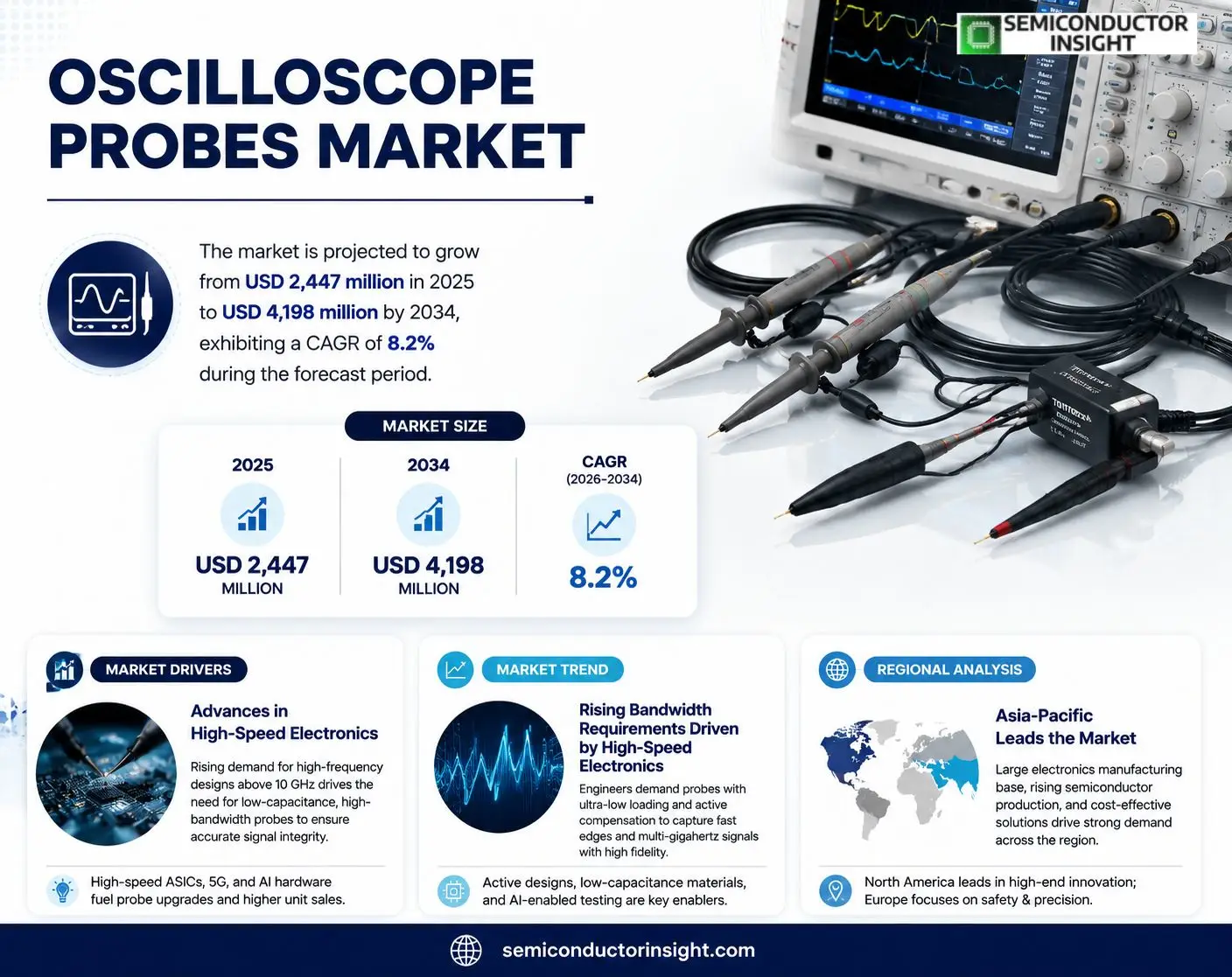
Oscilloscope Probes market was valued at USD 2,447 million in 2025 and is projected to reach USD 4,198 million by 2034, exhibiting a CAGR of 8.2% during the forecast period.
Oscilloscope probes are front‑end interface devices that create a physical and electrical link between a test point and an oscilloscope. They transmit the signal from the device under test into the oscilloscope’s input with high fidelity while minimizing distortion and loading effects. A typical probe comprises a probe head, compensation network, cable assembly and connector, engineered to preserve signal integrity across wide frequency ranges. Types include passive and active voltage probes, differential probes and current probes, each tailored for specific measurement environments such as high‑frequency digital or differential signal domains.
MARKET DRIVERS
Advances in High‑Speed Electronics
The surge in high‑frequency digital designs forces engineers to select probes that can faithfully reproduce sub‑nanosecond transitions. Modern mixed‑signal ASICs now operate above 10 GHz, compelling the Oscilloscope Probes Market to introduce low‑capacitance, high‑bandwidth variants that mitigate loading effects. This technical necessity translates into higher unit sales as OEMs upgrade test equipment to keep pace with design cycles.
Expansion of Automotive Electronics
Electrified powertrains and advanced driver‑assistance systems (ADAS) embed dozens of sensors and control modules that must be validated in‑situ. Manufacturers demand probes capable of withstanding harsh temperature ranges while delivering precise voltage measurements. Consequently, probe manufacturers are tailoring ruggedized offerings, a shift that nudges the Oscilloscope Probes Market toward a new revenue stream tied to automotive validation labs.
➤ “Customers are willing to pay a premium for probes that guarantee signal integrity across emerging 5G and automotive platforms,” noted a senior product manager at a leading probe supplier.
Beyond hardware, the proliferation of remote diagnostics platforms encourages subscription‑based calibration services. Service contracts add recurring income and lock users into ecosystem upgrades, reinforcing the market’s growth footing.
MARKET CHALLENGES
Cost Sensitivity in Emerging Economies
While advanced probes fetch higher margins in developed regions, price‑conscious buyers in Asia‑Pacific and Latin America often postpone upgrades, opting for legacy accessories. This dynamic caps volume expansion despite rising design complexity, forcing suppliers to balance premium features against affordable pricing tiers.
Other Challenges
Technological Obsolescence
Rapid iteration cycles for semiconductor fabs mean a probe model can become outdated within two product generations. Companies must sustain aggressive R&D pipelines to avoid inventory write‑downs.
Regulatory Hurdles
Stringent safety certifications for probes used in medical device testing add compliance costs. Smaller players may lack the resources to certify new designs, limiting competitive diversity.
MARKET RESTRAINTS
Limited Availability of Specialized Materials
The manufacture of ultra‑low‑inductance cables relies on high‑purity silver and specialty dielectrics, which face supply bottlenecks due to fluctuating commodity markets. When material shortages arise, lead times stretch and pricing spikes, dampening demand from cost‑averse engineering groups.
MARKET OPPORTUNITIES
Integration with AI‑Driven Test Automation
AI algorithms that flag anomalous waveforms in real time require probes with consistent, low‑noise performance. Vendors that embed digital identifiers for automated calibration stand to capture a segment of the Oscilloscope Probes Market that is currently underserved. Partnerships with software platforms could unlock bundled solutions, driving incremental sales and creating differentiated value propositions.
Oscilloscope Probes Market Trends
Rising Bandwidth Requirements Driven by High‑Speed Electronics
The Oscilloscope Probes Market is responding to a wave of high‑frequency designs emerging in communications, automotive and semiconductor sectors. Engineers now routinely target signal integrity beyond several gigahertz, a regime where traditional passive probes introduce measurable loading and phase distortion. Manufacturers have therefore prioritized active compensation networks and low‑capacitance geometries to preserve waveform fidelity. This shift matters because measurement error at the front‑end propagates through design verification, leading to costly revisions or reliability failures. By delivering probes that can faithfully track fast edges and multi‑gigahertz carriers, test equipment suppliers enable faster design cycles and lower time‑to‑market for next‑generation products.
Other Trends
Material Innovations Elevate Probe Performance
Advances in dielectric composites and nano‑structured conductors are reshaping the construction of probe heads and cables. High‑purity PTFE variants reduce dielectric loss, while silver‑nanowire meshes improve shielding without adding bulk. These material choices directly address the need for minimal insertion loss and stable impedance across a wider bandwidth. As a result, the probe’s contribution to overall system noise is decreasing, allowing users to extract subtler signal features that were previously masked. The material‑driven improvements also support higher voltage ratings, making differential and current probes viable for power‑dense automotive platforms.
Regional Divergence in Adoption Patterns
North America continues to invest heavily in R&D for aerospace and advanced silicon, which sustains demand for premium‑grade probes with stringent calibration traceability. In contrast, the Asia‑Pacific manufacturing hub balances performance with cost, prompting local vendors to introduce hybrid probe lines that combine active front‑ends with economically sourced housings. Europe’s mature automotive ecosystem leans toward probes that meet rigorous safety classifications, reinforcing a market segment focused on CAT‑III and CAT‑IV compliant devices. Emerging economies in Latin America and the Middle East are expanding university laboratories and modest production lines, generating a modest but steady appetite for versatile, mid‑range probes. This geographic mosaic forces suppliers to maintain parallel development streams: high‑performance, low‑volume offerings for innovation centers, and scalable, cost‑efficient models for volume production.
COMPETITIVE LANDSCAPE
Key Industry Players
Oscilloscope Probes Market – Competitive Overview
The probe segment is heavily influenced by a handful of original equipment manufacturers whose oscilloscope portfolios dictate probe design priorities. Tektronix, for instance, leverages its deep integration between hardware and probe accessories to command a premium share in high‑bandwidth testing environments; its proprietary compensation network and low‑load front‑end architecture have become a reference for aerospace and semiconductor customers who demand sub‑nanosecond timing fidelity. Keysight follows a parallel strategy, pairing its agile active probe line with a service network that accelerates adoption in automotive electronics, where rapid firmware cycles require swift probe swaps without sacrificing calibration integrity. Rohde & Schwarz rounds out the triad by focusing on differential and current‑measurement offerings that address power‑train validation in electric‑vehicle development, a niche that benefits from the firm’s strong presence in European safety‑critical markets.Beyond the tier‑one suppliers, a diverse cohort of specialist firms sustains market depth by targeting application‑specific niches. Companies such as Pico Technology and Siglent have carved out space in educational and mid‑range design laboratories, delivering cost‑effective active probes that still meet the 1 GHz bandwidth threshold demanded by emerging 5G research labs. Pomona Electronics remains a go‑to source for custom cable assemblies and high‑voltage probes used in power‑electronics test rigs, while GW Instek and Hantek supply affordable passive probes that satisfy small‑shop requirements in Southeast Asian manufacturing hubs. Fujian Lilliput Optoelectronics and B&K Precision focus on optical‑signal and precision‑impedance probes respectively, aligning product roadmaps with niche standards in photonics and medical device testing. Collectively, these players introduce incremental innovation and price competition that prevents market concentration and encourages broader accessibility of advanced measurement tools.
List of Key Oscilloscope Probes Companies Profiled
- Tektronix
- Keysight Technologies
- Rohde & Schwarz
- Pico Technology
- Siglent Technologies
- Pomona Electronics
- GW Instek
- Hantek
- Fujian Lilliput Optoelectronics Technology
- B&K Precision
- UNI‑T
- National Instruments
- Yokogawa Electric
- Teledyne LeCroy
- RIGOL Technologies
Segment Analysis:
| Segment Category | Sub-Segments | Key Insights |
| By Type |
|
Passive voltage probes
|
| By Application |
|
Semiconductor validation
|
| By End User |
|
Research and development laboratories
|
| By Frequency Band |
|
Mid frequency range
|
| By Architecture |
|
Miniature active integrated design
|
Regional Analysis: Oscilloscope Probes Market
North America
Companies in the region allocate a disproportionate share of budget to probe‑centric research, targeting bandwidth extensions beyond 10 GHz and enhanced dielectric isolation. Partnerships with university laboratories accelerate prototype validation and shorten time‑to‑market for breakthrough designs.
Harmonized safety and EMC standards across the United States and Canada simplify product certification, allowing manufacturers to focus on performance differentiation rather than compliance bottlenecks.
A handful of large semiconductor firms anchor demand, but a growing cohort of midsize design houses seeks modular probe kits, prompting vendors to diversify SKU portfolios and offer flexible pricing models.
Proximity to component foundries and an entrenched logistics network mitigate lead‑time volatility, enabling just‑in‑time delivery that aligns with the fast‑paced development cycles of high‑tech firms.
Europe
European manufacturers benefit from a coordinated standards environment under the IEC framework, which streamlines cross‑border sales of precision probes. The region’s strong emphasis on low‑power, high‑integrity designsdriven by automotive safety regulations and industrial automationcreates a niche for probes with superior noise rejection. While the market size lags behind North America, the presence of several specialized probe producers in Germany and the UK fuels incremental innovation, particularly in modular testing solutions for renewable energy converters. Companies are also capitalizing on the EU’s push for digital sovereignty, positioning locally sourced probe assemblies as compliant alternatives to imported components.
Asia-Pacific
Asia‑Pacific emerges as a fast‑adapting arena where burgeoning electronics design houses intensify demand for cost‑effective yet high‑performance probes. Nations such as China, South Korea, and Taiwan host extensive semiconductor fabs that increasingly adopt advanced test methodologies, prompting local distributors to expand inventory of high‑frequency offerings. Despite a fragmented supplier base, the region’s emphasis on aggressive pricing and rapid product cycles drives manufacturers to adopt modular probe architectures that can be quickly reconfigured for diverse applications. The strategic focus on building indigenous design capabilities also encourages collaborations between probe makers and OEMs to tailor solutions for emerging 5G and AI hardware.
South America
In South America, modest R&D budgets and a reliance on imported test equipment shape market behavior. Nonetheless, rising investments in aerospace and defense sectors in Brazil and Argentina generate pockets of demand for ruggedized probes capable of withstanding harsh field conditions. Local distributors increasingly act as value‑add partners, offering calibration services and on‑site technical support to offset the limited in‑house expertise. This service‑focused approach helps sustain growth despite overall market modesty, and it nudges vendors to consider regional service hubs as a competitive lever.
Middle East & Africa
The Middle East & Africa region exhibits a nascent but strategically significant profile for the Oscilloscope Probes Market. Oil‑and‑gas instrumentation and emerging smart‑city projects in the Gulf Cooperation Council countries generate demand for probes that can operate reliably in high‑temperature environments. Meanwhile, African nations are investing in telecommunications infrastructure, prompting a gradual uptick in high‑frequency testing needs. Limited local manufacturing capacity means the market is heavily import‑reliant, yet this creates opportunities for vendors to differentiate through dedicated regional training programs and extended warranty schemes, thereby building long‑term relationships in a developing landscape.
Report Scope
This market research report provides a comprehensive analysis of the Oscilloscope Probes Market , covering the forecast period 2026–2034. It offers detailed insights into market dynamics, technological advancements, competitive landscape, and key trends shaping the industry.
Key focus areas of the report include:
- Market Overview: The report begins with an overview outlining its current market scenario, key growth indicators, and industry transformation drivers. It discusses macroeconomic factors, demand–supply balance, regulatory landscape, and the strategic role of semiconductors in powering advancements across industries such as automotive, telecommunications, consumer electronics, and industrial automation.
- Market Size & Forecast: Historical data and future projections for revenue, unit shipments, and market value across major regions and segments.
- Segmentation Analysis: Detailed breakdown by product type, technology, application, and end-user industry to identify high‑growth segments and investment opportunities.
- Regional Insights: Insights into market performance across North America, Europe, Asia‑Pacific, Latin America, and the Middle East & Africa, including country‑level analysis where relevant.
- Competitive Landscape: Profiles of leading market participants, including their product offerings, R&D focus, manufacturing capacity, pricing strategies, and recent developments such as mergers, acquisitions, and partnerships.
- Technology Trends & Innovation: Assessment of emerging technologies, integration of AI/IoT, semiconductor design trends, fabrication techniques, and evolving industry standards.
- Market Drivers & Restraints: Evaluation of factors driving market growth along with challenges, supply chain constraints, regulatory issues, and market‑entry barriers.
- Stakeholder Insights: Insights for component suppliers, OEMs, system integrators, investors, and policymakers regarding the evolving ecosystem and strategic opportunities.
Primary and secondary research methods are employed, including interviews with industry experts, data from verified sources, and real‑time market intelligence to ensure the accuracy and reliability of the insights presented.
FREQUENTLY ASKED QUESTIONS:
What is the current market size of Oscilloscope Probes Market?
-> Oscilloscope Probes Market was valued at USD 2447 million in 2025 and is expected to reach USD 4198 million by 2034.
Which key companies operate in Oscilloscope Probes Market?
-> Key players include Rohde & Schwarz, Keysight Technologies, Tektronix, Fluke, Teledyne LeCroy, Yokogawa Electric, RIGOL Technologies, Siglent Technologies, Pico Technology, Pomona Electronics, Hantek, GW Instek, Fujian Lilliput Optoelectronics Technology, B&K Precision, UNI‑T, National Instruments.
What are the key growth drivers?
-> Key growth drivers include increasing electronic system complexity, adoption of next‑generation communication technologies, advanced semiconductor designs, high‑speed digital interfaces, rising automotive and industrial automation demand, material‑science advancements, and supportive policy environments that promote domestic electronic manufacturing and R&D intensification.
Which region dominates the market?
-> Asia‑Pacific leads in overall volume due to its large electronics manufacturing base, while North America drives high‑end technology adoption and innovation.
What are the emerging trends?
-> Emerging trends include development of ultra‑high‑bandwidth and modular multi‑signal probe platforms, integration with AI‑enabled analysis software, enhanced probe designs for 5G/6G and autonomous vehicle testing, and greater emphasis on low‑loading, high‑fidelity measurement solutions.
Get Sample Report PDF for Exclusive Insights
Report Sample Includes
- Table of Contents
- List of Tables & Figures
- Charts, Research Methodology, and more...
 Download Sample Report PDF