RF Test Socket Market Insights
RF Test Socket market size was valued at USD 238 million in 2025 and is projected to reach USD 407 million by 2034, exhibiting a CAGR of 8.4% during the forecast period.
An RF test socket, also called an RF test fixture or RF socket, is a specialized device that provides electrical connection between radio‑frequency integrated circuits (ICs) or modules and automated test equipment during production or validation stages. In 2025 production reached roughly 303 k units, with an average selling price of about USD 863 per unit.The market expands because of accelerating deployment of 5G smartphones, broader adoption of Wi‑Fi 6/7 devices, and increasing integration of radar and V2X functions in automotive platforms. These trends raise demand for high‑frequency sockets that preserve signal integrity across GHz bands while delivering high‑throughput, repeatable testing in mass‑production environments.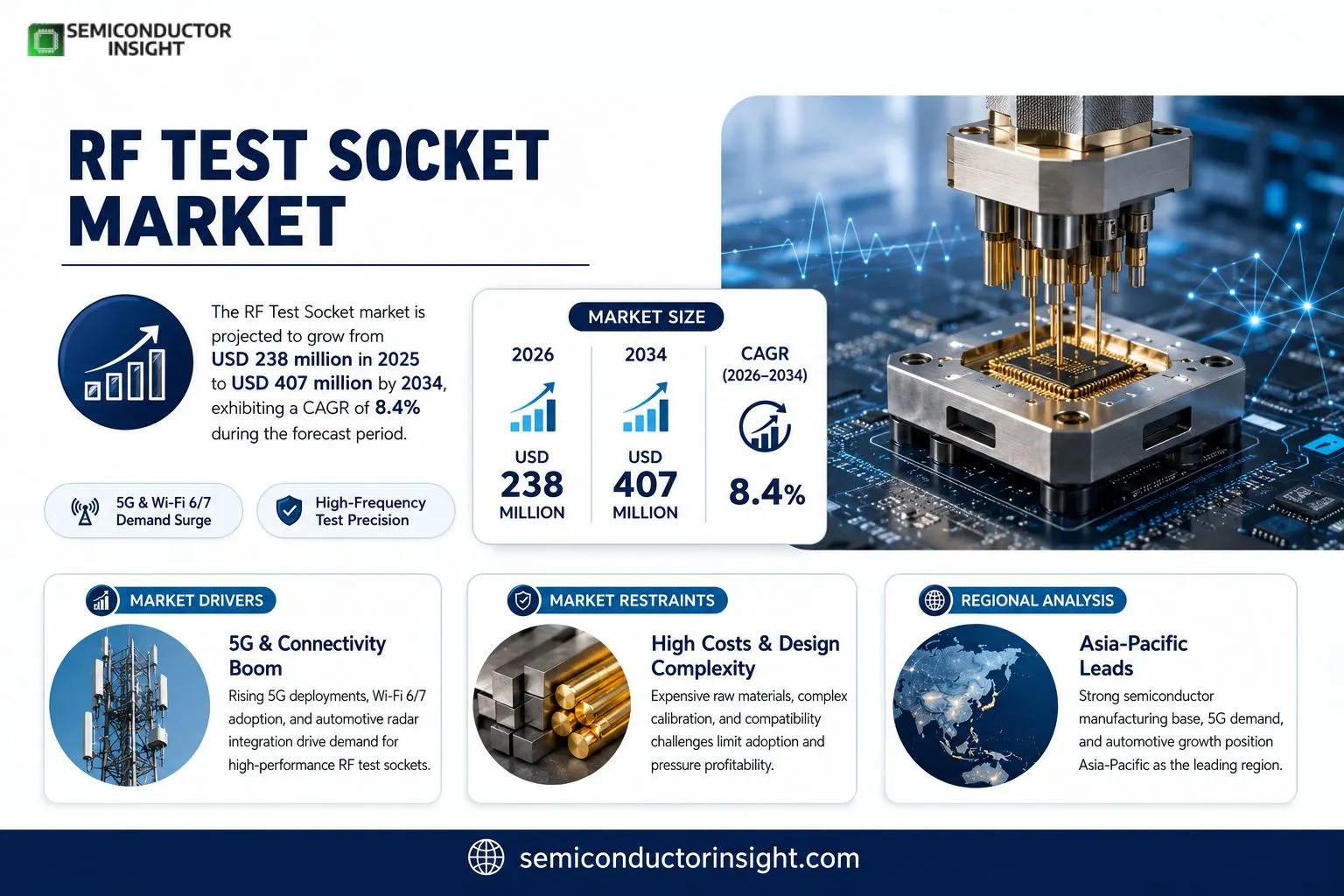
MARKET DRIVERS
Increasing Adoption of 5G Infrastructure
The rollout of 5G networks has heightened the need for precise radio‑frequency validation, prompting OEMs to invest in sophisticated test equipment. RF Test Socket Market participants are responding to this pressure by expanding product lines that accommodate higher frequency bands, thereby strengthening their relevance to network builders.
Shift Toward Miniaturized Devices
Consumer electronics are trending toward smaller modules with tighter tolerances, which raises the complexity of probing solutions. Suppliers that can engineer sockets with reduced insertion loss and enhanced durability are seeing their offerings become indispensable in high‑volume production lines.
➤ Manufacturers that integrate automated socket handling see cycle‑time reductions of up to 15%, directly influencing throughput and cost efficiency.
Emerging standards for automotive radar and satellite communications also require test fixtures capable of sustained high‑power operation. Companies that embed thermal management features into their sockets gain a competitive edge, as they help customers meet rigorous reliability criteria without sacrificing test accuracy.
MARKET CHALLENGES
Escalating Material Costs
The raw materials essential for high‑frequency connectors, such as gold‑plated contacts and low‑loss ceramics, have experienced price volatility. This pressure translates into tighter margins for end‑users, who must balance performance requirements against budget constraints.
Other Challenges
Calibration Complexity
Maintaining calibration integrity across a diverse test suite demands skilled personnel and frequent verification, which can strain resources in smaller test labs.
Supply Chain Fragility
Geopolitical tensions and pandemic‑related disruptions have exposed vulnerabilities in the supply of precision components, leading to lead‑time extensions that affect project schedules.
MARKET RESTRAINTS
Limited Compatibility with Emerging Form Factors
As new RF module architectures emerge, legacy socket designs often lack the mechanical or electrical flexibility required for seamless integration. This mismatch forces designers to either redesign test setups or accept sub‑optimal measurements, discouraging broader adoption.Regulatory scrutiny over electromagnetic emissions has intensified, compelling manufacturers to adopt more stringent testing protocols. The additional procedural steps can elongate validation cycles, which some firms view as a deterrent to rapid product launches.
MARKET OPPORTUNITIES
Customizable Modular Socket Platforms
Clients are expressing interest in modular socket systems that allow quick reconfiguration for different frequency ranges and form factors. Providers that deliver plug‑and‑play modules can capture a growing niche, especially among contract manufacturers seeking agility.Integration of predictive analytics into socket performance monitoring offers a pathway to preemptive maintenance. Vendors that embed sensor data and cloud‑based analytics into their offerings can differentiate themselves and open new revenue streams through service contracts.
RF Test Socket Market Trends
5G and Wi‑Fi 6/7 Test Volume Acceleration
The surge in 5G handset shipments coupled with the rollout of Wi‑Fi 6/7 equipment has forced semiconductor test houses to increase their RF measurement capacity. In 2025, manufacturers processed roughly 303 k sockets at an average price of US$ 863 each, reflecting a balance between higher unit cost and the need for tighter signal‑integrity control at gigahertz frequencies. Test engineers are now prioritising socket designs that minimise insertion loss while sustaining repeatable contacts across thousands of cycles, because any deviation directly translates into yield loss on high‑value modules. This pressure has prompted a wave of incremental design refinementssuch as tighter impedance tolerances and lower‑profile spring contactsthat enable faster test‑throughput without compromising the electrical performance required for modern communication chips.
Other Trends
Automotive Radar and V2X Testing Demands
Automakers are integrating radar and vehicle‑to‑everything (V2X) radios into every new model, expanding the addressable RF test volume beyond consumer devices. Unlike smartphones, automotive RF components must operate reliably under temperature extremes and vibration, which forces socket suppliers to adopt materials with superior thermal stability and to certify contact life for harsher cycles. The shift has spurred a noticeable uptick in the production of sub‑6 GHz and 6‑18 GHz sockets with reinforced coaxial interfaces, enabling accurate characterization of radar front‑ends that operate across broader bandwidths. For test service providers, this translates into a new revenue stream: offering specialized calibration and validation services for automotive‑grade RF modules.
Advanced Packaging Compatibility as a Competitive Lever
Emerging package formatssuch as wafer‑level chip‑scale packages (WLCSP), QFN variants, and RF‑SiP modulesrequire sockets that can accommodate tighter pitch and unconventional footprints. Suppliers that can deliver custom‑engineered contact arrays, often blending pogo‑pin and blade‑spring technologies, enjoy higher gross margins because the alternative is a costly redesign of the test handler itself. However, the heightened customization also introduces tighter tolerances in the upstream supply chain, where precision‑machined insulators and high‑frequency dielectric materials become bottlenecks. Companies that have integrated vertical manufacturing capabilities can mitigate these risks, securing a more predictable cost structure and reinforcing their position with major OSATs and IDMs.
COMPETITIVE LANDSCAPEKey Industry Players
RF Test Socket Market – Competitive Overview
Cohu remains the dominant force in the RF Test Socket arena, leveraging an extensive portfolio that spans single‑contact to redundant‑contact designs and supports frequency bands up to 40 GHz. Its ability to pair high‑precision mechanical engineering with RF‑grade materials enables customersprimarily OSATs and major IDMsto achieve low insertion loss and stable return loss across high‑throughput test lines. The overall market architecture is characterised by a concentration of revenue among three to five manufacturers, while a broader set of specialised firms occupy niche segments defined by ultra‑high‑frequency capability, bespoke package footprints, or advanced contact‑type technologies such as pogo‑pin and coaxial structures.Beyond the market leader, a cohort of agile companies is sharpening their value proposition through focused innovation. Leeno and WinWay Technology, for example, have concentrated on sub‑6 GHz and 6‑18 GHz sockets that cater to the exploding demand for 5G smartphones and Wi‑Fi 6/7 modules. ISC and TwinSolution Technology differentiate themselves by offering modular socket families that can be rapidly re‑configured for emerging RF‑SiP formats. Smiths Interconnect, United Precision Technologies, YOKOWO, Ironwood Electronics, Aries Electronics, TSE Co., SRC Inc., Micronics Japan, and several regional specialists provide incremental performance improvementslower contact resistance, enhanced thermal stability, or extended lifecycle supportthat are critical for automotive radar, V2X and industrial IoT testing. Their collective presence injects competitive pressure that sustains a healthy rate of product evolution across the value chain.
List of Key RF Test Socket Companies Profiled
- Cohu
- Leeno
- WinWay Technology
- ISC
- Smiths Interconnect
- TwinSolution Technology
- United Precision Technologies
- YOKOWO
- Ironwood Electronics
- Aries Electronics, Inc
- TSE Co., Ltd.
- SRC Inc.
- Micronics Japan Co., Ltd.
Segment Analysis:
| Segment Category | Sub-Segments | Key Insights |
| By Type |
|
Single‑contact Socket
|
| By Application |
|
Production/Final RF Testing
|
| By End User |
|
OSATs
|
| By Frequency Band |
|
6‑18 GHz RF Socket
|
| By Contact Structure |
|
Coaxial RF Socket
|
Regional Analysis: RF Test Socket Market
North America
The region’s firms rapidly integrate silicon‑on‑insulator and ceramic substrates into socket designs, enabling performance at millimeter‑wave frequencies while preserving durability under repeated cycling.
A diversified supplier base for high‑purity copper and specialty polymers cushions the market against raw‑material shortages, allowing steady throughput for test socket production.
Federal communications guidelines encourage rigorous device verification, prompting manufacturers to adopt sophisticated test sockets that meet stringent emission and interference standards.
Established vendors leverage extensive service networks to offer on‑site calibration, giving them a strategic edge over newer entrants lacking such logistical depth.
Europe
European firms exhibit a strong focus on precision engineering, especially in the automotive and industrial IoT sectors. The emphasis on sustainability influences material selection, with many manufacturers prioritizing recyclable composites for test socket construction. Collaborative research programs across Germany, France, and the Netherlands foster incremental improvements in high‑frequency performance, while regulatory harmonization within the EU simplifies cross‑border product validation, encouraging broader market participation.
Asia‑Pacific
The Asia‑Pacific region showcases a fast‑moving production environment, powered by large‑scale semiconductor fabs in China, South Korea, and Taiwan. Cost‑effective manufacturing techniques coexist with a rising push for quality, as local OEMs seek to meet the expectations of Tier‑1 customers. This balance drives incremental upgrades in socket durability and repeatability, positioning the region as a vital supplier of volume‑oriented test solutions.
South America
South America’s market activity is centered around Brazil’s growing wireless infrastructure projects. While overall volume remains modest, the region benefits from targeted government incentives aimed at expanding broadband reach. Test socket providers are adapting to these initiatives by offering modular designs that can be quickly reconfigured for diverse frequency bands, supporting a gradual but steady market ascent.
Middle East & Africa
In the Middle East and Africa, telecom expansion and burgeoning data‑center deployments create niche opportunities for RF Test Socket Market. Multinational equipment firms are establishing regional service hubs to reduce response times, while local partners focus on customizing sockets for harsh environmental conditions prevalent in desert and tropical climates. These adaptations help embed advanced testing capabilities within emerging network rollouts.
Report Scope
This market research report provides a comprehensive analysis of the RF Test Socket Market , covering the forecast period 2026–2034. It offers detailed insights into market dynamics, technological advancements, competitive landscape, and key trends shaping the industry.
Key focus areas of the report include:
- Market Overview: The report begins with an overview outlining its current market scenario, key growth indicators, and industry transformation drivers. It discusses macroeconomic factors, demand–supply balance, regulatory landscape, and the strategic role of semiconductors in powering advancements across industries such as automotive, telecommunications, consumer electronics, and industrial automation.
- Market Size & Forecast: Historical data and future projections for revenue, unit shipments, and market value across major regions and segments.
- Segmentation Analysis: Detailed breakdown by product type, technology, application, and end-user industry to identify high-growth segments and investment opportunities.
- Regional Insights: Insights into market performance across North America, Europe, Asia-Pacific, Latin America, and the Middle East & Africa, including country-level analysis where relevant.
- Competitive Landscape: Profiles of leading market participants, including their product offerings, R&D focus, manufacturing capacity, pricing strategies, and recent developments such as mergers, acquisitions, and partnerships.
- Technology Trends & Innovation: Assessment of emerging technologies, integration of AI/IoT, semiconductor design trends, fabrication techniques, and evolving industry standards.
- Market Drivers & Restraints: Evaluation of factors driving market growth along with challenges, supply chain constraints, regulatory issues, and market-entry barriers.
- Stakeholder Insights: Insights for component suppliers, OEMs, system integrators, investors, and policymakers regarding the evolving ecosystem and strategic opportunities.
Primary and secondary research methods are employed, including interviews with industry experts, data from verified sources, and real-time market intelligence to ensure the accuracy and reliability of the insights presented.
FREQUENTLY ASKED QUESTIONS:
What is the current market size of RF Test Socket Market?
-> RF Test Socket Market was valued at USD 238 million in 2025 and is expected to reach USD 407 million by 2034.
Which key companies operate in RF Test Socket Market?
-> Key players include Cohu, Leeno, Micronics Japan Co., Ltd., WinWay Technology, ISC, Smiths Interconnect, TwinSolution Technology, United Precision Technologies, YOKOWO, Ironwood Electronics, Aries Electronics, Inc., TSE Co., Ltd., SRC Inc., among others.
What are the key growth drivers?
-> Key growth drivers include 5G smartphone proliferation, Wi‑Fi 6/7 adoption, expanding automotive radar and V2X deployments, industrial IoT growth, and increasing demand for high‑frequency, low‑loss RF test sockets.
Which region dominates the market?
-> Asia‑Pacific is the dominant region, driven by high demand for 5G devices and automotive applications, while Europe and North America also show strong growth.
What are the emerging trends?
-> Emerging trends include development of sub‑6 GHz to >40 GHz socket solutions, integration with advanced packaging (QFN, WLCSP, RF SiP), and increased focus on thermal stability and extended contact life for high‑throughput testing.
Get Sample Report PDF for Exclusive Insights
Report Sample Includes
- Table of Contents
- List of Tables & Figures
- Charts, Research Methodology, and more...
 Download Sample Report PDF